Grapefruit vs. Cactus, regular season?

CoronavirusRedImagine there’s no National League or American League, for one season, at least. Imagine, instead, there’s a Cactus League and a Grapefruit League, for just one season. If you take the word of USA Today‘s Bob Nightengale, it could happen this year when baseball’s able to return. If it’s able to return this year.

For just one season I’d be all in. Thanks to a combination of a pestiferous viral pandemic and assorted and sundry responses running the line from ignorant to delayed to scrambling and back, it’ll be a short baseball season if the game can come back. A short season is better than no season.

Nightengale says the Cactus/Grapefruit realignment is just one idea being tossed around the horn for when the stay-at-home/social-distancing orders are lifted. But it’s not a terrible idea at all. That’s the alignment we get watching the spring exhibitions, so it isn’t exactly as though we’d be thrown into the Twilight Zone now.

“The plan would have all 30 teams returning to their spring training sites in Florida and Arizona, playing regular-season games only in those two states and without fans in an effort to reduce travel and minimize risks in the midst of the COVID-19 pandemic,” Nightengale writes. “The divisions would be realigned based on the geography of their spring training homes.”

Under this plan, Nightengale continues, both the Grapefruit and Cactus Leagues would be arranged in three divisions each: North, South, and East for the Florida-based Grapefruit League and Northeast, West, and Northwest for the Arizona-based Cactus League.

And how would the teams be arrayed within those divisions? Nightengale has your answer, too:

Grapefruit League: North—New York Yankees, Philadelphia Phillies, Toronto Blue Jays, Detroit Tigers, Pittsburgh Pirates. South—Boston Red Sox, Minnesota Twins, Atlanta Braves, Tampa Bay Rays, Baltimore Orioles. East—Washington Nationals, Houston Astros, New York Mets, St. Louis Cardinals, Miami Marlins.

Cactus League: Northeast—Chicago Cubs, San Francisco Giants, Arizona Diamondbacks, Colorado Rockies, Oakland Athletics. West—Los Angeles Dodgers, Chicago White Sox, Cincinnati Reds, Cleveland Indians, Los Angeles Angels. Northwest—Milwaukee Brewers, San Diego Padres, Seattle Mariners, Texas Rangers, Kansas City Royals.

OK, the bad news is that the Cactus League would have fewer logistical and distance problems, since the Arizona spring camps are separated by no more than an hour’s drive apiece. The spread in Florida is a lot wider, which Nightengale notes might compel a few tricky maneuvers in the event any team personnel might need to be isolated.

A few traditional rivalries would get temporary short shrift to a certain extent, too. It’ll take a little getting used-to picturing the Yankees and the Red Sox in different divisions, not to mention the Dodgers and the Giants or the Cubs and the Cardinals likewise, with the Cubs and the Cardinals in different leagues in the bargain.

On the other hand, several in-state rivalries remain intact, such as they are. The Reds and the Indians for the honour of Ohio. The Phillies and the Pirates, for Pennsylvania power, never mind how lopsided it now is in the Phillies’ favour. The Dodgers and the Angels for bragging rights to Interstate 5 traffic jams.

How delicious would it be, also, to see even a temporary seasonal rivalry between last year’s World Series combatants—each of whom behaved rudely enough in the other’s house, one of whom won it all in the other’s house, with the winner also out-smarting the other’s flair for espionage even before the other’s exposure as electronic, off-field-based cheaters?

You say it’s theoretically possible that the World Series comes down to the Cardinals vs. the Cubs? Since the Grapefruit/Cactus alignment would keep them apart on what comes of the regular season, how surrealistically bristling would it be to see those two traditional division rivals otherwise in a hammer-and-tongs, few-holds-barred feud for a lease to the Promised Land?

Even if they can’t play the games in St. Louis or Chicago, oh boy will Cardinal and Cub fans go nutsh@t over that.

If there’s one thing baseball’s great for, it’s stirring the imagination. Now we could have one of the greatest imagination stirrers in recorded baseball history. And all it took was a nasty little virus out of a Chinese province that resembles a ball spiked with (depending on the developed image) rubber darts or red broccoli florets to do it.

Except that there are still a few problems. The players themselves would be far less than thrilled to be isolated into playing games strictly in one or the other region. Especially those who happen to be expectant fathers with their anticipated offspring due during the season and their wives expecting them to be there for the deliveries.

No matter how much money they’re paid to play, you can’t blame them for not wishing to be isolated even further from the families away from whom they spend enough time during a normal regular season.

Not to mention that, no matter how often some fans in the stands are bothersome nitwits (reality check: a few such fans are too many, and they’re there, they always have been there), enough players admit it’s just not the same playing in empty ballparks—which could still happen, depending on the extent to which the social distancing orders get lifted.

This much we know: Forget the dollars at stake, they want to play. Bears gotta bear, bees gotta bee, and baseball players gotta baseball. They’ll consider any and just about all alternatives if it means playing ball with the least amount of family encumbrance.

“When you’re trying to get really creative, why say no now?’’ says Hall of Fame manager Tony La Russa—who now works as a senior advisor for Angels baseball operations, and whom Nightengale says was told of the possible Grapefruit/Cactus plan.

“So you have a unique season. I’ve got no problem with that,” La Russa continued. “I’m not sure we’ll be able play in our own cities across the country, so if you split it up like that, it’s a possibility.”

How would they play, then? Nightengale says each league would play twelve games each within their new temporary divisions, six apiece against other teams in the league, at least one doubleheader a night when all the teams are on the schedule because of the fifteen-team leagues.

And, everyone plays with a designated hitter.

Oh, you can hear it now. The “traditionalists” snarling and foaming over further polluting the game. Making those poor National League teams now in temporary league with those sissy American League teams take it like a manperson.

Never mind that last year the National League’s pitchers batted a whopping .133 overall or that all Show pitchers batted a lethal .100 overall. You want to keep wasting a lineup spot on that? Instead of your team putting what amounts to an extra cleanup hitter or an extra leadoff-type hitter in the spot? Instead of having a fifty percent or better shot at putting more runs on the board?

I was in the anti-DH camp for a long enough time. For life, actually. And for the same reason—“tradition.” I don’t dismiss tradition lightly, but there are traditions worth keeping and traditions worth dumping. Baseball’s dumped a few traditions best left to the scrap heap, too. Remember how long it was “traditional” to bar non-white players from “organised” baseball? Or to play strictly day ball?

Sure, it’s a blast (pun intended) when a pitcher hits one into the seats—once in the proverbial blue moon, but it’s just a little self-defeating to sustain some cockeyed idea of “tradition” when you might be adding a little more real run creation/production. “It’s fun to see Max Scherzer slap a single to right field and run it out like he thinks he’s Ty Cobb,” the incomparable Thomas Boswell wrote last year.

But I’ll sacrifice that pleasure to get rid of the thousands of rallies I’ve seen killed when an inning ends with one pitcher working around a competent No. 8 hitter so he can then strike out the other pitcher. When you get in a jam in the AL, you must pitch your way out of it, not ‘pitch around’ your way out of it.

As a result, some weaker pitchers survive in the NL. But survival-of-the-unfittest isn’t good for the evolution of a league. Over time, high-quality hitters migrate to the AL, where they can have longer, richer careers by finishing as a DH. That is the main reason the AL has dominated interleague play in this century.

By the way, the blow that arguably did the most to put the last World Series into the Nationals’ bank? After the same Max Scherzer pitched on less than fumes and somehow managed to keep things no worse than a 2-0 Nats deficit through five innings?

That would be Howie Kendrick, turning on a Will Harris cutter arriving off the middle of the plate, sending it off the Minute Maid Park right field foul pole with a bonk! “It doesn’t add up,” said Astros shortstop Carlos Correa when it was over. “The way [Harris] throws his cutter, it’s one of the nastiest cutters in the game. Down and away, on the black, and [Kendrick] hits it off the foul pole.”

Kendrick was the Nats’ DH on the evening. Do you still want to argue against it sticking around after the coronaball season when baseball goes back to normal next year?
Phillies say phooey to ’93 Series Game Six

2020-04-10 MitchWilliams

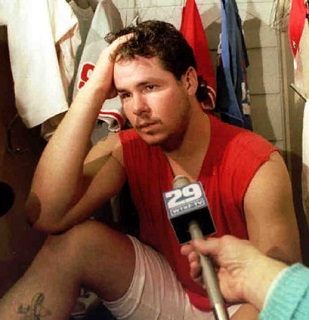
Mitch Williams didn’t run and hide after surrendering the 1993 World Series-losing home run. The Phillies threw him under the proverbial bus anyway.

One of the devices by which baseball’s keeping itself alive during the coronavirus shutdown is assorted networks, YouTube, and Twitter linking to classic games. Allowing that “classic” is in the eye of the beholder a little more often than in the eye of history, you were probably right if you thought at least a few such games might anger more than amuse.

The Phillies aren’t amused that Major League Baseball itself tweeted Game Six of the 1993 World Series. Nobody likes to remember their World Series ending with the humiliation of the other guys’ home run sending those guys to the Promised Land, of course. But there’s a little more to that story than just the Blue Jays’s Joe Carter ruining closer Mitch (Wild Thing) Williams and the Phillies that night.

“Oh, not to be Mitch Williams, now that winter’s here,” Thomas Boswell wrote in a Washington Post column republished in Cracking the Show. “For the rest of us, it’s still autumn. But winter came early for Wild Thing . . . does baseball have eighteen goats to match Williams? . . . When the bullpen phone rang with the Phils leading, 6-5, when Williams saw the top of the gaudiest lineup in baseball awaiting him to begin the ninth, did he want to plead nolo contendere?”

Actually, Williams didn’t want to plead any such thing.

The Wild Thing had to deal with death threats over his blown save in Game Four (the Jays won the game 15-14) reaching him as he arrived home from Veterans Stadium. First he admitted he was terrified enough to spend a sleepless night holding his shotgun. Then he he rejected thoughts of handing the closing role to someone else: “No one’s going to scare me that much,” he answered when asked. “No one will make me hide.”

Nobody did, in fact. Not even after he walked Hall of Famer Rickey Henderson to open the bottom of the ninth with the Phillies up a run and three outs from forcing a seventh game. Not even when pitching coach Johnny Podres visited him on the mound and urged him to use a slide step delivery, instead of his normal, right knee bent to his shoulder leg kick, in a bid to keep the Man of Steal from grand theft second base.

Not even after getting Devon White out on a fly to left, a base hit from Hall of Famer Paul Molitor sending Henderson to third, and Carter checking in at the plate—with yet another Hall of Famer, Roberto Alomar, on deck. Not even when Williams stayed with his pitching coach’s suggestion despite its alteration of his delivery and threw Carter a 2-1 fastball when he had Carter, a low-ball hitter, thinking breaking ball.

“The only reason I hit it fair,” Carter eventually said, “was because I was looking for a breaking ball the whole time. I wasn’t way out in front of the ball. I guarantee you, if I was looking fastball, I would’ve swung and missed or hit a foul ball.” He swung instead into Toronto lore, his three-run homer nailing the Blue Jays’ second straight Series win and hammering Williams into Philadelphia infamy.

Not even facing the press gamely and answering every last question sent to him, however stupid or careless, saved the Wild Thing. “Ain’t nobody on the face of this earth who feels worse than I do about what happened,” he said straight, no chaser. “But there are no excuses. I just didn’t get the job done. I threw a fastball down and in. It was a bad pitch. I’ll have to deal with it.”

In due course, Williams gave the real breakdown. “I knew I made a mistake,” he’d say in due course. “That fastball was down and in, right in Carter’s nitro zone. I wanted to throw it up and away, which I could’ve done if I’d gone with my full leg kick. But the slide step altered my delivery and I ended up rushing the pitch.”

2020-04-10 JoeCarterMitchWilliams

Williams walks off the field after Carter (29) begins his romp around the bases. The pair have since become friends and often autograph this photo together.

Williams’s teammates had his back—at first. “We wouldn’t have been here if it wasn’t for Mitch,” said first baseman John Kruk. “He’s not afraid to take the ball and I like a guy like that on my team,” said center fielder Lenny Dykstra, who might have had the 1993 World Series MVP to put on his mantel (or, all future things considered, put up for sale on eBay) if it hadn’t been for Carter.

Phillies historian William C. Kashatus wrote Macho Row about the ’93 Philthy Phillies, particularly a contingency within the team who lived by their own Code (the upper-case C is Kashatus’s) of solidarity inside and insularity from the outside. Clockwise the cover showed Kruk, Dave Hollins, Darren Daulton, Williams, and Dykstra. It took the figurative equivalent of five minutes after the Phillies finally left Toronto after the Series loss for someone to throw Williams under the proverbial bus.

Actually two someones. Both Dykstra and pitching star Curt Schilling—whose gutsy Game Five shutout got the Phillies as far as to Game Six in the first place—talked to the press showing “concern that Mitch Williams not return to the Phillies” after the Carter bomb, Kashatus wrote. “I love the guy,” said Dykstra. “He’s a great competitor and I’m sure he wants to pitch here again, but for his sake I hope he doesn’t have to . . . he’ll probably never be able to pitch in Philly again.”

That was mild compared to Schilling, who’d made a few World Series waves by sitting on the bench with a towel over his head whenever Williams came into a game and now suggested trading the Wild Thing would be a positive.

“What if we win and go to the postseason again next year?” Schilling asked, then answered. “We’d still be going in with the mentality of ‘Can he do it?’ Mitch was tired at the end of the season. It was a question of whether he was able to. Mitch gave his all every time out there, but, in the big leagues, it’s not a matter of giving everything and wanting the ball. It’s a matter of success.”

Nobody, of course, thought even once to question Podres’s judgment in urging Williams to the slide step delivery even with Henderson on the bases ready to commit high crime at the first known opening. Once a Brooklyn hero for beating the Yankees twice to win the only World Series the Dodgers ever won as the Brooklyn Dodgers, Podres served three more seasons as the Phillies’ pitching coach.

If Podres couldn’t make a second mound visit, the rule being a second visit by either coach or manager meaning the incumbent pitcher having to leave, why couldn’t he send Williams a sign to take the slide step off? Even with Henderson on second?

What’s the worst that could happen from there with the slide step taken off—Carter not missing, not fouling, but maybe hitting a soft fly ball on which even Henderson might not score, maybe even whacking into a game-ending double play that forces Game Seven?

Dykstra and Schilling may have insisted as Kashatus wrote, that Williams not take it personally, but then Williams did indeed get traded, to the Astros early that December. He fumed particularly over Schilling’s remarks at first, the two trading insults for a spell until Williams’s career hit the pit in Houston, Anaheim, and Arlington to follow before he retired.

Come 2008, Dykstra gave a radio interview in which he called Williams a barrel-finding joke. It prompted Williams to talk to the same station the following morning and call Dykstra “the most common sense-void person I’ve ever met in my life. He’s a savant with a bat in his hand. You could have a better conversation with a tree.”

Williams even predicted Dykstra’s long-infamous Players Club venture, giving financial advice to professional athletes, would collapse. Which is exactly what happened, along with enough other financial improprieties including bankruptcy fraud to send Dykstra to the calaboose in disgrace.

Not that it taped Dykstra’s mouth shut when it came to Williams. At a 2015 comedy roast, Dykstra told Williams, “Prison was a [fornicating] fantasy camp compared to playing behind you.” Williams wasn’t exactly caught unprepared, retorting that the only real reason Dykstra still burned over the Carter home run was because it cost Dykstra that ’93 Series MVP.

Schilling ended up going from Philadelphia to become a postseason legend in Arizona and Boston, a qualified Hall of Famer who throve when the games were the biggest, until a combination of his 38 Studios’s collapse and his tendency toward political opinions delivered with threatening tones sank his public image.

The harshest part of that isn’t just that Schilling hasn’t been elected to Cooperstown but that he also caused his parallel reputation for philanthropy to become ignored or at least bypassed. He was fired as an ESPN baseball analyst at a time when he needed the income badly enough after the 38 Studios debacle for which he never shirked responsibility.

Compared to all that, Williams’s life became something of a rose garden for a long enough time. His first marriage collapsed but he’d remarried in 1993. He became a Philadelphia baseball broadcaster who attracted MLB Network into hiring him as an analyst.

Then came an incident while he was coaching one of his son’s youth baseball team’s games. A dispute with an umpire, an accusation that he’d ordered a pitcher to throw at a batter, and another claiming he called an opposing player a feline euphemism for a certain part of the female anatomy. MLB Network fired him when he refused to sign a deal barring him from those games.

Williams sued MLB Network over the firing and Deadspin‘s parent Gawker Media for defamation, and eventually won a $1.5 million settlement in 2017. The Wild Thing couldn’t resist a tweet: “To all of the people that have wondered where I have been for 3 years.today that answer was provided by a court of law#justice.”

He never bought the Phillies saying they traded him to the Astros because they “thought the fans would crucify me the next year. But they underestimated me. They didn’t understand that the fans appreciated that I didn’t run and hide after the World Series or during the off-season. The fans knew I was a guy who fit into their city. They knew that every day I walked out there I gave everything I had.”

That standing ovation with which the Veterans Stadium crowd hit Williams when he returned as an Astro proved it.

A decade before Williams won that settlement, the Mitchell Report and other documents named Dykstra, fellow Macho Rowers Pete Incaviglia, Hollins, and reserve catcher Todd Pratt as using or being connected to actual or alleged performance-enhancing substances. “If someone was using steroids on that team,” Kruk insisted, “they were awfully quiet about it. And we talked about everything on that club.”

Speculation abounded, too, about regular catcher Daulton, who eventually admitted during his battle with brain cancer, “Anything I did in the past is my fault. Not my ex-wives’ fault, nor any of my kids’ faults, not baseball, not the media—me, my fault—I did the damage.”

There are indeed reasons why the Phillies today might not be amused to be reminded of Game Six of that ’93 Series. Reasons having almost nothing to do with the standup pitcher who shook off a sleepless, death-threatened night, listened to his pitching coach once too often, and didn’t look for the nearest hideout after one pitch meant disaster.

The guy who’s since forged a pleasant friendship with the man who destroyed his 2-1  fastball and the hope of a Game Seven. The guy to whom Phillies fans gave that standing O his first time back to Philadelphia because he was maybe the only stand-up man in the crowd.

Who’d have thought, when all was said and done, that the Wild Thing was the ’93 Phillie who had the least amount of splainin’ to do?

It wasn’t as simple as Kaline made it look

2020-04-08 AlKaline

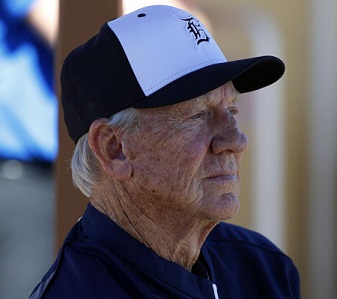
Hall of Famer Al Kaline, observing a spring training 2014 Tigers workout. “I have to work as hard if not harder than anybody in the league,” he once said of playing the game he made look simple.

The late Al Kaline was twenty years old when he won his only American League batting championship, in 1955. In wins-above-replacement-level-player terms, it’s the third best season by any twenty-year-old, with only Alex Rodriguez (9.4 WAR, 1996) and Mike Trout (10.5, 2012) passing Kaline’s 8.3.

In earthier terms, that season planted such extreme expectations upon him that Mr. Tiger eventually said it was the worst thing that could have happened to the man who finally became a Detroit icon for his play and his accommodating personality. Neither of which came simply to him, no matter what you think of the flood of tributes pouring forth upon and since his death at 85 Monday.

“Detroit’s Al Kaline looks like a man who plays with consummate ease as well as rare skill,” said Sports Illustrated in a 1964 profile, “but he is finding it hard to follow baseball’s toughest act: himself.” Kaline was the cover story in that issue, and the headline attached to a photograph of Kaline following through on a swing said, simply, “Enigma of the Tigers.”

By then the Hall of Famer struggled with injuries that kept him from posting many more than 140 games a season. Even in one of his eighteen All-Star seasons, this one during the period when fans were still bereft of the vote following the Cincinnati ballot box-stuffing scandal of 1957, this was a time when some sportswriters and enough Tiger fans called for the team to trade the right fielder who’d retire as a franchise demigod.

“This put the pressure on me,” Kaline told SI writer Jack Olsen of the beginning that culminated in that batting title. “Everybody said this guy’s another Ty Cobb, another Joe DiMaggio. How much pressure can you take? What they didn’t know is I’m not that good a hitter. They kept saying I do everything with ease.

“But it isn’t that way,” Kaline continued. “I have to work as hard if not harder than anybody in the league . . . I don’t have the kind of strength that [Mickey] Mantle or [Willie] Mays have, where they can be fooled on a pitch and still get a good piece of the ball. I’ve got to have my timing down perfect or I’m finished . . . I’ll tell you something else: I’m not in the same class with players like Mays or Musial or Henry Aaron, either. Their records over the last five seasons are much better than mine.”

There have always been those players who make baseball look so simple that Joe and Jane Fan become deluded enough to think they can play it even half as well as Kaline did. Kaline himself was the first to admit that making baseball look simple required work, and lots of it. Marry that to the expectations a talent showing itself early inspires, and you might find a player despairing of ever being what he thinks people want him to be.

“In the first few years after he won the batting championship,” Olsen wrote, “Kaline went into frequent depressions over his inability to give the fans what he knew they expected. He would come into the clubhouse after a game and slump in front of his locker, speaking to no one.”

That actually earned Kaline a reputation for difficulty for awhile. But Kaline himself—who once earned Hall of Famer Ted Williams’s respect and a tip to use hand weights to strengthen his wrists for hitting—told Olsen he wasn’t exactly being a sulk during those first few post-title seasons.

“I was just quiet, and when a newspaperman came up to me and said, ‘Nice game,’ or something like that, I’d just say, ‘Thank you’,” he said. “I would never prolong the conversation, and the guys who didn’t know me would say, ‘Look at this stuck-up kid.’ But it was just my way. I don’t talk much. I don’t like to make people mad at me, and if you talk too much you’re gonna put your foot in your mouth sooner or later.”

When Kaline had a terrific 1956 followup to his batting title season and pressed for a salary raise that might bring him at least next to then-Tiger Harvey Kuenn’s income neighbourhood, then-Tigers president Spike Briggs put his foot into his own mouth.

Briggs told a Detroit advertising club meeting, “Kaline thinks he’s as good as Mickey Mantle, and wants as much money as Mantle.” Except that Kaline thought and said nothing of either sort. It took the intercession of player development director John McHale to get Briggs to back off and hand Kaline $30,000 for 1957.

Under misinterpretation Tiger fans began booing Kaline and the sharp right fielder was, understandably, none too thrilled. He merely clammed up for a good while. Especially when the Tiger front office tried to impress upon him the idea that a little flash out on the field might go a long way. Asking Al Kaline to become a showman would have been something like asking Casey Stengel to become an undertaker.

“They told me to be more colorful, that I could bring more people into the ballpark if I was more colorful,” Kaline told Olsen. “But how could I do that? I could jump up and down on the field and make an ass out of myself arguing with umpires, but I’m not made up that way. I could make easy catches look hard, but I’m not made that way, either.”

He merely made himself a ten-time Gold Glove winner, and it wasn’t by reputation alone. Only two right fielders—Hall of Famer Roberto Clemente and sometimes-forgotten Jesse Barfield—finished with more fielding runs above average. He made near-impossible catches look simple, if not painless. He made throwing runners out look routine. He made hitting tough pitches look as natural as eggs on a breakfast plate.

His early 1964 slump didn’t worry his then-manager, one-time Brooklyn icon Charlie Dressen, one lick. “He’s not hitting now, but what does that mean? Nothing,” Dressen said then. “When a man is an established hitter like Kaline, you know what he’s gonna do. The pitchers are getting him out now, but later on in the season somebody’s gonna suffer.”

Kaline’s injury issues only began with an osteomyelitis-plagued left foot that led to small bone removal surgery which compelled him to develop a way to run on the side of the foot. “On top of that,” Olsen wrote, “he has suffered more than the average number of injuries, among them depressed fractures of both cheekbones, two beanings and a broken collarbone. Baseball has not been a frolic through sylvan glades for Al Kaline.”

The Tigers’ 1964 general manager knew it. “Al Kaline has had more reason to jake it than almost any ballplayer I know, but I have never seen him give less than everything he had,” Jim Campbell told Olsen. “That’s the way he learned to play baseball, and that’s the only way he knows how.” Campbell also said oh, sure, he’d think about trading Kaline—for Hall of Famers Mays, Juan Marichal, and Orlando Cepeda of the Giants in the same deal, that is.

Olsen’s piece was titled inside the magazine, “The Torments of Excellence.” “Talking to Kaline,” he observed then, “is like making funeral arrangements.” The longer he played, the farther behind he left the old expectations and front-office animosities, the easier it became for him to be himself, around fans and players in his and opposing uniforms.

The only funeral arrangements Mr. Tiger ever made were in the 1968 World Series. His seventh-inning, bases-loaded shuttlecock of a single turned a 3-2 deficit into a 4-3 Tiger lead, jerking them to a win, and they never looked back. Especially after Kaline flattened a service from Hall of Famer Steve Carlton into a two-run homer on a 3-for-4 day during a 13-1 Game Six rout, before Mickey Lolich out-pitched Bob Gibson to win Game Seven.

He’d also smash an eleventh-inning bomb off Hall of Famer Rollie Fingers in the 1972 American League Championship Series to break a one-all tie in a game the Athletics won in the bottom of the inning; then, in Game Four, his tenth-inning single set him up to score the tying run in what became a 4-3 Tigers win. It wasn’t enough to stop the A’s from winning Game Five.

Two years later, in his native Baltimore, Kaline swatted a leadoff double the other way, into the right field corner, against Dave McNally in the fourth inning for his 3,000th hit. His next time up, he smacked a game-tying RBI single off McNally.  (The Tigers eventually lost the game.) Then he made good on a promise he’d made to retire after he got the hit. If he didn’t get it in 1974, he’d get it in 1975.

“I’ll retire now,” he said simply after the game.

Meaning after the season. Kaline took a year to get the game out of his system, then re-joined the Tigers as a broadcaster, which he’d remain for a quarter century to follow before moving into the front office as an advisor. In the interim, the ancient and short-lived battles dissipated completely. Kaline made fans feel warm and Tigers who followed him feel well enough endowed.

When the Tigers played their final game in Tiger Stadium (“Character, charm, and history,” Kaline once said was the Old Girl’s strength), on 27 September 1999, Kaline gave a rookie Tiger named Robert Fick the pre-game word: Fick would hit one out that night. In the bottom of the eighth, facing Kansas City reliever Jeff Montgomery with the bases loaded and one out, Fick ripped one off the right field roof.

A year earlier, while traveling around the country and spending some time outside Detroit with a friend, I got to take in a game at Tiger Stadium, copping a field-level seat down the left field line next to the foul pole, on a night the Tigers and the Reds wore throwback tribute Negro Leagues uniforms. I looked across to the right field roof on the facade of which were four retired uniform numbers: 2 (Hall of Famer Charlie Gehringer), 5 (Hall of Famer Hank Greenberg), 6 (Kaline), and 16 (Hall of Famer Hal Newhouser).

Kaline’s 6 stood out especially because I’d seen him play often enough growing up, as a Met fan who’d watch the occasional Yankee game just to see the other teams and their big men, remembering how easy Kaline made baseball look—whether running a ball down and throwing a runner out from right field, whether stroking a hit or three with men on base (he has a lifetime .322 batting average in high-leverage situations and .311 with men in scoring position)—but not knowing how much work he did to make it that way.

I thought of that night in Tiger Stadium again when learning of Kaline’s death. Somehow, having the chance to see just one live game in the Old Girl, it felt like Kaline’s house, we were his guests, that Tiger fans were comforted knowing that he was there (still in the broadcast booth at the time), and that he might make even a traveling fan in his first and only Detroit visit feel at home.

“This fellow is amazing,” Stengel said of Kaline during the 1950s. “You ask yourself four questions. Can he throw? And the answer is yes. Can he field the ball? And you answer yes. Is he active on the bases? Yes, you’d have to say yes. And then, can he drive in the runs? The real test. And again you say yes. So he is an amazing fellow.”

Tell Kaline to his face that he was amazing and he’d have denied it under oath. And he’d have gone on trial for perjury.

Great misfortune meaning unforeseen baseball reward?

2020-04-07 ChaseFieldIn a 1930 collection of brief essays, The Book of Journeyman, Albert Jay Nock—once upon a time a semi-professional baseball player himself—included a piece called “Decline and Fall.” He began by disclosing a New England college trustee revealing golf becoming more popular than baseball on campus since baseball’s “over-commercialisation” now impressed students as lacking golf’s class.

Accepting all that, Nock saw “one merit” in that shift of view, writing that golf “is no game to watch—one must play it oneself to get anything out of it.” Funny, but that’s what a lot of people who don’t like to watch baseball say about baseball, even as the fact that so many people have loved watching baseball’s “great spectacle made its commercialisation possible.”

There is some commercialisation of football and tennis, but it will never go any distance as it has in baseball; and golf, I think, will always remain a player’s game. How odd it would be, though, if a generation should grow up which knew not baseball! America would no longer seem like America.

Nock couldn’t have foreseen the future popularity of football, or future baseball administrators becoming as inept as they’ve been in preserving and enhancing the game’s popular value. But neither could he know a day would come when a viral pandemic, whose advent and arrival was bungled worse than any commissioner bungled baseball’s standing, would bring baseball to a halt indeed.

The meme cliche is now weeks old in which you can remember just how profoundly Joni Mitchell’s ancient lyric fits baseball this minute: “Don’t it always seem to go/that you don’t know what you’ve got till it’s gone.” The winter of malcontent over Astrogate melted uneasily enough into spring before the coronavirus’s surge forced American sports to suspend themselves. Baseball’s absence has made more than a few of the restless more so.

Now comes word of a plan of sorts to bring the major league game back  “as early as May,” as ESPN’s Jeff Passan phrases his report, with the apparent blessing of “high-ranking federal public health officials” he says believe baseball can return safely—in Arizona alone, and with nobody in the stands to root-root-root for the home team or otherwise.

The plan, sources said, would dictate that all 30 teams play games at stadiums with no fans in the Phoenix area, including the Arizona Diamondbacks’s Chase Field, 10 spring training facilities and perhaps other nearby fields. Players, coaching staffs and other essential personnel would be sequestered at local hotels, where they would live in relative isolation and travel only to and from the stadium, sources said. Federal officials at the Centers for Disease Control and Prevention as well as the National Institutes of Health have been supportive of a plan that would adhere to strict isolation, promote social distancing and allow MLB to become the first professional sport to return.

There was indeed talk of playing to empty houses by design before baseball and other sports suspended over the coronarivus. Baseball has a precedent, of course, thanks to the 2015 riots that battered Baltimore, a surreal game between the Orioles and the White Sox for which Camden Yards was closed to the public and both teams (the Orioles won, 8-2) felt as though they were playing in the Twilight Zone.

But this isn’t the immediate aftermath of a city-breaking riot provoked by the combustibility of police malfeasance and looters using the very real outrage over Freddie Gray’s death in police custody as beards for their destruction. This is baseball and the world at large trying to overcome one of recorded history’s worst pandemics while trying to find its way back to a semblance of normalcy.

It’s bad enough that governments and leaders seize upon the virus as a beard for their impulses toward bringing their subjects further under control than they’ve craved without such pandemics. It might be just as bad if industries feeling the impact of the shutdowns reach for desperate ploys upon their returns, whenever those returns may be.

Aside from the logistics Passan discusses in fine detail, neither baseball’s government nor the Major League Baseball Players Association has agreed to any plan under which the game might return for even a portion of 2020. This was baseball government’s formal statement:

MLB has been actively considering numerous contingency plans that would allow play to commence once the public health situation has improved to the point that it is safe to do so. While we have discussed the idea of staging games at one location as one potential option, we have not settled on that option or developed a detailed plan. While we continue to interact regularly with governmental and public health officials, we have not sought or received approval of any plan from federal, state and local officials, or the Players Association.

The health and safety of our employees, players, fans and the public at large are paramount, and we are not ready at this time to endorse any particular format for staging games in light of the rapidly changing public health situation caused by the coronavirus.

It’s not just a “format for staging games” they have to consider. They’ll have to consider suspending baseball’s already ridiculous broadcast blackout rules. If you think there are fans restless without baseball at all now, just imagine how ornery they’ll become if they can’t watch any single-state-located games.

They’ll also have to consider ways to make a pennant race and a postseason feasible off a circumstantially shortened season. And there have been times past when seasons disrupted turned into the game outsmarting itself. (The 1981 strike, the split season, and the first divisional-series postseason, anyone? Where the two best teams in each National League division didn’t even make the postseason cut?)

There’s talk that includes the possibility of playing seven-innings-a-game doubleheaders, the better to get as close to a full season as possible. Never mind that a key reason why the doubleheader faded away was owners exhausted of losing gates (doubleheaders traditionally charged a single admission to both games) and players not named Ernie (It’s a beautiful day, let’s play two!) Banks exhausted of being exhausted from playing them.

Try this one on if you like. Suspend the wild cards. Especially if it becomes possible to play baseball in its usual venues, not just in Arizona, draw a schedule that enables each league’s teams to play each other in season series twice. Schedule limited interleague play, as contingent upon local or regional reach as feasible. (This could prove problematic for the Braves, but it’s time for baseball’s brain trusts to use, well, their brains.) Assuming baseball can return in June, all this could make a 100-game schedule workable.

Now, just this once, seize the moment. Streamline the postseason at long enough last. Give the division winner with the best season’s record a round-one bye and let the other two winners play a best-of-three division series. Let those winners meet the bye teams in a best-of-five League Championship Series. And let the World Series remain the prime and the only  best-of-seven.

You guessed it: I’m sort of (ho ho ho) sneaking in a proposal I’ve long advocated on behalf of de-saturating postseason baseball and making pennant races mean something once again. Aren’t you finally tired of all the stretch drive thrills watching teams fight to the last breath to finish . . . in second place?

(It’ll also address an alarm raised by Clayton Kershaw and others. Who really wants the World Series played near Christmas in “neutral” territory? Jingle ball all the way? Who wants to kill the fun of the combatants playing before their home crowds when scheduled?)

Whether baseball can return in May or even June, this would be the ideal condition in which to try it out. If you think the broadcast ratings might take a jump when the season gets underway at all, think of what’ll happen to them when they’re not drowning in postseason excess. Would it be so terrible if that, too, inspires baseball to restore proper championship competition for non-pandemic seasons to come?

This might also be a time for baseball’s government to re-consider the already execrable plan to contract the minor leagues. If you think the Show’s going to make the nation feel loved again upon its return, just imagine what the minors will do for the hamlets, towns, villages, and smaller cities where they play. Remind yourself while you’re at it that that execrable plan is another reason to believe baseball’s better off without Jeff Luhnow, the Astrogate-deposed general manager whose brainchild the minor league contraction was in the first place.

This much we can guess: Baseball’s return is going to be the biggest morale boost this nation has seen since the game was able to return after the respite imposed by the horror of 9/11. Even those to whom baseball is no great shake will feel comfort that somehow, somewhere, there’s a ball game being played.

You might think it either silly or salacious to lean upon even a fictitious Mafia don for comfort, if not wisdom. But in The Godfather (the novel, not the film) Don Vito Corleone mused how true it was that great misfortune often led to unforeseen reward. Baseball has a couple of great chances now to prove how right that is.

Al Kaline, RIP: Mr. Tiger was a pussycat

2020-04-06 AlKalineFredHutchinson

Hall of Famer Al Kaline (left) with Fred Hutchinson, his first major league manager. Hutch introduced the lad to Hall of Famer Ted Williams, who introduced him to wrist strengthening that enhanced his formidable enough hitting–but Kaline’s glove and arm were equal.

Hall of Fame outfielder Al Kaline, whose career ended before Andy Messersmith shattered the reserve era once and for all, once turned down a salary raise because he believed he didn’t earn it. He still became the first Tiger to sign a six-figure single-season contract in due course.

A year ago, a teammate of Kaline’s on the 1973 Tigers told me during a telephone interview about how Kaline—who died today at 85—became a team leader without big talk or big noise.

“Al Kaline was extremely soft spoken,” said Bill Denehy, the former Mets pitcher whose third of three major league seasons was in Detroit. “Any time we had a team meeting, any time we had anything that, you know, caused the team to get together to give their opinion . . . Al would sit at his locker and vote just like he was—Bill Denehy. He wasn’t someone who would complain, he wasn’t someone who really wanted to put his opinion out there, he was the ultimate team player.”

Kaline signed with the Tigers right out of high school for a $35,000 bonus. Under the once-infamous Bonus Baby rule of that era, such players had to be kept on major league rosters for two seasons before they could be farmed out for real seasoning. Of all the players impacted by that bonus rule, Kaline was one of only three to become Hall of Famers. (The others: Sandy Koufax and Harmon Killebrew, though Killebrew was the only one of the three to see minor league time after his bonus period expired.)

The son of a Baltimore broom maker and a scrubwoman, Kaline used his bonus to pay off his parents’ mortgage and for his mother to undergo eye surgery. “They’d always helped me,” he once told a reporter. “They knew I wanted to be a major-leaguer, and they did everything they could to give me time for baseball. I never had to take a paper route or work in a drugstore or anything. I just played ball.”

Kaline was in a Tiger uniform the week after his high school graduation. By the time he became eligible to be sent to the minors, in 1955, it was the last thing on the Tigers’ mind: he was about to become the American League’s batting champion. He developed a near-picture swing, partially on Hall of Famer Ted Williams’s advice, Williams having suggested he try squeezing rubber balls and moderate small weight lifting to build his wrists.

What Denehy considered the ultimate team player on the Tigers proved it on the final day of his major league career, against the Orioles. Coming in having hit in thirteen of his previous eighteen games, including the one that gave him 3,000 lifetime, Kaline also hadn’t hit one out since that September 18. His next home run would be the 400th of his career.

It never came.

Kaline batted twice against the Orioles’ Mike Cuellar, striking out and flying out, while also playing through a badly ailing shoulder. When his next turn to hit arrived in the fifth, Kaline put baseball ahead of a notch on his resume. He told manager Ralph Houk to take him out, which Houk did, sending Ben Oglivie up to pinch-hit against Baltimore reliever Wayne Garland.

The tiny Tiger Stadium crowd booed lustily. “I was sitting there in the clubhouse,” Kaline remembered, “and I could hear them booing. I really felt sorry for Ben. It wasn’t his fault.” Houk, for his part, empathised with Kaline. “With a hitter as great as he is,” he told reporters, “you don’t send him back out there when he says he’s had enough. I think I owed Al that much.”

When Kaline became the (still) youngest batting champion (at 20), he tied for second with Hall of Famer Mickey Mantle in the American League’s Most Valuable Player voting. That wasn’t the only thing he had in common with the Yankee legend. Kaline dealt with osteomyelitis, too, but in his left foot, requiring removal of some bone and forcing him to learn to run on the side of the foot, something that plagued him along with numerous other injuries in his career.

Writing The Cooperstown Casebook, Jay Jaffe ranked Kaline the number seven right fielder who ever played the game, including that his 155 defensive runs saved lifetime are second only to fellow Hall of Famer Roberto Clemente among right fielders. Yet when Kaline became a first-ballot Hall of Famer in 1980, fans and the Detroit press hammered the Tigers yet again over Kaline’s early exit in that final game.

Kaline also faced questions over it even then. “That was one of my most embarrassing moments,” he said long afterward. “But you have to understand that I didn’t realize at the time the fans came out to see me in my last time at-bat.”

He had nothing for which to apologise. A man who puts baseball ahead of his own potential milestone and knows when it’s time to sit down is entitled to dispensation.

“When you talk about all-around ballplayers, I’d say Kaline is the best I ever played against. And he’s a super nice guy, too,” said the Orioles’ Hall of Fame third baseman Brooks Robinson, during Kaline’s final season, Robinson just so happening to be a super nice guy himself. (“Around here,” Brooks Robinson Day MC Gordon Beard said, “people don’t name candy bars after Brooks Robinson—they name their children after him.”)

“There aren’t too many guys who are good ballplayers and nice guys, too,” Robinson continued. “Your attitude determines how good you’re going to be — in life as well as in baseball. He’s got a great attitude.”

So much so that Kaline began getting applause in opposing ballparks around 1969-70, something that didn’t go unnoticed by him. “This makes a guy feel good,” he told The Sporting News in 1970. “Most of it is for being around so long. I’ve stood the test of time. And I haven’t done anything to embarrass the game or myself.”

Kaline’s humility was as legendary in Detroit as his playing consistency. He missed five weeks in 1968 with a fractured forearm, then saw limited time when he returned. He even questioned whether he belonged in the World Series when Mickey Stanley and Jim Northrup, who’d gotten most of Kaline’s plate appearances in the interim, had run the distance.

That’s when then-manager Mayo Smith devised his gambit of moving Stanley from center field to shortstop, displacing good glove/spaghetti bat Ray Oyler, and shifting Northrup to center field, enabling Kaline to take his usual post. Kaline’s two-run single in Game Five yanked the Tigers from the brink of elimination and he finished the Series with a 1.055 OPS.

That was the man who said after the Tigers clinched the pennant in the first place, “I don’t deserve to play in the World Series.”

Kaline became a respected commentator on Tigers’ game telecasts, working with play-by-play man George Kell and then, after Kell retired from the booth, Ernie Harwell. He did that for two decades to follow before he was moved to the Tigers’ front office in an advisory role. More than that, making friends among just about everyone who met Mr. Tiger seemed to come second nature to him.

He had numerous admirers even among his opponents. “I like to watch him hit,” said Hall of Fame pitcher Jim Palmer once. “I like to watch him hit even against us. He’s got good rhythm, a picture swing. Other hitters could learn a lot just by watching him. The thing about Kaline is that he’ll not only hit your mistakes, he’ll hit your good pitches, too.”

Yet the Tigers honoured him with one of only six statues around Comerica Park by having him seen with a glove, rather than a bat in his hand. It depicts Kaline making a leaping, one-handed catch, very much like the catch he made scaling above the old Yankee Stadium right field, field-level scoreboard, to take a homer from Mantle in 1956.

Kaline was as elegant an assassin shooting down runners from right field as he was at the plate. “He was the only fielder,” tweeted actor/baseball fan Jeff Daniels, “who could make the ball come to him.” Not long ago, though, Kaline lamented contemporary outfielders doing less work on their throwing than he and his contemporaries did.

“The outfielders really need to be practicing making long throws because sometimes you can go several games before you have to make a long or hard throw,” he told a writer.

They don’t do it at all. Today the outfielders play long catch before the game, and they work on the outfield walls when they go to another ballpark but they don’t regularly practice throwing home like we did when I played. They just don’t do it. Throwing in game conditions is a lot different then just playing long catch in the outfield. In a game you have to move your feet a lot faster and you don’t have time to set up and throw . . . I don’t know why they don’t practice throwing home at least once every series just to get used to game situations as you possibly can.

Two years before that robbery against Mantle, Kaline threw White Sox baserunners out in three straight innings. The bad news was the White Sox still slapping the Tigers silly in that game, a 9-0 win with sixteen White Sox hits. Typically, Kaline refused to call for fireworks on his own behalf. “That was a pretty fair day,” he said of his three kills in three innings. “I liked it.”

Kaline had only one more enduring marriage than with the Tigers—with his wife, Louise, his high school girl whom he married after the 1954 season and whom he loved for her beauty, her brains, and for her ability to talk baseball. One of their two sons played in the Tigers organisation briefly.

When baseball changed the name of its annual sportsmanship/community involvement award to the Roberto Clemente Award, Kaline was the first to win the award under that name. Fittingly. Both men had 3,000 hits or more and howitzers for throwing arms. But Kaline has just one up on Clemente: his was the first uniform number (6) retired by his franchise.

Such a kind and generous man who meant so much to so many,” tweeted longtime Tigers pitcher Justin Verlander. “I hope you knew how much I enjoyed our conversations about baseball, life, or just giving each other a hard time. I am honored to have been able to call you my friend for all these years.”

Always felt that to be a slam-dunk HOFer you had to have an ego and be selfish, always knowing how many W’s or HRs you were away from Cooperstown,” tweeted Claire Smith, a Hall of Fame baseball writer herself. Then I met #AlKaline Billy Williams, Sandy Koufax, Phil Niekro — gentlemen & gentle men. “R.I.P. Mr. Tiger.”

In numerology, 6 means, basically, family, home, harmony, nurturing, and idealism. It sounds like a thumbnail sketch of Kaline himself. If we have to say farewell on the day this gentleman and gentle man went to the Elysian Fields, the date is only too appropriate, too. The sixth.