. . . and, will it come back smartly?

2020-05-12 SeanDoolittle

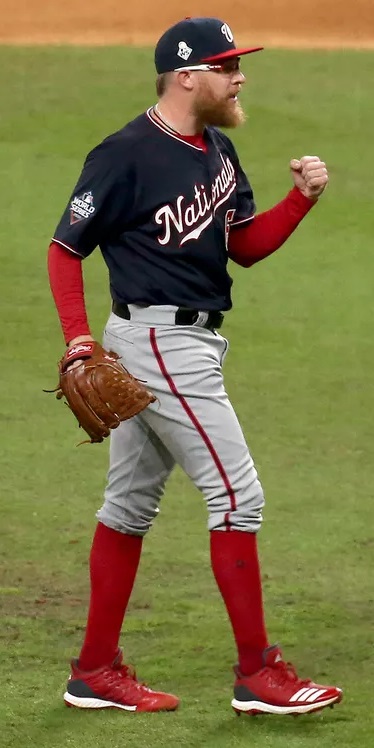
Sean Doolittle during last year’s World Series. He’s now concerned that baseball considers everyone’s health before coming back.

Forget for the moment how arduous might become the grapple between owners and players on how to pay whom if the Show returns. More significant will be how to keep more than just the players healthy, a significance that has not escaped the thoughtful eye, ear, and mind of one Washington Nationals relief pitcher.

Sean Doolittle isn’t even close to the only major league player with health on his mind. But it isn’t every player who’s unburdened himself aboard Twitter to lay out the health questions that must be answered if the Show is to come back to give a coronavirus-exhausted nation even a small degree of respite.

Bear with me,” Doolittle (who calls himself Obi-Sean Kenobi Doolittle on Twitter) began his Monday stream, “but it feels like we’ve zoomed past the most important aspect of any MLB restart plan: health protections for players, families, staff, stadium workers and the workforce it would require to resume a season.”

There are players and other personnel now who may be more vulnerable to the virus than others almost regardless of the health and safety protocols MLB might secure, as Ken Rosenthal observes in The Athletic. Colorado outfielder David Dahl is one. Rosenthal cites the Mayo Clinic saying your vulnerability to life-threatening infections heightens after spleen removal. Dahl’s spleen was removed five years ago.

Doolittle’s own wife, Eireann Dolan, is vulnerable thanks to being asthmatic. Two Chicago Cubs, pitcher Jon Lester and first baseman Anthony Rizzo, are cancer survivors. Cleveland pitcher Carlos Carrasco has battled leukemia and, six years ago, undergone “non-invasive heart procedure,” Rosenthal writes. At least three players are Type 1 diabetics: pitchers Scott Alexander (Los Angeles Dodgers) and Jordan Hicks (St. Louis Cardinals), and outfielder Adam Duvall (Atlanta Braves).

One and all of them plus countless more players are only too willing to play ball this year. “Obviously, this thing is unstoppable if it gets you the right way,” said Rizzo, who’s worked with and through his charitable group aiding Chicago front-line workers, in April. “But they said I’m cured and as strong as ever and that everything functions the right way. If I was to get it, they’re not overly concerned, like they would be with older people who have had conditions before.”

Doolittle also knows it’s not that simple to work with. “Because this is a novel virus, there is still so much we don’t know—including the long-term effects,” he said aboard his Twitter stream. “On top of respiratory issues, there’s been evidence of kidney, intestinal, and liver damage, as well as neurological malfunctions, blood clots & strokes.”

Referencing several research results, the lefthanded relief pitcher cited coronavirus patients’ vulnerability to scarring in their lungs, “found even in asymptomatic patients, and because the virus often affects both lungs, can cause permanent damage in some cases. Definitely a concern for an athlete.”

It’s also a concern, and Doolittle knows it, for those who work in close enough proximity, including clubhouse personnel, press personnel, team staffers, and stadium workers. Baseball as a game may work in a kind of social distancing on the field, if you don’t count the three-man cluster of batter, catcher, and umpire at the plate, but off the field in the dugout, the clubhouse, and the ballpark is something else.

Even if the Show returns come July with no fans in the stands to begin, it isn’t going to be simple. “We know that sharing indoor spaces greatly increases the infection risk,” Doolittle continued, “and it’s rare that only 1 person gets sick. Will there be modifications made to clubhouses or other facilities to prevent a spread?” Indeed.

“Even if maybe guys don’t realize it right now, it’s our job and MLB’s job to make sure all those concerns are taken care of,” says Cardinals relief pitcher Andrew Miller, who’s a member of one of the player’s association’s executive sub-committees. “Health and safety of our players and our staff is first and foremost before we can even think about getting games off the ground and the logistics of all that.”

Baseball players might not be in close contact during a game the way football players are,” Doolittle tweeted, referencing the prospects for an NFL season this fall, “but there is a lot of shared space in a clubhouse among players, coaches and staff.”

That’s one reason why it isn’t going to be as simplistic as just keeping the owners from using baseball’s measured return to try suppressing players’ pay, considering the question to be answered as to whether the players will play for a 50-50 revenue split or for the contracted-for pro-rated 2020 salaries to which they agreed in March.

“The risk of exposure to the virus is one reason players are adamant about not accepting a further reduction in pay,” Rosenthal writes. “They agreed in March to pro-rate their salaries in a shortened season, but the league will seek additional concessions, sources said, because the games, at least initially, will be played without paying customers.”

Doolittle also pondered, not unreasonably, whether baseball could or would consider additional health care benefits for players and staffers “extend[ing] beyond their employment and into retirement to mitigate the unknown risks of putting on a baseball season during a pandemic?”

We don’t have a vaccine yet, and we don’t really have any effective anti-viral treatments. What happens if there is a second wave? Hopefully we can come up with BOTH a proactive health plan focused on prevention AND a reactive plan aimed at containment.

Doolittle and other players hope any plan to bring the Show back considers plans to acquire enough real coronavirus tests “ethically,” and the best, most feasible protocols if any player, staffer, or ballpark worker contracts the virus.

The owners and the players union have that to think about as well, even if they also have to ponder concurrent issues. For the players, they know the longevity of given careers isn’t guaranteed. For the owners, whose longevity is far more assured, there’s the risk that the national economy’s eventual recovery doesn’t happen before they’re forced to furloughs, firings, and bankruptcies.

“We want to play,” Doolittle concluded. “And we want everyone to stay safe.”

Not once in his Twitter exegesis did Doolittle talk about money. The cynic might reply that that was easy for him not to say, since his full 2020 salary would have been $6.5 million and his pro-rated nut wouldn’t exactly be pocket money. Hearing comparable health and safety concern from more players such as Doolittle and Miller would go plenty far enough.

Before this week’s return proposal, earlier ideas that meant complete player isolation put several players on edge for having to go to the serious work of play without their families. A normal baseball season provides separation enough. A season played in near-isolation with out-of-the-ordinary health and isolation issues is tricky above and beyond the safety concern.

Mike Trout and his wife, who’ve been donating quite liberally to front-liners in the region of his native southern New Jersey (including donating food), await the birth of their first son in August. He’d rather hit the deck after taking a hit off the helmet from a headhunting pitcher than be absent when Baby Trout premieres.

Clayton Kershaw, whose third child (and second son) was born three months ago, and who raised money (and matched it dollar-for-dollar out of his own deep pocket) for a Los Angeles group serving 13,000 meals a day during the pandemic, has suggested the balance between playing baseball safely and being isolated from their families didn’t exactly thrill himself or his fellow players.

Still, it’s always reassuring to know that there are those who actually play the game, who understand that, for all the dollars they earn to play it, the common good of the game isn’t always the same thing as just making money for it or dividing the spoils from it.

They also know a coronavirus-exhausted country needs what they do. Colorado Rockies outfielder Charlie Blackmon doesn’t want to be ill, doesn’t want people making each other ill, but wants a way for the game to return for those who love it and those who depend on it for their living.

“But bigger than that,” Blackmon said in a Monday radio interview, “this country needs baseball.” This country, and baseball itself, also needs to have it done right.

The Show’s coming back?

2020-05-11 CodyBellinger

Where have you gone, Cody Bellinger—and Mike Trout, Jacob deGrom, Max Scherzer, Aaron Judge, Mookie Betts, Ronald Acuna, Jr., Clayton Kershaw, Justin Verlander, and Christian Yelich? A nation turns its quarantined eyes to you . . . but . . .

Baseball, the sport that more or less invented social distancing (if you don’t count the batter, the catcher, and the home plate umpire in a close enough cluster), is about to return to America, so it is said. At least the Show will. This brings good news, bad news, and very bad news.

The good news is, the proposed July return acknowledges a nation in dire need of respite from the coronavirus’s toll in human life and human mischief and exhausted of asking, “Where have you gone, Cody Bellinger—and Mike Trout, Jacob deGrom, Max Scherzer, Aaron Judge, Mookie Betts, Ronald Acuna, Jr., Clayton Kershaw, Justin Verlander, and Christian Yelich? A nation turns its quarantined eyes to you.”

The bad news is, there’ll have to come bristling debate on part of the proposal: will the players get only their cuts of a half-and-half league revenue split, or will they get their normal if prorated-for-time 2020 salaries?

The very bad news is that slightly more than half season to come may leave room for some of Commissioner Rob Manfred’s mischief. The proposal approved by major league owners and submitted to the Major League Baseball Players’ Association includes that the postseason will begin with fourteen teams, courtesy of two more wild cards each in the American and National Leagues.

Manfred has only sought such a postseason expansion for almost as long as he’s been Bud Selig’s successor, of course. Bad enough that some of his thoughts about redressing play-of-game issues have run the gamut from nonsense to more nonsense. Worse is that he has no apparent thought that play-of-postseason requires even more serious redress.

Even if the proposed structure for this year is one time only, well, we’ve heard it before when baseball’s governors tried things once—and let them linger regardless of their wisdom or enhancement of the game.

The postseason is already long enough. And we’ve suffered long enough, too, the thrills and chills of teams fighting down the stretch to the very last breath to determine who’s going to finish . . . in second place.

The original wild card advent legitimised the second place finisher as a championship contender, which was bad enough, and removed the time-honoured incentive of the first place finish as the sole legitimate entree into postseason play. Manfred appears to be witless to comprehend it even as he further exposes himself a man to whom the common good of the game equals little more than making money for it.

You guessed it: here I go yet again. But a three-division league giving a round one bye to the division winner with the best record of the three, while the other two slug it out in a best-of-three division series, with that winner playing the bye team in a best-of-five League Championship Series, would a) produce far more of a genuine league champion and b) far fewer viewers turning off or avoiding television sets or radios on the road to the best-of-seven World Series.

All that said, there are a couple of things to come in the short 2020 season that Manfred, the owners, and the players alike would be wise to make permanent. Rosters are proposed to expand from 26 to 30. Sound as a nut. Make it permanent.

The designated hitter will come to the National League for the short 2020. Good. Make it even more permanent. Pitchers batted for a .128/.159/.163 slash line in 2019. That is unacceptable production no matter what you think of “tradition,” and baseball history is nothing if not full enough with traditions that deserved to be and were killed. OK, you asked for it: Thomas Boswell’s wisdom, one more time . . .

It’s fun to see Max Scherzer slap a single to right and run it out like he thinks he’s Ty Cobb. But I’ll sacrifice that pleasure to get rid of the thousands of rallies I’ve seen killed when an inning ends with one pitcher working around a competent No. 8 hitter so he can then strike out the other pitcher. When you get in a jam in the AL, you must pitch your way out of it, not ‘pitch around’ your way out of it.

As a result, some weaker pitchers survive in the NL. But survival-of-the-unfittest isn’t good for the evolution of a league. Over time, high-quality hitters migrate to the AL, where they can have longer, richer careers by finishing as a DH. That is the main reason the AL has dominated interleague play in this century.

Depending upon the team’s up-and-down lineup possibilities, I’d far rather have what amounts to an extra leadoff hitter or cleanup hitter in that spot than a gang of spaghetti bats who might maybe hit one to the back of the yard as often as Halley’s Comet shows up. Assuming they don’t get injured swinging or running the bases and taken out of action when you need their arms the most.

I don’t want Jacob deGrom, Max Scherzer, Stephen Strasburg, Jack Flaherty, Clayton Kershaw, Walker Buehler, Josh Hader, Noah Syndergaard (when he returns), or Jon Lester wasting time at the plate no matter how many home runs they’ve hit once in a blue moon. I want them strictly on the mound missing bats or luring outs. That’s why they’re paid what they’re paid.

Beyond that? I’m not going to complain about the possible electronic strike zone, I want the balls and strikes called right, too, which means by the rule book and not according to Angel Hernandez’s mood on a particular afternoon or evening.

But I’m going to complain that Manfred and company continue underrating and underdiscussing umpire accountability, which still seems not to exist much if at all. More’s the pity. When the Korean Baseball Organisation sends an entire ump crew to the country’s minors for re-training after a few too many complaints about a few too many individual strike zones, the American Show needs to pay attention. And the Hernandezes, Joe Wests, and C.B. Bucknors ought to be made to watch their behinds.

MLB’s return will mean empty stadiums to begin with gradual re-openings, not to mention one-time mixed-league divisions based on geography to a great extent and special considerations for keeping players, coaches, managers, umpires, and grounds crews safe. It may sound like a pain in the sliding pants, but it may also beat the living hell out of the alternative, which we’ve had restlessly enough for over a month and counting.

And, like anything else, desperate times call for desperate or at least temporarily ameliorative measures. The only thing we have to fear is that the least appealing of them might become permanent and the most appealing and truly necessary among them might become memories after the season ends.

Draft Shaft

2020-05-11 OzzieSmith

You never know when the late draft rounds will bring you another Wizard of Oz . . . but this year’s draft won’t have that chance.

Do you think you could win a division at least, a pennant a little more generously, or a World Series at most with a team such as this? An asterisk means the player is a Hall of Famer incumbent or likely in waiting.

C—Mike Piazza.*
1B—Albert Pujols.*
2B—Ryne Sandberg.*
3B—Wade Boggs.*
SS—Ozzie Smith.*
OF—Jim Edmonds, Kenny Lofton, Dave Parker.
SP—Mark Buehrle, Jacob deGrom, Roy Oswalt, Nolan Ryan*, John Smoltz*.
RP—Goose Gossage*, Eddie Guardado, Trevor Hoffman*. Sergio Romo.
DH—Howie Kendrick.

That group has players who all played on division winners. Fifteen of the eighteen played on pennant winners. Eleven played on World Series winners. Nine are Hall of Famers incumbent or (in Albert Pujols’s case) in waiting. One delivered the biggest blow to send the Washington Nationals to the Promised Land in Game Seven last October.**

And all of them were taken after the fifth round of major league baseball’s annual draft, which has now been stopped at the fifth round for this year. The culprit, of course, is the coronavirus. The hope, of greater course, is that this will be a one-time limit. The fear is that Andujar’s Law (In baseball, there’s just one word—you never know) still applies, and baseball government may (underline that) consider this a possible permanent thing.

That was then: 1,200 players would hear their names called in the annual June draft. This is now, at least: A mere 150 will hear their names called. “The advent of hard-slotting and the sophistication of the amateur scouting apparatus has made it tougher for players to slip through the cracks,” write The Athletic‘s Rustin Dodd and Andy McCullough. “How much talent will baseball miss out on this June? It is too soon to know. Many college players will simply be forced to accept $20,000 bonuses or return to school — and college sports face uncertainties as well.”

Another Athletic writer, Keith Law, author of The Inside Game, has further less than encouraging news:

With the current financial situation and uncertainty of when, or if, we will see baseball this year, as well as the likelihood that we’ll see little to no minor-league baseball this summer, some reduction in the draft made sense from a player development standpoint, and it saves MLB teams some cash in the short term. But this decision to essentially draft and sign as few players as possible could have significant long-term consequences for players and teams alike, most of them not good.

The most obvious impact is that we’ll see a lot of good players who had some major-league potential go undrafted this year . . . Any change to the draft or college scholarship availability will disproportionately hit players from disadvantaged backgrounds, reducing their choices, their opportunities to play and their potential return if and when they are drafted. It’s great to talk about increasing diversity in youth baseball and to try to get more young players of color into the sport. You have to back that up with real money, however, and this appears to work against those goals — if you’re cutting bonuses and opportunities, your talent pool will consist only of players who can afford to make little to no money while they play. Players who need incomes, or who might have been able to use a six-figure signing bonus to get by while they played in the minors, might end up leaving the sport for other careers.

Which could prove even more life-altering if MLB goes through with a shameful proposal to contract the minor leagues. As Law goes on to observe, “It takes money away from some of the players who do sign, even before we consider the risk that some teams will lowball high picks and spend less than their total bonus pools. It creates potential logjams of players at four-year colleges and reduces players’ leverage in future drafts. The savings are marginal and matter in the short term — just until revenues return when games resume — more than the long term.”

In other words, it’s going to do the biggest favour to MLB’s owners, who still have to decide whether 2021 will feature a January draft for the players who miss out on this June’s shorter draft (it’s been done before, forty years ago), and whether this shorter draft to come next month is a one-time aberration. As if the game doesn’t have enough to worry about trying to figure out how to get even half a season under way.

Commissioner Rob Manfred’s regime has been marked well enough by issues ranging from seeming indifference (umpire accountability, the survival of the minors) to seeming short sight (immunity to cheating players leaving us only to guess—pending future whistleblowers—about just whom really availed themselves of the Astro Intelligence Agency and the Red Sox Replay Room Reconnaissance Ring) and back to ignorance. (Dubious pace-of-play suggestions/adjustments and equipment tinkerings that imply Manfred knows little enough about the game he oversees.)

What he does regarding the draft now abbreviated thanks to a pestiferous pandemic may well begin the final definition as to whether he’s been little more as a commissioner than a fiddler while baseball potentially burns. Manfred often seems indifferent to his prospective legacy. Would he wish it to include that he might have blocked future Hombres, Wizards of Oz, Geese, and Expresses from playing the game?

————————————————–

** Give me a nudge and I’ll add that Kenny Lofton has a Hall of Fame case that was flattened one-and-done on an overcrowded 2013 BBWAA ballot , while Jim Edmonds and Dave Parker probably would have more solid Hall cases if they hadn’t been thwarted by injuries too often.

Between the latter two, Edmonds has the far stronger case. Parker missed on 2019’s Modern Era Committee vote. Neither Edmonds [highlight-reel, run-preventive defense, and power hitting] nor Lofton [virtuoso table setting and defense] are eligible again until the 2023 Today’s Game Committee where they might have a better chance. Might.


The KBO actually holds umps accountable, too

2020-05-09 KoreanUmps

In this photo from South Korea’s Yonhap News, umpires work on a review with the Korean Baseball Organization’s video review office during a pre-season game last month. The KBO has demoted a full crew after complaints about inconsistent strike zone calling.

It almost seems as though every mistake by American baseball government instructs the Korean Baseball Organisation, “Study this and learn what not to do.” In American baseball, umpire accountability often seems something along the line of promiscuous celibacy. In South Korean baseball, umpire accountability is a necessity.

When enough players between the SK Wyverns and the Hanwha Eagles complained about an inconsistent strike zone following a Thursday game, the KBO didn’t just hoist platitudes about effort, they up and did it. They demoted the entire umpiring crew, re-assigning every member of the crew to the country’s Futures League for re-training.

What a concept. And, as a Yahoo! Sports writer named Mark Townsend observes, “Try to picture this scenario. MLB officials approach Joe West. MLB officials then inform Joe West that his entire crew is headed back to rookie ball for retraining. And you thought the stare West gave Madison Bumgarner was frightening?”

Stare, schmare. From what American baseball fans have seen of American umpires the past couple of decades, many if not most American umps might be tempted to take hostages at the very hint of the American game taking a KBO-like stance on accountability.

Townsend cites a writer with the Korean news service Yonhap News, Jee-ho Yoo, who quoted Eagles outfielder Yong-kyu Lee as asking the KBO to consider that the league’s umpires should take player complaints into consideration more seriously. The league actually listened.

“Even though [the KBO season has] only been three games this season,” Lee says, “a lot of players are really unhappy with the lack of consistency on ball-strike calls. I’d like to ask all the umpires to please be more considerate of the players. We’re all very confused. I know the umpires are doing their best out there, but I just hope they should start seeing things from the players’ perspective, too.”

Allow that Lee spoke in language considerably more polite than the average American major leaguer, and you still see a serious point. The KBO isn’t really in the mood to suffer foolish umpires gladly. They’re funny that way. You might think the American Show would reply, “Say what?” when you call for uniform strike zone call and enforcement, not this too-long-time nonsense regarding umpires’ “individual” zones, and the KBO says “Say this!” when demoting inconsistent umpires.

You would have thought American umpires learned the hard way, after the accountability question provoked their original union to implode over two decades ago.

You don’t remember? I take you back to the summer of 1999, right around the All-Star break, when Major League Umpires Association director Richie Phillips announced that 57 of the Show’s 66 umpires resigned effective the coming 2 September. The arbiters wanted “to continue working as umpires, but they want to feel good about themselves and would rather not continue as umpires if they have to continue under present circumstances,” Phillips proclaimed. “They feel in the past seven months or so, they have been humiliated and denigrated.”

Let’s review the humiliation and denigration, shall we? We can do so courtesy of the late Doug Pappas of the Society for American Baseball Research, whose essay “22 Men Out”  ran the entire business down admirably.

Pappas noted that umpire Tom Hallion got suspended for bumping a player during an argument and the umpires screamed blue murder, momentarily and blissfully ignorant of how much louder they would have been screaming if a player didn’t get suspended for bumping one of them.

Then-commissioner Bud Selig, who wasn’t customarily known for taking positions of wisdom, proposed that the commissioner’s office and not the individual leagues (they still had their own administrative structures at the time) should assume the business of umpire oversight. As Pappas observed, Phillips put the proverbial kibosh on that by proclaiming that would amount to a change of employer good for millions in umpire severance pay.

The Major League Baseball Players Association conducted a survey of players, coaches, and managers to rank umpire performance, which led to Selig’s office asking teams to chart pitches and file reports on each umpire’s strike zone. Pappas reminded his readers that Phillips dismissed the former as lacking “credence” because “ratings are always subjective” and the latter as “just another case of Big Brother watching us.”

Pappas cited a 14 June 1999 installment of the HBO series Real Sports aboard which Phillips “took his arrogance to a new level,” comparing umpires to federal judges who “should [not] always be subject to the voter, just like federal judges are not subject to the voter.” Sandy Alderson, then doing the job Joe Torre does now, could barely stifle a laugh.

“Federal judges can be impeached,” Alderson retorted. “I got worried when I found out that players were more concerned with who was umpiring the next day than they were about who was pitching.” (Who’s to say today’s players aren’t concerned likewise, often as not?)

Phillips didn’t stop with the mass resignation, either. On the same day he announced it, he proclaimed the umps would now be employed by a body called Umpires, Inc. that “would negotiate to provide umpiring services to MLB—and it, not MLB, would supervise and assign the umpires,” Pappas wrote. “In short, Phillips proposed to turn the umpires into a self-governing association, free of MLB control.”

To owners and players alike, this demand was tantamount to a municipal police union demanding an end to civilian control of the police force. Even if the owners had been willing to cede such authority, the screams of the MLBPA would have killed the deal. And the owners weren’t willing. When informed of the umpires’ move, Sandy Alderson . . . termed the resignations “either a threat to be ignored or an offer to be accepted.”

The final outcome, of course, was 22 umpires gone for good, seemingly, after the leagues hired 25 minor league umps (all of whom had major league experience) and several of the MLB arbiters scrambled to rescind their resignations. The American League re-hired the first fourteen rescinders; the National League decided “performance standards” would apply when picking the umps to re-hire. Imagine that.

A group of MLUA dissidents led by John Hirschbeck and Joe Brinkman called for a new union and for de-certifying the MLUA, both of which happened in the 1999-2000 off-season, with the World Umpires Association (now the Major League Baseball Umpires Association) born. Eleven of the 22 men out (including Joe West and Sam Holbrook) were finally re-hired in 2002.

All that because Phillips and his allies in the old union sought to become and remain a law unto themselves. Today there remain enough umpires who still think they alone and not the rule book have the power of the strike zone and other calls. They may even think that fans pay their way into the ballpark (whenever they’ll be allowed to do so again) to see the umpires. All things considered, it might be true in West’s case. Might. But not for the reasons he might think.

Commissioner Rob Manfred, whose reign has been inconsistent when phrased most politely, but who’s rarely been caught beyond mere thought when it comes to umpire accountability, ought to look more acutely at the answer the KBO handed to at least one umpiring crew who thought so: “Not so fast.”

In Korea, they let the kids play, bless them

2020-05-07 NCDinos

Members of the KBO’s NC Dinos during a game.

In America, when professional baseball was still played and when it might be played again (it’s anybody’s guess, educated or otherwise), the game remains a wrestling match of a sort. It’s between letting the kids play and letting the old farts persist with enforcing and applauding too many unwritten rules that seem too many times to enjoin against—oh, that vulgarity—fun.

The old farts lost their credibility long enough ago. They did it with rank hypocrisy. They’re all in favour of baseball being played like a business until the game’s business comes out to play.

Let a home run hitter flip his bat or a pitcher pump his fist or fan his imaginary pistol upon a strikeout, and it’s time to remember “respect for the game.” Let a player negotiate on a properly open market for however many millions that market determines he’s worth, and it’s time to remember they’re already being paid many millions enough to play a goddam game.

Enter the Korean Baseball Organisation, that ten-team league where baseball is underway thanks to South Korea being a little bit more alert than other countries when it came to coronavirus safety measures. And, where (the horror) baseball is played under the distinct encouragement to take and give joy in the playing. Even if the coronavirus compels near-empty stands.

You can conjugate numerous differences between the KBO and the American Show, but Yahoo! Sports’s Leander Schaerlaeckens reduces it to simple terms: “At a big league game, the loudest person in your section is often the ice cream guy.”

OK, that’s a slight exaggeration. But only slight. Two days ago, Chang-min Mo blasted one into the empty left field bleachers and flipped his bat in the same motion. He swung and the bat flipped out of his hands on the follow through. Americans might say ok, he did it in one motion and didn’t put on a show out of the box. Enough American pitchers would still want to rumble over it.

Not Josh Linblom, who spent some time pitching in Korea (and was the KBO’s MVP last year) before signing for three years and mucho million to return to the United States courtesy of the Milwaukee Brewers. “I’ve never had more fun playing baseball than I did there,” Lindblom tells Schaerlaeckens. “Just the joy of it.” Major league baseball and its fans, do take note.

Take note, too, that it doesn’t stop with demonstrative hitters and pitchers, Schaerlaeckens continues.

Korean baseball also leads the way in weird glasses. Fans sing and chant in unison. Cheerleaders hype the crowd. Players scrub each other’s backs in the showers. They have coordinated mascot dances. There are fire-breathing robot dragons, even though they have nothing do with their team or its mascot. Each player doesn’t merely pick his own walk-up song – no no. Special theme songs are composed for them and they’re amazing. The atmosphere, above all else, is generated by the crowd itself, rather than being orchestrated by a PA system as spectators are tamely shepherded through whatever “fan engagement” is expected of them.

Why do you think the Washington Nationals were such engaging World Series winners last October? Because they managed to vanquish the Houston Astros subsequently exposed as barely-if-at-all apologetic 2017-18 high tech cheaters? Well, yes, that was part of it. But there was also the irrepressible sense that the Nats actually had fun playing the game, even in the Serious Postseason, and couldn’t have cared less who knew it or who objected.

They Baby Sharked, dugout danced, and pantomime drove their way to something unseen in MLB in Washington since Calvin Coolidge’s first and only election to the White House in his own right. It was almost as infectious as the coronavirus and a hell of a lot more entertaining. You had to be a terminal grump to say the Nats won a world championship by disrespecting the game—and there were enough such grumps who probably did.

Maybe the cheerleaders in the KBO are a little bit much. But Schaerlaecken’s observations otherwise look like precisely the kind of things that would engage and amuse. And they’re far more creative than stuff like the Brewers’ Racing Sausages who only run their races once a game anyway.

Worried about the time of game, you say? The KBO is taking that bull by the horns. They’ve already instituted a twelve-second pitch clock. They’re kicking around a slightly wider strike zone. (The width of the plate, the traditional old top-to-bottom between the batter’s shoulders and knees, however the batter positions himself at the plate, and umpire accountability to enforce such a uniform strike zone, wouldn’t hurt.)

Maybe the one flaw in the KBO is that it’s as offense-weighted now as the Show was in the 1990s and the past couple of seasons now. Schaerlaecken observes that, in 2019, the KBO’s league-wide batting average was .286 and league-wide ERA was above 5.00. It has work to do to re-balance the game.

But I wouldn’t bet against them. All evidence thus far indicates they’re always trying to improve things for the fan’s and the game’s sake. Real baseball fans love good pitching duels—whether it’s the periodic starters’ clash or a battle of wits between bullpens—as much as batting clinics.

Come to think of it, real baseball fans love entertaining pitchers as well. Those my age remember how much fun Juan Marichal was on the mound, as well as being great, with his maybe twenty different windups and fifteen different leg kicks including the one that became his most indelible image. Or how Dennis Eckersley in his early seasons thought nothing of fanning an imaginary pistol after striking a batter out.

Or Mark (The Bird) Fidrych, who was a package of fun and laughs before he even threw a pitch. And anyone who could infuriate the Bronx Zoo Yankees with his antics—and, in his Rookie of the Year season, the pitching to back it up—should have been given the keys to his city. It was more the pity that Fidrych’s knee injury the following spring led to too many premature comebacks, shoulder demolition because of them, and career killed in its crib.

I’ve said it before but I’ll say it again: I don’t care if a pitcher fans his pistol, a batter flips his lumber, or a slick double play combination goes into a tandem juggling pantomime after delivering a slick double play. I haven’t seen the juggling act among Korean or American major and minor league middle infielders yet, but it wouldn’t shock or enrage me if I see one.

(Just for the record, I’m not exactly a spring chicken myself, but I decided long ago that age didn’t have to mean hardening of the arteries—actual or mental—either. How old am I? I’ll put it this way: On my last birthday, I got serenaded nigh unto death with a certain song aboard the Beatles’ legendary Sgt. Pepper’s Lonely Hearts Club Band . . . and it wasn’t “Being for the Benefit of Mr. Kite.”)

Real baseball fans also don’t like to see lineup spots wasted on the unproductive. The KBO has the designated hitter rule. “[S]kirting the entire farce of forcing the unskilled labor of pitchers hitting upon the public,” Schaerlaeckens writes.

Last year, MLB pitchers hit for a cumulative .128/.159/.163. “Traditionalists” would rather wait for the next Bartolo Colon or Madison Bumgarner than accept that wasting a lineup slot on a pitcher who isn’t being paid to swing the bat or run the bases (and might well injure himself out of his normal season’s work doing so) is plain damn dumb.

Even more dumb than huffing, puffing, and blowing down the house rather than letting the kids play, the way they play in Korea, the way the Koreans who are otherwise among the world’s most mannerly people expect them to play, for fans’ entertainment—even if the fans are limited because of the coronavirus—and their own.

Once upon a time, the late Jim Bouton (in Ball Four) revealed that Seattle Pilots manager Joe (Ol’ Sh@tf@ck—or Ol’ F@cksh@t, depending) Schultz lectured his players about the entertainment dollar. In that day’s game, catcher Jim Pagliaroni scampered to catch a foul pop near the dugout and made a point of running deliberately to the steps, sliding down those steps, and crashing into the bench. When Schultz questioned him, Pagliaroni replied, “I was just going for the entertainment dollar.”

The KBO isn’t about to start staging dugout crashes on foul pops, I think, but there’s plenty to be said about going for the entertainment everything. Even crusty Crash Davis (in Bull Durham) reminded his teammates, “This game’s supposed to be fun.” When American baseball fans have to gaze upon games being played as far away as one American war was once fought, American baseball has a (pardon the expression) serious problem.