John McNamara, RIP: Forgiven

Boston Red Sox

John McNamara, who wouldn’t let himself live Game Six of the ’86 World Series down.

John McNamara died at 88 Tuesday. He lived a lot more quietly as a retiree in Nashville with his second wife, Ellen, than he once lived as an ill-fated Boston Red Sox manager. And, to the day he died, Johnny Mac lived with an extraterrestrial baseball burden.

“I do not want John’s professional career defined by one game,” Mrs. McNamara told Boston Globe columnist Dan Shaughnessy when texting him of her husband’s death. “He was so much more than that. A good, kind, loving man.”

Good, kind, loving men make mistakes. Not all of them do it as publicly as McNamara once did. Not all of those doing it publicly  do it managing a World Series team with a history even half as snake-bitten as McNamara’s 1986 Boston Red Sox carried into Game Six that October.

McNamara was the good, kind, loving man whose loyalty to one, contradiction of another, and inability to read a third, abetted the next-to-last greatest heartbreak in the history of a team whose surrealistically harsh legacy needed a new century to end.

Those Red Sox defied their history when, with the California Angels one strike away from going to the ’86 World Series, late-season Red Sox acquisition Dave Henderson rifled a game-tying home run in the top of the ninth, then won the game two innings later with a sacrifice fly.

The Red Sox won the rest of the set and went to the Series instead. Where they had the New York Mets—that band of mostly wild and crazy guys who made the Gas House Gang resemble monks—down to their final strike of the Series and the year. Maybe beating a franchise with their own star-crossed reputation to get to the Series in the first place was a little too presumptuous for those Red Sox?

Even before that tenth inning disaster, the Red Sox flirted with death. McNamara lifted his young, stout starting pitcher Roger Clemens with a 3-2 lead but a blister on his pitching hand. Clemens swore later the blister was no big deal. McNamara pinch hit Mike Greenwell for Clemens with one on and one out in the top of the eighth.

“My pitcher told me he couldn’t go any further,” McNamara said post-game. When that remark was repeated to Clemens, it was reported widely, the Cy Young Award winner-to-be had to be restrained from charging the manager in his office.

It tore John up that the press believed Clemens,” Mrs. McNamara texted Shaughnessy. “John would not make something like that up. When Roger told him he wanted to come out, John said, ‘You’ve got to be [expletive] me!’ That’s what happened. When the chips were down, Roger spit the bit.”*

“The decision was definitely all Mac’s,” Clemens told reporters in due course. “Yeah, my finger was bleeding and it was up to him.” That was then, this was Clemens to Shaughnessy upon McNamara’s death and Mrs. McNamara’s remarks: “Interesting. I think after Fish corrected him on the non-truthful things, they didn’t talk much after that. Need to focus on the positives . . . Sorry to hear of the passing of John. We had great success with him as our manager.”

In that same eighth, with the bases loaded against Mets relief pitcher Roger McDowell, Mets manager Davey Johnson lifted McDowell for the lefthanded half of his great closing tandem, Jesse Orosco—with lefthanded hitting, ankle-challenged first baseman Bill Buckner coming up to hit. No pinch hitter in sight.

As Shaughnessy would write in The Curse of the Bambino, there was “only one logical” reason McNamara refused to pinch hit for Buckner in the top of the eighth.

McNamara wanted his veteran war horse in the victory celebration photographs. The manager and Buckner have always bristled when this subject is raised, but leaving Buckner in the game simply didn’t make sense and was a departure from the way McNamara had managed in every other postseason victory. Boston won seven playoff and Series games in 1986, and in the final inning of every victory, Dave Stapleton was playing first base.

Hall of Fame catcher Gary Carter tied the game with a sacrifice fly in the bottom of the eighth. The game went to the tenth inning. Henderson led off against Rick Aguilera with a home run shot right off the Shea Stadium auxiliary scoreboard in left field. Marty Barrett subsequently drove Hall of Fame Red Sox third baseman Wade Boggs (double) home with a base hit.

In that moment McNamara looked like a genius with a two-run tenth-inning lead. He also left his young closer Calvin Schiraldi, a former starter now working his third inning on the night, in for the bottom of the tenth. On the Mets bench, Aguilera spent most of his time in apparent deep prayer.

Back-to-back fly outs to center from Wally Backman and Keith Hernandez. Carter dumping a single into right center field. Aguilera’s pinch hitter Kevin Mitchell lining Schiraldi’s 0-1 slider into short center. Ray Knight—down to the Mets’ final strike—dumping a quail into center to send Carter home. 5-4, Red Sox.

Then McNamara lifted Schiraldi for veteran righthander Bob Stanley. Finally, it seemed, McNamara paid attention to Schiraldi’s self-admitted wounding flaw as a pitcher, a tendency to indict and convict himself when things got a little dicey. The Mets, who’d developed Schiraldi before trading him for stout lefthander Bob Ojeda, thought this game was too big for Schiraldi, who’d only been closing since August after not quite making it as a starter.

Stanley had Mookie Wilson to a full count and the Mets down to their final strike once more. Then, the wild pitch that should have been ruled a passed ball, allowing Mitchell to score the tying run and Knight to take second. Then, the slow roller up the first base side. Then Buckner playing Wilson deep on the infield creaking over to field it with Stanley going to cover first base.

Then the ball skipping through Buckner’s feet and into right field. Knight barreling home with the winning run. The Mets living to play another day and eventually winning Game Seven after being down 3-2 again, but after would-have-been Series MVP Bruce Hurst finally ran out of fuel on the mound. Buckner—who died last year—wrongfully and often cruelly derided as the Series goat, though he alone seemed to know it wasn’t supposed to be the end of the world.

“Hey,” he’d remember thinking, “we get to play in Game Seven of the World Series.”

Stapleton’s major league career ended after that season for one reason: a Rookie of the Year runner-up in 1980, Stapleton gradually lost what bat he had and couldn’t hit now if you handed him a door. He’d lost his regular first base job to Buckner in 1984. But he was healthy and could play the position without caution tape wrapped around his hide.

“He would have fielded that ground ball,” wrote Mike Sowell in One Pitch Away. “He would have gotten the out. Stapleton knew it. The other ballplayers knew it. Maybe deep down even the manager knew it.”

Maybe he would have. But Wilson had the play beaten by about two steps at first, with Howard Johnson—to come into his own as one of the National League’s premier power hitters in 1987—on deck. The best case for the Red Sox was Wilson beating out the grounder, first and third, tie game, two out, and hoping Stanley could get Johnson out.

Another Red Sox relief pitcher, fellow former Met Joe Sambito, told Thomas Boswell the following spring training that Schiraldi was so down on himself it worried Sambito. Possibly every other Red Sox, too.

“So what happened after Schiraldi’s defeat in Game Six?” Boswell wrote. “He came back the next day ready to redeem himself. And it rained. He had a day to sit in a New York hotel room and think. When Schiraldi took the mound in the seventh inning of the seventh game, score tied, he was a wreck.”

Eventual Series MVP Knight wrecked Schiraldi at once with a leadoff liner into the left field bleachers. Schiraldi now looked like the guy who came home with anniversary roses for his wife and found his best friend in bed with her. Tie broken. Heart broken. Game, set, and Series eventually lost.

Schiraldi told Sowell that, so far as he was concerned, the League Championship Series was way more significant than the World Series: “If you lose the championship series, basically nobody remembers you. The World Series, at least you’re there. And there’s a lot of people who haven’t been there.”

McNamara would long insist in the years to follow, “We lost Game Six but [the Mets] won Game Seven.” Strictly speaking, he was right. But he may not really have taken the complete measure of his players, may not have known them as fully as he might have. He also overestimated his righthander-heavy Series relief corps (Sambito was its only lefthander), as Backman hinted to Sports Illustrated after the set: “I wouldn’t have said this before the Series, but we knew that if we could get into their bullpen it would be no contest.”

McNamara lost his team gradually in 1987 and just about permanently in 1988, before he was fired in favour of Joe Morgan (not the Hall of Fame second baseman), who yanked the Red Sox up and back into the race and to a division title.

Before that dissipated ’86 Series, McNamara had a reputation as a firm but fair man managing several teams, including having been the man to take the Cincinnati Reds’ bridge when—with the Big Red Machine’s late-1970s dismantling in full swing—Hall of Fame manager Sparky Anderson was fired. Not a pleasant way to take a job.

McNamara managed to get the Reds to the 1979 National League West title before they were flattened in the League Championship Series in three straight by the “Fam-I-Lee” Pirates. He’d previously managed in Oakland (where a crack by Dave Duncan provoked owner Charlie Finley to fire Johnny Mac with those A’s on the threshold of dominance) and San Diego. (Where equally over-his-head owner Ray Kroc didn’t get that the Padres’ poor pitching was killing the team.)

After the Red Sox, McNamara would get final managing chances with the Cleveland Indians (where he shepherded the coming-together of the young team that would restore the Tribe to greatness in the early 1990s, though he’d be fired in 1991) and the Angels. (When Marcell Lachemann, who’d succeeded Buck Rodgers, resigned in August 1996, McNamara finishing the season before handing off to ill-fated Terry Collins.)

Remembering McNamara’s ill-fated 1987 spring counsel that his players not even think about getting to that previous World Series, Hurst thinks like Mrs. McNamara that Johnny Mac never got over the ’86 Series loss. “Everything seemed to be negative after that,” Hurst told Shaughnessy while saying McNamara’s death saddened him.

The haunted Angels relief pitcher who surrendered Henderson’s ALCS-changing home run, Donnie Moore, would find his own inner demons married to the fury of Angel fans and writers who never forgave him for throwing a nasty, down-and-away fork ball that Henderson somehow sent over the left field fence.

They culminated in Moore’s 1989 suicide. Upon which tragedy Boswell, in a Washington Post column re-published in his anthology Game Day, laid down the new law: the sports goat business was too far out of hand.

This is for Bill Buckner, Ralph Branca, John McNamara, Tom Neidenfuer, Don Denkinger, Johnny Pesky and Gene Mauch. It’s for the ’64 Phillies, the ’78 Red Sox, the ’87 Blue Jays and every Cub since World War II. In particular, it’s for Donnie Moore, who shot his wife, then committed suicide this week.

You, and countless others who get branded as “goats” in sports, didn’t do anything wrong. We know it, though we almost never say it. Just once, let’s put it in words: The reason we don’t forgive you is because there’s nothing to forgive in the first place. You tried your best and failed. In games, there’s a law that says somebody has to lose.

Many of us wish that, just once, we could be in your shoes and have a chance to fail so grandly. Although, if we really had to live the experience and its aftermath, which sometimes lasts a lifetime, maybe we would not.

Hall of Famer Reggie Jackson would agree with Ellen McNamara that her husband was a good, kind, loving man who doesn’t deserve to be remembered for one larger-than-life game loss. In one of his memoirs, Jackson remembered McNamara managing him in the minors and being a man who’d stand up to bigots on the road in the minor-league South still under segregation’s yoke.

“When we’d be on a road trip and we’d stop at a diner for hamburgers or something to eat, McNamara wouldn’t compromise,” Jackson wrote. “It was simple for him: if they wouldn’t serve me they weren’t going to serve anybody. He’d just take the whole team out of the restaurant, we’d get into the bus and we’d keep driving.”

That, ladies and gentlemen, is what a good, kind, loving man does. The best of men have made the worst of mistakes, and the worst of men have often done even one thing transcending them. So why do enough of us still forgive, justify, and spin politicians’, police’s, and even soldiers’ transgressions—but still want to guillotine baseball players and managers for theirs?

A man who managed to manage 2,395 major league baseball games and win 1,160 of them, despite skippering a not-so-great team here and there, doesn’t deserve eternal condemnation for one terrible night in New York.

I do not want John’s professional career defined by one game.

Mrs. McNamara, as far as I’m concerned, it no longer is. May the angels of the Lord escort your Johnny Mac to the gentler world of the Elysian Fields, where surely Bill Buckner awaited him with an embrace, a drink, and a hearty thank you for the loyalty laid waste by one skipping ground ball.


* An interesting turn of phrase, that. I wonder if Mrs. McNamara is aware that the Yankees’ King-of-Hearts owner George Steinbrenner once used it to humiliate a prospect whose rough patch provoked Steinbrenner to banish him to the minors.

The prospect was Ken Clay, whose moment in the Yankee sun was when he combined with Jim Beattie to beat the Kansas City Royals on a two-hitter in Game One of the 1978 American League Championship Series.

Clay would ultimately be used erratically, inconsistently deployed between starting and relieving, until a particularly rough outing in September 1979. “He’s a morning glory,” The Boss said of Clay after accusing him of lacking heart. “That’s a term we use for a horse who is great in the morning workouts, who looks beautiful, but who can’t do it in the race. The horse spits the bit, and Ken Clay has spit the bit.”

The Yankees traded Clay to the Texas Rangers for Hall of Famer Gaylord Perry in August 1980. After eight games with the Rangers, then 22 in 1981 following a trade to the Seattle Mariners, Clay was released in spring training. Career over, except for a bid in the 1980 Senior Professional Baseball League—where he joined, but never pitched for, the Gold Coast Suns.
Justice at last for high-tech cheaters?

2020-07-30 JoeKellyFightClub

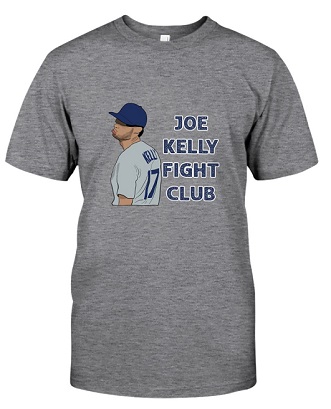
While such “Joe Kelly Fight Club” T-shirts became popular instantly, MLB and the players union finally agreed to let the commissioner hammer electronic cheaters. But are there catches?

Well, what do you know. Joe Kelly’s Tuesday night messages to Alex Bregman and Carlos Correa may have proven more than just worth an eight-game suspension (being appealed) and his canonisation as a saint in Los Angeles and elsewhere.

They have gotten both MLB’s dubious commissioner and the Major League Baseball Players Association on board with punishing future Astrogaters and Soxgaters. If they’re caught taking or transmitting such electronically-pilfered intelligence, they can be suspended without pay and lose the days of those suspensions in service time.

The news comes from one of the most unimpeachable sources—Evan Drellich, one of two writers for The Athletic (Ken Rosenthal was his teammate on it) to whom former Houston Astros pitcher Mike Fiers, an Oakland Athletic since August 2018 (after a stop in Detroit), blew the whistle on the Astro Intelligence Agency in the first place.

“MLB’s rules on the use of electronics and video grew significantly in the wake of penalties for the Astros and [Boston] Red Sox, according to a review of the document by The Athletic and conversations with officials familiar with it,” Drellich writes in an article published Thursday morning.

The league has newly hired an outside security firm to police the video replay room entrance and no later than next year plans to edit out the signs from the footage players look at in-game.

But no alteration may be as significant as the league’s ability to discipline. Commissioner Rob Manfred has the hammer, although the union can always appeal his decisions.

. . . Kelly was said by some to be delivering the justice to Astros players that MLB did not.

Whether MLB could have effectively administered that justice previously is a complicated question.

Technically, Manfred could have attempted to suspend Astros players had he not granted them immunity during his office’s investigations. But the punishments might not have stood up to expected grievances from the MLBPA because the league and union never before agreed how these specific issues would be handled. In fact, Manfred had declared in 2017, well before the Astros and Red Sox investigations, that he would hold club officials, not players, accountable for sign stealing.

No one condoned throwing at a batter’s head, as Kelly appeared to do when he threw such a pitch to walk Bregman with one out in the bottom of the sixth Tuesday, when they knew without being told that Kelly did only what it seemed at least half of major league baseball’s players—knowing how un-contrite both the Asterisks and the Rogue Sox seemed in spring training after the verdicts—thought was going to be done this season.

(It didn’t exactly take forever for a rash of T-shirts celebrating Kelly’s knockdown of Bregman and subsequent breaking-ball dustings of Carlos Correa, not to mention protesting his suspension, to go on sale online. “Free Joe Kelly” and “Joe Kelly Fight Club,” with or without Kelly’s image answering Correa’s huffing with a mock-crybaby face, seem the most popular.)

Until the coronavirus world tour knocked baseball as inside out as the rest of the world, Astrogate especially and Soxgate concurrently were the number one topic and scandal around the game. At times it was tough to determine which was more scandalous, the AIA and the Red Sox replay room reconnaissance ring, or Manfred having given players immunity instead of using his office’s powers to order them, “Spill, or be spilled.”

Not only did Chicago Cubs third baseman Kris Bryant say this was worse than the prior scandals around actual or alleged performance-enhancing substances, Dodger pitcher Alex Wood said, “I would rather face a player that was taking steroids than face a player that knew every pitch that was coming.”

Wood faced such players in the 2017 World Series. He had the lowest ERA (1.17) of any Dodger pitcher who pitched five or more innings in the set. He started Game Four in Minute Maid Park and surrendered George Springer’s two-out solo home run to break a scoreless tie and end his evening; he relieved Kenley Jansen for the Game Seven eighth and retired the side in order in Dodger Stadium.

Because the AIA’s apparatus involved either installing an additional and illegal real-time camera in Minute Maid Park, or taking an already-installed camera off the mandatory eight-second transmission delay, the 2017-18 Asterisks couldn’t run their sign-stealing scheme on the road. (In due course, it developed that Asterisk administrators tried but likely failed to urge scouts on the road to steal signs from the stands with cameras or field glasses.)

The 2018 Rogue Sox could operate their replay room reconnaissance ring in Fenway Park and elsewhere, anywhere, because it didn’t depend on altered or extra equipment. Basically, MLB handed them the keys to the candy store. Who knows how many other teams did as the Rogue Sox did, posting someone to decipher enemy pitch signs and signal them to a baserunner who’d then signal them to the hitter.

Remember: Sign-stealing on the field is as old a brand of gamesmanship as baseball itself. That’s why nobody went more than boo when New York Yankees right fielder Aaron Judge was recently seen as a runner on second looking as though sending a stolen sign to the hitter.

The 1951 New York Giants posted a coach in the clubhouse/offices above center field in the ancient Polo Grounds to steal signs telescopically and relay them to the bullpen from where signs were sent to hitters who wanted them. (The Giants stole the pennant! The Giants stole the pennant!) The verdict on their spectacular pennant race comeback forcing that fabled pennant playoff was left to history, alas.

The Red Sox married classic gamesmanship to off-field assistance handed to them (and anyone else who might have done likewise) in a gift-wrapped box. They didn’t install an extra camera and monitor in the room so far as is known. The new protocols now include prohibiting video room operators from communicating with players, coaches, and managers; and, outside security hired by MLB to guard the rooms, one guard for now and perhaps two after the coronavirus restrictions can be lifted.

Was Kelly punished too harshly for doing only what everyone with the proverbial two brain cells to rub together knew was likely to happen sooner or later, especially when the delayed season’s schedule included the surprise of the Astros facing the Dodgers in two sets? Another Athletic writer thinks so.

“When Manfred declined to punish the Astros, whether you agree with retaliation or not, he all but ensured opposing players would take matters into their own hands,” writes Molly Knight.

The Astros escaped their first series of this pandemic-shortened season against the Mariners without incident. But did anyone really expect none of the Dodgers to seek revenge?

MLB confirmed the Astros cheated their way through the 2017 World Series, and it still took them seven games to beat the Dodgers. It was as close as Los Angeles has come to winning it all since 1988. The scars from that series three years ago are still fresh for Dodgers fans, no matter how often Astros fans tell them to get over it. It’s hard to see how Astros fans would be over it if the trash can had been banged by the other team.

Considering that Kelly has a history as an erratic pitcher who rarely lets an actual or perceived offense go unanswered, it practically figured that he’d be the Dodgers’ version of the Green Hornet, flirting with crime to take down the grand theft felons. But keep in mind, too, that an eight-game drydock in a sixty-game season equals a 22-game suspension for a full 162-game season.

“Manfred may have thought he was sending a message about vigilante justice by giving Kelly an eight-game ban,” Knight writes. “But all he did was draw attention back to the absurdity that Astros players cheated to win a World Series and justice wasn’t served.”

Now Commissioner Nero has a hammer to swing on the high-tech off-field-based cheaters. Even if he catches another such intelligence/reconnaissance operation in the act—or another Fiers blows the whistle—and swing, and the Players Association files grievances on behalf of the hammered. He’d still send the message loud and strong that any more AIAs or Rogue Sox Reconnaissance Rings are verboten.

The question is whether he really will. And, whether the hammer will be a mallet or a marshmallow.


Let’s talk professional, shall we?

2020-07-29 JoeKellyCarlosCorrea

Taunting Carlos Correa back was one thing. But s ending Astrogate messages?

Lance McCullers, Houston Astros pitcher, is distinctly unamused that Joe Kelly, Los Angeles Dodgers pitcher, walked Astros third baseman Alex Bregman on 3-0 with a pitch up, in, toward Bregman’s head, but flying past his shoulders as he ducked Tuesday night. Most of the Astros weren’t amused, of course. But McCullers goes further.

Kelly threw behind Bregman “on purpose,” USA Today‘s Bob Nightengale quotes McCullers. “Not only did he take it upon himself to send a message, but he wasn’t even a part of that team. We knew coming into the game he likes to go off script. What he did was unprofessional.”

Notice that McCullers didn’t say Kelly’s subsequent double-dusting of Astros first baseman Carlos Correa on breaking balls before striking Correa out to end the bottom of the sixth lacked professionalism. But notice, too, what McCullers forgets.

We’re not necessarily condoning fastballs to or toward the cranium when we remind McCullers—and any other Astro who forgets—that Kelly might not have been a 2017 Dodger, but he was a 2017 Red Sox pitcher. And the Red Sox lost that year’s American League division series to the Astros in four games, the only Red Sox win a 10-3 blowout for which Kelly, ironically, received pitching credit.

Kelly the 2017 Red Sox surely had as much right to fume over the subsequent Astrogate revelations as the Dodgers who lost the 2017 World Series had, considering the Manfred Report suggested very powerfully that the Astro Intelligence Agency—illegally-installed extra center field camera sending stolen pitch signs to a clubhouse monitor, where their translator banged the can slowly to send them to Astro hitters—didn’t go out of business for that postseason.

The fact that Kelly has worn a Dodger uniform since 2019 would normally be irrelevant. But the Dodgers were one of numerous teams whose players sniped over Astro players getting away with Astrogate murder, thanks to Manfred foolishly giving them immunity to spill instead of using his office’s powers to tell them spill or be spilled.

Many of those sniping players suggested strongly enough that there should be and likely would be justice administered on the season, whenever the season might have gotten underway since the coronavirus pandemic shuttered spring training and sent the Show into an untoward battle over when to start something resembling a regular season.

If any team had reason to want Astro heads on plates, the Dodgers did. “They may be playing baseball in the middle of a world-wide pandemic, where social distancing is strongly encouraged and breathing on one another is prohibited,” Nightengale writes. “But sorry, it wasn’t about to stop three years of built-up anger and rage.”

“You going to throw at somebody,” fumed Astros manager Dusty Baker, who has enough on his hands trying to steer his charges through and past the iceberg-heavy waters of Astrogate’s aftermath, “you don’t throw at a guy’s head. That’s dirty baseball. Now you’re flirting with ending his career.”

Baker’s 2017 ended when his Washington Nationals imploded in Game Five of their own division series against the Chicago Cubs. So did his tenure managing that team. Surely he wasn’t so isolated since as to miss the truth and depth of Astrogate. If throwing at a dome is dirty ball, what does Baker call illegal electronic off-field-based sign-stealing? Clean ball?

After Bregman’s walk, Astros outfielder Michael Brantley forced him at second base. Somewhat emphatically, Brantley stepped on Kelly’s foot as Kelly covered first base on the play. Kelly lingered near the base a few moments and someone in the empty-but-for-cutouts Minute Maid Park was heard hollering something along the line of, “Get the [fornicate] back to the mound,” unless it was, “Get back to the [fornicating] mound.”

Someone asked Baker if Kelly’s subsequent dustings of Correa equaled payback for those utterances. “No,” the manager said sharply enough, “don’t give him an excuse. I’m not going to give him an excuse because we didn’t say anything. My guys didn’t do nothing, OK?” Eight of Baker’s guys now were also 2017 Astros. (For the record, ten Dodgers today were 2017 Dodgers, too.) They certainly didn’t do nothing that year and at least part of 2018.

Nothing actually got done about it, despite others around the league the next two seasons putting bugs (if you’ll pardon the expression) into the ears of reporters reluctant to press editors to run with stories for which those people refused to go on the public record. Not until Mike Fiers—pitcher, 2017 Astro turned Detroit Tiger turned Oakland Athletic—got fed up at last and blew the whistle last November.

Someone on Kelly’s Red Sox was caught red-handed during that regular season using an AppleWatch to try stealing New York Yankees signs, while the Yankees were caught with an extra and unlawful dugout phone presumed to have been a sign-stealing aid. Commissioner Rob Manfred slapped them on the wrists and handed down a near-toothless directive saying, basically, if you guys do that again we’re going to be . . . very, very angry at you.

The Red Sox Replay Room Reconnaissance Ring, also exposed and harrumphed by Manfred in Astrogate’s immediate wake, didn’t go into business until 2017 Astros bench coach/AIA co-mastermind Alex Cora became the 2018-19 Red Sox’s manager. They pushed the Astros aside in the 2018 American League Championship Series and beat the Dodgers in the World Series.

Those who still demand to know why the Rogue Sox don’t draw even half the fury the Asterisks have, the answer is simple enough: replay room video equipment is already there, at home and on the road. With a plan dependent entirely on having men on base to transmit the de-coded, pilfered intelligence to their hitters, the Rogue Sox didn’t have to think about installing an extralegal camera transmitting to an isolated closed-circuit television network.

The replay room wasn’t exactly designed to nourish team intelligence agencies, of course. But the Rogue Sox at least honoured the spirit if not the legal letter of gamesmanship. Baseball’s government could be considered to have handed them the keys to the cookie jar, which compares admittedly to giving teenagers the keys to the hooch hutch. It didn’t exactly give the Asterisks any opening to cross the line from mere gamesmanship to illegally-equipped underground espionage.

When Dodger players sniped with particular harshness among the players around the league in spring, demanding Astro justice, Kelly wasn’t one of them. He didn’t say, “Everybody knows they stole the [World Series] ring from us.” Cody Bellinger did. He didn’t say, “It’s pretty evident to me that it wasn’t earned, and it’s not something that a banner should be hung at their stadium, a trophy should be put up.” Justin Turner did.

When the Astros greeted spring training with those distinctly unapologetic apologies for the AIA, Bregman and Correa were thought to have been two of the more vocal such unapologetics. If Kelly didn’t keep that in the back of his mind, it might be almost as shocking as the pandemic-provoked, health-and-safety-seeded regional schedule that matched the Dodgers and the Astros early enough this truncated season.

“There is a lot of tension between the Dodgers and Astros, mainly because the Astros won the 2017 World Series, beating the Dodgers in seven games, and the Dodgers haven’t won a World Series since the Reagan administration,” writes Houston Chronicle columnist Jerome Solomon, who thinks the “cult” fuming over Astrogate is almost exclusively Los Angeles-based.

Wrong, Mr. Solomon. Astrogate outrage didn’t and doesn’t remain confined to the greater Los Angeles area. A lot wider community of baseball fans across the country was outraged that a genuinely great team needed an in-house illegal intelligence agency to abet them when their own mass of talent and skill should have been more than enough.

Mr. Solomon would do better asking the Astros why they were so apologetically unapologetic when questioned in spring, instead of dismissing the national fury as Los Angeles’s alone. And, asking McCullers and Baker why throwing at or near a head isn’t professional but illegal electronic sign-stealing is.

Manfred’s government gave the cheaters immunity but dropped the hammer on Kelly Wednesday with an eight-game suspension for throwing at Bregman and taunting Correa, never mind that Correa taunted Kelly first after the pitcher left the mound for the dugout. Kelly’s appealing the suspension; Dodgers manager Dave Roberts will serve a single-game suspension tonight. Because the benches cleared, Baker was fined.

With the health and safety protocols mandating nobody in the stands other than cardboard cutouts of man, woman, and sometimes even beast, the coronavirus inadvertently gave the Astros a phenomenal break from the crowds who otherwise might have greeted them on the professional road with lusty booing, hissing, howling, and even their own trash can bangings.

The pandemic also gave the Astros a break when the benches cleared after Kelly’s and Correa’s mutual assured schoolyard spewing as Kelly approached the third base line returning to the Dodger dugout. Though, I repeat, it might have been mad fun to watch them obey social distancing guidelines and have a pantomime brawl.

It may seem between silly and frivolous that boys will be boys even playing baseball in the time of coronavirus. But there’s still something reassuring in at least one team and possibly more to come not forgetting the AIA, the damage it did baseball itself, and the seeming indifference of the Astros themselves to the ramifications even after Manfred’s marshmallow hammer dropped.

If they don’t hand Kelly the keys to Los Angeles, they might at least be tempted to name a candy bar after him. We’ve had Mounds, Snickers, Crunch, and Krackel. Maybe they could create the Hey, Joe!

Astrogate messages at last?

2020-07-28 JoeKellyCarlosCorrea

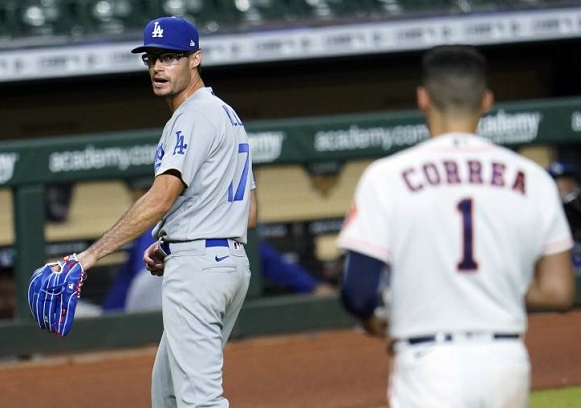
Joe Kelly (left) jawing with Carlos Correa, whom he brushed back twice in the same plate appearance Tuesday night. Should the Astros be shocked that somebody sent them post-Astrogate messages at last?

It’s not that you didn’t expect it to happen, but no matter how you feel about the Houston Astros and their extralegal electronic cheating you merely hoped it might not happen. Even if Tuesday night was the first time the Astros and the Los Angeles Dodgers met since that now-tainted 2017 World Series.

They weren’t expected to meet again unless they might tangle in another World Series. Then, the coronavirus world tour happened. When the Show returned at last, the pandemic and its mandate for extraordinary health and safety protocols prompted its governors to sketch regional scheduling featuring the Dodgers and the Astros in Houston this week, in Los Angeles come September.

You might think things are tough enough playing coronaball (reference, especially, the afflicted and drydocked-for-now Miami Marlnis) without the Dodgers having to face the team now believed to have cheated their way to that World Series title.

You might think things were tough enough without other Astro opponents still thinking in the backs of their minds that the Astros need to be taught a few little lessons in manners and in accepting responsibility in the sometimes-forgotten Astrogate wake.

You might have thought so until Joe Kelly relieved fellow Dodger reliever Brustar Graterol for the bottom of the sixth in Minute Maid Park Tuesday night.

With one out, Kelly had Houston third baseman Alex Bregman 3-0 when he decided ball four should be a fastball sailing up and past Bregman’s shoulders. The next batter, outfielder Michael Brantley, forced Bregman at second on a ground ball but made a point of stepping on Kelly’s foot as the pitcher covered first base on the play.

Kelly lingered just a little bit near the base after Brantley’s step-on and a voice was heard in the empty ballpark. It may or may not have been Astros manager Dusty Baker, but it hollered, “Get back on the mound, [maternal fornicator].” Kelly did return and go back to work.

Known to be erratic at times, and un-allergic to brushback pitches when he thinks they’re mandated, Kelly walked Astros first baseman Yuli Gurriel on four straight pitches, then opened to Astros shortstop Carlos Correa with a breaking ball behind Correa’s head and all the way to the backstop.

Officially, of course, it was ruled a wild pitch. Unofficially, even the cardboard cutouts in the otherwise empty stands knew good and bloody well that Kelly wanted to remind the Astros once again that it wasn’t nice to set up a furtive closed-circuit, off-field-based television network for stealing opposing pitch signs and think they could get away with it.

Commissioner Rob Manfred helped them think they could get away with it. Foolishly or otherwise, Manfred handed all Astro players immunity from discipline in return for spilling about the Astro Intelligence Agency after former Astro/current Oakland Athletics pitcher Mike Fiers finally blew the whistle on the AIA to The Athletic‘s Ken Rosenthal and Evan Drellich last November.

The AIA cost three managers (the Astros’ A.J. Hinch and two 2017 Astros-turned managers, Alex Cora in Boston, Carlos Beltran in New York, before he had a chance to manager even one Mets game) and one general manager (the Astros’ Jeff Luhnow) their jobs. (Any thought of Hinch possibly returning for 2021 was vapourised when the Astros exercised Baker’s 2021 club option.)

Astros owner Jim Crane was asked for no accountability beyond being fined for what amounts to maybe a year’s worth of tip money for him. Called upon to stand when spring training opened, Crane and assorted Astros players weren’t exactly apologetic for the AIA’s operations. Numerous opposing players fumed that, one way or the other, they’d find ways to administer justice, and no official edict was going to stop them.

2020-07-29 AlexBregman

“That’s dirty baseball,” Astros manager Dusty Baker fumed over this pitch to Alex Bregman from Joe Kelly. Would Baker call the Astros’ electronic sign-stealing  good clean baseball?

After Kelly struck Correa out swinging for the side, with a couple of more inside pitches in the mix, Correa was distinctly and, apparently, vocally unamused as Kelly walked off the mound and crossed the third base line to his dugout. Prompting Kelly to shoot a couple of mock crybaby faces and choice words Correa’s way.

That may have been the specific flash point under which both benches emptied and milled around the plate area. They forgot some of the social distance protocols, meaning a fine or three might be forthcoming. The dispute was bark, no bite, unless the Astros and the Dodgers were willing to dissipate the tension with some six-feet-apart pantomime boxing, but neither side was in the mood for comedy.

Baker was quoted by USA Today‘s Bob Nightengale thus: “What really enraged everybody was what he told Carlos when he struck him out, ‘Nice swing bitch!”’ Not nice. Send the message, sure. Taunt them no matter what they did or didn’t jaw your way, not so fast. Naturally, one of the Twitterpated couldn’t resist defending Kelly’s taunts thus: “Should have said something along the lines of ‘hard to hit when you don’t know what’s coming’.”

The warnings were handed to both sides after the second Correa duster. Perhaps naturally, Kelly said of the Bregman shoulder kisser, post-game, “It was a ball, obviously. It wasn’t my best pitch. Ball four, I walked him, never good to put a guy on when you’re leading the game.”

Of the breakers bending Correa, he said, “I guess he didn’t take too kind to a curve ball [inside]. It is what it is. I finally made one good pitch for the punchout . . . I pitch competitively, but with the no fans here it’s easy to hear some stuff.”

You stick to that story, son.

Some observers seemed to think, too, that the Astros were more infuriated by the buzzer  off Bregman’s shoulders than the two breakers dusting the otherwise non-entertained Correa. For his own part, Bregman merely shrugged it off when Kelly’s heat ricocheted off his shoulders and took his base. Almost as if he was well enough prepared for the incoming messages Tuesday and yet to come.

“The history obviously is out there,” said outfielder Joc Pederson before the series began. “Everybody knows what’s at stake and what happened. For being no fans, maybe sometimes the energy could be lacking a little bit. I don’t think that will be the case for this series.”

That doesn’t necessarily mean Pederson urged or condoned any message from any Dodger pitcher to any Astro hitter. Nor does it mean the Astros went into the game expecting nothing more than balls, strikes, hits, and outs, considering the jawing between the two teams before spring training was cut off at the coronavirus pass.

Recall: Dodger center fielder Cody Bellinger saying the Astros cheated for longer than affirmed and that their second baseman Jose Altuve stole the 2017 American League Most Valuable Player award from New York Yankees right fielder Aaron Judge. Recall, too: Correa rejoining that Bellinger thus spoke recklessly.

Just don’t kid yourselves that the Astros forgot for even a moment that a brushback or a knockdown was liable to come from any arm, at any time, in any game, no matter how much it seemed the pandemic pushed the long toxins of Astrogate to one side.

Until Tuesday night, only Gurriel and Correa were hit by pitches, both in the second game of the truncated season, at home against the Seattle Mariners. Until Kelly decided to lay down the law, however, all anyone thinking clearly probably thought was that the Astros were so thoroughly roasted in the immediate public Astrogate wake that throwing brushback or knockdown pitches would be as foolish as it would be unnecessary.

Like the Rogue Sox and their 2018 Replay Room Reconnaissance Ring, the Astro Intelligence Agency wear the stain of their extralegal cheating all season long, however long the season, whenever the season began. There but for the lack of grace of the coronavirus would fans and commentators alike remind both teams, good and strong, that crossing the proper gamesmanship line is filthy pool.

Only three Rogue Sox have been plunked on the truncated season thus far. But don’t fool yourself that they’re immune to thoughts that a little extra payback might be coming, too. It may not be quite as pronounced as any the Asterisks face, since they merely used what was available, predicated it with a man on base to transmit the pilfered intelligence, and didn’t install an illegal camera to begin their dirty work.

Baker himself seemed more enraged at the Kelly bullet that almost grazed the back of Bregman’s shoulders. “You don’t throw at a guy’s head,” the manager said. “That’s playing dirty baseball.” Baker’s in the unenviable position of having to help his team past the  Astrogate mess he wasn’t part or parcel of, but what would he call the AIA—good clean baseball?

Kelly wasn’t a Dodger when the AIA’s espionage operated. But he was one of the 2017 Red Sox downed by the Astros in the American League division series and the 2018 Red Sox who beat the Astros in that ALCS. You bear in mind that neither Astro nor Red Sox pitchers were co-operators of those teams’ Spy vs. Spy operations.

Kelly was also the hapless Dodger who served the pitch Washington Nationals second baseman Howie Kendrick destroyed for a tie-breaking, Dodger-burying, National League division series-winning grand slam in the Game Five top of the tenth. The last thing he needed even in abbreviated spring training was his Dodgers and the Astros getting into an Astrogate-inspired jawing contest.

Otherwise, Kelly was a pitcher in need of some kind of redemption, any kind of redemption in the eyes of Dodger fans in Los Angeles and elsewhere. The taunts were more than a little out of line. Perhaps Kelly didn’t need to send more than one brushback Correa’s way, but those weren’t half as juvenile. Well, boys will be boys, even in a time of pandemic.

Still, somewhere in that fan base they’ll remember the Dodgers beat the Astros, 5-2, to open this series, but it’ll be a by-the-way remembrance. One that has to be rushed into the conversations, swiftly, amidst the hot take that Kelly made himself something nobody in Los Angeles thought he’d become to Dodger fans after last October. A hero.

Commissioner Nero fiddles while MLB burns

2020-07-28 MarlinsPark

Marlins Park, which won’t host the Marlins vs. the Baltimore Orioles for a second day in a row after the Fish were flogged with COVID-19.

A month and a half ago, I wrote that Major League Baseball commissioner Rob Manfred had to go. The grounds already were several. Now, you can add that Manfred won’t even think about closing the Show for the season unless the coronavirus infects enough players on a team to rule it out of competitiveness.

Just when you thought you’d seen and heard everything from Manfred, the spectre of several Miami Marlins COVID-19 positive, of the Philadelphia Phillies’ clubhouses infected, and of games cancelled over positive tests, prompted this commissioner to put the competition ahead of health and safety.

MLB Network interviewer Tom Verducci, who normally writes for Sports Illustrated, asked Manfred just what it would take to close the Show, whose early performances have already run the gamut from farce to foolery and back under several Manfred-pushed rules experiments.

Those weren’t what the interviewer addressed, though. The issue was COVID-19 outbreaks among one team at minimum. Forget dropping the ball. Manfred threw it from the mound over the outfield wall. It only began with the commissioner saying the Marlins’ outbreak wasn’t “a nightmare,” before four more Marlins tested positive, raising the total number to seventeen—fifteen of whom are players.

“A team losing a number of players, making it completely noncompetitive, would be something we would have to address and have to think about making a change,” he said. “Our first concern is the health of the players and their families. And making sure we do everything possible to minimize the spread of the virus to our employees.”

Do you really need me to suggest that Manfred spoke out of both sides of his mouth while making clear enough that a team rendered futile on the field took even a slight priority over that “first concern” about player health and that of their families?

The Marlins outbreak, which may or may not have been seeded in Miami, prompted the Phillies to test en masse on Monday, while the same day’s scheduled Marlins home opener against the Baltimore Orioles was cancelled, as was the Phillies’ scheduled game against the New York Yankees. Tuesday morning came word that the tested Phillies tested negative. Their Tuesday game against the Yankees is postponed anyway. So is the second scheduled game between the Marlins and the Orioles.

Four of the Marlins’ infected were pulled away before the Sunday game against the Phillies, including scheduled starting pitcher Jose Urena. Manfred could and should have stepped in to cancel it if the Marlins’ administration didn’t. He didn’t, either. Indeed, that the game got played not after a call from competent medical and health observation but in a group text-message vote.

Last Friday, around the time the Fish began to flail, and two Atlanta Braves catchers were sent home showing symptoms but testing COVID-19 negative, Thomas Boswell fumed over the sense that Manfred already put the coffers of his bosses, the owners, ahead of the good of the game with his gimmicks such as a sixteen-team postseason, a free man on second to open each extra half-inning, and a three-batter minimum for relief pitchers.

Concurrently, though, Boswell hammered Manfred’s apparent lacking when it comes to his sport’s taking the pestiferous pandemic seriously enough to be the adult in the room when need be.

“You don’t measure disaster for a country — with refrigerator trucks lined up with corpses — the same way you measure it for a pro sport,” he wrote. “But how do you measure it for a sport? I don’t know . . . League bosses, who are not at risk, and athletes, who think they are invulnerable, are both going to be tempted — to keep playing chicken with the virus until it makes them stop.

“As most of the world already knows, by then it is usually disastrously too late.”

Manfred chose the media platform MLB itself owns to say he’d close the Show first and foremost if any team loses enough players to leave it non-competitive. (Resist the temptation to remind him of a pre-existing condition, Marlins fans.) He put that ahead of “our first concern” of the health and safety of players, their loved ones, and other MLB team employees.

A certain American president of dubious repute is often seen and even heard believing the coronavirus world tour has been nothing more (and nothing less) than a plot cooked up somewhere, anywhere, to thwart his re-election campaign. Now a baseball commissioner of dubious repute can be seen as possibly believing the pandemic has been a plot cooked up to keep the owners from making money.

Dave Martinez, the manager of the defending world champion Washington Nationals, looked upon the Marlins outbreak and shivered. “I’m going to be honest with you, I’m scared. I really am,” Martinez told Washington’s ABC news affiliate.

I go from here, home, back here every day, that’s all I do. I wash my hands, I went from 47 times a day to probably 99 times a day. Wear my mask everywhere I go. But there’s always that concern, you know. You don’t know, because of my heart condition, what happens to me if I do get it. I have to be extra careful. With that said, sometimes I tend to put myself aside and worry about other people more than me. I think that’s why I’m here, because I worry about those guys before I put myself first.

Martinez’s Nats were scheduled to travel to Miami to play the Marlins this coming weekend. “He says the players are his family, and he’s already lost a lot of sleep this month,” tweeted the Washington Post‘s Nats beat writer, Jesse Dougherty. “When asked about whether he has doubts about going to MIA this weekend: “Hopefully they make the right decision. That’s all I’m going to say.”

And, from among the players who opted out of playing this season over the pandemic, Los Angeles Dodgers pitcher David Price is probably more secure in believing he did the right thing. Especially considering baseball’s health and safety protocols have had issues and hiccups tracing back to the beginning of that delayed spring training called “summer camp.”

Now we REALLY get to see if MLB is going to put players health first,” the lefthander tweeted after the Marlins news exploded Monday. “Remember when Manfred said players health was PARAMOUNT?! Part of the reason I’m at home right now is because players health wasn’t being put first. I can see that hasn’t changed.”

That and more is what the commissioner says isn’t “a nightmare.”

Manfred and only too many within and without MLB thought any COVID-19 hits would strike maybe one, two, three players or MLB employees in just a sixty-game season. “Time to blow up that assumption,” Boswell wrote this morning.

If half of the Marlins team can test positive within a few days, then the scale of danger to health — the number of people who may get sick and the severity of the damage they may suffer, including prime-of-life pro athletes — just shot through the ceiling.

Our assumptions, while well-intentioned, have been blown to pieces. And in short order, so will the season of one, or perhaps several, of our sports.

So has been Manfred’s reputation, what’s left of it. The commissioner showed what kind of leader he was operationally, factually, and even morally before the coronavirus went on world tour. It wasn’t a great showing.

He’s never been able to bring himself to address complete umpire accountability. He slapped the Yankees and the Boston Red Sox on the wrists over illegal dugout phone and AppleWatch sign-stealing cheating in 2017 and handed down a nebulous directive rather than demand an immediate rule book change and clarification.

He let Red Sox and Houston Astros players walk in return for information rather than bring the powers of his office to bear on them over their off-field-based, illegal sign-stealing cheatings. He suspended two managers for this year (Carlos Beltran, a 2017 Astros player, was forced out of managing the New York Mets before he managed even a spring training game for them) but never even thought of holding the teams’ ownerships to real account.

The cheating players skated, their owners paid what amounted to tip money (for them) in fines, their fan bases were forced (sometimes kicking and screaming) to come to terms with chicanery that compromised each’s recent World Series titles, and Manfred dismissed the World Series championship trophy—which many thought should be stripped from both the Astros (2017) and the Red Sox (2018)—as just a hunk of metal.

He never quite suggested he might be interested in investigating whether the Astros and the Red Sox might be right in suggesting they weren’t exactly the only ones willing to flout rules against off-field-based electronic sign-stealing, either.

Nor did he demand the Yankees explain why they’re so desperate to challenge a judge’s ruling that a disciplinary letter over their 2017 sign-stealing cheating be made public, either, or said anything else about the letter itself. “[I]f the infractions cited by Manfred [in the letter] were as minor as originally claimed,” asked Beyond the Box Score writer Sheryl Ring in mid-June, “why are the Yankees so reticent to turn the letter over?”

Don’t forget Manfred’s push on behalf of his bosses, the un-impoverished owners, to try reneging on that March agreement and gaming the players out of their full pro-rated 2020 salaries if and when the season got underway.

Now that COVID-19 has taken out about half the Marlins’ playing team, Manfred is slightly more concerned for teams’ competitive ability—which can also be viewed as making money for the owners—than their health?

Here’s something on which the owners and the players might unite if put to them properly. Manfred’s successor, and every commissioner to follow, should be anyone except another owner, his hand-picked successor, or other baseball official. The successors should also be elected by representatives of all ownerships and by the players through their team player reps.

But I’m convinced even more that Manfred must go. Commissioner Nero’s been fiddling while MLB and the country that loves it burn. His music is cacophonous.