Tempered joy in Metsville

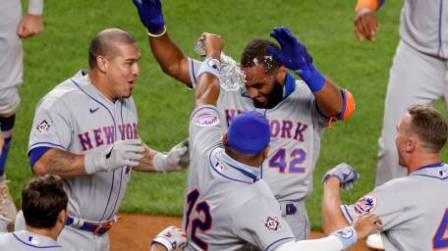
Amed Rosario (arms up) gets a hero’s welcome after his walkoff bomb finishes a doubleheader sweep of the Yankees Friday night. Crowning a pair of surreal days for these surreal Mets.

When hedge fund titan Steve Cohen first emerged as a potential buyer of the New York Mets, I had a little mad fun with that news because we have a couple of things in common. Not financially, of course; Cohen can hand out in tips about a million times what I’ll ever be required to pay in taxes. But we have our mutual grounds regardless.

We’re both Long Island boys who’ve been Met fans since the day they were born. We both made our baseball bones on the original troupe about which it’s fair to say they were baseball’s anticipation of Monty Python’s Flying Circus. We both grew up or (in my case) finished growing up (har har) in Long Island towns with pronounced Mob connections.

Cohen grew up in Great Neck, where there lives the opulent wedding/bar-mitzvah factory emporium (Leonard’s) at which Johnny Sack asked Tony Soprano to perform a hit, a request made just before Sack was carted back to prison from his daughter’s wedding. Bronx native though I am, I finished growing up (snort) in Long Beach, also the home of Don Vito Corleone in The Godfather.

Sorry, Mr. Cohen. My mob family’s Oscars can blow up your mob family’s Emmys.

But it looks at last as though Cohen will graduate from an eight percent stake to controlling ownership of the Mets, more or less as the last man standing. So that gives him more than one up, since the only piece of the Mets I own and can afford is a game hat.

Celebrity would-be buyers Alex Rodriguez, a former Yankee who actually grew up loving and hoping to play for the Mets one day (he actually had his chance, which either he or his then-agent blew like a ninth-inning Met lead), and his paramour Jennifer Lopez, pulled out of the bidding Friday. That may have been the first heavy sigh of relief from Met fans on the day.

Apparently, not even J-Rod could come up with quite the money needed to buy the Mets, whose incumbent Wilpon ownership has long enough been a two-man implosion machine. The J-Rod group would also have included one NFL owner (the Florida Panthers’ Vincent Viola), a BodyArmour founder (Michael Repole), and a WalMart e-Commerce U.S. wheel. (Chief executive officer Marc Lore.)

J-Rod said farwell to the bidding by observing they “submitted a fully funded offer at a record price for the team which was supported by binding debt commitments from JP Morgan and equity commitment letters from creditworthy partners.” The Athletic‘s Daniel Kaplan observes red flags:

[N]otable in the statement is a reference to debt and equity commitment letters from creditworthy partners. On the latter, equity commitment letters are different from money in the bank, and adding a lot of debt to a team that loses around $50 million per year, pre-COVID-19, is not a recipe upon which MLB may have looked fondly.

MLB isn’t “too keen on another [Derek] Jeter/Marlins where they had to scrape their last nickel to pay the purchase price,” a source close to MLB told The Athletic earlier this month, referring to the debt-heavy Marlins. “Especially for a major-market club that already has such large operating losses. Cohen’s checkbook is even more valuable in a COVID and post-COVID environment.”

Not that Kaplan missed red flags flying around Cohen himself, of course. Cohen’s former SAC Capital outfit copped to insider-trading charges and coughed up a record fine of $1.8 billion. Cohen himself wasn’t accused of wrongdoing, but in 2016 he had to agree to the Securities and Exchange Commission’s demand that he not manage the monies of outside investors for 24 months.

Just as problematic may be sex discrimination claims filed in Connecticut against Cohen’s Point72 Asset Management, which I noted myself during the week. Those don’t charge Cohen personally, but one filed in 2018 does, Kaplan writes, though he adds that later in 2018 “the parties voluntarily agreed to terminate the case and submit the case to arbitration, according to court filings.”

Buying an eight percent take in a major league franchise won’t place you under the proverbial microscope, but looking to become the controlling partner will. Baseball’s 23 other major league ownerships have to be edgy about welcoming to their often-dubious ranks a man whose history includes battles over financial crime and sex discrimination charges.

Fred Wilpon and his son, Jeff, haven’t been anywhere near such suspicions so far as anyone knows. They’ve been seen mostly as having been more dumb than dishonest regarding the Bernie Madoff scandal, in which they invested and took an extremely expensive bath. The same could be said for most of Madoff’s investors. But the fallout eventually amplified the Wilpons’ wounding flaws.

Their naivete about Madoff helped them leverage to make the notorious Bobby Bonilla deferred-compensation contract, compel them to pay a reported $29 million into the fund marked for compensating other Madoff victims, and force them “to borrow hundreds of millions more to cover debts they had made against their Madoff assets, [having] almost a major-league payroll’s worth of money due every year just in interest on those debts.”

In baseball terms, the Wilpons weren’t exactly geniuses, either. Before they bought out their original co-owner Nelson Doubleday, they tried to thwart a deal Doubleday wanted to make in the worst way possible. Lucky for them that wiser minds prevailed. That’s two wild cards, one pennant, and one World Series appearance—not to mention the post-9/11 shot heard ’round the world and a Mets hat atop his head—underwriting Mike Piazza’s Cooperstown plaque.

For every Piazza, Carlos Beltran, Carlos Delgado, Johan Santana, and Billy Wagner deal, the Wilpons blocked exponential other solid signings and tradings their baseball brain trusts recommended or signed off on deals and trades about which “dubious” could be considered a compliment.

When Cohen first stepped into the Mets’ controlling partnership picture last winter, I remembered the Wilpons also doing once what some thought could never be done. They made George Steinbrenner himself, the man who threw out the first manager of the year during the 1980s, resemble the epitome of benevolence, with their despicable 2008 execution of manager Willie Randolph, his pitching coach Rick Peterson, and his first base coach Tom Nieto.

The guillotines dropped on the trio after the struggling Mets traveled all the way west from New York to play the Los Angeles Angels in an interleague set and won the first of the set. At three in the morning. It must have been enough to make Randolph, a longtime Yankee fixture at second base, nostalgic for The Boss’s Malice in Wonderland fun house.

Red flags or no red flags, the news that J-Rod dropped out of the Mets’ bidding does indicate the Mets dodging at least one bullet, if what I noted during the week is true and Rodriguez was taking informal counsel from disgraced former Houston Astros general manager Jeff Luhnow. Taking baseball administration counsel from Luhnow is like seeking family counseling from Ma Barker.

The news may also have had an effect on the Mets otherwise.

On Thursday, the night before J-Rod pulled out of the Mets’ running, the Mets’ front office botched almost completely a stirring protest gesture against rogue police and racism, when the Mets and the Marlins observed a moment of silence on field before walking off the field postponing their game.

But come Friday, as MLB commemorated its pandemic-delayed Jackie Robinson Day, and—tragically—the actor (Chadwick Boseman) who played Robinson so powerfully in 42 lost his battle against colon cancer the same day, the Mets swept a doubleheader from the Yankees in the Bronx.

The sweep finished when Amed Rosario, pinch hitting for starting Mets shortstop Luis Guillorme, caught hold of a hanging slider from Yankee closer Aroldis Chapman with pinch-runner Billy Hamilton aboard and sent it into the left field seats. A Mets team who entered the twin bill as the Show’s worst for hitting with men in scoring position (.199) went 5-for-12 in that situation Friday.

Come Monday is the reported deadline for new Mets ownership bids. Joy in Metsville about the end of the Wilpon era is probably tempered by their wish that a saviour with cleaner hands might enter at the eleventh hour. Such a saviour will need five king’s ransoms to out-bid the Long Island boy who once paid for a single painting what the Mets will have paid stud pitcher Jacob deGrom for the entire length of his current contract.

The Mets have been many things in their 58-year life. Dull isn’t necessarily one of them.
Ballplayers aren’t wild about qualified immunity, either

I am . . . a huge fan of getting rid of qualified immunity, and holding cops and everyone accountable, just like we hold ourselves.
—Lorenzo Cain.

Over two months ago, over 1,100 professional athletes and at least 300 front office workers in professional sports signed a letter from the Players Coalition. It expressed support for a Congressional bill to end qualified immunity for law enforcement personnel. No few incumbent and former baseball players signed the letter.

They only began with Tim Anderson, Chris Archer, Alex Bregman, Byron Buxton, Eric Davis, Jack Flaherty, Dexter Fowler, Jason Heyward, Jordan Hicks, Austin Jackson, CC Sabathia, Denard Span, and Giancarlo Stanton.

The Ending Qualified Immunity Act was introduced 4 June 2020 by Republican-turned-Libertarian Rep. Justin Amash of Michigan and Democratic Rep. Ayanna Pressley or Massachussetts. The Players Coalition letter appeared six days later. When Rep. Tom McClintock (R-California) signed on, the bill became the first tripartisan legislation in the history of Congress.

“[P]olice are legally, politically, and culturally insulated from consequences for violating the rights of the people whom they have sworn to serve,” Amash said after he and Pressley  introduced their bill. “That must change so that these incidents of brutality stop happening.”

Amash and Pressley wrote the bill specifically after George Floyd’s death at police hands, but it isn’t just non-white people who suffer or die at the hands of rogue police. It’s safe enough to presume that too many of those breaking entire cities over police atrocities care less about justice than about cover for their own destruction.

“Whatever his motive,” McClintock said announcing his co-sponsorship, “the killer of George Floyd had eighteen complaints for misconduct, and one of his accomplices had six. Why is such misconduct tolerated by big city police departments? Is it because the doctrine of qualified immunity shields corrupt officials from accountability for a wide range of crimes?”

Not long after that, the Supreme Court—which created qualified immunity in the first place in 1982—turned down seven cases in which it might have revisited the monster the Court itself created. Justice Clarence Thomas rejected that rejection. “There . . .  may be no justification,” he wrote in his dissent, “for a one-size-fits-all, subjective immunity based on good faith.”

Whether the end of qualified immunity would have prevented the Kenosha, Wisconsin police shooting of a suspect named Jacob Blake is your guess as well as mine. Rogue police have this much in common with the criminals they’re otherwise sworn to apprehend—they think the law doesn’t apply to them.

But absent qualified immunity at least the officer who pumped seven bullets into Blake’s back wouldn’t necessarily be protected from consequences above and beyond whatever a Kenosha police departmental investigation imposes upon him.

“[C]ivil society is impossible without a well‐​functioning criminal justice system,” wrote Clark Niely, vice president for criminal justice at the Cato Institute, a libertarian think tank, a month before the Amash-Pressley bill emerged, explaining why Cato took qualified immunity on as a specific analytical subject within a subject.

But in order to be well‐​functioning, it is not enough that a criminal justice system have the power to arrest, prosecute, and punish wrongdoers. The system must also be perceived by citizens as fundamentally legitimate and thus genuinely worthy of their confidence and support . . . [I]t is difficult to imagine anything more delegitimizing than a law‐​enforcement community that insists upon being held to a vastly lower standard of accountability than the one it imposes on ordinary citizens. But that, unfortunately, is precisely what we have. Even more tragically, it is an unforced error caused by a misbegotten blunder into judicial policymaking by the Supreme Court.

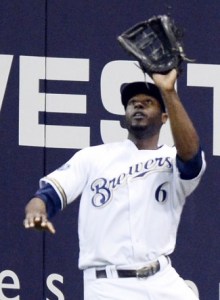
“The fact we’re talking about this in 2020, I don’t see the progress in that,” says Milwaukee Brewers outfielder Lorenzo Cain to The Athletic. “It’s almost like we’re going backwards. I think we’re going to be in the same situation until we start holding the people doing this accountable. Until that changes, it’s going to be tough for real change.”

Cain opted out of playing this season over the coronavirus world tour after the truncated season began but over safety concerns on road trips. He also prefers quiet protests like postponing baseball games over breaking the neighbourhood. “It’s burning buildings. It’s people out there shooting each other,” he tells The Athletic‘s Andy McCullough. It’s chaos. It’s bad.” And he’s not going to let rogue police off the hook, either.

I just feel like the change we need, as far as the top of our government, all the police forces out there, I just feel like deadly force shouldn’t be the first thing we go to. They’ve got Tasers and every other weapon on their tool belts. And deadly force is always the go-to.

That’s why I am such a huge fan of getting rid of qualified immunity, and holding cops and everyone accountable, just like we hold ourselves. That’s what I’m all about, getting rid of that qualified immunity.

Cain doesn’t have to be told that police officers don’t always have time to think before they fire. But neither does he need to remind anyone with a brain that shooting a suspect with his back turned even while possibly reaching for a knife makes a cop a crook.

So does killing an unarmed suspect. So does performing a home invasion based on questionable evidence. So does sending the SWAT team to terrorise a family accused wrongly of growing marijuana where it’s still illegal. So does holding Grandma and her four-year-old granddaughter at gunpoint while executing a sloppy or out-dated warrant.

When the men and women sworn to uphold the law become the lawless themselves, be afraid. Be very afraid. And you don’t need baseball players taking knees or postponing games to tell you. Among those who would tell you, and just did, are this paternal grandson of a New York police officer, the only known cop in my family. I’ve said it until I’m blue in the face but I’ll say it again. He’d have been just as appalled by rogue cops as he was by rogue citizens.

Today is baseball’s delayed commemoration of Jackie Robinson, who once lamented that violent contingencies would hurt more than help his people and all people.

We’ll never know truly what the Hall of Famer today would think of Kenosha, Minneapolis, and other places where rogue police make themselves judges and juries on the scene, and rogue citizens use rogue police acts as beards to burn the innocent and claim justice. Based on his own record in and after baseball, Robinson would likely reject both.

“He does not want society to burn,” Roger Kahn wrote after spending long time with him for The Boys of Summer. “Burn America and you burn the achievements of Jackie Robinson. After ruinous, anarchic blaze, who will remember the brave, fatherless boyhood, the fight for an inch of Army justice, the courage in baseball, the leadership and the triumph of a free man who walked with swift and certain strides?”

Very likely, Robinson himself would support the end of qualified immunity. As Lorenzo Cain does today. As did the Andersons, Bregmans, Flahertys, and Heywards signing the letter supporting the Amash-Pressley bill. The bill was referred to the House Judiciary Committee when last seen. I hope it’s not the last we’ve seen of it.

Be careful what you wish for, Mess fans

Earlier this week, the worst you could say about the New York Mess (er, Mets) was a piece of doggerel I sketched to Prince’s “1999,” after a Miami Marlins baserunner stumbled, bumbled, and fumbled down the third base line—and still stole home:
Two thousand, 2020, party over—oops! Shame on you!
Tonight we’re gonna party like it’s 1962.

A Met fan since the day they were born can tell you that, compared to loving the Mets, it was easier for Mad Men‘s Don Draper (who kept a souvenir Mets pennant in his office) to be loved by his first and second wives, neither of whom found it simple and both of whom, their own flaws to one side, often felt like singing “19th Nervous Breakdown.

Draper was haunted by having been born and raised in abject hell, if “raised” is the proper word to describe a child treated like a home invader and handed an accidental chance to remake/remodel himself in a wartime accident that killed his field commander. The Mets weren’t quite born in hell, but they’ve been haunted by managements that often treated them like home invaders.

The Mets have been built, un-built, re-built, un-built, re-built again, and un-built again, more often than Orpheus rolled the stone up the mountain to be rolled back down. Today the Mets are on the sales floor. And the Wilpons, who have never been quite the same since they walked into Bernie Madoff’s pyramid trap and walked out fortunate that their heads weren’t removed from their shoulders, simply can’t go gently into that good gray night.

Thursday’s Twitterverse exploded with the news from ESPN’s Jeff Passan that Mets general manager Brodie Van Wagenen, a man seen in over his head when speaking politely of him, zapped commissioner Rob Manfred for the thought that the Mets and the Marlins might walk off the field tonight in protest, over the police shooting of African-American Jacob Blake, only to return to play an hour later.

Until he didn’t. Within less time than it once took for Mike (The Human Rain Delay) Hargrove to complete a plate appearance, Van Wagenen hustled a statement forth saying, whoops! The idea was really Jeff Wilpon’s, not Manfred’s, after Wilpon was informed the Mets’ players voted not to play tonight, a decision with which the Marlins apparently concurred. Van Wagenen concurrently apologised for the original Manfred remark.

What the Mets actually did was take the field, led by Dominic Smith and Billy Hamilton, two African-American Mets. The Marlins did likewise. Both teams observed 42 seconds of silence (the 42 refers, of course, to Jackie Robinson’s uniform number), then walked off the field. The idea was that of the Marlins’ Miguel Rojas. The game was postponed, just as three were on the same grounds Wednesday.

This after Los Angeles Dodgers pitcher Clayton Kershaw stood with his teammates standing together when Mookie Betts opted not to play Wednesday. Observing the negative backlash, Kershaw said, “Yes, I have seen those comments and that’s okay because I feel we’re doing the right thing.” Among other things were those backlashers accusing the Dodgers of standing up for a convicted child molester.

The now-paralyzed Blake isn’t a sterling citizen, of course, and he dealt with Kenosha, Wisconsin police last weekend in the first place over an arrest warrant involving a domestic dispute with his estranged girlfriend, with whom he has three children. The child molestation/child sex assault charges have been debunked. (Yes, you can look it up.)

A criminal suspect’s right not to be shot seven times in the back isn’t contingent on the crime he’s accused of committing. Jack Ruby wasn’t a cop but prying through a small crowd to shoot presidential assassin Lee Harvey Oswald to death didn’t make him any less a murderer.

And those police officers who succeed in performing their jobs without becoming the criminals they’re consecrated to apprehend must be grotesquely appalled whenever one of their breed commits if not succeeds at such attempted murder, knowing as they’re trained to know that absent a bona fide life-and-death moment they’re not sworn in to exercise absolute power of life and death.

Today’s clumsiness is just the latest in a bill of particulars a Met fan and others can lodge against the Wilpon ownership and its administrative subordinates while agreeing the sooner their ownership ends, the better. However, Met fans may well be advised to be very careful what they wish for.

Steve Cohen, who now has a small ownership stake in the Mets but would like to buy the team outright, seemed at first like the ideal choice having grown up a Met fan himself. But reports earlier this month imply that sexual discrimination charges filed recently against his Point72 Asset Management hedge fund firm would compromise him as the next Mets owner.

A team in the middle of a surrealistic enough truncated season in which the game’s players now speak and act on behalf of battling racism, discrimination, and the criminal element within law enforcement can’t afford to become the property of a man whose own company may have issues with discrimination.

But Alex Rodriguez (former Mariners/Rangers/Yankees star (however tainted) turned broadcaster) also aspires to own as big a stake in the Mets as he and his paramour Jennifer Lopez can buy. And Rodriguez is said “in touch” with suspended former Houston Astros general manager Jeff Luhnow, whose results uber alles mentality did too much to reduce the Astros from champions to pariahs.

Luhnow’s administration was exposed plausibly as lacking human decency to match its cold analytical inclinations, while fostering concurrently conditions that made possible the Astrogate illegal electronic sign-stealing scandal that stained the kings of the American League West (and 2017 world champions) until, possibly, the entire roster and organisation are turned over in due course.

The good news is that Rodriguez isn’t said to be thinking of Luhnow as his GM should he win his stake in the Mets, and Luhnow can’t be employed in baseball again until 2021, assuming anyone in baseball wants him. The bad news is that, if that’s who A-Rod leans upon for even informal counsel, be afraid, Mess fans. Be very afraid.

So why did the Mariners trade Walker?

If the Mariners traded Walker over his speaking out pro-protest postponement, they got some splainin’ to do.

Me and my big mouth. Well, keyboard.

Earlier today, writing about baseball game postponements in protest over the Jacob Blake police shooting, I referenced a 1968 trade involving pitcher Milt Pappas, who supported no games played during Robert F. Kennedy’s funeral. Pappas fumed when his Cincinnati Reds management may have strong-armed players into playing. In sort of a blink, he was then an Atlanta Brave.

That’ll teach me.

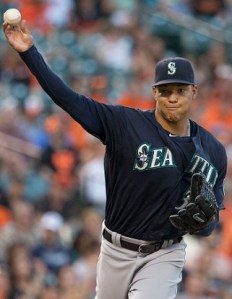
On Wednesday, when the Seattle Mariners and the San Diego Padres elected not to play, Mariners pitcher Taijuan Walker tweeted, “Glad to be apart of this organization and group of people!” Thank you for standing with us always!!” Come today, Thursday, Walker became a Buffalonto Blue Jay, traded for the proverbial player to be named later. He inprocesses with his new team Friday, when baseball is supposed to commemorate Jackie Robinson.

Pappas would never really know whether the Reds’ then general manager Bob Howsam told the truth when he insisted that 1968 trade was in the works before the Kennedy funeral issue. Walker at this writing may or may not really know soon, or even ever, if Marines general manager Jerry Dipoto had a deal in the works before the protest postponements, either.

In 1968, then-commissioner William D. (Spike) Eckert ordered no baseball to be played during Kennedy’s funeral. Washington’s notorious traffic issues delayed the procession, bumping the funeral to coincide with the start of the Reds’ scheduled game against the St. Louis Cardinals. Pappas supported not playing; the team voted 13-12 to play, possibly after pressure from Howsam and manager Dave Bristol. Three days later—Pappas was gone.

Major League Baseball’s official statement on the protest postponements said, “Given the pain in the communities of Wisconsin and beyond following the shooting of Jacob Blake, we respect the decisions of a number of players not to play tonight. Major League Baseball remains united for change in our society and we will be allies in the fight to end racism and injustice.” Walker tweeted his approval of his team’s protest postponement decision the same night they made it. One day later—gone.

If timing is everything, this timing looks more than a little out of time. It may not even pass the proverbial smell test.

Pappas, who died in 2016, was a white man born in Detroit of Greek parents. (His name at birth: Miltiades Stergios Papastergios.) Walker is a black man born in Shreveport, Louisiana; his father was black, his mother a Mexican-American woman who raised him alone. One dead pitcher and one living one can now hold hands as they say, plausibly enough, that baseball still has growing pains over intolerance not solely regarding a racial issue.

The game has never been entirely comfortable with players known to be outspoken on all sorts of matters. Once upon a time, the Chicago White Sox tried to compel the late pitcher/author Jim Brosnan to sign a contract enjoining him from writing for publication without prior team approval. The author of from-the-inside baseball classics The Long Season and Pennant Race elected to retire rather than allow the White Sox to decide what he could or couldn’t write.

When the then-Florida Marlins traded first baseman Carlos Delgado to the New York Mets after the 2005 season, Delgado—who’d sat in the dugout as a Blue Jay and a Marlin during seventh-inning-stretch playings of “God Bless America,” in protest the Iraq War and using his native Puerto Rico’s island of Vieques as a bombing practise spot—changed his protest tune, possibly under compulsion from the Mets’ front office.

“The Mets have a policy that everybody should stand for ‘God Bless America’,” Delgado said at the time, “and I will be there. I will not cause any distractions to the ballclub . . . Just call me Employee Number 21.” Said Mets chief operating officer Jeff Wilpon at the same time, “He’s going to have his own personal views, which he’s going to keep to himself.”

Delgado didn’t act during playings of “The Star Spangled Banner,” but on Wednesday Mets outfielder/first baseman/designated hitter Dominic Smith did. A young black man who’s a product of south central Los Angeles, Smith took a knee during the song’s pre-game playing to protest the Blake shooting.That contravened his stance in the George Floyd aftermath, when he said a knee wasn’t enough compared to teaching and learning.

There went that idea. Though his teammates had his back, too, refusing to criticise and some supporting him publicly (outfielder Michael Conforto in particular), Smith spoke for himself at a press conference. In tears. Asked by a reporter to describe the most difficult part of the past two months, Smith paused, then sighed, then said through a few sobs, “I think the most difficult part is to see people still don’t care . . . it just shows the hate in people’s hearts and, I mean, that just sucks.”

The Mets’ administration hasn’t said or done anything regarding Smith as I write. That can be considered good if we’re talking about dealing him out of town, post haste or otherwise, as the Mariners may or may not have dealt Walker over his comments. But that can be bad if we’re talking about whether Smith’s team above and beyond his clubhouse teammates will stand for his elementary right to speak his mind and heart.

I’ve said it before in these pages, but I’ll say it again: I have skin in the game of police lawlessness. I’m the paternal grandson of a New York police officer whom you could call both a true man’s man and yet one of the gentlest and most playful of men you’d ever meet in your life, especially with any and all of his eight grandchildren.

Grandpa Walter would have been as appalled at police officers behaving like the thugs they’re charged with apprehending as he would have been about people using police criminality as an excuse to break entire cities. If he’d been presented with the case for doing away with the “qualified immunity” that shields police officers from consequences for their crimes, I believe Grandpa would support its end, as I do.

But I think baseball fans and those who play and administer the game should want to know, for dead last certain, whether the Mariners traded Taijuan Walker—a serviceable, about-average major league pitcher—because it was an already-in-the-works trade on baseball grounds alone.

If they really did, they’re guilty perhaps of bad timing alone. If they didn’t, well, Lucy, they got some splainin’ to do. Did they deal Walker out of Dodge because the very thought that he spoke out proudly and unapologetically on behalf of his teammates postponing a game in protest of racism and police lawlessness offended them?

Protest by postponement

When Mookie Betts (far left) elected not to play in protest over Jacob Blake’s shooting by police, his Dodgers mates—including manager Dave Roberts (second from left) and pitchers Clayton Kershaw (second from right) and Kenley Jansen (far right)—had his back and joined him postponing against the Giants.

This is now: The Show’s government stood by teams postponing games Thursday in a show of respect to Jacob Blake, a young African-American man shot by rogue police, and quiet outrage over the manner in which Blake was shot. (Seven bullets in the back, with his children in sight in their car.)

But that was then: A Cincinnati Reds pitcher was hustled the hell out of Dodge for standing on behalf of not playing baseball during Robert F. Kennedy’s funeral. What a difference 52 years makes.

“Given the pain in the communities of Wisconsin and beyond following the shooting of Jacob Blake,” MLB’s official statement said Thursday, “we respect the decisions of a number of players not to play tonight. Major League Baseball remains united for change in our society and we will be allies in the fight to end racism and injustice.”

It could also have said plausibly that baseball stood athwart the grotesquery of Kyle Rittenhouse—a white teenager (seventeen), making his way from Antioch, Illinois to Kenosha, Wisconsin, where violence and destruction reigned courtesy of those who seize upon genuine grief, rage, and sorrow as a beard to destroy—now accused of shooting two to death after his arrival.

Once the National Basketball Association’s Milwaukee Bucks stepped up front as the first professional sports team to decline play Thursday in protest over Blake’s shooting, and theirs was a playoff game, baseball teams who had yet to play on the day—several games had finished already or were well enough in progress—began to step up front as well.

The Milwaukee Brewers and the Reds postponed, particularly after Brewers relief star Josh Hader spoke publicly about the team considering it. Those who chose to condemn Hader a few years ago, after immaturely racist tweets in his school days surfaced, should ponder once again (if it occurred to them in the first place, when Hader apologised publicly) that, yes, mis-oriented youth can and often does mature into thoughtful adulthood.

The Los Angeles Dodgers and San Francisco Giants postponed their Thursday night game after Dodgers outfielder Mookie Betts, informing his teammates earlier in the day he had no intention of playing as a show of protest, discovered to his happy surprise (he’d encouraged the Dodgers to play anyway) that one and all his teammates had his back on that.

The Dodgers’ long-enough-time franchise face Clayton Kershaw took the lead on backing him. “Mookie was saying, ‘If you guys want to play, I support that’,” Kershaw said when asked. “But we made a collective, group decision to not play tonight and let our voices be heard for standing up for what is right.”

The Seattle Mariners elected as a team not to play Thursday night, and their scheduled opponents, the San Diego Padres, agreed no questions asked. “For me, and for many of my teammates,” tweeted Mariners infielder Dee Gordon, “the injustices, violence, death and systemic racism is deeply personal. This is impacting not only my community, but very directly my family and friends. Our team voted unanimously not to play tonight.”

Elsewhere around the Show individual players declined to play even if their teams went ahead and played, and none of those players looks to face retribution or team discipline for their decisions while their teammates mostly (not unanimously, alas) likewise supported their stance.

Paralyzed waist down by his wounds, Jacob Blake isn’t exactly a model citizen, alas. He had a knife on his car’s floorboard though not in his hands, and police were dispatched to the location after a woman’s call that her boyfriend (Blake) was present when enjoined formally against being there. He also had an arrest warrant upon him. Neither gave Kenosha police officer Rusten Sheskey the right to pump seven bullets into his back.

Wherever he is in the Elysian Fields, Miltiades Stergios Papastergios must be thinking to himself, “Slowly comes the dawn.” You know him if at all by his Americanised name, Milton Steven Pappas. In 1968, he took a stand similar to that taken by the aforementioned teams and players and refused to budge when circumstances altered the original plan. The Reds traded him post haste afterward, and nobody knew for certain whether that stance provoked it.

Milt Pappas became a Red, of course, in the infamous trade that sent Hall of Famer Frank Robinson to the Baltimore Orioles, where Pappas was once part of the Orioles’ heralded but ruined “Baby Birds” starting rotation full of fresh youth. He pitched serviceably if not spectacularly for the Reds but, with Robinson winning a Triple Crown in his first Baltimore season and continuing to play like his Hall of Famer self, it wouldn’t have mattered if Pappas was the second coming of Robin Roberts.

When Dr. Martin Luther King, Jr., was assassinated in early April 1968, baseball’s Opening Day coincided with the day of King’s funeral. Baseball would have played fully if the Pittsburgh Pirates—with such non-white stars as Hall of Famers Roberto Clemente and Willie Stargell, plus former Dodgers shortstop Maury Wills—hadn’t refused to play. The Pirates triggered similar actions by other teams.

Baseball’s then-commissioner, William D. Eckert, was denounced for “calling up the club owners, not to tell them what to do, but to ask them” over the King funeral, wrote New York Daily News columnist Dick Young. But two months later former U.S. attorney general turned senator from New York, Robert F. Kennedy, freshly triumphant after winning California’s Democratic Party primary, was murdered after he left the stage at Los Angeles’s Ambassador Hotel on 6 June 1968.

With the Kennedy assassination, Eckert decreed no games should be played during Kennedy’s funeral. The man nicknamed Spike but derided previously as “the unknown soldier” (he was a retired Air Force general with no known previous baseball tie) proved he learned fast, even if he had to learn the hard way.

The Reds were scheduled to play the St. Louis Cardinals with a starting time well after the Kennedy funeral might have ended originally. Then, the funeral was delayed, after Washington’s notorious enough traffic issues delayed the funeral train’s procession. It looked as though the Reds and the Cardinals would play during the funeral after all.  Not so fast, Pappas insisted. He felt then and to the day he died four years ago that the game shouldn’t be played out of respect to Kennedy.

Reds manager Dave Bristol and general manager Bob Howsam felt the opposite. Howsam even visited the Reds clubhouse to pronounce that RFK himself would have wanted the game played. Pappas argued against playing right then and there. “Who is this guy, anyway,” Pappas told a reporter later on, “to tell us what Bobby Kennedy would have wanted us to do?”

The Reds’ players promptly took a team vote, some after having been strong-armed by Bristol, Howsam, or both. The vote was 13-12 in favour of playing. Pappas quit on the spot as the Reds’ player representative. Six games ended up postponed anyway despite the funeral delay. Three days later, in a deal Howsam swore was in the works before Kennedy’s assassination, he traded Pappas to the Atlanta Braves in a five-man swap making Reds out of fellow pitchers Tony Cloninger and Clay Carroll.

Baseball’s government, much like America’s, often has to learn the hard way about doing the right things as opposed to doing the expedient or the partisan things. There’s little to the appropriate causes monetarily as many do, other than symbolic acts that speak louder than rioters enough because their familiarity and popular appeal is powerful weight to throw above and beyond a game.

Those who think Thursday night’s players and team were out of line might care to ask what they’d prefer as a protest against rogue police and citizens alike—postponing baseball games and denouncing racism; or, breaking entire cities.