The power of positive Padre-ing

It didn’t need a meal and a stewardess a la Willson Contreras, but Fernando Tatis, Jr.’s Thursday bat flip was second only to hitting two bombs in two innings helping the Padres steal the Thursday Show.

Clayton Kershaw channeling his future Hall of Famer self to pitch eight innings, strike thirteen out, walk one, scatter three hits, and refuse to let a single Milwaukee Brewer even think about coming home? Fun, and who cares?

The Oakland Athletics having a ball on the Chicago White Sox bullpen’s dollars and walking as much as swatting their way to a division series for the first time in fourteen years? More fun, and who cares again?

Marcell Ozuna joyously pantomiming a selfie up the first base line after he launched a mammoth two-run homer against Atlanta reliever Raisel Iglesias, driving the Fun Police and the boring old farts out of their skulls while helping the Braves to their first postseason series win since the immediate wake of 9/11? Marvelous. And who cares yet again?

The Slam Diego Padres thinking they were twelve outs from winter vacation one moment and deciding that being swept out of a wild card series by the St. Louis Cardinals was not a viable option? Now you’re talking.

Yes, it’s possible that the Padres and the Cardinals fighting baseball’s equivalent of the Battle of the Bulge right down to the final out, with Fernando Tatis, Jr. playing George Patton, just to force a third wild card game, was the most must-see baseball on a Thursday that was overloaded with must-see.

If we weren’t going to get a continuing opportunity for the 29-31 Brewers to push onward and possibly (underline that, gang) meet the 29-31 Houston Astros in the World Series, and thus make a first class chump out of Commissioner Nero and his hopes that this sixteen-team-opening postseason becomes a permanent blight on the concept of championship, the least we could get was some plain fun ball.

The Padres made sure it was the very least and absolute most when they out-wrestled, out-bopped, out-slapped, and out-lasted the Cardinals, 11-9, in Petco Park, the lair where the big bats normally went to die at the mercy of the infamous Dreaded Marine Layer. The one that floated into San Diego and turned booming home runs into bloated, crashing fly outs. Or, once in awhile, turned those bombs into measly dropping base hits at best.

These Padres couldn’t care less about that marine layer. They’ll just drive their long balls right through it and part it the way God parted the Red Sea. And they won’t even let it bother them that they can finish five innings, sit in the hole 4-2 against the Cardinals, and sit concurrently twelve outs from being swept into early winter vacation.

The Cardinals tack up two more in the top of the sixth? Tatis will just have to hit a three-run homer followed by Manny Machado hitting a solo bomb in the bottom to tie it. Then the Padres will keep the Cardinals from scoring in the top of the seventh, Wil Myers will hit one over the left field fence to open the bottom of the seventh, and—two outs after a walk to Austin Nola—Tatis will send one over the right field fence for a 9-6 lead.

“I feel like we needed that big swing for the entire team to get us going,” said Tatis—who hit four homers only three other extra-base hits from 2-27 September—about that first bomb. “We were missing a lot with runners in scoring position. I feel like whoever did it first, we were going to feed off that. Thank God I did it first, but I’m just happy the team clicked and we won the game.”

Padres reliever Drew Pomeranz has to plunk Matt Carpenter to open the St. Louis eighth and Tatis himself has to throw offline on the next play to set up second and third for Harrison Bader and Kolten Wong to hit back-to-back sacrifice flies and close the Cardinal deficit back to a single run? No problemo. Jurickson Profar will be more than happy to bop a two-out single in the bottom of the eighth and Myers will be even more than that to hit one over the center field fence.

Then Paul Goldschmidt leading off the top of the ninth hit an 0-1 bomb against an old Cardinals buddy, reliever Trevor Rosenthal, once a lights-out closer, but addled since by injuries and picked up by the Padres from the New York Mets’ scrapyard. For several brief, none-too-shining moments, it looked as though walking Carlson and letting Yadier Molina single Carlson to second meant Rosenthal was going to let the Cardinals re-tie at least and make the bottom of the ninth either a Padres last stand or a Padres plotz.

No chance. Pop out to second, swinging strikeout, and ground out to first. And pandemonium wherever Padres fans were watching since the pandemic-mandared empty ballparks came into force. Even the broadcasters working remotely from ESPN’s Connecticut headquarters let their enthusiasm for a game like that spill into the next work stations where another team was still covering and calling Kershaw and company.

“We’re in the playoffs. The game was not done, the job was not done until we get those 27 outs, we cannot back down, we cannot settle,” Tatis went on to say about his second homer. “There was a lot of game left. I was wanting to keep motivating my teammates, just to let them know, to keep on. They are a team that they’re going to answer back, so we’ve got to keep doing the work.”

How could the Dodgers and the Brewers possibly top the Friars roast? These Padres just did in one three-inning stretch what they’d never done in any postseason series—hit five over the fences. They never came back from four or more runs behind in any previous postseason—but they came back from 4-0 Thursday.

Tatis and Myers also became the first teammates to swing for the Delta Quadrant twice in a single postseason game since—wait for it!—Hall of Famers Babe Ruth and Lou Gehrig in Game Three of the 1932 World Series. The one in which Ruth is still alleged to have called his shot. Neither Tatis nor Myers thought of calling theirs, but don’t bother us now, brothers and sisters.

For that matter, the last time the Cardinals blew a four-run lead in a postseason game was Game Four of the 1982 World Series, a series they won. Not to mention that in the past eight years the Cardinals won 139 times straight in games where they scored nine or more runs. Until Thursday.

“We played a great lineup, a great team,” said Cardinals starter Adam Wainwright, who lasted three and two thirds and two runs worth Thursday, “and they came at us over and over and over again and we never backed down. We answered back almost every time. Every time we put them in a hole they came right back.”

The Friars’ work is never done yet. They still have to push, shove, and rumble past Jack Flaherty Friday. Flaherty started the irregular season brilliantly enough, then faltered mostly due to one horrific nine-run battering inflicted by the Brewers in mid-September. But he’s still Jack Flaherty. And he’s no pushover. Yet.

But that won’t diminish what the Padres did Thursday and all season long. Lots of teams made baseball fun again this year. These Padres made those guys resemble funeral home staffs. Even when you beat them, which happened 23 times against 37 times they beat the other guys, they wouldn’t let you go without feeling like the whole game was a party.

Oh, yes. Before I forget. When Tatis launched his second bomb, he delivered a lovely bat flip two steps out of the batter’s box. It wasn’t even close to requiring a meal and a stewardess on board, as Willson Contreras’s flip a week ago, but it spun like a Lockheed Constellation engine’s propeller warming up nonetheless.

The joyous leaping forearm bumps among Tatis and Myers and their mates after they crossed the plate were just as rich and just as much fun. Take that, Bambino, wherever you are!
Waste not, want not

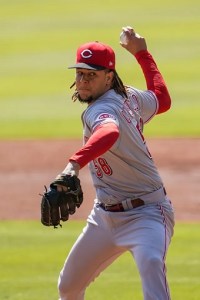
Like Trevor Bauer in Game One, Luis Castillo’s Game Two effort was wasted by the Reds’ absentee bats and futile running.

Joey Votto said going in that his Cincinnati Reds in the postseason, however rough and tumble things had to be to get them there, would be a “[fornicating] nightmare.” He just didn’t bargain on every man in a Red uniform at the plate or on the bases being their own worst nightmares.

If the Reds wish to remain postseason competitive, waste management means waste avoidance. Because if you don’t avoid waste, no matter how efficient your pitching might be, you’ll get wasted the way the Atlanta Braves wasted the Reds late but imperatively Thursday afternoon.

The Reds’ irregular season’s grind just to claim one of this year’s ten wild cards got wasted, too, even worse than Marcell Ozuna and Adam Duvall wasted relief pitcher Raisel Iglesias’s canteloupes.

Nobody wants to take anything away from the National League East-winning Braves. They clung stubbornly in their wild card set, held on to win Thursday, 5-0, and didn’t let the Reds’ stellar starting pitching blow the spirit out of them no matter how long it took. The Reds made it a little too simple for them in the end.

The Reds won’t live this one down too readily. They’re going to have to try explaining how they became the first team in Show history to be shut out for an entire postseason set, 22 innings worth, even if it was a mere best-of-three.

They’re going to have to try explaining how Trevor Bauer in Game One struck out twelve Braves without walking a soul or surrendering a run, without getting credit for a win, but with the Reds losing in the thirteenth inning on the game’s only run—on a measly RBI single by likely National League Most Valuable Player Freddie Freeman.

They’re going to have to explain how Luis Castillo’s first-ever postseason start produced seven strikeouts in five and a third innings, only one run surrendered, only one batter walked, and Iglesias getting blown up in the eighth after Lucas Sims spelled Castillo with an inning and two-thirds of spotless relief.

Ronald Acuna, Jr. doubling home Austin Riley off Castillo with two out in the fifth only made it 1-0. But Iglesias walking Freeman to open the eighth was flirting with death. Death accepted the invitation when Ozuna found a 1-0 meatball so irresistible he yanked it into the empty left center field seats.

Walking Ozzie Alibes after striking Travis d’Arnaud out following that launch wasn’t advisable, either. How inadvisable came too clear when Duvall licked his chops at an even meatier, 0-2 meatball, and sent it out down the left field line.

“Such a professional hitter,” Braves rookie starting pitcher Ian Anderson said of Ozuna after the game, calling Ozuna the life of the club all year long. “Loves the big moment. And I know it was getting to him a little bit, the way his at-bats had unfolded up until that point. Yeah, he couldn’t have been happier, and we couldn’t have been happier for him. That was a huge hit for the team. You could kind of sense that the dugout relaxed then, just a little bit.”

The Braves now wait to see who wins the win-or-be-gone game between the Miami Marlins and the Chicago Cubs in Wrigley Field, which might have been played Thursday but for the rain saying “not so fast.”

The Reds are also going to have to explain why they couldn’t find more than two hits off Anderson but found their way to nine strikeouts against the rook making his first postseason start following six irregular season assignments and a shimmering 1.95 ERA.

Those thirteen runners the Reds stranded need some explaining, too. So does having nothing to show against three Braves relievers from the seventh through the ninth.

They’re also going to have to explain why a team with baseball’s worst collective batting average (.212) despite a few offensive upgrades last winter couldn’t find ways to avoid becoming baseball’s first to be shut out of an entire postseason series.

How many times did the Reds answer opportunity’s knocking with “Go away, we gave at the office?”

When they greeted Max Fried in Game One with back-to-back singles giving them first and third and nobody out, only to see Votto—Mr. On-Base Machine—ground out to first, Eugenio Suarez line a badminton shuttlecock to Ozzie Albies at second base, and Mike Moustakas ground out?

When manager David Bell thought he could get away with a play that even the Little League won’t try all that often, having Kyle Farmer on first and Aristedes Aquino on third try a double steal the Braves could smell from about five minutes prior to attempt, with Aquino bagged in an even more kiddie-looking rundown?

When Bell sent spaghetti-bat veteran Freddy Galvis out to pinch hit for Shogo Akiyama with two out and two on in the top of the twelfth, despite Akiyama hitting well enough down the stretch to earn the opportunity, and Galvis rewarded Bell for his unexpected faith by looking at strike three right down the middle?

When they spent Game Two with no non Venezuelan-born Red getting a single base hit, and no Red from any geography reaching base between Galvis’s walk in the second and his off-the-pillow base hit up the first base line in the fifth? When no Red from there got so much as a hit by pitch to reach base and seven out of the final thirteen Red batters struck out?

Their number one irregular season issue, their inability to hit in multiples in most innings, swallowed them deeper than the Braves’ own pitching turned out to do.

“You can look at the defensive positioning, you can look at hard-hit balls that didn’t go for hits,” Bell said after the Game Two loss. “But, it’s something we have to take a closer look at because all teams are really good at defensive positioning and can hit into bad luck at times. Why did that happen for us? We just have to really take a close look at it. We did all year. Yeah, I say, we absolutely do believe in our guys, we made adjustments as much as we possibly could. But we have to find a way to get better.”

Right he is. Every Reds position player except for three will be back in 2021, and enough of them will be on the far enough side of thirty years old. They’ll still have most of their solid pitching, though the Braves didn’t get to see Sonny Gray this week, but Bauer could walk into the free agency market this year with as many potential suitors as a debutante.

Another, older Ian Anderson, leading a British band known as Jethro Tull, sang the epitaph for this year’s Reds a little over half a century ago: It was a new day yesterday, but it’s an old day now.

Heartbreak Hotel, Cleveland

James Karinchak, rocking a Ricky Vaughn haircut, but having been rocked by Gio Urshela Wednesday night.

Bad enough: Cleveland having to host the world babyweight championship bout that was Tuesday night’s allegedly presidential debate. Worse: The Indians won’t get the chance to win their first World Series since the births of Israel, NASCAR, the Polaroid Land camera, and Scrabble.

Again.

They won’t even get to play a division series after the New York Yankees swept them out of their wild card series. But to lose an almost five-hour Wednesday night grapple extended by two rain delays totaling 76 minutes and finishing in a 10-9 Yankee win, after both sides threw everything including the kitchen, bathroom, and laundry room sinks?

It’s not quite the same as losing Game Seven of the 2016 World Series after one somewhat long rain delay and an almost equally soul-wrenching back-and-forth. But it’s close enough. It isn’t quite the single most heartbreaking loss in Indians history. (Game Seven of the 1997 World Series still clings to the top. Barely)

But it’s close enough to have turned Progressive Field—in the city that also hosts the Rock and Roll Hall of Fame—into Heartbreak Hotel.

The Indians unable to cash in for another tie at minimum in the bottom of the ninth—when Yankee closer Aroldis Chapman’s should-have-been game-ending strikeout turned into a wild pitch, enabling pinch hitter Orlando Mercado to take first on the house, before Chapman regrouped and struck out swinging another pinch hitter, Austin Hedges? It isn’t Edgar Renteria ruining Charles Nagy with a two-out RBI single in the bottom of the eleventh.

But it’s close enough.

The Show’s most reliable irregular season closer and one of the league’s better defenses handing the Yankees a re-tie and go-ahead in the top of the ninth? It isn’t Bryan Shaw surrendering a tie-breaking and a semi-insurance run, and the Indians able to get only one of those runs back, in the tenth inning in Game Seven, 2016 Series.

But it’s close enough.

While you’re at it, it won’t do any good to comfort the Indians by telling them the Yankees once lost a World Series Game Seven by a 10-9 score. Not even if you tell the Tribe the Yankees lost it when Hall of Famer Yogi Berra playing left field could only watch helplessly when Hall of Famer Bill Mazeroski’s leadoff drive sailed over the left field wall in ancient Forbes Field.

Cleveland’s going to have a tough enough time trying to figure out which part hurt the most Wednesday night. They’ll have plenty of candidates. They’ll need plenty of salve.

“We had many different things and a lot of obstacles, but this group stayed together — by any means,” said Sandy Alomar, the Indians’ interim manager thanks to Terry Francona’s continuing health issues, who might yet get Manager of the Year votes just for getting the Indians to the postseason at all. “We had an eight-game losing streak, they came back. Today’s game reflected how much this team grinds and how much they fight.”

The candidates for the biggest hurt of the Indians’ now-finished season may only begin with Alomar deciding he needed a strikeout machine to handle Yankee third baseman Gio Urshela in the top of the fourth, with the bases loaded, nobody out, and the Tribe with a 4-1 lead they built with a pair of RBI doubles and an RBI single in the bottom of the first.

Alomar brought in James Karinchak to relieve starter Carlos Carrasco, cheated a bit by the rain delays The first pitch of the game was delayed by rain that hadn’t yet arrived. The second hit in the bottom of the first, and that time the rain lasted slightly over half an hour.

Until he entered Wednesday night, Karinchak’s young career showed 131 batters facing him and only one ever hitting anything out. It also shows him rocking the jagged-back haircut Charlie Sheen made famous as fictional flame-throwing Indians pitcher Ricky Vaughn in Major League. Now, Urshela and Karinchak wrestled to a full count.

The Wild Thing he wasn’t, but poor Karinchak’s young career now shows one postseason appearance and one disaster. With one swing and one launch into the left field bleachers, former Indian Urshela burned his old team four ways to eternity.

He also made Yankee history while he was at it. Thirteen Yankees have hit postseason grand slams, and Urshela is the first Yankee third baseman to slice such salami and the only Yankee anywhere to do it when the Yankees were behind.

Maybe it’ll comfort Indians fans to know that the Buffalonto Blue Jays got shoved out of the postseason earlier and likewise Wednesday. When the Jays’ best pitcher, former Dodger Hyun-Jin Ryu, faced Hunter Renfroe, a Ray who’d been 2-for-18 with seven strikeouts lifetime against him, in the second inning . . . and Renfroe sliced what amounted to season-ending salami for the Jays.

All night long, the Indians had answers for the Yankees. Let Giancarlo Stanton put the Yankees up 6-4 with a sacrifice fly in the top of the fifth, three innings after Stanton accounted for the first Yankee run with a home run? Why, they’ll just let Jose Ramirez whack a two-run double down the right field line to re-tie in the bottom of the fifth.

Let Gary Sanchez—the embattled Yankee catcher benched for Game One after he made Mario Mendoza resemble Mickey Mantle on the irregular season, and batted ninth for Game Two—smack a two-run homer in the top of the sixth to break the six-all tie? Why, the Indians will just send Jason Luplow to the plate, pinch hitting for Josh Naylor—their return from San Diego, after unloading pitcher Mike Clevinger a fortnight after he violated  COVID protocol violations.

That was some cojones on Alomar pinch hitting for Naylor, who’d set a Show precedent with five hits in his first five postseason plate appearances. Good thing the Indians let Luplow smack a two-run double to the back of center field to re-tie the game at eight.

For good measure, they’ll even let Cesar Hernandez fight Chapman off to dump a floater of an RBI single into short center field to make it 9-8, Indians. Then, they’ll shake off Urshela’s likely game-saving double play start to end that eighth and bring in Brad Hand, who led the Show with sixteen saves and didn’t blow a single save opportunity all irregular season long while he was at it.

Hand picked the wrong night to open a save opportunity by walking Stanton. Urshela then singled Stanton’s pinch runner Mike Tauchman to second. Gleyber Torres beat out an infield dribbler to load the pillows, and Brett Gardner struck out, but Sanchez lofted a re-tying sacrifice fly to center field.

Up stepped American League batting champion D.J. LeMahieu. He called slider in the center pocket and cued it right up the middle and right through the Indians’ middle infield. And, alas, right under center fielder Delino DeShields’s down-stretched glove, enabling Urshela to score the tenth Yankee run.

The Indians ran out of answers in the bottom of the ninth.

One night after they punished American League Cy Young Award favourite Shane Bieber, the Yankees had to survive the elements and Indians tenacity to get themselves a division series date with the Rays, who beat them out of the American League East title and who lack both the Yankees’ star power and the meaning of the word “quit.”

“You don’t have to pour champagne on each other,” said Yankee manager Aaron Boone, whose winners stuck to the COVID protocols and exchanged mere fist bumps to celebrate, “to appreciate what an epic game that was and the fact that we’re moving on.”

Forgive Cleveland if the epic side of the game escapes for a good while. Embrace these Indians who fought the good fight against a Yankee team they never saw on the irregular season but had to get past excess familiarity with the medical profession for a second straight season.

So far as the Indians are concerned, these Yankees picked the wrong time to remember how to win on the road. And, the Tribe with the irregular season’s best pitching overall picked the wrong time to post an 11.00 ERA in two games against the Empire Emeritus with eleven walks in eighteen innings and seven home runs surrendered.

So far as these Yankees are concerned, they survived the best the Indians could throw at them to make it four times in the past four seasons they’ve sent either the Indians or the Minnesota Twins home for the winter early. But the Indians and their fans—already rubbing their eyes over Francisco Lindor, Franmil Reyes, and Carlos Santana going 1-for-23 at the plate this set—are going to wonder how their number one strength, their pitching, became their number-one vulnerability.

Don’t remind Cleveland that the same thing happened in the 1954 World Series, when another stellar Indians pitching staff—including Hall of Famers Bob Lemon and Early Wynn, Mike (The Big Bear) Garcia, and what still remained of Hall of Famer Bob Feller—led an 111-game winning team into a Series sweep by the New York Giants. It won’t make this one sting any more gently.

“That game is literally the definition of a rollercoaster ride right there,” said Indians relief pitcher Nick Wittgren after it ended Wednesday night. “It was amazing to see our guys fight back . . . We were fighting, battling the entire game. That was fun to watch. It would have been a little more fun to be playing tomorrow.”

Usque ad proximum annum expectare.

Here’s what enough are gonna say now, Astros

Carlos Correa hitting a tiebreaking homer to put the Astros up to stay and win Wednesday? Good. Carlos Correa challenging Astrogate critics after winning one sneak-in wild card set? Not so good.

So the Houston Astros bumped the Minnesota Twins to one side almost in a blink in their American League wild card series. They swept the Twins in the best-of-three in the Twins’ own playpen. Their 4-1 and 3-1 wins weren’t exactly overpowering but they don’t have to be bombing raids or ground massacres to be wins.

Not only does it make for the Twins losing eighteen straight postseason games they’ve played since 2004, it makes for losing them at home after being the best in Show at home this irregular season. When you beat a team in their house when their irregular season winning percentage was .774, you earn a couple of days’ bragging rights.

What you haven’t earned yet, you Astros who snuck into this overcompensating sixteen-team postseason with a 29-31 irregular season record, is the right to call out your Astrogate critics after this early two-game uprising by asking, as shortstop Carlos Correa—whose home run in the top of the seventh Wednesday busted a one-all tie—did post-game, asking, “What are they gonna say now?”

Let’s see. They’re gonna say the Astros haven’t even reached the World Series yet. They’re gonna say the Astros haven’t even played a division series yet, and don’t know at this writing whether they’ll face the Oakland Athletics or the Chicago White Sox in that set. The A’s regrouped after losing their Game One to beat the White Sox and former Astro Dallas Keuchel, 5-3, Wednesday.

Like it or not, whatever the reasons that got them there, they’re gonna say the Astros are still one of the two losing teams that got into this postseason thanks to Commissioner Nero and his ownership minions deciding the pandemically-irregular season required eight teams per league starting the postseason even at the risk of losing teams winning any of the six designated wild cards.

Like it or not, some of them are gonna say the Astros are still evoking the old maxim that even the worst teams in baseball can heat up, stand up, and iron up to win in a short burst. We’re still waiting for the likewise 29-31 Milwaukee Brewers to show if they’ll do likewise, since I sat down to write before they played so much as a single out against the Los Angeles Dodgers Wednesday.

And, as much as we’d love to see the Astros and the Brewers iron up enough to meet each other in the Series, the better to make Commissioner Nero think twice (if he can think) about making permanent the prospect of losing teams going to the postseason, it’s not going to make Astrogate just an unpleasant memory just yet.

What else are they gonna say now? It’ll take a lot more than one shortstop throwing down such a gauntlet, and one not-yet-likely 2020 World Series appearance, to eradicate the stain.

Don’t even go there, Astros. The Boston Red Sox getting caught sign-stealing with an AppleWatch in the dugout and, in due course, with deciphering signs in the video rooms to relay to runners to signal hitters, isn’t even close to what you did.

The AppleWatch coach was foolish enough to do it in plain sight and get caught by the New York Yankees. That was his own bright idea. But the video rooms were provided all teams by MLB itself. Do I have to say it again? It was Mom and Dad giving the teenagers the keys to the liquor cabinet while they went out of town for the weekend.

The only shock would have been if the Rogue Sox and any other team (including the Yankees, apparently) availing themselves accordingly had resisted the temptation to accept MLB’s gift horses without developing and operating their reconnaissance rings.

So far as we know for dead last certain, those teams didn’t either alter an existing ballpark camera off its mandatory eight-second transmission delay or install a second camera to transmit in real time. Nor did MLB provide second cameras or give exemptions allowing them to alter the first.

Nor did those teams tie such cameras to monitors in the clubhouse for translators to decipher opposing signs and transmit them by banging the can none too slowly depending on which pitch they wanted hitters to expect.

Those cameras, those monitors, and that trash can drumming were the Astros’ own ideas. They were above and beyond boys being boys and figuring out how to get away with unlocking and indulging the liquor cabinet.

What else are they gonna say now? How about that the Astros haven’t yet proven how elite they are at the plate this postseason. They’ve still got the horses no matter how feebly too many of them swung during the irregular season. The one thing they do have in common with the Rogue Sox is that they had (and have) too many talented hitters (still) for them to have needed a surreptitious intelligence agency.

But when they muster a mere seven runs on thirteen hits over two wild card games, they’re not exactly earning an image as this postseason’s Murderer’s Row II just yet. Zack Greinke, Jose Urquidy, and the Astros’ bullpen deserve more credit for stopping the Twins’ thumpers than their bats deserve for delivering close enough to the bare minimum.

Remember, too, that most of the rest of baseball and most of baseball’s fans were outraged not only that the Astros were exposed as extra-legal sign-stealing cheaters but that Commissioner Nero for various reasons saw fit to give the cheating players immunity in return for spilling.

The spilling didn’t outrage people, the getting off the hook did. So did owner Jim Crane and since-deposed general manager Jeff Luhnow trying to blame everyone else for the poisonous organisational culture they brewed that opened the passway through which the Astro Intelligence Agency passed.

A.J. Hinch—the hapless manager, who couldn’t or wouldn’t muster enough strength to do more to stop his high-tech cheaters except smashing a couple of the clubhouse monitors, and maybe telling them if he caught them doing it again he’d be . . . very, very angry at them—is long enough gone. Of any Astrogate figure Hinch, whose Astrogate suspension from baseball ends when the World Series does, probably deserves a second chance the most. But he’s liable to find it elsewhere. Sadder but, hopefully, wiser.

Alex Cora and Carlos Beltran, the 2017 bench coach and designated hitter who co-masterminded enough of the Astro Intelligence Agency’s operating apparatus, are also gone. So are all but eight members of the 2017-18 players’ roster.

It’ll probably take the final, complete remake of the roster and overhaul of the organisation for the Astros to lose the entire Astrogate stain. Even that may not remove all of it. Just as history renders the 1951 New York Giants forever not as a daring thirteen-game-out comeback team but as off-field-based, illegal telescopic cheaters (The Giants stole the pennant! The Giants stole the pennant!), history renders the 2017 (Astros) and 2018 (Rogue Sox) World Series winners as tainted forever.

Because Astrogate took until late 2019 to expose, this year’s Astros were going to take their lumps no matter what. Their mealymouthed pre-pandemic shutdown February presser just compounded the outrage.

But the Giants got past the ’51 cheaters in due course. So did several other pennant-winning teams whom history has long since exposed as comparable cheaters.

The Philadelphia Athletics got past 1910-14, never mind periodic suspicions that their off-field-based sign-stealing had almost as much hand as economics in Connie Mack’s first notorious fire sale. The Detroit Tigers got past their 1940 cheaters. So did the 1948 World Series-winning Cleveland Indians. So did the 1961 Cincinnati Reds. So, too, will the Astros and the Red Sox in due course.

Just a World Series presence this year—as unlikely as it might still seem now, but achieved straight, no chaser—would be a flood of Febreze removing a lot more of the Astrogate stain. Until it does, Correa may want to remember God gave him two eyes, two ears, two nostrils, and only one mouth for a very good reason.

The Braves get the lucky thirteenth

Freddie Freeman finally drives in the only run of the game . . . in the bottom of the thirteenth.

Put Commissioner Nero and his itch to fix what isn’t broken plus his allergy to fixing what might be to one side. The second loveliest word pair in the English language is “extra innings”—right there behind “play ball!” The Cincinnati Reds and the Atlanta Braves certainly believed in lovely word pairs Wednesday afternoon.

We just didn’t think they’d take it to a 12.5 inning shutout extreme while they were at it, before the Braves finally won 1-0 in the bottom of the thirteenth.

Neither did we think fourteen pitchers would combine for 37 strikeouts that only began with Braves starter Max Fried’s five in seven innings and Reds starter Trevor Bauer’s 12 in seven-and-two-thirds. That would mean twelve relief pitchers combining for 25 strikeouts.

It also meant history’s first Show postseason game that ever went scoreless for 12.5 innings. Not to mention Bauer become first in Show ever to throw seven-plus shutout innings with no walks and twelve or more strikeouts.

Now, Fried and Bauer were masterful. No question. But then they were also smart enough to exploit a pair of teams whose diets are dominated by long bombs. Teams who also spent six part of their first National League wild card game trying to hit eight-run homers and half a dozen parts running the bases like Dick Van Dyke trying and failing to avoid somersaulting over the ottoman after he’s only three steps through the front door.

Try not to miss the free cookie on second base to start each team’s extra half inning, either. It’s not part of the postseason, but still. Until Freddie Freeman knocked home the winning run in the bottom of the thirteenth, these Reds and these Braves spent the day proving that if they did have the cookies they still would have stranded them.

Except for the top of the tenth and the bottom of the eleventh in Truist Park, neither side could get anyone home even if they’d paid ransom remands. The Reds even stranded the bases loaded in the eleventh and the thirteenth. Atop an afternoon aboard which the Reds went 1-for-12 with runners in scoring position and the Braves went 1-for-10 likewise.

Freeman’s was the one that counted. With Amir Garrett on the mound for the Reds, and pinch runner Cristian Pache plus Ronald Acuna, Jr. aboard with one out, he lined a slightly hanging slider into right center field far enough for Pache to hit the plate unmolested.

For the Braves first baseman who prayed COVID-19 wouldn’t get him an early transfer to the Elysian Fields before the irregular season opened, it had to be the single most satisfying hit of his career to date.

It was the least Freeman and his mates could do after reliever Shane Greene left successor A.J. Minter with the bases loaded and one out in the top of the thirteenth. Thanks large for lunch, you could imagine Minter thinking as Aristedes Aquino checked in at the plate, I was dying for a jam sandwich, anyway.

Aquino wrestled Minter to 1-2 including four foul-offs before Minter lunged for and missed a changeup that broke so far low and away Aquino would have needed a search party to make serious contact. Then Minter served Jose Garcia just enough to hit a grounder up the middle that forced Mike Moustakas out for the side.

Memo to the Reds and the Braves hitters: When beasts like Fried and Bauer are on the mound, it’s wise men who heed the wise advisory, “Please don’t feed the animals.”

And, memo to everyone banging Reds manager David Bell for not putting Freeman aboard with a base open and only one out—Freeman may be the National League’s Most Valuable Player in waiting, but he’s far less effective against lefthanded pitchers (.250 batting average against portsiders this year) than righthanded. (.341.) And Garrett this year kept the lefthanded swingers to hitting .043 against him.

Lurking behind Freeman? Righthanded Marcell Ozuna, his 1.067 2020  OPS, and his penchant for demolishing lefthanders like condemned buildings and righthanders close enough to that. (.345 batting average against lefthanders this year; .333 against the starboard arms.) You want to pitch to that with the bases loaded, instead of chancing your man luring Freeman into a double play? Cream Puff the Magic Dragon Ozuna ain’t.

So Bell made the only move he could have made and left his lefthander in to face the lefthanded. You give Freeman all the credit on earth for jumping Garrett’s hanging slider. For better or worse there are times when doing the right thing isn’t as right as the other guy doing it.

Better that Reds fan is frustrated by Adam Duvall and Austin Riley collaborating on nailing Nick Castellanos at third in the sixth, when he tried taking the extra base on a single and Duvall thre the kind of strike requiring nothing but the best tag Riley could get down on Castellanos.

Or, by Aquino channeling his inner Little Leaguer with two out in the seventh, getting himself canned in a rundown between third and home. To think he reached base in the first place after a swing and a miss that dropped him on his can before singling to left with one out.

Now the Reds get to play Game Two hoping they can drop Ian Anderson and the Braves on their cans, instead of ending up singing, “It was a new day yesterday/but it’s an old day now.”