Benedict Angel?

Harkins, accused of handing an illegal weapon to the enemy.

About six decades ago, when The Dick Van Dyke Show‘s protagonist Rob Petrie assured his fellow television writer Buddy Sorrell he had no thoughts of vengenace for a practical joke, Sorrell pleaded for mercy, sort of. “C’mon, let’s be fair. If I know something’s coming, I’ll worry,” Sorrell urged, “but if I don’t know I’ll go nuts.”

At that, Petrie smirked mischievously and the third member of the fictitious writing team, Sally Rogers, rasped to Sorrell, “Congratulations, General Custer, you just sold some guns to the Indians.”

A now-former Los Angeles Angels clubhouse attendant, Brian (Bubba) Harkins, is accused of giving ammunition to the Indians—not to mention the Astros, the Athletics, the Mariners, the Rangers, and any other team playing against the Angels in their digs just outside Disneyland.

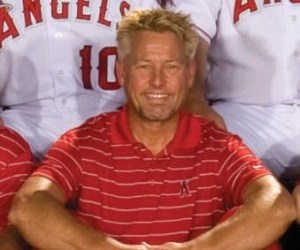
Harkins tended the visitors’ clubhouse at Angel Stadium since 1990, well before the place was made over completely from its Anaheim Stadium root. The Angels fired him last March, after baseball’s government informed the team that Harkins provided opposing pitchers with a little extra to put on their pitches.

Specifically, MLB let the Angels know they had abundant reason to believe Harkins, for whatever cause, mixed up a homemade stickum from melted-down pine tar and rosin, the better to give opposing pitchers (ahem) better grips (hee hee) on their pitches (wink-wink, nudge-nudge).

Harkins sued both the Angels and MLB in August charging defamation and pleading that he never made or distributed anything unlawful in all the years he worked for the Angels. Both have filed to get the Harkins suits tossed; the hearings on those will happen in January and February.

If Harkins is guilty as accused, it begs the question of why. Why on earth would one team’s visiting clubhouse master provide the visitors’ pitchers with that new old fashioned medicated goo? Angel Stadium is known as a pitcher’s park, and the climate therein isn’t exactly the type that would move a pitcher to get a little extra help keeping a grip.

It’s not as though the Angels’ pitching staff was pinning the opposition to the walls especially in the past five seasons. Their pitching problems in those years have been documented so well and detailed that the other guys have needed extracurricular equalisers on the mound about as desperately as Hall of Famer Rickey Henderson needed Acme jet sneakers to steal his record 1,406 bases.

It’s certainly not as though the Angels have been scoring vaults full of runs, either. Remember, this is the team with the best all-around player on the planet, a guy who can make things happen just kneeling in the on-deck circle, and they can’t get runners aboard ahead of him or provide more than an aging and fading Albert Pujols behind him to get him home, either.

A team whose pitching staff posts a 4.57 ERA and a 4.59 fielding-independent pitching rate over a particular five-year spread including this year is not exactly a group against whom you need salvation by salve. The other guys’ pitchers could have thrown what they throw without sticky fingers and just waited for their own hitters to prick, poke, pound, pulse, or pulverise these Angel staffs.

It’s a little beyond belief to think that Haskins may have decided one fine day that the other guys stood so little chance against an Angel staff that handed runs out like Halloween candy to trick or treaters. Set aside for one second what you do or don’t think about cheating and ask yourselves whether you’d have thought that, all things considered, the 2016-2020 Angels were the guys who needed whatever breaks their pitching staffs could get by hook, crook, or anything else they could get their meathooks on.

You might not think it any more kosher, but you might understand if the visiting clubhouse attendant for any team employing Gaylord Perry in the prime of his actual or alleged grease-balling career decided to mix up a little gunk for the visiting enemy, the better to give them an even chance against Perry, who might actually have thrown fewer actual naughty balls than he let on. (Surely you remember Perry’s little mound routine prior to delivery, the better to let the batter think he was preparing a lube job.)

Try to imagine teams’ road clubhouse people looking for and providing ways for the other guys to even things out against such real or suspected scuffers, scratchers, swampers, and ringers as Bo Belinsky, Lew Burdette, Whitey Ford, Art Fowler, Mudcat Grant, Ross (Skuzz) Grimsley, Kevin Gross, Tommy John, Eddie Lopat, Joe Niekro, Phil (The Vulture) Regan, Preacher Roe, Mike Scott, and Don Sutton.

And, try to imagine such teams catching their trusted visitors’ clubhouse hosts handing the travelers anything, never mind Harkins’ blended Creme de Mess, to counter the like of Burdette’s suspected swamp balls. (The fidgety righthander was believed to spit his tobacco juice to the same spot by the rubber for a scoop o’sewage when he bent over.) Or, Ford’s mud or ring balls. Or, Regan’s sweat ball. (The Vulture got away with it for as long as he did because nobody suspected he was just letting his natural heavy sweat run down his arm.) Or, Grant’s soap balls. (The Mudcat once liked to soap the inside of his jersey and got nailed only when he overdid it inside his gray road uniform—and the warmth of the sun turned the Ivory so pure it foamed visibly through the material.)

Not to mention being unable to wait as long as Belinsky once swore he did for the chance of a Ford mud, ring, or buckle ball awaiting him on the mound before confiscation when it was side retired. “If Whitey left one for me on the mound,” the playboy-flake lefthander once said, “I had two outs waiting for me right there. If he didn’t, I was dead.” Did the usually clever Ford ever think he might be loading the enemy cannons himself?

John actually did little other than wait for a ball in play to be thrown back to him. If the ball wasn’t removed, he’d spot the merest scuff from the play action and turn it into a double play ground ball. When Orioles pitcher Mike Flanagan showed Thomas Boswell a ball he cut with three straight gashes and said, “Any time I need four new pitches I got them,” Flanagan also said of that ball, “My God, Tommy John could make this ball sing ‘The Star Spangled Banner’.”

It’s rare enough now to find pitchers suspected of putting more on the ball than just their fingers. Teams taking traitorous pity on the other guys against such scofflaws among their own troops have their work cut out for them, if their own scofflaws are as slick as the Burdettes, Fords, Johns, and Regans.

My best guess is that trying to prove game by game which Indians (or Astros, Athletics, Mariners, Rangers, or others) ambushed the Angels with goop balls provided from the inside might be a fool’s time-guzzling errand. We’re pretty sure the Angels a) weren’t going rogue; or, b) if they were, they set undetected records for the driest spitters in baseball history.

Maybe the other guys approached Harkins and offered him a little extra emolument that he accepted gratefully enough to duck into the lab and blend his brews. If it can be proven that they did and he did, at least that would make perverse sense. If it can be proven that they didn’t and he didn’t, Harkins might consider himself fortunate that fired was the worst he got.
Cohen asks Met fans for input

View Post

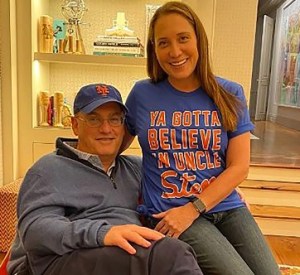
The New York Post captures Steven Cohen and his wife, Amy, celebrating Cohen’s purchase of the team he’s rooted for since the day they were born.

Forget everything else since the World Series finished and ponder this. A fellow Met fan since the day they were born now owns the team. And he hit Twitter running over Halloween weekend, soliciting his fellow Met fans’ input on improving their experience as fans.

Social media has been with us by and large since about the turn of the century, or within the first few years. Until Steve Cohen did it, I don’t remember any incoming baseball owners jumping aboard Twitter, reviving a dormant account, and asking their new teams’ fans much of anything, never mind a question like that.

Some of the answers Cohen received during his weekend Tweet and greet were on the sublime side, as were his replies. “You’ve already done it by buying the team,” tweeted a user handled Austin. “Nah,” Cohen replied, “we can do more than that.” David Tratner, identifying himself as a former NFL public relations executive, tweeted, “Hire smart people in every area (which may include people already in the building).”  Cohen replied, “Hire them smarter than you. That has worked for me in the hedge fund biz.”

Except perhaps for that time when his old hedge fund outfit got spanked by the Securities and Exchange Commission over insider trading. Now, read carefully: Cohen himself was neither accused of nor charged with wrongdoing in that case. It didn’t stop assorted naysayers from screaming blue murder over the prospect of a “felon” becoming a baseball owner.

It also didn’t stop New York’s self-congratulatory mayor, Bill de Blasio, a man who illustrates wisdom by standing athwart it, from threatening at almost the eleventh hour to kill Cohen’s purchase of the Mets. Cloaking himself in doing “our due diligence,” de Blasio sought to use a customarily obscure clause in Citi Field’s land lease agreement with the city—empowering the city to block users known for (brace yourselves) “moral turpitude” from buying—to kill the sale. (The Mets actually own Citi Field through their Queens Ballpark Company subsidiary, but the city owns the land on which it sits.)

When de Blasio was quoted credibly as saying he didn’t want some “billionaire hedge fund” guy buying the Mets, nobody thought to ask, nor did he deign to say so far as is known, which kind of billionaire he preferred to buy the team. Finally, last Friday, the requisite majority of major league owners voted to approve the sale. Cohen thus got the next-best thing to every Met fan’s boyhood wish. If he couldn’t become a Met, at least he got to buy the team.

Some of the weekend answers Cohen got were on the ridiculous side, too, but you might have expected that. “We also don’t need a new analytics department,” tweeted a user handled LOLCOWBOYS—his @ account identifier indicated himself as a Yankee fan—after suggesting the Mets should sign such aging free agents as Yadier Molina and/or J.A. Happ. “Going old school works. Just ask A rod. You should hire A rod as head of the analytics department.”

Cohen didn’t answer that one. But when not rejecting the former Yankee whose powers of baseball analysis have been found very wanting of late, respondents urged the Mets away from baseball’s playing senior citizens: “For too long,” tweeted a fan named Pete, “the Mets have been a team where talent acquired was of the Player to be named to the DL later variety.

A considerable consensus urged Cohen to consider restoring the black alternate jerseys the Mets wore a decade ago. (Say I: No chance. Stick to those handsome blue alternates.) Another fan suggested installing markers in the parking lot, where Shea Stadium used to sit, signifying important moments and plays in Met history, such as the precise spot where left fielder Cleon Jones caught the final out of the 1969 World Series. (Sound as a nut.)

“I like that one,” replied Cohen. He also went on to promise a far better institutional job of honouring the better and more instructive sides of the Mets’ chameleonic history, adding that he’d even return the Mets’ annual Old-Timers Days on partial behalf of doing exactly that. “No brainer,” he said.

My own contribution to that cause was suggesting such uniform number retirements as David Wright (5), Hall of Fame catcher Gary Carter (8), Dwight Gooden (16), should-be Hall of Famer Keith Hernandez (17), and Tug McGraw (45). Cohen didn’t reply to that one as I write, but a Twitter account identified as Carter’s gave it a like. My best guess is that the account based from Carter’s Palm Beach home belongs to his family. (He died at 57 in 2012.)

I should have made another suggestion, on behalf of such former Mets as pitcher Bill Denehy, outfielder George (The Stork) Theodore, and other pre-1980 Mets whose major league careers came and went in a blink for assorted reasons. So I’ll make it now.

Mr. Cohen, you have the kind of good will and resources to make something happen for Denehy, Theodore, and over six hundred other former major leaguers who, for reasons ranging from the nebulous to the ridiculous, got frozen out of a 1980 re-alignment of baseball’s player pension plan.

The owners and the Major League Baseball Players Association agreed to change the plan and make players’ vesting eligibility 43 days of major league service time instead of the original four-year service time requirement. They also agreed to a one-day service time requirement as vesting eligibility for health benefits. But they excluded short-career major leaguers whose short careers happened between 1949 and 1980.

That mistake affected over 1,100 former players in 1980; attrition since has reduced the number to a little over six hundred. Denehy* may be the best-remembered of the impacted former Mets: after an injury-blocked rookie season in 1967, the Mets traded him to the Washington Senators in order to bring their manager, Gil Hodges, back to New York to manage the Mets.

An unconscionable volume of cortisone injections following his original 1967 shoulder injury—which proved a rotator cuff tear, about which then-Met and other medical personnel were far less than truthful with him—have helped make Denehy legally blind since 2005 and place him now on the threshold of total blindness. He isn’t the only one of the six hundred plus pension freeze-outs with profound health issues.

Eight years ago, then-Players Association director Michael Weiner and then-commissioner Bud Selig got Denehy, Theodore, and their fellow pension freeze-outs a small but telling redress. They got those players $625 per quarter for every 43 days’ major league service time for up to four years. The kicker is that they can’t pass those monies on to their loved ones after they pass on. And they still can’t buy in to the players’ health plan.

“It was a nice gesture on the part of Weiner and Selig who, undoubtedly also realized it could hardly make up for all those lost years in which the pre-1980 players got bupkis,” wrote longtime New York Daily News columnist Bill Madden last February.

Just why those players were frozen out of the original 1980 re-alignment remains somewhat mysterious. Denehy, former Texas Rangers pitching phenom David Clyde, and other affected players have said they think many if not most involved in the re-alignment believed many if not most of those short-career men were little more than September call-ups.

Denehy made the 1967 Mets, the 1968 Senators, and the 1971 Detroit Tigers out of spring training. Clyde was signed for a six-figure bonus right out of high school and thrown onto the mound for the Rangers immediately, before the Rangers broke a promise to Clyde and manager Whitey Herzog to send him to the minors for proper seasoning after letting him start twice to goose the struggling Rangers’ gates.

More of the short-career men made clubs out of spring training than the owners and the union remembered or even cared to know. Eligible former players since 1980 collect their pensions whether they were blink-of-an-eye one-day fill-ins, short-term scrubs, long-term spare parts, long-term regulars, or Hall of Famers. Pension vesting isn’t tied to statistical achievement.

It’s rare enough to see a genuine fan grow up to become the owner of the team he grew up loving. (Like me, Mr. Cohen, you saw your first live Mets games in the ancient wreck of the Polo Grounds in 1962-1963.) It’s even more rare when such an owner actively solicits his fans’ input and doesn’t laugh them out of town for their answers.

Mr. Cohen, the worst kept secret on earth is that your pockets are deeper than the Atlantic Ocean. You don’t have to open them to every last one of the six hundred plus pension freeze-outs. If all you do is address Bill Denehy, George Theodore, and their fellow short-career pre-1980 Mets, you would throw down one of the most considerable gauntlets of your time.

“Realistically speaking,” Denehy told me this morning, “no one’s going to come in and bankroll the whole six hundred [plus] players. But if they just take care of the former players in their own organisations, it would be a great start and get the ball rolling a little bit.”

You made yourself an instant hero among Met fans with your weekend Twitter excursion, Mr. Cohen. For that alone, you may repeal the law that says no fan in the history of professional sports has ever bought a ticket to a game to see the team’s owner. (Frustrated 1980s Yankee fans buying into Yankee Stadium to boo, hiss, insult, or hang George Steinbrenner in effigy at the depth of his act notwithstanding.)

You might make yourself even more a hero taking that pension bull by the proverbial horns, especially if more Met fans really knew and understood what little the Denehys and Theodores and others ask for having played the game even briefly. It may help you to know that the late Players Association director Marvin Miller—who was finally elected to the Hall of Fame posthumously as a pioneer—is known to have said in his retirement that not revisiting the 1980 pension re-alignment on behalf of the short career freeze-outs was his biggest regret.

Moving to take care of just your Mets’ own short-career pension freeze-outs would put you even further on the side of the angels and challenge your fellow owners to take a second, third, and even fourth look at their own, Mr. Cohen. Those would be the most profound looks those former players have received in years.

And it would consecrate you, sir, as what your weekend Tweet and greet merely began, the man who started to clean up the New York Mess—and started to clean up a long, long overdue pension plan redress.

———————————————————————

* Fair disclosure: Since interviewing him for a 2019 essay—recalling his role in bringing Hodges to New York, his battles with substance abuse borne in due course of his rookie-season shoulder injury misdiagnosis, after he was subject to such a volume of cortisone shots that eventually contributed to the blindness with which he’s lived since 2005—Bill Denehy and myself have become friends.

Hold Cash accountable for the right reason

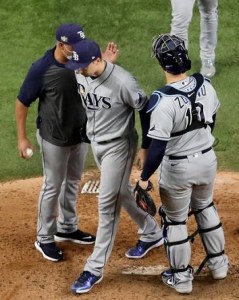
Blake Snell (center) leaving the mound. Cash should answer for bringing Anderson in, not taking Snell out.

I didn’t want to go here now. I thought I’d taken care of that two essays ago. But since it seems the mob won’t let go, I guess I’ll have to. Even if I have an audience of ten. So I’m going there: Lifting Blake Snell was not the biggest mistake Tampa Bay Rays manager Kevin Cash made in World Series Game Six Tuesday night.

He lifted the right pitcher but relieved him with the wrong pitcher. That’s what turned the Rays’ early 1-0 lead—on Randy Arozarena’s one-out-in-the-first smash into the right field seats—into the 3-1 Series-losing defeat.

If you are one of my ten readers, you’ve already read it, so bear with me just in case there’s an eleventh reader lurking. Snell was dealing through five full. The cards began getting just a little shaky in the bottom of the sixth, and it’s not as though Snell hasn’t been there before.

Over his entire career, Snell has been the way, oh, just about every starting pitcher worthy of the job has been: He’s easier to hit the third time around the order than he is the first. Makes no sense without the numbers? Here we go again:

Blake Snell Around the Order BA OBP SLG OPS
First Time .205 .280 .312 .592
Second Time .234 .316 .396 .711
Third Time .247 .329 .413 .742

Snell opened the bottom of the sixth getting Los Angeles Dodgers left fielder A.J. Pollock to pop out to short right center field, with Rays second baseman Brandon Lowe ambling out for the catch. Then, on 1-1, Snell hung a slider in the middle for Dodger catcher Austin Barnes to line off the middle into center for a base hit. But he’d started Barnes with a fastball that was slower than his peak speed just a couple of innings earlier.

Remember: Snell finished his evening with nine strikeouts, an awful lot of swing-and-misses, and having struck out the side in the first and the third. He also hadn’t gotten past the sixth inning all year long. And his third-time-around-the-order numbers, analyst Eno Sarris reminds us (just in case we’d known before), are 23 percent worse than the league average for starting pitchers.

And looming on deck as he dealt with and lost Barnes was Mookie Betts.

The Mookie Monster. The guy everyone else is still screaming struck out twice against Snell earlier in the evening and only hit .200 against lefthanders this year. This truncated, irregular-season year. (Which is why his mere 64 plate appearances against lefthanders this year don’t really mean all that much.) Betts is also the guy who hits .297 with an .888 OPS against lefthanders lifetime. It’s practically even-up in the splits with his numbers against righthanded pitchers: .302/.897.

Since the commentators during Game Six made such a point of mentioning it, it’s only right to mention it here, too: From his years with the Boston Red Sox, Betts had the most direct experience of any Dodger against Snell. Here’s the part they didn’t mention so far as I knew in the moment: Betts hit .304 with a .370 on-base percentage against Snell lifetime entering this postseason.

Cash wanted a righthander to match up with the righthanded Betts, even with Betts’s near-even split. He had righthander Nick Anderson up and throwing as Snell started the sixth. He was hoping for a return engagement by the Anderson who was lights out in nineteen irregular season gigs (0.55 ERA; 1.35 fielding-independent pitching rate; 0.49 walks/hits per inning pitched rate; 26 strikeouts and no walks in sixteen innings). Not to mention the Anderson who struck six Yankees out in four and two thirds division series innings.

He got, instead, the Anderson whose American League Championship Series ERA was a ghastly 8.31 while striking nobody out, walking three, and surrendering seven hits; and, whose postseason total entering Tuesday night was a 6.75 ERA and a 1.88 WHIP.

Cash should have thought sooner and better of Ryan Thompson, the rookie who’d been lights out in six ALCS and World Series games with his 1.93 postseason ERA (and zero ERA in the Series) and 1.18 postseason WHIP (and 0.38 Series WHIP), and who’d worked a one-walk, one-strikeout, fifteen-pitch ninth in Game Five two nights earlier. If not Thompson, then Diego Castillo would have been a viable option even with his 3.38 Series ERA, but Thompson really was Cash’s best hand among the Rays’ righthanded bulls.

Maybe you should listen, too, to Anderson himself. “Workload, 2020 season, the whole thing is just crazy, honestly,” he told reporters post-Game Six. “Not having a normal routine, lifting, the season, everything — it’s been crazy. I didn’t feel as good as I would have liked to, but it’s the big leagues; you’re not going to feel good every time. I was still confident. It wasn’t the situation, it wasn’t being in the World Series or anything like that. Not a lot of gas.”

Anderson himself admitting he wasn’t feeling a hundred percent or maybe even seventy-five percent. Cash read Snell properly as Snell began tiring but he read Anderson not at all. Thompson wasn’t even a Game Six rumour, never mind a topic.

The screamers roasting Cash for hooking the hot hand didn’t stop think about the hotter hand. Not in the moment, not when Betts ripped a double down the left field line, not when Anderson wild-pitched Barnes home with Series MVP Corey Seager at the plate, and not when Betts slid home ahead of a throw down from first on Seager’s hopping ground out.

Please, let’s not go there again about “heart” and “character” and “fortitude.” Do you really want to be reminded how often men and teams stand and play proud, with all the heart, character, and fortitude you can ask for, and then some . . . and still get sunk crossing the Jordan to the Promised Land?

Do you still really want to let Snell hang in there to face the Mookie Monster? The net result might tell you yes, but the deepest and most objective look says no. Cash’s mistake was Anderson. Lucy, that and only that is where the manager and his front-office overseers got some splainin’ to do.

On roasting Manfred and redeeming Kershaw

How sweet it is for Clayton Kershaw at last.

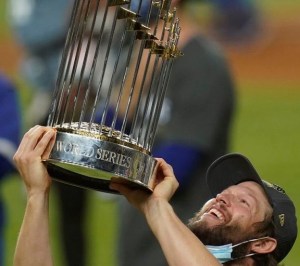
Above and beyond the obvious, two sights and sounds in Globe Life Field tended to out-shine the rest after the Los Angeles Dodgers won the World Series. In order, they were commissioner Rob Manfred being booed while he spoke during postgame ceremonies, and Clayton Kershaw hoisting the World Series trophy with the biggest grin this side of Teeth Malloy.

Getting a season in at all in the time of coronavirus was somewhat miraculous, even if Manfred and his overlords did just about everything in their power to make it difficult, impossible, and don’t-even-think-about-it. Would it have been better to live without the Show at all this year? We’ll never know now.

Then Manfred and his masters decided to impose the sixty-game irregular season. And they couldn’t resist tinkering like the nutty professor going a hundred miles backward to go one mile forward. Manfred may be seen as just the owners’ messenger boy, but his office also allows him liberal latitude to act on behalf of the good of the game.

The good of the game does not include a free runner on second to start the extra innings. The good of the game does not include a three-batter minimum for relief pitchers except when they were brought in during disaster and got out of it. The good of the game does not include a postseason array that actually made room for two losing teams to even think about playing for a championship.

One out of four ain’t bad. The universal DH needs to stay. Period dot period. That one Manfred gets right. It only took 129 years for the National League to be made to catch up to the NL owner who thought of it in the first place because the pitchers in his day couldn’t hit, either.

God help us if Manfred decides the 29-31 Houston Astros getting to within one game of winning the pennant says, “See? We told you! Letting the losers in didn’t stop the cream from rising!” Even allowing the irregular, truncated regular season, there was only one reason to pray the Astros got to the World Series: if the likewise 29-31 Milwaukee Brewers somehow got there, too.

It would have made Manfred and his masters look like the fools they would have been if American baseball’s annual crowning achievement had been decided between (ir)regular season losers. Not that they needed that to look foolish, of course.

Pray that even one among the owners to whom the common good of the game is, was, and always will be making money for it otherwise hits Manfred with the wake-up-your-brain two-by-four. And, that 2021 will see a return to some semblance of normalcy. Just some will do. Would Steve Cohen, the brand-new owner of the New York Mets, like to be that stand-up guy? He’d make Branch Rickey the proudest man in the Elysian Fields.

Enough of that for now. Manfred getting booed is only a transient pleasure. Kershaw hoisting that piece of metal is transcendent. Especially after he pitched like the Hall of Famer-to-be that he is all postseason long. Especially after his manager finally figured out how to keep him from situations in which even the Greatest Pitcher of His Generation could get bushwhacked, bastinadoed, broiled, and basted.

The narrative of Kershaw looking like Sandy Koufax in his regular season career but Crazy Schmit in the postseason was always a little on the ridiculous side. It finally got exhausting to remind people that you could probably win a pennant fielding a team full of the Hall of Famers whose regular seasons put them in Cooperstown but whose World Series gigs compared to Blooperstown, often through no fault of their own.

Juan Marichal only got to appear in one Series at all and barely had the chance to strut his real stuff. Willie Mays had The Catch in 1954 but nothing much else to show for three Series. Ted Simmons reached one Series near the end of his career and showed the beginning of his decline phase. Ted Williams reached one Series, was throttled by an elbow injury, and never got another chance. Robin Roberts lost a tough game in his only World Series and never got another chance to try. Joe Morgan had the occasional moment but a modest overall Series jacket.

To them add these Hall of Famers: Luke Appling, Ernie Banks, Jim Bunning, Rod Carew, Andre Dawson, Ferguson Jenkins, George Kell, Ralph Kiner, Phil Niekro, Gaylord Perry, Ryne Sandberg, Ron Santo, and Billy Willams never got even a single taste of Series play.

“Baseball executives like to talk about how variance dictates the postseason,” Andy McCullough writes in The Athletic. Kershaw has pitched long enough in October to live that truism. It would be disingenuous to say his bad numbers stem from bad luck. Yet it would be foolish to ignore the breaks.”

Once upon a time, Kershaw’s handiwork got wrecked through little enough fault of his own. This time, whenever Kershaw needed the breaks the most he got them. Breaks like Cody Bellinger’s stupefying, back-to-the-wall, rising theft of a go-ahead bomb by Fernando Tatis, Jr. Like the Braves’ Austin Riley tripping into a key out. Like Victor Gonzalez in relief ending a troublesome inning by palming Mike Zunino’s speeding bullet.

Kershaw is a man whose teammates describe him as playful and a little goofy on the days he doesn’t pitch. He’s so unapologetically footloose when playing with his young children at the ballpark and elsewhere on his days off that it’s easy to ask who’s more fortunate, Kershaw for having such agreeably charming children or the children for having such an agreeable father.

He also prizes control of his work and his personal environment on the days he does pitch. Especially the past two seasons, when he’s had to remake his approach in part because of persistent back issues and in part because of the onset of baseball age. But he appreciates when he gets those little extras in a game that so often prove the equivalent of the World War II fighter pilot having nothing but a turning propeller between himself and disaster.

This time around, Kershaw didn’t have to be the most powerful engine on the Dodger aircraft. He just had to do what he could do with whatever he had. The Dodgers entered Game Four believing they’d finish one game from crossing the Jordan and ended up on the wrong end of maybe the single most berserk loss in World Series history.

All that meant was Kershaw pitching Game Five not to get to the Promised Land but to get to the Jordan’s banks after such a surreal throwback. Kershaw’s Game Five mastery got  them back to the banks. This time, Mookie Betts, Corey Seager, Austin Barnes, and the Dodger bullpen rowed them across in Game Six.

“Who knows how many times I’m going to get to go to the World Series?” Kershaw has been quoted as saying. “I know more than anybody how hard it is to get there.” He also knows a lot more than a lot of people forget how hard it really is to get across from the banks to the Promised Land.

The Boys of Pandemic Summer

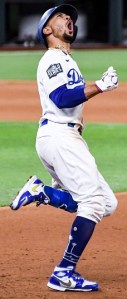
The Mookie Monster, after hitting his eight-inning Game Six blast.

They don’t have to say “wait till next year!” for the eighth straight year. Crowning a season that once threatened not to hit the field at all, the Los Angeles Dodgers have reached the Promised Land—for the first time since the near-end of the Reagan Administration.

They threw several mountains off their shoulders while Tampa Bay Rays manager Kevin Cash, whose club fought the Dodgers gamely and exuberantly, assumes one that may or may not take three decades plus shake away. No, it’s not exactly the one you think it is.

But first, the credit where due. To the Dodger bullpen whole and Julio Urias especially for turning the Rays off Tuesday night, after Randy Arozarena—the rookie whose season was delayed fighting COVID-19, who arose first in September, then made this postseason his personal possession—hit the first pitch of his one-out, top-of-the-first plate appearance the other way into the right field seats.

Credit Mookie Betts—Mr. Everything, whom the Boston Red Sox decided they could ill-afford, for reasons that may make sense in worlds of flight and fancy but not necessarily on the third stone from the sun—with seizing the moment once Cash made his right-to-wrong move in the bottom of the sixth, doubling to set up second and third—for Austin Barnes to come home on a wild pitch and Betts to have third with eventual Series MVP Corey Seager at the plate.

And, with running home like a thief ahead of Rays first baseman Ji-Man Choi—the guy who split and leaped his way into whatever Tampa Bay hearts still beat—throwing down the line on Seager’s hopping ground out up that line.

Credit the Mookie Monster again with leading off the bottom of the eighth by catching hold of Rays reliever Pete Fairbanks’s 0-2 slider hanging just enough under the middle of the zone and hanging it over the center field fence.

Credit Urias, the seventh pitcher on the night of the running of the Dodger bulls, with two and a third’s closing relief so spotless the young man would have a future making and advertising disinfectant if he didn’t have such a splendid one as a major league pitcher.

Now hold the Rays responsible for spending too much of this Wild Series forgetting how to hit with runners in scoring position, including and especially their 0-for-4 and leaving six men aboard total in Game Six.

And, now hold Cash to account for the bottom of the sixth.

Yes, his lefthanded starter Blake Snell was dealing big through five and a third. Including two hits, no walks, and nine strikeouts that including striking out the side in the first and the third. Yes, Snell looked none the worse for wear opening the sixth getting A.J. Pollock to pop out on the inning’s first pitch and surrendering a followup base hit to Barnes.

Remember what you were taught about looks not being everything? Snell’s entire career shows he’s less effective by a considerable distance when he faces a batting order the third time around. The first time, they other guys have hit .205 against him. The second time, they hit .234. The third? They’ve hit .247. The OPSes against him are .592 the first go-round, .711 the second, and .742 the third.

Betts may have hit only a .200./313/.218 against lefthanders in 2020, but for his career he hits .297 against them with an .888 OPS. Want to know the difference when he hits against righthanded pitching? Five points in the batting average, nine in the OPS. You may not have known those things off the bat, but Cash probably did. He probably also knew that Betts—the Dodger with the most previous experience facing Snell—hit .304 with a .370 OBP against the lefthander prior to this postseason.

With Betts scheduled next following the Barnes single, and Seager right behind Betts, Cash didn’t want Snell getting murdered on the spot at his most historically vulnerable if he could help it. No matter how good Snell looked getting to this point. Even Snell knows it through his obvious disappointment at being hooked.

“I felt good,” the lefty said postgame. “I did everything I could to prove my case to stay out there, and then for us to lose, it sucks. I want to win, and I want to win the World Series, and for us to lose, it just sucks. I am not going to question him. He’s a helluva manager, so I am not going to question him. And I can only look forward to what I am going to accomplish this offseason. But we came up short, and the only thing I can focus on is what I can be better at next year.”

The real problem wasn’t Cash hooking Snell but whom he had ready to follow. If he wanted the righthander-to-righthander match with Betts possibly feeling a little too familiar with Snell by this moment in a World Series elimination game, Nick Anderson—who’d been lights out on the irregular season but vulnerable enough this postseason (6.75 ERA, 1.88 walks/hits per inning pitched rate entering Game Six)—wasn’t his best choice.

Cash would have been better served with Ryan Thompson, who’d worked an efficient ninth in the Rays’ Game Five loss and who hadn’t surrendered a single run in three appearances and two and two thirds innings Series work entering Game Six. But Thompson didn’t seem to be a rumour, never mind a topic Tuesday night.

Sometimes you throw the book into the fireplace. Sometimes you stay with it. Sometimes you make the right move and get blown up. Sometimes you make only half the right move. Lifting Snell was the right half. Prepping and bringing Anderson in showed only too clearly how the wrong half died.

Yes, I regret the decision because it didn’t work out. I thought the thought process was right,” Cash said postgame, knowing he’ll be second-guessed for it for the rest of his life and then some. “I totally respect and understand the questions that come with it. Blake gave us every opportunity to win. He was outstanding. They’re not easy decisions . . . Didn’t want Mookie or Seager seeing Blake a third time. There was no set plan. As much as people think, there’s no set plan.”

It was only half right.

And it wasn’t even close to the worst managing decision any postseason ever saw. It wasn’t Charlie Dressen picking fastballing Ralph Branca over curve balling Carl Erskine with fastball-hitting Bobby Thomson checking in at the plate and the 1951 pennant playoff on the line. It wasn’t Tommy Lasorda deciding it was safe to pitch to Jack Clark with first base open and the Dodgers one out from forcing the 1985 National League Championship Series to a seventh game.

What was all right was the Dodgers in their triumph exorcising eight previous seasons in which their regular-season, National League West-owning dominance got cut off at the postseason pass every time, including back-to-back World Series losses that began to make even those among themselves and their fans who don’t believe in extraterrestrial trickeries begin wondering if they were . . . you know . . .

No. Let’s not go there. Not now. Let’s stay with the current program. With Hall of Famer to be Clayton Kershaw pitching like a Hall of Famer this postseason, his manager making bloody well sure he couldn’t be left in a position to get blown up after stout effort, and savouring that brief postgame spell of heavy, hard breathing relief before joining the party.

With the entire team’s pick-up/dust-off/start-over approach to Game Five after that Three Stooges-meet-Hitchcock Game Four loss at the eleventh-last second in the eleventh hour. With the exuberant Betts and Seager leading the Dodger packs at the plate and stolid Justin Turner keeping them glued, focused, and ready to rumble.

With Betts, period, hell bent to cross the Jordan after the Dodgers dealt for him and David Price in February. “I was traded for to help get us over the hump,” Betts told reporters, “so I used that as my fuel.” He put whatever was left of the Rays’ fire out with gasoline, is all. Seager may have won the Series MVP award. Betts probably made himself the Series MVP in hearts and minds.

Now let’s hold Turner to account for a phenomenal mistake when the Dodgers finally crossed the Jordan.

He had to be lifted from the game in the eighth inning when the Dodgers got word he’d tested COVID-19 positive Tuesday, after a prior test on Monday’s off day proved inconclusive. Assorted officials league and team asked him to isolate himself for prudence and safety sake. Turner wasn’t going to let a little thing like a COVID-19 positive keep him from the party.

Not brilliant. Hadn’t baseball put itself through enough contortions from the sublime to the ridiculous to get anything resembling a season in at all? How brilliant did it look for one of the Dodgers’ signature leaders to come out that irresponsibly and possibly put an entire band of world champions and their families at risk?

How brilliant, too, would it have been if the Rays somehow found one more dose of eleventh-hour unreality and forced a Game Seven—would Turner’s action have delayed that for who knows how long until the rest of the Dodgers plus the Rays tested clean? Remember the irregular season, when even single positive COVID-19 tests meant for postponements.

Remember, too, as The Athletic‘s Ken Rosenthal and other commentators do, that enough with the Dodgers are higher risk. Manager Dave Roberts has survived cancer; relief pitcher Kenley Jansen—who fought and beat COVID-19 in July—has a heart condition; at least one Dodger player has a pregnant wife.

Dear Lord, wasn’t it hard enough for the Boys of Pandemic Summer even in a pandemically-truncated irregular season to get back to the Promised Land at long enough last without that? Nobody forgets Turner the longest-tenured Dodger who isn’t Kershaw or Jansen, Turner who played on six previously-frustrating NL West champions. But tenure usually carries responsibility with status.

The Dodgers’ ancestors of 1955, winning at last what proved the only World Series triumph Brooklyn would ever know, had nothing on this. This may be the first time in the long, glory-to-surreality-and-back history of the World Series, in which the winners needed as many prayers after they returned to the Promised Land at last as they did in the three decades plus it took them to get there.