The Nats extend an Opening Day first-pitch invite

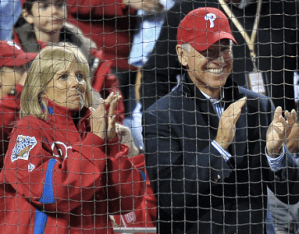
President-elect Joe Biden and his wife Jill, in Phillies gear, watching a game at Citzens Bank Park.

When Donald Trump first took the job he will vacate in January, the Washington Nationals hastened to invite him to throw out a ceremonial Opening Day first pitch. At least, the team and the White House were in “talks” toward arranging it. The then-new president seemingly hastened not to accept the invitation thanks to a “scheduling conflict.”

That was then, this is now. Trump is on the threshold of departing office as only the second sitting American president not to throw out a ceremonial first pitch at any major league baseball game since William Howard Taft introduced the practise in the first place. Who would have thought Trump shared common ground with Jimmy Carter?

President-elect Joe Biden is known to be a longtime Philadelphia Phillies fan but not otherwise sinister on a personal level. (He likes to joke that being a Phillies fan allows him to sleep with his wife.) That didn’t stop the Nationals from extending him a post-victory invitation to come to Nationals Park, just about any old time he chooses, Opening Day preferably, and throw out a ceremonial first pitch.

Spotting the invitation on Twitter myself during a Saturday visit, I couldn’t resist replying to the Nats as I’d replied to Jesse Dougherty, the Washington Post‘s Nationals beat writer: Biden should do well throwing out such a first pitch. He won at last by standing on the mound with the bases loaded, two out, and a full count in the bottom of the ninth, and freezing Trump with a called strike three on the low outside corner.

“[Biden] was up by 4 million+ runs, so not a save situation,” tweeted one respondent. No, but I probably should have made clear that Biden and Trump dueled in a complete game that went to extra innings before Biden finally delivered the game-ending strikeout.

Complete games have become baseball outliers over a longer period of time than stubborn baseball “traditionalists” want to admit or care to research. (The last time half or more of a season’s games were complete games: 1922; the last time forty percent or more were such games: 1946; the last time thirty percent of more were such games: 1959.) So don’t fault the respondent for not knowing one when he saw one.

Biden/Trump wasn’t quite analogous to the most fabled extra-innings complete game, between Harvey Haddix and Lew Burdette in 1959, but the Biden/Trump game in presidential politics is even more of an outlier than was Haddix taking a perfect game to the bottom of the thirteenth.

Trump, of course, pitched the extra innings under protest. No few of his arguments compared to the kind a frustrated 1960 Yankee fan might have made, when he or she noticed the Yankees out-scored the Pittsburgh Pirates (55-27) in the World Series the Pirates won and proclaimed thus that those Yankees were the true Series winners. Well, no, they weren’t.

Those Yankees weren’t exactly outliers, either. Eighteen other teams in World Series history have out-scored the opposition while losing the Series. The Yankees themselves had three other such Series, in 1957 (they out-scored the Braves by two), 1964 (they out-scored the Cardinals by one), and 2003. (They out-scored the Marlins by four.) They’ve also been outscored in three Series (1962, 1977, 1996) they won.

But I digress. Give Trump credit where due: he may have performed the most unusual first-pitch ceremony of all time in September 2004. Invited to throw out the first pitch for the Somerset (NJ) Patriots, Trump audaciously landed his corporate helicopter in center field, then strode to the mound to wind up and throw. For the record, he threw something arriving just under the floor of the strike zone that might have meant a swinging strikeout in actual competition. Might.

Trump did interrupt a coronavirus briefing from the White House in July to say he’d be throwing a first pitch out at Yankee Stadium come 15 August, before a game between the Empire Emeritus and the Boston Red Sox. The president spoke about an hour and a half before Dr. Anthony Fauci threw one out at Nationals Park on baseball’s pandemically-delayed Opening Day. (We do mean “out”: Fauci’s pitch would have been a strike . . . if the low outside corner was more adjacent to the on-deck circle than the plate.)

It proved to be news to the Yankees, more or less; they told reporters the president hadn’t actually been given an invitation for that date. Trump countered that he’d gotten the invite straight from the Yankees’ team president Randy Levine, who’d once been rumoured to be on Trump’s list of candidates for his White House chief of staff.

Levine didn’t affirm or deny, but another Yankee official said subsequently that the invite was on. The invite may have been on but that Trump first pitch ended up not happening.

Biden has said since his win that he’d like to work in a bipartisan spirit as best as possible in (speaking politely) contentious Washington. I have a suggestion for the president-elect and the Nats that might show he means business when Opening Day arrives next April.

He could do as then-president George W. Bush did when major league baseball returned to Washington in 2005. Bush was presented a unique baseball to throw for the ceremonial first pitch, owned by the late Washington Senators relief pitcher Joe Grzenda, who’d saved it from the final Senators game, ever.

Grzenda intended to throw that ball to Yankee second baseman Horace Clarke at the plate, with two out and the Senators looking to say farewell with a 7-5 win on 30 September 1971. Thanks to heartsick Senators fans bursting the fences, swarming the field, leaving the RFK Stadium field and scoreboard resembling the remains of a terrorist attack, and forcing the umpires to forfeit the game to the Yankees, Grzenda never got to pitch to Clarke.

But he kept the ball and, at long enough last, got the invite to throw it as a first pitch in RFK in 2005 before the freshly transplanted (from Montreal) Nationals opened for new business. Instead, he handed the ball to Bush, likewise clad in a Nationals jacket, and Bush—ironically, a former co-owner of the Texas Rangers that the Senators became—threw a neat breaking ball up to the plate.

Nats catcher Brian Schneider caught the Bush pitch. He had ideas about keeping the ball until Grzenda asked to have it back and the memorabilia-happy catcher obliged.

Grzenda died in July 2019. (Clarke passed away three months ago.) Assuming his family still possesses the ball—which Grzenda pitched to get Bobby Murcer on a grounder for the second out before being unable to pitch to Clarke—Biden’s people might think to ask them for the honour of throwing that ball out for the Opening Day first pitch.

The Nats might also think about making that particular ball an annual Opening Day first pitch tradition. They don’t have to worry about weird mojo attaching to the ball. Their 2019 World Series triumph took plenty of care of that.

If Biden jinxes or fouls his own presidency, it won’t be because he throws the last ball of Washington Senators baseball. Just be sure he doesn’t get any bright ideas about arriving at Nationals Park to do it by way of landing Marine One in center field.
Advisory and consignment

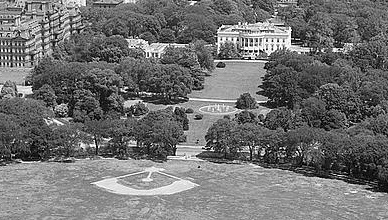
Once upon a time, they played baseball just south of the White House. On a large, circular field with four baseball diamonds, known as the White Lot. (The Ellipse sits there now.) They did it first in the year Abraham Lincoln was elected to the White House on the threshold of the Civil War.

Some today think the presidential election finally done and affirmed was a spiritual equivalent of a civil war. Some also thought it would take longer to settle the election than it took for the Cubs to win their first World Series since the deaths of Butch Cassidy and the Sundance Kid.

Now that it’s been decided at long enough last, first I place President-elect Joe Biden on notice: Your presidency to come will be judged first and foremost by your positions on the four most serious issues facing these United States today.

Mr. Biden, your first order of business is acceding to plain sense and supporting the universal designated hitter. Your next is standing athwart the free cookie on second base to begin each extra half inning, the three-batter minimum for relief pitchers, and the permanently-expanded postseason.

Now, I bid advance farewell to the departing president whose early life included playing a little high school first base and, for whatever reasons lost to history long enough, reputedly attracting a little attention from the Philadelphia Phillies. He grew up (spoken facetiously) to use the presidential bully pulpit for pointing the way to sports wisdom by taking positions that ran, not walked, in the opposite direction entirely.

It didn’t begin with a February tweet in which Mr. Trump demanded, and I quote, “Pete Rose played Major League Baseball for 24 seasons, from 1963-1986, and had more hits, 4,256, than any other player (by a wide margin). He gambled, but only on his own team winning, and paid a decades long price. GET PETE ROSE INTO THE BASEBALL HALL OF FAME. It’s Time!

A president who thinks (erroneously) that Article II of the Constitution granted him the license to do as he damn well pleased as president isn’t a president on whom the rules make any great impressions. I remind you first of the precise language of baseball’s rules and defy you, concurrently, to find one syllable suggesting the prescribed punishment for Rose and any other such gambler on baseball is contingent on whether he bet on his team to win:

1. Any player, umpire, or club official or employee, who shall bet any sum whatsoever upon any baseball game in connection with which the bettor has no duty to perform shall be declared ineligible for one year.

2. Any player, umpire, or club or league official or employee, who shall bet any sum whatsoever upon any baseball game in connection with which the bettor has a duty to perform shall be declared permanently ineligible.

Second, I remind you that the Hall of Fame itself, an independent body in actual fact, enacted a rule declaring that those on MLB’s permanently ineligible list were likewise ineligible to stand for election to the Hall of Fame.

The Hall enacted the rule when it looked very much as though Rose would be elected despite his banishment. In effect, the Hall asked itself whether the game’s highest known honour could and should be conferred upon those considered persona non grata in the game itself.

Mr. Trump’s February revival of an argument he enunciated a time or two in the past (especially when commissioner Rob Manfred denied Rose’s reinstatement in 2015) wasn’t even close to the only time he showed his faith that the rules don’t mean a thing if they ain’t got that swing toward his preferences.

Almost a year earlier, he decided that disqualified Kentucky Derby winner Maximum Security was a victim of—wait for it!—political correctness.

The Kentucky Derby decision was not a good one. It was a rough & tumble race on a wet and sloppy track, actually, a beautiful thing to watch. Only in these days of political correctness could such an overturn occur. The best horse did NOT win the Kentucky Derby – not even close!

The best horse in that Derby broke the following rule to enable the victory of the 65-1 longshot Country House: “If a leading horse or any other horse in a race swerves or is ridden to either side so as to interfere with, intimidate, or impede any other horse or jockey, or to cause the same result, this action shall be deemed a foul . . . If, in the opinion of the stewards, a foul alters the finish of a race, an offending horse may be disqualified by the stewards.”

Perhaps the best wisecrack in the immediacy of Mr. Trump’s pronouncement came from a CNN reporter, Ana Navarro: “Apparently one horse won the popular vote and another horse won the Electoral College.”

When Mr. Trump appeared in Nationals Park during Game Five of the 2019 World Series, two things stood out especially: 1) He hadn’t attended a single Washington-area sports event since he assumed his oath of office. 2) The seventh inning found a considerable contingency in the stands chanting “Lock him up! Lock him up!” a la his 2016 campaign crowds chanting likewise for his opponent Hillary Clinton.

Those who thought the chanting was aimed at Mr. Trump might have been disappointed to know they were really aimed at home plate umpire Lance Barksdale, whose dubious ball-and-strike calls—especially the ball four Barksdale called strike three on Nationals center fielder Victor Robles—left you unable to determine whether Nats fans or Astro fans were more outraged.

Mr. Trump had to settle merely for being booed. Many of his minions were not amused. Some among them thought it was unprecedented disrespect to a sitting president. Herbert Hoover (Prohibition-weary Philadelphia Athletics fans booing when not chanting “We want beer!” at the 1931 World Series), Harry Truman (booed on Opening Day, 1951, after throwing out the first commander of U.N. Forces Korea), the first George Bush (he got his at the 1992 All-Star Game not long after breaking his no-new-taxes promise), the second George Bush (at the Nats’ 2008 home opener, from perhaps a war-weary and economically nervous audience), and the only Barack Obama (he got his in St. Louis when he threw out a ceremonial first pitch before the 2009 All-Star Game for wearing a White Sox jacket), might have argued against the lack of such precedent.

This week’s protracted election vote counting and state calling provoked Mr. Trump and the Twittersphere alike to round after round of remarks ranging from the sublime to the ridiculous and all the way back to the you-had-to-be-there. The most popular might have been Mr. Trump hereby declaring himself the winner on more than one premature occasion, and the Twitterpated hereby declaring all manner of previously-decided sports contests decided otherwise.

I couldn’t resist joining the fun on one online forum and declaring the St. Louis Browns the winners of the 1944 World Series. As the week plodded onward, though, I was almost convinced it would take more time to declare a winner between Messrs. Trump and Biden than it took for the Dodgers to return to the Promised Land. Almost.

No, no—a thousand times, no

Steve Cohen’s purchase of the Mets closed Friday. Almost at once, Cohen became the Mets’ version of the Hoover—beating, sweeping, cleaning. He flipped team president Sandy Alderson’s switch and Alderson hit the carpet roaring.
General manager Brodie Van Wagenen? Hasta la Volkswagen. Special assistant and former GM Omar Minaya? Gone. Assistant GMs Allard Baird and Adam Guttridge? Bye, bye, birdies. Executive director of player development Jared Banner? Dearly departed.

So said ESPN’s “news services” within a blink of the Cohen purchase closing. And then, a red flag: “Friday’s moves make [manager Luis] Rojas’ future uncertain. Fired Astros GM Jeff Luhnow, who completed a season-long suspension last week, could be a candidate for the analytics-oriented Cohen.”

Met fans celebrating the official consecration of Cohen as the new owner and that feeling of relief with the eighteen-hundred-ton Wilpon truck finally pulling away and off their backs should be hollering, “Danger, Will Robinson!”

They should remember that Alex Rodriguez and Jennifer Lopez and their gang probably got spurned as potential Met buyers not just because they couldn’t round up the full dollars but because A-Rod was foolish enough to seek informal administrative counsel from Luhnow, while Luhnow remained under suspension and J-Rod were still in the running to buy the team.

They should remember that seeking Luhnow’s advice on baseball operations compares to seeking marital counseling from Zsa Zsa Gabor.

They should remember that Luhnow continues blaming God’s will or any and everybody else for the Astrogate debacle that brought that a world champion and American League West dominator not to its knees but to a stance of defiance despite being exposed as particularly extralegal electronic video cheaters.

They should remember that, given another chance to own up, Luhnow lied to Houston NBC reporter Vanessa Richardson when he said, “Whether it’s the players or the video staffers, they just decided on their own to do it and that’s a shame, because had they come and asked me for permission I would have said no. Had they gone and asked Jim for permission, he would have said no. There’s just no reason why that should have happened.”

They should remember that,  even before the advent of the Astro Broadcasting Company, Luhnow was exposed (by Wall Street Journal reporter Jared Diamond) as seeing and not rejecting a front office-developed algorithm, Codebreaker, that the intern showing it to him said could be deployed for off-field-based sign stealing.

They should remember that Luhnow’s Astro “culture” was well exposed as a result-oriented culture in which human relationships were cheap, disposable, and disregarded. ”Luhnow had all year to speak,” thundered baseball writer Jose de Jesus Ortiz in a delicious Twitter rant. “But as was the case throughout his tenure Luhnow is as calculated as ever. That’s why baseball folks throughout the country say he’s dismissive of traditional baseball folks, scouts, players, etc. He sees them as assets, people to manipulate.”

They should remember that Luhnow dismissed the near-complete opposition in his front office, when he dealt disgruntled relief pitcher Ken Giles for then-under-domestic-violence-suspension relief pitcher Roberto Osuna in 2018. And, that Luhnow tried to cover the hide of his then-assistant Brandon Taubman being so fornicating glad they got Osuna in the presence of female reporters after the Astros won the 2019 American League Championship Series.

They should remember that, when Luhnow said to Richardson, “there’s no reason why we needed to explore breaking the rules to gain an advantage, it made no sense to me,” it begged the question of why Luhnow didn’t kill the Astro Intelligence Agency in its Codebreaker crib.

They should remember that 2017 Astros designated hitter Carlos Beltran, hired by Van Wagenen to manage the Mets last fall, never got to manage even a single spring training game for the Mets—because Beltran’s own Astrogate culpability got him suspended for 2020, too.

They should remember that it’s one thing for the Tigers to hire a repentant A.J. Hinch, especially since he won’t be getting his second chance at the original scene of the crimes at which he looked the other way, mostly; but, it’s something else that the Red Sox re-hired Alex Cora, whose fingers were all the way in the Astrogate pie, while not quite being in the pie known as the Rogue Sox Replay Room Reconnaissance Ring. Hinch and Cora are like the Watergate burglars but not the Big Enchiladas when all is said and done.

They should ask aloud that, if the new owner about whom they’re raving otherwise is as analytically inclined as advertised, Cohen shouldn’t even think of Luhnow and the stain he’d bring to the Mets, when there are likely a good number of candidates with the same inclination but a parallel respect for the humans who work or play under them and an equal disinclination toward cheating your way to the top.

They should insist that Cohen, who’s shown a remarkable agreeability to reasonable fan input, keep the house clean once he’s cleaned it up. That Cohen and Alderson should have but one thing to say about even the outside prospect of inviting Luhnow into his remaking/remodeling Mets: “No, no—a thousand times, no!”

Alex Cora, prodigal manager

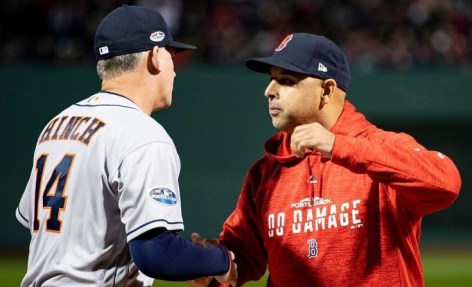
Red Sox manager Alex Cora (right) in a 2018 ALCS handshake with his Houston counterpart A.J. Hinch. Cora’s been re-hired by the Red Sox, while his fellow Astrogater Hinch gets his second chance in Detroit.

Well, I was wrong. About Sam Fuld possibly having the faster track to the job and Alex Cora finding a new one elsewhere. The Red Sox rehired Cora to manage them Friday. Have they let a cheater come back to the scene of the crime?

Cora’s Astro Intelligence Agency culpability was deep enough it was too easy to believe he had a hand or at least a fingertip in the 2018 (and maybe 2019) Rogue Sox Replay Room Reconnaissance Ring. It’s also a truism oft repeated (including by me) that when you lead you take responsibility for what’s done by the troops.

But baseball’s government pinned that replay reconnaissance responsibility on Red Sox video room operator J.T. Watkins. Pinned it on him or scapegoated him for it, depending on your point of view. Either he or someone he allowed decoded opposing signs and signaled them to Red Sox baserunners to send home to the hitters at the plate.

Watkins took the fall. The MLB investigation that discovered the Astros went above and beyond just using what MLB itself provided in the replay rooms behind all dugouts but that the Rogue Sox just got caught doing what a few other teams at minimum must have been doing likewise.

“I know J.T. and how he works,” Cora said when Watkins was taken on the perp walk. “I trust the guy. Was I surprised at what came out? Yes, I was.”

Whether Cora beat the Rogue Sox rap on a technicality, or really didn’t have any clue as to what Watkins and who knows which Red Sox players were up to, Cora has his old job back. His Astrogate suspension ended the moment the World Series did. Officially, anyone with the opening was free to hire him.

If he was in it up to his neck in Houston he was found caught pants down with everyone else in Boston, officially. Unofficially, suspicions will cling. That’s the nature of the human beast. Begging the question for many as to why the Red Sox elected to bring back someone who’d been caught dead to right cheating above and beyond in one town even if he just might have been innocent enough in theirs.

“Forgiveness comes a little easier,” writes The Athletic‘s Chad Jennings, “when there’s a [World Series] ring involved.”

In that sense, Cora was the Red Sox safest choice. Any other manager would have faced an inevitable comparison. Early losing streak? Cora could have stopped it. Under-performing player? Cora would have known what to say. Disappointing season? Not on Cora’s watch. He maintains some benefit of the doubt, even beneath the weight of his past transgressions.

In other words, the hapless Ron Roenicke—handed the bridge after Cora’s exit, but helpless to keep the Red Sox together following their winter trade of franchise player Mookie Betts, the ownership’s greater concern for staying beneath the luxury tax threshold over fortifying the team’s compromised pitching staff, and several key injuries (Andrew Benintendi, Eduardo Rodriguez, Chris Sale)—didn’t stand a chance.

According to Jennings, Roenicke might have felt Cora’s “spectre” hovering overhead—except that he denies it. “No, never,” the skipper who’d been Cora’s bench coach said. “And the reason I can say that is because Alex should be managing . . . I’m hoping he does this again, whether it’s here or somewhere else, he should be managing.”

“At the time that we parted ways with Alex,” says Chaim Bloom, the Red Sox GM/chief baseball officer, whose longtime knowledge of Fuld—former outfielder turned Phillies player information coordinator—helped drive speculation of Fuld taking the bridge, “we were clear that that was a result of his role and what happened with the Astros and everything the investigation over there revealed. It had nothing to do with what may or may not have occurred in Boston.”

It’s enough to make you wonder whether bringing Cora back was Bloom’s ultimate choice or whether—the way then-GM Ben Cherington had Bobby Valentine jammed down his throat after the 2011 collapse—the Red Sox ownership likewise stuck Cora down Bloom’s throat.

Valentine, of course, took on a fragmented team and detonated a season-long bomb worth of divide-and-conquer dissipation. His firing after that 2012 disaster practically detonated block parties around New England. Cora’s departure practically detonated mass mourning that a guy with his brains and his ability to keep his players on board had to go.

Players and others within the Red Sox organisation couldn’t bear to let Cora go entirely even as the Red Sox leadership pushed him away with little choice following the affirmation of his Astrogate culpability. For those players partaking of Watkins’s replay room espionage, it must have felt like Dad going to the calaboose unfairly for the kiddies’ breaking the neighbourhood.

Hinch was popular with his Astros players, too, but once the Astros fired him and GM Jeff Luhnow upon their Astrogate suspensions the Astros showed little inclination or longing to bring him back. Even as the Red Sox put distance between themselves and Cora, they kept their eye on him a little longingly in the distance, ultimately re-narrowing it.

“[O]nce he departed,” writes NBC Sports Boston’s John Tomase, that opened the door for Bloom to make his own hire, since the manager-GM relationship is the most important in baseball operations”

And Bloom sent consistent signals that he planned to look elsewhere, a point reinforced by the process that ultimately led us back where we started.

With Cora available and ready to be rehired, Bloom still conducted a lengthy search, interviewing multiple candidates and eventually identifying five finalists. The choice reportedly came down to Cora vs. . . . Fuld, whom Bloom knew from Tampa.

The Red Sox will insist that at the end of this process, Bloom and Bloom alone chose Cora, and that had better be true. Because otherwise it means that ownership either tacitly or explicitly overruled its baseball boss on his most consequential hire . . . Imagine bypassing a beloved figure for a first-timer like Fuld? The last thing a rookie manager needs to be greeted with is resentment.

Surely Tomase isn’t alone in pondering what might have been if the White Sox had reached out for Cora instead of Hall of Fame manager Tony La Russa, who was only too clearly an ownership move instead of their GM’s. Would Bloom have felt free to hand Fuld the Red Sox bridge after all? We’ll never know.

It’s not that cheaters haven’t been forgiven before. The New York Giants’ leadership may have been well aware of Leo Durocher’s telescopically-buzzing cheating scheme down the 1951 stretch, but it was a third-place finish the year after they swept the Indians in the World Series that got Durocher fired.

Fred Hutchinson may or may not have sanctioned scoreboard-based sign-stealing by his pennant-winning 1961 Reds, but it took 1964’s courageous but fatal battle with lung cancer, not 1961’s telescopic cheating, to seal Hutch’s fate.

Cora’s culpability in the Rogue Sox Replay Room Reconnaissance Ring isn’t even close to being as cut and dried as his Astro Intelligence Agency activities proved to be. For now, no matter. Officially, Watkins paid for any and all Rogue Sox sins. Unofficially, Lucy, they’ve still got some splainin’ to do.

Every baseball eye in and away from Boston will put Cora and the Olde Towne Team under the most acute microscope since Zachariah Janssen invented the thing—in the year Urban VII became the shortest-reigning Pope (three months) in the history of the Catholic Church. It won’t necessarily be inappropriate.

Could Fuld be the next Red Sox manager?

Sam Fuld, who fought the walls only too often as an outfielder, may have an immediate future as a manager—where he doesn’t have to bang his head on walls to make points.

Don’t look now, but someone is making a better impression upon the Boston Red Sox’s brass in the team’s managerial search than you might have thought. His name isn’t Alex Cora, either.

Sure, Cora’s still in the running to reclaim the job his Astrogate shenanigans cost him last winter. Sure, his squeeze-out happened even before we saw affirmed that his Rogue Sox turned out to be cheaters of a slightly less nefarious variety en route their own 2018 World Series conquest.

Like former Astros manager A.J. Hinch, Cora deserves another chance after having served the sentence that ended the moment the World Series did. But notice that Hinch is getting his in Detroit, not Houston. No matter how popular he was among his Red Sox players, Cora’s second chance cannot come in Boston.

You have to ask? Maybe Cora did or didn’t order, abet, or merely encourage his 2018 and maybe 2019 Rogue Sox to steal signs off the feeds in their video replay room. You don’t applaud cheating qua cheating when you say the Rogue Sox can be seen as led into temptation by MLB itself providing the apparatus. (Behind both dugouts in all parks, by the way)

But you don’t absolve Cora or his troops for giving in. Just because Mom and Dad left the keys to the hooch hutch lying around open before going out for the evening it doesn’t mean their short-of-legal-age kids have the license to get themselves swacked.

Let’s give the benefit of the doubt a moment and assume Cora didn’t order, abet, or merely encourage. No matter. The first responsibility of leadership is that you take responsibility for what your subordinates do. Or, undo. Hinch learned the hard way, too. He was a lot more forthcoming in the aftermath while he was at it. When he spoke of wishing for a second chance, he never exactly said it ought to be with the Astros.

To those Red Sox fans who were just as outraged over the Red Sox Replay Room Reconnaissance Ring as Astro fans outraged over the Astro Intelligence Agency, take heart. If Red Sox general manager Chaim Bloom gets his way, you might see a white knight riding in from Philadelphia soon enough.

MLB Network’s Jon Heyman says former outfielder turned Phillies coordinator for player information Sam Fuld has “a real chance” at landing the Red Sox bridge. “Fuld, who is from (New Hampshire) and is well regarded,” Heyman says, “can’t be ruled out here as Bloom is said to love him going back to their [Tampa Bay] Rays days.”

It’s not that Bloom’s unaware that previous Red Sox GMs found their ultimate managerial choices overruled by Red Sox ownership. Just ask now-Pittsburgh Pirates GM Ben Cherington. His choice after the infamous 2011 collapse, and Terry Francona walking subsequently before he could be booted, was anybody but Bobby Valentine.

Valentine wandered into a clubhouse already toxic from the 2011 collapse and played with matches. Even the 27 disabled-list trips Red Sox players made in 2012 weren’t half as detrimental as Valentine’s divide-and-conquer style. Questioning popular but aging Kevin Youkilis’s heart in hand with his physical health lost the skipper his clubhouse too early that season.

Valentine threw so many people under buses in Boston that Cherington probably sang “Happy Days Are Here Again” to himself when he got to fire Valentine after that season ended. The last thing Bloom should want now is to get an ownership boot in the backside by way of a forced hire he might have to can after 2021.

“Bloom may want a fresh start as he rebuilds this team from the ground up—in which case Fuld sounds like the man for the job,” writes Yahoo! Sports’s Darren Hartwell.

“The new chief baseball officer deserves his own hire, and Cora made his life miserable when he threw a managerial search on top of trading a franchise player last winter,” writes NBC Sports Boston’s John Tomase. Bloom’s public statements about Cora have been cool at best, suggesting the former skipper needed to undertake some serious soul searching and image rehabilitation following his central role in Houston’s cheating scandal. If Bloom wants to start fresh, why interview Cora at all?”

Why indeed. But Red Sox brass traveled to Cora’s home in Puerto Rico to talk to him. You might think that’s an exercise in futility, considering Cora isn’t exactly an unknown quantity to the Red Sox. You’d also think the Red Sox wouldn’t need to know anything—other than, perhaps, the depth of his contrition for his Astrogate role and Soxgate allowance—that they didn’t know already.

Fuld was a hustling outfielder who rarely met a wall or fence he didn’t think he could conquer on the run. His frequent spells on the disabled list reminded him there were more than a few walls and fences that didn’t suffer fools or outfielders gladly. If he studied baseball history formally, the one day he ditched was probably the day they taught the sad story of Pistol Pete Reiser.

He defied the still-lingering prejudice against players who weren’t six foot-plus galoots, yet he didn’t make his first team right out of spring training until he was 29. He was also a solid contact hitter who could extort his way on base and whose injuries—especially one to his wrist ligaments—probably eroded those skills far sooner than they should have.

Fuld was also as analytically-inclined as a player as he was the type who dared the outfield to blow him to Kingdom Come. When the Phillies hired him following his 2017 retirement, Fuld became so well respected that he was on the short list for several managerial openings including four last fall. The Cubs, the Mets, the Pirates, and the Giants gave him serious looks before Fuld turned them down to stay in his Phillies job.

But with the Phillies canning GM Matt Klentak and their next GM likely to look for his own people, Fuld is probably very available now. He’s not exactly alien to New England, either. He’s the son of a longtime University of New Hampshire dean and a former New Hampshire state senator, and he grew up an avid Red Sox fan, keeping posters of Nomar Garciaparra on his bedroom wall and visiting Fenway Park as often as he could.

Fuld once made a big day of his own at Fenway while playing for the Rays. On 11 April 2011, he went 4-for-6 and might have hit for the cycle except for his final plate appearance, where he needed a single to finish the cycle but hit the ball far enough down the line that he knew he had a shot at the clean double and had to take it.

Consummating the cycle would have made headlines, highlighted SportsCenter, and thrilled his visiting family even more. But baseball’s more than great theater, and Fuld knew it. “I never thought about stopping at first,” he told ESPN’s Tim Kurkjian post-game. “That’s not the right way to play the game. If you can advance to the next base, you advance. That’s the only way to play baseball.”

A guy who surrenders a cycle to play the game right is a guy who’ll take his marriage of right play and right analysis and get whatever rebuilding Red Sox are handed to him to play the game right. Assuming Bloom is allowed his head rather than unexpectedly bereft of it, Fuld should be more than just a little green dot on the Red Sox radar.