“The sooner one side blinks, the better”

Chris Davis and the Orioles remain locked in an expensive dance.

Two seasons ago, Chris Davis finally cried out from the wilderness of his ionosphere-salaried decline. A few months after the eyes of the nation fell upon the grace with which he handled and finally ended an unconscionable hitless-game streak, Davis finally boiled over following a low throw across the infield that he couldn’t handle at first base.

He had words with his Orioles manager Brandon Hyde, after Hyde apparently made a remark about the errant scoop attempt. Hyde may have been as painfully unaware of Davis’s own internal estimation of his own self-deflation as Davis was in the moment that the skipper had enough trying to stir accountability within a mediocre team.

The Orioles had the next day off. Davis spent it the best way he knew, regrouping with his wife and children. “That’s really the only way that I know kind of how to escape, is just to be a dad, and be a husband,” he said. “I enjoyed the time with them, but I look forward to coming back in there and getting back to work with these guys.”

When he returned to work the first thing Davis did was report to Hyde to apologise and talk frankly. He told reporters he thought both himself and his skipper “had an off day. I think it was probably best that we did, just to kind of give us a little bit of time. I didn’t think about it a whole lot. I tried not to. I think he was kind of in the same boat.” Hyde for his part said nothing suggesting he’d hold the meltdown against Davis.

Davis spoke of “a couple of weeks” worth of frustration, but the suspicion was that he really meant more than a couple of seasons. His collapse after signing a lucrative seven-year deal has been nothing short of surrealistic.

Bravery when you lead your league in home runs two out of three seasons running is simple. Leading the league in striking out two consecutive seasons makes bravery a lot less simple. Then, when your OPS (.539, 2018)  is lower than the lowest team OPS in the league (the 2018 Tigers: .697), bravery isn’t even a topic. Not when you might be tempted to say, as a button given Frank Robinson while he managed a murderous Oriole losing steak decades earlier, “It’s been lovely, but I have to scream now.”

Barring either Davis or the Orioles or both deciding at long enough last that the proverbial jig is up, they’re stuck with each other until the end of the 2022 season. “Davis and the Orioles,” Baltimore Sun writer Jon Meoli wrote last month, “are in a staring contest over the remainder of his career that neither seems to be willing to blink in.”

On pure baseball terms, things look simpler. Trey Mancini is recovered from cancer and looking to be the regular Oriole first baseman; they have a little juggling to think about in the designated hitter slot with Renato Nunez absent for the time being, but bank on it. That won’t be Davis’s full-time job, either.

What does it do to a man who has tasted greatness at one point in his professional career only to taste harder-sustained failure elsewhere during the same career? From 2013-2016 Davis was a no questions asked great hitter who looked like a classic late bloomer. (He was 27 in 2013.) His past four seasons have made that spell resemble a protracted flash in the proverbial pan.

Enough players have had such long enough terms of greatness followed by far longer terms of invisibility. Baseball is more crowded than the busiest airport or railroad station by those players whose careers were nondescript but who had blinks when they resembled men who stepped forth from the lands of the giants.

For every Dick Radatz (three years: the nastiest reliever in baseball; five injury-pushed years of low-fi pitching later: career over) there’s a Moe Drabowsky. (Game One, 1966 World Series; nothing much otherwise but beloved pranksterism—and surrendering Stan Musial’s 3,000th career hit.) For every Roger Maris (busting ruthsrecord in the middle of three Hall of Fame-like seasons; injury-abetted fall over six years to follow), there’s a Pablo Sandoval. (Game One, 2012 World Series; nothing much otherwise beyond his roly-poly Kung Fu Panda image.)

Former Orioles infielder Mike Bordick, once a Davis teammate and now an Orioles broadcaster, thinks Davis has people rooting for him to re-emerge from his protracted collapse even if such re-emergence may never happen. He’d had a good spring training before baseball shut down over the coronavirus pan-damn-ic last year, but he had less than a stellar “summer camp” before an injury curtailed a mediocre enough irregular season for him.

A Davis comeback is “never going to happen because of his work habits,” Bordick told NBC Sports Washington in December.

He proved that after he left spring training [last year] because when he came back he wasn’t the same. He didn’t have the same explosive bat speed. He didn’t even have the same mental attitude. He thought he could repeat that without the repetition of the work. Unfortunately, it doesn’t happen in baseball. Period. I don’t care what age you are, but as you age in this game, you actually have to work harder, not less.

One of the most human of impulses is the belief that, because you did it and sustained it once before, you can do it again, at will. Davis isn’t the only ballplayer to learn the hard way how that can veer between difficult and impossible. Even for those who work harder as elders than they did as live youth.

Just ask Hall of Famer-to-be Albert Pujols, who may yet retire after this season after a decade worth of his feet and legs betraying him to the point where he looked a sad impersonation of his once off-the-charts-formidable self. And Pujols, one of the proudest of men ever to play the game, never stopped working hard.

“The sooner one side blinks,” Meoli concluded of Davis and the Orioles, “the better for all involved.” Whichever side does blink at last, it’ll take a glandular swallow of pride.

On living rent-free in one’s head

From Sandy Koufax, Game Seven, 1965 World Series . . .

Moments, acts, and people living rent-free in one’s head don’t always have to be the ones that broke your heart. When an online baseball group member asked fellow members for such moments, I found it impossible not to think of a truckload of such moments. Of course, many will betray my age. I’ve been betrayed by worse.

Fair disclosure: I don’t lack for non-baseball moments living rent-free in my head. Things such as the first time I wrote with a fountain pen, my first unaccompanied-by-elder jaunt around the New York subways, my first airplane flight, my first experience with a Gibson guitar, my first crack-of-dawn in Air Force basic training, my first paid published newspaper by-line, my first turn on radio.

But ask me about baseball and I probably have enough tenants living rent-free in my head to fill an apartment house. Half way, at least:

* Hall of Famer Sandy Koufax. On two days’ rest. A second shutout with nothing but a fastball left after 359 innings that year. Game Seven, 1965 World Series.

* Willie Davis. Three errors. Top of the fifth, Game Two, 1966 World Series—costing Koufax a win in what proved his final major league game.

* Donn Clendenon ripping a home run over the left field auxiliary scoreboard in Shea Stadium, right after Cleon Jones was awarded first base for the shoe-polish plunk, Game Five, 1969 World Series.

* One not-so-foggy Christmas Eve, 1969: Curt Flood writing to commissioner Bowie Kuhn that he didn’t believe he was just a piece of property to be bought and sold at will.

* Oakland owner Charlie Finley’s capricious attempt to fire infielder Mike Andrews over a couple of errors not entirely of his own making, Game Two, 1973 World Series—and Shea Stadium sign man Karl Ehrhardt, the next day, greeting the first A’s fielding miscue with a sign: YOU’RE FIRED! 1973 World Series.

* Carlton Fisk’s “body English” home run to win Game Six, 1975 World Series.

* ‘Twas the day after Christmas, and all through the house, baseball went ballistic when arbitrator Peter Seitz ruled in favour of Andy Messersmith. 1975.

* Reggie Jackson. Three pitchers. Three pitches. Three swings. Three bombs. Game Six, 1977 World Series.

Tommy Lasorda deciding it was safe for Tom Neidenfuer to pitch to Jack Clark with first base open and the Dodgers one out from forcing a seventh 1985 NLCS game—and Jack the Ripper deciding how unsafe it was with what proved a pennant-winning three-run homer three-quarters of the way up the left field bleachers.

* Don Denkinger. If you have to ask . . . (Even if it wasn’t his fault the Cardinals imploded in Game Seven.)

* Mookie Wilson and Bill Buckner. If you still have to ask . . .

* Phillies pitching coach Johnny Podres forgetting to tell Mitch (Wild Thing) Williams to abandon the slide step (which Podres put on in the first place to keep Hall of Famer Rickey Henderson from grand theft) and pitch straight, no chaser to Joe Carter, Game Six, 1993 World Series.

* Derek Jeter and The Flip.

* Mike Piazza’s mammoth blast in the bottom of the eighth, in the first Mets home game following baseball’s break after the 9/11 atrocity.

* Dusty Baker handing Russ Ortiz the game ball somewhat ostentatiously, when lifting him in Game Six, 2002 World Series, and Scott Spiezio making Felix Rodriguez pay for it to start the Angel comeback that forced the Game Seven they won.

* Alex Gonzalez and the double play hopper bounding off his glove, eighth inning, Game Six, 2003 NLCS—with the Cubs five outs from going to the World Series they wouldn’t reach yet.

* Alex Cora. Dodger Stadium. Eighteen-pitch plate appearance ending in a two-run homer. May 2004.

* Dave Roberts. David Ortiz. Game Four, 2004 ALCS.

* Curt Schilling and the bloody sock game, Game Six, 2004 ALCS.

* “Back to Foulke—Red Sox fans have longed to hear it! The Boston Red Sox are world champions!”

* Albert Pujols vs. Brad Lidge, Game Five, 2005 NLCS. (The only thing keeping Pujols’s blast in the building was the retractable roof bracing of Minute Maid Park.)

* Pujols, three bombs after the sixth inning, in a kind of reverse cycle (three-run homer, two-run homer, solo homer), Game Three, 2011 World Series.

* David Freese. Game Six, 2011 Series.

* Kung Fu Panda. Three bombs. Game One, 2012 Series.<

. . . to Mookie Betts, Game Six, 2020 World Series.

* Madison Bumgarner. Game Seven, 2014 Series. In relief.

* “Now, that’s announcing yourself . . . Game on!” crowed Tom Verducci, the Sports Illustrated prose poet working as a Fox Sports commentator, when Noah Syndergaard dropped Alcides Escobar on the first pitch, leading off Game Three, 2015 Series.

* Lucas Duda unable to make a simple throw home to finish what should have been a Game Five-winning double play to send the 2015 Series back to Kansas City.

* The Cubs. Finishing their 108-year rebuilding effort. 2016 World Series.

The first Angels home game following the tragic death of pitcher Tyler Skaggs. Every Angel wearing Skaggs’s uniform number 45. Mike Trout opening the 13-0 proceedings with a two-run homer. Pitchers Taylor Cole and Felix Pena combine on a no-hitter. July 2019.

* Unaware that a standoff between a narcotics suspect and Philadelphia police left six officers wounded during the game . . . Bryce Harper. Bottom of the ninth. The Phillies down two runs with the bases loaded. The mammoth ultimate grand slam flying past the foul pole into the second deck. Harper running it out as though he had a process server on his tail. August 2019.

* Howie Kendrick. Salami. 2019 NLDS.

* Kendrick, ringing the foul pole and the Astros’ bell, Game Seven, 2019 World Series.

* “The Rays are going to ask for the biggest hit in the life of Brett Phillips.” Game Four, bottom of the ninth, last year’s World Series.

* The Mookie Monster. Last year’s World Series.

And I have many more apartments to fill before my eventual date in the Elysian Fields.

Lew Krausse, RIP: Accidental co-pioneer

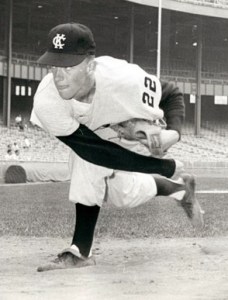
Lew Krausse, warming up on the sideline at Yankee Stadium when he was young and an Athletic.

Being suspended and fined by Charlie Finley over a nebulous accusation put righthanded pitcher Lew Krausse into a very unlikely position. Inadvertently, he helped baseball players still bound by abuse of the old reserve clause see what could be had if they were allowed to negotiate on a fair, open market for their services.

The first six-figure bonus signing in Athletics history, Krausse died at 77 two days after Valentine’s Day. Finley’s foolishness involving a notorious 18 August 1967 team flight provoked outfielder Ken (Hawk) Harrelson’s release, a public remark from Harrelson that made him persona further non grata with the A’s, and into unexpected and profitable free agency.

Aboard a 3 August flight from Boston to Kansas City, Harrelson and pitcher Jack Aker sat near the rear of the aircraft, knocking back drinks while Harrelson tried getting Aker to relax over the reliever’s frustration over a spell of bad pitching. How that translated to trouble was anybody’s guess, because when the A’s flew from Kansas City to Washington on 18 August, Finley ordered the flight crew not to serve drinks to his players.

That flight landed with the players learning Krausse was singled out, suspended, and fined $500 for . . . who the hell knew exactly what? “Conduct unbecoming a major league player,” Finley’s public statement said. A’s manager Alvin Dark apparently talked to several players and concluded that Krausse did nothing more than play soft in-flight pranks on broadcaster Monte Moore. If there’s one behaviour that’s never been unbecoming of major leaguers, it’s been practical joking.

The problem was that Moore, reportedly, decided to lose his sense of humour about it and to lie about it. He told Finley a very different story, one involving Krausse addressing a pregnant woman aboard the same flight in “deplorable language.” That accusation had the same credibility as a seven-dollar bill.

Dark refused to deliver Finley’s suspension order to Krausse. Finley promptly demanded a meeting with Dark at the team hotel, after the A’s landed in Washington for a set with the Senators. The meeting lasted as long as some doubleheaders did. During the meeting, Finley fired Dark, un-fired him, then fired him again—after the manager was handed a players’ statement having his back and zinging Finley both for the Krausse incident and, among other things, for sending spies out to follow them off the field.

Harrelson was one of the more vocal A’s having Krausse’s back. He even called Finley a menace to baseball while he was at it. Meanwhile, Major League Baseball Players Association director Marvin Miller filed a formal complaint with the National Labour Relations Board after Finley, apparently, tried coercing his players into dropping their support for Krausse. The capricious owner also withdrew Krausse’s suspension but refused to budge on the $500 fine.

That in turn prompted Krausse and fellow A’s pitchers Aker and Jim Nash to demand trades. In due course, Aker would be left open to the expansion draft that made him an original Seattle Pilot, and Nash would get his wish after that 1969 season when he was traded to the Braves for veteran outfielder Felipe Alou. And Krausse would be traded to the Pilots in January 1970 . . . before their eleventh-hour move to Milwaukee to become the Brewers.

After his 25 August 1967 release, Harrelson found himself the unlikely subject of a bidding war on his unexpected open market. If Hall of Fame pitchers Sandy Koufax and Don Drysdale showed players what could be done when they bargained together in spring 1966, the fun-loving Hawk was about to show them something Koufax and Drysdale couldn’t quite show.

According to Peter Golenbock’s Fenway, Harrelson refused to retract his public remarks, rejected Finley’s initial attempt to send him to the minors, challenged Finley to suspend him, yet said he didn’t want to be released for fear of being blackballed out of the game. Finley released Harrelson on 25 August, anyway. Baseball’s jaw dropped.

Finley had just dumped the hottest hitter on his team; in 61 games with Kansas City following a trade back to the team from Washington, Harrelson’s slash line was .305/.361/.471. “Now,” Golenbock wrote, “Harrelson was scared. He blinked back tears. Was he through?”

Not even close. His telephone rang just a short while after Finley released him. The White Sox’s general manager Eddie Short called to say that, four days later, after he cleared the irrevocable waivers list, the Hawk would be a free agent. He could sign any old place he pleased. How much would it take to bring him to Chicago? Harrelson, whose 1967 salary was $12,000, replied: $100,000.

Short didn’t faint. He said only that he’d get back to Harrelson. Then came calls from the Tigers and the Red Sox, and the Braves. The Tigers and the Red Sox didn’t make offers at first, despite Red Sox executive Heywood Sullivan once being a Harrelson teammate, but the Braves—whose then general manager Paul Richards just so happened to be one of Harrelson’s golf friends—offered him $112,000.

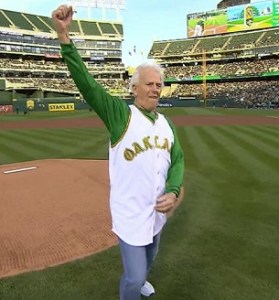
Lew Krausse, after throwing a ceremonial first pitch to mark the A’s fiftieth anniversary in Oakland.

“Harrelson called Sullivan,” Golenbock wrote, “and told him he had an offer from another club worth over a hundred thousand and was taking it. Once Sullivan learned the club was in the National League, he wished Harrelson luck. Both Detroit and Baltimore said they would give him more than the Braves, but Harrelson decided he’d have more fun with Richards. Money was important, but not that important.”

Enter Red Sox GM Dick O’Connell. The pennant-challenging Red Sox were desperate for outfield help after Tony Conigliaro’s tragic beaning the day after Finley tried suspending Krausse. Harrelson told O’Connell he’d committed to “another club” without naming the Braves, but O’Connell wouldn’t surrender without a fight. “You don’t understand, Kenny,” the GM said. “We’ve got to have you here. How much money would it take for you to play in Boston?”

Money may not have been that important, but Harrelson was no fool, either. His reply was $150,000. O’Connell simply said it’s a done deal. In an unexpected bidding war, the Hawk bagged himself a $138,000 pay hike.

He went to the Red Sox, where he didn’t hit often but made it count when he did hit with thirteen runs batted in down the stretch, and mostly let his outsize personality take the press pressures away from other players as the Red Sox nailed the 1967 pennant at the eleventh hour themselves. (The Hawk would have an outstanding 1968 in Boston and make himself a fan and player favourite alike.)

Seven years later, when Dodger pitcher Andy Messersmith finished what former Cardinals outfielder Curt Flood started, Hall of Fame catcher Ted Simmons said, “Curt Flood stood up for us. [Catfish] Hunter showed what was out there. Andy showed us the way.” Simmons forgot about what Harrelson reaped in the immediate aftermath of the bungled Krausse incident. Hunter may have shown the millions, but Harrelson showed six figures on an unexpected open market.

Krausse probably had no idea of the chain reaction he’d provoke on that fateful August 1967 flight.

You’d love to say that Krausse went on to great triumph himself, but it wasn’t to be. He had the talent–he won his first major league start with a three-hit shutout against the expansion Angels in 1961, days after receiving his $125,000 bonus; he eventually pitched the first shutout from any Brewers pitcher in July 1970. But he also had arm and elbow issues that may or may not have been ignored by the A’s.

In 1966, The Sporting News quoted then-A’s director of player development George Selkirk as quoting in turn a doctor who, in 1961, “said the boy had the arm of a man of 25 because Krausse had pitched so much as a boy. The doctor said he doubted Krausse could pitch over a period of years.”

The namesake son of a short-lived 1930s Philadelphia Athletics pitcher–who ended up signing his own son as an A’s scout–managed to eke out parts of twelve major league seasons between starting and the bullpen. When he was good, he often pitched through terrible run support. After doing assorted jobs during his off-seasons, he had a successful post-baseball career running a metals business.

He had just as successful a marriage to Susan Wickersham, whom he met when she was a flight attendant in 1969. In fact, Mrs. Krausse told the Kansas City Star something telling about the man: her husband not only went unforgotten by Kansas City fans, he received daily letters including baseball cards in the mail to autograph–and, when those requests included a few dollars, “Lew always returned the money.”

May the Lord have welcomed the inadvertent pioneer home to the Elysian Fields gently but warmly.

The Machine is winding down?

Albert Pujols, hitting the 661st home run of his major league career last September to pass Willie Mays. His wife says he’ll call it a career when his contract ends after the 2021 season.

“Since the time he was a child, [he] would eat, sleep, and breathe this sport,” wrote Deidre Pujols on Instagram Monday. Right after she announced that that day would be day one of her husband, Albert’s final season as a major league baseball player. The loving husband responded to his wife’s post with three heart emojis.

The game and those who love it are liable to respond with a lot more than that. Tears included. Not just because of what Pujols was and the no-questions-asked Hall of Fame greatness he personified, but because of what injuries—almost all involving his feet and legs—made of the second half of his career.

But will he retire after this season, really?

Mrs. Pujols subsequently updated the post. “Today is the first day of the last season (based on his contract) of one of the most remarkable careers in sports!” it now reads. Then, she updated it again, saying she wanted only to send him into this season with blessings.

His ten-year, gigabucks Angels contract expires after this season. His tenure has been so injury addled that there came times Angel fans wondered if the Cardinals, who declined to re-sign the first baseman after the 2011 season, hadn’t slipped a whoopee cushion under their tails.

Under normal circumstances nobody likes to see the greats hit their decline phases. Were there more heartbreaking sights than Babe Ruth as a feeble Boston Brave? Walter Johnson, Warren Spahn, Satchel Paige, Robin Roberts, Whitey Ford, and Henry Aaron showing their ages at last?

Those men at least enjoyed the shorter declines. Pujols’s body turned his into a decade. Willie Mays’s kicking-and-screaming decline lasted seven years, heartbroken that he could no longer play the game he loved the way he did for so long. Steve Carlton spent almost half a decade jumping from team to team trying to find the left arm that went AWOL after almost two decades of Hall of Fame excellence. Pujols beat him and everyone else by almost double.

Last year, Pujols finally met and passed Mays on the all-time home run list. Earlier that pan-damn-ically truncated season, Pujols received a text from Mays: “It’s your time now. Go get it.” On 13 September, Pujols finally got it to tie. He turned on Rockies reliever Carlos Estevez’s 1-1 fastball and drove it just the way he did it in the truly glory years, half way up the left field seats on a parabola down the line.

Five days later, Pujols turned on Texas reliever Wes Benjamin’s fastball right down the chute on 1-2 and drove it into the visitors’ bullpen in Angel Stadium to pass Mays.

For a few brief, shining moments, Angel fans were reminded of treasures not really theirs to know, and Cardinal fans from a distance were reminded of what they were so fortunate to see for eleven transdimensional seasons. Watching a transdimensional talent who never stopped believing he absolutely had to get better.

The three-run detonation off Brad Lidge in the 2005 National League Championship Series, kept inside Minute Maid Park only by the retractable roof bracing wall. The reverse cycle of homers in Game Three of the 2011 World Series, every one of them after the sixth inning: the three-run homer, the two-run homer, the solo blast. The deadly lifetime postseason record. All those seasons as the game’s greatest righthanded hitter as well as a very run-preventive first baseman.

And, the sweet way Pujols paid tribute to the Cardinals legend who’d long befriended him, when Hall of Famer Stan Musial died in 2013. “I know the fans call me El Hombre, which means The Man in Spanish,” Pujols insisted, “but for me and St. Louis there will always be only one Man.”

Pujols was so emphatic about it that, when he became an Angel and the organisation festooned southern California with billboards announcing El Hombre‘s arrival, El Hombre blew his sombrero. He insisted very publicly that only one player should ever be called The Man, and his name wasn’t Albert Pujols. It takes longer for mob hit men to disappear their victims than it took the Angels to dispose of those billboards.

You think that was for showing and not for blowing? Few players have had as deep a reverence for baseball’s history as Pujols has had. That depth enabled Pujols to befriend Musial and mentor Mike Trout, “who might be the only position player this century to match [Pujols’s] level of peak greatness,” says The Athletic‘s Fabian Ardaya.

When Pujols said of Trout last year, ““We have the best player in the game, and five or six years from now, he’s going to be making history, too,” he didn’t have to be told Trout’s already made some history of his own. He knows it. He respects it. He mentored Trout into becoming the Angels’ team leader not by way of claiming the role for himself but by what he does on the field and how he lives off it.

Pujols himself lives a well-apportioned life away from baseball. Among other things, when not raising his own family, he and his wife have worked arduously with Down’s syndrome children—among whom is their own daughter, Isabella—and against human trafficking.

His lower body ruined what should have been a kinder, gentler, simpler decline phase. It’s left him prone to as much criticism under ordinary, non-milestone circumstances as he received high praise whenever the vintage Pujols made the periodic cameo. If the Angels looked foolish for signing him long-term and extraterrestrial salary after the injuries began to chip him down, they never once doubted Pujols was giving the best he had with whatever he had left.

““He plays through discomfort,” former general manager Billy Eppler told MLB.com after he tied Mays. “He endures a lot and doesn’t talk a lot about it. But I can tell you that he’s definitely someone that wants to play and fights through a lot of adversity to make sure he’s out there and contributing to the club.”

Even those whose admiration for him didn’t crumple the way his injuries forced him to crumple hoped somewhere, somehow, several times the past few years, that Pujols would swallow his formidable pride, leave the rest of his formidable money on the table, let nothing further tarnish his near-singular legacy, and sink into that ten-year services contract he still has with the Angels following his retirement.

“It has been so hard to watch one of the greatest players in the history of baseball fade like this,” wrote another Athletic scribe, Joe Posnanski, almost a year ago. “Each year, I hope against hope for Pujols to be Pujols one more time. Sadly, that just isn’t how time works. He is 40 now and a decade past his prime. It hasn’t been a sad career, though; far from it. It has been extraordinary. It has been an inspiration.”

It’s not unfair to say Pujols’s contract hamstrung the Angels when administrative tunnel vision didn’t when it came to re-tooling the team back to contention. Neither is it unfair to say that spending that much for a well-established Hall of Famer who hadn’t yet been hit with his physical issues didn’t have to mean the Angels ignoring their other issues, either.

Like his final Cardinals regular season, Pujols’s first Angel season was solid, if below his former standard. His 2011 postseason and how he helped the Cardinals win that outer-limits World Series may have deked people into thinking he’d only had one off year but plenty of petrol left in reserve.

Then plantaar fascitis in his heel kept him to 99 games in 2013 and a staggering enough fall from even that 2012 performance. Further injuries below his waistline made sure he’d look like an imitation of himself from then on, despite a few shining hours, a few significant milestones, a few moments in which he looked exactly the way he did over those impeccable St. Louis years.

But he didn’t hold a gun to the Angels’ heads and tell them to waste their remaining resources, either. The Angels have been an anti-model franchise during most of Pujols’s tour with them. If Pujols calls it a career after the season to come, the Angels, their fans, and their critics won’t have Pujols to blame for what wasn’t his fault in the first place.

This is Pujols according to my Real Batting Average metric (TB + BB + IBB + SF + HBP / PA):

PA TB BB IBB SF HBP RBA
Career 12,394 5923 1331 312 115 108 .628
With the Cardinals 7433 3893 975 251 68 77 .708
With the Angels 4961 2030 356 61 47 31 .509

That’s what the injuries did in turning what should have been a natural decline phase into a hard-lived one.

Albert Pujols was a .708 batter as a Cardinal. His career RBA with a normal decline phase should have lined him up to finish at the top of the heap of Hall of Fame first basemen who played their careers in the post-World War II/post-integration/night-ball era. If his .628 holds by the end of this year, it’ll plant him in between Jeff Bagwell and Willie McCovey, and Pujols was the better all-around first baseman among those three plus first base RBA leader Jim Thome.

Pujols’s other nickname has been The Machine. Unfortunately, even machines have finite lives to do what they were built to do. They don’t all decline as sadly as this one did. Even if this one’s going make what promises to be a singular Hall of Fame acceptance speech in 2027. With Stan Musial smiling broadly upon him from the Elysian Fields, if not blowing him a chorus of “Take Me Out to the Ball Game” on his ubiquitous harmonica.

“Why did he quit?” Joe DiMaggio’s brother, Tom, once said when asked why the Yankee Clipper would call it a career after thirteen war-disrupted seasons and a persistent heel issue that turned into back trouble. “He quit because he wasn’t Joe DiMaggio anymore.”

Maybe the gigabucks Pujols earned as an Angel kept him from quitting precisely when he wasn’t really Albert Pujols anymore. Maybe his pride did it. Maybe both. Maybe, come the next off-season, it’ll be impossible at last for Pujols to tell himself he can be day-in, day-out great again. Maybe he’ll tell himself at last it’s time to let his whole record take him out of the box and into Cooperstown.

And maybe the Angels will find ways to a) make the game’s best player since Pujols joined the team proud; and, b) reach the postseason to send Pujols into retirement in a blaze of glory.

We can dream, can’t we?

On Mather’s cringeable blather

Kevin Mather has put more than his foot in it.

You say you’d like to know why it is that right-thinking baseball fans trust major league owners about as far as Walter Alston could hit major league pitching? (Alston grew up to be a four-time World Series-winning manager—but he struck out in his lone major league plate appearance.) Four words: Seattle Mariners, Kevin Mather.

Over the weekend now past, we learned Mather informed the Bellevue Breakfast Rotary Club via early February Zoom conference of many things the Mariners probably preferred not reach the public eye and ear. That’s Bellevue the city in Washington state, not Bellevue the legendary New York City psychiatric hospital.

According to Mather’s 5 February blather, the Mariners think nothing of player service time manipulations. Former Mariners pitcher/freshly minted Mariners special assignment coach Hisashi Iwakuma improved his English “dramatically” when told his interpreter would cost the team $75,000 a year. Outfield prospect Julio Rodriguez is larger than life but he “is loud, his English is not tremendous.”

Mather’s English is only too tremendous, alas.

“Perhaps Mather is at the extreme with his discriminatory remarks . . .  and what he perceived as the difficulty [Iwakuma and Rodriguez] have faced in learning English as a second language,” writes The Athletic‘s Ken Rosenthal. “Or maybe some other executives think this way, but he was the only one in his position dumb enough to say such things in a public forum.”

The Mather blather turned up on YouTube this past Friday but was taken down Sunday—after the SB Nation blog Lookout Landing posted a complete transcript. Rosenthal wonders whether the Mariners, who were tone-deaf enough not to fire Mather after he was accused of sexual misconduct in 2018—resulting in financial settlements to women accusing Mather and two other team executives—will tune their hearing enough to fire him now.

Mather admitted to the Rotarians that the Mariners offered another top outfield prospect, Jason Kelenic, a six-year deal with three team options that Kepnic rejected while planning to demote Kelenic back to what’s left of the minors in April. Mather described Kelenic as “betting on himself,” as though the Mariners president thought the outfielder was plain out of his noodle.

“[Mather’s] cringeworthy musings, one more misguided than the next,” Rosenthal writes, “are Exhibits A through Z in why many players and fans hold owners in contempt. If this is how ownership types really think, why should any of them be trusted?”

“After pondering it for several days and talking to the union, he’s turned us down and in his words, he’s going to bet on himself,” Mather said of Kelenic according to the full transcript. “He thinks after six years, he’ll be such a star player that the 7th, 8th, 9th year options will be under value. He might be right, he might be right, we offered and he turned us down.”

We’re not exactly taking about a group of people who were simon pure in the past. Too often, baseball owners and their designated operators have pointed the way to wisdom by exercising behaviours and offering opinions completely contemptuous of it.

But even among a group historically infamous for disparaging players at designated strategic moments (think for openers of Branch Rickey’s infamous and boneheaded bid to run down Hall of Famer Ralph Kiner during a contract haggle by comparing him to Babe Ruth, with several false arguments), Mather stands now with his own singular infamy.

His “requisite” apology (Rosenthal’s word) seemed just that, little enough more. Thom Brennaman’s spontaneous on-air apology after an unexpected hot-mike moment in which he blurted about “one of the –g capitals of the world” before returning to the Reds play-by-play was more substantial and less scripted.

“By the time the session was over, Mather had given the union 45 minutes of bulletin-board material, at a time when tensions between the players and owners are the highest they have been since the players were on strike in 1994-95,” Rosenthal writes.

His comments about Iwakuma and Rodriguez alone should be enough to prompt his dismissal. But then, the outcome of the team’s investigation after Mather was the subject of two complaints from female employees in 2009-10 should have been enough to remove him. And the good ship Mariner rolled merrily along.

It would be a rank understatement to say here that the Show suffers a long-continuing pandemic of foot-in-mouth disease. To those who think Mather’s firing would be arbitrary and not long overdue, you might care to remember an ancient musing from the historian and Pulitzer Prize-winning poet Peter Viereck: “Any bid to scrape the barnacles off an excellent ship is never taken to be an attack on the ship itself. Except by the barnacles.”

——————————————————————————————-

Update: Kevin Mather resigned as the Mariners’ president Monday afternoon. Managing partner John Stanton will act as interim president until hiring Mather’s replacement.