No, Roberto Alomar wasn’t Pete Rosed

Roberto Alomar

Roberto Alomar’s new baseball ineligibility doesn’t mean a backdoor pass into Cooperstown for Charlie Hustler.

Let’s get this out of the way first and foremost, since (it almost figures) at least a few social media tweeters raised it. Hall of Fame second baseman Roberto Alomar’s fresh ineligibility to work in baseball doesn’t mean Pete Rose suddenly gets a pass to stand for Hall of Fame election.

The news broke Friday that Alomar—working as an advisor to baseball’s government and a Blue Jays special assistant concurrently—is now on baseball’s ineligible list over sexual misconduct said to have occurred in 2014, at the sad expense of a baseball industry employee. He’d been elected to Cooperstown on his second try in 2011.

“Roberto Alomar got Pete Rose’d today,” tweeted Ice Cat Sports Cards, from South Dakota. “If Roberto Alomar is on the Ineligible list,” asked a tweet by someone handling himself ElScorcho, “how can he stay in the Hall of Fame? I mean that says Pete Rose should be in right?”

Wrong.

Specific details of Alomar’s sexual misconduct aren’t disclosed as I write. But it happened three years after he was elected and inducted into the Hall of Fame. (To its credit, the commissioner’s office engaged an independent law firm to investigate.) If he’d committed the misconduct that now has him purged before 2011, Alomar wouldn’t have even been on the ballot, never mind elected.

Rose violated Rule 21(d) before he would have made his first Hall ballot. The very likelihood that he might be elected despite his ban prompted the Hall to rule: if you’re ineligible to associate with organised baseball, you’re not eligible to appear on a ballot conferring the game’s highest honour.

No, ladies and gentlemen, Roberto Alomar did not get Pete Rosed on Friday. Any drumbeating for shoving Rose into the Hall of Fame on the basis of Alomar’s banishment is factual and moral idiocy. So don’t even think about hammering the Hall of Fame for refusing to purge Alomar.

“When he was elected to the Hall of Fame by the Baseball Writers’ Association of America in the Class of 2011, Alomar was an eligible candidate in good standing,” the Hall said in a formal Friday statement. “His plaque will remain on display in the Hall of Fame in recognition of his accomplishments in the game, and his enshrinement reflects his eligibility and the perspective of the [Baseball Writers Association of America] voters at that time.”

Alomar isn’t the first to land on baseball’s permanently ineligible list over sexual misconduct or its concurrent behaviours. Former Astros assistant general manager Brandon Taubman got there for crowing he was so [fornicating] glad they obtained relief pitcher Roberto Osuna while Osuna was still under investigation for domestic abuse. A rant delivered in the presence of three female reporters in the Astro clubhouse after they won the 2019 American League Championship Series.

The persona non grata list also includes one-time Cardinals scouting director Chris Correa, thanks to his being caught red-handed hacking into the Astros’ databases. It also includes former Braves general manager John Coppolella, after he inflated or deflated signing bonuses for Dominican prospects to maneuver around baseball’s international signing rules.

Maybe the BBWAA will fume over the Hall of Fame refusing to purge Alomar. But at least  one member might advise not so fast. “I don’t disagree with the Hall’s more measured response,” wrote Toronto Star columnist Rosie DiMinno Friday, after commissioner Rob Manfred announced the Alomar termination and purge.

It would be insupportable to retroactively banish someone from Cooperstown when egregious conduct comes to light. Just imagine going backwards in time and stripping a player of that specific honour, a summation of career brilliance, for behaviour which is now recognized as reprehensible but wasn’t then. So many scoundrels are in the Hall and, at least figuratively, their statues would have to be toppled.

Please don’t ask which such scoundrels not named Cap Anson and Kenesaw Mountain Landis would be removed from the Hall right now. You won’t like a lot of the answers. They might or might not only begin with Babe Ruth.

Lisa Banks, the attorney for the unnamed woman at the center of the Alomar purge, sent a statement out as well. Quoted by DiManno, Banks said, “We applaud MLB for having this matter thoroughly investigated and for taking meaningful action against Mr. Alomar . . . My client has no plans to file a lawsuit or take further action. She has not exposed Mr. Alomar’s behaviour for notoriety or for money and looks forward to moving on with her life. She simply wants to ensure that Mr. Alomar is held accountable.”

But DiManno goes forward saying that while baseball has a perfect right to purge someone over particular misbehaviours, since being in professional baseball is not an absolute right but an absolute privilege, something about the Alomar case isn’t quite passing the proverbial smell test yet.

. . . I don’t know what Alomar is alleged to have done and Manfred isn’t telling. I do know that some accusations, when exposed in a court of law, criminal or civil, do not rise to the threshold of conviction. And nowhere have I seen a claim that Alomar’s conduct was criminal. It might or might not pass the sniff test of a human rights complaint. It clearly did not pass scrutiny of the MLB investigation — conducted independently by an external legal firm . . .

I wish there were more details disclosed about the alleged incident, which surely could have been done without identifying the complainant . . . I’ve covered enough legal proceedings on this subject to understand that a great deal of nuance separates accusation from even the lower bar of civil action proof. The vacuum of information leaves a worrisome gap for warranting so ham-fisted a decision.

And that, she continues, “comes from someone who was once called a [fornicating (four-letter euphemism for ‘vagina’ starting with ‘c’)] by a player in the Jays clubhouse; who, on another occasion, had a player simulate pelvis thrusting from the rear while I was bending over to conduct an interview with another player at his stall. These were not incidents I reported to the club or to my employer. I’m just not that delicate a flower.”

The Blue Jays will disappear Alomar’s presence promptly enough, the team has said, including pulling his commemorative banner down from Rogers Centre and removing him from its Level of Excellence. The Jays also said in their own statement they’re committed to an environment of respect for everyone in their organisation, applauding concurrently the unnamed woman who stepped forward in the first place.

This is not a pleasant denouement for the man who hit what DiMinno says remains, arguably, the single most important home run in Blue Jays history. That would be the Game Four-tying two-run homer off Hall of Famer Dennis Eckersley in the top of the ninth, finishing a comeback from a five-run deficit, pushing the Jays to the eleven-inning win that gave them a 3-1 American League Championship Series advantage in 1992. En route their first World Series conquest.

I’m not entirely convinced that launch compares to Joe Carter’s World Series-winning three-run bomb in 1993. But you can’t convince me Alomar’s blast off Dennis the Menace wasn’t just as important in Jays history. “Emotional bonds are difficult to sever,” DiManno opened. “Historical facts can’t be expunged.”

Neither can a Hall of Famer eligible for election and getting elected well enough before the acts that got him banished from baseball eligibility. Alomar’s behaviour as a three-year Hall incumbent is terrible enough, without using it to argue Rose into the Hall when Rose’s rule breaking got him blocked before he was eligible for a Cooperstown ballot at all.

Harper’s class can’t fix a true pitching dilemna

Bryce Harper

Bryce Harper took the highest road before Thursday’s Phillies-Cardinals game. Phillies reliever Hector Neris took the lowest in the ninth Thursday night.

When the Phillies and the Cardinals tangled the night after Bryce Harper and Didi Grigorius took back-to-back drills, from Cardinal reliever Genesis Cabrera’s first two pitches of the top of the sixth, you’d have understood almost completely if the Phillies came out bent on making the Cardinals pay.

You’d have understood because a) Harper’s was the truly frightening one, taking a runaway 97mph fastball on the left side of his nose that knocked his helmet clean off and him to the ground; and, b) the umpires saw fit to issue nothing but warnings to both side, without doing what one of today’s most foolish new rules bars a manager from doing.

But therefore you wouldn’t have known that Harper himself put a stop to any possibility of all-out war before the Phillies and the Cardinals met again Thursday. Until Phillies reliever Hector Neris said not so fast in the bottom of the ninth at Cardinals third baseman Nolan Arenado’s expense.

I couldn’t find the exact words in question, but Harper sent Cardinals manager Mike Schildt a text message saying, essentially, Your guy wasn’t trying to decapitate me, he had an off night, you know it and I know it, and I didn’t get my brains blown out or my head torn off, so don’t let it blow you or him apart, my dudes, we’re good.

Whatever the actual words Harper sent Schildt the day after he nearly went from Genesis to Revelation, Schildt was nothing but appreciative. It’s not every day that an almost-headless man shows a little empathy for the unintended executioner.

“Whoever’s a fan of Bryce Harper, whoever has children that are fans of Bryce Harper, support that guy,” Schildt told reporters. “Because what he sent over in a message today was completely a class act.”

If anyone knows the difference between lack of intent and deadly intent, it should be Harper. Four years ago, almost, then-Giants pitcher Hunter Strickland opened the top of the eighth facing then-National Harper by hitting Harper in the hip—in payback for a three-year-old pair of postseason home runs—with a pitch so obvious that Stevie Wonder would have seen intent without blinking twice.

Before the rule mandating relief pitchers face three batters at minimum unless he came in mid-inning and ended the inning before a third batter faced, Schildt by his own Wednesday night post-game admission would have gotten Cabrera the hell out of there after following Harper’s near-beheading with a drill through Grigorius’s ribs.

Why the umpires didn’t remains a mystery at this writing. The umps have been asleep at the switches an awful lot this season thus far, on the field and even in the replay review rooms in New York. If they’re not calling strikes on pitches far enough from the zone that you could fly a plane through the space, they’re calling walkoff hit by pitches on near-flagrant bids to take one for the team with the pillows stuffed.

On Wednesday night, they warned both the Phillies and the Cardinals against any further funny business. Then, they ejected Phillies manager Joe Girardi when he sailed out of his dugout demanding accountability for Cabrera’s obvious wildness following the Grigorius drill.

“I understand they don’t want things to escalate. They don’t want people to get hit. But if a guy hits a guy in the face and a guy in the ribs with two pitches, he’s got to go, right?” Schildt himself told the press post-game. “If you’re really protecting the players, obviously, he doesn’t have command. He’s got to go.”

The official rules don’t specify when an umpire can order a wild pitcher out of a game on behalf of keeping peace. But The Baseball Codes author Jason Turnbow, writing on his Website of the same name, says the arbiters have the option by default: “[U]mpires have one more wrinkle to consider in the same spirit as bench warnings: Those times when ejecting a pitcher for his own good might actually serve to cool tensions from both sides of the field.”

Sometimes it seems as though almost nobody wants to address a concurrent issue that Harper’s former Nationals teammate Ryan Zimmerman does: baseball organisations seeking and finding pitchers who can throw supersonic pitches but haven’t learned to control them properly.

“You see these teams just call up these guys that throw 95 or 100 mph and the team doesn’t really care. They’re just trying to see if they have anything in them,” Zimmerman told the 106.7 radio station’s Sports Junkies podcast after his old mate and friend nearly lost his head Wednesday night.

A couple years ago, these guys would be in Double-A or Triple-A for another year trying to learn how to pitch but these teams just call them up to see if they can kinda hit lightning in a bottle. If not, they send them back down. They don’t care if they hit four guys on the other team. What does it matter to them? The [general manager] of the other team is not in the box, so he doesn’t care. It’s a different kind of game but it is what it is and that’s where we’re at.

You almost predict what those clubs want: floods of strikeouts. But Hall of Famer Bert Blyleven got floods of strikeouts (3,701 lifetime) and his money pitch was maybe the third most monstrously voluptuous curve ball yours truly has ever seen. (Numeros two-o and uno: Dwight Gooden, and Hall of Famer Sandy Koufax.)

It’s bad enough that the three-batter relief minimum throttles managers from getting wild pitchers out of there before they do worse damage than turned out done to Harper and Grigorius Wednesday night. It’s worse when baseball organisations seem to believe pitching is purely a matter of who can throw the lamb chops faster and farther past the wolves.

“Hitting is timing,” Hall of Fame lefthander Warren Spahn once said. “Pitching is destroying timing.” That was then, this is now, and for once the Old School has it right. Today hitting may still be timing, for all the overstated obsession with launch angles and exit velocities, but pitching today often seems oriented on destroying batters instead of their timing.

In case you were curious, the prankish Spahn—whose money pitch was a screwball and who happened to be one, himself, especially allied to longtime Braves buddy Lew Burdette—averaged two hit batsmen a year.

That was also then: minor league legend Steve Dalkowski could throw a cruise missile past a fighter jet on Mach-plus cruising speed. But he couldn’t find the strike zone with a search party and bloodhounds half of the time. (The ill-fated Dalkowski never saw one inning’s major league action: he’d barely made the ’63 Orioles roster in spring training when he blew his elbow out during an exhibition game.)

This is today: If Zimmerman is right, today’s organisation wouldn’t care half as much for Dalkowski’s inability to find and keep the strike zone as for his ability to scare the opposition to death and back.

NBC Sports writer Matt Weyrich says there are some hard numbers supporting Zimmerman’s theory: In 2018, the Show set a new record with 1,922 pitches hitting batters. Then, in 2019, the Show broke that record by 62. The wild pitches also climbed, with the Show’s seven highest wild pitch totals “all recorded in the seven seasons from 2013-2019.” This year’s 291 wild pitches and 354 pitches hitting batters, Weyrich adds, threaten to set new league records yet again.

Remember the postgame exchange between fictitious Durham Bulls manager Skip Riggins and coach Larry Hockett about Dalkowski-inspired pitching prospect Nuke LaLoosh in Bull Durham?

Riggins: He walked eighteen.
Hockett: New. league. record.
Riggins: He struck out 18.
Hockett: Another new. league. record. In addition, he hit the sportswriters, the public-address announcer, the bull mascot— twice—also new. league. records. But, Joe—this guy’s got some serious shit.

In theaters and on DVD, that’s about ten laughs. In the real game, it’s as funny as a shave with a Mixmaster. “You’re in the big leagues,” Zimmerman told that podcast. “There’s kind of a thought that if you’re at this level, you should be able to control — especially if you’re throwing 97 mph.”

Did any rough stuff happen between the Phillies and the Cardinals on Thursday night, then? Well, yes, there was—briefly. And that was with neither Harper nor Grigorius playing, Girardi having added that both players would be re-examined when the team returned to Philadelphia today to open a weekend set with the Mets.

With the game tied three-all, and two outs in the bottom of the ninth, Neris decided Harper didn’t speak for him when sending Schildt that pregame, give-peace-a-chance text.

Neris gave his own piece a chance at the expense of Cardinals third baseman Nolan Arenado—hitting him up and in and on the back of the shoulder on the only pitch of the plate appearance.

Would Girardi or any other Phillie care to expose just who whacked Neris with the stupid stick? The righthander resembled a bullying coward willing to endanger his own team for the sake of who the hell knew exactly what. He was lucky the benches didn’t clear after betraying the letter and intent behind Harper’s olive branch.

It wasn’t as though the next Cardinal batter was liable to blast a two-run homer to win it on the spot. Tyler O’Neill plays major league baseball in the first place because he’s a very plus outfielder. At the plate, calling him a spaghetti bat might be putting things politely. Don’t think Neris wasn’t aware of it when he did what four Phillies pitchers preceding him didn’t even think about doing.

He hit one of the Cardinals’ big sticks to take the easy out, striking O’Neill out on three pitches. Neris is lucky Schildt took the higher road likewise, applauding the Arenado hit as “old school baseball.”

Then another Phillie reliever, David Hale, threw a wild pitch past Cardinals shortstop Edmundo Sosa, a pitch catcher J.T. Realmuto might or might not have been able to block successfully considering its movement. It allowed O’Neill—who began the inning as the free cookie on second to open it, and took third when Cardinals catcher Andrew Knizner grounded out leading off—to score the winner in the bottom of the tenth.

Neris should count his blessings that it looks as though he won’t get a week’s detention.

From Genesis to Revelation

Bryce Harper

Bryce Harper, a split second before his nose met Genesis Cabrera’s fastball leading off the sixth Wednesday night.

Eons ago, it seems now, Yogi Berra had a handy response to those who thought he looked like one of the title supporting players in Edgar Rice Burroughs’s Tarzan of the Apes. “It don’t matter if you’re ugly in this racket,” the Hall of Famer said, “All you have to do is hit the ball. And I never saw anybody hit one with his face.”

Berra got a few laughs while he drove home one point. But the flip side is that you can see one hitter too many take one with his face, which is every hitter who ever had to do it.

Thank God and His servant Stengel that it’s still the exception. It still doesn’t erase the fear of longtime watchers and fans that the latest such victim will be the game’s next Tony Conigliaro. Such fears even among his critics struck when Bryce Harper’s face was in the top of the sixth Wednesday night.

Hit one with his face? Harper led off the inning seeing one pitch from Cardinals reliever Genesis Cabrera. The pitch sailed up and into Harper’s nose on the left side while knocking his batting helmet clean off his head and the Phillies’ right fielder crumpling to the ground in the batter’s box.

The man who nearly went from Genesis to Revelation merely picked himself up, dusted himself off, and walked away from the plate under his own power. Rather gutsy for a man who was lucky he wasn’t decapitated by a fastball that veered so far off course it would have inspired “Mayday! Mayday!” calls from the crew if it was an airplane.

What we ought to be hearing now is louder demands that the ridiculous three-batter minimum for relief pitchers unless they ended an inning facing fewer needs to go the way of the Oldsmobile. Faster than the Oldsmobile went away, too.

Phillies manager Joe Girardi anguished for his man but maintained in the moment, sending Matt Joyce out to pinch run. Then Phillies shortstop Didi Gregorius checked in at the plate. He saw one pitch from Cabrera, too. This time, the errant fastball didn’t sail up toward his sight lines but, rather, did a magnificent job of trying to bore a hole in his ribs.

The umpiring crew issued warnings to both sides. Nothing more. Since a manager can’t remove an out-of-control relief pitcher until he’s seen three batters minimum under the current and extremely dubious rule, it should be on their heads as to why Cabrera was allowed to remain in the game despite two pitches dropping two batters dangerously enough.

That was enough to send Girardi sailing out of his dugout in raw fury. As might you if you’d seen the first two of your men scheduled to bat in the inning coned and drilled back-to-back, on two pitches, courtesy of a pitcher who’d just entered the game but shown as much control as a runaway truck.

Raw fury and naked fear. Girardi knows only too well the terror of fastballs reaching your face. He took one in his own pan from then-Padres pitcher Woody Williams in 2000. As happened to Harper Wednesday night, that Williams pitch drew blood from Girardi’s own schnozzola. “It’s extremely scary,” he said of Harper’s drop, “and I can tell you from experience.”

Under normal circumstances, Girardi is one of the more mild-mannered men in baseball, even given his well-known competitiveness. But he was enraged almost as much by the umps not even thinking of sending Cabrera to the rest of the night off as he was by his first two sixth-inning swingers getting hit by those out-of-control fastballs.

“I understand why they give the warnings, right?” he told reporters. “I understand they don’t want things to escalate. They don’t want people to get hit. But if a guy hits a guy in the face and a guy in the ribs with two pitches, he’s got to go, right? If you’re really protecting the players, obviously, he doesn’t have command. He’s got to go.”

So Girardi fumed to the umpires and, rather theatrically, turned to Cabrera and made the gesture umpires usually use when they’re giving someone the ho-heave. If you can think of any precedent for a manager throwing an opposing player out of the game, Girardi might like to know it. The gesture proved only that, lawfully.

But it also proved Girardi’s own departure, when plate umpire Chris Segal promptly did to him what he believed appropriately should have been done to Cabrera. As he walked off the field following the thumb, Girardi barked at Cabrera, “Throw the [fornicating] ball over the plate!” Not an unreasonable demand.

He also exchanged a bark or three from a distance with Cardinals manager Mike Schildt, who spoke after the game like a man who didn’t exactly have in mind trying to beat the other guys by assassination instead of playing baseball.

Schildt also admitted something that flies in the face of the pan-damn-ic inspired three-batter relief minimum rule. If not for that rule, Schildt told reporters, he would have gotten Cabrera out of the game the moment Harper hit the deck.

“That’s a failure of the three-batter minimum,” he told the press. “It absolutely is that. Completely, absolutely, no doubt. But that’s an outlier of it.” He’s right about the hit batsmen issue with one pitcher whose control went AWOL for the evening. But as The Athletic’s Matt Gelb observes rightly enough, “The rule was designed to quicken games (it has not) and has generated unintended consequences (too many to count).”

Schildt won’t hear Girardi complain. This very circumstance—a pitcher brought in with his control missing stuck for three batters even if he hits one, never mind two—has been one of Girardi’s primary exhibits when fuming, as he’s done from the moment it poked its nose out of its hole, against the three-batter minimum.

After Grigorius took his base to set up first and second, Andrew McCutchen singled Joyce home to break the three-all tie and chase Cabrera out of the game. One inning later, Grigorius himself sent Alec Bohm home on a bases-loaded sacrifice fly with what proved to be the final score, 5-3 Phillies.

Then things got a little testy in the bottom of the eighth, after Phillies reliever Sam Coonrod shook off Nolan Arenado’s leadoff single to strike Paul DeJong out and lure Tyler O’Neill—who’d hit a two-run homer in the bottom of the second—into a broken-bat grounder to short that Grigorius might have caught but took on the hop for a step-and-throw, inning-ending double play.

Viewers at home then saw a commercial followed by Coonrod walking off the field, but not without pointing and hollering at the Cardinals dugout. Small wonder. During the commercial break, Coonrod looked as though he wanted nothing more than to bake five and twenty Redbirds in a pie.

Phillies third baseman Brad Miller—whose own two-run bomb tied the game at three in the first place an inning before Harper and Grigorius got coned and drilled—tried to stop Coonrod before inadvertently letting go of the reliever’s hand. But Coonrod, himself a St. Louis product, put all thoughts of one-man demolition out of his mind and settled for a few hollerings, though he knew in his heart of gut Cabrera wasn’t exactly trying to vapourise his two teammates.

“As a teammate, you appreciate the intensity,” Miller told reporters after the game. “The dude came in and got some big outs for us. It’s a close game. And, yeah, he was a little fired up, obviously. Three getting hit like that was pretty scary.” “Three,” of course, refers to Harper’s uniform number.

Cabrera himself was genuinely contrite after the game—wasn’t he? “I want to apologise for all of the action that happened, especially to Harper,” he said through his translator. “I really wish him the best. I hope he has a speedy recovery, in whatever it is that happened, and that he’ll be able to return to baseball activities. The game got away from me at that point. I’m really sorry for everything that happened today. None of it was intentional. And again, I’m sorry for everything.”

Is it just me, or did a lot of Cabrera’s remark sound like prepared boilerplate?

Struggling teams are known to feel more than a little fired back up after confronting near-disaster. Until Wednesday night, the Phillies were a back-and-forth .500 team with inconsistency at the plate and arson out of the bullpen. What they showed after Harper and Grigorius got drilled reminds you that it’s a somewhat sad thing if and when a team rehorses and irons up after coming face to face with near manslaughter.

Yes he did pitch a no-hitter. Wanna fight?

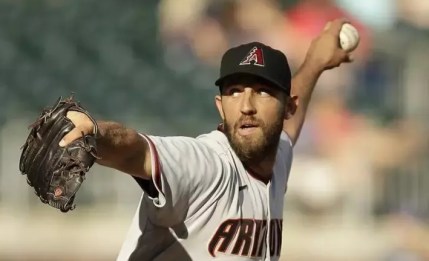
Madison Bumgarner

Bumgarner won’t get credit for his no-hitter because . . . seven innings, in a doubleheader now mandated as two seven-inning games. But he damn well should get it.

Repeat after me: Madison Bumgarner pitched a no-hitter Sunday afternoon. Madison Bumgarner pitched a no-hitter Sunday afternoon. See? Simple, and appropriate.

The carpers carp that MadBum won’t and shouldn’t get credit for a no-hitter because of the seven-inning rule applied to doubleheader games. That’s almost as bad as saying Bumgarner himself decided to help make the rule so let it be on his head and to his discredit. They’re both false, too.

Bumgarner worked his seven innings, struck out seven, and might have had a perfect game if not for Diamondbacks shortstop Nick Ahmed’s throwing error on Braves second baseman Ozzie Albies’s grounder leading off the bottom of the second. MadBum’s mates gave him a cozy five-run lead before he even had to throw a pitch, then tacked on single runs in the third and the sixth.

The lefthander with the 747 wingspan spread as he’s about to deliver is being cheated out of his propers because of a strange contradiction. A 1991 rules change declared no-hitters to be nothing less than nine innings with the pitcher finishing on the winning side. That was prodded by Yankee pitcher Andy Hawkins’s no-hit loss to the White Sox in Chicago, where he didn’t have to pitch the ninth.

The rule changers then didn’t ponder what didn’t occur to them, the wherefores of un-hit pitchers in official games made less than nine innings by future rule changes. Such as the pan-damn-ic safety protocols prompting makeup games required for any reason being parts of doubleheaders and going only seven innings each.

That doubleheader rule was held over for this season, of course. When last I looked, those between the commissioner’s office and the Major League Baseball Players Association who agreed to keep such doubleheaders this year didn’t include Madison Bumgarner.

So playing within both the 1991 no-hitter rule adjustment and the pan-damn-ic doubleheader innings limit does him no favours. He gets credit for a complete game but not a no-hitter. Bumgarner wuz robbed.

Let me go back on record right now to say again that I approve of doubleheaders with seven-inning games—because they make just plain common sense. Old Fart Contingency members who denounce them as just more kowtowing to candy-ass contemporary players are invited hereby to stuff those denunciations, then learn or re-learn a little baseball history.

In Game of Inches, Peter Morris—a baseball historian whose specialty is the earliest baseball generations and the debunking of longtime myths about them—recorded that the doubleheader actually predated the professional game, until it died awhile because when the game went professional team ownerships felt a little (ho ho) funny about two for the price of one keeping money out of their kitties.

“When the National Association began in 1871, there were no doubleheaders. Nor were there any the next year,” noted The Hardball Times‘s Chris Jaffe in 2010. “Professional baseball had its first one in 1873, and it would prove to be the only one in the five-year history of the NA. It took place on the Fourth of July, which was fitting because this would quickly become one of the great days for doubleheaders in baseball.”

Fast forward. The ancient American Association challenged the National League as a major baseball league. By 1891, the upstarts finally so inspired the National League that, in that season, the NL played more doubleheaders than the AA.

Mostly a holiday occurrence at first (Jaffe notes Memorial Day 1883 as the first time all Show teams played doubleheaders on the same day), the full decade of the 1890s showed the National League—having it all to itself with the AA’s collapse—playing doubleheaders a quarter of the time all decade long.

Oh, yes. There was one distinctive trend within the NL’s growing doubleheader friendliness: the bottom-feeding teams played the most doubleheaders. “This was an especially important development, because it remained true for decades,” Jaffe observed.

That makes sense if you think about it. Poor teams need an added inducement to convince the fans to come out and see them. Perhaps more importantly, when they traveled on the road their opponents needed an extra bit of persuasion to convince rooters to see what promised to be some lackluster on-field performances.

After the American League formed and joined in the Show fun, times came when teams often played 25 doubleheaders a season and sometimes more. The doubleheader had far less to do with the good of the game than with making money for the owners—especially those owning the also-ran teams who needed whatever they could get to draw fans at home, and those owning the more powerful teams who needed to draw fans when the also-rans came to town.

The Great Depression really exposed that one. From 1930-34, the National League teams averaged 36 percent a year’s schedule in doubleheaders and the American League teams, 30 percent. During World War II, the NL’s teams averaged 46 percent of their schedule in doubleheaders and the American League’s teams, 45 percent—including AL teams playing practically half their schedule in doubleheaders in 1943 and the NL teams doing likewise in 1945.

If a National League team had played just one more doubleheader, it would have meant over half the league’s games being played in twin bills.

Naturally enough, nobody gave much thought to what it might take out of players to play so many doubleheaders in a season. Especially the 1943 White Sox. For whatever reasons, those White Sox alone played an unconscionable 44 doubleheaders. Those included eleven in July, eleven between September’s beginning and the 1 October regular-season finish, and 27 pairs of doubleheaders played either on back-to-back days or with an off-day between them.

Never mind Hall of Famer Ernie Banks’s fabled watchword, “It’s a beautiful day—let’s play two!” You try thinking about playing 36 innings of baseball in two or three days by design rather than by extra innings happenstance. You might be at least as exhausted thinking about it as the men who played those innings in that stretch must have been playing them.

Doubleheaders began fading away little by little by the end of the 1950s. But it’s to wonder why baseball’s overlords of the era previously discussed didn’t even think about considering seven-inning games for doubleheader days. The ’43 White Sox played 774 innings worth of doubleheaders before extra-inning games are considered (eight times a White Sox doubleheader game went to extras that year); if they’d been seven-inning games, they would have played 602 doubleheader innings.

Discussing in February the pan-damn-ically inspired rule changes that should be kept or dumped, CBS Sports writer Mike Axisa applauded keeping doubleheaders of seven-inning games:

Games are going to be postponed, potentially a lot of games, and they will have to be made up at some point later in the season. We saw teams play three doubleheaders in a single week at times last year. MLB has to assume something like that will happen again, in which case seven-inning doubleheaders are a necessity. You can’t ask players to run themselves into the ground like that.

. . . [O]f all the 2020 rule changes MLB and the MLBPA should consider for 2021, this is the one that most has to happen . . . It’s less wear and tear on the players, and less time at the park equals less exposure to the pandemic for players, coaches, stadium workers, and fans. Seven-inning doubleheaders are a must.

They should be a must even beyond the eventual end of the pan-damn-ic. Especially for the reason Axisa said primarily. Baseball players aren’t automatons who can play endlessly, no matter what the Old Fart Contingent thinks or maybe even wishes. They’re human beings, with human limitations, no matter how much baseball talent and skill they bring while it’s there for them to bring. (“By the time you finally learn how to play,” mammoth bombardier Frank Howard once said, “you can’t play anymore.”)

Forget how much money they’re earning. Forget Hall of Famer Willie Stargell’s memorable observation, during a long and arduously-traveled road trip, “The umpire doesn’t say, ‘Work ball’.” Professional baseball requires hard work to play. It’s not a question of just suiting up, going out to play seven or nine innings, then changing clothes with a shower and heading home.

Madison Bumgarner went to the mound Sunday in a lawfully-scheduled seven-inning game under rules he didn’t make . . . and didn’t surrender a single hit. He earned credit for the win. The 1991 no-hitter rule change didn’t account for arbitrarily but necessarily changed structures of doubleheaders, and Bumgarner didn’t ask for a seven-inning game to start half a twin bill.

Officially, MadBum gets credited with a complete game. Also officially, he gets no credit for a no-hitter. If you can tell me how much sense that makes without tripping over both of us, you’re a better manperson than I. Far as I’m concerned, the seven-inning doubleheader needs to stay beyond the pan-damn-ic . . . and Madison Bumgarner damn well did pitch a no-hitter.

Tatis and Bauer continue defunding the Fun Police

Fernando Tatis, Jr.; Trevor Bauer

Trevor Bauer (27) wasn’t thrilled about surrendering bombs to Fernando Tatis, Jr.—but Bauer didn’t mind Tatis trolling him over them, either.

If the Dodgers and the Padres are really brewing baseball’s best rivalry since the Dodgers and the Giants, or the Yankees and the Red Sox, you can count on one less Fun Police officer overloading the Tabasco sauce. Turns out that the sense of humour of Trevor Bauer, Dodger pitcher, includes taking his lumps in the troll department.

Padres shortstop Fernando Tatis, Jr. accounted for the only two runs Bauer allowed Friday night with a pair of delicious looking home runs. He hit the first in the top of the first, sending a slightly hanging cutter clean over the left center field fence on the second pitch of the game.

After rounding first, Tatis put his right hand over his eye as he turned around toward the mound, then turned to continue running it out. When he hit the second bomb in the top of the sixth, following a six-pitch, full count wrestling match, Tatis crossed the plate with a move made familiar to UFC fans by Conor McGregor. It just so happens to be the move Bauer himself busts after he has a particularly controlling inning’s work.

By his own admission Bauer missed the hand-over-eye move, which referenced Bauer’s own one-eyed pitching against the Padres during a spring training contest, but he couldn’t help noticing the Padres dugout covering single eyes after Tatis’s second homer landed about three or four rows up the left center field bleachers.

Bauer didn’t mind any of the moves at all. In fact, talking to reporters after the game, which the Dodgers yanked out to win 5-4 despite Tatis’s mayhem, the righthander whose own trolling stones make him as controversial as he is colourful sent a message to every other pitcher on the third stone from the sun who thinks letting the kids play is tantamount to heresy.

“I like it. I think that pitchers who have that done to them and react by throwing at people, or getting upset and hitting people or whatever — I think it’s pretty soft,” Bauer told reporters after the game. “If you give up a homer, the guy should celebrate it. It’s hard to hit in the big leagues. So, I’m all for it. And I think it’s important that the game moves in that direction, and we stop throwing at people because they celebrated having some success on the field.”

Where was Bauer when the Cardinals got soft on Nick Castellanos a couple of days after Castellanos smashed a home run off Jack Flaherty? When Jack Woodford drilled him with a pitch, then bumped him as he crossed the plate beneath a sliding tag attempt, before Castellanos sprung up from his slide, barked a bit at Woodford, then started walking away from the plate area when Yadier Molina returned to the plate area and gave Castellanos a shove by his neck—when Castellanos wasn’t even looking behind him?

Rest assured, Bauer would have had a lecture to deliver Madison Bumgarner two years ago, after Max Muncy launched one of his first-inning services into McCovey Cove. “Don’t watch the ball—run!” Bumgarner barked. Rounding first and heading to second as he ran it out, Muncy by his own admission hollered back, precisely, “If you don’t want me to watch the ball, go get it out of the ocean.”

Perhaps if Bauer was a Dodger then, he’d have been the first to buy the blue T-shirt that hit the ground flying after that, with “Go Get It Out of the Ocean” emblazoned in white, over an upside-down reproduction of the flying baseball that’s part of the Dodgers’ official team logo.

Bauer knows Tatis has reasons enough to celebrate his handiwork lately. Friday night’s flogs came one night after the kid who’s must-see television did what no major leaguer had done before—hit a pair of bombs on the 22nd anniversary date of his father hitting a pair of salamis in the same inning against the same opponent.

Friday night also made Tatis the first player to hit a pair of bombs on back-to-back nights against Cy Young Award-winning pitchers, says the Elias Sports Bureau. On the anniversary of Pop’s pops, Tatis wreaked his two-bomb havoc on Clayton Kershaw’s dollar.

Tatis returned Bauer’s compliment, whether or not he’d actually heard Bauer say it immediately. “Payback time,” the lad told reporters, referencing Bauer’s one-eyed-jack pitching in that spring game.

It’s just fun. When you know you’re facing a guy like that — he’s doing his stuff, he’s having fun on the mound, and when you get him you get him, and you celebrate, too. He’s a hard guy to deal with.

Bauer didn’t even mind when Padres first baseman Eric Hosmer got even in the sixth for what Bauer did in the fourth. Hosmer struck out awkwardly in the fourth and Bauer delivered his pulling-the-sword-out bit, “sword” considered contemporary baseball lingo for the broken swing a hitter often delivers when he’s been fooled like a rookie on a pitch. In the sixth, though, Hosmer nearly drilled a hole in Bauer with a hard liner up the pipe, then pulled a sword of his own out after reaching first.

Once again, Bauer had no intention of ducking into a nearby phone booth and changing from your everyday not-so-mild-mannered pitcher into the Fun Cop ready to clunk all miscreants with his nightstick and drag them off to the hoosegow.

“That’s what it is to be a competitor,” the righthander said. “I’m gonna go at you. I’m gonna get you sometimes, and you’re gonna get me sometimes. We can have fun, we can celebrate it while we’re still competing at the highest level. I just thought that was important to note tonight.”

I’ve been saying for how long that pitchers need to start thinking, “Hey, you got me good this time. Have your fun. I’ll get you out the next time, and I’ll have my fun?” I’m not even close to the only one. There was Sean Doolittle two years ago, when he was still a hard-toiling and popular National. “If a guy hits a home run off me, drops to his knees, pretends the bat is a bazooka, and shoots it out at the sky, I don’t give a shit,” he said emphatically in an interview I cited at the time.

When you’re in the backyard as a kid playing and falling in love with the game and you crush the ball? You do a celebration. You stand and watch it like Ken Griffey, Jr. You don’t hit the ball and put your head down and run as fast as you can. That’s not fun. It’s okay to embrace that part of a game.

To which I wrote, myself, “I hope a lot of hitters drop to one knee and point their bats to the sky like bazookas when they hit one out. I hope a lot of pitchers start channeling their inner Dennis Eckersley and start fanning pistols after they strike someone out. I’d kill to see a hitter moonwalk around the bases after hitting one out. Let’s see more keystone combinations chest bump or make like jugglers after they turn a particularly slick and tough double play.”

The new Murphy’s Law ought to be, “Celebrate!” Said Dale Murphy himself, in one of his first essays as a contributor to The Athletic. It must have sent the Fun Police to the whiskey bottles when Murphy called out Bumgarner over that Muncy waterball:

Admiring a home run is OK. Bat-flipping is OK. Emotion is OK. None of that is a sign of poor sportsmanship or disrespect for an opponent. It’s a celebration of achievement — and doing so should not only be allowed, but encouraged. Pitchers can shout excitedly after an important out. They can pump their fist after a clutch strikeout. Players, fans—and basically any rational-thinking human—will understand that no harm is intended by these spontaneous expressions of joy.

Wouldn’t you love to know what Bauer thought, when the Rangers decided it was right and proper to wait, until near the end of the final game of their final season series against the Blue Jays in May 2016, to repay Jose Bautista for an epic bat flip the previous October?

Bautista hit a monstrous three-run homer in the seventh to give the Jays a 6-3 lead that held up to send them to the previous American League Championship Series. He flipped his bat whirlybird style as he left the plate to run it out. Rogers Centre went nuclear. The Rangers pitcher who surrendered that bomb, Sam Dyson, spoke as a Fun Policeman after the game.

“Jose needs to calm that down, just kind of respect the game a little more,” Dyson said after the game. “He’s a huge role model for the younger generation that’s coming up playing this game, and I mean he’s doing stuff that kids do in Wiffle ball games and backyard baseball. It shouldn’t be done.” (I couldn’t resist rejoining, “That’s how many kids playing Wiffle ball who grow up to hit postseason-advancing skyrockets?”)

Bautista was hit by a pitch late in that mid-May 2016 game. Then, he delivered a hard slide at second to let the Rangers know he didn’t appreciate the too-long-delayed “message.” Then he had to bear the brunt of the followup brickbats when Rougned Odor swung on him. Pretty soft? The Rangers were squishy cowards in tough guy clothing behind Mommy’s dress when Matt Bush—a relief pitcher who wasn’t even a Ranger in October 2015—delivered that seven-months delayed drill.

Bauer has his faults. Misogynistic harassment of women online is known to be one of them. But he’s never been accused of being physically abusive with any woman he’s dated or associated with. The Dyson who demanded Bautista “just kind of respect the game a little more” is the one who got suspended for this season for abusing his former girlfriend.

You can hear the Old Fart Contingent [OFC] who didn’t or don’t play the game fuming about Respect For The Game, too. Most of the same OFC want to see players treat baseball like Serious Business on the field or at the plate or around the bases—but they  become the first to scream, “It’s a [fornicating] game!” when it’s free agency contract time.

Bauer and Tatis have just fired off significant shots in what should be a continuing, baseball-wide campaign to defund the Fun Police. The defunding shouldn’t be limited to players alone.