“It’s been a show for quite awhile”

Bryce Harper

Philadelphia’s king of swing launches one into the second deck Thursday night.

When April was just about over, Bryce Harper resembled dead meat. He’d just been nose-coned by an errant Genesis Cabrera fastball, and it turned out worse for him. No, his schnozz wasn’t smashed, but the pitch ricocheted onto his left wrist.

After an April that finished with him showing a 1.063 OPS Harper’s May was abbreviated to fifteen games and a .634 OPS to show for them. Clearly enough the lefthanded launcher struggled through the injury, making far less than his normal hard contact, and probably should have been tied down to rest and let it heal properly.

Finally, after an 0-for-5 game on 22 May, Harper was indeed put on the injured list. Phillies manager Joe Girardi got caught lying through his teeth about the depth of Harper’s wrist injury. Some believed the Phillies would rather “engage in subterfuge to trick the opposing manager than play with an actual full roster.”

One way or the other, for all the tricks and lack of treats, Harper clawed his way back. All the way back to awakening this morning with the major league leadership in OPS (1.055) and OPS+ (183). All the way back to the rare standing of a .300+/.400+/.600+ slash line. (Harper’s: .314/.428/.627.)

All the way back into the National League’s Most Valuable Player Award conversation. All the way back from that balky wrist to entering a weekend set against the Mets as Philadelphia’s king of swing.

All the way back to helping as big as Harper can help in yanking the Phillies back to three games behind the Braves in the National League East and 2.5 games away from the second National League wild card.

If you wonder how big that can be at the most extreme, you should have watched the Phillies resurrect themselves against the Cubs, 17-8 Thursday night—with Harper doing the critical damage, especially a mammoth home run in the seventh.

So the Cubs battered seven runs out of the Phillies in the top of the third? The Phillies tore seven out of the Cubs in the bottom of the fourth. The Cubs who thought they had it made after the third didn’t know yet that they’d all but had it for the night.

Harper had already walked twice in the game when he squared off against Cub reliever Manuel Rodrigez in the bottom of the sixth with first and second and one out. On 1-2 he hit a long double sending Odubel Herrera home with the tiebreaking run. One out later, Didi Gregorius—who’d been drilled by a Cabrera pitch immediately after Harper took one off his beak in that late April game—singled Juan Segura and Harper home to make it 10-7, Phillies.

The next inning, after Willson Contreras got one back for the Cubs with a homer in the top of the frame, Harper got even more frisky. After Herrera doubled a pair home with one out, Harper faced yet another Cub reliever, Rex Brothers, and showed anything but brotherly love with first and third—he hit a three-run homer.

Segura merely added insult to injury with a two-run double in the bottom of the eighth. The Cubs, who’ve been dying since their trade deadline fire sale, gave up the ghost several innings earlier.

They must have wondered whether they’d been a little too greedy over apparent Phillies generosity in that seven-run third. Phillies starter Matt Moore walked the bases loaded and then hit Ian Happ with a pitch to start the Cub fun. Contreras then lined Rafael Ortega home, Patrick Wisdom sent a two-run double to the back of left center, and—one strikeout later—Matt Duffy hit one over the left center field fence.

The Phillies must have said to themselves, “Greed shall be its own downfall” in the fourth. Andrew McCutchen started that party with a two-run double down the right field line. A base hit and a hit batsman later, Matt Joyce wrung Cubs starter Kyle Hendricks for a bases-loaded walk. Herrera drove Brad Miller home with a base hit, and Freddy Galvis scored on a ground out, before Harper drew his second walk and J.T. Realmuto singled Joyce and Herrera home.

The full fifth and the top of the sixth passed cleaner than hounds’ teeth before Matt Vierling opened the bottom with a base hit up the pipe. After Herrera reached on an error at first base and Segura forced Vierling at third, Harper hit one the other way down the left field line to break the seven-all tie, before coming home with Segura when Grigorius shot one through the hole at shortstop into left.

Those were just warmups for what proved the main attraction in the seventh, with Herrera on third, Segura on first, and Harper hitting Brothers’s first pitch into the second deck behind right field.

“It feels good,” Harper said post-game, “but we’ve got a while to go. I want to keep playing well and have good at-bats, have good games and just be where we need to be down the stretch.”

“We’re all involved in this, right? And the game is always, to me, about our team,” Girardi said. “But he’s a big reason why we’ve hung around, just because of the season that he’s had and the last two-and-a-half months, whatever he’s done. It’s been incredible to watch. It’s been a show for quite awhile.”

“The challenge,” writes The Athletic‘s Matt Gelb, “has always been squeezing enough from the roster around Harper. It is flawed and will continue to be flawed even if the Phillies sneak into the postseason. It will not dampen the doubts about the organization’s long-term plan. But Harper has given the Phillies everything he promised, and the rest of the franchise has seventeen days to make it count for something.”

Neither Girardi nor the Phillies want the show to end. It might or might not be just a sliver outside possibility’s realm. But in theory, at least, they could even reach the postseason by a nose.

Luis’s pieces

Luis Rojas

If you want to know why Met fans call for manager Luis Rojas’s execution every other day, Tuesday night’s loss to the Cardinals handed the prosecution incontrovertible evidence.

Maybe it’ll be better all around if the Mets end up out of the postseason picture, after all. If the manner in which manager Luis Rojas ran Tuesday’s 7-6 loss to the Cardinals is any indication, the Mets would be lucky to get past a wild card game, never mind to it in the first place.

No, we’re not taking the Mets’ hitters off the hook for going a measly 4-for-14 with runners in scoring position. We’re not taking them off the hook for killing four rallies by hitting into double plays.

We’re not taking them off the hook for one of those double plays coming in the tenth inning, after a walk to Jonathan Villar added to the free cookie on second to start the inning. And we’re not taking Pete Alonso off the hook for hitting into two of those double plays plus striking out with first and second to kill a fifth-inning chance at tying or taking a lead.

But we’d like to know what on earth Rojas was or wasn’t thinking, after he lifted his starting pitcher Marcus Stroman following six innings of two-run ball in which his only troublesome inning was the fourth, when the Cardinals scored those two runs on a deep infield hit and a sacrifice fly.

Since Rojas entered the game knowing he wasn’t going to use either Seth Lugo or Miguel Castro, he brought Aaron Loup in for the seventh. Watching Loup use only seven pitches to get two fly outs and a swinging strikeout, it didn’t cross Rojas’s mind that Loup might have another healthy and even economical inning in him.

No, Rojas went instead to Jeurys Familia, who’d been less than effective in his previous two outings, rather than giving the ball to his usual eighth-inning option Trevor May. May might have been pried for three runs in his previous outing (against the Yankees, in the 9/11 anniversary game), but he’d been sharp and un-scored upon in nine of his prior ten gigs until then.

Familia surrendered a one-out walk (to Paul Goldschmidt) and a two-run homer immediately to follow (by Tyler O’Neil). Not until the Cardinals followed at once with Nolen Arenado singling and Yadier Molina reaching on catcher’s interference did Rojas finally remember May. And May only caught Dylan Carlson looking at strike three before getting Edmundo Sosa to ground out for the side.

Rojas also didn’t read the deep text when inconsistent Edwin Diaz pitched a scoreless ninth with only thirteen pitches needed. Sure, Harrison Bader led off reaching on an error, but the Cardinals handed Diaz and the Mets a present by ordering pinch-hitter Lars (Sometimes You Feel Like a) Nootbaar to sacrifice. After such Cardinal generosity, Diaz needed only two pitches to get rid of Tommy Edman on a ground out and four to get Goldschmidt to foul out for the side.

Then Javier Baez led off the bottom of the ninth against Cardinals reliever Geovanny Gallegos by hitting the first pitch of the turn over the left field fence to tie it up at four. Three Met outs later, Diaz might well have been able to pitch the tenth successfully, leaving Rojas the option of Heath Hembree for the eleventh.

But no. He lifted Diaz and sent Hembree out for the tenth. Hembree struck O’Neil out swinging to lead off. The Mets ordered Arenado to first on the house and got exactly what they bargained for, Molina hitting into a double play to end the inning. It only cost Hembree seven pitches (remember, you don’t have to throw four wide ones for an intentional walk anymore) to do it. There might have been no harm, no foul if Rojas sent Hembree back out for the eleventh, either.

“I can’t ask any more from the guys,” Rojas said post-game, when asked why he didn’t push his pen men just a little bit harder considering the time running out on the Mets’ hair-thin postseason chances.

“Right now, it would be unfair,” he continued. “I can’t put them in a situation where it would compromise anything else, their stuff, their health. You might run a guy out there and he might not be the same pitcher you’re asking the guy to be, as well. There’s just a lot of things that go into it. Ideally, the manager wants to pitch everyone every day, but there’s some other things that come into play when you talk. It’s the player’s feel, the pitching coach’s feel, my feel.”

Where was the feel when the best options Rojas played pitched so economically in their effectiveness that an extra inning from any of them might have made a phenomenal difference?

There came harm and foul when Rojas instead went to Jake Reed, a 28-year-old rookie not long returned from the injured list and not having thrown a major league inning since mid-August. The good news was Reed, too, pitching economically enough—eight pitches total.

But then there’s the bad news: 1) His third pitch was hit for a leadoff single, sending the free cookie on second to third post haste. 2) His sixth pitch was hit for an RBI single to break the four-all tie. 3) His eighth pitch was turned into a two-run single.

Then Rojas brought in Trevor Williams, his import from the Cubs and normally a starter but well between assignments and able to throw part or all of an inning if necessary. Williams shook off a base hit to get Goldschmidt to dial Area Code 6-4-3 for the side.

Now the questions would include why not have Williams open a clean inning (if you didn’t count the cookie on second) instead of opening it with a rusty rookie? Said Rojas: Well, Reed’s a reliever and Williams is a starter. There’ve been how many skippers burned alive when they went by The Book instead of what their eyes, ears, and actual numbers whispered in their ears?

Going his Book enabled Rojas to pull the lulu of the night—turning to spaghetti bat Albert Almora, Jr. to pinch hit in the bottom of the eleventh, after the Mets pulled back to within a run on an RBI double and a throwing error by Cardinals reliever Kim, and with Williams’s lineup slot due up.

He picked Almora over Luis Guillorme. After opening 0-2, Almora wrestled his way to a full count—and grounded out modestly to end it. Why Almora over Guillorme? “Against a lefty,” Rojas said, “not the right matchup.”

Which part of his Book did Rojas ignore, in deciding the righthanded Almora was his best chance to tie or win despite the fact that Almora’s been hitting like . . . a pitcher, this season? (Slash line: .115/.148/.173.)

Which part of that Book did Rojas ignore in deciding Guillorme the lefthanded bat had no business going to the plate in that spot . . . even with his .344 on-base percentage against portside pitching in 33 plate appearances this season?

(What’s the name of his Book, anyway? For Whom the Bell Tolls?)

Maybe Guillorme would have poked an RBI hit to tie or even win the game. Maybe he would have ended the game the same way Almora did; maybe he might have flied out to end it. But he’d have given Rojas and the Mets the absolute better shot at keeping the game alive or winning it.

The only time Rojas did set his Book to one side Tuesday night was taking Familia over May. As Casey Stengel might have said, there comes a time in every man’s life and he shouldn’t have had that one.

You want to know why frustrated Met fans call for Rojas’s summary execution after just about every other Met loss and sometimes after oddly-managed Met wins? Tuesday night was gilt-edged evidence for the prosecution.

This morning they’re thanking God and His servant Stengel that Tuesday night wasn’t a postseason game. They may even thank both if the Mets finally don’t make the dance at all. How sad is that?

Could that someone be Max the Knife?

Max Scherzer

Scherzer’s stellar pitching has made possible the Dodgers leaving the Bauer embarrassment behind.

On Saturday, Los Angeles Times columnist Bill Plaschke called Trevor Bauer the biggest embarrassment in Dodgers history. Two days later, Plaschke’s fellow Times columnist Bill Shaikin called Max Scherzer cover for the Dodgers’ Bauer disaster.

Bauer’s 2021 season is over. With his legal status remaining in limbo, baseball’s government and the Major League Baseball Players Association decided it was the better part of valor that Bauer should remain on paid administrative leave through the end of the season.

“He will surely never pitch for the Dodgers again,” Plaschke wrote Saturday. “He may never pitch for anybody again. But the damage his brief presence wrought upon an organization built on strong community and smart baseball has been indelible.”

“[H]istory,” Shaikin wrote Monday, “seldom offers a silver lining more glistening than this: If Bauer is on the Dodgers’ roster, Max Scherzer is not.”

Signing Bauer last winter indicated only that the Dodgers were willing to gamble on a misogynist alone. Even vetting Bauer completely, the team couldn’t have foreseen his exposure as having crossed lines separating mere kink from downright abuse, making mere misogyny resemble virtuousness.

Dealing for Scherzer and shortstop Trea Turner from the Nationals at the trade deadline may yet make the Dodgers’ Bauer embarrassment the footnote to a footnote in their long and storied-enough history. Especially if the deal turns out to have made the postseason and the pennant possible.

It’s not that Turner has been useless, far from it. He’s had more than a few moments since he swapped Nationals for Dodgers fatigues. (For one thing, he’s now the only baseball player known to have almost moonwalked his way back up and out of a safe slide across the plate.) But he can’t begin to measure up to Scherzer’s impact.

Nobody can.

Nobody else could conceivably start eight straight games for a team and post a 0.88 ERA, a 1.26 fielding-independent pitching rate, five measly walks, and 72 strikeouts over those eight starts. Except maybe an uninjured Jacob deGrom, who actually did spend starts from 25 May through 1 July posting a 1.20 ERA, a 0.92 FIP, four measly walks, and 71 strikeouts.

But deGrom is more than a fair few seasons younger than Scherzer. DeGrom has slightly more than half of Scherzer’s lifetime 3,003 strikeouts. It would be foolhardy at best to predict that a day lurks in the future when deGrom will nail his 3,000th strikeout on the same day he pitches an immaculate inning and takes a perfect game into the eighth inning.

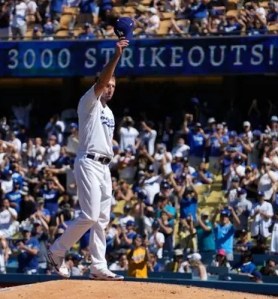
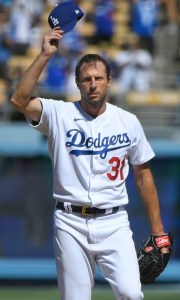
That’s what Max the Knife did Sunday. The Dodger Stadium crowd didn’t exactly pack the house, but it made noise enough that only a corpse on the Klingon home world couldn’t have heard it when Scherzer threw down and in on a full count and eluded Padres first baseman Eric Hosmer’s bat for the milestone swishout.

He pitches for a team that has an easier time keeping greatness on the mound from going unrewarded. Unlike deGrom, who pitches like a Hall of Famer for a team that knows how to snatch the proverbial defeat from the jaws of victory as often as not, the Dodgers have won every one of Scherzer’s eight starts since his arrival.

“None of Bauer’s teams,” Shaikin notes, “have won eight consecutive games in which he started.” That’s any eight consecutive starts, never mind the first eight he’s made with any of the four teams for whom he’s pitched.

(For those curious, this year the Mets did manage to win eight straight deGrom starts—but deGrom got win credit in only five of those games. On the other hand, one of his injury issues put a big time space between the first two of those starts. DeGrom’s ERA over those starts was four points lower than Scherzer’s over his first eight Dodger starts, and deGrom’s FIP was eleven points lower.)

Plaschke feared free agent-to-be Scherzer would be a rental only. But when Shaikin noted another future Hall of Famer, Clayton Kershaw, sitting a mere 347 strikeouts away from the Magic 3,000, he quoted Max the Knife about that: “Hopefully, I’m here, and able to watch his 3,000th as well.”

Could that have been a not-so-subtle hint that Scherzer would like nothing more than to stay in Dodger silks for the rest of his career? Could that have been a not-so-subtle suggestion that the Dodgers are thinking about the same thing as they begin to imagine a post-Bauer world for which Bauer bears the brunt of the blame?

Don’t even think about it: Merely because a judge denied a restraining order against Bauer regarding one of his victims, Bauer isn’t off the hook. Restraining order petitions address  feared future acts. They don’t deny or acquit known previous acts.

“[T]he central truth of this entire affair — the stuff that Major League Baseball will look to regarding Bauer’s behavior, irrespective of whether [criminal] charges are brought — points pretty clearly to Bauer doing exactly what his accuser said he did,” wrote former NBC Sports baseball analyst Craig Calcaterra last month.

Everything else is secondary.

After 12 hours of testimony, his accuser said, under oath, “I did not consent to bruises all over my body that sent me to the hospital and having that done to me while I was unconscious.” There was zero evidence presented which explained how those bruises appeared in a way that was benign or refuted the idea that the woman was unconscious when Bauer inflicted them. That, in my mind, is all that matters.

Six days before the Dodgers pulled the trigger on the Scherzer trade, it became known widely enough that there wasn’t a Dodger to be found in the clubhouse who really wanted Bauer back among them.

Between that day and the day they landed Scherzer, the Dodgers fell from two to three games out of first in the National League West. They’re back to two and a half out of first with a few hiccups here and there, none of which involved Scherzer. But his one-for-the-books outing Sunday further exposed the upstart Padres (18.5 games out of first) as not ready for National League West prime time just yet.

Both Scherzer and Kershaw face free agency this winter unless the resources-rich Dodgers elect to stay their course with both pitchers. For Kershaw it would be keeping him in the only baseball family he’s known his entire career. For Scherzer it would be making sure he finishes his career with his fourth and final baseball family. Maybe with another World Series ring or two on his finger.

Remember: Enough of the world thought the Nationals made a huge mistake signing Scherzer to a long-term deal. Then Scherzer finished his Nats tenure with a) the most wins above replacement-level pitcher of any marksman during the life of the deal; b) struck more batters out than anyone else in the Show over the life of the deal; and, c) helped the Nats win an unforgettable World Series title.

Somewhere in there, Max the Knife also managed to win two of his three Cy Young Awards. Back-to-back while he was at it. He’s even in this year’s conversation as regards winning his fourth Cy Young Award.

After net results such as those, nobody would necessarily bet on the Dodgers just burning money if they elect to make Kershaw and Scherzer offers they can’t refuse to stay. Even four-year deals keeping them Dodgers for the rest of their baseball lives.

“Wasn’t it true,” Mario Puzo had Don Vito Corleone musing in The Godfather (the novel, not the film), “that sometimes the greatest misfortune brought unforeseen rewards?”

The Dodgers’ rewards are bound to be a lot happier with Scherzer aboard for his final acts than they’d be with even one more episode of the Bauer dope opera.

Max the Knife vs. the Lindor Rock

Max Scherzer

Max the Knife went from immaculate to 3,000 in the same Sunday afternoon game . . .

Who says baseball isn’t good for a little hair raising anymore? If you weren’t paying attention Sunday, you missed some real hair raising in Los Angeles and New York. As a matter of fact, you could feel sorry for Dodger Stadium’s  being upstaged by Citi Field’s.

Even if both hit the history books running.

Max Scherzer took a perfect game into the eighth inning. Along the way he pitched an immaculate inning—the third man ever to do it three times, joining Chris Sale and Hall of Famer Sandy Koufax—and bagged his 3,000th career strikeout. Right there it should have been the biggest story in the game.

Immaculate inning? Three thousand strikeouts? Could that someone be Max the Knife?

Those Big Apple pains in the ass had to horn in on Scherzer’s glory. They had to go from a brothers-in-arms 9/11 twentieth-anniversary hair-raiser to a Sunday night soiree full of chirping, whistling, snarking, bombing, and oh, yes, Francisco Lindor doing what nobody else in the 139-year history of the Subway Series had done before.

It wasn’t enough that Scherzer should have struck San Diego’s Eric Hosmer out swinging on down and in and a full count in the fifth to record the milestone strikeout. It wasn’t enough that Hosmer was sandwiched by Fernando Tatis, Jr. and Tommy Pham in the middle of that immaculate second.

It wasn’t even enough that Hosmer should have been the one to bust Scherzer’s perfect bid with a double deep to right field, a little quiet revenge for having been on the wrong side of Max the Knife’s further burrowing into the history books.

No. Those spoilsport Mets and Yankees had to go out and enable Lindor—the off-season signing splash whose first year as a Met has been a battle at the plate while remaining a study at shortstop (where he’s worth five defensive runs saved about the National League average)—to do the damage that mattered in a 7-6 Met win.

Never in the entire history of New York’s major league teams tangling against each other—we’re talking serious World Series tonnage, plus all those decades when the Dodgers and the Giants turned baseball into total warfare against each other, not to mention the Yankees and the Mets in regular-season interleague play—had any single player hit three home runs in a single contest between them until Sunday night.

In other words, Lindor accomplished what not even a small truckload of Hall of Famers ever did in Big Apple uniforms against each other. Not Home Run Baker or Babe Ruth. Not Lou Gehrig or Mel Ott. Not Joe DiMaggio or Jackie Robinson. Not Yogi Berra or Johnny Mize. Not Mike Piazza or Derek Jeter. Not even Willie, Mickey, and the Duke.

All around the Lindor clock, hey, let’s do the Lindor Rock!

Bottom of the second. Lindor batting lefthanded, squaring off on 1-1 against Clark Schmidt, a Yankee excavated from the farm system to make the start in the first place, and hitting a hanging breaking ball for a three-run homer into the bullpens behind right center field, pulling the Mets from a 2-1 deficit into a 4-2 lead.

“If Francisco Lindor’s first year as a Met could include a signature moment,” called ESPN broadcaster Matt Vasgersian as Lindor came down the third base line and crossed the plate, “we just watched it.” If only his crystal ball had undergone a tuneup.

Bottom of the sixth. One out, Yankee reliever Wandy Peralta throwing his first pitch to Lindor batting righthanded. The changeup arriving down and on the lower outside corner got driven high and into the left center field seats. Fattening a 5-4 Met lead by a run.

Francisco Lindor

“I am the Whistler, and I know many things, for I bomb by night . . .”

On the way home down the third base line, Lindor made a gesture simulating a kid sticking two fingers into his mouth to whistle a huge blast—a zap back at the Yankees over suspicions that Saturday night’s Mets starting pitcher, Taijuan Walker, was caught tipping his pitches with the Yankees whistling the tips to their batters during their five-run second.

Maybe the Yankees did it, maybe they didn’t. It’s not as though the Yankees have been immune to suspicions of on-field chicanery in the recent past, even if they’re not yet suspected or affirmed to have been quite as deep-cover as the 2017-18 Astros were shown to be for espionage aforethought.

But Lindor tripped a Yankee trigger when Giancarlo Stanton smashed a game-tying two-out, two-run homer in the top of the seventh. Stanton and Lindor jawed back and forth while Stanton was still running the homer out, though the Yankees and the Mets were both kind enough to let Stanton cross the plate before the benches and bullpens emptied completely for a little, shall we say, conversation over the matter.

“The last couple nights, we’ve just been loud over there,” said Yankee manager Aaron Boone. “Not doing anything.”

“I’m not accusing them,” Lindor said post-game Sunday night. “I’m not saying they’re doing it 100 percent because I don’t know 100 percent, but it definitely felt that way. And I took that personal. I took that personal and I wanted to put runs on the board to help my team win.”

For his part, Stanton postgame thought Lindor was actually ticked off at Peralta for whistling—not to steal signs but to try putting a little more life into what Stanton suggested had been a sluggish Yankee bench during a sluggish Yankee spell. That, Stanton said, is what he was trying to convey to the Mets’ shortstop en route the plate.

“If you’ve got a problem to Wandy, give it to Wandy,” the left fielder said. “Don’t be talking to multiple people, bringing everybody into it. Running around the bases, that was my thought process. Obviously, I didn’t get all that out running around.”

If anyone had a real complaint about Peralta’s whistling, it was probably Yankee right fielder Joey Gallo. “It’s definitely not for pitch-tipping or anything like that,” Gallo insisted, before complaining  good naturedly. “It’s been hurting my ear, honestly. It’s unbelievable how loud he can whistle.”

Bottom of the eighth, one out, Lindor back batting lefthanded against another Yankee reliever, Chad Green. This time, he hit a 2-0 meatball practically down the chute even higher over the right field fence than his first flog of the night traveled.

It wasn’t as spiritually delicious as Hall of Famer Piazza’s eighth-inning blast in old Shea Stadium, during the Mets’ first home game after the original 9/11 atrocities’ baseball hiatus, but the Citi Field racket as it traveled out of reach was equal in volume to that twenty-year-old cathartic hysteria.

There’s nothing like a three-thump night to make a high-priced shortstop—who’s spent most of his first such high-priced season struggling at the plate if not with the leather—suddenly feel lovable. “It probably helped them believe in me a little bit more,” Lindor said post-game.

Poor Scherzer. The tenacious righthander hit the history books with a flying fist. So he had to be one-upped by those New York yo-yos. Not even Mookie Betts speaking postgame could neutralise things. “He was destined for it,” the Mookie Monster told reporters. “All the work he puts in, everything he does. It kind of sounds weird, but I expect nothing less from him.”

Echoes of Hall of Famer Don Drysdale once saying of his rotation mate and buddy Koufax, “I expect Sandy to pitch a no-hitter every time he takes the mound.”

The bad news in New York was that Met fans have come to expect a discomfiting balance between virtuosity and disaster from reliever Edwin Diaz. And Diaz delivered just what they expected in the ninth Sunday night.

He wasn’t the only bullpen culprit in the hair raising, not after Jeurys Familia threw Gleyber Torres a two-run homer in the sixth, and not after Brad Hand handed Stanton that jaw-inspiring two-run shot in the seventh. But Diaz was the bull most over the edge, almost.

A leadoff strikeout followed by a base hit. A followup walk followed by a swinging strikeout. Then, he had a little help from catcher James McCann, letting a 1-1 pitch to Stanton escape, enabling pinch-runner Tyler Wade and Yankee first baseman Anthony Rizzo to third and second.

Lucky for Diaz and the Mets that Stanton got under the 2-2 fastball and popped it up. To the left side. Where, of all people, Lindor awaited to haul down the game’s final out. Some dared call that one poetic justice.

On a sober anniversary

New York Mets, New York Yankees

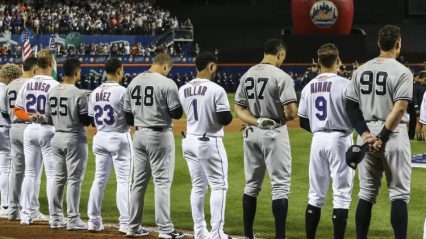
Honouring the murdered and the fallen who tried to save them during the original 9/11 atrocity at the World Trade Center, the Mets and the Yankees stood shoulder-to-shoulder before Saturday night’s game. Shown left to right here: Pete Alonso, Gleyber Torres, Javier Baez, Anthony Rizzo, Jonathan Villar, Giancarlo Stanton, Brandon Nimmo (still on the injured list), and Aaron Judge.

Members of the 2001 Mets, including Hall of Famer Mike Piazza, escorted various groups of first responders onto and around the field Saturday night. The Citi Field audience cheered loud and long, not just for those Mets but for those first responders who survived or whose comrades were lost in the 11 September 2001 atrocity upon the World Trade Center.

Several of today’s Yankees and Mets—wearing assorted New York first-responder hats, this time with the blessing of baseball’s government—lined up intermingled on the baseline and came close enough to tears. The Mets wore the same non-pinstriped home whites the team wore in 2001, complete with “9-11-2001” embroidered on the right sleeve, but this time with a  black-shadowed version of their “New York” traveling letters across the chest.

After a moment of silence in honour of those murdered in the WTC attacks,  and those who died trying to rescue the attacked, the New York City Cops & Kids Choir sang “The Star Spangled Banner” in a striking balance of chorale, section, and soloist. The cheer at the finish amounted as much to a prayer that a country now fragmented in enough ways might yet un-fragment once again in enough ways, as it did the performance that truly honoured the dead.

The Fox Sports telecast cut to a special anniversary video story, recalling the moment New York can never forget, ten days after baseball ended its self-imposed hiatus following the original atrocities—Piazza blasting what proved a game-winning, two-run homer in the bottom of the eighth, in old Shea Stadium, off Braves reliever Steve Karsay, off the second tier of a television camera stand behind the center field fence.

Then, the Mets’ and Yankees’ 2001 managers, Bobby Valentine and Hall of Famer Joe Torre, threw ceremonial first pitches to the plate, after Valentine puckishly ran back onto the mound to toe the rubber. That was a very far cry from Valentine having led his 2001 Mets in running rescue-and-recovery efforts outside old Shea Stadium itself—and having fear of further danger, as he’s acknowledged often since—after the WTC attacks.

After a commercial break—including a stunning montage of a young lady named Rowen Emerson Jones playing “God Bless America” on her violin, at various New York spots including the Brooklyn Bridge and a 9/11 memorial—it was time at last to set sober reflection and ceremony to one side, play baseball, and grip the Citi Field crowd until the last out of an 8-7 Yankee win.

On baseball terms, the Mets’ home crowd would have loved to have back the awkward should-have-been double play finisher second baseman Javier Baez—hurrying the throw to first—sent airmail past first baseman Pete Alonso that allowed the eighth Yankee run in the top of the eighth in the first place.

This was an interleague game whose sole significance otherwise rested solely in the now-faint postseason hopes of both the Mets in the National League East and the Yankees in the American League East. Had it not been for 9/11’s twentieth anniversary, the bigger baseball news of the night might have been Brewers pitchers Corbin Burnes and Josh Hader collaborating on a major league record ninth no-hitter of the season in their 3-0 win over the Indians—now the first team to be no-hit three times in a season.

The Yankees and the Mets exchanged single-hit halves of the first inning off their starting pitchers, Corey Kluber for the Yankees and Taijuan Walker for the Mets. The baseball fun really began in the top of the second, when the Yankees battered Walker for a pair of two-run homers (catcher Kyle Higashioka, center fielder Brett Gardner), a solo bomb (Aaron Judge, right after Gardner), and a too-early 5-0 lead.

Aaron Judge

Judge led the Yankee attack with two home runs Saturday night.

The Mets got right back into the game in the bottom of the inning. Second baseman Javier Baez, one of the notorious Thumb Bunch, waited out a leadoff four-pitch walk and stole second while left fielder Jeff McNeil struck out swinging. Then a second Thumb Buncher, Kevin Pillar, drove Baez home with a liner just inside the left field line, before catcher James McCann—who’s seen as one of the Mets’ more dubious free agency signings ordinarily—hit a drive that eluding a leaping Judge at the right field wall into an RBI triple. Walker himself followed with a line single to right sending McCann home effortlessly.

From there, Walker overcame his own wounding flaw, trouble commanding his fastball, and retired each the next thirteen Yankees he faced. Along the way, Baez turned on a Kluber service with two out in the bottom of the third and ripped it on a fast high line into the lower left field seats to pull the Mets back to within a run.

Kluber endured through four innings before Yankee manager Aaron Boone opened his bullpen and brought Lucas Luetge in to work the bottom of the fifth. The good news for the Yankees: Luetge shook off a one-out base hit by Mets right fielder Michael Conforto, shot through unoccupied shortstop territory on the defensive shift, to get rid of Alonso on a fly to the back of right field and Baez on a bullet liner Yankee third baseman Gio Urshela speared in a somewhat spinning crouch for the side.

The bad news for the Yankees was Luetge opening the Mets’ half of the sixth by walking McNeil on four straight pitches. Exit Luetge, enter Chad Green in a double switch sending Tyler Wade to play third base. Unfortunately, enter three baseballs thrown onto the field in right by unknown Citi Field idiots, followed by another couple of jackasses running onto the field but taken down swiftly enough by stadium security.

The unruly delay knocked Pillar out of his batting rhythm and into a swinging strikeout. But it didn’t stop McCann from turning on a 1-1 service and driving it into the left field seats, yanking the Mets into a 6-4 lead and inspiring one fan adjacent to the broadcast booth to holler, “Rock ’em! Sock ’em!” Those who remembered Piazza’s 2001 blast hoped against hope that another Met catcher’s bomb would prove the winner on the actual 9/11 anniversary, instead of in the first Mets home game back after baseball’s self-imposed September 2001 break.

The Mets had one more run in them in the bottom of the seventh, when with two outs and Clay Holmes on the mound for the Yankees, Baez chopped one off the plate up toward third, with Wade having a tough throw to make and Baez beating it by a hair as a few television replays plus the umpires’ review showed. McNeil singled him to third, Pillar singled him home with a liner to left, and it looked as though the Mets had an insurance run.

Seth Lugo had relieved Walker and thrown a spotless top of the sixth, and now Trevor May took over for the seventh. Oops. Gardner opened with a base hit through the hole at second, and Judge hit a parabolic punt sailing above the top of the stadium roof but landing halfway up the left field seats to tie the game at six. Yankee left fielder Giancarlo Stanton chased May with a long single, and Aaron Loup took the mound for the Mets.

It looked like Loup would have a simple gig when he got rid of Yankee first baseman Anthony Rizzo in a hurry on a fly out that nudged Conforto back almost to the track in right. Shortstop Gleyber Torres smashed one hard enough on the ground to short that his Mets counterpart Francisco Lindor couldn’t handle properly and got ruled a base hit.

Luke Voit pinch hit for Holmes. He grounded one to short on a very weird hop, but this time Lindor snapped it up at once and threw to second to get Torres. Baez in his rush to end the inning threw flatfoot off his right leg, mid-pivot, and the ball sailed over and past Alonso, enabling Stanton’s pinch runner Andrew Velasquez to score the eighth Yankee run.

The blameless Loup promptly struck Higashioka swinging on four pitches, but the Mets couldn’t cash in the two-out baserunner they got when Lindor wrung Yankee reliever Albert Abreu for a full-count walk. After another delay from another idiot running on the field—Hall of Fame pitcher/Fox Sports analyst John Smoltz wondered aloud, and appropriately, why people pick even evenings of sober commemoration for their “look at me!” moments—Conforto wrung Abreu for another walk.

Up to the plate came Alonso, the Met everyone in the ballpark wanted in this situation. He gave it his best shot, too. On 1-1 he hit one high and deep to center field, but he’d connected just on the underside of the ball, enough to give the Yankees a momentary jolt but not enough to keep Gardner from catching it on the edge of the track.

Veteran Mets relief pickup Brad Hand rid himself of Wade (ground out to second), Yankee second baseman D.J. LeMahieu (identical ground out to second), and Gardner (foul tip swinging strikeout) in the top of the ninth. But Mets pinch-hitter J.D. Davis’s one-out ground-rule double wasn’t enough in the bottom. He took third when strike three escaped Higashioka but the Yankee catcher recovered the ball soon enough to keep Pillar from taking first by just a step.

Then McCann gave one a ride out to right. It wasn’t enough of a ride. Judge snapped the ball into his glove to end the game, snapping a low for the Yankees in which they’d entered Saturday night having lost seven straight and—how cruel the irony—nine of eleven.

In baseball terms, the win put the Yankees into a tie with the Blue Jays for the second AL wild card, the Blue Jays having taken a doubleheader from the hapless Orioles. The loss kept the Mets five behind the Braves in the NL East and four behind the Reds and the Padres—both defeated earlier Saturday—for the second NL wild card.

In spiritual terms, the full Citi Field house, the pre-game ceremonies, and the shoulder-to-shoulder interweaving of Mets and Yankees on the baseline during those ceremonies reminded people of the better sides of New York City. The sides that show recovery and perseverance with little more than just basic effort of the heart. Even commemorating the anniversary of an atrocity that—who could have predicted—killed fewer people than were reported to have died Friday alone from COVID-19-related illness.

Maybe sports don’t really heal, but maybe something like a baseball game relieves the sting of certain atrocities, pestilences, and sorrows for just a little while.

But to the idiots throwing balls on the field, running onto the field, and even booing the 7 Line Army—that particular group of orange-shirted, die-hard Met fans—for refusing to partake of the still-idiotic Wave in the seventh inning (if the 1980s call demanding it back, let them have it back, unapologetically), three words: Go to hell.