The bullet bites the Dodgers

Corey Seager

Seager couldn’t stop the unstoppable smash hit in the bottom of the ninth.

It didn’t cost anyone a World Series they were one strike away from winning. It didn’t cost anyone a pennant. It was only Game Two of the National League Championship Series, and one team has a 2-0 disadvantage that actually can be overcome and overthrown in a best-of-seven set.

Corey Seager’s inability to stop Eddie Rosario’s two-out smash up the pipe in the bottom of the ninth Sunday night, and thus stop Dansby Swanson from scoring the winning Braves run, stands to be a candidate for the worst individual moment in Dodger postseason history. Unless the Dodgers can perform that overthrow.

How many years have you mused how readily one player can go from hero to goat in the same game—if not the same inning? But how often does it happen in a game—and a set so far—in which his team seems to see men in scoring position as allergies above opportunities?

Twice on Sunday, Seager played the hero, once in the top of the first and once in the bottom of the ninth. Within minutes of the second play, he stood shriven and the Dodgers stood halfway toward the end of their season, and all he’d been asked to do in that harrowing moment, in effect, was to try what amounted to catching a speeding bullet with his teeth.

Seager opened the Dodger scoring in the top of the first with Mookie Betts aboard on a jam-shot pop single to shallow left. He turned on Braves starter Ian Anderson’s first service and hammered it over the right center field wall. In two blinks he put Anderson and the Braves into a 2-0 hole.

In a four-all tie in the bottom of the ninth, Seager hustled from defensive shift positioning well behind second base to take Dodger reliever Brusdar Graterol’s slighly offline throw to second to erase pinch-runner Cristian Pache on Swanson’s would-have-been sacrifice bunt. That’s the way to make the Braves waste a precious offensive out even worse.

After Braves center field double-switch insertion Guillermo Heredia grounded out to push Swanson to second, Dodger manager Dave Roberts lifted Graterol for Kenley Jansen, with Rosario checking in at the plate having a 3-for-4 night and counting.

A ground out pushed Swanson to second, Graterol was lifted for Kenley Jansen with Rosario coming up, having gone 3-for-4 thus far—and having scored the Braves’ third run when third base coach Ron Washington waved him home daringly on an eighth-inning Ozzie Albies base hit, diving behind the plate just eluding Dodger catcher Will Smith’s tag.

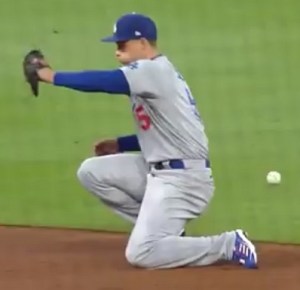
All Jansen did now was throw Rosario one nice little cutter heading for the inside part of the plate. All Rosario did was fire it right back up the pipe at a reported 105.4 miles per hour. Seager had little choice behind second but to turn down to his right to try backhanding the bullet. It blasted off his downstretched glove and into shallow center field.

Swanson shot home with the winner in a 5-4 Braves win, the second walk-off-winning run in two NLCS games for these Braves, who must be feeling as though they’re living charmed lives so far. The bullet bit Seager and the Dodgers. With 32 teeth.

But if you’re going to pound the goat horns into Seager’s forehead, or even demand Dodger manager Dave Roberts’ immediate execution over one or two of his pitching decisions, you really should consider this:

How come the team that led this year’s National League in runs scored, and had a team .806 OPS with runners in scoring position, couldn’t go better than 2-for-18 with four walks and a hit batsman in 24 chances to get runs home so far in this set?

How come the two hits each came from Chris Taylor, with one of them a Game Two bloop misplayed by Heredia into a tiebreaking two-run double in the top of the seventh? Where have all the other Dodger bats been when they manage to get somebody on second base or beyond?

Go ahead and second-guess Roberts’ pitching moves all day long if you must. Argue as you must how foolish it was to send Max Scherzer out to start when Scherzer by his own postgame admission had a dead arm going in.

When Roberts lifted Scherzer for Alex Vesia in the fifth, this time there was no objection from the gassed marksman. Max the Knife was probably lucky that the worst damage in four and a third innings was former Dodger Joc Pederson—now a Brave, by way of the Cubs’ trade deadline fire sale—hitting a two-run homer well above the Chop Shop behind Truist Park’s right field seats in the third.

Argue as you must, too, that Roberts’ real weakness handling his pitching staff isn’t so much playing it by any analytical script as it is relying far too heavily on the more highly-revered members of his pitching staff, instead of paying close attention to which arms have which hot hands regardless of star power.

This time, it was using his 20 game-winning starter Julio Urias in an oft-familiar role—moving him between postseason starting and relieving, a role he’s normally thrived in performing—only to see it backfire spectacularly enough in the Braves’ two-run, re-tying eighth.

Argue as you must that Roberts could well have Graterol for the seventh—after Joe Kelly got rid of the Braves in order in the sixth—and saved Blake Treinen and Jansen to start clean eighth and ninth innings. Or, that he could have given Graterol the night off and used  Treinen and Jansen over the final three innings to divide the last nine outs between them. Or, that he could have brought lefthanded Justin Bruihl in to handle the lefthanded Braves due to swing in the eighth.

Roberts said postgame that in weighing every option the lefthanded Urias was the best arm he had to bring in for the eighth. There’s nothing but positive when you reach for what you think is the best available arm when there’s a two-run lead to protect. That’s what a smart manager does. But even Urias is only human, not Superman.

Sometimes, even in the worst possible moment, the other guys are just a little bit better. The goat hunters too often like to forget that when they’re prowling for a head onto which to plant the horns.

Roberts is no stranger to calculated gambling. If the Urias gambit worked, he’d have resembled a Stengelian genius. When he said postgame that the postseason is the time of year when “careful” isn’t an option, he was dead right. “Careful” wasn’t exactly an option for the Braves, either, when Washington waved Rosario home and left room for Game One walkoff conqueror Austin Riley to send an RBI double to the back of center field.

Since the Braves managed to stand the Urias gambit onto its own head with a little risk taking of their own, it may force Roberts into even deeper such gambling, since Urias was originally his projected Game Four starter but now may be compromised going into that game if he’s still on the slate.

But offer succor to Seager, not sulfuric acid. The Braves didn’t walk Game Two off because Seager did what he wasn’t supposed to do or what he knew better than to do. He’d done his level best to send his team toward a win as the game opened. He’d done his level best to keep them alive and toward extra innings.

Now, Seager did his level best again to keep his team alive but failed to stop the unstoppable bullet. The Dodgers have nine Game Two goats to hold to account. Those batters who couldn’t and didn’t hit with six more Dodgers in scoring position after Seager’s homer and before Taylor’s double.

There’s a reason a smash hit is called a smash hit. Often as not, it’s just too unstoppable.

ALCS Game Two: The traveling Red Sox delicatessen

J.D. Martinez

Martinez—slicing salami in the top of the first . . . (Fox Sports screen capture.)

Two innings. Two thick slices of beef salami. Never before done in a single postseason game.

If there’s a spicier way for the Red Sox to recover from a tight enough American League Championship Series-opening loss than that, you may need to deploy an archaelogical expedition to exhume it.

Six teams have hit pairs of grand slams in the same postseason series, from the 1956 Yankees (World Series) to the 1977 Dodgers (National League Championship Series), from the 1987 Twins (World Series) to the 1998 Braves (NL division series), from the 2001 Diamondbacks (NLDS) to the 2013 Red Sox (ALCS).

Then came J.D. Martinez in the top of the first and Rafael Devers in the top of the second. Just like that, they powered themselves into postseason history and the Red Sox toward a 9-5 series-evening Game Two win. Even if the Astros managed to scrape, scratch, and then launch themselves out of an embarrassing blowout.

There were those asking before the postseason began whether the Red Sox could handle the team who beat them the most frequently when they met in October. The Rays beat them eleven times over the season’s final 89 games. Well, now. After an opening game shutout, the Red Sox sent the Rays home from the division series with three straight losses.

Then, they asked whether the Red Sox could handle the team that beat them with the most ammunition. The Astros beat them in five out of seven meetings in May and June and outscored them 42-25. Well, now. This ALCS is about to shift to Fenway Park after a set-opening split in Minute Maid Park.

The scoring thus far is 13-10, Red Sox. But don’t fool yourselves. The racket only sounded larger than life in Houston because the Astros elected to keep their home playpen’s roof closed for the most part. In open and cooler Fenway Park, the lack of a roof doesn’t matter. The postseason racket is manna for the Red Sox and anything but for visitors.

Right now, the Red Sox ride momentum they snatched back from the Astros in Game Two even more swiftly than the Astros wrestled it for themselves in Game One.

Things were bad enough for the Astros on Saturday with their starting pitcher Luis Garcia taking the ball on a balky right knee, the leg on which he pushes off the pitching rubber. They got worse when Kyle Schwarber opened Game Two with a double to deep left center, Rafael Devers returned from 0-2 to work a one-out walk, and Alex Verdugo waited a two-out walk to set up the ducks on the pond for Martinez.

Rafael Devers

Devers, slicing salami in the second . . . (Fox Sports screen capture.)

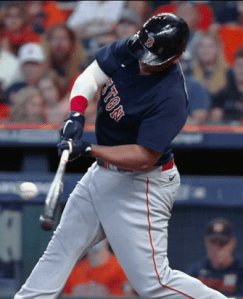
The Red Sox designated hitter brought a string of no hits in his twelve previous plate appearances with men on base. Martinez made up for it with one swing, driving a 1-0 fastball just off the strike zone’s bull’s eye the other way and into the right field seats.

Unaware in the moment about Garcia’s push knee, Martinez knew the pressure was almost entirely on the Houston righthander who looks almost as though he does the rhumba at the rubber before he delivers home. “[The pressure’s] not on me to come through there,” Martinez said postgame.

“It’s the first inning,” he continued. “He has the bases loaded. I’m trying to tell myself that, trying to stay relaxed and just looking for a pitch so I can just put a barrel on it.” Barrel? Martinez put a depth charge into it.

Garcia was probably lucky to get out of the inning on life support by striking Hunter Renfroe out. But after Red Sox starter Nathan Eovaldi slithered out of his own lesser two-out jam in the bottom of the first, Alex Bregman aboard with a two-out double as Yordan Alvarez flied out to deep center, Garcia wouldn’t be so fortunate in the second.

He walked Kevin Plawecki, Eovaldi’s personal catcher, on four high pitches. Manager Dusty Baker and head trainer Jeremiah Randall visited the mound. The entire Astros infield plus catcher Martín Maldonado surrounded them. Garcia finally admitted his right knee bothered him a good while before Game Two.

Baker lifted him for another righthander, Jake Odorizzi, who might have waited to start Game Four otherwise in the Astro plan. Inadvertently, Baker did the Red Sox what may yet prove the largest favour done the Olde Towne Team this year. Pitchers who relieve by profession get themselves ready swiftly enough when they get the call, even if they’re brought in with all the time they need to heat up when taking over for the wounded Starters don’t.

Being a starter by trade, given all the time he needed to warm up, Odorizzi went through as quick a version of his normal pre-start routine as he could muster in the moment. For him it was quick, but for the Red Sox it meant getting a good, acute, long look at him to determine just what he would or wouldn’t have coming in—and how they could or couldn’t exploit it.

And Odorizzi knew it going in.

“I was caught off guard by it, obviously,” Odorizzi said postgame, referencing the Garcia knee issue. “I didn’t know what was going on. I knew he was healthy coming into the game, so I was caught off guard by it. I think everybody was.

“My typical routine is out the window at that point,” he continued. “I hadn’t even stretched, thrown, anything, so it was going to take me a good while to warm up. I think all things (considered) — I’m sure it felt like forever for y’all — but for me, that was about the fastest I can warm up. Usually it takes me 30-plus minutes. I think I did it in under 15. So not ideal, and it’s not like it’s a fun warmup. You’re sitting there pretty much naked in front of the other team.”

Finally, the game got back underway, and the Red Sox showed how much they appreciate naked models with which to work.

Odorizzi dodged one bullet when Christian Arroyo’s long drive down the left field line banged foul off the box seat rail. But he couldn’t dodge Arroyo finally lining a base hit through the open right side, contravening the Astros’ defensive shift. Schwarber struck out swinging, but Kiké Hernández lofted a fly base hit to left.

This time, the ducks on the pond were set up for Rafael Devers, the Red Sox’s lefthanded hitting third baseman bothered himself by a balky forearm. But the forearm knew how to behave when it mattered the most. Devers pulled a 1-1 cutter that arrived up in the middle and a little inward high down the right field line and just inside and past the foul pole.

That second slice of salami tastes even better than the first. Especially with a little spicy mustard on it.

Xander Bogaerts popped out near first base, Verdugo dropped a jam shot into left for a base hit, but Martinez grounded sharply right back to Odorizzi to stop the Red Sox merry-go-round. But an 8-0 lead in two innings meant the music would play onward and upward.

With Eovaldi pitching a gutsy five and a third innings, Hernández himself cranked the music up a little further with one out in the top of the fourth. He yanked a 2-1, down-and-in  Odorizzi splitter into the Crawford Boxes. It was merely the fifth home run of the postseason for the streaky guy who once couldn’t convince the Dodgers he was worth everyday play.

Kike Hernandez

. . . and, Fox Sports getting cute demonstrating just how well Hernández sees pitches lately . . . (Fox Sports screen capture.)

The infielder-outfielder’s first Red Sox postseason’s success continued so dramatically that Fox Sports couldn’t resist developing a special visual to demonstrate how hitters on a roll are believed to see pitches coming their way—it showed Odorizzi’s splitter blowing up into a beach ball just after leaving his hand, floating up and down toward Hernández’s hitting wheelhouse.

According to The Athletic‘s Ken Rosenthal, also an in-game Fox analyst, the Red Sox hitters had a pre-game confab reviewing their attack plan against Astro pitching when Schwarber piped up with a plan of his own: “Let’s be like Kike,” the Schwarbinator said. “Spray balls all over the park. Hit ’em on top of the railroad tracks.”

Ask Hernández what turns him from a mere jack-of-all-trades with a little power and a modest career curriculum vitae into a weapon in the postseason lifetime thus far but into Hank Aaron in this postseason—especially after he was wrung out by a battle with COVID from late August through early September—and he’s either stuck for an answer or reduced to boilerplate.

“I don’t know,” he said when Rosenthal asked. “I guess feeling good. The importance of the game is allowing me to stay focused, stay locked in, not think too much about it. I’m just glad I’m able to put good at-bats, get on base, drive myself in to help us win, to get to this position.”

Sure. That oh-so-slight move forward in the batter’s box, especially on the breaking balls Hernández formerly had trouble handling, had nothing that much to do with it. From a lifetime .196 hitter on breakers in the regular season to a .700 hitter with three bombs on breakers this postseason. We’ll buy that not-think-about-it jazz—as soon as we make the last payment on that Antarctican beach club.

The Astros’s five runs seemed almost incidental compared to the Red Sox’s mayhem Saturday afternoon. With two out in the bottom of the fourth, Kyle Tucker drove one bouncing off the left field scoreboard wall to send Yordan Alvarez (walk) home, and Yuli Gurriel lined a two-run single the other way to right.

The next time they scored, in the bottom of the ninth, Gurriel hit a full-count fastball up from Red Sox reliever Darwinzon Hernandez into the Crawfords and, one out later, late-game catching insertion Jason Castro hit Hernandez’s 2-1 meatball over the center field fence. Compelling Red Sox manager Alex Cora to bring in Ryan Brasier to fool Jose Altuve into hitting a pitch on the strike zone’s ceiling to deep left for the game-ending out.

“We won the seventh, eighth, and ninth,” Baker said postgame. “But those two innings in the beginning, that’s a tremendous mountain to climb.”

In absolute fairness, the Astros’ pitching issues have proven a bump to the Red Sox’s plate formidability now. Even winning Game One the Astros were forced to get six and two thirds innings from their bullpen after starter Framber Valdez couldn’t get out of the third inning alive. Garcia being salamied on a balky knee meant eight bullpen innings Saturday.

Odorizzi gave the Astros’ proper relief corps a break Saturday, but José Urquidy—who hasn’t pitched since 3 October, and who carries a 4.14 fielding-independent pitching [FIP] rate for the regular season—is now listed to start Game Three. He’s a calculated risk even in Fenway Park, since the Red Sox team OPS was almost thirty points higher against righthanded than lefthanded pitching this year.

It also meant Odorizzi out of any Game Four plan, maybe not even a topic until a Game Six if the set gets there. It may mean Valdez having to start Game Four on short rest. Not to mention that the Astros can’t afford any more short starts—and once-formidable Zack Greinke isn’t exactly stretchable anymore. With his own regular season 4.16 ERA but 4.71 FIP, Greinke may even be a bigger risk now if he has to work past forty pitches.

Losing Lance McCullers, Jr. to a forearm muscle strain for the ALCS is hurting a lot more than the Astros bargained for, so far.

Cora bet the ranch that he could get away with a running of the bulls in Game One because Eovaldi would give the pen itself relief on Saturday and leave the manager the option of starting Nick Pivetta and Eduardo Rodriguez in the first two Fenway games, the order unknown at this writing. Cora won that bet.

It didn’t hurt that the Red Sox opened a traveling delicatessen in Houston Sunday with salami prominently on display, either.

ALCS Game One: The world didn’t implode

Jose Altuve

Jose Altuve’s two-run homer tied Game One and turned the game’s momentum to the Astros . . . (Fox Sports screen capture.)

Before the American League Championship Series began, it was easy to remember but so hard to forget. The elephant still lingered in the room.

The American League West-winning Astros. The American League wild card-winning Red Sox. Electronic sign-stealing cheaters versus electronic sign-stealing cheaters. Right?

Not quite that simple. Not even if Red Sox fans and others still cringe over the 2017-18 Astro Intelligence Agency. Not even if Astro fans and others still think the 2018 Rogue Sox Replay Room Reconnaissance Ring proved the Astros weren’t alone in high-tech cheating.

Those Red Sox got nailed using their replay room as a sign-stealing helpmate. But they didn’t install the video apparatus in there, MLB did—for them and all thirty teams, behind all home and visitors’ dugouts in all thirty ballparks. Their way, and they probably weren’t the only team doing it, depended on having men on base to relay stolen signs to their batters.

I’ve said it before, I’ll say it one more time: With the best intentions, MLB in essence were Mom and Dad leaving the keys to the liquor cabinet behind expecting the kids were mature enough not to open up and party while they were out of town for the weekend. The 2018 Rogue Sox opened up and partied. The 2017-18 Astros built their own distillery.

Their front office used an in-house-designed computer algorithm devised for sign stealing during games, despite the designer’s warning that doing it in-game was illegal. They used a high-speed, real-time camera to abrogate the mandatory eight-second transmission delay and send opposing signs to clubhouse monitors, next to which someone sent the hitters the dope via the infamous trash can bangs.

Both teams cheated then. Both teams seemed like deer frozen in the proverbial headlights when asked to show public accountability and contrition. The Astros were far, far worse. They went far, far above and beyond both the traditional on-the-field, in-the-dugout gamesmanship and the sort of boys-will-be-boys thing the Rogue Sox and others did with the MLB-gifted replay rooms.

Commissioner Rob Manfred may have erred in granting players from those teams immunity in return for the details, but his investigation did at least turn up and discipline the key overseers.

He suspended then-Astros general manager Jeff Luhnow and manager A.J. Hinch before owner Jim Crane fired the pair. He suspended then-Astros bench coach Alex Cora over Astrogate, but determined the 2018 Rogue Sox’s prime culprit was video room operator J.T. Watkins while manager Cora, his coaches, the front office, and maybe half the Red Sox’s players weren’t in on the replay room reconnaissance ring.

Nobody can redeem those Astros or Red Sox, even if the Red Sox did re-hire a contrite-enough Cora to manage them this year. But we can remind ourselves that, today, only five Astrogate players remain with the team. We should remind ourselves that at least one such suspect, second baseman Jose Altuve, actually demurred from accepting stolen signs and even told his teammates and others to knock off the trash can banging while he was at the plate.

Only nine Rogue Sox members remain in uniform today, too. And, the rules against electronic sign-stealing were tightened in Astrogate’s aftermath. Video room security is now three people deep. Video feed delays are now fifteen seconds over the previous eight. Players caught stealing signs electronically can be suspended without pay or credited major league service time.

This year’s Astros and this year’s Red Sox got to this year’s ALCS regardless. Remove their former taints, and you have two opponents who entered the set with suspect pitching (particularly the Astros, losing Lance McCullers, Jr. to a forearm issue) but very strong offenses. Then, you watched Game One Friday night, even if in spite of yourselves.

You watched Red Sox center fielder Kike Hernandez strike long twice but Altuve strike once to change the game’s momentum toward the eventual 5-4 Astros win.

You watched Astros starting pitcher Framber Valdez and Red Sox starter Chris Sale unable to get out of the third inning alive. You watched the ordinarily suspect Astros bullpen hold the Red Sox to four hits, one walk, and one measly run, when Hernandez—who tied the game leading off the top of the third by hitting a Valdez curve ball far over the left center field seats—caught hold of a Ryan Pressly slider and send it deep into the Crawfords in the top of the ninth.

You watched the Red Sox take a 3-1 lead in that third a ground out, a walk, and a base hit up the pipe later, when designated hitter J.D. Martinez’s hopping grounder bumped off Altuve’s glove to send shortstop Xander Bogaerts (the walk) home, before right fielder Hunter Renfroe ripped an RBI double past Astros third baseman Alex Bregman and down the left field line to score Bregman’s Red Sox counterpart Rafael Devers (the base hit).

You watched Altuve ruin that lead in the bottom of the sixth, with Astros center fielder Chas McCormick aboard on a one-out single, when he hit the first pitch he saw from Red Sox reliever Tanner Houck into the Crawfords.

You watched another Red Sox reliever, Hansel Robles, fire sub-100 mph bullets in the bottom of the seventh to get rid of Bregman on a grounder to short and left fielder Yordan Alvarez on a hard-swinging strikeout, before offering Astros shortstop Carlos Correa a changeup that hung up enough for him to yank into the Crawfords to break the three-all tie.

You watched a Red Sox reliever who hadn’t pitched in almost two weeks, Hirokazu Sawamura, surrender a leadoff walk to Astros first baseman Yuli Gurriel before McCormick bounced a base hit in front of Red Sox left-field insertion Danny Santana (a top-of-the-eighth pinch hitter). You saw Martin Maldonado take a pitch off his right wrist to load the pads with nobody out.

And you saw Altuve hit a sacrifice fly to center to send Gurriel home with the fifth Houston run, though a slightly more on-line throw might have gotten Gurriel at the plate to keep things within a single run for Hernandez’s second launch of the night.

Kike Hernandez

Hernandez’s dive-and-roll catch of Michael Brantley’s second-inning-ending, bases-loaded sinking liner wasn’t enough to stop the Astros Friday night. Neither were his two long home runs. (Fox Sports screenshot.)

Hernandez’s mayhem—the two homers on a 4-for-5 night (the first such leadoff hitter in the Show to do it), bringing him to fourteen hits in 28 postseaon at-bats this time around, his MLB-record third lifetime postseason game of ten total bases—may not have been quite enough for the Red Sox to take Game One. But it was more than enough to impress Astros manager Dusty Baker.

“I haven’t seen a hitter this hot in the last week than Kike Hernandez,” the skipper said post-game, after Hernandez’s first launch came during Baker’s brief turn talking to Fox Sports broadcasters Joe Buck and Hall of Fame pitcher John Smoltz. “Boy, when I saw that ball go up, I was like, oh man, that was a blast. Then he blasted another one. It’s not a good feeling when you know you’re live on air and you see that ball leaving the ballpark.”

Hernandez wasn’t the only one dancing with the record books. Altuve and Correa became the first teammates to homer in the same postseason game for a fourth time. “He is just so dangerous,” said Correa of Altuve post-game. “His track record in the playoffs is insane, and he just inspires me. He inspires me without saying much.”

That track record includes tying Hall of Famer Derek Jeter for number three on the all-time postseason bomb roll with his 20th such launch Friday night. But you should have heard Altuve speak of Correa, too. “He is amazing,” the compact second baseman said of his keystone partner at shortstop. “He likes this kind of game. He wants to go out there and hit big homers. It seems like he expects to go out there and do it, so if you’re expecting something, eventually you’re going to make it happen, and that’s him.”

Hernandez also impressed the Astros and maybe even some of their home crowd Friday night with a few defensive gems, particularly his dive-and-roll catch of designated hitter Michael Brantley’s bases-loaded, sinking line drive to end the bottom of the second. But he’d have swapped all that for a Red Sox win.

“I think overall we played a good game,” he said postgame. “Once again, we didn’t do a good job of adding on to the lead, and at the end of the day, that’s why we lost. We weren’t able to add any more runs.” That was in large part because the usually suspect Astro bullpen managed to keep them to a measly four hits and a walk in the unexpected bullpen game.

With Nathan Eovaldi starting Game Two, and the still-fresh memory of being shut out by the Rays to start a division series in which they won the next three straight, the Red Sox don’t exactly have reasons to cringe just yet. Even Sale admitted Eovaldi was their best foot forward to launch Saturday.

“We’ve got the right guy on the right mound, and that’s all we can say,” he said. “Our lineup is going to bang with the best of them. There’s no doubt about that. We’ve got to do the little things right, and with Nate taking the ball, that’s everything we could ask for.”

So guess what didn’t happen when the two teams still recovering from their own Astrogate and Rogue Sox scandals—yes, listed in the order of true gravity—tangled in Game One? Knowing that no one will be comfortable with either one wholly, but the Astros especially, until the last Astrogater or the last of the Rogue Sox no longer wears either uniform?

The world didn’t implode. The flora didn’t wilt. The fauna didn’t commit mass suicide. The moon didn’t fall into the river. The sun didn’t awaken before its appointed time. The nations didn’t fall from the earth. The earth didn’t go flat.

Unless there comes fresh contravening evidence, the Astros and the Red Sox played it straight, no chaser, in a game that would have classified as a bit of a thriller had it not been for that still-lingering elephant. The one aboard which the Astros, like it or not, still look far, far worse than the Red Sox or their fellow unverified-but-certain replay room rogues do.

When getting it right means the worst message to kids

Wilmer Flores, Will Smith, Doug Eddings

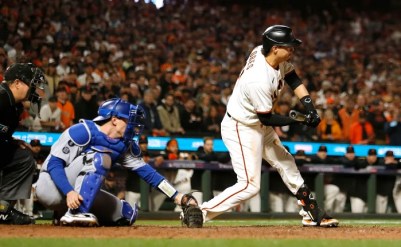
Wilmer Flores—representing the potential Giants’ winning run—checking his swing Thursday night. On appeal from plate umpire Doug Eddings (far right), the check swing was denied by first base umpire Gabe Morales and thus strike three ended the NLDS and the Giant’s season. Some think such robbery sends the “best” message to kids.

Social media isn’t exactly renowned as the exclusive domain of the learned. But when you see something such as I’m going to quote—I won’t embarrass the source by identifying him, though I know him well enough to know that he ought to know better—you tremble for your country when you remind yourself that God may be just but humans may be willfully ignorant.

The gentleman in question responded to “The Strike Heard ‘Round the World,” my account of NLDS Game Five and the shamefully needless way it ended. With Wilmer Flores’s check swing ruled a strike, erroneously, by first-base umpire Gabe Morales on appeal. With Flores robbed of a chance to persevere against Max Scherzer, despite his weak career papers against Max the Knife.

With the potential tying run on first for the Giants and himself representing the potential winning run, Flores should have had the chance to try before it was game over. He was denied improperly. My correspondent says, essentially, so what? “So what” works as a classic jazz exercise by Miles Davis. Not proper baseball analysis.

What the players do is human, what the broadcasters do is human,” said the gentleman in question, being a former baseball broadcaster himself.

[S]o the umpires do human things, smart or stupid. players and fans have to live with it. we’re sending the worst kind of message to our kids. Kids need to know that rotten calls will be made against them and they can’t plead for a review because there won’t be any.

Oh. So one of championship baseball’s most important jobs is to send the best kind of messages to kids. Got it. Very well, I surrender.

Let’s talk, indeed, about the Worst Kind of Messages We Send Kids when an umpire makes a mistake on what might be the final out of a postseason set’s final game, offers at least a mildly coherent explanation, then allows his crew chief to elaborate when asked further with, “Yeah, no, we, yeah, yeah, he doesn’t want to say.”

It tells me that the adults in the room who won’t stand for it when the kids dissemble upon being caught with their hands in the cookie jar or the liquor cabinet haven’t got that strong a leg to stand upon. I’d clean up betting that that’s what the kids in the room figure out, too.

Let’s talk, indeed, about the Worst Kind of Messages We Send Kids when the adults in the room decide, basically, yeah, we’re being rotten sonsabitches. But tough toenails, kids, that’s the way it is. This isn’t up for debate. We’re the mommies and daddies, that’s why. Because we said so, that’s why.

It tells me the adults in the room have no eyes to see. The kids in the room gather that their parents drink deep of power and parch themselves of prudence. They see might making right regardless of justification, in one or a hundred instances. They see authority with unsound foundation.

Let’s talk, indeed, about the Worst Kind of Messages We Send Kids when we tell them review isn’t an option. It tells me the adults in the room know three things about the country in which their game was born, nurtured, and grown in the first place: jack, diddley, and squat. Baseball’s government may lack in the complete range of reviewable acts, but baseball’s country’s government actually consecrated the right to review.

This nation’s founders consecrated a Bill of Rights that mandates, among other things, the right to petition for a redress of grievances. Such grievances are usually (though not exclusively; reference Congressional committee hearings) presented and argued before—what do you know—a Supreme Court. Never mind for the moment that given Supreme Court panels can seem as judicially tyrannic as umpires who are, after all, baseball’s most immediate arbiters.

But the Supreme Court has also overturned its own rulings frequently enough, unless higher authority—you know, the legislative branch, and the president, and in that order—writes and signs laws accordingly. The Supreme Court blew the Dred Scott decision? (It emanated first in the same city from which Curt Flood fired the Second Shot Heard ‘Round the World.) Abraham Lincoln’s Emancipation Proclamation plus the Thirteenth and Fourteenth Amendments took care of that blown call. That’s just one example.

By the way, federal judges up to and including even Supreme Court justices can be impeached. (Sixteen have been, including Supreme Court Justice Samuel Chase.) Baseball’s government hasn’t yet designed or imposed genuine umpire accountability. The better umpires in the game are compromised by their lessers.

Those concerned more with the Best Kind of Messages We Send Kids than with getting things right in championship or championship-aspirant games should ponder something else. Why might it be that ordinary, everyday enterprises impose accountability on their people, from the most obscure warehouse people to the highest-stationed boardroom people—but baseball can’t impose accountability on the arbiters who can, and often do, make, break, or compromise a game?

You want to send the Best Kind of Message to Kids? How about telling them that an improper lack of redress for check swings meant we’ll never know whether Wilmer Flores would have risen to the occasion of a 1-2 count, in a postseason series-deciding game, and overcome his career-long futility against Max Scherzer to keep the Giants’ now-ended season alive?

How about telling them the reason we’ll never know is because Flores was robbed of the chance to try once more at least?

Saying umpires make mistakes because they’re only human is one thing. Saying baseball shouldn’t do its best to correct and prevent key mistakes in-game—especially with a championship or an advance toward one on the line—is pitiful. Saying baseball shouldn’t do it because it would Send the Worst Kind of Messages to Kids, which is patent nonsense, should leave you at minimum with no credibility as a baseball commentator.

The strike heard ’round the world

Don Denkinger, you’re off the hook. Flores checking his swing into the arguable worst blown call in postseason history

Giants manage Gabe Kapler wouldn’t say it, even though anyone with eyes to see would say it for him. Even the Dodger fans among them. Maybe it wouldn’t change the outcome with that wired a Max Scherzer on the mound.

But ending this National League division series with that bad an umpire’s call? For the final out of the season for one team, not the first out of the ninth as was Don Denkinger’s infamous blown call at first in Game Six of the 1985 World Series?

There isn’t a jury in the land that would rule Kapler unjustified if he’d blown his proverbial stack or even demanded an investigation. This tight a Game Five between two of baseball’s most bitter of blood rivals plus the two winningest teams in this year’s Show deserved better than that.

These Dodgers and these Giants deserved better than first base umpire Gabe Morales ruling Wilmer Flores’s checked swing a strike to end it, after home plate umpire Doug Eddings—to his eternal credit—called for Morales’s help. That kind of help neither Eddings nor the Giants needed.

Two teams who’d been even-up in their regular season meetings, had the same number of hits against each other (173), and entered Game Five with each having 109 wins for the year including the postseason thus far, deserved better than a 2-1 Dodger win tainted through no fault of either team’s own.

“There are other reasons we didn’t win today’s baseball game,” Kapler said post-game. “That was just the last call of the game.” That was like a Japanese commander saying Hiroshima and Nagasaki were just the last blows of World War II.

Let’s give Morales a temporary benefit of the doubt. “[C]heck-swings are one of the hardest calls we have,” he said post-game. “I don’t have the benefit of multiple camera angles when I’m watching it live. When it happened live I thought he went, so that’s why I called it a swing.”

But Morales was shown a replay of that final pitch. Then, someone asked if he’d still call it failed check swing. Ted Barrett, the crew chief, answered for him. Sort of. As if Morales was incapable of speaking for himself.

“Yeah, no, we, yeah, yeah, he doesn’t want to say,” Barrett said. If there’s a more mealymouthed response upon a blown call’s questioning on record, I’d love to see it. Even Denkinger wasn’t that foolish when confronted with how badly he’d blown it calling Jorge Orta safe at first despite being out by almost a full step.

“Obviously you don’t want a game to end that way,” Kapler also said. “Obviously it’s going to be frustrating to have a game end like that, but pretty high quality hitter at the plate that can climb back into that count. There’s no guarantee of success in that at-bat. It’s just a tough way to end it.”

Flores checked his swing on an 0-2 pitch that came in just under the low outside corner. All things considered, especially the proliferation of dubious pitch calls all series long against both the Dodgers and the Giants, it wouldn’t have been the worst possible outcome for the plate appearance to continue.

But Flores checked his swing. Eddings called to Morales. Morales rang Flores up for game, set, and match. Sending the Dodgers to a National League Championship Series against the Braves, sending Giants fans reaching for the nearest possible liquid salves, and soiling the Game Five this series deserved otherwise.

They’d gone tooth, fang, claw, and just about anything else not just to get to Game Five in the first place but to get to the bottom of the ninth with only a single run separating them.

The Dodgers had gone to a bullpen game, opening with reliever Corey Knebel, continuing with fellow reliever Brusdar Graterol, then sending starting pitcher Julio Urias out of the pen to pitch a solid enough third through sixth. Then back to the pen men Blake Treinen for the seventh and Kenley Jansen for the eighth.

The thinking was that the Giants—a club full of elders and anonymous role players for the most part—were so deadly in situational play that, as The Athletic‘s Andy McCullough observed, the Dodgers’ best shot at neutralising that advantage by throwing two-thirds of their bullpen at the Giants and returning Urias to the postseason role where he’d been so effective in the recent past while they were at it.

It’s not that teams haven’t gone to bullpen games before. The Rays make about a third of their living doing it. Why, almost a full century ago the Washington Senators (Washington—First in war, first in peace, and last in the American League) won the 1924 World Series going to a bullpen game prototype in Game Seven.

All the Dodgers needed was Urias on board with the idea. “He earned the right to pitch in this game,” said Dodgers pitching coach Mark Prior. “If he said, ‘No, I want it,’ he was going to get it.” They surveyed other Dodgers including starters Scherzer, injured Clayton Kershaw, and Walker Buehler, who’d pitched so effectively in the Dodgers’ Game Four win.

“When they were on board,” Prior said, “it made sense. Everyone is in it to win it. Let’s go.”

That’s how they countered the Giants sending their stout young starter Logan Webb out for Game Five. He gave the Dodgers as good as their pen game gave the Giants. He pitched seven solid innings. The only blemishes on Webb were Mookie Betts delivering three of the four Dodger hits against him, and Corey Seager sending the Mookie Monster home with a double down the left field line in the top of the sixth to deliver the game’s first run.

Until Scherzer came into the game, the only real blemish against the Dodgers’ pitching was Giants left fielder Darin Ruf tying the game at one leading off the bottom of the sixth, by hitting Urias’s full-count fastball over the center field fence.

But until the Flores check swing that should have been, the co-story of the game might have ended up being the Dodgers leaving the Giants behind with yet another Belli-ache plus Max the Knife plunged into their backs in the bottom of the ninth. More’s the pity.

Continuing his re-adjusted postseason revival—after an injury-marred regular season reduced him to terms so low people questioned why Dodger manager Dave Roberts kept running his former MVP out there at all—Cody Bellinger broke the one-all tie in the ninth.

He made the Giants pay after their young relief ace in the making Camilo Doval hit Justin Turner up and in on the first pitch after Will Smith grounded out to shortstop to open the top of the ninth. Gavin Lux snuck a base hit through the right side of the infield to set first and second up.

Then, Bellinger took ball one low, swung through a slider around the middle, bounced a foul ball off to the right, then shot one up the middle and into center field sending Turner home with the tiebreaking run. Which probably amped Scherzer up in the pen even more than he’d already sent himself.

When he wasn’t throwing warmup pitches, Scherzer paced and pranced like a maniac. It was a wonder nobody had to shoot a tranquiliser dart into his rump to make sure he could go in and pitch the bottom of the ninth without dismantling himself.

He all but shot in from the pen to the mound as the sides changed. It was so must-see television that the TBS broadcast obeyed the call, too, not cutting to a commercial break as he made his way to the mound. You’d have thought the back of his uniform carried not his surname and number 31 but Danger! High Explosives! Keep Back 500 Feet!

Pinch hitter Matt Beaty ended the top of the ninth by grounding out to Flores playing first for the Giants. “Flores touched first base,” said Betts with a laugh, “and it felt like Scherz was halfway to the mound.”

This was virgin territory: Scherzer had never recorded a relief save in his entire professional pitching career. Yet he flew in from the pen as though fourteen years’ worth of a Hall of Fame pitching career to date was merely the overture to his kind of Unfinished Symphony.

So, with Bellinger shifted from first base to center field and Billy McKinney out playing first, Max the Knife unsheathed. He got Crawford to line out the other way to left. He shook off Turner bobbling Kris Bryant’s grounder up the third base line enabling Bryant safe on the error to strike out Lamonte Wade, Jr., who’d been making a name for himself with assorted ninth-and-later heroics for the Giants.

Then came Flores, the former Met who’d been part of their 2015 run to the World Series. A slider hitting the middle of the zone for a called strike. A foul off. Then, the fateful slider coming down and just off the corner. The checked swing. Eddings’ appeal to Morales at first. Strike three. Game, and Giants’ season, over.

There are eleven categories of reviewable umpire calls that managers are allowed to challenge. In the postseason, a skipper gets two challenges instead of the one allowed during the regular season. Check swings and pitches aren’t among the eleven. Maybe in the postseason they ought to be.

The “human element” be damned. When Whitey Herzog (Cardinals manager in 1985) called outright for replay in his 1998 memoir You’re Missin’ a Great Game, he had it as right as right can be: “This is for the championship—let’s get it right.” This was toward a potential championship and a win-or-wait-till-next-year game in the bargain. It should have been gotten right.

Seventy years ago, the Giants’ Bobby Thomson hit the Shot Heard ‘Round the World to finish a pennant playoff we’ve long since known, with full proof, was tainted by an off-field-based sign-stealing plot that helped those Giants come from thirteen games back to forcing that playoff in the first place.

Maybe it was tempting the fates a little too flagrantly when it turned out someone with the Giants—not a fan or fans, as I thought when seeing the sign in a flickering moment during the Game One telecast—tacked that “Remember ’51!” up on a deck rim in Oracle Park. Very clever, using a tainted triumph for motivation.

But ’51 was then, and this was Thursday night. Tainted not by cheating but by the kind of malfeasance that’s brought demands for further and fuller umpire accountability and for technology to help get the calls right. I don’t have to be as kind as Gabe Kapler.

Don Denkinger, you’re off the hook for the arguable worst blown call in postseason history. Maybe Scherzer would have retired Flores anyway if the proper call was made; maybe Flores would have kept the inning alive with a base hit. Maybe—unlikely as it might have been, considering his 0-for-17 lifetime jacket against Max the Knife—he might have tied or even won the game with one swing.

Maybe. We’ll never know now.

Until or unless baseball’s government effects real, substantial umpire accountability and stops allowing the “human element” to enable them to get away with murder, this NLDS Game Five’s finish should be known forever as The Strike Heard ‘Round the World.