On Anderson, Robinson, Donaldson, and jokes

Tim Anderson

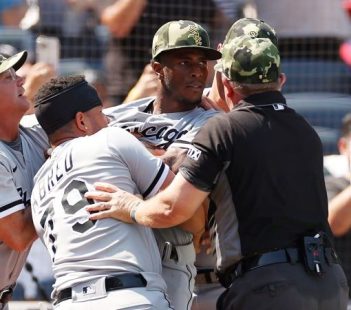
Tim Anderson has to be restrained by teammates including Jose Abreu, and plate umpire Nick Mahrley, after Josh Donaldson took what he calls a joke too far Saturday.

That’d teach him. Three years ago White Sox shortstop Tim Anderson gave Sports Illustrated reporter Stephanie Apstein an interview in which he likened himself to Jackie Robinson. Not as a race pioneer, but as the kind of pioneer looking to break down another barrier, the barrier against having plain fun and letting it show while you play baseball.

Anderson didn’t kid himself. He as much as said he didn’t and probably wouldn’t face the kind of obstacles Robinson faced. What he did say, in language as plain as the plays he makes at shortstop or the hits he nails at the plate, was that he didn’t care two figs what you thought of him having fun playing, you know, a game.

The impetus for the interview was his then-recent suspension for hollering an insult back at Kansas City pitcher Brad Keller, after Keller hit him on the rump roast with the first pitch, two innings after Anderson demolished a Keller pitch for a two-run homer, looked to his dugout, and nailed a delicious bat-flip as he proceeded up the first base line.

“I kind of feel like today’s Jackie Robinson,” Anderson told Apstein then. “That’s huge to say. But it’s cool, man, because he changed the game, and I feel like I’m getting to a point to where I need to change the game.” In other words, Anderson planned to have his fun while he played. Oh. The hor-ror.

“Anderson’s point is more nuanced than it might sound,” Apstein wrote.

Robinson remains an American hero, and Anderson will never face the Jim Crow horrors Robinson and the first generation of black major leaguers endured. Also, plenty of players, white and nonwhite alike, have had fun while playing the game.

But, as a rule, baseball does not encourage individualism. As other sports have evolved to showcase their stars’ personalities, the baseball old guard has held tight to its principles. Run out ground balls. Keep your mouth shut. Gently place your bat near home plate—a player should react to a home run just as he would react to the news that an acquaintance filed his taxes on time.

Yankee third baseman Josh Donaldson remembered Anderson’s “I kind of feel like today’s Jackie Robinson” only too well. On Saturday, the Yankees and the White Sox had a dustup on the field over it, a few innings after Anderson says Donaldson greeted him with an apparent “What’s up, Jackie?”

A few innings later, as Donaldson approached the plate with the Yankees up 6-3, White Sox catcher Yasmani Grandal engaged him in a little chat. It didn’t look like anything drastic at first—from the outside. The next thing anyone knew, plate umpire Nick Mahrley was moving between the pair and the benches and bullpens emptied. With White Sox teammates moving Anderson back to the dugout before any serious damage could be done.

Nobody other than the immediate participants had any clue until White Sox manager Tony La Russa spoke to reporters following the 7-5 Yankee win. “He made a racist comment, Donaldson, and that’s all I’m gonna say,” La Russa said. It took Anderson himself to elaborate.

“He just made a disrespectful comment,” the shortstop said of Donaldson. “Basically was trying to call me Jackie Robinson, like ‘what’s up Jackie?’ I don’t play like that. I don’t really play at all. I wasn’t really gonna bother nobody today. But he made the comment, and it was disrespectful. I don’t think it was called for.”

Donaldson didn’t deny calling Anderson “Jackie,” but he did say the motive had nothing to do with race and everything to do with Anderson telling SI he felt like the Robinson of defunding baseball’s Fun Police.

“All right, so first inning I called him Jackie,” Donaldson told reporters post-game.

He’s gonna bring back fun to the game. [In] 2019 when I played for Atlanta, we actually joked about that on the game.

I don’t know what’s changed — and I’ve said it to him in year’s past. Not in any manner than just joking around for the fact that he called himself Jackie Robinson. If something has changed from that, my meaning of that — has not any term trying to be racist by any fact of the matter. It was just off of an interview of what he called himself.”

Donaldson may have lacked racial intent but his timing Saturday was a terrible look. “The very simple problem with Josh Donaldson calling Tim Anderson ‘Jackie’,” tweeted Business Insider writer Bradford William Davis, “is that he perverted honour into mockery.”

Could there have been those thinking Anderson, who’s normally as unpretentious as the morning sun, did likewise when he suggested himself as the Jackie Robinson of letting the kids play? Robinson broke barriers far more severe and grave than those between ballplayers letting joy in accomplishment show and ballplayers still artery-hardened enough to continue thinking you should play a game as though you’re wearing a three-piece suit in the board room.

And I for one have long tired of the hypocrisy saying one moment that you need to play professional baseball like a business but saying the next—as in, contract talks, free agency markets, or collective bargaining agreement skirmishes—that you need to remember you’re only playing a kids’ game, dammit.

Maybe Anderson was being just a little grandiose in 2019, while his heart was clearly enough in the right place. Maybe Donaldson chose the absolute wrong conversational weapon to send a message that baseball’s Fun Police aren’t about to be defunded without a fight.

Or, giving him the benefit of the doubt about the exchange he cited from 2019, maybe Donaldson doesn’t get that a joke has a finite shelf life. As in, immediately after he and Anderson laughed about it the first time. Cracking it three years past that expiration date doesn’t mean a laugh or a tension dissipator but a nasty cut to the heart and soul.

“This game went through a period in time where a lot of those comments were meant,” said Grandal post-game, after telling reporters they didn’t want him to tell them what he actually said to Donaldson behind the plate. “And I think we’re way past that. And it’s just unacceptable. I just thought it was a low blow and I want to make sure I’ve got my team’s back. There’s no way that you’re allowed to say something like that.”

Baseball government told Anderson with a suspension that there’s no way he’s allowed to call Keller, who’s white, “a weak-assed [N-word]” after he got drilled in 2019. Let’s see if baseball government tells Donaldson the same way that there’s no way he’s allowed to call a black player “Jackie” even as a joke, three years after the joke’s shelf life expired.

Roger Angell, RIP: Hitting for distance

Roger Angell, at his induction as a J.G. Spink Award winner at the Hall of Fame.

The great New Yorker essayist and baseball companion has passed at 101. The Elysian Fields gains an incomparable baseball companion but the works he left for us continue to instruct, delight, resonate, and embrace. I can do no better now than to re-publish the tribute I wrote upon his centenary in September 2020.

“Since baseball time is measured only in outs,” Roger Angell once wrote, “all you have to do is succeed utterly: keep hitting, keep the rally alive, and you have defeated time. You remain forever young.” Perhaps a man whose last known published anthology is called This Old Man can’t be called forever young.

At age one hundred as of today, Angell himself can be called forever. Six anthologies of his singular New Yorker baseball writings, plus his unlikely election to the Hall of Fame as a J.G. Taylor Spink Award winner, places him there.

“Unlikely?” you say. It was, until Susan Slusser—the San Francisco Chronicle baseball writer, when she was president of the Baseball Writers Association of America—made it her personal mission to get Angell elected despite the fact that he’d never held down a daily baseball beat in any newspaper and was never a BBWAA member. “I felt very strongly,” Slusser once said, “that there should not even be a writers’ exhibit in the Hall without Roger Angell.”

Angell was inducted the same year as Tom Glavine, Greg Maddux, and Frank Thomas among players; Bobby Cox, Tony La Russa, and Joe Torre among managers; and, the Texas Rangers’s Eric Nadel as the Ford C. Frick Award-winning baseball broadcaster. “J.G. Taylor Spink,” Angell said, beginning his induction speech, “this was one of that early fun of tingling baseball names that rushed over me when I was a boy and first began reading about and hearing about baseball.”

As I wrote elsewhere last February, Slusser knew the often-forgotten parallel between baseball and its writing: a winning team must have at least one man who hits for distance. Angell’s distance hitting since 1962 has been as instructive and as much fun as this year’s Slam Diego Padres have been hitting for distance with the pillows occupied.

This son of Katherine Sergeant Angell—New Yorker fiction editor, who birthed her son nine days before Eddie Cicotte broke the Black Sox silence with his grand jury confession, and nine years before she would re-marry to New Yorker literary legend E.B. White—even hit for distance describing hits for distance. He hit a hefty belt of his own in 1975 when describing the first spring training encounter between a freshly-minted Met outfielder named Dave Kingman and a freshly-minted Yankee pitcher named Catfish Hunter.

Now, with one out in the top of the second, Dave Kingman stood in for the Mets, occasioning a small hum of interest because of his height, which is six feet six inches, and his batting style, which is righthanded, tilted, and uppercutting. The hum was replaced by an explosion of sustained shouting as Kingman came around on a high Hunter changeup, caught all of the ball—every inch and ounce of it—with his bat, and drove it out of the park and out of the lights in a gigantic parabola, whose second, descendant half was not yet perceptible when the ball flew into the darkness, departing the premises about five feet inside the left field foul line and about three palm trees high. I have never seen a longer home run anywhere.

. . . The Yankees were still talking about the home run the next day, when Hunter told Ron Blomberg he hoped he hadn’t hurt his neck out there in left field watching the ball depart. Others took it up, rookies and writers and regulars, redescribing and amplifying it, already making it a legend, and it occurred to me that the real effect of the blast, except for the memory and the joy of it, might be to speed Catfish Hunter’s acceptance by his new teammates. There is nothing like a little public humiliation to make a three-and-a-half-million-dollar executive lovable.

The Mets inadvertently launched Angell’s baseball odyssey in the spring of their birth. New Yorker editor William Shawn—in what was surely the single most unlikely but unimpeachable moment of American inspiration since Benjamin Franklin took whomever up on the admonishment to go fly a kite—sent Angell to spring training to see what he might find. The man who succeeded his mother as the magazine’s fiction editor assented.

“[I]t was clear to me,” he wrote introducing his first anthology, The Summer Game, “that the doings of big-league baseball . . . were so enormously reported in the newspapers that I would have to find some other aspect of the game to study.”

I decided to sit in the stands . . . and watch the baseball from there . . . I wanted to pick up the feel of the game as it happened to the people around me. Right from the start, I was terribly lucky, because my first year or two in the seats behind first or third coincided with the birth and grotesque early sufferings of the Mets, which turned out to be the greatest fan story of all.

The odyssey since has seen Angell ease naturally, intelligently, and empathetically, from merely a fan among fans with a notebook and pen in his hand to an observer of particularly acute insight, especially when it came to reminding his readers that, when all is said and perhaps too much done, the men who play the game are only too human, just publicly so. Few essays published in my lifetime remind you so humanely as “Gone for Good,” his June 1975 observation (including time spent with the man) of pitcher Steve Blass’s unexpected and un-repairable collapse.

Like anyone in hard straits, he was deluged with unsolicited therapies, overnight cures, natruopathies, exorcisms, theologies, and amulets, many of which arrived by mail. Blass refuses to make jokes about these nostrums. “Anyone who takes the trouble to write a man who is suffering deserves to be thanked,” he told me . . .

“There’s one possibility nobody has brought up,” he said. “I don’t think anybody’s ever said that maybe I just lost my control. Maybe your control is something that can just go. It’s no big thing, but suddenly it’s gone.” He paused, and then he laughed in a self-deprecating way. “Maybe that’s what I’d like to believe,” he said.

Angell never had to come right out and say that Joe and Jane Fan, huffing, puffing, and threatening to blow down the house of a player who’s just failed dramatically, don’t get it. He’s never forgotten that even the greatest of the greats have their moments of mere humanity on the field, that the one thing a multi-millionaire player has in common with the guy just up from the minors is that, at any moment, he can look anywhere from silly to incompetent no matter what he’s done before or might do after.

Or, if a manager, he’ll stop thinking, perhaps allow sentiment and affection to supercede baseball’s immediate or coming need, and have to live with the disaster thus inflicted upon him. You may demur from the late John McNamara’s keeping creaky Bill Buckner at first base, instead of sending normal late replacement Dave Stapleton out, for the bottom of the tenth in Game Six, 1986 World Series. But McNamara’s widow is also right to insist his entire baseball life shouldn’t be judged by one lapse in baseball judgment. (“We lost Game Six,” McNamara has also said, “but [the Mets] won Game Seven.”)

Angell empathised with those such as the Mets who were born in purgatory and fought their way to the Promised Land in eight years; with craftsmen such as Bob Gibson, artists such as Sandy Koufax, and such little engines that could as the 1985 Royals, the 1990 Reds, and the 2002 Angels; and, with a breed gradually more rare as time and the professional game went forward—an owner who genuinely loved the game, longtime Giants owner Horace Stoneham:

He is shy, self-effacing, and apparently incapable of public attitudinising. He attends every home game but is seldom recognised, even by the hoariest Giants fans. His decisions are arrived at after due consideration, and the most common criticism levelled at him is that he often sticks with a losing manager or an elder player long after his usefulness to the club has been exhausted . . .

. . . [W]hen I read that the San Francisco Giants were up for sale, it suddenly came to me that the baseball magnate I really wanted to spend an afternoon with was Horace Stoneham. I got on the telephone to some friends of mine and his (I had never met him) and explained that I did not want to discuss attendance figures or sales prices with him but just wanted to talk baseball. Stoneham called me back in less than an hour. “Come on out,” he said in a cheerfully, gravelly, Polo Grounds sort of voice. “Come out, and we’ll go to the game together.”

“Baseball is mostly about losing,” Angell said during his Hall of Fame induction speech. “These fabled winners here in the Hall are proud men. Pride is what drives every player, but every one of them knows or knew the pain of loss, the days and weeks when you’re beat up and worn down, and another season is about to slip away.” When Angell laboured to profile Gibson himself (“Distance,” republished in Late Innings), a pitcher whose pride was second to almost none, Angel would remember to Sports Illustrated‘s Tom Verducci, near his Hall induction, that he was terrified.

Gibby brings me to his house and he gives me a swimsuit, and we’re sitting by the side of his pool, and for three or four days I’m with him all the time. And he’s telling me every single thing I want to know. When the piece was finished, he sent me a picture of himself and wrote, ‘The world needs more people like you’.”

Angell wanted and got to spend an afternoon talking baseball with Horace Stoneham? I’d still like to spend an afternoon or evening talking baseball with Angell. With a promise not to call him baseball’s prose poet laureate (a description he’s known to despise), with the quiet prayer that Angell would answer mere me as Stoneham once answered him. The coronavirus world tour makes that impossible for now.

At least his baseball anthologies—The Summer Game, Five Seasons, Late Innings, Season Ticket, Once More Around the Park, and Game Time—continue living up to their customary subtitles: A Baseball Companion. He’s been that, in the permanence of print and the timelessness of lyric prose, at minimum. They’re the next best thing to sharing a seat at the ballpark with him.

Like the Dodgers’ Hall of Fame broadcaster Vin Scully, Angell grew up in New York as a Giants fan. Maybe there was something to those Giants, after all, beyond the sixteen pennants and five World Series championships they won while playing in northern Manhattan. Their old rooters included baseball’s future Cicero and Homer. Except that we know better: Cicero was ancient Rome’s Vin Scully, and—I say once more, with no apology, in wishing him a very happy centenary—Homer was ancient Greece’s Roger Angell.

The Cincinnati Dreads

Hunter Greene

Hunter Greene (here) and reliever Art Warren combined to keep the Pirates hitless—and the Pirates still found a way to win with a little help from the Reds themselves.

“Come an’ see my amazin’ Mets,” their original manager Casey Stengel liked to crow about his 1962 theater of the absurd. “I been in this game a hundred years but I see new ways to lose I never knew were invented yet.”

Reds manager David Bell isn’t that quick with a quip. Whatever his other virtues, he won’t occupy half the space in the quote anthologies that Stengel does. The Young Perfesser he ain’t. His team’s as funny as the eastbound end of a westbound horse.

Today’s Reds are compared a little too often to those embryonic Mets for futility. When the Original Mets won their very first game after nine straight life-opening losses, “Break up the Mets!” became a prompt wisecrack. These Reds have actually been 6-4 in their last ten games, but their 9-26 record hasn’t inspired such cracks as that. Red fans may yet just crack.

But even those Mets never figured out a way to no-hit the opposition and lose. This year’s Reds figured that out all by themselves in Pittsburgh on Sunday. Against the Pirates, who aren’t exactly out of the tank yet but have at least won in double digits by now. The franchise whose past includes a Big Red Machine have now become the Cincinnati Dreads.

The 1962 Mets (ha! you thought I’d avoid saying it again) had Abbott pitching to Costello with Who the Hell’s on First, What the Hell’s on Second, You Don’t Want to Know’s on third, and You Don’t Even Want to Think About It at shortstop. These Reds don’t even have the understudies for My Mother, the Car.

Those Mets finished their tragicomic maiden season with their first owner  insisting, as she entered 1963, “Let’s hope it is better this year. It has to be. I simply cannot stand 120 losses this year. If we can’t get anything, we are going to cut those losses down. At least to 119.”

This year’s Dreads have a team president who listened to his fan base’s lament over purging five key players on the threshold of Opening Day, thus leaping from competitiveness to tanking in a single bound, and replied, “Well, where you gonna go?”

Let’s start there. I mean, sell the team to who? I mean, that’s the other thing, I mean, you wanna have this debate? If you wanna look at what would you have this team do to have it be more profitable, make more money, compete more in the current economic system that this game exists, it would be to pick it up and move it somewhere else. And, so, be careful what you ask for. I think we’re doing the best we can do with the resources that we have.

Joan Payson had a wry sense of humour and a realistic assessment of her embryonic Mets and the unlikely, almost countercultural affection they stirred among New York fans bereft of two storied National League franchises, left with nothing but the smug hubris of a Yankee fan base spoiled by incessant success and blind to the Original Mets’ earthy appeal.

Phil Castellini thinks he can afford to be smug in a one-team baseball city, but he hasn’t learned that buying what you can afford doesn’t always mean you should buy it at all. Especially when you all but admit that the common good of your team and its game is nothing more than showing profit and making money for it.

Mrs. Payson—formerly the lone stockholder voting against the New York Giants moving west—became New York’s empathetic favourite grandma. Mr. Castellini, the son of the Reds’ owner, seems more like Cincinnati’s unapologetically distant, carping, authoritarian father.

Those Mets were a newborn team plucked from the flotsam and jetsam of the National League, in the league’s first expansion draft. These Reds may not even be that good. And that doesn’t stop at what might yet prove to be this year’s won-lost record.

Those Mets and their fans learned to laugh, like Figaro, that they might not weep. These Reds may have to learn to laugh that they might not fall to the temptation presented to 1988 Orioles manager Frank Robinson, late in that team’s season-opening 22-game losing streak. Robinson showed an empathetic reporter a button he’d been given saying, “It’s been lovely, but I have to scream now.”

It hasn’t been lovely for this year’s Dreads, but their fans have to scream now, anyway. The boss all but threw them under the proverbial bus. Among several major league fan bases about whom you can say frustration is a way of life, none of them are as rightfully frustrated as Red fans now.

Last year’s Reds finished third in the National League Central with a winning enough record and continuing hope for another solid race. Then Castellini’s general manager Nick Krall either sent or allowed to walk Nick Castellanos, Sonny Gray, Eugenio Suarez, and Jesse Winker. For the moment I struggle to remember the last time any team effected a fire sale on the threshold of Opening Day.

Castellanos signed with the Phillies and is having a solid season thus far. Gray is solid enough in the middle of the Twins’ starting rotation after his trade there for a spare bolt. Suarez and Winker have opened sleepily in Seattle for the most part, but the Reds could probably have received more in return than a middling pitcher and a few washers.

But nothing seems more telling about this year’s upended Reds than touted rookie howitzer Hunter Greene plus relief pitcher Art Warren combining to no-hit the almost-as-moribund Pirates but still losing, 1-0 Sunday. Thanks to the rule that proclaims no-hitters official only if the no-hit-pitching team throws nine no-ht innings, this one doesn’t even count—except as one further entry into the 2022 ledger of Reds roughing.

What a difference half a century plus eight years makes. On 23 April 1964, the Reds were no-hit by Ken Johnson (a former, very brief Red) and the Houston Colt .45s, but they won, 1-0 . . . and Johnson retains credit for a no-hitter. The game was played in Colt Stadium—about which Original Met (and Hall of Famer) Richie Ashburn observed, “This is the only park in the league where the women wear insect repellant instead of perfume.”

Thus did Johnson have to face the Reds in the top of the ninth. That’s where he lost the game but not the no-hitter. Johnson himself threw Pete Rose’s one-out bunt for a hit wild, allowing Rose to second. Rose took third on a ground out but scored when Hall of Fame second baseman Nellie Fox—approaching the end of his playing career—booted Vada Pinson’s grounder. Johnson retired Hall of Famer Robinson on a fly out to left for the side, but Reds pitcher Joe Nuxhall finished the shutout he started in the bottom of the ninth.

That was then, this was now. (Four other teams between 1964 and Sunday have thrown no-hit baseball but lost.) For Sunday’s eventual stinker, the good news was Greene striking nine out in seven and a third innings and 118 pitches. The bad news was Greene walking five while three Pirates pitchers kept the Reds to four hits and two walks. The worse news was Greene walking the next two men he faced after getting rid of Pirates right fielder Jack Suwinski on an eighth inning-opening ground out.

Exit Greene, enter Warren, who promptly walked Pirates left fielder Ben Gamel to load the pads before third baseman Ke’Bryan Hayes grounded into a run-scoring force out. Warren managed to induce an inning-ending infield pop out, but the Reds disappeared in order in the top of the ninth.

There wasn’t a Little Tramp, a Keystone Kop, a Marx Brother, or a Stooge among them, either.

By dint of their postgame comments, these Dreads don’t exactly have among them a Shelley Berman, a Lenny Bruce, a Godfrey Cambridge, a George Carlin, or even a Chester A. Riley. What a revoltin’ development that is.

And that single most frustrated fan base in the Show can only shrug, shake its heads, and not so much lament but accept, while quoting an ancient black spiritual that might yet become the Reds’ 2022 epitaph: “Were we really there, when this happened to us?”

Bo knew, almost too late

Bo Belinsky

Bo Belinsky delivering during the 1962 rookie no-hitter that accelerated his Hollywood lifestyle.

The easiest supposition to make in the wake of still-rookie lefthander Reid Detmers’s no-hitter this past Tuesday is that the Angels hope he doesn’t go the way of the lefthanded rookie who pitched the franchise’s and southern California’s first major league no-hitter at age 25. They’re separated by a mere sixty years and five days.

The Angels pray Detmers is separated from Bo Belinsky by a lot more than time.

So far, Detmers seems the polar opposite of the fellow who preceded him all those decades ago. He seems grounded well and aware of himself, lacking the taste for the demimonde, the thirst for the high life (in more ways than one), the self-destruction that sank the Angels’ first no-hit pitcher.

“In short, within days after his no-hitter, Belinsky, a former pool hustler from Trenton, N.J., would be heralded as sport’s most original and engaging playboy-athlete,” wrote pitcher-turned-writer Pat Jordan, in a 1972 Sports Illustrated profile

His name would become synonymous with a lifestyle that was cool and slick and dazzling, one that was to be a trademark of those athletes who appeared later in the ’60s—Joe Namath, Ken Harrelson, Derek Sanderson. But, in time, the name Belinsky would mean something else. It would become synonymous with dissipated talent.

Belinsky became an Angel in the first place because the team picked him during the 1961-62 minor league draft; he’d been in the Oriole system for several years, showing on-and-off promise on the mound, before making a splash pitching winter ball in Venezuela, where he developed a nasty screwball to match his riding fastball.

“When Bo was on,” said his Angels catcher Buck Rodgers, “he had that electric kind of stuff.” In more ways than one. A Belinsky biographer, Maury Allen, recorded (in 1973’s Bo: Pitching and Wooing), recorded that the first thing Belinsky said to Rodgers, accepting congratulations for that 5 May 1962 no-hitter, “Hey, look at the blonde with the big tits!”

Belinsky began the game by striking out former longtime Reds second baseman Johnny Temple and future World Series-winning manager Dick Williams in order before getting future Hall of Fame third baseman Brooks Robinson to ground out on a ball deflected by Belinsky to Angels second baseman Billy Moran.

He ended it by striking out flaky Orioles outfielder Jackie Brandt, luring catcher Gus Triandos into a ground out to shortstop Joe Koppe, and getting right fielder Dave Nicholson to pop out to third baseman Felix Torres. When the game ended, Belinsky’s ERA stood at a sparkling 1.53 with a respectable 3.47 fielding-independent pitching rate.

Reporter: Bo, when did you start thinking about a no-hitter?

Belinsky: This morning at about five o’clock.

It was nothing compared to the sparkling that became Belinsky’s off-field lifestyle. As girl crazy as the night was long already, Belinsky’s date book now came to include such as Tina Louise, Ann-Margret, Juliet Prowse, Connie Stevens, and Mamie Van Doren, the fifth of whom became his fiancee for a spell. Hollywood embraced the street kid from New Jersey who’d made his way hustling pool before becoming a minor league pitcher.

Belinsky was as quick with a quip as he was with a wink and with bringing his roommate and fellow rookie Angels pitcher Dean Chance, an Ohio farm kid, along for the ride. He even got himself name-checked by then-popular song parodist Allan Sherman, on Sherman’s landmark 1962 album, Allan Sherman’s Mother Presents My Son, the Folk Singer.

The lefthander with the wicked screwball and the personality to match returned the embraces with a curious balance between enthusiasm and alienation. For the rest of 1962, Belinsky cavorted between the bright lights and beds of Hollywood and back-and-forth success on the mound; he finished that season with a 3.56 ERA/4.06 FIP, while the second-year Angels surprised observers by making pennant race noises.

He struggled enough in 1963 to be sent to the Angels’ Triple-A farm in Hawaii, posted a splended 2.53 ERA/3.14 FIP, and returned to finish a dismal major league season. Hawaii, though, proved a Belinsky haven. His engagement to Van Doren ended but he seemed inordinately happy there. His return to the Angels wasn’t successful at first but he seemed to have a new balance.

Dean Chance, Mamie Van Doren, Bo Belinsky

Belinsky (right) and Mamie Van Doren (center) on the town with Belinsky’s Angels teammate and best friend Dean Chance (left). “I’m returning his engagement ring,” Van Doren was quoted as saying after their engagement ended. “I’m afraid if I don’t, he’ll cut my finger off and take it—or worse, make me take over the payments.”

“Belinsky had fashioned a persona as both bon vivant and rapscallion,” Steve Oney would write in Los Angeles in 2005. “He possessed the brio of a Dean Martin, yet he also bore the antiestablishmentarian markings of a Jack Kerouac. In him, the lounge lizard and the free spirit commingled.”

In 1964 he rediscovered his better pitching side, too. He stood with a 2.86 ERA/3.25 FIP after a tough 11 August loss to the Indians . . . and after an interview he had no idea would change his career and his life irrevocably. Frustrated by the loss and the Angels’ faltering, Belinsky at 27 told wire service reporter Charlie Maher he was thinking seriously about leaving the game.

According to most who remembered the story, Maher wrote it up somewhat sympathetically, indicating as best he could that Belinsky’s thoughts were nothing more than out of frustration over a spell of solid pitching gone little-to-no reward. When the Angels landed in Washington after a long cross country flight, Belinsky learned the hard way that he wasn’t the only frustrated one.

Los Angeles Times writer/editor Braven Dyer, who wasn’t exactly a Belinsky admirer as it was, was furious over the Maher story. He demanded Belinsky give him a story about whether he was going to quit. He even went to Belinsky’s room at around 3 a.m., possibly drunk, to pursue it further. The confrontation ended with Dyer on his can after Belinsky flattened him with a punch.

The Angels suspended him at once. Belinsky’s celebrity back in Los Angeles seemed to heighten at first, but then when the offseason came the club traded him to the Phillies for first baseman Costen Shockley and pitcher Rudy May. After Phillies manager Gene Mauch—who actually coveted him—couldn’t convince him to abandon the screwball and lean on his fastball, he exiled Belinsky to the bullpen. Fatal mistake.

Bo Belinsky, Bud Furillo

Belinsky and Los Angeles Times writer Bud Furillo look at the headline announcing his trade to the Phillies after the ill-fated 1964 season.

The ’65 Phillies pen was riddled with the red juice amphetamine variant and Belinsky got hooked. Unadaptable to the regimen of long relief and spot starting as it was, Belinsky was sent back to the minors in early 1966. His career dissipated further (despite some minor league successes, including another no-hitter pitching for Hawaii), but the amphetamine addiction would stay along with his taste for alcohol.

Belinsky’s star dissipated likewise. He married Playboy‘s 1965 Playmate of the Year, Jo Collins but the marriage eventually ended in divorce. His final major league hurrah was a trio of relief appearances for the 1970 Reds after he’d worked hard to make the team out of spring training. Sent back to the minors yet again, Belinsky called it a career.

Two years earlier, turning 30 during a turn with the Astros, Belinsky observed, “It’s no fun knowing that in every home in America your birthday is celebrated as a day of infamy.” Jordan would remember the remark well enough when profiling Belinsky in 1972:

[T]he remark was telling. It was characteristically cute. It seemed to have been delivered more for its effect than its truth by a man more concerned with style than substance. It was tossed off, discarded really, with that ironic smile of disavowal—as if it were nothing but the surplus from a warehouse of such remarks, remarks he must unload whenever he felt the occasion deserved not truth but wit. Yet the annoying suspicion remained that Belinsky felt the remark contained more truth than wit. Whether this feeling was nothing more than the overblown self-pity of a too shallow man or the heightened perception of a too sensitive man was not clear. It was certain only that Belinsky had dissipated a promising career, that people had grown tired of him, and that most of his difficulty could be traced to his personality. He did not have the knack of later athletes—the Namaths, Harrelsons and Sandersons—of cultivating his personality precisely up to, but not beyond, that point at which the public becomes bored with it.

He eventually sobered up for keeps, especially after his second marriage (to lumber/paper products heiress Janie Weyerhaeuser) collapsed, and went to work helping other alcoholics and addicts sober up, including his former Angels teammate, pitcher Eli Grba. “Bo and I had never been that close,” Grba told Oney. “He was too Hollywood. But he came and got me and took me to an AA meeting. I was nervous, but Bo said, ‘Don’t worry, Eli, they’re all drunks just like you and me’.”

After a third failed, brief marriage, and continuing estrangement from the three children (one with Collins, two with Weyerhaeuser) his marriages produced, Belinsky finally ended his wandering ways to match his hard-won sobriety. By the 1990s he’d relocated to Las Vegas, where he worked in public relations for a pair of automotive dealership groups and became a born-again Christian involved deeply with Trinity Life Church.

That might have been the last thing his old Hollywood crowd would have predicted. “Can you imagine?” he said, almost typically, “I had to come to Las Vegas to find Jesus Christ.”

Bo Belinsky

Clean, sober, born-again, and looking a little wiser in Las Vegas.

Belinsky even reconciled to the Angels, appearing at Old-Timers Day events at the team’s invitation, his place in their early history secured at last. In due course, he would say of the Dyer incident that ended his Angels days and his days as a toast of Hollywood, “I screwed myself out of a job with the Angels.”

More than that, a son born out of wedlock in 1963 met and got to know him pleasantly after Belinsky settled in Las Vegas. Don Carroll not only resembles a less-dissipated version of his father but he even named his own son Beau, after the man he finally met and liked and understood.

Too much, too little, too late. Belinsky died at 64 in 2001. Almost a full year before the Angels won their only World Series to date.

“Bo was a one-of-a-kind guy and there won’t be another one like him,” said Dean Chance at a Dodger Stadium memorial he arranged for his old friend, fourteen years before his own death of heart failure. “He was full of cancer, his heart was bad and his hip was hurting him terribly at the end. He had slipped and fallen and it was really tough on him. But he made his peace with the Lord and he is probably better off today than he was last week. He’s not suffering terribly any more.”

“Nobody could ever figure me out,” Belinsky said years after his baseball career dissipated.

I wouldn’t show what was really inside me, inside Bo Belinsky I was just a facade I’d carried along all my life . . . I was born apart. My mother was Jewish, my father Polish Catholic. To Jews I was a Polack. To Poles I was a kike. I was removed—removed from people in my family, people in my school. Even in my youth, I didn’t know where to park myself.

By the time he could and did show enough of his real self, heart failure claimed him after he’d already been battling bladder cancer and diabetes, the net result of a baseball youth that brought him to the stratosphere but crashed him even more profoundly long before. In Las Vegas, Belinsky found a home, a purpose, and salvation at last.

Sixty years separate Angel no-hit rookies

Reid Detmers

Reid Detmers pumps a fist after finishing his no-hitter Tuesday night.

Justin Verlander is a 39-year-old Hall of Famer in waiting by general consensus, but he merely flirted with a fourth career no-hitter in his 460th major league start Tuesday night. Reid Detmers is a 22-year-old rookie who landed his first and his Angels’ twelfth no-hitter later in the evening during his eleventh career major league start.

The Illinois lad who’s a product of the University of Louisville isn’t Verlander’s kind of strikeout machine. But on a night when Verlander’s flirtation featured five strikeouts but was ruined by Gio Urshela’s one-out base hit, Detmers struck out a measly two taking it all the way to Yandy Diaz’s game-ending ground out to shortstop.

Verlander got help enough from his Astro friends hanging five runs on the board against the Twins before his evening ended after eight. Detmers got almost as much help from his Angel friends against the Rays as Taylor Cole and Felix Pena got almost three years ago when they combined for a no-hitter against the Mariners.

As if a good luck charm, Angels pitcher/designated hitter Shohei Ohtani was presented his hardware from 2021 before the game (including his Most Valuable Player award), and on Shohei Ohtani Bobblehead Night in the bargain. (He pitched in at the plate with a 2-for-5 night while he was at it.)

Then, the Angels blew the Rays out 12-0 Tuesday night while Detmers put his defense to the bulk of the work keeping the Rays hitless. Before the Angels’ first home game following pitcher Tyler Skaggs’s tragic death, they commemorated Skaggs’s memory. Then Cole and Pena enjoyed working in the warm jacuzzi of a 13-0 blowout at the Mariners’ expense.

In that game, Mike Trout merely opened the proceedings with a hefty two-run homer in the bottom of the first before going forth to account for almost half the Angels’ scoring on that night. Come Tuesday night, the future Hall of Famer smashed a pair of homers in the second and the eighth, and yanked himself back into the major league slugging, OPS, OPS+, and total bases leads.

While the Rays had nothing much to say against Detmers’s array of off-speed services, the Angels scored two in the first (a run-scoring ground out, an RBI single), then three in the second. (RBI double, sacrifice fly, and Trout’s first bomb.) Their abuse of Rays starter Corey Kluber continued in the third when Chad Wallach hit a three-run bomb into the bullpens in left.

And all stayed mostly quiet except for a few defensive gems that saved Detmers along the way, until Trout checked in with one out and Andrew Velasquez aboard off a leadoff single, squared up Rays reliever Brett Phillips’s first service, and drove it well over the center field fence. Ohtani followed immediately with a double down the rear of the right field line, before Anthony Rendon—often injured, but still a force when healthy—sent a 1-0 pitch into the same neighbourhood to where Trout’s smash traveled.

Oops. Did I mention Phillips is normally a Rays outfielder—and the man whose base hit set up the insane game-winning runs on a pair of Dodger errors in Game Four of the 2020 World Series—who was sent to the mound to take one for the team in that inning?

Kluber’s evening ended after three full. Sad. Especially since he threw a no-hitter of his own almost a year ago. The Rays sent four bona-fide relievers out to keep the Angels scoreless over four more innings’ work before manager Kevin Cash decided his bullpen needed a break with only an eight-run deficit. Apparently, Cash didn’t think his hitters could stage a Metsian eight-run comeback at the eleventh hour.

So with Trout due up as the third hitter of the inning, and Ohtani and Rendon right behind him in the Angel order, Cash chose Phillips to be the sacrificial lamb. Maybe Cash figured that, on a night a rookie lefthander kept his batters befuddled enough, the better part of valour might have been to bite the bullets. It turned out to be hard swallows upon two howitzer shells.

Detmers took the third-highest career ERA into a no-hitter since they started keeping earned runs as an official statistic in 2013, according to the Elias Sports Bureau. If the lefthander’s as decent a young man as he’s been portrayed, he’ll make damn sure to let it be known that his teammates did far more to achieve the no-hitter than he actually did.

A no-hitter with only two pitching strikeouts doesn’t look that dazzling in the box scores. And as it turned out Detmers got a lot of help from his friends on both sides—eighteen hits at the plate, then fourteen fly outs and eleven ground outs including the one that some cynics are going to say was a seventh-inning gift handed the rook on a plate.

Before Phillips went to the mound to serve those eighth-inning Angel gifts, he grounded one to the right side of Angels first baseman Jared Walsh who played him back and well enough off the line. Walsh reached for the ball on the move, seemed to have it, then it fell out of his mitt. Walsh overstepped the ball still moving right before he grabbed it and, with Detmers hustling to cover the pad, saw he had no chance to get the swift Phillips.

Everyone in Angel Stadium expected the tough enough play to be ruled an infield hit. Walsh admitted post-game he prayed for the ruling otherwise. “I literally knew. Everybody knew,” he told reporters. “I was just like, ‘Hell yeah, give me that error baby’.” Which is exactly what official scorer Mel Franks did.

Detmers did keep the Rays out of their comfort zone with his repertoire of off-speed breaking balls and expecially his well-regarded changeup, which he threw a career-high 24 times Tuesday night. But he threw 25 things the Rays hit that managed to find Angel gloves. He got eleven ground outs and fourteen fly outs. Giving Detmers exactly seven percent of the direct responsibility for the Rays going hitless Tuesday night. Well.

Bo Belinsky

Bo Belinsky—sixty years and five days earlier, he was an Angel rookie pitching the franchise’s first no-hitter.

Five out of 57 no-hitters prior to Detmers included the pitcher in question striking out five or less. The last one to do it with two strikeouts was Francisco Liriano in 2011. And there’s at least one perfect game on record with the pitcher striking out only two—David Palmer (Montreal Expos) in 1984.

Detmers can say at least that he did a little to help his own no-hit cause Tuesday night. He didn’t make his teammates do all the work getting all the outs the way Earl Hamilton (1912), Sam Jones (1923), and Ken Holtzman (1969) did. And he pitched his no-no sixty years plus six days after the first no-no in Angels history, Bo Belinsky’s notorious no-no against the Orioles in 1962.

That lefthander’s game was a nine-strikeout, four-walk affair that left him with a season-opening 1.53 ERA over his first four starts—and 33 percent direct responsibility for his gem. Except for a 1964 to come in which he had a 2.86 ERA, before an overnight brawl with Los Angeles sportswriter Braven Dyer (who triggered it with a drunken verbal assault at the pitcher’s hotel room in Washington) ended his Angels days, Belinsky would never again pitch that successfully.

He was a street kid from New Jersey who’d bounced around the Oriole system several years (speedball legend Steve Dalkowski was once a teammate) before the Angels lifted him in a minor-leaguers’ draft. He proved to have too much taste for the Hollywood demimonde, too little regard for his own talent, too much vodka, and (especially after a spell in the 1965-66 Phillies’ bullpen) too many amphetamines, before three failed marriages and desperation drove him to hard-fought sobriety and Christianity later in life.

When Belinsky retired Dave Nicholson on a pop out to third to finish his rookie no-hitter, as he eventually admitted in his inimitable way, his first words to catcher Bob Rodgers were, “Hey, look at the blonde with the big tits!” The first question he faced from reporters after the game was, “When did you start thinking about a no-hitter?” Belinsky’s answer: “This morning at about five o’clock.” Wink-wink, nudge-nudge.

Detmers seems too grounded to even think about spiraling into the Belinsky style. “There are times that it hasn’t really sunk in that he’s in the major leagues,” his mother, Erin, told a reporter. “Because he’s still our son. He’s only 22. It just seems so surreal. But it’s real.”

He’s known to only look relaxed before a start while pondering his game plan for the day. “It’s just something I’ve dreamed of ever since I was a little kid,” said post-game. “I didn’t think it’d ever happen. I don’t even know. I probably won’t even remember this tomorrow.” For this Angels rookie, it won’t be for the sort of reasons his Angels rookie ancestor from 1962 might have forgotten a few details, either.