Unknown's avatar

About Jeff Kallman

Member, Internet Baseball Writers Association of America and the Society for American Baseball Research.

Paul O’Neill vs. Hank Bauer?

Mickey Mantle, Casey Stengel, Yogi Berra, Hank Bauer

Hank Bauer (far right) with (left to right) Mickey Mantle, Casey Stengel, and Yogi Berra, in 1954. A key element in Stengel’s platoon system, Bauer was immortalised by a comic as a man “with a face that looks like a clenched fist.” (UPI photo.)

My Friday morning e-mail included a copy of the Internet Baseball Writers Association of America’s Here’s the Pitch newsletter. Fair disclosure: I contribute to that newsletter once a month at minimum, sometimes more if called upon, and no one has requested my assassination over anything I’ve written there. Yet.

Further fair disclosure: Paul Semendinger, Ed.D., is an educator, elementary school principal, enthusiastic Yankee blogger, and author of The Least Among Them. He has even been agreeable enough to republish a few of my own writings on his blog Start Spreading the News.

Dr. Semendinger may not be so agreeable about my demurral from this: he says in this morning’s HTP that Hank Bauer deserves a Yankee uniform retirement number just as the forthcoming Paul O’Neill does. (O’Neill’s 21 will be retired this season.) Until this morning’s e-mail, and nothing against O’Neill himself, I’d never considered him a candidate for uniform retirement.

Not just because the Yankees have retired a few too many numbers already (21); not just because eight of the 21 don’t belong to Hall of Famers. (Thurman Munson’s 15 is retired, but he deserves a plaque in Cooperstown and will get one in due course from the Hall’s Classic Era Committee covering pre-1980 players.) Yankee players may be wearing triple-digit uniform numbers exclusively by the time this century is half over.

O’Neill was as solid a ballplayer as you could ask. So was Bauer. They have much in common. They were both right fielders with good throwing arms and route instincts; they both hit for extra bases as often as not; they both played on multiple World Series winners. They were both the kind of men to whom teammates looked in the clubhouse as well as on the field.

They also both played in high-offense eras though O’Neill’s was somewhat higher than Bauer’s. Neither is close to having been a Hall of Famer, but Dr. Semendinger thinks Bauer was the better ballplayer by margin enough. I’m no more convinced of that than I am that either man deserves a number retirement, however excellent they happened to be.

The traditionalists might care to note that O’Neill has a higher batting average as a Yankee than Bauer: .303 vs. .277. Even allowing the righthanded Bauer some slack for having to hit to that cavernous left center field in the old Yankee Stadium, that’s a big river between them. Bauer hit only a couple of points higher at home while slugging a few points less at home.

O’Neill was a lefthanded batter who hit better at home in two cavernous ballparks (Riverfront Stadium, the remodeled old Yankee Stadium which kept the shorter right field porch) than on the road. But the splits aren’t as wide between the two as you might think.

So we should take a look at the two right fielders as Yankees according to my Real Batting Average metric: total bases + walks + intentional walks + sacrifice flies + hit by pitches, dividing that sum by their total plate appearances. Dr. Semendinger may or may not like this:

Player PA TB BB IBB SF HBP RBA
Hank Bauer 5375 2123 491 24 19 33 .500
Paul O’Neill 5368 2313 586 51 69 13 .565
Paul O'Neill

Paul O’Neill at the plate during his Yankee seasons.

How could Bauer have only nine more plate appearances than O’Neill despite playing three more seasons as a Yankee than O’Neill did? Simpler than you might think if you know where to look.

Bauer has been remembered as one of the near-typical elements of Hall of Fame manager Casey Stengel’s platoon system, usually in hand with fellow outfielder Gene Woodling. He averaged 117 games a season as a Yankee. O’Neill wasn’t a platoon player in the Joe Torre era and averaged a percentage point short of 140 games a season in the pinstripes.

And in nine fewer Yankee plate appearances O’Neill has 190 more total bases, drew 27 more walks, and was handed 27 more intentional walks. I submit the last indicates the pitchers in Bauer’s time feared him at the plate less than the pitchers in O’Neill’s time feared him.

Dr. Semendinger points to Bauer’s 29.3 wins above replacement-level as a Yankee and O’Neill’s 26.7 WAR as a Yankee as further evidence. Well, now. If you got to play three more Yankee seasons than the next guy even if you were almost the same kind of player, of course you’re going to have 2.6 more WAR.

Bauer also has one leg up for being a slightly better defensive right fielder than O’Neill was, but have a look at their offensive WAR as Yankees: O’Neill (29.9 oWAR) has Bauer (24.0 oWAR) beaten by a decent distance. Bauer’s seven-year peak WAR is 25.7 . . . but O’Neill’s is 27.4.

Dr. Semendinger made a point of noticing Bauer’s 158 home runs in a Yankee uniform. I did mention both men had some power. But I forgot to mention O’Neill hit 185 out as a Yankee. It’s not exactly Bauer’s fault that Stengel saw him as the kind of player who’d shine in his platoon system as a platoon man, though Bauer did get remarkable enough playing time for a man made a key part of that platoon system.

But O’Neill wasn’t considered a platoon player, and I submit the final numbers say O’Neill was just that much more valuable to his generation of Yankees than Bauer was to his. Not so fast, Dr. S. might rejoin.

“If O’Neill deserves credit for being a leader on four championship teams, Bauer also deserves that same credit, and then some,” he writes. “Bauer was a leader on seven World Championship Yankees teams.” It’s O’Neill’s fault that he didn’t have the full caliber of teammates Bauer had?

Let’s see. Bauer played with three full-time Hall of Famers: Yogi Berra, Whitey Ford, and Mickey Mantle. O’Neill as a Yankee played with two enshrined full-time Hall of Famers (Derek Jeter, Mariano Rivera) and a third who belongs in Cooperstown (Roger Clemens) but isn’t there yet thanks to continuing suspicions (as opposed to, you know, evidence) about involvement with actual/alleged performance-enhancing substances.

Bauer’s teams had the slightly better role and platoon players. (Imagine if O’Neill’s Yankees could have had their own Gil McDougald, to name only the most versatile.) They also had Berra behind the plate doing what almost no other catcher in major league history did: helping their pitchers pitch better as Yankees than they did a) with any other Yankee  behind the plate and b) on any other team in their careers.

Bauer also played in the pre-division era where you finished in first place or you went home for the winter a couple of weeks early. He got to play in nine World Series and on seven Series winners, of course, and he finished with a .245/.279/.399 career postseason slash line. O’Neill played in seven division series, six League Championship Series (five as a Yankee), and six World Series with five rings (four as a Yankee) to show for it . . . and his career postseason slash line is .284/.363/.465.

Does this mean Hank Bauer doesn’t deserve Yankee recognition? Of course not. But if you’re going to even think about retiring his uniform number, too, you’re going to have a problem. Dr. Semendinger thinks it’s not that big a problem:

[H]ere’s the beautiful thing—retiring Hank Bauer’s number wouldn’t change anything uniform wise. His number 9 is already retired for Roger Maris.  By retiring the number in Bauer’s name as well, the Yankees would simply be recognizing another great Yankee.  The fact that this is so easy and obvious makes me wonder why this hasn’t been part of the plan already.

Hank Bauer

Bauer managed after his playing days and skippered the Orioles to their franchise-first World Series championship in 1966.

He’s kidding, right? There’d be nothing beautiful about co-retiring number 9, it’d be a downright insult—to Roger Maris, for whom it was retired in the first place, a man who was probably the single most insulted and disrespected Yankee great of them all.

Maris busted the single-season home run record held by an all-time Yankee idol and received more opprobrium than praise for doing so, for not being the glib, movie-star-handsome idol just about every Yankee fan prayed would break it if it had to be broken. And if you insist on going there, Maris was a better man than both the guy whose record he smashed and the guy Yankee World prayed would do it instead.

What might have been regarding Maris’s career remains unknown; he was ground down first by the unwarranted attacks for pursuing and breaking ruthsrecord (that’s how they said it back then, folks) and then by numerous injuries.

The Yankees have also insulted one great with a co-retired number already. There was no way they should have retired number 8 for anyone other than Hall of Fame catcher Yogi Berra . . . but the Yankees made it a co-retirement with Bill Dickey, the pre-integration great who mentored and taught Berra the fineries of the position. (Surely you’ve seen Yogi’s observation, “Bill is learning me all his experiences.”)

Dickey on the surface resembles a better hitter than Berra, but Dickey played in an even higher-offense era than Berra did, and Berra shook out as the far better receiver and handler of pitchers behind the plate. (Yogi also caught the same number of World Series winners as Dickey while catching one more pennant winner, by the way.)

Dickey deserved a plaque in Monument Park more than he deserved a uniform retirement. Yogi deserved the uniform retirement exclusively. Bauer absolutely deserves the Monument Park plaque (O’Neill has one), but that’s it. (For that matter, so does another Stengel Yankee, Gil McDougald.) But number 9’s retirement deserves to belong to Maris alone.

Bauer was an underappreciated ballplayer, generally. He could hit leadoff, hit third, hit almost anywhere in the order and deliver. He was also underappreciated for his World War II service as a Marine in the Pacific. That service didn’t exactly harm him as a player; he’d played only one minor league season in 1941, then enlisted at age eighteen after Pearl Harbour. (His father had to sign his enlistment papers. “I traded a bat for a rifle,” he once said.)

He saw action among the Marines who invaded New Georgia, Emirau, Guam, and Okinawa, taking shrapnel in his thigh that stayed for life because it was considered too dangerous to remove. He also battled malaria while he was at it in the middle of all that. He returned to the Yankee system and didn’t get his call to the parent club until 1949; he might (underline that) have made it about two seasons sooner otherwise.

But as Bauer settled into his fine Yankee career, according to Bill James (in The New Bill James Historical Baseball Abstract), he endured a nastier insult than even the time comedian Jan Murray immortalised him as a man “with a face that looks like a clenched fist”:

A Congressman trolling for publicity published a list of athletes who had gotten “soft duty” in World War II, and put Bauer’s name on the list. This didn’t get the distinguished gentleman the kind of publicity he had been hoping for. “Did I say Bauer?” said the Congressman. “I meant Sauer, Hank Sauer.” Sauer had also seen combat, although not as much as Bauer, so that didn’t help much.

Paul O’Neill looked the military type (you could see him just as readily in an Air Force uniform as a Yankee uniform) but he never saw military service, never mind combat. He was 27 and six years into his baseball career when Saddam Hussein’s takeover attempt of Kuwait stirred Operation Desert Storm. As much as O’Neill looked the part, the military might not have wanted to recruit a fellow his age, anyway.
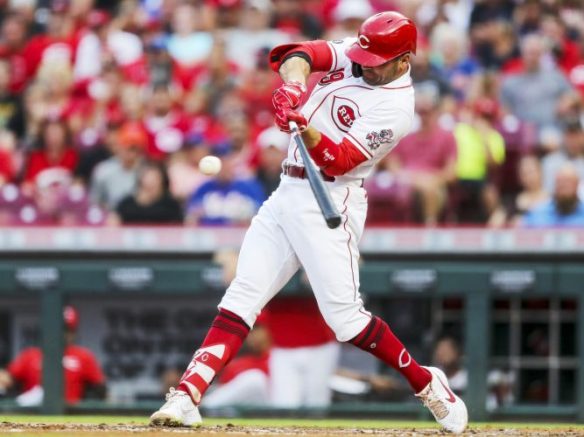
Where Votto sits

Joey Votto

Father Time may have something to say about Joey Votto’s major league days soon enough. But Grandfather All-Time has wonderful things to say about Votto’s career as a Red.

Earlier this month, Cincinnati magazine published an audacious looking article proclaiming Joey Votto the greatest Red of all time. The hype of that headline alone was probably enough to bring Votto’s critics to a boil, and that was before such social media cracks as:

Seriously?

LMAO!!!!!!!!!!!

In your Dreams!!

Frank Robinson Pete Rose Johnny Bench Joe Morgan Concepcion just to name a few not even mention the pitcher.

They were All Much Better ballplayers and Definitely More Valuable to Their team! I might take Tony Perez at first before Votto!

Way too many crack smokers out there.

Against my better judgment, I responded to that next-to-last one first, reminding the entrant it wasn’t Votto’s fault that he didn’t (and doesn’t) have the caliber of teammates Perez had. That was after mentioning that Votto’s 63.7 wins above replacement-level (WAR) as a Red are 18.1 higher than Perez’s.

The article’s author, Chad Dotson, mentioned that since Votto’s Show premiere in 2007 only two players have more WAR than Votto: Mike Trout, and Robinson Canó. (Canó may or may not be compromised by two suspensions for actual or alleged performance-enhancing substances, of course.) When you’re third in the WAR race since 2007 you’ve got a powerful case as one of your time’s genuine greats.

Votto has been an on-base machine for the most part; his seven league OBP titles are matched only by Hall of Famers Babe Ruth, Rogers Hornsby, and Ted Williams, plus should-be Hall of Famer Barry Bonds. Votto’s also done something only Hornsby, Williams, and Hall of Famer Wade Boggs have done: win four straight OBP titles.

Which doesn’t impress the Votto critics—including his former general manager Walt Jocketty—who think he walks too much and passes by too many chances to put a ball in play, including (as Dotson observed) taking pokes at pitches out of the strike zone. Oh. The hor-ror. Taking pitches out of the strike zone. Didn’t they used to call that a great batting eye?

“[J]ust on the surface, it’s clear that there is more to Votto than standing in the batter’s box, bat on shoulder, waiting for ball four,” Dotson wrote. “After all, the guy has led the league in slugging percentage, doubles, and OPS and has pounded 24 or more homers in nine different seasons . . . He’s a well-rounded player who has been one of the game’s best for a long, long time.

There’s more to Votto than just those league leaderships and his career average 28 home runs per 162 games, too. Wait until you see Votto measured by way of my Real Batting Average metric. The Votto critics will discover that, among the top six WARriors as Reds, Votto looks a lot better. Not that they’ll pay attention.

One more time: Real Batting Average (RBA) does what the traditional batting average fails to do to the point of it being a fraudulent statistic. The oldest fart among baseball’s statistic traditionalists should be made to answer why we should continue living by a stat that a) treats all your hits equally and b) determines its champion by a minimum number of plate appearances even though it goes no further than dividing all hits regardless of value by official at-bats alone.

RBA accounts for just about everything a man does at the plate and uses the sum of the following parts:

Total bases (TB), which treats your hits with the unequality they deserve. (If you still think a single’s equal to a double’s equal to a triple’s equal to a home run, get thee back to sixth grade math and that may be giving you too much credit.)

Walks (BB). The only thing insulting about a walk should be that you read the strike zone better than anyone else in the park. If that’s a crime, Votto should be only too happy to plead guilty and serve sentence—namely, a trip to first base. The last I looked, one of your most valuable assets in a batting inning is baserunners.

Intentional walks (IBB). You deserve to be credited separately for the other guys preferring—for whatever reason, whether it’s your formidable swinging or the lesser man behind you they’d prefer as the easier out—that you take your base instead of their pitchers’ heads off.

Sacrifice flies (SF). Unlike the sacrifice bunt—in which you’re giving up a precious out to work with on purpose, on behalf of an advance that gives you team a better scoring chance after your bunt than before it in only one of six known “sacrifice bunt” situations—you’re not trying deliberately to make an out here. You didn’t check in at the plate thinking boy, I’m gonna hit that slop all the way for . . . an out, but your fly out brought him home. And you should damn well get some credit for it.

Hit by pitches (HBP). Their pitcher puts you on first the hard way? Let it be to your credit and on his head. You didn’t ask to get drilled, but—assuming you didn’t start a bench-clearing brawl over it and get thrown out of the game—there you are on first base. You just gave your team that much more shot at, you know, scoring.

We take the sum of all the foregoing and divide that sum by total plate appearances to get your RBA. And this is Votto as a Red according to RBA, and compared to the five other franchise WAR leaders (none of whom happens to be Tony Perez):

Player (as a Red) PA TB BB IBB SF HBP RBA
Frank Robinson 6410 3063 698 129 53 118 .634
Joey Votto 8241 3523 1309 147 48 69 .618
Joe Morgan 4973 1885 881 39 52 22 .579
Johnny Bench 8674 3644 891 135 90 19 .551
Barry Larkin 9057 3527 939 66 67 55 .514
Pete Rose 15,890 5752 1210 167 79 107 .460

Think about that. RBA places Votto as the number two Red in the history of the franchise and shows him as one of only two players among the franchise WAR leaders with a .600+ RBA in in Cincinnati uniform. The only thing missing on his resume is beyond his control. It isn’t Votto’s fault the Reds have never reached, never mind won a World Series with him.

The only alarm that ought to be raised over Votto now is whether age (he’s 38) is overtaking him for keeps at long enough last. (His .407 RBA for 2022 as of this morning is 211 points below his career mark.)

The Reds didn’t exactly look like the Dreads hosting the Cubs at Great American Ballpark Thursday afternoon. Not when they beat the Cubs 20-5 with a twenty-hit battering after the Cubs held a 3-0 lead following an inning and a half. Not with a two-run second, an eight-run third, a single-run fifth, a two-run sixth and seventh, and a five-run eighth.

Votto had only a small hand in the Reds’ destruction, scoring on a two-run single in that third. He walked twice, struck out once otherwise. But if he’s always been the kind of player who cares about improving his craft, he’s also been one of those men who couldn’t care less about his own numbers so long as his team wins.

The wins these days are about as easy to come by for the Reds as summoning up his longtime brio has been for Votto this year. About the only thing remaining intact from his younger years is Votto’s continuing passion for the game.

Remember: This is the guy who got thrown out of a 2021 game early, arguing a check swing call against him, then learned a young fan in San Diego at her first live major league game was disappointed at not being able to see him, her favourite player—and sent her a ball he signed that also said, “I am sorry I didn’t play the entire game.”

The spirit remains willing even if the reflexes are no longer fresh and the swing is no longer swift. Even if he admits to being embarrassed by the Dreads’ 14-30 season’s record thus far. Father Time may be starting to tell him that his major league days might be numbered at long enough last. Grandfather All-Time says Votto may not be the greatest ever to wear a Reds uniform but he’s at least the number two man at the plate in their long, long, storied, long history.

You tell me who needs to retire the crack pipe now.

Legit enough not to quit

Luis Gonzalez

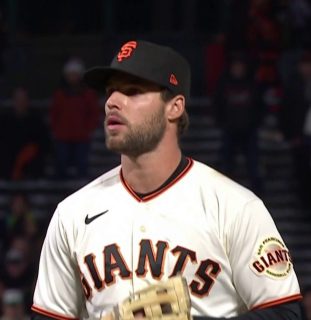
Luis Gonzalez—the first Giants position player to pitch in back-to-back games since 1906 wasn’t exactly just thrown to the Mets wolves in the ninth  Monday night. The Mets didn’t exactly abuse a patsy, either.

They’ve been without uber ace Jacob deGrom all season thus far. They’ve lost Max Scherzer for six to eight weeks thanks to an oblique strain forcing him to pull out of a start against the Cardinals last Wednesday. Hands up to everyone who thought the Mets would fold the way they did often enough when the injury bugs swarmed in the recent past.

Guess again. Without deGrom the Mets sit 29-15 and a very healthy eight games in front of the second place Phillies in the National League East. Since Scherzer went down, they’re 5-1, including the game from which Max the Knife removed himself after feeling it a little too hard on the left side.

And, especially after they demolished the stumbling, likewise injury-plagued Giants 13-3 in San Francisco Monday night, a fifth straight loss for the Giants leaving them third in the NL West and with a 3-7 record in their last ten games.

The Mets rode a solid start from David Peterson, freshly recalled from the farm, to a five-run third, a four-run eight, a three-run ninth, and a single run in the sixth. They laid fifteen hits on legitimate Giants pitching and three more against Luis Gonzalez, a right fielder by trade asked to pinch hit in the eighth before taking one for the team in the ninth.

More on that soon enough. Peterson’s shakiest inning was the second, when Brandon Crawford tore a two-run homer out of him on 2-0, but then he got stronger for the next four innings before handing off to the Mets’ pen. Of course, the Mets’ bats made Peterson’s life almost comfortable enough that he could have pitched to the Giants from a lounger and kept them quiet.

That was Francisco Lindor with two out and the bases loaded on Giants starter Alex Cobb in the top of the third, bouncing a ground-rule double into the left field stands, before Pete Alonso sent a first pitch the other way over the left center field fence for a three-run shot.

The game stayed manageable enough for the Giants over the next several innings, before J.D. Davis—whose recent plate struggles had Met fans’ side of the Twitterverse demanding his replacement, if not his execution—sent Jeff McNeil home with a flare double on two outs into left in the top of the sixth.

That ended Cobb’s evening and turned the Mets fast and loose into the Giants’ bullpen, and in the top of the eight they got faster and looser. Alonso opened beating out an infield hit, McNeil hit a two-run homer to the top of Levi’s Landing, and Mark Canha followed almost immediately with a launch over the left center field fence, all on Giants reliever Mauricio Llovera’s dollar. One out and a Davis double later, Mets catcher Patrick Mazeika doubled Davis home with a shot all the way down the right field line.

Giants manager Gabe Kapler elected to waste no further pitching from there. He sent Gonzalez out to the mound for the top of the ninth. Prowl the social media world and you’ll find plenty harrumphing against the Mets’ lack of “sportsmanship” for the way they treated Gonzalez. It might be a fine thing to ask in reply whether it’s sportsmanlike to ask the other team to tank because you don’t want them to waste legitimate pitching.

Closing seven-run deficits or larger in the ninth inning isn’t unheard of, either. The Tigers looked doomed trailing by nine at 13-4 in the ninth on 25 April 1901 . . . and beat the ancient Milwaukee Brewers (about to become the American League edition of the St. Louis Browns) 14-13.

The same year, Cleveland trailed Washington by eight coming to the bottom of the ninth of a May game—and won, also 14-13. The 1934 Indians trailed the Philadelphia Athletics by eight in the top of the ninth in an August game and scored nine before holding on to win, 12-11. And the 1990 Phillies trailed the Dodgers by nine coming into the top of the ninth of another August contest—and won, too, also 12-11.

You get Kapler not wanting to burn a relief pitcher, but you also remember baseball doesn’t have a mercy rule yet. Suppose the Mets had cut Gonzalez and the Giants a break and played dead in the ninth. What was really to stop a) the Giants from mounting a seven-run comeback in the bottom of the ninth; or, b) anyone else from accusing the Mets of—dare we say it?—tanking for a game?

On the other hand, quit your yammering, social media meatheads. Gonzalez wasn’t just thrown to the Met wolves, either, and the Mets didn’t just pile on against a puny position player. He had a pitching record for the season entering Monday night and it wasn’t exactly a record to be ashamed of, either.

He’d had two previous relief outings before Monday night with a zero ERA to show for it. And, a very respectable 3.11 fielding-independent pitching rate to match it. He surrendered no runs and a hit to the Cardinals for an inning while the Giants got blown out 15-6 in St. Louis on 15 May. He surrendered no runs and a hit in two and a third while the Giants got blown out by the Padres 10-1 at home the night before the Mets came to town.

Come Monday night, Kapler and the Giants just might have had a reasonable hope that Gonzalez—whose only known pitch seems to be an eephus that goes up to the plate in a floating parabola—really could keep the Mets from any further damage in the top of the ninth.

The Mets must have scouted him on the mound somehow. Gonzalez may have gotten two quick ground outs to open, but he walked McNeil on 3-1, surrendered a clean base hit to Canha on 1-1, a two-run double to Eduardo Escobar on 1-0, and a first-pitch RBI single to Davis. He threw ten strikes out of nineteen pitches but four built three more Met runs.

Alas, Monday ruined Gonzalez’s chance to inspire waxings about the bullpen’s answer to Shohei Ohtani. He’s got a nifty .372 on-base percentage, an .825 OPS, a respectable 137 OPS+, and a 2022 Real Batting Average (total bases + walks + intentional walks + sacrifice flies + hit by pitches, divided by total plate appearances) of .523 so far.

But he only has two home runs on the season thus far, too. (Ohtani has nine, not to mention a 2.82 ERA/.2.14 FIP on the mound.) The Giants may continue using him to mop up on the mound when they’re getting blown out, but that’s probably all. They’re probably hoping Monday night was his exception, rather than his rule to come.

Joe Pignatano, RIP: The vegetable man

Joe Pignatano

As a player, Joe Pignatano was a reserve whose career ended with an unlucky three. As a coach, Pignatano grew bullpen vegetables while keeping the nuts from going completely squirrely.

According to outfielder Art Shamsky, Miracle Mets bullpen coach Joe Pignatano had one job: “to keep control of the pitchers out in the bullpen who were out of control.” According to starting pitcher Jerry Koosman, “Piggy was [manager Gil] Hodges’ spy.”

According to Mets history, Pignatano—who died this morning at 92 following a battle with dementia, the last living member of the Miracle Mets coaching staff—was once a reserve catcher who made an indelible impression in what proved his final major league plate appearance on 30 September 1962.

Piggy took over the catching from Choo-Choo Coleman in the bottom of the sixth in Wrigley Field against the Cubs. After the Cubs scored a pair of unearned runs off Mets reliever Craig Anderson in the bottom of the seventh, Pignatano came up to the plate in the top of the eighth with nobody out and back-to-back base hits from Sammy Drake and Hall of Famer Richie Ashburn setting a lovely table for him.

The man who eventually became fabled for growing a vegetable garden in the Shea Stadium bullpen couldn’t eat the meat that might have left the Mets as close as a single run behind. It wasn’t for lack of trying, either.

Pignatano ripped a bullet to the right side and right at the Cubs’ Rookie of the Year-in-waiting second baseman, Ken Hubbs. Hubbs went to first at once to nail the once-fleet Ashburn before Hall of Famer Ernie Banks, the big bully, whipped one to shortstop Andre Rodgers to bag Drake. The Cubs held on to win.

“It mattered not that the New York Mets won or lost, or even how they played the game today before 3,960 fans at Wrigley Field,” said the New York Times‘s lead. “For the record, though, the season’s final, for which Casey Stengel asked and obtained volunteers, went to the Cubs, 5-1.” Volunteers, indeed.

The Original Mets may have been baseball’s precursor to Monty Python’s Flying Circus, but even they couldn’t have made this up. In the final game of that surrealistic 40-120 season, Pignatano became the only major league player ever to end his playing career by hitting into a triple play.

He became one of Hodges’ coaches when Hodges ended his own playing career to become the manager of the Washington Senators’ second edition. He had the pleasure there of giving Hodges one of the best laughs of his early life as a manager, even if it was serious business to the serious skipper.

“In spring training one year,” Hodges remembered to Times writer Joseph Durso (for Amazing: The Miracle of the Mets), “I was standing across the street from the hotel when I saw four of my players leave.”

It was about ten minutes before curfew. I hung around for a half hour, and they didn’t come back. The next day in the clubhouse, I made a little speech. I told the club that I knew some of the players had broken curfew, and I was going to give them an opportunity to save some money. If they wanted to pay fifty dollar fines right now, the case would be closed. If the money wasn’t in by the end of the day, I’d hold another meeting and name names. The only thing was that the fines would then be one hundred dollars apiece.

I told them to leave their checks on the desk in my office. About an hour later, Joe Pignatano, one of my coaches, walked over to where I was hitting fungoes. He had a great big grin on his face and said, “You made a smart move. You offered four guys a chance to admit they broke curfew. Seven guys have paid the fines already.”

As the Mets’ bullpen coach, Pignatano did have to preside over a kind of psych ward. “[Ron] Taylor could be very funny,” he remembered to Maury Allen for After the Miracle: The Amazin’ Mets Twenty Years Later, while back in uniform at a Mets dream camp. “Just a lot of one-liners for the moment, getting on a guy about something.” Which was nothing compared to known flake Tug McGraw:

The day McGraw got that waiter in a white suit to bring trays of ribs and chicken and hamburgers to the bullpen and started heating everything over a sterno can really was something. It wasn’t the food that annoyed me. It was that the guy said I had to pay the bill.

Go ahead, say it. Piggy and the Stooges.

Pignatano enjoyed the Miracle Mets ride as much as anyone. He also suffered more than most when Hodges suffered his fatal heart attack in April 1972, after a round of golf in West Palm Beach. “We finished playing on a real fine day,” Pignatano told Allen.

Then we sat down with Jack Sanford, the old Giants pitcher, who was the club pro, and had a couple of beers at the nineteenth hole. We began walking back to the hotel, maybe fifty yards away. We were talking about the golf as we walked across the grass to the concrete path leading to the hotel rooms. [Third base coach Eddie] Yost and [pitching coach] Rube [Walker] were off to the left, and Gil and I had rooms to the right. Just as we reached the walk where the paths split, I turned slightly to Gil and asked, “What time do you want to meet for dinner?” He never answered. He just fell over backwards on that path and landed on his head. You could hear the crack as his head hit the sidewalk.

“Pignatano got up from his chair in that Florida dream camp clubhouse,” Allen wrote. “He shook his head. There were tears in his eyes. The interview was over.”

Hodges and Pignatano went back to Piggy’s first season as a Brooklyn Dodgers player and remained besties even after the team moved to Los Angeles and Pignatano moved on to the Kansas City Athletics, the Giants, and finally the Original Mets. As a catcher, Pignatano caught the final Dodger game at Ebbets Field, 29 September 1957, including eighth inning relief from Hall of Famer Sandy Koufax against the Phillies.

He remained the Mets’ bullpen coach until 1981, then coached for Hall of Fame manager Joe Torre in Atlanta a spell before leaving the game but returning with the Braves’ organisation as a minor league pitching coach in 1988. Much later in life, Pignatano enjoyed associating with the Mets again, particularly relief pitcher John Franco, who rooted for the Miracle Mets as a boy in Brooklyn.

He also remained friendly with other old Dodger teammates such as Koufax, with whom he once roomed on the road. According to Koufax biographer Jane Leavy, the pair attended a Baseball Assitance Team dinner in New York and Pignatano found an empty seat next to Koufax. “Hey,” Leavy recorded a voice asking almost demandingly, “how come he gets to sit there?” Koufax smiled. “Roomie seat,” he replied.

“On the surface,” Leavy wrote, “Pignatano is everything Koufax is not—paunchy and balding, indifferently dressed in the manner of baseball men who never had to decide what to wear when they got up in the morning, his accent Brooklyn thick. In fact, they are not so  different. Piggy is who Koufax aspires to be—just another guy happy to be on this side of the grass.”

“And all the lot is what I got/It’s what I wear, it’s what you see/It must be me, it’s what I am/vegetable man,” went a lyric by Pink Floyd’s ill-fated founding guitarist and songwriter Syd Barrett.

That haunted soul self-shorn from the heights couldn’t know his words fit a guy happy to be on his own side of the grass, whether keeping the nuts from cracking in the bullpen, mourning the loss of his best friend after a time check on dinner, growing vegetables in the pen, relaxing with a Hall of Fame teammate.

Pignatano had two great loves in his life, baseball and his wife, Nancy, who died two years ago. His sons and grandchildren’s mourning may be cushioned only by knowing that he and she are reunited serene and happy in the Elysian Fields.

“Making [maternal fornicators] shut the [fornicate] up”

Tim Anderson

Tim Anderson can only hope to shush the Yankee Stadium louts rounding third on a late Sunday three-run homer . . .

You think of the damnedest things at times, in the immediacy of controversy. When Tim Anderson checked in at the plate in the top of the eighth Sunday, in the second game of a Yankee Stadium doubleheader, his uniform number suddenly seemed very large and very, very vivid.

Seven. The number retired by the Yankees in honor of their Hall of Fame center fielder Mickey Mantle. A player whose off the charts performances and record were equaled only by his off the charts flaws as a man who finally told the world, as he battled cancer by way of a liver transplant, “This is a role model: Don’t be like me.”

Seven. Now on the back of the White Sox’s shortstop, a black man who declared three years ago that he wanted to be the Jackie Robinson of bringing and keeping fun in the actual playing of professional baseball, in front of a crowd that roots for the team whose third baseman didn’t know when what he called a joke wasn’t funny anymore.

By Josh Donaldson’s own admission he’d first needled Anderson by calling him “Jackie” shortly after that 2019 interview, and that Anderson and himself shared a laugh over it. By Donaldson’s further admission, he’d pulled the joke a few times since, right up to Saturday’s game. He said he intended nothing racial by it. Pardon the expression, he may be a minority of one.

The White Sox took the first game 3-1 Sunday and led 2-0 in the nightcap, on a pair of two-out RBI singles from Andrew Vaughn and Reese McGuire, when Anderson checked in against Yankee reliever Miguel Castro.

Every time Anderson batted Sunday the Yankee Stadium boo birds hammered him with boos and jeers, which you’d just about expect in any ballpark when a particular field or plate antagonist on the visiting team shows up and goes to the serious work of play. But Anderson was also hammered with more than a few noisy chants of “Jac-kie! Jac-kie!” during the twin bill.

Such is the lack of class for which particular fans are known to be particularly shameless. Yankee fans are no strangers to the loutish among them who would do such things as taunt an opposition pitcher during his pre-game warmups over his known battles with anxiety and depression. They may not love such louts among them, but they never seem in too big a hurry to thwart them, either.

That lout contingency would hardly reject a chance to hammer an opponent taunted by one of their own with a particularly nasty racial reference during a game the day before, a reference that led in due course to a sharp exchange of words behind the plate and the benches and bullpens clearing, with Anderson needing to be restrained from potentially tearing Donaldson apart.

Even Donaldson’s own manager demurred from defending his man entirely after Saturday’s incident. “I don’t believe there was any malicious intent in that regard,” began Aaron Boone. “But you know, this is—just in my opinion—somewhere he should not be going.”

Donaldson went 0-for-4 at the plate during the doubleheader’s opener, which the White Sox won after busting a one-all tie in the ninth inning thanks to A.J. Pollock sending one into the left field seats and Adam Engel sending Vaughn home with an RBI double. He sat out the nightcap, during which the Yankees could summon up a measly three hits to no avail against three White Sox pitchers.

Now, in the top of the nightcap eighth, with first and second, on 1-1, Castro threw a slider that hung up just enough for Anderson to drive it the other way into the right field seats for what proved the final 5-0 score.

A Yankee fan wearing the jersey of retired Yankee first baseman Mark Teixiera threw the ball back onto the field on a no-doubt line, perhaps blissfully unaware that Teixiera as a player (and now a broadcaster) had too much class to applaud such depths. Unlike the Toronto fan in Rogers Centre who handed an Aaron Judge home run ball to a young fan wearing a Judge jersey, this fan probably wouldn’t have shown that kind of character if there’d been an Anderson fan adjacent to him.

A young White Sox fan wearing a replica of the team’s mid-1980s game jersey snapped a photo with his cell phone as Anderson continued his travels around the bases. When Anderson stepped on the plate it was as though planting an exclamation point at the end of an emphatic sentence.

As he took a few steps toward the White Sox dugout, Anderson put his index finger to his lips as he looked toward the crowd, just as he had rounding third. He didn’t talk to reporters after the game but a hot microphone courtesy of the game’s broadcast aboard ESPN captured his no-doubt explanation: “Making [maternal fornicators]  shut the [fornicate] up.”

Anderson probably knows in his heart of hearts that it’s easier to pass the proverbial camel through the eye of the proverbial needle than to shut the worst of Yankee or any other fans the fornicate up. Not even the evidence that Donaldson hasn’t exactly been a friendly opponent to Anderson and other White Sox in the recent past would convince them otherwise.

“[I]n this clubhouse,” said White Sox relief pitcher Liam Hendricks before Sunday’s doubleheader, “we have TA’s back in everything. It’s like having an inside joke with a guy you are a nemesis with, I guess you could say, but yeah, that’s not how it went down in this clubhouse and I don’t understand how, if [Donaldson] ever thought about [his “Jackie” taunt] like [a joke], it’s straight delusional.”

Anderson sent a message back on enemy territory in the best way possible. If only it could have been as joyous as the one he sent in the bottom of the ninth in last August’s Field of Dreams Game, against most of these same Yankees.

“The game’s never over,” Anderson said after that one. “And once [Yankee reliever Zack] Britton walked [White Sox catcher Seby Zavala], I knew there was a chance to start something real dope.”

That was then, this was Sunday. The hankering to know just what MLB’s reported investigation of the Saturday incidents determines heightens. But now Anderson finished something real dope under unwarranted provocation from a real dope.