The new Yankee bats are barrels of fun

Baseball Bugs

Contrary to social media bleating, this is NOT one of the new Yankee bats . . .

They resemble elongated bowling pins upon first glance, those new and legal Yankee bats, perhaps the kind that would be spotted on a bowling lane . . . built for Paul Bunyan. Don’t laugh. Wielding those curious new bats among their regular lumber on Saturday against the Brewers, the Yankees resembled a gaggle of Bunyans at the plate. It began (ahem) right off the bat against former Yankee Néstor Cortés.

Three pitches. Three long enough solo home runs.Two outs later, another solo smash. That was just in the bottom of the first, against the guy they traded to make a Yankee out of postseason Brewers victim Devin Williams.

OK, let’s get more detailed. After the Brewers did nothing with a one-out walk to Christian Yelich from newly-minted Yankee starter Max Fried in the top of the first, Paul Goldschmidt—erstwhile Diamondback and Cardinal, now manning first base for the Yankees and leading off, of all things—watched a first-pitch, four-seam fastball travel well enough into his wheelhouse to drive it to the rear end of the bullpen in left center field.

One pitch, one bomb, one run.

Newly-minted Yankee Cody Bellinger—erstwhile Dodger and Cub, who hasn’t really been the same since a shoulder injury during the Dodgers’ 2020 run to the World Series title—watched another first-pitch, four-seam fastball rising in the middle of the zone, but not high enough that he couldn’t yank it into the right center field seats about six rows past the bullpen wall.

Two pitches, two bombs, two runs.

Aaron Judge—the Yankees’ bona-fide Bunyan, all 6’7″ of him, beginning his tenth season in the sacred pinstripes—watched Cortés switch things up a little, having learned the hard way abour first-pitch fastballs not always obeying orders. The lefthander opened with a cutter. It got even more into Judge’s wheelhouse than that fastball got into Goldschmidt’s. And it disappeared into the left center field seats.

Three pitches. Three bombs. Three runs. Who knew the Yankees were just getting warmed up? (And, did Goldschmidt feel even a small kind of déjà vu all over again, since he’d once hit three out against the Brewers by himself, as a Cardinal?)

Cortés then showed the Brewers what they thought they’d traded for when he struck (All That) Jazz Chisholm, Jr. out looking and got Anthony Volpe to ground out right back to the mound. Up stepped Austin Wells, who’d opened the Yankee season with the first known leadoff bomb ever hit by any major league catcher last Thursday.

Wells was kind enough to wait until Cortés opened up with a pair of cutters off the inside part of the plate for a 2-0 count before Cortés threw him a fastball and he drove it over the left center field fence. It took back-to-back walks and a called punchout on Trent Grisham to stop the bleeding. The tourniquet proved unable to contain it for very long.

From there, after Fried almost handed the Brewers a quick enough tie on the house, what with a one-out hit batsman, an RBI single, a run scoring on an infield error, another base hit, and a run scoring when Fried threw Yelich’s grounder offline, the Yankees had more treats in store.

They began with Volpe, who turned out to have been the inspiration for the new elongated bowling-pin bat. Yankee fans watching the broadcast on television got the skinny from broadcast institution Michael Kay when Chisholm batted in the first:

The Yankee front office, the analytics department, did a study on Anthony Volpe, and every single ball it seemed like he hit on the label. He didn’t hit any on the barrel, so they had bats made up where they moved a lot of the wood into the label, so the harder part of the bat is going to actually strike the ball. It’ll allow you to wait a little bit longer.
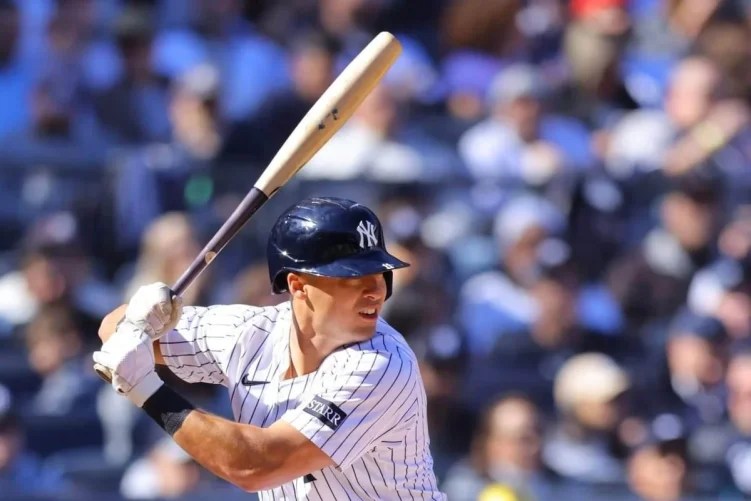
Anthony Volpe

. . . but this is, in the hands of the man whose plate performances got the Yankee brain trusts—oh! the hor-ror!—thinking. (Volpe rewarded them by hitting one of the nine Yankee bombs against the Brewers Saturday.)

The woofing and warping began aboard social media (cheaters! cheaters!) until someone, who knows whom, slipped into the bellowing the fine and legitimate point that the rule book doesn’t quite outlaw such bats. I give you Rule 3.02: The bat shall be a smooth, round stick not more than 2.61 inches in diameter at the thickest part and not more than 42 inches in length. The bat shall be one piece of solid wood. You might note that it says nothing about just where the thickest allowance must be.

You might also note that there do remain baseball traditions immune to change. Suspecting the Yankees of crime is one of them. But you don’t have to be a Yankee cultist to wonder why it was (and is) that nobody else thought of creating such bats within the rules before the Yankees got the a-ha!

You might also note, further, that Cortés wasn’t exactly unfamiliar to the Yankees, since he’d been one of them fo five of the past six seasons. “Nestor (had) been here for years,” said Judge postgame. “He’s one of the best lefty pitchers in the game. He’s going to go out there and throw strikes and attack you. We just tried to go out there and be aggressive in our zone. Goldy and Belli, they were aggressive and got things going there. This place was rocking once I got up there.”

So. When Volpe batted the secone timd in the bottom of the second, he had Judge and Chisholm aboard and two out. This time, he waited until he had a full count before swinging and hammering a Cortés cutter over the left field fence. Now the game was 7-3, Yankees. And the party wasn’t even close to being over.

Fried survived a miniature jam in the top of the third, but Cortés didn’t survive walking Yankee designated hitter Jasson Domínguez to open the bottom. Connor Thomas came in to pitch. Grisham singled Domínguez to second, Thomas plunked Goldschmidt, Bellinger beat out an infield hit to send Domínguez home and load the pillows for Judge—who sliced salami on a 2-1 up-and-in cutter.

Then Chisholm wrung his way up from a few fouls to hit a 1-2 service into the right field seats. Making it 13-3, Yankees, which turned to 16-4 (erstwhile Phillie Rhys Hoskins poked an RBI single in the top of the fourth) in the bottom of the fourth, when Bellinger sent Grisham home on a sacrifice fly after Goldschmidt doubled him to third, but Judge followed with a two-run homer over the center field fence.

Judge’s third major league three-bomb day and his first since 2023. Eight home runs on the day for the Yankees so far, tying a franchise record they’d break when pinch-hitter Oswald Peraza hammered Brewers reliever Chad Patrick for a one-out, two-run homer in the bottom of the seventh. Making it 20-6 (the Brewers scored two in the sixth); the Brewers had at least an RBI double (Jake Bauers) and a two-run homer (Brice Turang) in them before the carnage finally ended.

“You think you’ve seen it all in baseball,” said Brewers manager Pat Murphy postgame, “and you haven’t because we saw it today—three pitches, three homers. Usually, you wake up from that. You go, ‘Wow. God. That can’t ever happen.’ It just did.”

The game was so disastrous for the Brewers that Murphy finally sent Bauers forth to pitch the bottom of the eighth, hoping to spare his pitching staff any further humiliation. The first baseman didn’t do any worse on the mound than the real pitchers, either. He shook off a two-out hit batsman and followup walk with a pop out for the side. He’d even gotten Judge to fly out in the eighth, an inning after Judge’s bid for a four-bomb day came up short enough in the sixth that he settled for a double.

He had to settle for becoming the fourth Yankee ever to have three three-bomb days, joining Hall of Famers Lou Gehrig (he had four of them) and Joe DiMaggio, plus third baseman Álex Rodríguez. “Anytime you get mentioned with those guys and what they’ve done in the game, and the careers they’ve had,” Judge said postgame, “it’s pretty special.”

Not that the Yankees were perfect on the day. Their five errors, which weren’t half as disastrous as their Game Five fifth inning in the World Series, hung Fried with four unearned runs among the six he did surrender on the day. Still.

“What a performance,” Yankee manager Aaron Boone summed up. “Kind of a weird, crazy game.” Kind of a crazy way to describe a massacre, too.
And the season begins in earnest . . .

Rate Field

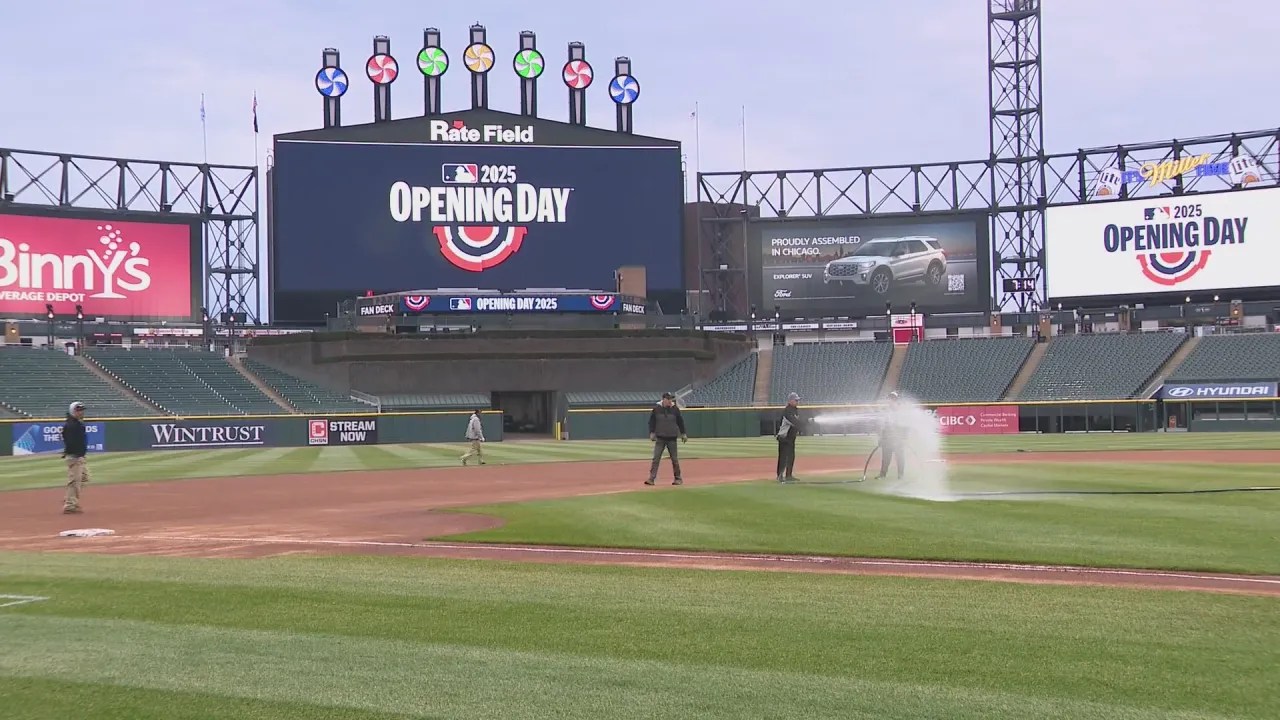
The grounds crew conditions Rate Field in Chicago for Opening Day. Little did they or those fans who did show up know the White Sox would open with—stop the presses! (as we’d have said in ancient times)—a win.

Opening Day is many things. Boring is never one of them. This year’s Opening Day certainly offered further evidence, including but not limited to . . .

Ice, Ice, Shohei Dept.—First, Ice Cube drove the World Series trophy onto the pre-game Dodger Stadium field. Then, 1988 World Series hero Kirk Gibson threw a ceremonial first pitch to 2024 World Series hero Freddie Freeman. Then, Shohei Ohtani finally ironed up in the seventh and hit one out for the badly-needed insurance, enabling the Dodgers to beat the Tigers, 5-4.

That left the Dodgers 3-0 after MLB’s full Opening Day, and one after they swept the Cubs in the Japan Series. I did hear more than a few “Break up the Dodgers” hollers, didn’t I?

This Time They Spelt It Right Dept.—“Traitor,” that is, when Bryce Harper and his Phillies opened against Harper’s former Nationals in Washington . . . and Harper said welcome to 2025 by stuffing the boo birds’ mouths shut with a blast over the right center field fence in the top of the seventh. That kicked the Phillies into overcoming a 1-0 deficit toward winning, 7-3.

That launch tied Harper for the most Opening Day home runs among active players, with six, but this was the first time he did it in Phillies fatigues.

“I love coming in here and playing in this stadium,” said Harper postgame. “I’ve got a lot of great memories in here, as well. Everywhere I go, it’s exactly like this. Some places are louder than others. It’s all the same.” Except that he left Washington a prodigious but lowballed boy to become man of the Phillies’ house since he signed with them for keeps in 2019.

I Can Get Started Dept.: Tyler O’Neill Display—One of the players Harper’s sixth Opening Day blast tied is Orioles outfielder Tyler O’Neill. That’s where the similarities end between them, for now—in the top of the third against the Jays, O’Neill hammered Jose Berrios’s sinker for a home run to make it six straight Opening Days he’s cleared the fences.

O’Neill hit 31 homers and produced an .847 OPS for last year’s Red Sox, before signing with the Orioles this winter as a free agent.

I Can Get Started Dept.: Paul Skenes Display—The indispensable Sarah Langs pointed out that Pirates sophomore Paul Skenes—fresh off his Rookie of the Year season—became the fastest number one draft pick to get his first Opening Day start yet, getting it just two years after he went number one. That beat Mike Moore (1981 daft; 1984 Opening Day) and Stephen Strasburg (2009 draft; 2012 Opening Day).

The bad news: Skenes had a respectable outing on Thursday, only two earned runs against him, but the Marlins managed to turn a 4-1 deficit into a 5-4 win when their left fielder Kyle Stowers walked it off with an RBI single in the bottom of the ninth.

I Can Get Started Dept.: Spencer Torkelson Display—My baseball analysis/historical crush Jessica Brand informs that Spencer Torkelson, Tiger extraordinaire, is the first since 1901 to draw four walks and hit one out in his team’s first regular season game.

Fallen Angels Dept.—Things aren’t bad enough with the Angels as they are? They not only had to lose on Opening Day to last year’s major league worst, and in the White Sox’s playpen. They needed infielder Nicky Lopez to take the mound in the eighth to land the final out of the inning—after the White Sox dropped a five spot Ryan Johnson in his Angels debut. Lopez walked White Sox catcher Korey Lee but got shortstop Jacob Amaya to fly out for the side.

Jessica Brand also reminded one and all that the last time any team reached for a position player to pitch when behind on Opening Day was in 2017, when the Padres called upon Christian Bethancourt with the Dodgers blowing them out.

South Side Reality Checks Cashed Dept.—The White Sox didn’t exactly fill Rate Field on Thursday. (I’m sure I’m not the only one noticing the Freudian side of “Guaranteed” removed from the name.) But those who did attend weren’t going to let little things like a 121-loss 2024 or nothing much done to improve the team this winter stop them.

“It’s delusion that feeds me,” said a fan named JeanneMarie Mandley to The Athletic‘s Sam Blum. “I don’t care . . . I know we suck. I’m not stupid.”

We’re guessing that a hearty enough share of White Sox fans think Opening Day’s 8-1 win over the Angels was a) an aberration; b) a magic trick; c) a figment of their imaginations; or, d) all the above.

Well, That Took Long Enough Dept.—What do Mickey Cochrane, Gabby Hartnett, Ernie Lombardi, Yogi Berra, Roy Campanella, Johnny Bench, Carlton Fisk, Gary Carter, Ted Simmons, and Ivan Rodriguez have in common other than Hall of Fame plaques?

The answer: They never hit leadoff homers on Opening Day in their major league lives. But Yankee catcher Austin Wells did it, this year, on Thursday, sending a 2-0 service from Brewers starter Freddy Peralta into the right field seats to open the way to a 4-2 Yankee win.

“Why doesn’t it make sense?” asked Yankee manager Aaron Boone postgame. Then, he answered: “Other than he’s a catcher and he’s not fast, although actually he runs pretty well for a catcher . . . I think he’s gonna control the strike zone and get on base, too, and he’s very early in his career. I think when we look up, he’s gonna be an on-base guy that hits for some power.”

We’ll see soon enough, skipper.

Don’t Put a Lid On It Dept.—The umps admitted postgame that they missed completely a flagrant rules violation by Yankee center fielder Trent Grisham in the ninth Come to think of it, it seems both the Brewers and the Yankees missed it, even if Brewers fans didn’t.

With a man on, Devin Williams on the mound for the Yankees, and Isaac Collins at the plate for the Brewers, Collins ripped one into the right centerfield gap. Grisham ran it down, removed his hat, and used the hat to knock the ball down after it caromed off the fence, the better to keep the ball from going away from him.

With one and all missing the rules violation, it left Collins on second with a double and the Brewers with second and third—instead of Collins on third with a ground-rule triple and the run scoring. Had anyone seen Grisham’s move and demanded a review, it might have meant just that and, possibly, the Brewers winning the game in the end. Possibly.

Just Juan Game Dept.—Juan Soto’s regular-season Mets debut was respectable: 1-for-3 with two walks and one strikeout. But he didn’t get to score or drive home a run. The Mets, who still have baseball’s best Opening Day winning percentage, lost to the Astros, 3-1, in Houston.

The only serious problem with Soto’s punchout was Astros closer Josh Hader doing it to him with two on in the ninth. Now, try to remember this about that ninth:

* The Mets entered trailing 3-0.
* Hader surrendered two singles and a bases-loading walk to open.
* Then, he surrendered a sacrifice fly by Francisco Lindor to spoil the shutout.
* Hader fell in the hole 3-0 to Soto first.
* Then, he got Soto to look at a strike, foul one off, then swing and miss on a low slider.

That’s how Hader earned an Opening Day save and a 9.00 season-opening ERA. That’s further evidence—and, from the Craig Kimbrel School of Saviourship, of course—that the save is one of the least useful statistics in baseball.

Or: That kind of save is like handing the keys to the city to the arsonist who set the fire from which he rescued all the occupants in the first place.

Blind Justice Dept.Umpire Auditor reports that Opening Day umpires blew 186 calls. That would average out to about 2.6 blown calls per umpire, I think. Just saying.

Just Wrong Dept.—Is it me, or—aside from the pleasure of only one true blowout (the Orioles flattening the Jays by a ten-run margin)—were there four interleague games on Opening Day?

That’s just plain wrong. It may be an exercise in futility to argue against regular-season interleague play anymore. But the least baseball’s government can do it draw up and enforce a mandate that no interleague games shall be scheduled for Opening Day again. Ever.

Trump threatens to pardon Rose

Pete Rose

The late Pete Rose, shown at a signing table at 2023’s GalaxyCon in Columbus, Ohio.

Those to whom Donald Trump points the way to wisdom by standing athwart it have further evidence to present. The president who thinks (yes, those four words isolated by themselves would flunk a polygraph) he knows all says he will pardon the late Pete Rose. On which grounds, you ask?

Let the man speak a moment:

Major League Baseball didn’t have the courage or decency to put the late, great, Pete Rose, also known as “Charlie Hustle,” into the Baseball Hall of fame. Now he is dead, will never experience the thrill of being selected, even though he was a FAR BETTER PLAYER than most of those who made it, and can only be named posthumously. WHAT A SHAME! Anyway, over the next few weeks I will be signing a complete PARDON of Pete Rose, who shouldn’t have been gambling on baseball, but only bet on HIS TEAM WINNING. He never betted against himself, or the other team. He had the most hits, by far, in baseball history, and won more games than anyone in sports history. Baseball, which is dying all over the place, should get off its fat, lazy ass, and elect Pete Rose, even though far too late, into the Baseball Hall of Fame!

Is there anyone within the oatmeal-for-brains arterials of the second Trump Administration with the will and the backbone to counsel him that he’s talking through his chapeau? Seeing none thus far, I volunteer, though I’m not of the Trump or any other government administration.

To begin, unless Trump speaks of Rose’s conviction and sentence served for tax evasion having to do with his income from memorabilia shows and sales, his power of the pardon doesn’t reach major league or other professional baseball.

Herewith a memory refreshment for the president who once opined—erroneously, unless Congress is still foolish enough to transfer its responsibilities to the White House—that Article II of the Constitution, which codifies the president’s job, enabled him to do as he damn well pleased: From Section 2, Article II: The President shall . . . have Power to grant Reprieves and Pardons for Offences against the United States, except in Cases of Impeachment.

Rose’s violations of Rule 21 weren’t legal offences against the United States. Moral and cultural violations are other stories, of course. (And how, when it came to Rose, alas.) Sorry, Mr. President. (That’s Mr. President, not Your Majesty, Your [In]excellency, or Your Lordship.) That only begins to convict you of erroneous assault with a dead weapon.

Consider: Rule 21’s prohibition of MLB personnel betting on MLB games does. not. distinguish. between betting on one’s team to win and betting on one’s team to lose. The notebooks whose revelations affirmed the depth of Rose’s betting on baseball that began while he was a player/manager affirmed concurrently that there were days aplenty when Rose’s baseball bets didn’t include bets on his Reds.

Read carefully, please: In the world of street/underground/extralegal gambling, a player or other team personnel known to bet on baseball but not laying a bet down on his team on a particular game sends signals to other street/underground/ extralegal gamblers not to bet or take betting action on that team. That’s as de facto betting against your team as you can get.

Now, about that business of, “He had the most hits, by far, in baseball history, and won more games than anyone in sports history.” Rule 21 doesn’t make exceptions for players who achieve x number of milestones or records. Especially not the clause that meant Rose’s permanent (not lifetime) banishment: Any player, umpire, or Club or League official or employee, who shall bet any sum whatsoever upon any baseball game in connection with which the bettor has a duty to perform, shall be declared permanently ineligible.

Did you see any exception for actual or alleged Hit Kings?

If you count Nippon Professional Baseball as major league level, and its quality of play says you should, Rose’s 4,256 hits don’t make him the Hit King—but it does crown as such freshly-minted Hall of Famer Ichiro Suzuki with his 4,367, between nine seasons with the Orix Blue Wave (Japan Pacific League) and nineteen seasons with the Mariners, the Yankees, and the Marlins.

Did you see any exception for those who “won” more games than anyone in sports history?

Modesty wasn’t exactly among Rose’s virtues, but he liked only to brag that he had played in more winning major league baseball games than anyone who ever suited up. Played in. Even Rose never once said or suggested that he won those games all by his lonesome, with no help from the pitchers and the fielders who kept the other guys from putting runs on the scoreboard, or with no help from the other guys in the lineup who reached base and came home.

Baseball is “not in the pardon business,” said Rose’s original investigator John Dowd, in a statement to ESPN, “nor does it control admission to the [Hall of Fame].” Baseball’s commissioner could have reinstated Rose any old time he chose. The Hall of Fame, which is not governed by MLB though the commissioner sits on its board, enacts its own rules, including the rule barring those on the permanently-ineligible list from appearing on any Hall ballot.

Rose tried and failed to get two commissioners to end his banishment. The trail of years during which he lied, lied again, and came clean only to a certain extent. And he did the last only when it meant he could peddle a book. “[W]hat had once been a sensation,” his last and best biographer Keith O’Brien wrote (in Charlie Hustle: The Rise and Fall of Pete Rose, and the Last Glory Days of Baseball), “quickly became yet another public relations crisis for Pete Rose.”

Somehow, his book managed to upset almost everyone . . . He refused to admit that he bet on baseball in 1986 while he was still a player, despite evidence showing otherwise. At times, he painted himself as the victim. Even the book title–My Prison Without Bars–sounded whiny, as if he hadn’t helped build the prison walls with his own choices . . . He picked fights over little pieces of evidence instead of taking full responsibility for his mistakes. He didn’t sound very sorry, critics said, and reinstatement eluded him every time he asked for it: in 2004, in 2015 and 2020, and in 2022. Nothing changed. If anything, his situation only grew worse.

Not even Rose’s jocularity when signing autographs or bantering with fans who met him in the years since his banishment could rescue him. Perhaps that was because, in part, it was tough to tell whether he was just kidding or sending none-too-subtle zingers at the critics he really believed done him wrong. Sorry I bet on baseball. No Justin Bieber, I’m sorry. Build the wall for Pete’s sake. Sorry I broke up the Beatles. I’m sorry I shot J.F.K. About the only thing missing was, I’m sorry I built the Pontiac Aztek.

Only one man was responsible for Rose’s exile to baseball’s Phantom Zone. It wasn’t his original investigators, or the commissioner who banished him under the rules, or the commissioners who denied his reinstatement petitions in the years that followed until his death of hypertensive atherosclerotic cardiovascular disease last fall.

“All his adult life,” wrote another freshly-minted Hall of Famer (writer’s wing division), Thomas Boswell, after Rose was first banished in August 1989, “he has thought, and been encouraged to think, that he was outside the normal rules of human behaviour and above punishment. In his private life, in his friendships, in his habits, he went to the edge, then stepped over, trusting his luck because—well, because he was the Great Pete Rose.”

Funny, but with just a name change at the end, and regardless of party affiliation or ideological core, you could say the same thing about more than one president of the United States. Including and especially the once and current incumbent.