Doing right by minor leaguers, but not by pre-1980 short-career Showmen

Larry Yellen

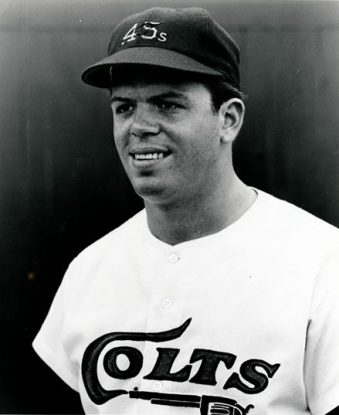
Larry Yellen–He shared a rookie card with eventual Miracle Met Jerry Grote . . . and had to miss being part of an all-rookie Colts starting lineup because the game would happen on Yom Kippur. (Photo from Jewish Baseball Museum.)

With the eyes of baseball world upon Tuesday’s trading deadline, and upon whom among the big enchiladas might be moving where, something happened almost too quietly to notice. Baseball’s government paid $185 million to settle litigation with minor league players who sued on grounds that minimum wage laws were violated.

According to the Associated Press, it’s going to work this way: 24,000 players from 2009 through last year are eligible to share the money. The estimated payments will range between $5,000 and $5,500. The money’s been transferred to JND Legal Administration. The AP says they plan to make the payments by 14 August.

The settlement covers all players with minor league contracts who played in the California League for at least seven straight days starting on Feb. 7, 2010, through the settlement’s preliminary approval last Aug. 26; players who participated in spring training, extended spring training or instructional leagues in Florida from Feb. 7, 2009, through last Aug. 26; and players who participated in spring training, extended spring training or instructional leagues in Arizona from Feb. 7, 2011, through last Aug. 26.

The original plaintiffs filing in 2014 were Aaron Senne (1B/OF, Marlins system), Michael Liberto (IF, Royals system), and Oliver Odle (P, Giants system.) Senne retired before the suit was filed; Liberto and Odle have retired long since.

Last fall, of course, minor league ballplayers joined the Major League Baseball Players Association. This past spring, the minor league faction agreed to a five-year contract doubling all minor league player salaries, the AP said. That was nothing but good for the players, the union, and the game itself.

But you have to wonder. If the players’ union was willing to welcome minor leaguers into their ranks and back them on a five-year deal that jumped all their salaries, why can’t the union find a way to welcome and redress the issue of pensions denied what are now 500+ short-career major leaguers whose time in the Show came prior to the 1980 pension re-alignment?

At this writing, they haven’t, and it still looks as though they won’t. It also sounds as though they’ll continue to say what they’ve said too long about that pension redress: nothing.

The 1980 re-alignment started handing pensions to major leaguers who had 43 verified days on major league rosters and health benefits to those who had one verified day there. The kicker was that it went to major leaguers whose careers ended after 1980. Those who had 43 verified major league roster days before 1980? Oops.

Double oops: The union’s line then was that the majority of those pre-1980 short-career major leaguers were measly September call-ups. Not that that should matter a damn, but not so fast. Peruse the records of the 500+ and you should discover that the majority of them saw major league time:

* Prior to any September in any year.
* As early as April of any year.
* Making major league rosters out of spring training even once.

Allow me to mention a few of those pre-1980 players who have passed on to the Elysian Fields this year.

Larry Yellen (pitcher, Colt .45s: the Astros-to-be)—He was a September call-up in 1963 . . . but he appeared in thirteen games (twelve in relief) between 21 April and 3 October. He was sent back to the minors for August, brought back in September, then played one more season in the Houston system before leaving the game.

According to the Jewish Baseball Museum, Yellen nearly helped make a little history during September 1963: He would have been the starting pitcher late that month when the Colts elected to send an all-rookie lineup out against the Mets—until he made his debut the day before, thanks to the Mets game being scheduled on Yom Kippur.

Yellen’s post-baseball life proved a solid one. Though eventually divorced from his first wife, Yellen graduated from Fredonia State University in 1987, took up a life in sales and marketing, remarried happily, and eventually worked for a tutoring company until his retirement. He died at 80 on 18 July.

Yellen has another intriguing element in his baseball past: he shared a 1964 Topps rookie card with future Miracle Mets catching mainstay Jerry Grote.

Mike Baxes (middle infielder, Kansas City Athletics)—After seven prior minor league seasons, he looked promising when he came up to the Athletics in 1956, even as a classic good-field/little-hit middle infielder. But after a solid April 1957 followed by a regression at the plate, Baxes looked to be getting his swing back when he suffered an ankle fracture trying to turn a double play.

Traded to the Yankees, Baxes wasn’t likely to endure with established middle infielders Bobby Richardson and Tony Kubek nailing it down shut. He bounced around the PCL until the Buffalo Bisons—for whom he’d been a fan favourite before going up to Kansas City—took a chance on him. The injury drained more than anyone thought, and Baxes left the game in 1961.

His older brother, Jim, may have had a more lasting major league impression, alas: the elder Baxes hit his first home run off a Cardinals pitcher surrendering his first major league home run: Hall of Famer Bob Gibson. The elder Baxes died in 1996; the younger, at 92 on 13 April.

Pete Koegel (catcher/first baseman, Brewers, Phillies)—The first major league player from Long Island’s Seaford High School, Koegel is sort of a Ball Four footnote. He was one of a pair of minor leaguers traded out of the Athletics organisation to the Seattle Pilots—after the 1969 season ended, and before their move to Milwaukee to become the Brewers—for former Athletics pitcher and noted Jim Bouton nemesis Fred Talbot. (Talbot got into one game with the A’s before he called it a career.)

As a high school athlete, Koegel was named the MVP of the New York Journal-American‘s high school All-Star game—and was presented the award by no less than Hall of Famer Lou Gehrig’s widow, Eleanor. After his brief stints with the Brewers and the Phillies, Koegel played a few more years in the minor leagues (including the Mexican league) before calling it a career after 1977.

One of three 6’6″ catchers ever to see major league time, Koegel saw major league time in April 1971 before returning to the minors and being traded to the Phillies; and, for most of the season with the 1972 Phillies. He moved to Saugerties in upstate New York after leaving baseball, and spent the rest of his life in that region. He died at 75 on 4 February.

Ron Campbell (infielder, Cubs)—He was a September call-up in 1964 and 1965, but he appeared in June-July and then mid-August through the end of the season in 1966. His first major league hit (off Cincinnati’s mercurial John Tsitouris) drove a run home; his final day in the Show saw him have the second of a pair of lifetime three-hit games (against the Mets).

He spent four more years entirely in the minors before leaving baseball after 1970. He’d been a natural third baseman blocked by Hall of Famer Ron Santo, but he’d also been a highly regarded high school football and basketball player in his native Tennessee. In fact, he was inducted into the Chattanooga, Bradley County, and Tennessee Wesleyan Halls of Fame. He died at 82 on 2 February.

Those men died without seeing any full major league pension thanks to their 1980 re-alignment freezeout. The only thing they saw was a stipend arranged in a deal between then-Commissioner Bud Selig and then-players union executive director Michael Weiner: $625 per quarter for every 43 days’ worth of MLB time, up to four years’ worth. The stipend was hiked by fifteen percent in the settlement of the 2022-23 lockout.

But it still wasn’t a full pension. And Yellen, Baxes, Koegel, Campbell, and the remaining 500+ pre-1980 short-career major leagues couldn’t and still can’t pass the money on to their families upon their deaths.

The union’s first executive director, Marvin Miller, said originally, and perhaps accurately, that the union then didn’t have the money available. But he also said subsequently—and I’ve been told this by several of those pre-1980 players whom I’ve interviewed (and, in a few cases, befriended)—that a) when the money was there, they wouldn’t be forgotten; and, b) the union’s failure to re-visit the issue substantially was his biggest regret.

You might think that, if baseball’s government, presiding over a sport worth billions, could find $185 million to settle with minor leaguers, the players’ union—likewise said to have $56.8 billion in revenues—could find a way to do right by pre-1980 short-career major leaguers.

But you might first have to convince more than just a tiny handful of sportswriters to give the issue the airing it deserves. And that’s proven, thus far, to be about as simple as trying to sneak one past Shohei Ohtani.

Season lost, Scherzer gone

Max Scherzer

Scherzer waived his no-trade clause to go from the deflating Mets to the AL West-leading Rangers.

The contemporary Mets fan, to whom a season is usually lost over one terrible inning in early to mid-April, sees Max Scherzer speaking without boilerplate about talking to the front office regarding, stop, hey, what’s that plan, after the Mets traded solid relief pitcher David Robertson to the Marlins for a prime-looking prospect. And, is barely amused.

Then, they see the three-time Cy Young Award-winning future Hall of Famer traded within a day or so to the American League West-leading Rangers, for a more prime-looking prospect. They are somewhere between dryly amused and snarkily contemptuous. Not to mention terribly inattentive or misinformed.

Nobody questions that age has begun to catch up to the righthander. Assorted small injuries plus lingering issues with his back and his side did a little too much to keep him from resembling his vintage self. One moment, Scherzer did a plausible impression of what he once was. The next, he did a plausible impression of a piñata.

There are some who see this year’s 9-4 won-lost record and say, so there! There are others who see this year’s 4.01 ERA and 4.73 fielding-independent pitching rate (FIP) and see a man whose youth and prime may not be visible in the rear view mirror anymore.

When the Mets traded Robertson a few days ago, Scherzer didn’t hold back. He was neither nasty nor snarky about saying it was time for him to talk to the Mets’ front office about the rest of the season and just who projected what. But, first, he was honest enough to begin with a sober assessment of the Mets’ deflating season thus far.

“[O]bviously, we put ourselves in this position,” he said. “We haven’t played well enough as a team. I’ve had a hand in that for why we’re in the position that we’re at. Can’t get mad at anybody but yourself, but it stinks.”

Then he went forward: “You have to talk to the brass. You have to understand what they see, what they’re going to do. That’s the best I can tell you. I told you I wasn’t going to comment on this until [owner] Steve [Cohen] was going to sell. We traded Robertson. Now we need to have a conversation.”

That was after Scherzer looked a little like the old Max the Knife against his old team, the Nationals: striking seven out in seven innings, scattering six hits one of which was a solo home run, and the Mets rewarding him with a 5-1 win, not to mention their seventh win in eleven games. But still.

Some Met fans think the front office elected to punt on third down, metaphorically speaking. Others think that, when Scherzer said they “needed to have a conversation,” it might have meant a conversation about Texas being the next destination for Scherzer himself.

If that involved Scherzer agreeing to go from the sinking Mets to a division-leading troop of Rangers in return for a prize prospect who turns out to be Ronald Acuña, Jr.’s promising brother, it probably took less than we think (even allowing the time) for Scherzer to say yes to one more active, not passive pennant race.

Scherzer had to waive his no-trade clause and exercise his contract’s 2024 opt-in to make the deal. Luisangel Acuña is a middle infielder and center fielder with a live bat (if not always as powerful as big brother’s) who can hit pitching from both sides readily, and wheels to burn on the bases. (42 stolen bases in 82 games; an .894 stolen base percentage.) Most known analyses of him say his challenge is to harness his aggressiveness.

The prime issue for Scherzer at 38 is staying healthy and avoiding home runs. His 1.9 home runs per nine this season are a career high. Yet, his tenure as a Met overall hasn’t exactly been a wash. His Met totals include a 3.02 ERA, a 3.52 FIP, and a 1.02 walks/hits per inning pitched rate. And, a 10.05 strikeouts-per nine rate with a 5.54 strikeout-to-walk ratio.

But they also include his having run out of fuel in Game One of last year’s National League wild card series, battered for four home runs that accounted for all the Padres scoring in a 7-1 loss.

“If [Scherzer] can limit the long ball and stay healthy,” observes The Athletic‘s Brittany Ghiroli, “he should help the Rangers fend off the Astro in the AL West and avoid the wild-card round. What’s more, his competitive personality and postseason experience could rub off on his new teammates.”

He’ll join a Rangers rotation that took a hit when former Met superpitcher Jacob deGrom went down to Tommy John surgery, but resuscitated itself via Nathan Eovaldi and Dane Dunning. He’ll be backed by a bullpen anchored by Will Smith. And a roster hitting .274. So far.

Mets players said goodbye to Scherzer Saturday night, during a rain delay before a game against the Nats that ended in an 11-6 Nats win. Surely they also started wondering what else and who else after Max the Knife could be talked into waiving his no-trade clause. They might have cast eyes first upon Justin Verlander, who’s showing his age as well, but who shook an early injury to look a little better than his old Detroit rotation mate this year.

“It’s not a certainty that Verlander will be traded,” say Athletic writers Will Sammon and Tim Britton, “but the Scherzer deal offered a blueprint of what to expect should the Mets decide to unload their other top starter. Verlander has performed better than Scherzer and, in theory, should net a better prospect.

“However, Verlander also has a no-trade clause in addition to being under contract for 2024 with a vesting option for 2025. It’s also unknown whether the Scherzer trade made Verlander feel any different about playing for the Mets.” Not to mention whether reported serious interest from the Dodgers, the Rangers, and Verlander’s old team in Houston might compel him to revisit his feelings.

The Mets barely said goodbye to Scherzer when Sports Illustrated reported they were in, quote, deep talks with the Astros about bringing back the future Hall of Famer who won an unlikely Cy Young Award in their silks last year but signed with the Mets as an offseason free agent. Unlikely because Verlander’s the oldest pitcher to win the prize after returning from late-career Tommy John surgery.

As with Scherzer, the Mets will likely demand a choice prospect or two (or even three) while the Astros will likely insist the Mets help them pay for Verlander’s return, including his 2025 vesting option. As the Rangers did with Max the Knife, the Astros may not be averse to helping the Mets continue their farm replenishment and remake for the privilege of one more term with JV.

There’s just one problem with that idea, from the Houston side, encunciated by Three Inning Fan podcaster Kelly Franco Throop: “[T]hey have nothing to give: they are considered to have one of the worst farm systems in the game.”

So much for providing a delicious pickle in the AL West, the two who once headed the Tigers’ rotation together going against each other to help decide that division. As of this morning, the Astros were only a game behind the Rangers in the division and in a dead heat with the Blue Jays for AL wild card number one.

The Mets may have pushed the plunger on a 2023 that was getting away from them through too much fault of their own, but all is not necessarily lost. There’s 2024 toward which to gaze.

There’s also a very outside chance that losing their best reliever and one of their better starters sticks the ginger into their tails. They’re “only” seven back in the National League wild card race. But a Met fan since the day they were born says, “Anything can happen (and often enough does).” Today’s patience-of-a-Nile-crocodile Met fan says, “This year’s been next year since the end of spring training.”

Playing the trade deadline period for prime prospects is a win-win, too. Either they become better than useful Mets soon enough, or they provide fodder for a bigger/better deal or three down the road.

Even if all they’ve sacrificed yet is Max the Knife and their best relief pitcher, the Mets are still in position to bring a certain front line starting pitcher into the ranks for a longer period and potentially better results. The unicorn who now wears Angels silks, threatens Aaron Judge’s AL single-season home run record while he’s at it, and becomes a free agent after this season.

On this much the lifelong Met fan and the contemporary Met fan can agree: The Mets are many things. Dull isn’t one of them.

How to avenge an unwarranted plunk

Willson Contreras, Ian Happ

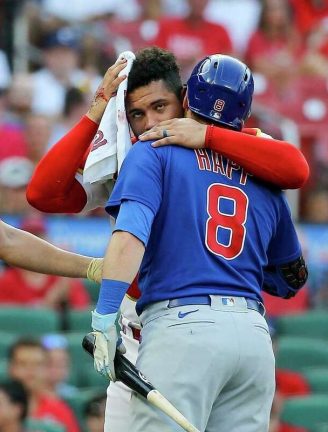
Contreras and Happ embracing, after Happ’s backswing caught Contreras on the coconut, quite accidentally—which didn’t stop Cardinals starter Mike Mikolas from buzzing, then drilling Happ in wrongful retaliation Thursday.

Memo to: St. Louis Cardinals. Subject: The Backswing Bop.

Dear Cardinals: We don’t care how long, how deep, and how bristling is your ages-old rivalry with the Cubs. Nobody checks in at the plate looking to conk a catcher on the coconut with a backswing, no matter what kind of swing he has, long, short, whatever. And, no matter that the catcher is set up so far inside for an inside pitch that he might have been lucky if his head didn’t meet the batter’s lumber.

P.S. When your conked catcher and the batter in question—who happen to be former Cub teammates— hug on the catcher’s way off the field, right then and there you should take it to mean peace, and let’s play ball.

You do not want your starting pitcher taking the perverted law into his own hands going back to work by buzzing that batter upstairs before planting one squarely on his backside. Not if you want to keep your pitcher in there instead of seeing him thrown out of the game, turning things over to an unprepared bullpen that’s liable to get pried, pricked, pounded, and poked for ten runs over the eight and a third innings to come.

Unfortunately, that’s exactly what happened after Cardinals starter Miles Mikolas threw one up and in to Cubs left fielder Ian Happ, in the top of the first, making the count 3-1, before drilling Happ squarely in the top of his right rump roast on the next pitch. There were actually two things wrong with that drill.

Thing one: Mikoas was dead wrong to even think about sending “messages” to Happ and the Cubs at all. Happ wasn’t even close to trying with malice aforethought to catch Willson Contreras on the cranium with his backswing. Their hug as a cut and bleeding Contreras left the game told each other, I didn’t mean to hit you, dude. I know, dude. We’re good.

Thing two: Doing it with two out and resurgent Cody Bellinger on deck was an invitation to potential trouble of the kind having nothing to with machismo retaliation and everything to do with the scoreboard kind. The only kind the Cubs were willing to pursue.

It was also liable to produce exactly what it did produce immediately, Mikolas getting tossed from the game. To the none-too-subtle outrage of the Cardinals’ broadcast team who seem to believe accidents deserve assassination attempts in reply. Come on! You gotta be kidding me! You have got to be kidding me! Have a little feel for baseball. Have a little feel for the game. That’s awful.

What’s awful is a pitcher not seeing his catcher’s injury was unintentional and throwing twice straight at the batter, the second one hitting him. No “feel for the game” justifies throwing at a batter over a pure accident. What did Mikolas expect for playing that kind of enforcer? The Medal of Honour?

“[The umpires] had a meeting and decided to toss me,” a seemingly unrepentant Mikolas said postgame. “The umpires can believe what they want to believe. That was their choice. They believed there was intent there and that’s all umpires need.”

One pitch a little too far up and in, followed by the next pitch bounding off Happ’s posterior, was rather convincing evidence. So, exit Mikolas (and Cardinals manager Oliver Marmol); enter Dakota Hudson, who wasn’t going to get a lot of time to heat up because Mikolas didn’t leave the game on account of being injured.

Hudson promptly surrendered a base hit to Bellinger and walked Cubs right fielder Seiya Suzuki on five pitches before walking shortstop Dansby Swanson with the bases loaded and surrendering a ground-rule, two-run double to designated hitter Christopher Morel, before Cubs catcher Yan Gomes grounded out for the side.

The Cubs extorted three more runs out of Hudson before his day’s work was done, on a pair of third-inning RBI singles and a run-scoring fourth-inning forceout. Hudson’s relief, Andrew Suarez, was greeted rudely when Cubs center fielder Mike Tauchman planted a 2-2 fastball over the center field fence opening the top of the sixth, before a pair of one-out walks in the top of the seventh paved the way for Gomes to slash a two-run double.

During all that, the Cardinals had nothing much to say other than Contreras’s successor, Andrew Knizner, hitting Cubs starter Justin Steele’s first offering of the bottom of the fourth into the left field seats. Not until Knizner batted in the eighth with one out and Cardinals first base insertion Alec Burleson on second (leadoff double) and hit another one into those seats.

It made Knizner the first catcher to enter a game off the bench instead of in the starting lineup and hit a pair over the fences since . . . Cubs manager David Ross, as a Brave on 14 June 2009. “You don’t have much time get ready,” Knizner said postgame. “You just trust your instincts.”

The Cubs said, well, we’ll just see about that in the top of the ninth. Especially after late catching insertion Miguel Amayo was hit by a pitch before being forced at second to set up first and third, from which point Tauchman beat an infield hit out enabling Morel to score the tenth Cub run.

The 10-3 score held up, bringing the Cubs back to .500. They’d sent their own message back to the Cardinals. You want to drill one of ours because of an accidental shot in the head, we’re going to drill you the right way—with hits and runs.

Not even Mikolas (and, apparently, possibly-departing Cardinals pitcher Jack Flaherty) appearing to invite them to come out of their dugout for, ahem, a little chat, could sway them into anything but answering on the field, at the plate, on the mound.

Contreras’s wound was closed with special glue. “I feel good and I want to make sure I’m ready to go tomorrow,” he told reporters. “I wanted to stay in. It was bleeding really bad. It was bad for me because I wanted to stay in there.” Officially, he’s listed day-to-day at this writing.

Having now won eight of their last nine games, the suddenly-hot Cubs have not been without their problems thus far this season. Going back to nursery school with a willfully juvenile opposing pitcher wasn’t one of them.

“We’re going to roll the dice and see what happens”

Lucas Giolito

The Angels hope Lucas Giolito fortifies their rotation (and Reynaldo López relieves the bullpen) for one more postseason run before Shohei Ohtani moves on. How sound are the hopes?

The good news is just as The Athletic‘s Tim Britton exhumed: two teams in the past ten years went into the trade deadline approach as buyers and ended up winning the pennant. One was the 2015 Mets; the other, last year’s Phillies.

The bad news is that this is still the Angels about whom we’re about to talk.

Maybe nobody was terribly surprised when the Angels let it be known Wednesday that they weren’t going to move unicorn Shohei Ohtani this deadline, either. But while baseball world wrapped around that, general manager Perry Minasian heeded owner Arte Moreno’s mandate and went in for a continuing potential postseason run.

The best available starting pitcher on the market who wasn’t named Ohtani is now an Angel. So is a relief pitcher who could provide a little breathing room for a bullpen not necessarily one of the American League’s most reliable.

White Sox teammates Lucas Giolito (RHP) and Reynaldo López (RHP) came west in exchange for the top two prospects in a farm system that isn’t overloaded with highly-attractive prospects otherwise. Giolito gives the Angels a reliable rotation workhorse to augment Ohtani. What López gives them out of the bullpen depends almost entirely on him.

That was last year: López was one of the stingiest relievers in the business, with a 1.93 fielding-independent pitching rate (FIP) showing his 2.76 ERA indicated a bit of hard luck. This has been this year: His 11.1 strikeout-to-walk ratio is undercut by walking over twice as many this year (4.7 per nine) as last (1.5), but . . . in his final five White Sox gigs before the trade, López struck eleven out in six innings while walking only three.

If that indicates returning to his 2022 form, the Angels will take it.

Giolito, of course, is a mid-rotation man at best, his 2020 no-hitter—the only no-no in White Sox history in which a pitcher struck ten or more batters out (he struck thirteen out)—notwithstanding. He does have a 3.12 strikeout-to-walk ratio this season, but he’s striking out shy of ten per nine but walking a shade over three per nine, almost exactly his career rates.

Pulling catcher Edgar Quero and projected reliever Ky Bush (LHP) in exchange is a plus for the White Sox, who’ve re-entered rebuilding after their last re-set didn’t quite get them where they wanted to go. They’re also hoisting pitchers Lance Lynn and Joe Kelly on the market hoping for another couple of reasonable prospects.

But did the Angels really do themselves such a big favour? Can they really iron up for one more postseason push while their unicorn (Ohtani) and their soon-to-be-returning veteran future Hall of Famer (Mike Trout) remain together? The smudge on the Angels has long enough been that they lacked what was needed behind those two to make their two greatest generational players, ever, postseason champions.

The deal for Giolito and López can prove to be either the jumpstart or the sugar in the fuel tank. Ask Britton, and his lack of optimism might prove alarming:

On the eve of the German invasion of Belgium in 1914, the Baron de Bassompierre summed up the feelings of his fellow Belgians: “If we are to be crushed,” he said, “let us be crushed gloriously.”

That’s the animating principle behind the Angels’ decisions on Wednesday night. Backed into a corner best described somewhere between “suboptimal” and “downright impossible” by a years-long inability to win with two transcendent stars, the Halos have decided to make one last stand with Ohtani.

His Athletic colleague Andy McCullough isn’t all terribly optimistic, either:

The phrase “moral hazard” comes to mind when considering the Angels emptying an already threadbare farm system on this quixotic quest for a wild-card spot this autumn. But you know what two other words come to mind? “Shohei” and “Ohtani.” Which leads to a different phrase: “moral obligation.” At least until October, the Angels plan to employ Ohtani, and Moreno has decided to maximize his franchise’s postseason chances, however remote. So the window is right here, right now, consequences be damned.

And so it is that the Angels shipped out two of their best prospects — an admittedly low bar — for Giolito, a mid-rotation starter who looks bound for some regression, and López, a reliever with a 4.29 ERA. As Britton mentioned, Giolito was the best pure rental starter on the market. He may benefit from leaving the White Sox, where little has gone well during the past two seasons. Even so, Giolito’s peripheral markers — all the knobs on Baseball Savant that were red in 2021 but blue in 2023 — are alarming. The Angels might have bought the dip. But, hey, when you’re a buyer, you buy what you can. López’s strikeout numbers have jumped in 2023 but so has his walk rate. He’s a reliever. Who knows if it’ll work out.

But, look, they decided to go for it. This is what going for it looks like. It’s going to be a heck of a ride.

Well, they said the California bullet train was going to be a heck of a ride, too. Until it wasn’t. We may yet end up trying to decide which was the bigger California boondoggle: the bullet train, or this and the past few years of Angels baseball.

That seems like a harsh thing to say about a team that’s won seven of their last nine games and now sits seven games out of first in the AL West, and four out of the final AL wild card slot, with the Red Sox and the Yankees just ahead of them there. But Minasian says of the Giolito-López acquisition that the Angels are “going to roll the dice and see what happens.”

They’re hoping to roll boxcars on two pitching rentals, while refusing yet again to let their extremely marketable unicorn bring back the prospects they need badly to begin re-seeding a farm whose drought won’t be saved by weeks of rain storms. And all three become free agents at season’s end.

Most of the Angels’ existence under the Moreno regime has equaled shooting craps. And, more often than not, crapping out.

Riding the pine tar

George Brett

“I told [my kids] you better never make me this mad, and they never did.”—Hall of Fame third baseman George Brett.

The single most infamous moment in Hall of Famer George Brett’s career ended up becoming a tool in his fatherhood kit. “Showed it to my kids a whole bunch of times when they were young,” Brett told ESPN writer William Weinbaum in Cooperstown, where Brett spent the weekend including for the induction of Hall of Famers Fred McGriff and Scott Rolen.

“I wanted to see the look on their faces when I got mad,” Brett said of that day, forty years ago Monday, “and I told them you better never make me this mad, and they never did.”

One look at Dad’s face, bulging eyes and expanding mouth as he stormed from the dugout, seemingnly determined to amputate umpire Tim McClelland’s limbs if not his head, and the three children under Brett’s jurisdiction (he married in 1992, before his final season as a major league player) should have had no further doubt.

24 July 1983. Yankee Stadium. The Yankees and the Royals not exactly on friendly terms. Top of the ninth, two out, Brett’s Royals down a run, Royals infielder U.L. Washington on first, and Brett’s fellow Hall of Famer Goose Gossage on the mound in relief of Dale Murray. Knowing Gossage wouldn’t throw him anything but fastballs, Brett sat on one and drove it about seven or eight rows up the right field seats.

Brett barely finished rounding the bases when Yankee manager Billy Martin, a man who never missed an opportunity to deploy the rule book when it would work to his advantage above and beyond the actuality of a game, hustled out of the Yankee dugout demanding Brett’s bat be checked.

The Yankees noticed Brett’s bat had a visible excess of pine tar before the game, we learned in due course. Martin, typically, elected not to say or do something about it until or unless Brett did noticeably game-altering damage swinging it, as he did in the top of the ninth. After Martin asked rookie umpire McClelland to check the bat, McClelland and the umps confabbed, examined, confabbed more, laid the bat across the seventeen-inch width of the plate . . .

While talking to teammate Frank White in the dugout, awaiting the final call, Brett said he’d never before heard of too much pine tar, notwithstanding teammate John Mayberry checked for it in a 1975 game but ultimately surviving an Angels protest. But the usually jovial Brett knew just what he would do if McClelland and company ruled against his bat and thus his go-ahead home run. It wouldn’t be a parliamentary debate.

“I go, ‘Well, if they call me out for using too much pine tar, I’ll run out and kill one of those SOBs’,” he remembered telling White.

They called him out for using too much pine tar. Brett charged up from and out of the dugout like a bull who’d been shot with an amphetamine dart, resembling a man determined to part McClelland from his arms, legs, head, and any other extremity within reach. It took several teammates plus Royals manager Dick Howser and umpire Joe Brinkman to keep Brett from dismembering McClelland.

“I looked like a madman coming out,” Brett admitted to Weinbaum.

I think everything kind of got a little more dramatic than it should have. Because Joe Brinkman got behind me and started pulling me back, and I was trying to get away and he had a chokehold on me and just pulling me backwards and backwards and I was just trying to get free from him. I wasn’t going after Tim McClelland. I mean, as Timmy would always say, “George, what were you gonna do to me? I’m 6’5″, I’ve got shin guards on, I’ve got a bat in one hand, a mask in the other. What are you gonna do to me?” I said, “Timmy, I was just going to come out and yell at you, I wasn’t going to hit you. You would’ve kicked my ass.”

George Brett, Gaylord Perry

Fellow Hall of Famer Perry (right) advised Brett to stop using the infamous bat—because it was too valuable. It’s reposed in the Hall of Fame since 1987.

Brett’s Hall of Fame teammate, pitcher Gaylord Perry, a man who knew something about suspect substances (hee, hee), managed to get the bat away from the umps and into the Royals dugout striking for the clubhouse, until Yankee Stadium security retrieved the bat to submit to the American League offices. (This, children, was the time when the leagues weren’t yet placed under MLB’s direct, one-size-fits-all administration.)

Brett was ruled out over the bat. The Yankees won the game officially. Not so fast. AL president Lee MacPhail received the Royals’ appeal, ruled that the bat didn’t violate the pine tar rule’s actual intent (which was to keep baseballs from getting dirtier), and ordered the game continued in New York—on an off-day for both teams otherwise, 18 August. En route a Royals trip to Baltimore for a set against the Orioles.

“I was kicked out of the game,” Brett said, obviously over his raging bull charge and plunge after the nullified homer.

I was still gonna go to the [suspended] game, but [Howser] said don’t even go the stadium, it’ll be a circus. So me and the son of [actor] Don Ameche, Larry—he was a TWA rep, we always chartered TWA jets back then—we went to some restaurant in New Jersey, an Italian restaurant, and watched the game on a little ten-inch TV. And went back to the airport, the guys had to go there after finishing the game, and next thing you know we were flying to Baltimore.

The Royals and the Yankees re-convened from the point of Brett’s homer. Royals designated hitter Hal McRae faced Yankee pitcher George Frazier, himself familiar with actual or alleged foreign substances. (I don’t use foreign substances. Everything I use is made in the U.S. of A.) McRae struck out for the side. Then, the Royals’ often underrated closer, Dan Quisenberry, got two straight fly outs and a ground out to finish what was started almost a month earlier.

Brett continued using the bat until Perry advised him it was too valuable to risk damage. He sold the bat to fabled collector Barry Halper for $25,000—until he had a change of heart and refunded Halper’s money. The bat has reposed in the Hall of Fame since 1987. “Goose and I have had a lot of laughs over it since he got into the Hall of Fame,” Brett told Weinbaum.

Before a 2018 game celebrating their fiftieth season of life, the Royals handed out a Brett bobblehead showing him springing forth bent on manslaughter upon the home run nullification. Brett told Weinbaum a Royals A-level minor league affiliate saw and raised to make him, arguably, the first player depicted on a bobble-arm figurine—his arms waving as wildly as they did when he charged for McClelland.

Three years before the infamous pine tar homer, Brett was known concurrently as one of the American League’s great hitters (he nearly hit .400 that season) and, unfortunately, a man stricken by a pain in the ass after the Royals finally waxed the Yankees in an American League Championship Series: internal and external hemorrhoids.

Brett had to put up with crude jokes throughout that World Series, which the Royals lost to the Phillies (and his Hall of Fame third base contemporary, Mike Schmidt), but he tuned them out. The pine tar game knocked that onto its butt rather immortally.

“Seriously,” he told Weinbaum, “what would you rather be remembered for? Hitting a home run off Goose Gossage in the ninth inning to win a ballgame, or being the guy with hemorrhoids in the World Series?”

I think I’ll sit on that awhile.