“Some no-hitters are simply games that go your way”

Tyler Gilbert

Tyler Gilbert gets the congratulatory Gatorade shower . . . that he should have given his teammates, instead.

Tyler Gilbert had a night to remember Saturday, all right. He became only the fourth pitcher in National/American League/American Association history to pitch a no-hitter in his first major league starting assignment.

The company Gilbert joins includes Theodore Breitenstein (1891 St. Louis Browns, AA; the league folded at season’s end), Bumpus Jones (1892 Reds; he surrendered one run in a game in which he walked four), and Bobo Holloman. (1951 Browns, AL, and not the same franchise as the 1891 Browns.)

It took 62 years between Jones and Holloman, then 68 years between Holloman and Gilbert. Pitching a no-hitter is tough enough as it is. Pitching one in your first big-league start seems somewhere between finding the pillar of salt known as Lot’s wife and swimming the full Pacific solo. Right?

“Some no-hitters are pure dominance,” writes ESPN’s David Schoenfield, “and some are simply games that go your way and you get your name in the record books alongside two guys named Bumpus and Bobo.”

Let’s be real. On Saturday night, Gilbert had a game that went his way to get his name in the record books next to a couple of guys named Bumpus and Bobo. I’m not going to say Gilbert did bupkis to leave the Padres with bupkis, but he had more than a little help from his friends.

(He also had a lot of un-premeditated help from the Padres: Fernando Tatis, Jr. was still a day from leaving the injured list where that shoulder dislocation landed him. Gilbert didn’t even have to think about the biggest stick in the Padres’ lumberyard.)

Considering he was responsible for 23 percent of the outs directly, Gilbert had a lot of help from his friends. He faced 28 batters, struck five batters out, but walked three of them, the direct opposite of Holloman’s direct game performance. “[The Padres] a couple hard-hit balls, but I was glad somebody was there to catch them,” Gilbert admitted post-game.

A couple? Gilbert’s fielders took care of 77 percent of the outs (nine ground outs including a pair of double plays; thirteen fly outs); Holloman walked five, struck out three, and his fielders were responsible for 85 percent of the outs. (Twelve ground outs, eleven fly outs.)

And, since this was a National League game, with no designated hitter in the Diamondbacks lineup, Gilbert had to make four plate appearances in the game. He grounded out to the hole at shortstop once, struck out once, and dropped a pair of sacrifice bunts.

The first bunt set up second and third to be followed by a walk and an inning-ending double play. The second pushed Nick Ahmed to third after Ahmed opened the inning with a double. Ahmed scored the seventh Arizona run in due course on a long single down the left field line. That’s one wasted out, one push of a man to third to come home on a long single, and thus direct responsibility for a quarter of a run.

The Snakes did the bulk of their scoring early enough and often enough with a five-run first: an RBI double (Ketel Marte); an RBI single (David Peralta); and, a three-run homer (Drew Ellis). They added the sixth run with a leadoff single (Pavin Smith) and an immediate RBI triple (Josh Rojas) in the fifth.

All on the dollar of Joe Musgrove, who became the twelfth pitcher in Show history to pitch a no-hitter and have a no-hitter against him in the same season. Musgrove’s in pretty intriguing company himself that way—three of those twelve pitchers (Pud Galvin, 1880; Bob Feller, 1951; Juan Marichal, 1963) are Hall of Famers.

But are you really going to call a pitcher who takes care of only 23 percent of the other guys’ outs and does nothing other than a sacrifice bunt that pushed a runner to third base the guy most responsible for the triumph?

“For all of the consternation about the deluge of no-hitters in 2021,” wrote ESPN’S Jeff Passan after Corey Kluber nailed the season’s sixth no-hitter in late May, “the act itself—recording 27 outs without allowing a single hit—remains a miracle.”

In Gilbert’s case, just as in Holloman’s case, it also remains a testament to the efficiency of his defense and the evening potency of the Diamondbacks lineup. Kluber, Musgrove, Carlos Rodon, John Means, Wade Miley, and Spencer Turnbull did more to earn their no-hitters earlier this year than Gilbert did.

I recorded that after Kluber’s no-no, in May, but it’s worth seeing again, adding Gilbert for the full context. I include the fielding-independent pitching rates of each of those pitchers at the time they threw their no-hitters, indicating whom among them was the most likely to turn the trick. I also assign a Win Factor based on their strikeouts divided by the sum of the ground and fly outs in the game. Here they are:

Pitcher Game Score K GO FO WF FIP
Joe Musgrove 3-0 10 10 7 .588 2.88
Carlos Rodon 8-0 7 10 10 .350 1.91
John Means 6-0 12 3 12 .800 3.25
Wade Miley 3-0 8 15 5 .400 3.24
Spencer Turnbull 5-0 9 12 6 .500 2.77
Corey Kluber 2-0 9 9 9 .500 3.57
Tyler Gilbert 7-0 5 9 13 .227 2.79

Gilbert had the least direct responsibility for his no-hit performance among the seven, while Means had the most with Musgrove the second-most. Gilbert by FIP was more likely to pitch a no-hitter than four among the seven but less likely to do it than Rodon and Turnbull. On the other hand, Means lived almost as dangerously as Gilbert with those twelve fly outs in his game.

There are no game logs available to analyse Theodore Breitenstein’s and Bumpus Jones’s no-hitters, but we do have one to analyse Bobo Holloman’s. His yields a .125 win factor—three strikeouts, as noted earlier, but the Browns managed to divide the field labour evenly otherwise: twelve ground outs and twelve fly outs. Holloman’s 4.57 FIP also made him the least likely of any of the four rooks to throw a no-hitter in his first Show start. By far.

Gilbert on earth and Holloman in the Elysian Fields can still take heart that they did at least something on their own to produce no-hitters. They didn’t pitch no-nos in which they did nothing to earn them.

Ken Holtzman did, once, in 1969. Four years to the day after Cincinnati legend Jim Maloney’s oddity (a no-hitter with eleven strikeouts and ten walks), Holtzman’s Cubs beat the Braves, 3-0 . . . with Holtzman striking nobody out, walking three, and needing twelve ground outs and fifteen fly outs to get out alive, never mind with no hits against him.

Essentially, Holtzman did nothing direct to contribute to that win. (He didn’t even do anything at the plate to, ahem, pitch in, either: he went 0-for-3 with a pop fly out to the infield and a pair of ground outs.) But Holtzman took the headlines regardless, and his teammates congratulated him heartily when it should have been the other way around.

Congratulate Gilbert regardless. But once the ball left his hand and those bats, the job was out of his hands entirely. Gilbert should also thank God his fielders knew what they were doing out there to do the most at keeping the Padres off the bases.

There’s only one thing more weird than declaring a pitcher a “winner” in a game where he had little enough to do with his team’s scoring and the other guys’ lack of it. That’s declaring him a “loser” when a) he wasn’t responsible for his team’s lack of scoring; b) he didn’t throw the fat pitch that turned into a game-losing hit; c) he wasn’t in the game when the guy who reached base against him scored what proved the winning run; or, d) or his defense could have been tried by jury for criminal neglect in the field.

But there’s Gilbert with a no-hitter and a win on his record. A no-hitter and a win for which he did only 23 percent of the work needed to deliver without factoring his team’s batting on the night. A win toward which he contributed—without scoring or driving it in—to one fourth (it takes four bases to make a run, remember?) of fourteen percent of his team’s seven runs on the night when he showed up at the plate.

If that’s a “winner,” I’m the headless man in the topless bar.

“Hey, Dad? Want to pitch me a walk-off?”

Tim Anderson

Tim Anderson, finishing the hype-busting Field of Dreams Game with a two-run homer in the bottom of the ninth Thursday night.

The game finished by crossing its original protagonist, Field of Dreams, with The Natural. The most poetically inclined screenwriting/directing team in film couldn’t imagine climax that surreal.

A pair of two-run homers in the top of the ninth to yank the Yankees back into the lead at 8-7. A two-run homer in the bottom of the ninth to win it for the White Sox, 9-8. This wasn’t the way they won ballgames during the 1910s evoked by the special uniforms the two teams wore for the occasion.

Hey, Dad? Want to pitch me a walk-off?

It was as jolting a climax as ever provided by David Freese, Aaron Boone, Joe Carter, Kirk Gibson, Chris Chambliss, Bill Mazeroski, or Bobby Thomson. Even if it didn’t win a World Series, push a Series to a seventh game,  send a team to a Series, or put them in the postseason at all in the first place.

It defied the game’s subtexts. The ones not spoken often if at all in the hype. The ones involving Field of Dreams‘s unlikely turning of baseball’s worst gambling scandal into a fantasy of reconciliation; and, The Natural‘s study of a live young prospect shot Eddie Waitkus-like, into long, long wandering, into a haunted elder returning to prove neither he nor his old dream died, for however long it still had to live.

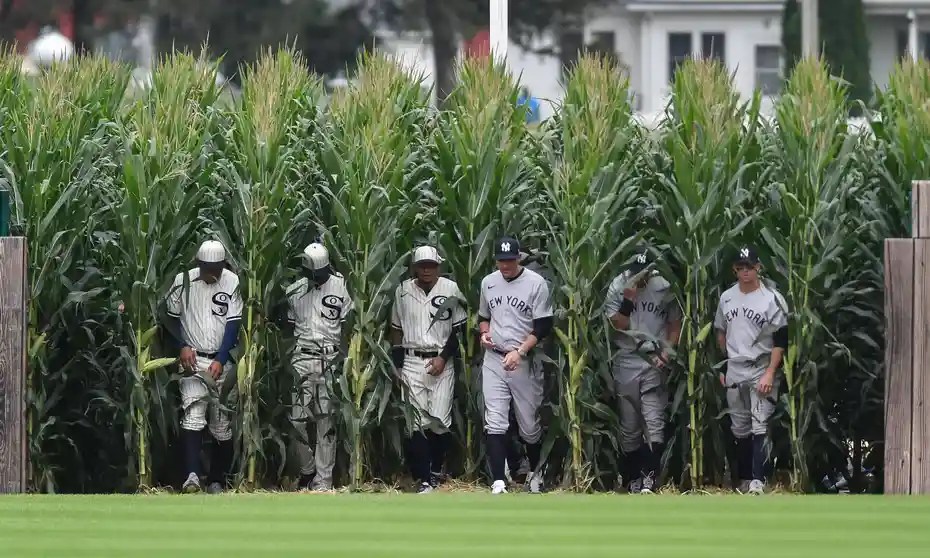
No volume of pre-game hype—this game’s tribute to artifices of fantasy was as hyped as any sports event could be—could have promised and delivered that kind of a ninth inning. Even Field of Dreams star Kevin Costner, escorting both teams onto the field from the corn beyond the wall, asking the crowd, “Is this heaven?” with the crowd hollering back, “No, this is Iowa,” wouldn’t have dared demand that in a script.

But there was Liam Hendricks, the engaging White Sox relief pitcher, looking made for wraparound sunglasses thanks to being endowed with wraparound eyes, working the top of the ninth, shaking a leadoff single off to strike Yankee veterans D.J. LeMahieu and Brett Gardner out swinging on four pitches each.

Then there was Hendricks at 2-1 to Aaron Judge. He threw Judge a high fastball and watched it sail far enough into the right field corn. Following which Hendricks wrestled Joey Gallo—the former Ranger whose stock in trade is either home run feast or strikeout famine, but who has the odd discipline of working walks (he averages 94 per 162 games lifetime)—into a walk after starting him 1-1 without throwing another strike.

Up to the plate stepped Giancarlo Stanton, a former National League Most Valuable Player and one of the game’s more formidable bombardiers until injuries began to grind away at him in earnest. Stanton hit Hendricks’s first service into the left field corn.

Even the somewhat partisan, small audience—savouring a game on the field built adjacent to the famous Field of Dreams farmhouse field, many paying through the nose secondarily for tickets with face values of $375 or $425, Iowa fans and White Sox season ticket-holders, the latter by special lottery—roared when that fabled Yankee power detonated in the top of the ninth.

It was nothing compared to what happened in the bottom, when Yankee reliever Zack Britton, himself having been in the top tier of his particular profession before injuries began shaving him down, too, took the role normally assigned to the injured Aroldis Chapman. He opened by luring White Sox pinch hitter Danny Mendick into a ground out to first but walking White Sox catcher Seby Zavala—who’d hit one into the corn himself in the bottom of the fourth.

Up stepped Tim Anderson, the lively White Sox shortstop. Britton pumped and pitched, a fastball right down the pipe. It was too fat a pitch to resist. If the White Sox have a classic kangaroo court in their clubhouse, Anderson would have been fined for malfeasance.

It didn’t win a pennant. It was more out of The Natural than Field of Dreams, whose co-protagonist by default Shoeless Joe Jackson had only one known walk-off hit in his entire career. (For the White Sox, against the Yankees, in July 1919.) But when Anderson hit it out, it won a ball game keeping the Yankees from gaining on the second place Red Sox in the American League East and fattening the White Sox’s AL Central lead to eleven and a half. Slamming an exclamation point down for baseball itself.

What began with Field of Dreams star Kevin Costner escorting the Yankees and the White Sox through the corn and down across the field ended with an African-American man from Alabama, who wouldn’t have been admitted to the 1910-1919 Show because of his race, channeling his inner Roy Hobbs, The Natural‘s psychically-buffeted protagonist.

Hobbs in the film version was down 0-2 and struggling mightily with an ancient bullet lodged in his insides, causing him to bleed through his lower stomach, when he hit the pennant-winning bomb that also shot the ballpark lights out. Anderson had no such encumbrance when he sent Britton’s canteloupe into the left field corn.

Until that ninth inning viewers at home and the fans who’d paid into the field saw a very reasonably played game. They saw White Sox first baseman Jose Abreu hit the first major league home run ever hit in Iowa in the bottom of the first. They saw Judge become the first Yankee to go long in Iowa when he hit a three-run homer in the top of the third.

Chicago White Sox, New York Yankees

Wearing 1910s style uniforms, the White Sox and the Yankees entered the Field of Dreams Game through the corn Thursday evening.

They saw White Sox starter Lance Lynn nail the first major league strikeout in Iowa when he froze Gardner on a high called strike, on a night when plate umpire Pat Hoberg was as generous with the strike zone ceiling as he was skinflint about proper strikes on the sidewalls of the zone.

They saw the early 3-1 Yankee lead disappear in a four-run White Sox third, when Anderson doubled center fielder Adam Engel home with one out, and recently-restored-from the-injured-list designated hitter Eloy Jimenez cracked a three-run homer into the right field corn.

They saw Gardner put a number on Lynn’s pitching evening when he hit the second pitch of the top of the sixth not too far from where Jimenez’s bomb landed. They saw Yankee infielder Tyler Wade, one of a host of spare parts coming into regular service thanks to the Yankees’ ongoing shuttle back and forth from the injured list, drop one of the only bunts that should be allowed in a game.

With one out, nobody on, and the non-shifting White Sox infield playing deep enough to prompt calls for sending a search party out to find them, the lefthanded Wade saw enough delicious open real estate to push a bunt to the left side, just enough to the middle to keep third baseman Yoan Moncada from doing anything more than grabbing the ball on the run in.

No wasted out. Nothing but a versatile enough utility infielder, who inclines toward hitting line drives (he has four doubles out of 24 hits this season), not feeling he was going to get something to hit on a line, seeing a free gift and pouncing on it before the supply expired.

Then, Wade stole second while LeMahieu occupied himself with working his way into a walk. Then, a ground out pushing second and third and Judge accepting a walk from White Sox speed reliever Michael Kopech after opening with strike one but seeing four straight balls, including a ball four which should have been called strike two.

No matter, far as the White Sox were concerned. Up stepped Gallo, flashing his usual all-or-nothing style at the plate, swinging mightily enough but whacking a pitch a little up out to shortstop to force Judge for the side.

From the moment Lynn started the game with ball one to LeMahieu and LeMahieu nailed the first major league base hit in Iowa baseball history, to the moment Anderson sent everyone home with his corn ball, the game told the hype to take a shower. Even if the live Fox Sports telecast referenced Field of Dreams to a fare-thee-well.

“I knew it wasn’t over,” Anderson said post-game. “The game’s never over. And once Britton walked (Zavala), I knew there was a chance to start something real dope.” So he finished something real dope with something as dope as it gets. In the immortal words of Hall of Fame baseball writer Jayson Stark, “Because . . . baseball!

Of fathers, sons, dreams, rapproachment, and baseball

Kevin Costner, Dwier Brown

Kevin Costner and Dwier Brown play extraterrestrially reconciled son and father, respectively, in Field of Dreams.

So the Yankees and the White Sox will play the so-called Field of Dreams Game Thursday. They’ll play on the Iowa field rolled out and planted inside an eight thousand feet grandstand, adjacent to the field-in-the-cornfield that was actually built and used to make the film after which the game’s named.

“How,” asks Athletic writer Richard Dietsch, “do you capture the essence of a famous film on a live broadcast between Major League Baseball teams? That’s the question Fox Sports production staffers have been contemplating for months.” The answer may well depend on how you define the essence of Field of Dreams.

I read the original short story, “Shoeless Joe Jackson Comes to Iowa,” turned into the novel Shoeless Joe, by W.R. Kinsella, back when both first appeared. I saw the 1989 film when it first appeared and a few times to follow when it was delivered on videotape, then DVD. The fantasy in print and on film had a particular resonance for me.

What began as an Iowa farmer lured to plow two-thirds of his corn, to build a major league-size field onto which Jackson and his fellow Eight Men Out might return to the game from which they were banished eternally, concluded (spoiler alert, to those few who haven’t seen it) with an estranged son (the farmer) and father (presented as a one-time New York Highlanders player) reconciling as time, illness, and death once denied.

Just like any son first misinterpreting a heavenly voice’s instructions to welcome Shoeless Joe Jackson, kidnap a renowned but reclusive J.D. Salinger stand-in, then do likewise to the elderly doctor turned eager youth who’d once been a single-appearance New York Giants right fielder. Then, bringing the latter two to his fresh field to witness games between the Black Sox and assorted deceased baseball stars

(Don’t bother. IMDb lists those cast members only as “additional ballplayers.” It’s up to you whether you think you see Walter Johnson, Babe Ruth, Lou Gehrig, Honus Wagner, or Cy Young—though the young Moonlight Graham points to and mentions Smokey Joe Wood and a pair of live-ball legends, Mel Ott and Gil Hodges.)

The story has its charms above and beyond capital crime on behalf of the greater good of the game. Above and beyond the very idea that you could turn into heroes eight men who disgraced the game with their World Series tanking for fun and profit or (in the case of infielder Buck Weaver) refusing to blow the whistle on the tank when it might have made a truly significant difference.

And, above and beyond the implication that there but for the grace of the gamblers to whom two or three of the Eight Men Out reached would the White Sox have steamrolled the inferior 1919 Cincinnati Reds. The actual record shows that implication as false as the still-holding idea that Jackson was entirely innocent, to say nothing of whether Jackson really did play to win in that Series. (Says the actual record: he didn’t, quite.)

For me, the film’s climax is the charm that hits too close to home. The adult, fictional Kinsella gets to reconcile with his father on the field, the father frozen by death in his young adulthood, wearing a Highlanders uniform, with a catcher’s chest protector and shin guards.

Father and son in Field of Dreams were estranged by disputes including the one in which the son chastised the father for worshipping a badly tainted baseball hero. Father and son in my case were estranged by contradictions that would be called child abuse today, followed by the ten-month battle against cancer that my father lost in 1966, when I was ten and he, thirty-nine.

My parents were foolish enough to believe nothing but physical discipline, with no concurrent attempt at real teaching, applied to mere human childhood mistakes the same as to real misbehaviour or disobedience. Confirmed decades later by an unimpeachable source (my father’s sister), my parents wanted children in the worst way possible—only to have no patience for children merely being children.

My father, alas, was even more foolish for believing the way to teach a son who didn’t know how to fight was to beat him even more violently, accompanied by every demeaning insult he could throw. The thought that a son needs to be taught to defend himself, that it isn’t knowledge with which you’re born, was never programmed into his software.

My father’s death stole any hope of eventual rapproachment in this world from me. Fantasy thought it is, the rapproachment between John and Ray Kinsella to conclude Field of Dreams was and remains something I envied every time I watched the film. The few things I had in common with my father included baseball. (And, in fairness, music, my interest in and facility for which my father encouraged but my mother rejected.)

I don’t remember whom he declared to be among his baseball heroes, other than his having been a Dodgers fan since their Brooklyn years. He spoke of various players without singling one out as a particular favourite, at least within my earshot, while I had as heroes assorted hapless 1962-66 Mets plus Sandy Koufax, Willie Mays, Juan Marichal, Henry Aaron, and Bob Gibson, among others.

But I do remember numerous catches, a few trips to the Polo Grounds and then Shea Stadium to see those embryonic Mets, and, in one fathers-and-sons game, my ripping a line drive off his crotch when he deliberately lifted his glove above it because (he admitted it later) he didn’t want to be the reason I made a hard out.

For all the contradictions and abuse, whenever I watch the Field of Dreams climax I’d give whatever I have to give to see my father walk toward me one more time, whether or not he wore a baseball uniform, and slip a baseball glove onto his left hand when I slip mine on and say, “Dad, want to have a catch?”

How do you capture the essence of a famous film on a live broadcast between Major League Baseball teams? Asking demands we ask just what that essence really is.

Is it giving eight disgraced baseball players a new home and a chance to recover by the gods what their misbehaviours—ranging from the morally criminal to the complicit to the willfully silent—stripped from them in the mortal world’s furies?

Is it the old, long-gone fans who refused to believe those men could have been anything other than victims of their own caprices, married to those of a purportedly unscrupulous baseball owner (and that theory has been debunked, too) and the professional gamblers a few sought to finance their intended subterfuge?

Is it re-discovering a truth enunciated in short form and long double-negative by Hall of Fame manager Sparky Anderson? We try every way we can think of to kill this game, but for some reason nothing nobody does never hurts it. Or in long form by James Earl Jones as Salinger’s stand-in Terrence Mann?

People will come . . . they’ll walk out to the bleachers; sit in shirtsleeves on a perfect afternoon. They’ll find they have reserved seats somewhere along one of the baselines, where they sat when they were children and cheered their heroes. And they’ll watch the game and it’ll be as if they dipped themselves in magic waters . . . America has rolled by like an army of steamrollers. It has been erased like a blackboard, rebuilt and erased again. But baseball has marked the time. This field, this game: it’s a part of our past . . . It reminds of us of all that once was good and it could be again.

The author's son

Photographed by his father through a fence, my son ends his first-ever national Special Olympics plate appearance with a home run. (Yes, he back-flipped his bat away!) My fortune includes that we will never require reconciliation.

Is it an otherwise composed, ordinary Iowa farmer compelled to restore an un-restorable purity to men who could have destroyed baseball but engaged his lost father enough to return to earth, fostering the rapproachment too many fathers and sons—including mine, wherever he is in the Elysian Fields, with me—wish with each other but never find?

My own fortune includes being a father myself. By marriage and mutual engagement, not biology. The marriage is long past; my fatherhood, never. We made each other father and son. I did my best with whatever I had, for a son whose intelligence and will overcomes his compromise by a speech and language impairment, and whose heart is too large to be contained.

He joined his southern California softball team winning silver at the national 2018 Special Olympics. (His first plate appearance in that event: a healthy home run.) During the tournament, his coach told me and he affirmed: he credited me with teaching baseball and softball to him. There was no one more proud of my son at that Special Olympics (except his mother, surely) than his father.

All I ever did was observe, see what he had beyond the love of baseball we shared at the outset, then let him develop what he had on his time, through his eyes, ears, and hands, through his heart, never once imposing mine upon him. (He imposed one of his own: his boyhood heroes were Shawn Green and Vladimir Guerrero.) I’d learned the hardest way how damaging the other ways around could be.

The pan-damn-ic has prevented in-person time with my son since last year. We’ve missed the pleasures of going to Angel Stadium, sharing a game, sharing an atmosphere, with accompanying talk, theory, and hopes of catching a foul ball. It may well do so again before this season ends. I’ll talk to my son on the phone and in instant messages, as always we do. No one needs to tell either of us it isn’t quite the same as direct human engagement.

Neither of us are Yankee or White Sox fans. My son is a die-hard Angel fan. His father is a Met fan since the day they were born, a Red Sox fan since the 1967 pennant race, an Angel fan since the first day I took him to an Angel game. (They beat the Yankees and The Mariano in extra innings.)

We will probably each watch the Field of Dreams Game, thinking our own thoughts while the Yankees engage the White Sox, adjacent to where a novel was made into a film of fantasy that raises questions not always simple to answer. When not contemplating the good, the bad, the excellent, the dubious, about the play of the actual game.

Far simpler to replay the fictional Ray and John Kinsella reconciling with a simple game of catch. Even more simple to remind myself how much more fortunate I am, for having overcome my own parental estrangement and bereavement. For knowing I can still talk to, counsel, listen to my now-adult son, and play catch with him when conditions allow—for pleasure, not atonement.

“Totally vindicated—at enormous cost”

J.R. Richard

J.R. Richard, who couldn’t convince anyone who mattered that something was seriously wrong with him before a trio of strokes almost killed him in 1980.

“The more money we make the less fans will be sympathetic with an athlete’s problems. I admit, players today are vastly overpaid. It blows my mind thinking about the salaries. But it seems like the money has taken away our humanity. Sign a million-dollar contract and you’re no longer a person. You’re supposed to be perfection.”

Let me guess: you just read those words and think they came from a replacement-level player, a jock-turned-broadcaster, or a sportswriter. If you chose the third, you’re half right. Thomas Boswell got those words out of the mouth of Deacon Jones—not the football legend, but the pitching coach of the 1980 Astros.

Jones spoke about the late James Rodney Richard. (That’s how broadcasters starting with Dodger legend Vin Scully identified him invariably on the first reference during a game.) What hitters couldn’t do to him at his best, what turned out a trio of strokes did. They took down and nearly killed the 6’8″ righthander who looked as though he could shake your hand from the mound without reaching before blowing you away.

Richard’s collapse during a personal Astrodome workout while on the disabled list embarrassed everyone in the game—from the Astros themselves on upward and outward. The ones who accused Richard of malingering. At best. At worst, well, you almost don’t want to know.

Jones and a few others with and around the Astros spoke to Boswell the day after. “Richard’s life and his career remained in danger yesterday in the aftermath of emergency ‘life-or-death’ surgery Wednesday for removal of the clot,” Boswell wrote. “However, Richard, whose reputation had suffered much public damage in the last month, was totally vindicated—but at enormous cost.”

For two months prior to that fateful workout and collapse, Richard struggled to pitch through an inexplicably dead feeling shoulder and arm that left his fingertips showing blood traces and his fingers feeling numb. Even in the 1980 All-Star Game, when he started the game and struck four batters out including Hall of Famers Reggie Jackson and Carlton Fisk.

“The saddest irony of Richard’s two months of pain,” Boswell wrote, “was that his fortitude and determination to pitch were what led to almost universal questioning of his motives.”

“”I hope the skeptics are happy now,” Jones said to Boswell. “J.R. has almost had to die before anyone would take him at his word.”

Every town where we went for weeks there were stories intimating that J.R. was a drug addict, or that he was jealous of [teammate/rotation mate] Nolan Ryan and wanted more money, or that he was just a rich, lazy athlete who was loafing.

This whole experience has felt sort of tragic because it’s so typical of our society to assume the worst about everybody. In J.R.’s case, they assumed the worst about the best.

“The world owes J.R. Richard an apology,” said a Houston radio editorial quoted by Boswell to open that essay. How often did that station’s sports people and others on the air and in the printed press of the time launch or jump aboard the lazy-J.R. wagon?

Think about Boswell’s words a moment. You can pitch or play your way through inexplicable pain and have your motives questioned. You can do something about that inexplicable pain before it turns to something worse—and have your motives questioned. In professional sports, it’s hell if you do and hell if you don’t.

Did we learn our lesson after what happened to Richard? Of course not. It’s bad enough that Joe and Jane Fan—and, too often, Joe and Jane Sportswriter or Joe and Jane Broadcaster—think losing is a sign of moral turpitude. It’s worse that, as often as not, they think injuries or illnesses equal character flaws. Including a penchant for theft.

Or have you forgotten how often people talked about the millions Albert Pujols “stole” from the Angels when—after he had a first Angel season reasonably close to a future Hall of Famer’s best when he’s about to hit a natural decline phase—a series of foot and leg and lower body injuries reduced him to a comparative shell who could still hit but couldn’t do anything else for the rest of his time in Anaheim?

It’s even worse than that when athletes who should be the first to know better see a struggling teammate who knows something’s grievously wrong with him and dismiss him as a malingering weakling—whether he’s a 6’8″ behemoth or a 5’10” shrimp.

Leo Durocher dismissed injured players as quitters. I’m racking my brain trying to remember which manager or coach was quoted as saying, “If you’re injured, you’re dead to me.” For a black athlete who only looked invincible on the mound enough that he seemed to be toying with hitters as if enjoying a private laugh, it was even worse.

“I hate to get into this,” Jones told Boswell. “Sure, being black is part of the way J.R. got treated. You won’t find a black player who doesn’t assume that. But, partly, it’s being rich and partly it’s being so big and indestructible looking.”

“The same people who cut [Richard] up so bad and said he is ‘jaking’ or having a nervous breakdown or even that he was getting a divorce,” fumed Richard’s Astros teammate and bestie Enos Cabell, “it’s like they’re down in a hole today with their shoulders hunched so low that you can barely see them. But they’ve done their damage.”

Don’t get me started on the graveyards worth of players who played through injuries or illnesses, made them worse, and cost their teams a lot more than what their teams lost with them on disabled lists. Who knows whether the 1980 Astros would have gone all the way, instead of being throttled in the National League Championship Series, if Richard’s early complaints were heeded, diagnosed properly, and treated accordingly?

Sports medicine has been a cesspool of willful ignorance and downright malpractice for a very long time—from long before what happened to J.R. Richard. In too many ways, it still is. It also works in reverse now and then. Who knows how often still a team receives  sound medical counsel and dismisses it the way George Steinbrenner once dismissed such counsel to make a dubious trade for a pitcher on the threshold of career over?

Steinbrenner wanted to trade for White Sox lefthander Britt Burns in 1985. The Yankees’ own team doctor, John Bonamo, told Steinbrenner not to even think about making the deal, because Burns turned up with a congenital hip issue that was likely to finish his career. After Bonamo left the room, according to Bill Madden and Moss Klein’s Damned Yankees, Steinbrenner turned to others said, “What does he know about baseball? He’s a doctor. We’re baseball men.”

The Boss made the deal anyway. Sure enough, Burns never threw another major league pitch. Dr. Bonamo would have been within his rights to snort about what Steinbrenner and his “baseball men” didn’t know about medicine.

Competent doctors with the 1980 Astros would have suggested a neurologist and a thoracic specialist have a look when Richard complained about the continuing numbness in his fingers, ringing in his ears, and general fatigue in his shoulder area. But maybe that Astro administration would have sniffed that “baseball men” knew better, too.

Those Astro quacks—who weren’t just on their medical staff—just told him to shake it off and keep throwing those 100 mph fastballs. Just the way a few too many fans today tell Mike Trout to just shake off that calf injury, get back up there, swing, and challenge outfield fences again. Damn the prospective long-term cost.

You may or may not remember: Richard eventually won a $1.2 million malpractise suit against those Astro quacks.

Richard’s career was over for all intent and purpose after that trio of strokes. He hit rock bottom over the decade to follow, then picked himself up, dusted himself off, and resurrected himself with a little help from his friends. (And, a lot of help from his church and his third wife.) Among all baseball’s injury/illness-felled “what-ifs,” Richard’s at least in the top five.

And Joe and Jane Fan, Joe and Jane Sportswriter, and Joe and Jane Broadcaster, often as not, still don’t learn. The least-seeming injury can be and often is a lot more serious and obstructive than you think. To which the only proper answer should be, “If you think injuries or illnesses equal malingering, moral turpitude, or money theft, you’re dead to me.”

J.R. Richard, RIP: Redeemed

J.R. Richard

It was easier to square off against a Boeing 747 than to face J.R. Richard at his peak.

You couldn’t resist wondering when you saw him at his peak. Suppose 6’8″ James Rodney Richard’s career began early enough to give him a shot at pitching to 6’8″ Frank Howard. Paul Bunyan at the plate versus the Leaning Tower of Houston on the mound. Accompanying music, John Coltrane’s classic “Giant Steps.”

There might have been one of two outcomes. Either Howard was going to hit Richard for a home run making first contact with the Delta Quadrant, or Richard was going to bust three strikes through Howard as casually as the Lou’siana fisherman Richard loved to be on his free time.

“(I)f you beat me,” J.R. Richard said in 2012, remembering his attitude on the mound, “I’m gonna die trying. I was willing to give my life for it.” He damn near gave his life for it.

What National League hitters couldn’t do once Richard finally harnessed his outsize ability, a stroke did, while he was on the disabled list after he’d started the 1980 All-Star Game by striking out three American League batters including Hall of Famers Reggie Jackson and Carlton Fisk.

It embarrassed everyone in baseball, too many of whom including his own team accused Richard—who died at 71 Wednesday night—of dogging it when he began complaining about feeling excess fatigue in his arm and shoulder areas before the All-Star break.

Not even renowned surgeon Dr. Frank Jobe could pinpoint the sources, after Richard visited him complaining of numbness in his fingers and ringing in his ears. Jobe and other doctors discovered obstructions in his arm and neck arteries—but decided they weren’t serious enough for surgery.

With the Astros on the road Richard gave himself a private workout at the Astrodome on 30 July 1980—and collapsed. The CAT scans to follow showed he’d actually suffered three strokes and also had thoracic outlet syndrome present thanks to his over-developed shoulder muscles. The strokes left his left side useless long enough.

Richard recovered enough to attempt a career comeback or two but it was futile. Now-retired Washington Post writer Thomas Boswell caught up to him during one of those comeback bids. “Richard is more pleasant, more outgoing, more generous with other people than ever before in his life,” Boswell observed.

Once he was the most forbidding Astro. Now he may be the least, signing autographs and seeking out chitchat. After a lifetime as the Goliath overdog, he is now everybody’s underdog, and he enjoys it. Richard may even have become the symbol of a decent, long-out-of-fashion idea: mutual tolerance.

““(W)hen people don’t understand who you are, when people can’t control you,” Richard told radio interviewer Bill Littlefield in 2015, promoting his memoir Still Throwing Heat, “they have a tendency to want to destroy you. But see, you got to realize this: Sports is a business. Nothing more or nothing less.”

Richard had signed a four-year, $3.2 million contract with the Astros the year before the trio of stroke took him down. His career ended for keeps in 1984 and he returned to his native Louisiana. He spent lots of time between there and Galveston fishing as if his life depended on it. He won a $1.2 million malpractise action against the Astros’ medical staff. He sold cars and recreational vehicles for a spell or two.

But then Richard, unlike his television namesake J.R. Ewing, discovered he had as much ability to navigate the oil business as hitters once had navigating his cruise-missile fastballs and his sweeping sliders. He lost $300,000 in what turned out an oil investment scam. Then he lost over $600,000 in his first divorce.

That led to a series of further business problems, a second failed marriage, and the loss of his home, finally bringing Richard so low that he lived homeless under a Houston bridge—until former teammates Jimmy (The Toy Cannon) Wynn and Bob Watson intervened.

Wynn called Watson, then the Astros’ general manager, some time in 1994. They reached out to the Baseball Assistance Team and together helped Richard back onto his feet. So did Richard’s church minister, Rev. Floyd Lewis, helping him stay on his feet and become a minister himself.

J.R. and Lula Richard

Richard with his wife, Lula: “My life is now better than ever because of the love of my life.”

He drew on his own homeless experience to help the homeless in particular, when not working with Houston donors to set up assorted children’s baseball programs where he’d teach the kids the game and a few hard-earned lessons of life, too.

“You see,” Richard told Littlefield, “a man could eat a whole whale, but it takes one bite at a time. Or he can walk a mile, but it takes one step at a time. So if you’re willing to take that step, [God] will make a way out of no way. See, God is the only one I know who can take a mess, go in a mess, clean up a mess and come back out and don’t be messy. Now you figure that out.”

Health and fate made that harder to figure out than he figured out how to strike fifteen Giants out in his first major league start—tying the rookie record set by Dodger legend Karl Spooner in 1954—or how to smash Hall of Famer Tom Seaver’s single-season National League record for righthanded pitchers.

Richard figured it out enough, too, to remarry happily. He met his third wife, Lula, when they shared a bus on a church trip. Maybe a little impulsively, Richard wrote his telephone number inside the cover of Lula’s Bible, and shared a steak dinner for their first date. They “courted” (Richard’s word) two years before marrying in 2010.

“She helped with a lot of stability, in every way,” Richard once said of her.

The man who once said he was the only man in baseball who could throw a ball through a car wash without the ball getting wet never lost his laconic wit, either, no matter what. Fans meeting him in later years and remembering their shock over his strokes often drew such replies as, “I couldn’t believe it, either.”

The Astros inducted Richard into the team’s Hall of Fame two years ago. They haven’t yet conferred the one thing Richard wanted most dearly when all was said and done, retiring his uniform number 50.

Nobody could believe what might have been the oddest game of Richard’s career. On 19 September 1978—the night he broke Seaver’s record—his mound opponent was Jim Bouton, Ball Four author, one-time Astro, attempting a quixotic comeback with the Braves. “The young flamethrower and the old junkballer,” Bouton described the matchup. Others called it David vs. Goliath.

Richard surrendered two earned run on three hits and three walks in seven inning; his money punchout came at the expense of Braves third baseman Bob Horner. Bouton surrendered two earned runs on five hits, walking five, striking out one. Lopsided as that looks, David and Goliath still fought to a draw. (The Braves won the game in the ninth.)

It wasn’t half as impressive as the battle Richard won after his career, the battle of life, after the kind of buffetings that would send lesser men into the Phantom Zone of walking death. May his beloved Lula, his family, all those who loved him for himself and respected his self resurrection, take comfort that the Lord in whom he devoutly believed welcomes him home with gentleness and kindness.

And, maybe, with a gentle joke Richard himself would appreciate—“About that car wash, J.R. . . . “