On disappearing the seven-inning-game doubleheader

Rob Manfred

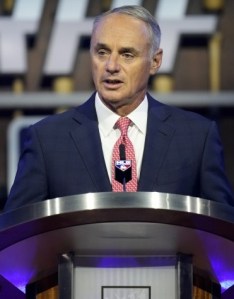
Commissioner Rob Manfred at the draft day podium. He wants to end doubleheaders of seven-inning games. He’s wrong.

Granted, the terms “good news” and “Rob Manfred” are too often oxymoronic. But in the immortal words of a once-legendary radio commentator, Gabriel Heatter, there’s good news tonight. (Well, this morning, when I sat down to write.) The free cookie on second base to open each extra half-inning, Manfred promises, will disappear after this season.

The bad news is that, when it comes to Manfred’s commissionership, for every piece of good news you risk the presence of five or more pieces of bad. This time, it’s the seven-inning doubleheader. That, too, will disappear after this season.

This commissioner oversees baseball with the mindset of a man believing the offspring of a back-street affair between Rube Goldberg and the Mad Hatter should be a baseball executive. Now, on Tuesday, Manfred told the Baseball Writers Association of America that the free cookie on second and the seven-inning doubleheader will bedevil them no more.

Reaching further for the good news, Manfred didn’t quite upstage the Home Run Derby in Coors Field. Even he couldn’t possibly upstage that event, nebulous as it might be. Not when Derby participants wore number 44 on their uniforms in tribute to the late Hall of Famer Henry Aaron.

Not when Mets first baseman Pete Alonso, winning a second consecutive Derby, repeated something else after blasting 74 into the seats or beyond: as in 2019, he earned more for one night’s work than he earned in an entire season’s worth of his Mets salary.

Not when Shohei Ohtani—the Angels’ flavour of the season with the incomparable Mike Trout missing enough of it with injuries so far, and the prohibitive favourite to beat the Derby into submission—proved exhausted enough that the Nationals’ outfield star Juan Soto sent him to an early rest-of-the-night-off in a round-one swing-off.

Not when Trey Mancini usurped Ohtani as a sentimental favourite thanks to his courageous conquest of cancer and his return thereafter, sending the Derby into a final-round showdown with Alonso that came up a bomb short.

Not when Alonso audaciously proclaims himself the best power hitter in baseball today when a) he’s not even in the top ten among the Show’s 2021 slugging percentages; b) he’s not even in the top ten among the Show’s 2021 OPSes; and, c) he’s not even in the top ten among the Show’s 2021 double, triple, or home run hitters.

Manfred may say now as then that the cookie on second to open each extra half-inning and the seven-inning doubleheader were motivated by pan-damn-ic health concerns. But those might have been valid reasons which just so happened to offer him cover to indulge his itch to experiment and his inability to distinguish between what does and doesn’t require repairs.

To the “purist” the doubleheader of seven-inning games is about as palatable as a Kaeopectate on the rocks. But if the Good Old Days Powers had pondered the idea in those alleged Good Old Days, the doubleheader might not have gone the way of the Duesenberg in the first place.

What I wrote in April is worth revisiting: if we must have doubleheaders, the doubleheader of seven-inning games makes perfect sense. And you Old Farts yammering about it being just more kowtowing to today’s candy-assed players are hereby invited to stuff it.

“We saw teams play three doubleheaders in a single week at times last year,” wrote CBS Sports’s Mike Axias then. “MLB has to assume something like that will happen again, in which case seven-inning doubleheaders are a necessity. You can’t ask players to run themselves into the ground like that.”

There’ve been 37 doubleheaders played through the All-Star break this season. There are ten more scheduled for the rest of the seasons, and that’s before any that should crop up as a result of single-game postponements. There are also serious side issues to ponder.

When Madison Bumgarner pitched a no-hitter in one half of a late-April doubleheader, he collided with a pair of colliding rules. The no-hitter was defined officially, a long enough time ago, as nine no-hit innings. Well, now. The doubleheader’s seven-inning game still counts as a complete game if you happen to pitch all seven innings. Does it make sense to award Bumgarner a complete game but not a no-hitter, since he pitched the game entirely under a rule he didn’t exactly help to enact?

Just as Joe and Jane Fan forget or ignore that pitching injuries are as old and as widespread as pitching itself, they forget that there was a time when the old nine-inning-game doubleheader wreaked as much havoc as health upon the game they profess to love.

Once upon a time, the bottom-feeding teams played the most doubleheaders. “Poor teams need an added inducement to convince the fans to come out and see them,” wrote Chris Jaffe in a 2010 Hardball Times doubleheader study. “Perhaps more importantly, when they traveled on the road their opponents needed an extra bit of persuasion to convince rooters to see what promised to be some lackluster on-field performances.”

During the Great Depression, from 1930-34, National League teams averaged 36 percent of their seasons’ scheduled playing doubleheaders and American League teams, 30 percent. During World War II, the NL’s teams averaged 46 percent and the American League, 45 percent. The National League fell one twin-bill short of playing over half its games in doubleheaders in 1945.

Of course, nobody thought (or gave a damn) what playing that many doubleheaders of nine-inning games might take out of the people you paid your money to see at the ballpark in the first place. (Hint: It wasn’t the owners.) The 1943 White Sox would probably love to disabuse you.

For whatever perverse reasons, those White Sox alone played an unconscionable 44 doubleheaders that year. They included eleven in July, eleven between September’s beginning and the 1 October regular-season finish, and 27 pairs of doubleheaders played either on back-to-back days or with a single off-day between them.

The hell with Hall of Famer Ernie Banks’s fabled catchphrase, “It’s a beautiful day—let’s play two!” How would you like to play 36 innings of baseball in two or three days straight by design rather than by extra-innings happenstance. Quit fooling yourself. You’d be more exhausted thinking about it than the men playing those innings in such a stretch were playing them.

Writing in Doubleheaders: A Major League History, Charlie Bevis—English instructor at Rivier College, Society for American Baseball Research member and author—devoted an entire chapter to Banks and “Let’s play two!” and came up . . . almost as unable to decide its veracity than could most who knew Banks during his Hall of Fame career and beyond.

Banks may have intended the phrase to signify nothing more than his genuine love for the game and his place in playing it. Bevis suggested plausibly that, whenever the idea first occurred to him, Banks may well have deployed it especially as a way to fight back against cantankerously careless Cubs manager Leo Durocher, who seemed almost as bent on showing Banks up as a washed-up veteran as he was on just about anything else.

But “Let’s play two!” took on too much life of its own at a time when the doubleheader became seen far more deeply as a burden than a blessing. “Banks’s attitude,” Beavis wrote,

helped to establish the romance surrounding the doubleheader as the concept entered its demise phase in the 1980s, when players and fans alike rapidly fell out of love with the seven-hour marathon that the doubleheader had become. “I’ve never heard anybody say they like doubleheaders, except Ernie Banks,” Mike Hargrove said in 1991. “And I think he was lying.” Just ten years after Banks was inducted into the Baseball Hall of Fame, the doubleheader was nearly extinct on the major league baseball schedule.

When he isn’t baseball’s version of Professor Pepperwinkle, Manfred’s barely able to conceal that his core belief is the common good of baseball equaling making money for the owners. Well. The old style doubleheader ended up turning into the separate-game, day-night doubleheader, because the owners weren’t making as much money with the single-admission twin-bill as they used to think they did.

What does Manfred wish to secure after 2021? Don’t be terribly shocked if the doubleheader of nine-inning games returns to the separate-game, day-night doubleheader. Don’t be terribly shocked, either, if such mundane corresponding issues as player health don’t matter a damn. To Manfred, and even to Joe and Jane Fan.

The doubleheader of seven-inning games was one of Manfred’s few sound ideas, whatever its impetus. It should be retained. Single admission. For the sake of those who, you know, play the games in the first place, and those who buy the tickets, even if those who buy the tickets don’t always know what’s good for themselves or for the game.

Good luck trying to “replace” Acuna

Ronald Acuna, Jr.

Three Braves trainers help Ronald Acuna, Jr. onto a medical cart, after Acuna landed awkwardly and tore his ACL trying to catch Jazz Chisholm’s high liner Saturday.

It can happen any time, any place. There’s no particular rule about when a simple running down of a drive to the back of right field will turn into a completely-torn anterior cruciate ligament that takes you out for the rest of a major league season.

It happened to Ronald Acuna, Jr. in Miami’s Ioan Depot Park Saturday. All he did in the bottom of the fifth was draw a bead on and run down Marlins second baseman Jazz Chisholm’s one-out, high liner toward the back of right field, take a leap trying to catch it before it hit the track near the wall, and land on his right knee hard and awkwardly enough to tear that ACL.

Acuna hit the track and the wall after the ball that eluded him by inches ricocheted back to the outfield grass as Chisholm finished running out an inside-the-park home run. Chisholm was anything but thrilled about getting it that way.

“For it to come at that expense, it kind of sucks for me and him, because the way that I got my home run is because he got hurt,” Chisholm told reporters following the 5-4 Braves win—and that was before he knew just how badly Acuna was injured on the play. “The baseball world is going to miss him if he’s out for long.”

The baseball world in general, and the Braves in particular. So sit down and shut up, you social media miscreants who think the same as one poster who said, ignorantly, “Sorry don’t feel sorry for any injury everyone gets them, next man, up.

If you think it’s that simple, let’s see you try to replace an effervescent clubhouse presence, and a guy who actually has as much fun playing the game as the Braves are going to sweat trying to replace a .900 OPS at the plate and twelve defensive runs saved above the National League average for right fielders this year so far.

Three Braves trainers tended Acuna on the track. He tried to get up and walk but could barely limp before the pain became too much. The trainers plus first base coach Eric Young, Sr. helped Acuna aboard the medical cart that drove out to him. Teammates talked to him like a fallen brother.

“It was more just trying to let him know that we love him and that we care about him, and we’re obviously with him throughout it all,” said shortstop Dansby Swanson post-game. “He didn’t really have anything else to say other than thank you for those words.”

This wasn’t a case of a player getting himself badly hurt doing what he wasn’t supposed to be doing. This wasn’t a baseball player attacking the game with a football mentality or playing the outfield as though the fences either didn’t exist or were there purely to surrender when he came barreling through.

This was a right fielder, maybe the best in the game this season, running down and leaping for a high liner he thought he had a chance to catch, landing with unexpected awkwardness followed at once by disaster.

This is also the game’s most dynamic leadoff hitter now gone for the year. Not to mention one of the classic current examples of reminding the Old Fart Contingent how foolish they look demanding players play the game like a business but remember it’s only a game when it comes down to its business.

“In his case,” writes The Athletic‘s David O’Brien, “there is even more substance than style, which is saying a lot considering he has style and swagger coming from his pores every moment he’s on the field . . . Though Freddie Freeman has been the undisputed captain of the Braves and the face of the franchise since Chipper Jones’ retirement, Acuna rivals him not just in terms of popularity among Braves fans but also in all-around performance and standing in the baseball world.”

Before Saturday night the only issue for Acuna seemed to be the Marlins having a particular penchant for hitting him with pitches. Acuna may like to take a couple of liberties with his batter’s box positioning, but the Marlins who’ve hit him with pitches twice this year and six lifetime—the most by any opponent in his career—have looked like headhunters when facing him.

It couldn’t possibly be that Acuna has more total bases against the Marlins (147) than any other team he’s played against in 50+ games, could it? It couldn’t possibly be that Acuna has a lifetime .736 real batting average (RBA: total bases + walks + intentional walks + sacrifice flies + hit by pitches, divided by total plate appearances) against the Marlins versus his .617 career mark to date, could it?

“This is actually the fourth time Acuna has had to make an early exit from a game this season due to an injury,” writes MLB Trade Rumors‘s Mark Polishuk, “but while those previous instances resulted in just a couple of missed games, [Saturday’s] injury appears to be much more serious in scope.”

That was just before how much more serious in scope came to pass. With a recovery time up to ten months, the Braves may well begin the 2022 season without Acuna for a spell, too.

“The only thing I can say,” Acuna himself said on a Sunday Zoom call, “is that I’m obviously going to put maximum effort to come back stronger than ever. If was giving 500 percent before, I’m about to start giving 1,000 percent.” The spirit is certainly willing. Unfortunately, the body may have other things to say about that. May.

“Acuna will be missed throughout baseball and especially by the Braves and their fans,” O’Brien writes. “Those fans scooped up Acuna jerseys and stood in line for Acuna bobbleheads and celebrated his every home run and bat flip, every stolen base and blazing dash from first to third—or home—and every cannon-armed throw to cut down a runner trying to take an extra base.”

Good luck trying to “replace” all that.

How long can the Shotime really go on?

Shohei Ohtani

Shohei Ohtani hitting his 32nd home run of the season. How long before his two-way life compromises him one or both ways?

Baseball’s flavour of the month, if not the season, is a 27-year-old fellow from Japan about whom The Sporting News once cited unnamed major league scouts saying he’d never be able to hit American big-league pitching. Some say that now compares to the British Decca Records executive who dismissed the Beatles’ manager with, “Groups of guitars are on the way out.”

That fellow is now half way on the way to hitting more home runs in a single season than Babe Ruth and Roger Maris ever hit. (Number 32.) He even has an outside but not unrealistic shot at hitting more home runs than the tainted Mark McGwire and Barry Bonds ever hit in a single season. (McGwire: 70, in 1998; Bonds: 73, in 2001.)

Shohei Ohtani awoke this morning leading the Show with his 32 home runs and his .700 slugging percentage, not to mention leading the American League with four triples. He also performs reasonably at his baseball hobby, pitching: he has a 3.49 earned run average and a 3.58 fielding-independent pitching rate.

That makes him the ace of an Angels pitching staff that hasn’t seen a genuine ace since the first Obama Administration, when Jered Weaver laid claim to the title. That was a decade ago; this is now: The Angels’ starting rotation has a 5.41 ERA; the entire pitching staff, 4.97. With Ohtani in the equation. Without him, the rotation would be 5.90.

So many baseball people, employees, fans, writers alike, rush to anoint Ohtani the 21st Century’s Babe Ruth. But Ruth’s career began on the mound and went from merely impressive to out of this galaxy when he exchanged the mound for right field full-time.

In five more or less full-time seasons as a pitcher, Ruth showed a 2.16 ERA and a 2.74 fielding-independent pitching rate—a period in which the American League’s ERA was 2.88 and its FIP, 2.91. Ruth’s ERA was .72 below the league average and his FIP was .20 below the league. Except for 1916, when his ERA was better than 1.00 below league average (and his only ERA title), Ruth wasn’t exactly the best pitcher in the league—or even the best pitcher on his team. (In 1916, Dutch Leonard had a lower FIP and a better K/BB ratio.)

Really, it’s Ruth’s 1919 that stirs the blood toward comparing Ohtani to him. Well, now. On the mound Ruth posted a 2.97 ERA/3.58 FIP—while leading the American League at the plate in on-base percentage (.456), slugging percentage (.657), and OPS (1.114) in his first season playing 130 games as an outfielder.

Ohtani’s 3.49 ERA thus far is .84 below the American League through this morning; his 3.58 FIP, .66 below. Like Ruth, Ohtani is a good pitcher who can be great now and then. Unlike Ruth, Ohtani can be a strikeout machine on the mound; his 11.7 K/9 is far, far, far beyond Ruth’s 3.7 from 1915-1919. But also like Ruth, Ohtani negates both that and the league hitting a measly .195 against him this year with a 4.9 walks-per-nine rate. (The Babe in 1919: 3.9 walks per nine.)

Ruth pitched in a time when pitchers were still, generally, trained to pitch to bat contact instead of trying to miss bats. (Walter Johnson and Christy Mathewson were outliers in that regard.) Of course, Ruth’s entire career took place in an arbitrarily limited game in terms of the available talent pool. A young Japanese man such as Ohtani would have been persona non grata in Ruth’s Show.

But he didn’t become The Babe until he changed jobs. He was a good pitcher with very occasional moments of greatness, but if he’d remained strictly on the mound he wouldn’t have become a Hall of Famer. He was a great (in 1919), then glandular hitter (just about the rest of his career), the absolute best of the pre-World War II/pre-integration/pre-night ball era position players.

It begs a serious Ohtani question. Co-hosting MLB Now for the MLB Network a few days ago, Brian Kenny—author of Ahead of the Curve: Inside the Baseball Revolutionsuggested it was time to think about restricting Ohtani to one or another role. Either make him a full-time pitcher, or make him a full-time designated hitter/periodic outfielder.

That suggestion sent apoplectic the New York Post‘s Joel Sherman, co-hosting the program with Kenny. “Why,” Sherman demanded, “would you stop him from doing one or the other?” Because, Kenny replied, “one could damage the other.”

Kenny was willing to acknowledge that it’s “great” if you can get an ERA under four and a slugging percentage beyond the tenth dimension, but he reminded Sherman audaciously enough that Ruth only really became Ruth when allowed to flourish (Kenny’s word) full-time with a bat in his hands.

“So,” Sherman shot back, “you would like one of the fifteen to twenty best starting pitchers in baseball to stop starting because you’re worried about something that could happen?” You can look it up: By his ERA and his FIP, Ohtani isn’t even one of the twenty-five best starting pitchers in this year’s Show. (ERA: 34th; FIP: tied for 30th.) What could happen, of course, is an injury determining Ohtani’s future employment one or the other way.

Stop snarling, Joe and Jane Fan. It happens. It has happened. Jacob deGrom, the best pitcher in baseball for several seasons, missed time enough this season due to a couple of injuries to his side incurred . . . swinging the bat. A few years ago, deGrom suffered a hyperextended pitching shoulder . . . from a hard swing-and-miss at the plate.

Adam Wainwright’s pitching life was compromised irrevocably by a torn Achilles tendon . . . running the bases. Before Steven Wright ran into trouble over domestic violence, his 2016 was ruined when he injured his pitching shoulder . . . diving back to second base. Chien-Ming Wang’s career was compromised irrevocably when he injured his right foot, the one with which he pushed from the pitching rubber . . . while running the bases.

Who’s to say a particularly hard swing or baserunning move won’t compromise an Ohtani body part whose health is required for even one of the top thirty starting pitchers in the game this season? Who’s to say a particularly hard or off-line throw from the mound won’t compromise the parts he needs to swing and hit balls into earth orbit?

Ohtani dodged such a bullet against the Red Sox two nights ago. He got hit on his surgically-repaired left knee (that’s on his landing leg for pitching, folks) when he fouled an Edwin Rodriguez pitch off his foot. One opposite foul later, Ohtani hit one halfway up the right field bleachers to pass Yankee legend Hideki Matsui for most single-season home runs by a Japanese-born Show player.

Lucky for him that he only had to jog around the bases. You still think the risk is just speculation? That time, it was just a foul off his foot and his knee. The next time, he could get blasted upside his head or his right shoulder (his pitching shoulder) with a pitch. Or, his brains blown out by a line drive on which he can’t get his glove.

I pondered the entire Ohtani phenomenon this morning in an essay for the International Baseball Writers Association of America’s Here’s the Pitch subscription newsletter. “I get the hungering and hankering for someone like Ohtani the so-called two-way player,” I wrote therein.

I get that baseball has done such a terrible job finding and promoting its stars that Ohtani presents a brilliant opportunity entirely on his own. That’s great for the gate and the press. “Shut up and let us enjoy the ride,” Joe and Jane Fan holler at the Brian Kennys.

But it isn’t smart baseball.

Smart baseball requires the maximum placement of a player into the maximum position to do the best he has to help his team win with the least risk possible. It requires Shohei Ohtani to spend his complete days at the serious work of play at the plate. Do you really want a roll call of outsize talents ruined because the gate and the hype were allowed to override if not steamroll the game?

A man walking four batters per nine innings on the mound is a phenomenal risk that really reduces his value from eleven to seven strikeouts per nine. The same man with a .745 real batting average in 2021 so far (total bases + walks + intentional walks + sacrifice flies + hit by pitches, divided by total plate appearances) is a man who can out-hit your pitching staff’s liabilities.

Go right ahead and keep up the two-way hype if it makes you happy.

With the incomparable Mike Trout still out with a calf injury, Ohtani is indeed just about the only reason Angel fans have to celebrate what shapes up to be yet another season lost.

The Angels can hit tons. They’re third in the American League for team hitting average and OPS; they’re fifth for OBP and second for slugging. Trout before his injury and Ohtani still have a lot to do with that. But they have a team administration that still seems to think building a viable pitching staff is beyond its pay grade.

So the bad news is that Ohtani, their best among (shall we say) modest starting pitchers  and their best damned hitter period, must continue going both ways, regardless of the prospective detriment to his career. He may well end up the new single-season home run champion and the league’s OPS leader. He may even get to both pitch and hit in the All-Star Game.

Wowie zowie, as Frank Zappa once sang.

Ohtani is the Rosetta Stone at the plate. He’d be the number four or five starter on another staff. There’s danger in that thar two-way business. There usually is danger when you put the gate and the hype ahead of the game. There’s better gate when you field winning baseball than a single outlying Shoman. (Just ask the 2002 Angels—the only World Series winner in the franchise’s history so far.)

Enjoy Shotime while you can, ladies and gentlemen. But if danger becomes actuality, and it costs the Angels either the most viable starter on a pitching staff hitters pray to face, or their most dangerous hitter (or maybe both at once), don’t say nobody warned you.

Be careful what you wish for, Yankee fans

Bill Gallo's "Baron von Steingrabber"

There were reasons why the late great New York Daily News cartoonist Bill Gallo portrayed George Steinbrenner as a Prussian autocrat. Today’s Yankee fan demanding “What would George do?” seems almost clueless. Almost.

Steven Goldman is a Baseball Prospectus writer whose Forging Genius: The Making of Casey Stengel should be required reading for anyone clinging to the myth that anyone short of a trained seal could have just wandered in and managed the 1949-60 Yankees to greatness. (Ten pennants, seven World Series rings.)

Goldman also thinks Yankee fans today need to get over the “What would George have done?” syndrome like five minutes ago.

Yes, the Yankees are 5-7 in their last twelve games and dropped two out of three to the Mets in holiday weekend interplay. Yes, they often seem like fish flopping on the dock or the boat deck, after being reeled in following an arduous battle.

And, yes, principal owner Hal Steinbrenner isn’t exactly his father’s son. Not if you consider a hair trigger pro-active leadership. Prince Hal would never have dismissed a promising but struggling prospect as the horse that spit the bit. It’s almost (underline that) to wonder how Prince Hal was a Steinbrenner in the first place.

On Sunday, the Mets nuked Yankee reliever Aroldis Chapman in the seventh of game one of a doubleheader made necessary by a Friday night rainout. Handed a 5-4 lead to protect, Chapman threw a 1-2 pitch to Pete Alonso that got sent over the left center field fence to tie. Oops.

He hit Michael Conforto with an 0-2 pitch, he walked Jeff McNeil on a full count, then watched his relief Lucas Luetge surrender a bases-loading single (Kevin Pillar), get the first Met out of the inning (James McCann, swinging strikeout), but then . . . two-run double (pinch hitter Jose Peraza), two-run single (Brandon Nimmo), RBI single (Francisco Lindor), before Luetge finally escaped the fire with Mets reliever Seth Lugo dispatching the Yankees too quietly in the bottom to end it.

Any team doing that to the Yankees that late in the game would have had The Boss going rogue. The Mets doing it would have had him going so far beyond that “rogue” would have seemed a relief.

“[B]oth social media and the Yankees broadcasters wondered how ‘George’ would have reacted had he been alive to see the resultant defeat. He would have reacted poorly,” Goldman writes.

During his lifetime, which ended 11 years ago, long after he had subsided into senescence, [The Boss] had placed a disproportionate emphasis on beating the Mets during meetings that, prior to the advent of interleague play in 1997, were restricted to meaningless exhibition games.

“He goes crazy if we lose to the Mets, even if it’s spring training,” said five-time Steinbrenner manager Billy Martin in his 1980 memoir Number 1. “He feels we’re going to lose fans to them if they beat us. It’s ridiculous, and it makes the players laugh at him.” Sometimes their reaction was a bit harsher than laughter. “The more we lose, the more he’ll fly in here,” third baseman Graig Nettles said in the last 1970s, “and the more he flies in, the better chance there’ll be a plane crash.”

George Steinbrenner was an awful lot more than just the man who threw out the first manager of the year, before his 1990 banishment over engaging a street hustler to help him soil the reputation of his Hall of Fame right fielder Dave Winfield. When things got a little dicey before then, The Boss left you surprised only that he hadn’t traded his entire organisation for that of the Mariners.

“[W]e know what George would have done were he alive today,” Goldman writes:

He would have flailed spasmodically, he would have made a lot of people unhappy to be Yankees employees, and he would have ordered Jasson Dominquez traded to the Tigers for Matthew Boyd, had Gleyber Torres and Anthony Volpe sent to the Rangers for Kyle Gibson and David Dahl, and taken whatever was left over and given it to the Royals for Mike Minor. And nothing would have changed except that in the short term the team’s record might have gotten even worse and in the longer term it definitely would have gotten worse. Anyone old enough to remember Steinbrenner’s immortal words of July 13, 1987 can tell you how that worked, words that should be emblazoned on Steinbrenner’s grave and the monument to him at Yankee Stadium in burning letters 15 stories high: “Lou, I just won you the pennant. I got you Steve Trout.”

Maybe today’s Yankee fan is typically someone who wasn’t alive when the depth of George Steinbrenner’s act hit depths possibly unseen among baseball owners—whose penchant for hitting depths is only slightly younger than the nation that loves the game to its soul—since the day William B. Cox was forced to sell the Phillies when manager Bucky Harris discovered Cox was betting on his own team.

“Here is a pretty judicial pickle,” wrote George F. Will, on the threshold of Steinbrenner’s suspension, in Newsweek. (The essay was called, “A One-Man Error Machine.”) “Imagine trying to assemble an impartial jury of New Yorkers to hear Steinbrenner’s case. ‘Tell the court, Mr. Prospective Juror, do you have any strong opinions about the owner who masterminded the trade of Fred McGriff from the Yankees to the Blue Jays in exchange for a couple of no-names? Stop snarling, Prospective Juror’.”

Maybe today’s Yankee fan forgets, if he or she really knew, what happened the night the news broke of Steinbrenner’s suspension over l’affaire Winfield: The Yankees hosted the Tigers. Yankee Stadium fans clung to portable radios. The news broke as the Tigers came up to bat. Cheering began at one end of the ballpark and swelled to cover the entire stands. The Tigers had no idea why they were coming up to hit to a loud standing ovation.

Goldman knows the what-would-George-have-done faction among Yankee fans (and broadcasters) either forget or ignore that Steinbrenner’s wholly-earned suspension did what more people than you might think thought would have been impossible during the 1980s. It kept The Boss from continuing his King of Hearts act (Don’t be nervous or I’ll have you executed on the spot!) and enabled general manager Gene Michael to rebuild the Yankees back to greatness.

Michael’s salient quality was the diametric opposite of Steinbrenner’s. Michael knew what he was doing. Michael would never have thought he could make Tommy John or Hall of Famer Phil Niekro into young sprouts again. He never would have traded McGriff. He never would have tried to make Ozzie Smith out of Bobby Meacham. He never would have had twelve managers and seventeen pitching coaches in two decades.

The what-would-George-have-done contingent would have unloaded Derek Jeter, Mariano Rivera, Andy Pettitte, Jorge Posada, and Bernie Williams at the drop of a four-game losing streak. To err is human; to forgive is not Yankee policy. Goldman knows that, too.

To ask what he would have done now or to wish that he were still around to do it is a fundamentally masochistic wish that suggests just how many toxic fathers have damaged their kids along with passing on their baseball fandom. How else to you explain this perverse prayer for an abusive, incompetent papa who, because we grew up to the sounds of his yelling and breaking the furniture, left us longing to experience the same chaos again? It’s the same wish that brought us Donald Trump (he and George were patrons of “Bully/Coward/Victim” Roy Cohn). Please, dear dead daddy, claw your way out of whatever Hell you reside in and show us your impotent love by saying something crude about a player who’s trying his best and then trading a top prospect for Merrill Kelly. You so crippled us that this is the only kind of love we can understand.

Who was Merrill Kelly? Don’t ask. Just thank God and His servant Stengel that Michael’s cooler head prevailed and The Mariano wasn’t traded for Felix Fermin—by a hair.

Did analytics turn this year’s Yankees into an inconsistent mess? Not quite, Goldman says. Analytics, sabermetrics, whatever you wish to call it, is nothing more and nothing less than objective information. “Facts themselves are not slanted; it’s what decision-makers do with them that leads to good or bad outcomes,” he writes.

If analytics exists to supply team leadership with a set of facts, then the opposite of being “weighted 90-10” towards analytics would mean a 90-10 bias in favor of—what? Just going with your gut regardless of what the facts might direct you to do? Well, that’s what George Steinbrenner did. If that’s what Yankees fans are asking for then they deserve what they’re going to get—a whole lotta nothing, just as was the case from 1979 through 1995. Better to shout, “Down beast! Down!” and drive the creature back to the place from whence it came.

“Some kids want to join the circus when they grow up,” said Graig Nettles, who often fenced with The Boss himself over trivialities great, small, and surreal. “Others want to be big league baseball players. I feel lucky. When I came to the Yankees, I got to do both.”

There was no better epitaph for the depths of The Boss’s reign than the late-80s Banner Day winner dressed as a monk, holding a scythe from which hung the sign, “Forgive him, Father, for he knows not what he does.” (The poor fellow got his prize—and was ejected from the ballpark on The Boss’s orders.)

Letting the kids play is one thing. Yankee fans demanding their team be allowed to party like it’s 1980-90 all over again are something else entirely. Forgive them, Father, for they know not what they really want.

What took so long?

Trevor Bauer

Trevor Bauer waited as long to go on administrative leave for abuse as  Hector Santiago waited to get grounded ten days for actual/alleged naughty sauce. What’s wrong with that picture? Plenty.

Get caught with legal rosin mixing with your own natural sweat? You baaaaaad boy! No going out to play for you for ten days, Hector Santiago.

Take rough sex too far and leave a woman bruised, undergoing CT scans, and finally filing a restraining order against you this week, under penalty of perjury? You’re still starting in regular rotation, Trevor Bauer . . . on the Fourth of July. In Washington, yet.

At least, you were, until MLB did Friday what it should have done on Wednesday, when the details came forth, and put you on seven days’ administrative leave.

Until then, it looked as though Santiago took heavier immediate consequences for actual or alleged naughty sauce than Bauer did leaving a woman with head and facial trauma, a partial basilar skull fracture, and blood around where she accuses him of trying a back door slider while she was out cold and in no position to allow it.

You can run the entire history of professional baseball and find players disciplined quickly and heavily for behaviour a lot less grave that what Bauer’s accused of having done to the lady. But then you can also still find too many people learning about Babe Ruth’s penchant for partying with gangsters and hookers and thinking it’s still just part of the big lout’s appeal.

Maybe the Dodgers couldn’t discipline Bauer unilaterally at once, as Sports Illustrated‘s Stephanie Apstein noted Thursday afternoon. But there was no law saying manager Dave Roberts couldn’t decide to hand the ball to another pitcher to start in Bauer’s place, especially on the anniversary of a declaration saying we’re entitled to life, liberty, and the pursuit of happiness.

The pursuit of happiness isn’t supposed to leave a woman’s head resembling a boxing gym’s speed bag. Not even if she was looking for just a little rough and wild sex.

Unless I’ve been led down one or another primrose path, even a little rough and wild sex isn’t supposed to end in head and face trauma, a partial basilar skull fracture, and blood on the seat God provided the human anatomy. Compared to that, The Thrilla in Manila (Muhammad Ali vs. Joe Frazier, the brutal Act III) was a dance contest.

Baseball’s domestic violence policy, Apstein reminded us, includes that baseball’s government can put an accused player on paid administrative leave up to seven days while investigating the accusations. MLB and the Major League Baseball Players Association can extend that period by mutual agreement, she observes.

“Perhaps MLB is waiting until Sunday so as not to start the clock,” she continued. “If they wait, that would keep him out of action until after the All-Star Break. That may make sense legally. It is indefensible morally.”

These people are so consumed with technicalities that they can’t be bothered to do the right thing. “We are not going to start Trevor Bauer on Sunday.” Not “We are going to take away Trevor Bauer’s money.” Not “We are going to suspend him.” Not “We are going to release him.” Not “We are going to throw him in prison.” Just “We are not going to offer this man the privilege of striding out to a mound in front of tens of thousands of people who paid for a nice afternoon.”

Let’s remember the word “privilege.” That’s what playing professional, major league baseball is. It’s not a basic human right. You won’t find any clause in the Supreme Law of the Land declaring you have the absolute right to any particular line of work.

The document over whose anniversary baseball and the nation is about to make a red, white, and blue racket—the like of which probably hasn’t been seen in long enough, after last year’s pan-damn-ic rudely interrupted such things—doesn’t say, “We hold this truth further, that you have the right to your particular chosen job, period, no matter what criminal behaviour you might commit while thus employed.”

Apstein said commissioner Rob Manfred—a man who normally points the way to wisdom by standing athwart it—should have put Bauer on administrative leave immediately. She also said the Dodgers’ administration should have ordered Roberts to hand the Fourth of July ball to anyone but Bauer, instead of Roberts telling reporters he’s still giving Bauer the ball.

While she was at it, she zapped that brass for leaving Roberts out to answer press questions by himself.

“Instead,” Apstein continued, “fans of the Dodgers and of the sport and of civil society have to wait days to learn whether a man accused of breaking a woman’s skull will get to pitch on the Fourth of July in the nation’s capital.”

The Athletic‘s Dodgers reporter Fabian Ardaya tweeted Thursday afternoon that Roberts also said the team’s “direction” was to do nothing “until they get guidance from MLB.” Since when does a team need guidance from baseball’s government to just take the ball from one pitcher and hand it to another?

The Dodgers have their guidance now. It took only two days from The Athletic’s Brittany Ghiroli’s and Katie Strang’s running down the literally gory details in the restraining order filing to get it. It shouldn’t have taken that long.

MLB was still a little too slow on the proverbial uptake. So were the Dodgers. They should have gotten ahead of it and changed Fourth of July pitchers at minimum to open. This is a look about which “ugly” would be an understatement for the team half a game out of first in the National League West.

Why did Manfred and his office wait so long to put Bauer on administrative leave? When former Cubs shortstop Addison Russell was first accused of abuse against his then-wife in 2018, MLB put him on administrative leave at once. When Yankee pitcher Domingo German was accused likewise in 2019, MLB put him on administrative leave likewise.

Both were suspended in due course, but the players’ union approved extensions of the administrative leaves first. What on earth was the hesitation now?

The presumption of innocence? Legally, that’s in a court of law. Morally, you don’t surrender it when you remove a pitcher from duty whose mind is occupied by matters more grave than trying to sneak fastballs or breaking balls past Kyle Schwarber, Trea Turner, and Juan Soto on the Fourth of July.

“Would the union fight a similar extension with Bauer?” another Athletic writer, Ken Rosenthal, asked. Then, he answers at once: “Perhaps, if it believed the league was acting unfairly. The union, after all, exists to defend and assert the rights of the players. But based on the details in the domestic violence restraining order against Bauer, the union also might view a prolonged investigation into his conduct as warranted.”

Somehow, it’s still impossible to believe that a pitcher caught with his sweat mixing to legal rosin and ending up in his glove—which, by the way, MLB turned out not to have inspected—almost faced heavier immediate consequences than a player under legal restraining order over leaving a woman injured, feeling abused, and more than a little afraid.

“[H]ow ridiculous would it look for MLB to dock Santiago and not even buy time with Bauer, whose alleged offense is far more serious?” Rosenthal asked. “What exactly would Manfred’s trepidation be here?”

I’m still a little too trepiditious to ask. A baseball commissioner who’s already threatening to set records for terrible looks took two days to do what he had to do this time. “Terrible” isn’t the word for that look.