Country Joe tosses the boss

Umpire Hunter Wendelstedt, unmasked, confabs (and points to Nats GM Mike Rizzo in the second deck) with masked crew chief Joe West Sunday.

Among many distinctions, not all of them affirmative, Joe West is now the man who threw out the first general manager of the season. The Washington Nationals aren’t the only ones among the barely amused.

What a weekend for Mike Rizzo. After entering spring training with his contract status unresolved beyond his own walk year this year, he finally landed the extension he deserved when all was said and done. He barely had time to savour it when he got into West’s crosshairs Sunday.

This pandemic-truncated season hasn’t exactly gone the way the defending world champions had in mind. They’re dead last in the National League East and next-to-last in this season’s crazed wild card picture. Their tragic number for elimination is sixteen. When the only National League outfit worse is the Pittsburgh Pirates, it’s enough to give last year’s self-resurrecting World Series conquerors pause going in.

Then the Nats spent the weekend with the Atlanta Braves and both sides seemed to spend much of it complaining that the umpiring was, shall we say, far less than exemplary or accurate. Rizzo all weekend was a particularly vocal complainer.

Thanks to pandemic-empty ballparks you can hear a lot more than perhaps you’d like to hear from the dugouts and even the men on the field or the coaching lines. There was Rizzo, all alone in a club box in the second deck of Atlanta’s Truist Park. Not a soul within a few hundred feet of him in either direction.

The next thing you knew, Rizzo was escorted from the premises by stadium security in the top of the seventh. That was as much a seventh-inning stretch as you could imagine in such surrealistic circumstances.

With the Braves up, 7-1 (they went on to win, 10-3), umpire Hunter Wendelstedt started pointing to the club level where Rizzo reposed and, apparently, objected to this or that call. “The umpiring crew, led by West, then went to call security,” writes Larry Brown. “The Braves’ announcers speculated that West might not have liked Rizzo complaining about balls and strikes. They also mentioned that Rizzo was not wearing a mask in the park.”

The mask issue seems a little like a red herring with no one within a hundred feet of Rizzo. Especially since a) West’s on record as thinking COVID-19 isn’t exactly a deadly enemy; and, b) Wendelstedt was unmasked while he confabbed with West, who was masked. They were probably ticked off most at Rizzo objecting to a strike call on a pitch that actually sailed in well enough off the plate while Nats infielder Asdrubal Cabrera batted.

Apparently, Rizzo kept barking over the pitch calls by the time first baseman Eric Thames batted on a 2-2 count. Then West pointed to the club boxes where Rizzo reposed and called stadium security after hollering, “You’re out! Get out!” Rizzo’s way.

“Should Rizzo be yelling at the ump audibly from his suite? Probably not, but it’s also the kind of thing that that happens every game,” deadpans Deadspin writer Sam Fels. “It’s the kind of thing that could probably be solved with a solitary look, or maybe a pointed finger. But no, that won’t due for hilljack Joe.”

You want to talk about delays of games? West held up the game so he could show Rizzo who’s boss around here. “Call security,” a voice hollered. You’d think objecting to dubious pitch calls equaled a small child refusing to go to bed when Mom and Dad so order. Unless Mom and Dad confuse proper parenting with tyranny for its own sake, they’re not Joe West.

“Joe West is the passenger on the plane who won’t let you out of the row to go to the bathroom because drink service will begin in five minutes,” Fels writes.

Joe West constantly tells the bartender when they’re low on ice. Joe West kettles protestors without informing them of curfew, then arrests them for violating curfew. It’s not so much that Joe West has to enforce the rules. He has to enforce that he knows the rules better than anyone. It’s not the order he’s after, but the acknowledgement, or more to the point the worshipping, of his knowledge and power.

West decided then and there it was time to show who knew the rules better than anyone. As His Holiness himself put it after the game, “I wouldn’t take that from a player. I wouldn’t take that from a manager. If it was Donald Trump, I’d eject him, too. But I’d still vote for him.”

Just let West try ejecting President Tweety. He’d be on the Trump tweetstorm target list faster than a base hit travels past the infield. And if West would have a GM thrown out of the ballpark for objecting to the umpiring, what’ll happen when fans—who aren’t exactly kind and gentle about questionable umpiring—are finally allowed to come back to the games?

Historically, umpires suffer neither fools nor protests gladly, even if they don’t always mind a little debate if the debator isn’t looking to show them up. The bad news is that even the best-humoured umpires lose their senses of humour when a questionable call is given.

The rules say players, managers, and coaches can’t argue ball and strike calls, and that if they head for the plate for such a protest they can be tossed. So can pitchers leaving the mound or batters stepping out of the box for such protests. But what about people in the stands, team personnel or otherwise? Umpires haven’t exactly been historically shy about throwing them out at certain times, either.

They’ve been known to eject ballpark organists or DJs for playing “Three Blind Mice” over bad calls. Or, for playing the theme from The Mickey Mouse Club. Or, for playing Bob Uecker’s sarcastic “Personally, I think we got hosed on that call” from Major League. They’ve been known to eject entire press boxes over catcalls coming down over questionable calls.

It’s one thing, too, for an ump to eject a fan suspected of doing a little sign-stealing on behalf of their hometown heroes. But good luck to the next fan who protests a pitch call by whipping up a placard that shows an eye test or performs a perfect impression of an optometrist’s business card.

Rule 4.06 bars managers, players, substitutes, coaches, trainers, and bat boys from “incit[ing] . . . by word or sign a demonstration by spectators.” (It also applies to broadcasters, technically, when fans cling to their radios in the ballpark as they’ve often done. Normally, though, such announcers escape with a mere warning.)

Rule 9.01(b) gives umps “the authority to order a player, coach, manager or club officer or employee to do or refrain from doing anything which affects the administering of these rules, and to enforce the prescribed penalties.”

Allow for pandemically empty ballparks allowing one and all on the field, in the dugouts, and even isolated singularly in the stands to hear every beef, debate, and expletive un-deleted. That said, just how could Mike Rizzo all alone in a second-deck club box objecting to pitch calls interfere with West and crew’s control of Sunday’s game?

If Rizzo was in that club box raining objections down with a full house of fans in the stands making their usual racket, only a dog could have heard it. The chances of West, Wendelstedt, and crew hearing his specific words would have been reduced to the margins and maybe further.

“We have already been in communication with the Nationals regarding what transpired during today’s game, and we will speak with the umpiring crew today,” said MLB’s government in a formal statement. “We will expect Joe West’s crew to provide a full account of their perspective, and we will follow up with them accordingly.”

Can you see the electronic strike zones and robo-umps coming a little more clearly in the rear-view mirror, too?

Lou Brock, RIP: “First base is useless”

With their son Lou, Jr. in the background, Hall of Fame thief Lou Brock and his wife, Jacqueline greet well wishers on his 81st birthday in June.

Lou Brock’s philosophy on the bases was simple enough. “First base,” he once said, “is useless. And most of the time, it is useless to stay there.” On 1,245 major league occasions Brock attempted grand theft next base. On 938 occasions, he succeeded.

It knocked fellow Hall of Famer Ty Cobb out of the record book, Cobb having held yet another of those records presumed unbreakable with his 892 lifetime thefts. Yet Brock himself predicted his records for career stolen bases and single-season stolen bases (118, breaking Maury Wills who’d broken Cobb’s old mark) would fall in due course—to the very felon who did break them, fellow Hall of Famer Rickey Henderson.

A long-enough battle between 81-year-old Brock and diabetes and multiple myeloma ended Sunday afternoon. Swell timing. A week earlier, the pitcher he faced most often in his major league career, Hall of Famer Tom Seaver, died at 75 after a battle with Lewy body dementia abetted by COVID-19.

Brock was blessed with a power failure-defying smile and an equally bright if not overbearing confidence in himself and his abilities. He wasn’t a particularly great defensive outfielder, though he worked hard to improve, but the St. Louis Cardinals didn’t pay his handsome for their times salaries because he was where balls hit to left went to die.

They paid Brock to get his fanny on base somehow, any how, and turn a baseball game into six parts track meet and half a dozen parts grand larceny. If he couldn’t snatch the bases, the least he could do was invite himself to live rent free in pitchers’ and catchers’ heads.

“[T]he most important thing about base stealing is not the steal of the base, but distracting the pitcher’s concentration,” the master thief once said. “If I can do that, then the hitter will have a better pitch to swing at and I will get a better chance to steal.” If the hitter swung at that better pitch and connected, that was more than all right with Brock; 53 percent of the time he reached base he took extra bases on followup hits.

Brock was as much a gentleman off the field as he was a larcenist on it. “There was a light inside of Lou Brock that brightened every place and space he entered,” remembers longtime St. Louis Post-Dispactch writer Bernie Mikllasz. “A light that warmed every person he encountered. Grace. Dignity. Class. Joy. His generosity of spirit touched so many. I’ve never known a finer man.”

That finer man became a Cardinal in the first place because the Chicago Cubs, who raised him, had no clue what to do with an outfielder who was swift afoot but not exactly the kind of power hitter normally seen on patrol in the ballpark depths. Brock himself may have hurt as much as helped his own Cubs cause by doing the unthinkable in the Polo Grounds on 17 June 1962, in the top of the first inning. One day before Brock’s 23rd birthday.

The Cubs faced the embryonic New York Mets and their stout lefthanded pitcher Al Jackson. Don Landrum’s leadoff walk turned into a stolen base thanks to Marvelous Marv Throneberry at first for the Mets. He misplayed the throw from home on the Ken Hubbs strikeout trying to catch Landrum leaning.

Hall of Famer Billy Williams grounded Landrum to third. Fellow Hall of Famer Ernie Banks worked Jackson for a walk. Fellow Hall of Famer Ron Santo tripled Landrum and Banks home. (With Richie Ashburn playing center field for the Mets that day, the game featured five Hall of Famers.)

Up stepped Brock. He swung and drove the ball to the same spot near the bleachers on the right side of center field as Santo’s triple traveled. Except that, somehow, some way, Brock’s drive flew past where Santo’s ball was rudely interrupted. Straight into the bleachers. Four hundred and sixty-eight feet from home plate. Real estate previously claimed by only two men in baseball history, Luke Easter in a 1948 Negro Leagues game, and Joe Adcock of the Milwaukee Braves in 1953.

Only Brock had no clue. He gunned it out of the batter’s box in his usual style, that of a man on the dead run from a process server. Rookie that he was, Brock actually thought the second base umpire giving the traditional home run signal was trying to tell him that at his rate of speed he had a clean shot at an inside-the-park job.

He learned otherwise when he was mobbed back in the dugout and Santo came over to holler, “Did you see where that ball went? I needed binoculars!”

Two years later, in 1964, the Cubs thought themselves in dire need of further pitching help. They also figured Brock could bring it their way in a trade. Buck O’Neil, the Negro Leagues legend who signed Brock for the Cubs in the first place, suspected the Cubs also feared being seen as “too black” by a fan base not always comfortable with their group of black players, even the popular Banks and Williams.

But another former Cardinal pitcher, Lew Burdette, obtained earlier that season, did his level best to talk the Cubs out of the trade. The Cubs’ target was righthander Ernie Broglio. Once a pitcher with formidable promise, the Cubs saw only the pitcher who’d finished third in the 1960 Cy Young Award voting (it was a major league award then, not one for each league) and won eighteen games in 1963. Burdette tried to warn them otherwise: Broglio had an elbow issue  and was taking more than one cortisone shot.

Unfortunately for the Cubs, general manager John Holland chose to ignore the word Burdette passed via then-College of Coaches head coach Bob Kennedy. The Cubs delivered the trade and learned the hard way just how badly damaged Broglio’s goods were. (For the record, the full trade involved Brock, relief pitcher Jack Spring, and spare starting pitcher Paul Toth going to the Cardinals for Broglio, veteran pitcher Bobby Shantz, and outfielder Doug Clemens.)

Not that the Cardinals were thrilled about their new toy. Broglio may have been struggling with his elbow but he was personally popular with his teammates. “Our friendship,” catcher Tim McCarver once said, “blinded us to what kind of effect Lou would have on the team — until we saw him run.” Said Hall of Fame pitcher Bob Gibson, “We thought it was the worst trade ever.”

They thought so until they proved the last team standing after that wild final weekend on which they won the pennant at the last split second, practically, following the infamous Phillie Phlop. When they noticed Brock in 103 games for his new team stole 33 bases, scored 81 of his season-long 111 runs, rolled up a .387 on-base percentage, and threw 21 doubles, nine triples, and twelve home runs into the mix for a .527 slugging percentage as a brand-new Cardinal.

Brock only looked cheerful, bright, and happy as the day was long during a game, and it caused enough people to misunderstand his commitment. “Some in the press and in the stands considered him too casual about his job,” wrote David Halberstam in October 1964, “but that was a misperception. In fact, he was driven, not merely by a desire, but by a rage to succeed.

As a Cub, Brock was seen as too intense and self-critical for his own good. “He’d break out in a big sweat,” then-Cub pitcher Larry Jackson observed, “just putting on his uniform.” As a Cardinal, he finally turned that intensity into progress without losing his natural joy in the game. He became so devoted to his craft that he started filming pitchers to study their tendencies for his on-base advantage. (Hall of Famer Don Drysdale: “I don’t want to be in your goddam movies, Brock!”)

Brock pitched in on the Cardinals’ 1964 World Series conquest but became a first class pain in the ass to the 1967 Boston Red Sox in that Series. When it wasn’t Gibson tying the Sox into knots from the mound, it was Brock hitting .414 and stealing seven bases. A year later, the Cardinals lost to the Detroit Tigers in seven games but it wasn’t Brock’s fault—that time, he hit .464, stole another seven pillows, and broke Bobby Richardson’s record for World Series hits with thirteen.

“Ernie is top of the charts,” Brock told ESPN’s William Weinbaum about Broglio in 2011. “He is a good man, a man with integrity. We have a good relationship because we laugh, we talk, and people, for whatever reason, are still interested.” Interested enough that you’d have thought Ernie’s real surname was Brockforbroglio.

Born to Arkansas sharecroppers, Brock’s family moved to Louisiana when he was two. “Jim Crow was king,” he once said of his youth, “and I heard a game in which Jackie Robinson was playing, and I felt pride in being alive.” He also learned a few lessons about conquering fear at home—when he told his father he feared animals were running under his bed, “[Dad] solved the problem quickly—he cut the legs off the bed.”

Just the way no few enemy pitchers, catchers, and infielders probably wanted to cut the legs off Brock before he swiped their clothes for good measure with the bases. What they couldn’t do, diabetes finally did in 2015, at least to part of his left leg.

After baseball (Cardinals owner Gussie Busch forgot all the animosities of earlier players’ union actions and dropped a sumptuous yacht on Brock as a retirement present), Brock prospered as a St. Louis florist and the inventor of a unique small umbrella hat (the Brockabrella) aimed at letting fans stay by their seats instead of fleeing to the indoor concourse during rain delays.

He saw his son, Lou, Jr., play football at USC and in the National Football League as a cornerback/safety for two seasons before becoming a Sprint/Nextel executive. He and his wife, Jacqueline, also became ordained ministers of the Abundant Life Church who frequented numerous Cardinals games and special events over the years.

Two years after losing that part of his leg, Brock was also stricken with multiple myeloma, the cancer that begins in the plasma cells. He didn’t let them keep him from savouring life or welcoming socially-distancing visitors to his home with his Jacqueline on his 81st birthday this past June.

“You have a great smile,” Brock once told then-ten-year-old Jeff Kurkjian, the son of writer Tim Kurkjian, in Cooperstown. “Let everyone see it. A great smile can disarm people like nothing else. Smile as much as you can. We don’t smile enough in the world today.”

I hope that was Ernie Broglio slipping his way to the front of the line awaiting Brock at the Elysian Field’s gates and handed him a cold beer and a bear hug. Unless his longtime manager (and Hall of Famer) Red Schoendienst beat Broglio to the front with a cold one—and a mock arrest warrant signed by the Lord for grand larceny. One and all smiling.

Ripken does not live by 2,131 alone

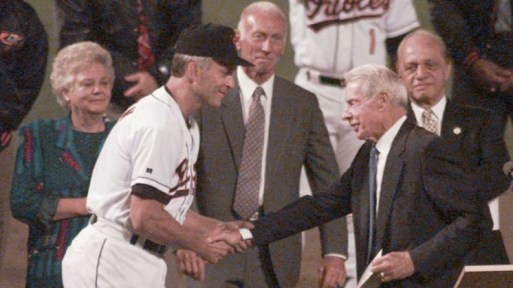
With his parents Vi and Cal, Sr. behind them, Cal Ripken, Jr. accepts congratulations from Joe DiMaggio, whose teammate’s streak Ripken had just broken 25 years ago.

After the game in which Cal Ripken, Jr. passed Lou Gehrig for consecutive major league games played, Joe DiMaggio—Gehrig’s teammate from 1936-39—spoke to the jammed Camden Yards crowd. He opened his on-field tribute by quoting Gehrig’s Yankee Stadium monument.

“A man, a gentleman, and a great ball player whose amazing record of 2,130 consecutive games should stand for all time,” the monument still reads, beneath a bronze impression of Gehrig’s face beneath his Yankee cap. DiMaggio finished quoting the sentence, then tilted his head a bit to his right.

The Clipper arched his right eyebrow, as if in slightly bemused disbelief. He pursed his lips into a half-mischievious, half-astonished look on the face age softened into a kind of regal handsomeness. As the crowd began to cheer again, he continued.

“Well, that goes to prove even the greatest records are made to be broken,” said the man whose own record 56-game hitting streak was once thought more likely to fall before Gehrig’s consecutive game streak. “And . . . wherever my former teammate Lou Gehrig is today, I’m sure he’s tipping his cap to you, Cal Ripken.”

Ripken’s father, Cal, Sr., an Oriole legend in his own right as a longtime minor league manager and teacher, stood behind DiMaggio beaming as DiMaggio turned to the son who’d just “reached the unreachable star,” as ESPN broadcaster Chris Berman said the moment 2,131 became an official game.

Ripken himself smiled in both relief and a little bit of awe as DiMaggio continued, “He’s a one in a million ballplayer, who came along to break [Gehrig’s] record, and my congratulations to you, Cal, you certainly deserve this lasting tribute.”

DiMaggio was 6’2″ in his playing days. Ripken was 6’4″ as he remains today, so far. Thanks to age, DiMaggio now stood a full head shorter as he shook hands with Ripken’s parents. He hadn’t just come forth to give a formal scripted tribute. The Clipper had watched the entire game (so had fellow Hall of Famers Frank and Brooks Robinson, the latter in the Orioles broadcast booth), including Ripken’s hefty drive halfway up the left field seats in the bottom of the fourth.

In game terms the Orioles’ 4-2 win meant almost nothing in their American League East standings, headed as they were for a third-place finish fifteen games behind the eventual East champion Boston Red Sox. The California Angels, in first place in the AL West that night, ended up finishing a game behind the champion Seattle Mariners after they couldn’t force a playoff game against Hall of Famer Randy Johnson.

But in baseball terms, of course, Ripken’s achievement meant more than the outcome of any pennant race or World Series. In the aftermath of a players’ strike that disillusioned the country, abetted no end by a sporting press two thirds of which at least bought into the owners’ insistence that the players stop them before they overspent yet again, Ripken told his country and the world it was more than okay to love the game all over again.

“My favorite piece of memorabilia of my years playing is the lithograph of him hitting that home run off me that he had signed for me the next year,” says Shawn Boskie, the Angels pitcher who surrendered that fourth-inning bomb, as part of The Athletic‘s remarkable oral history of the record night. “The biggest thing that can be said is that the electricity and the anticipation for that game, building up to that moment, is something that I would expect I’ll never see again.”

Ripken wasn’t always understood so well until he finally did pass Gehrig. For months he’d had to put up with notions from intelligentsia and fans alike that he was putting himself ahead of his team. The consummate team player, who’d been raised to believe that being an everyday player meant just that so long as you could play, must have bristled under that unwarranted lash.

He turned 35 shortly before he consummated the streak. He wasn’t having a classic Ripken year in a season shortened to 144 games by the hangover of the strike. To this day, he doesn’t buy the selfishness argument.

“I always thought my job was (as) a player. My job was to come to the ballpark ready to play, and the streak was not created because I dictated I was going to play,” he said for The Athletic‘s oral history.

It was created because I brought value to each and every day. The manager chose me . . . It was more about being there for the team and you could even make the case that it was a little bit more unselfish than selfish. But I endured the criticism. People enjoyed taking that position when it happened. And I always thought your best protection against that was to get out of your slump. As soon as you got out of your slump, all of that stuff went away.

Ken Rosenthal, today an Athletic writer and Fox Sports broadcaster but then covering the Orioles for the Baltimore Sun, understands well. “Whether it was a worthwhile endeavor or not, whether he could have had an even better career,” he said for the oral history, “we can debate that until we’re blue in the face.”

His point always was, ‘Hey, if my manager feels that I’m the best guy to be out there, well, that’s it.’ It wasn’t always that simple, of course, because managers felt afraid, I think, to (not start him). But I remember (former Orioles manager) Johnny Oates always saying, ‘Hey man, two outs in the ninth, that’s where I want the ball hit.’ And even when he wasn’t hitting, that was always the case. It was just a remarkable accomplishment. … It was a testament to his toughness, his mental strength, all of the physical attributes, everything. Just to do it was unreal.

Ripken would finish his career with 431 home runs, hitting 353 of them as a regular shortstop—ahead of Alex Rodriguez (345 as a regular shortstop) and fellow Hall of Famer Ernie Banks (298 as a regular shortstop). Remember: he was the prototype of the big man who could play a field position formerly governed by not-so-big men with spaghetti bats. Eight men have finished careers with 3,000+ hits and 400+ home runs; Ripken’s the only mostly middle infielder in the pack.

Baseball Reference defines fielding runs as the number of runs saved above the league average based on how many plays you make. Ripken’s 181 lifetime are behind only two shortstops, ever: his Oriole predecessor Mark Belanger* (238) and his fellow Hall of Famer Ozzie Smith (239). Belanger’s Oriole predecessor, Hall of Famer Luis Aparicio (who did most of his best work for the White Sox previously), is 27 behind Ripken.

For those willing to set aside Alex Rodriguez’s baggage, know that A-Rod isn’t even among the top 24 shortstops for fielding runs. He’s barely among the top one hundred. (His career total: +18.) We now know that those Seattle seasons during which he was hyped as possibly the greatest all-around shortstop of all time in the making was just that, hype.

Without the complete defensive numbers for Hall of Famer Honus Wagner (fielding runs weren’t even considered in his time, and Wagner’s only eleventh all-time in range factor, 23rd in career assists, and 79th in double plays turned, if that helps), we may or may not be able to say Ripken is the greatest all-around shortstop who ever played the game in any era. But it’s very safe to say he’s the absolute best all-around shortstop of the post-World War II/post-integration/night-ball era. No questions asked.

Would Ripken have done even better, after his throwing arm finally began resigning after all those years and games, had he been moved to second base instead of third for his final five and a half seasons? Would he have been healthy enough to hit 500+ if he had taken time off when injured? We’ll never know. We don’t have to know, either.

Once upon a time, reviewing DiMaggio’s war-interrupted career, Bill James suggested that times come when we shouldn’t measure a player “by what he could have done, by what he should have done, by what he would have done, but what he did done.” Ripken did done an awful lot more than just put on a two-decade show of physical and mental endurance.

He earned the right to be measured by far more than just what proved to be 2,632 consecutive games played before he finally took himself out of the lineup. He shakes out on the evidence as the number three shortstop ever to play the game. (A-Rod and the Flying Dutchman are ahead of him only because of their bats; Ripken has more defensive wins above replacement-level than a) the pair of them and b) any shortstop other than Belanger and Smith.) He didn’t get there only by showing up to work every day.

Twenty-five years later, Ripken doesn’t have to apologise to anyone or justify himself for hanging in tough and proud enough to break Lou Gehrig’s streak. He did it in honest competition; he came out of far fewer games than Gehrig actually did. It wasn’t Gehrig’s fault that an insidious disease ended his streak and career at once; it wasn’t a black mark against Ripken that his health allowed the Iron Bird to pass the Iron Horse.

Joe DiMaggio was right—Gehrig probably did tip his cap from the Elysian Fields to Ripken that night. Today, from those same Elysian Fields, Gehrig and DiMaggio will both tip their caps. So will every Oriole in uniform at Camden Yards this afternoon—when the Orioles play the Yankees.

The only shame in either the streak itself or its silver anniversary is that the coronavirus world tour continues keeps fans out of the ballparks. The idea of canned noise of a standing ovation celebrating Ripken this afternoon somehow seems as fraudulent as Ripken’s achievement wasn’t.


* So why isn’t Mark Belanger—clearly Ozzie Smith’s near-equal as a defensive shortstop—in the Hall of Fame, despite the Hall more recently taking defense, preventing runs, far more seriously than it had during his era? Three reasons, I suspect:

1) He couldn’t hit even compared to Ozzie Smith, who laboured to improve as a hitter as his career went on. 

2) His Hall of Fame teammate, Brooks Robinson, was overwhelming at third base and charismatic in the bargain, that even the World Series audiences who watched them play together gravitated toward the accessible Robinson first and, perhaps, took Belanger for granted, even if Oriole fans didn’t.

3) Belanger was such a terrible hitter that not even eight Gold Gloves at shortstop prevented the Orioles from trying to trade up during his career, looking for shortstops who could hit . . . but finding none who could field the position as well as he did.

Silver anniversary of a platinum night

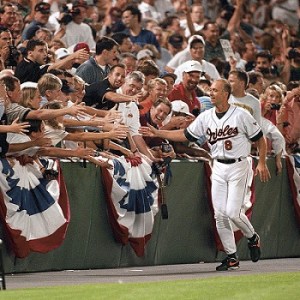
Cal Ripken, Jr.  takes his victory lap after his 2,131st consecutive game became official.

Just how old are we getting? One Sunday, Tom Seaver, the arguable greatest pitcher of his generation, loses a cruel battle against Lewy body dementia with a little help from the coronavirus. The following Sunday, tomorrow, baseball in general and Baltimore in particular celebrate the silver anniversary of the record everyone thought couldn’t be broken.

Until it was.

If you don’t count his sort-of cup-of-coffee 1981, Cal Ripken, Jr. and Seaver played the same number of major league seasons. (Twenty.) Ripken’s place in baseball lore would have been secured even without besting Lou Gehrig’s consecutive games played by 502, thanks to being the guy who proved tall, powerful men could play an infield position once thought the domain of bantamweights while hitting ike heavyweights.

Do you remember consecutive game 2,131 in Camden Yards? Baltimore won’t forget, but a lot of people with no skin in the Orioles’ game might need a refresher.

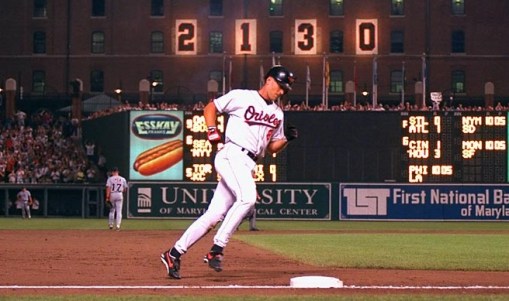
Ripken played consecutive game 2,129 and hit one out. He equaled Gehrig the next night . . . and hit one out. On the night he passed the Iron Horse, the Iron Bird turned on a 3-0 pitch from California Angels righthander Shawn Boskie in the bottom of the fourth—and sent it halfway up the left field seats.

“I gave him a great gift,” said Boskie after the game, with no malice aforethought. “I gave him the best gift he could get. It was three balls and no strikes. I felt like I had no outs. I didn’t want to walk a guy and get things started that way. At the same time, I felt like he might be swinging, but I felt like, Hey, I’ve got to take a chance of him popping it up or hitting a grounder. But he didn’t, so . . . Cal Ripken Day.”

The Orioles beat the Angels in that money game, 4-2. The sellout audience of 46,272 went at least as nuts at that blast as they’d go when the game became official at around 9:20 p.m. Eastern time. When Chris Berman, calling the game for ESPN, declared, “Cal Ripken, Jr. has reached the unreachable star.”

That was before then: We thought someone had a better shot at breaking Joe DiMaggio’s 56-game hitting streak than Lou Gehrig’s consecutive games. This has been since then: We think someone will have a better shot at DiMaggio’s streak than Ripken’s 2,632 consecutive games.

It took them over 22 minutes to calm down to mere cheering and applause after that point. The Camden audience included two Hall of Famers, one of whom was Ripken’s manager for a spell (Frank Robinson) and the other of whom just so happened to have had Gehrig himself as a living, breathing teammate. (DiMaggio.)

They celebrated the elite middle infielder who’d retire as the only one among the game’s eight greatest shortstops ever to nail three thousand hits or more and four hundred home runs or more. (Alex Rodriguez, love him or loathe him, moved to third base when he joined the Yankees and fell short of the milestones as a shortstop.)

The elite shortstop who never acted like anything more than the ordinary working stiff, from the dock or the line or the shop or the store to the boardroom and the penthouse and the Lear jet, showing up to work every day, few if any questions asked, never thinking of delivering less than the best of whatever he had.

Unknown, uncountable millions of such working stiffs showed up to work every day for eons before Ripken and continue doing so. How many of them don’t just show up but excel and even transcend their jobs?

“People who don’t know baseball as big leaguers experience it,” wrote George F. Will, “say: How lucky for Ripken that he was never hurt. Actually, he has been hurt every year, but not hurt enough to justify, in his mind, taking a day off. What defines Ripken is his defintion of ‘enough’.”

How many of them did it regardless of such interruptions as the 1994-95 strike for which the players took an unwarranted public relations beating thanks to a two-thirds-cowed press buying all the way into the owners’ insistence that the players stop them before they overspent, mis-spent, or mal-spent yet again?

No single player decided his brethren should spend the final third of 1994 and a sliver of 1995 on the picket instead of the field. Fools who think Ripken’s streak should be asterisked because of the strike ought to be asterisked themselves.

When White Sox owner Jerry Reinsdorf—the owner who pushed the hardest to force the strike—celebrated its end by insisting he wouldn’t leave Albert Belle’s domain until Belle kindly signed a three-year contract paying him three million a year more than the previous highest single-season player salary, he exposed himself and every other owner who pushed hardest to force that strike as hypocrites.

Ripken running out the home run he hit an inning before 2,131 became official.

The Camden crowd almost couldn’t have cared less about such not-so-fine details on the Big Night. But they celebrated an awful lot more than just their own baseball icon passing the record of a past baseball icon.

Shirley Povich, the arguable dean of deans among Washington baseball writers for what seemed a couple of centuries, a man who covered Walter Johnson saving the Washington Senators’ only World Series triumph and the Iron Bird leaving the Iron Horse behind, nailed it best:

By acclamation, Ripken has won approval as a hero and role model. In Gehrig’s day there were heroes, like himself and Babe Ruth, but folks didn’t talk of role models and, anyway, they would have been hard to find. So many, like Ruth, were flawed, so many like Gehrig were nice guys but absorbed mostly in baseball with little time for the community.

For all his fame, Cal Ripken is homespun. On the morning of the day he would go for the record he said it was important, too, that he take his daughter Rachel, 5, to her first day in school. When the cheers in Camden Yards were at their loudest—”We want Cal!”—he asked for his mom and dad to come onto the field to share them. When he got those eight curtain calls and he took that victory lap around the park, he tried to shake every hand offered him. He was being more than cheered. This was adoration.

Indeed, as Thomas Boswell recorded, Ripken wore a unique T-shirt beneath his Oriole uniform on the record night. It said on the back, “2130-plus. Hugs and Kisses for Daddy.” The audience saw it when Ripken removed and handed his jersey and hat to his first wife and their two small children after the game became official and the thunder began. Rachel Ripken, whom Daddy drove to school that morning, couldn’t resist crowing, “See, Daddy’s wearing my shirt!”

It happened after Ripken lined out to end the bottom of the fifth, after the game became official in the books. He donned a fresh jersey post-haste. Rarely a man of show, Ripken took about thirty curtain calls. Then he let teammates push him into taking that long victory lap around the park. Fans shook his hand. Umpires embraced him. Every Angel within reach who didn’t shake his hand bear-hugged him instead. Among the small sea of banners in the park read one particularly telling one:

We consider ourselves the luckiest fans on the face of the earth. Thanks Cal.

“My dad taught that ‘being an everyday player’ is literally every day,” Ripken told Boswell after he passed Gehrig. “My rookie year reinforced it. We tied the Brewers after 161 games. But we lost the last game of the season.”

Ripken’s devotion to his father’s devotion sometimes created issues. When the Orioles canned Cal, Sr. as their manager early in that notorious season-opening 21-game losing streak, Ripken was sorely tempted to leave the only organisation he’d known from his childhood to his major league playing career. He didn’t leave. His father probably wouldn’t have let him even think about it, but Ripken’s loyalty to the Orioles was the only thing equal to that for his family.

He led the Orioles in developing a gallows humour as that sad streak proceeded forward and successor manager (and fellow Hall of Famer) Frank Robinson did what he could with whatever he did or didn’t have. When a brand-new reporter covering the Orioles arrived in the clubhouse for the first time, Ripken beckoned him over. “Join the hostages,” the shortstop deadpanned.

“Ripken runs the risk,” Will observed, “of being remembered more for his work ethic than for the quality of his work.” Well. Ripken won two Most Valuable Player awards and both came in seasons described modestly as earth-shaking. His first MVP came in a season he helped the Orioles win their last-known World Series rings. His second, eight years apart (not quite enough to pass Hall of Famer Willie Mays for the greatest spread between MVPs), shows him earning the highest wins above replacement level (11.5) that year for any infielder, corner or middle, since . . . Gehrig (11.8) in 1927.

Only five position players in the post-integration era have two or more 10-WAR seasons, in fact. Cal Ripken, shake hands with Carl Yastrzemski (two), Barry Bonds (three), Mickey Mantle (three), and Mays (six). Ripken also became the first position player to beat Ty Cobb in percentage of Hall of Fame votes (98.5 percent to Cobb’s 98.2). Tom Seaver was the first any player to beat Cobb (98.8 percent), and his vote record stood until Ken Griffey, Jr.’s 99.3 percent.

Ripken led his league’s shortstops in assists seven times (he’s number eight all-time), putouts six, and double plays eight. (He’s number three all-time there.) Would you like to know the shortstop who’s hit the most home runs in major league history as a shortstop? It isn’t A-Rod. (345 as a regular shortstop.) It isn’t Ernie Banks. (298 as a regular shortstop.) The fellow who took that victory lap passing Gehrig for workplace attendance hit 353 of his lifetime 431 home runs as a regular shortstop.

Tomorrow, Ripken’s Hall of Fame credentials won’t bat as high in the order as the magnitude of what he achieved a quarter century earlier. If you think Baltimore won’t forget, you should listen to Ripken himself. YouTube’s made the game available to a fare-thee-well, but the Iron Bird himself couldn’t bear to watch it again until last month, says the Baltimore Sun.

“For the longest time,” he told Sun writer Mike Klingaman, “I wanted to preserve the memories I had with my own eyes. I was afraid that if I saw the game as it was, that experience would ruin it. The night was so special that I wanted it to be my memories — and I don’t regret having done that.”

Ask him as Boswell did to name his greatest baseball moments, Ripken—a prostate cancer survivor now who works to raise awareness of preventative checkups, and whose foundation named for his father builds a hundred or more Youth Development Parks in Washington and in 26 states so far—will tell you without hesitation.

“Catching the last out of the World Series in ’83 is my biggest moment,” he says. “There’s a finality, a fulfillment that just hits you in that instant. But the lap around the park was the biggest human moment.”

It’s not that Ripken’s life has lacked for sorrow. He and his family endured his widowed mother’s kidnapping and swift enough return in 2012; his first marriage ended shy of thirty years in 2016. But his son Ryan has become a professional baseball player in the Orioles’ now-on-hold minor league system. And Rachel—the daughter who put hugs and kisses for Daddy on his record night’s T-shirt—is now the director of community service for Colorado University’s athletics department.

Two years after his divorce, Ripken married Anne Arundel County (Maryland) Circuit Court Judge Laura Kiessling. Her Honour changed her name to read the Hon. Laura S. Ripken. Her husband’s long-legendary longevity proves that, unlike some of those appearing before her bench, she won’t have to teach him how to avoid being ruled out of order or held in contempt.

So what’s in a name?

This is about to spring forth in Milwaukee . . .

The Milwaukee Brewers have unveiled the logo for their home field’s name change as of 2021. From Miller Park to American Family Field. From a brewer to an insurer. Social media shows so far that Brewers fans are rather less than amused, though not yet ready for war over it.

For one thing, as one such fan tweeted, “Miller actually cared about the logo, the team and the branding of both. American Family is only interested in their own product.

Presumably, the Brewers’ administration cares greatly about the $4 million a year American Family Insurance will pay for the next fifteen years in return for the park bearing their name. It’s buzzard feed compared even to the Brewers’ actual $1.2 billion worth, but it’s income regardless.

American Family’s apparent concession to the Brewers involves that part of the intended logo that references Miller Park’s unique retractable roof, a stylising of the five curved sections that open and close above the field like a hand-held fan, more or less. One Twitter wag suggested American Family really wanted to show the launch angles of the home runs the adjacent Chicago Cubs tend to hit all over the place in the place. (Last year, the Cubs hit twenty out in ten games there.) Serious Brewer fans suggested, plausibly enough, that they’ll never think of the place as other than Miller Park for time immemorial.

. . . from this.

They’re not necessarily wrong about that, and not just because Miller Park’s official logo marries both the brewery’s logo and two baseballs on either end in a rather handsome badging.

Some of the world’s most famous structures remain referenced by their birth names no matter how often their actual names are changed. You may or may not know the Met Life building in New York City, but New Yorkers still refer to it as the Pan Am building—never mind that Pan American World Airways went cease and desist 28 years ago.

Ask a Chicagolander about Willis Tower and he or she will rejoin, “That’s the Sears Tower to you, fool.” Willis Group Holdings of London owns the naming rights until 2024. The name might change twenty times over the century to follow and Chicago children will be taught to call it the Sears Tower.

Baseball’s ballpark names have been a goulash of sorts. Some have borne or still bear the team name: Yankee Stadium, Dodger Stadium, Nationals Park, Tiger Stadium, Colt Stadium (Houston), Braves Field (Boston). Some have borne the names of team owners: Baker Bowl (William Baker, the Philadelphia Phillies), Comiskey Park (Charles Comiskey, the Chicago White Sox), Ebbets Field (Charles Ebbets, the Brooklyn Dodgers), Griffith Stadium (Clark Griffith, the Washington Senators), Navin Field (Frank Navin, the Detroit Tigers) . . .

Oops. Some parks have born the name of more than one owner. Wrigley Field (William, then Philip K.) was born as Weeghman Field. (Charles, who bought the Cubs after the Federal League collapsed. Wasn’t it kind of the Tribune Company to leave the name intact after buying the Cubs from the Wrigleys in the first place?) It remains the only baseball park known to wear the name of a chewing gum maker.

Navin Field eventually became Briggs Stadium during the Tigers’ ownership of Spike Briggs. Shibe Park (Ben Shibe, the Philadelphia Athletics until his death in 1922) eventually became Connie Mack Stadium (Shibe’s successor owner), though the main entrance bore both park names in due course. Sportsman’s Park (the St. Louis Cardinals) eventually became the first of three Busch stadiums. Two were named concurrently for the team’s principal owner and the brewery whose name is half theirs; the third’s such name nods kindly to history.

Busch Stadiums, Miller Park, and Coors Field (Colorado) have been the only major league stadiums named after breweries, which seems amiss considering that baseball and beer have been married longer and more successfully than most human marriages today. I still remember some whisperings in the early 1960s, when I was boy just beginning to embrace baseball, that the forthcoming home of my New York Mets might be named for its principal broadcasting sponsor. Now, there was a thought.

Alas, the playpen into which the Mets moved in 1964 wasn’t named for Rheingold beer.  (My beer is Rheingold the dry beer!) It was named for the corporate attorney (William A. Shea) who had a major hand in stirring the late 1950s pot (the proposed Continental League) that eventually brewed the National League’s return to New York. Who said we could have everything? (Or, why didn’t they name it for Branch Rickey, once the Dodgers’ chieftain, whose brainchild the Continental League actually was?)

Two ballparks, one of which has some nerve thinking of itself as a park, are named for orange juice: Tropicana Field (Tampa Bay) and Minute Maid Park (Houston). Three guesses which refreshment out-sells orange juice there. The most prominent sight in San Francisco’s PacBell/SBC/AT&T/Oracle Park, other than the Giants playing baseball, is a large, stylised soda pop bottle behind the left field bleachers, making you wonder why—when it came to the place’s naming rights—Coke wasn’t it.

When Shea Stadium’s life was to expire at last, the Mets’ new home—designed deliberately with references to the Brooklyn Dodgers whom ancient, autocratic city and state planning czar Robert Moses tried to strong-arm into what became Shea (If we play in Queens, we won’t be the Brooklyn Dodgers anymore—Walter O’Malley)—stirred hope (mine, mostly) that they might name the place for someone prominent in Mets history. (Stengel Field? Seaver Park?) Hope sprang infernal when the Mets sold the naming rights to a bank.

That wasn’t exactly going against the grain incumbent or to be, as fans who’ve spent time in such financially-named parks as Bank One Ballpark (Arizona, now known as Chase Field), Comerica Park (Detroit), SunTrust/Truist Park (Atlanta), PNC Park (Pittsburgh) or Guaranteed Rate Field—oops! Real Chicagolanders will never cease to call the place Comiskey Park.

At least one major league ballpark bore a name having nothing to do with baseball and everything to do with capturing Fort Duquesne from the French in 1758. Pittsburgh Pirates owner Barney Dreyfuss named Forbes Field in honour of the colonial general who led the capture. When Dreyfuss died, his family resisted entreaties to re-name the Old Lady of Schenley Park (one of the joint’s colloquial nicknames) in his honour.

Enough major league ballparks have had boring utilitarian names, though depending upon their locations and conditions they’ve been handed delightful colloquial nicknames: the Mistake on the Lake (Municipal Stadium, Cleveland), the Old Gray Lady of 33rd Street (Memorial Stadium, Baltimore).

Speaking of old ladies, once upon a time, Tiger Stadium bore the colloquial nickname “the Old Girl.” It caused havoc enough in the Florida household of ancient Tigers pitcher Elden Auker, who’d attended the park’s closing ceremonies. Auker’s local newspaper, the Vero Beach Press Journal, headlined that attendance: “Auker Says Good-bye to Old Girl.” As he wrote in his memoir (Sleeper Cars and Flannel Uniforms), it created a ticklish situation for the wife he loved for sixty-seven years until his death:

The headline . . . jumped off the page . . . and grabbed the attention of our housekeeper. She waited until I left the room and sidled up to Mildred with an expression made up of part sympathy and part admiration of Mildred’s strength. She wanted Mildred to know she had a friend in her time of need.

“Who was she?” Darlene whispered, and then braced herself for an explanation of the apparent scandal. Darlene thought the “old girl” in the headline was some old flame of mine.

Auker may have been more than a little wistful about Tiger Stadium’s demise, but he drew the line between wistful and unrealistic. “Who am I to complain about progress?” he wrote in the memoir. “After all, I’m on my fourth pacemaker.”

In Baltimore, of course, the Old Gray Lady of 33rd Street was succeeded delightfully by Oriole Park at Camden Yards, officially. Unofficially, of course, it’s Camden Yards. Nobody’s even thought of selling naming rights afresh there yet, so far as I know. Better stop there. We don’t want to give them any more bright ideas.

If you think re-naming a ballpark for an insurance company is a little off balance, consider: The longtime home of the New York Giants was the third structure on that site to be known as the Polo Grounds. Many things happened at those Polo Grounds, shaped in fact like a horseshoe, up to and including the two maiden absurdist seasons of the Mets. Polo wasn’t one of them.