The Maddoning crowd

2019-10-16 JoeMaddonAngels.jpg

Shown here during his years as Mike Scioscia’s consigliere, Joe Maddon returns to the Angels as their new manager—right in the middle of a further storm over Tyler Skaggs’s death.

Rarely have warnings about being careful what you wish for proven this prescient. If Joe Maddon really wished to return to the Angels he served three decades plus, and as their manager, yet, he couldn’t have picked a worse time to get his wish.

Amidst the thrills of the two League Championship Series a bomb exploded a couple of days ago. There was more to Angel pitcher Tyler Skaggs’s shocking death in Texas before the All-Star break than just an accidental overdose. Too much more.

Now Maddon will take the Angels’ bridge. It may have been a done deal from the moment the Angels pinked first year manager Brad Ausmus, which just so happened to be almost the precise moment in which Maddon learned he wouldn’t be returning as the Cubs’ manager once his contract expired at season’s end.

And if it was bad enough the Angels just had a second straight losing season and a third in four, despite having the best all-around baseball player on the planet, even that was nothing compared to the firestorm now erupting around Skaggs’s death.

“When stuff comes out, you want to know if it’s true,” said Mike Trout when autopsy results made public in early September showed how Skaggs died. “Obviously, if I knew I would definitely have said something or did something.”

Nobody has any reason to disbelieve Trout. But he may not like what transpires further. Especially after signing the gigabucks contract extension making him an Angel for life before spring training ended.

This is what we know so far: Skaggs, the likeable pitcher who was a clubhouse and fan favourite, was an opioid addict. For just how long seems unknown just yet. Also unknown for dead last certain at this writing is what manner of pain led Skaggs to the stuff in the first place. His family hired a Texas legal wolf to get to the bottom of it all. The digging is getting very disturbing.

What we also know so far is that the Angels’ communications director, Eric Kay, himself an opioid addict, knew about Skaggs’s issue with the drugs, procured them for the pitcher, and often used them with him. Kay has also told agents with the federal Drug Enforcement Administration that five more Angels, so far unnamed, use opioids and that there were other team officials aware of Skaggs’s issue with them.

The Angels deny such knowledge. And Kay issued a statement this past weekend concurrent to his denial that he provided the actual pills that provoked Skaggs to overdose accidentally and asphyxiate in his sleep in a Texas hotel room in early July:

I felt and continue to feel that it is time for everyone to stand up and take responsibility for their respective roles in this. Nothing anyone does will ever provide closure for the Skaggs family. I can’t, the Angels can’t, and the courts can’t, regardless of what happens there. But at least I can help them “know”‘ instead of “wonder.” My hope is that there is some peace in that for them.

But four Angels past and incumbent—pitchers Trevor Cahill, Matt Harvey, Andrew Heaney, and Noe Ramirez—have been interviewed and questioned by federal agents. NBC Sports says those four aren’t suspects, just witnesses. So far.

And ESPN’s T.J. Quinn says the Angels may face heavy sanctions from baseball’s government if it’s proven any team officials knew about Skaggs’s problem but didn’t speak up to the commissioner’s office about him using substances banned by baseball. The sanctions could include up to a $2 million fine against the Angels and the officials in question banned from baseball for life if proven.

An Angel spokeswoman, Marie Garvey, issued a statement on Tuesday in which she said the team had no knowledge that Kay provided Skaggs opioids:

We have never heard that any employee was providing illegal narcotics to any player, or that any player was seeking narcotics from him. The current and former employees that are being accused of knowing this behavior have categorically denied that assertion. The Angels maintain a strict, zero tolerance policy regarding the illicit use of drugs for both players and staff. Every one of our players must also abide by the MLB joint drug agreement.

There could be a reason why any Angels officials who did know about Skaggs’s problem, if they did know, were loath to speak up and out. A few years ago, then-Angels outfielder Josh Hamilton—a recovering substance abuser whose Angels seasons were throttled by injuries—had a relapse while watching a Super Bowl. Hamilton didn’t flinch. He reported it to the team and to baseball’s government immediately. That’d teach him.

It wasn’t enough then for Angels owner Arte Moreno. Never mind that Hamilton could have tried to run and hide but didn’t. For his forthrightness Hamilton was run out of town on the proverbial rail, right back to the Rangers from whence he’d come, with Moreno paying Hamilton’s entire salary just to be rid of him.

Adding insult to injury: Hamilton’s forthrightness didn’t impress then-manager Mike Scioscia one degree, Scioscia all but demanding that Hamilton owed the Angels a public apology, if not a perp walk. All Hamilton did was his absolute duty under baseball’s drug agreement when he relapsed. And his reward for doing his duty and shooting straight was orders to be out of town before sundown.

If you think that didn’t scare the living you-know-what out of anyone else working for the Angels, I have a fully-operating California bullet train to sell you for a song. Maybe a short medley. The scared may have included Kay and his boss/mentor Tim Mead, now running the Hall of Fame, but then the Angels’ vice president for communications.

We know that Kay’s mother, Sandra, claims her son told Mead about Skaggs’s opioid issues a few years prior to Skaggs’s death. We know Mead once visited Kay in the hospital with Kay’s mother present, and that Kay checked into a rehab program this past July. (Coincidence? Convenience?) We know Sandra Kay claims to have talked to Mead about Skaggs’s drug issue and that Mead denies the conversation.

“Keep in mind,” says Jessica DeLine, a writer for the SB Nation blog Halos Heaven, “opioid abuse often begins after surgeries, when the drug may be prescribed to the patient. Per the Mayo Clinic, opioids are highly addictive and your risk of addiction is increased after taking the drug for just a few days.”

Skaggs underwent Tommy John surgery in 2014, during his first Angels season after two with the Diamondbacks, and missed the entire 2015 season recuperating and rehabbing from it. It’s entirely possible that things happened for him just as the Mayo Clinic describes: he may have been prescribed one or another opioid (oxycodone and fetanyl were found in his system after his death) after the surgery and he got hooked.

In 2017, Skaggs spent 98 days on the disabled list with a strained oblique; in 2018, he spent three months on the DL with hip adductor muscle issues. If he wasn’t prescribed any opiate after his Tommy John surgery, who’s to say the pain of those injuries instead didn’t lead him to opiates’ doors?

“Someone is lying here,” DeLine writes, “and it’s either Tim Mead . . . or Sandy Kay. What would be the reasons either of them would lie? Sandy’s benefit would perhaps be to shift blame away from her son and onto the Angels. Mead’s reasons should be rather obvious.”

Skaggs’s death shocked baseball. The Angels were thoroughly waylaid by it. They went public with their grief. The Rangers in Texas allowed them to postpone the opening game of their pre-break series out of respect and even laid Skaggs’s number 45 on the back of their home mound, in the Angels’ uniform font style, out of further respect.

The Angels took two of three from the Rangers, lost two of three to the Astros, then returned home after the break to host the Mariners. What they did to open that series shocked baseball even further.

Wearing Skaggs jerseys and numbers one and all in tribute, pitchers Taylor Cole and Felix Pena combined to pitch a no-hit, 13-0 blowout against the Mariners in which Trout himself, emergent as a team leader over his friend’s death, opened the carnage with a two-run homer in the bottom of the first. When the game ended, the players left their jerseys on the mound surrounding Skaggs’s number 45 as a final tribute.

The news of opioids in Skaggs’s system the night he died came forth not long after that game. Now the possibility of the Angels administration sleeping at the switch while their pitcher battled such an addiction, and one of their P.R. people looks to have abetted him, stains their familiar logo halo.

That’s what Maddon is walking into right off the bat after signing a reported three-year contract to manage the team for whom he served as Scioscia’s longtime (and 2002 World Series-winning) consigliere on the bench before starting his own mostly successful managing career.

And Maddon has his own unfortunate small history of being caught with his pants down over comparable troubles. He looked almost entirely clueless in his responses when Cubs shortstop Addison Russell was exposed as a domestic abuser by Russell’s former wife last fall. Nobody with brains suggests Maddon condones domestic violence, but his tepid response at first, upon Russell’s exposure, was a terrible look for the man who shepherded the Cubs to their first World Series win (2016) in over a century.

Now Maddon has to think about more than just bringing a club together under a new bridge commander and thinking about percentages and execution on the field. He has to think about the potentials around disturbing revelations that may or may not prove to have been true involving the death of a popular pitcher and its continuing effects on his new players.

He may even have to think about the ramifications if it should turn out that any Angel players, other than the four current or former pitchers interviewed by federal agents, knew Skaggs had a serious addiction problem and did or said nothing to intercede before it was too late. Especially if the Manfred administration comes to appear more interested in making players do a Pittsburgh drug trials-like perp walk than in making real moves to solve a too-real, too-dangerous issue.

And those will still be nothing compared to the additional anger and grief Skaggs’s widow and family will suffer.
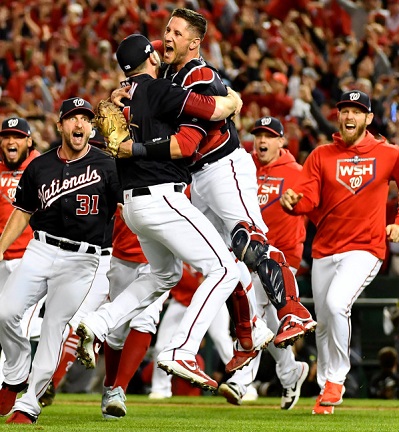

Washington—First in war, first in peace, and first in the National League

2019-10-16 WashingtonNationals

Max (the Knife) Scherzer (31) and Stephen Strasburg (far right) join up as the party starts with finishing reliever Daniel Hudson leaping in the arms of catcher Yan Gomes Tuesday night.

Let’s face it. Three pitching-dominant games are all well and good, for the Nationals and for anyone. But there’s nothing like a little hair-raising to make even a National League Championship Series sweep feel like an honest-to-God battle.

Even die-hard Nationals fans must have suspected it might take some doing, after all, to make it “Washington—First in war, first in peace, and first in the National League.” But make it the Nats did Tuesday night. And make it easy for them the otherwise overmatched Cardinals didn’t.

And somehow the Nats lived long enough to win 7-4 and sweep the Cardinals who never had even a single half-inning lead in the entire NLCS.

This time, there was no Book-damaged manager to hook a boy wonder an out away from a division series shutout and watch his team implode while leaving his best arm in the bullpen. This time, there was no stretch drive collapse. This time, there was no pair of catching errors (interference and throwing) to push the plunger deeper on a fifth-inning implosion. This time even their injuries couldn’t stop them.

This time, the Nats said nuts to all that.

After demolishing the Dodgers in a fifth division series game to get here in the first place, the Nats won the pennant in a sweep that felt more like they used vacuum cleaners instead of brooms. And had Nationals Park going nuts all Game Four long.

“I can truly say this is the best time of my career,” said series MVP Howie Kendrick, who’d been up and down with the Angels, the Dodgers, briefly with the Phillies, and then endured even a career-threatening Achilles tendon rupture as a Nat in 2018 before returning to hoist the best on-base percentage of his major league life as a role player this year.

“(I)t means a lot to be around those guys. I learn so much from them, and I love these guys just as much as they love me, and I know that 100%,” said Kendrick, who went 5-for-15 in the set and hit three doubles with three runs driven in in Game Three. “I think that’s the big reason why we have success, because we truly care about the next guy.”

Enough to land Washington’s first major league pennant since year one of the New Deal. Its first league championship of any kind since the Homestead Grays won the Negro National League pennant in 1948. Making this the second time a single-team city landed pennants in each league with separate teams.

Milwaukee can brag about two National League pennants and a World Series title with the Braves and one Brewers American League pennant. Washington has three Senators pennants and a World Series title in the American League and, now, one Nationals pennant in the National League.

And in the end it didn’t come quite as easily as reading of the four-game sweep on paper will make it look. “We still got work in front of us,” said Max Scherzer after the game, before diving back into the on-field party. The Nats re-learned about hard work Tuesday night without even trying. And they’d already learned about hard work starting in late May as it was.

A team that yanks itself up from a season-opening 19-31 to get to the postseason in the first place doesn’t reach the World Series without beyond-maximum effort in the end. And survival instincts. And baby sharking a la veteran pickup Gerardo Parra, who introduced it in honour of his little daughter who loves Baby Shark.” And Natitude enough.

“We knew where we were at one point, but we knew where we wanted to go,” said third baseman Anthony Rendon, who faces his first free agency after the postseason is finally over. “The season wasn’t over and back then we were upset, but it was still the first half of the season. You don’t win the division or the World Series in the first half of the season.”

Slice and dice Cardinals starter Dakota Hudson with a little help from momentarily caught-frozen Cardinal fielders? Yank another pair off Adam Wainwright coming in to rescue the poor guy but leave the Cardinals in a 7-0 hole after just one full inning? All well and good. The Cardinals escaped three runs shy of knowing exactly how the Braves felt in division series Game Five.

But don’t let Patrick Corbin spend most of his bullets in the first four innings, when he becomes baseball’s first to strike out double digits in four innings of any postseason games, ever. Even despite surrendering a sort-of excuse-me home run to Yadier Molina that rudely interrupted three more Cardinal strikeouts in the top of the fourth.

Because even pushed out of the boat early, these Cardinals weren’t allergic to the smell of blood in the water yet as they came to the top of the fifth.

A walk, a single, and a walk loaded Cardinals on the pond with nobody out. A ground out to second by Tommy Edman nudged a second Cardinal run home; a two-run double by Jose Martinez yanked the Cardinals back to within three. Then Corbin reached for reserves enough to nail Paul Goldschmidt and Marcell Ozuna on back-to-back swinging strikeouts to end that uprising before it got genuinely poisonous.

And that seven-run Nats first started looking safe again even with the Cardinals somehow grinding their way back to within three runs. Until it wasn’t.

Until Daniel Hudson relieving Sean Doolittle with two out in the top of the eighth plunked Molina with a man on and walked Paul DeJong to load the Cardinals on the pond. And with Matt Carpenter pinch hitting, the Cardinals were suddenly one solid swing away from changing the game entirely.

But Hudson ran it to 2-2 before luring a ground out to second out of Carpenter to dodge maybe the biggest howitzer shell of the Nats’ season to date. You can’t say the Cardinals went down like canaries. They made the Nats fight for their right to party.

Among numerous sadnesses for the Cardinals is that their bullpen went on from the first inning disaster to throw seven and two-thirds shutout relief, not without some doing, with seven strikeouts, one walk and four hits against them. This is what’s called heroism in a lost cause in some quarters. And it’ll be forgotten against the Nats’ final stand.

Who knew that after Corbin struck out the side swinging to open Game Four that Rendon’s sacrifice fly with nobody out and two on in the bottom of the first would prove the first splash of a profound flood? The Cardinals couldn’t have known, no matter what they did to the Braves. The racket in Nationals Park probably masked that the crowd knew nothing but merely hoped it wouldn’t stop there.

Juan Soto promptly shot one the other way into the left field corner to send Adam Eaton (double) home. After the Cardinals put eventual NLCS MVP Howie Kendrick aboard on the house, the Cardinals’ normally skintight defense betrayed them yet again.

The Nats’ grand old man, Ryan Zimmerman, slashed one up the third base line that Cardinals third baseman Edman stopped with a racing dive, scrambling up to throw to second. And the throw ricocheted off the glove heel of Kolten Wong, the Cardinals’ Gold Glove-caliber second baseman, unusually and unfortunately.

Leaving the bases loaded for Victor Robles in his second game back from a hamstring tweak. He hit a tall opposite field pop fly to shallow right, not far from the line. Wong from second and Goldschmidt from first ran toward the ball. Right fielder Martinez ran in toward the ball. With the three converging it appeared Martinez snapped his glove a time or two indicating he’d have it.

Martinez held up as if thinking Wong would have the play. Except that Wong made one move suggesting he’d back off. The ball hit the grass off Martinez’s left. It might as well have been a bomb drop. And Soto hit the plate with the third Nats run and the sharks still on the docks. Goldschmidt looked like a robbery victim. Martinez looked skyward as if praying.

But Nats catcher Yan Gomes shot one just past a diving Cardinal shortstop Paul DeJong and Kendrick and Zimmerman scored runs three and four. Cardinal manager Mike Schildt pulled his starter for Wainwright, his veteran approaching the end, who’d been magnificent for him all postseason long so far.

After Corbin dropped the kind of sacrifice bunt that some people still think is sacrilege today, Wainwright ran right into Trea Turner, the Nats shortstop who’d started the merry-go-round with a leadoff single. And Turner continued obeying the Nats’ order of the first inning: jump on the first pitch if it looks meaty enough but swing on the second if you must.

Wainwright hung him a curve ball to open. Turner jumped on it, hitting a high liner to left for which Ozuna inexplicably slowed before playing it on the hop when he was a mere step and a half from a catch. Two more Nats runs. The last two Nats runs of the game as things turned out. The last two they’d need the rest of the night.

This is how pumped the Nats were in the first. Only two Nats—Turner leading off—saw third pitches in their plate appearances that inning. Turner smacked a 2-0 sinker without a lot of sink into right field to open; Robles’ bomb drop in almost the middle of Martinez, Goldschmidt, and Wong was a fifth-pitch loft on 1-2 off a sinker hitting the low inside corner. Eaton’s inning-ending line out was a third-pitch curve ball. His one on/no out double, Rendon’s sacrifice fly, Gomes’s two-run single, and Turner’s eventual two-run single, all came on the first pitch of the turns.

And just like the Cardinals against the Braves, the Nats did it without even one ball flying over the fence. Maybe the baseball that was a little hopped up during the regular season did get just a little deadened down this postseason. Maybe. The Nats bombed their way into the NLCS in the first place and surely didn’t mind settling for pistols, machine guns, bazookas, and mere cannons to win Game Four.

Even if they didn’t suspect the Cardinals would put up four in the fourth and fifth. Even if they didn’t suspect three out of their now four-man flying bullpen—rookie Tanner Rainey and veterans Doolittle and Hudson—would have to perform feats of derring-do without nets over the final couple of innings. Derring-do, hell. Hudson had to plug the leak before the Hindenburg exploded in the top of the eighth. Then he got the three NLCS-ending air outs almost in a blink. Almost.

Once upon a time, just a couple of months ago, calls to the Nats bullpen caused Nats fans to reach for the nitroglycerin pills if not call for the crash carts. Now the only thing missing Tuesday night was Rodney not getting a chance to shoot another invisible arrow up, out, and maybe clear through the Capitol Dome.

Wait until the Nats get to tangle with either the Yankees or the Astros in the Serious. They may have to stop that nasty iceberg from hitting the Titanic. And they just might be able to do it. Only one team in baseball scored more runs over the regular season’s final 123 games than the Nats: the Yankees. And if the Astros can hoist Verlander, Cole, and Greinke, with Greinke not exactly a sure thing lately, the Nats can hoist Scherzer, Stephen Strasburg, and Corbin. Plus Anibal Sanchez and his high enough-flying junkyard.

But World Series against either of those teams won’t be the walk in the park (Nationals or otherwise) they took against the Cardinals, and they did get close enough to being mugged near the end. Neither the Yankees nor the Astros are liable to let even the Nats’ stellar pitching do to them what they did so amazingly to the Cardinals, whom the Nats’ arms struck out 48 times in 123 at-bats.

The Cardinals hit .130 as a team with a team .195 on-base percentage; Goldschmidt, who shook off early season struggles to hit 37 home runs, had one hit in the NLCS while striking out nine times. Their best hitter turned out to be Martinez (.500/.500/.700 NLCS slash line) in a mostly part-time role; he went 3-for-8 as a starter in Games Three and Four.

“There’s not one thing you can point to,” said Goldschmidt, before doing just that in his own case. ”I didn’t play well enough to help us win. One hit in four games, that’s not going to cut it when you’re hitting third. It just came back to bite us.” So does being out-scored 20-6 in a four-game set. Oh, that shark bites.

The Nats’ pitching and depth made the difference. The Cardinals didn’t stand a chance against a pitching staff working to a 1.25 ERA and a 0.64 walks/hits per inning pitched rate in the NLCS, while theirs posted a 4.50 ERA/1.41 WHIP. Against Scherzer (eleven strikeouts in Game Two), Strasburg (twelve in Game Three) and Corbin (twelve in Game Four), the Cardinals looked like the victims of three Bob Gibsons.

These Nats aren’t exactly afraid to go the distance if they have to, either. But another kind of distance may yet be in their way: only one team that ever swept a best-of-seven League Championship Series (it was a best-of-five until 1986) went on to win the World Series, the 1995 Braves.

“You can’t simulate that type of emotion that you go through in an NLCS, nor when the World Series starts,” says Jimmy Rollins, now a TBS analyst but long the Phillies shortstop anchorage who was one key to their 2008 World Series winner after winning the NLCS in five.

“You try to use it as rest. Mentally, you’re on. You’re thinking about execution, you’re thinking about who you may face as you’re watching the games, and game planning,” Rollins continues. “You have to do something mentally. Physically, you’re body’s naturally going to shut down for a day or two, then you have to get on the field, get on a treadmill, start throwing and get it revved back up . . . usually this long of a break is the only thing that stops momentum. Hopefully that’s not the case.”

Are you kidding? These Nats aren’t exactly afraid of any worst-case scenario. They survived the worst of all starting in late May. The pitching coach was executed. The team was going to be broken up or at least partially shaved down by the new single mid-season trade deadline. Manager Dave Martinez was going to the guillotine, the lethal injection chamber, the firing squad, or the electric chair. Whichever came first.

A measly week off to keep their minds calibrated, their bodies in tune, and their hearts well enough massaged shouldn’t be that problematic. Should it? Don’t ask now. The Nats are probably still in party mode today. And considering their franchise drought plus their city not having seen a World Series since the year Franklin D. Roosevelt first threw out a first pitch from the boxes at old Griffith Stadium, you can’t blame them.

On Tuesday night, hoisting the National League championship trophy from a podium set up post-game on the infield, Martinez could afford to channel his inner Ecclesiastian. “Often bumpy roads lead to beautiful places,” he told the Nationals Park throng who refused to leave just yet. “And this is a beautiful place.”

Some Yankee fans travel first crass

2019-10-15 GerritCole

Gerrit Cole was less than his best in Game Three but he let them beat themselves. And enough Yankee fans were worse.

There are reasons why people who don’t live in New York can’t let themselves root for or at least like the Yankees. Even in a season during which the Yankees gave major lessons in survival despite attrition and, like the Astros and maybe more so, won over 100 regular season games despite almost as many Yankees in the infirmary as on the field or at the plate.

A lot of those reasons have to do with a few too many of their fans, unfortunately.

When not behaving as though the Yankees are entitled, mind you to be in the World Series every season on earth, a few too many Yankee fans behave like spoiled brats when things don’t go the Yankees’ way in a game. The look is bad enough if it happens in the regular season. In the postseason it goes from bad enough to downright disgrace.

And there are also times when they do it when one of the other guys suffers a misfortune not of his own making, too.

Edwin Encarnacion looked to have it beaten at first base when his eighth-inning slow grounder was picked by Astros third baseman Alex Bregman but thrown a little off, enough for first baseman Yuli Gurriel to have to reach and bring a sweep tag around Encarnacion’s shoulder area.

Every known video replay showed Gurriel nailed that awkward sweep tag. The Astros called for a review and the original safe call was overturned. The Yankee Stadium faithful in the right field area began throwing debris on the field, though none of it got anywhere near Astros right fielder Josh Reddick.

And they went from bad to worse in the top of the ninth, when Yankee reliever Luis Cessa, turning in a solid turn of work in a lost cause, threw a fastball that ran in on and hit Bregman. There was very audible cheering over that one, too.

That’s the way to travel first crass.

“Stuff like that doesn’t belong in baseball,” Reddick said after the Astros banked the 4-1 Game Three win that put them ahead 2-1 in the American League Championship Series Tuesday afternoon.

Reddick, whose second inning launch into the right field seats provided the second Astro run, spoke specifially about trashing the right field area but he could have been talking about the cheers when Bregman got plunked, too.

Listen up, you creatures in the Yankee Stadium right field area. You want to get indignant? I’ll give you several reasons having nothing to do with an overturned call at first base or an unintentional hit by a pitch.

How about your heroes being unable to lay a glove on Gerrit Cole on a day Cole pitched like anything but the virtuoso of earlier in the postseason? When he could have been had but it turned out to be the Yankees who were had?

How about your heroes loading the pillows on Cole with two out in the bottom of the first, after Jose Altuve hit Luis Severino’s first one-out pitch to him into the left field seats in the top of the inning, and Didi Gregorius grounding out weakly enough to second base?

How about three more first-and-second situations for the Yankees ending with a swinging strikeout (Aaron Judge), a fly out to center field (D.J. LaMahieu), and a fly out to right? (Gregorius.)

How about Adam Ottavino leading Zach Britton with first and third, the Yankees getting rid of George Springer in a rundown down the third base line leaving second and third, and then Britton puking the bed with a run-allowing wild pitch and a sacrifice fly to put the final two Astro runs on the board in the seventh?

How about the Yankees going 0-for-6 with runners on second or better and leaving nine men on base all game long?

How about having Cole vulnerable for a change with more walks than strikeouts at one point but the Yankees still unable to touch him if they’d borrowed one of Cardinal pitching coach Mike Maddux’s drivers to swing?

How about the Yankees having nothing to say to the Astro bullpen other than Gleyber Torres hitting a too-little/too-late solo shot into the right field seats in the bottom of the eighth? Oh, yes. You were still a little too busy throwing debris into right field when Torres nailed a Joe Smith sinker that didn’t quite sink enough.

About the only time you really behaved yourselves was when plate umpire Jeff Nelson had to leave the game, after all, an inning after he took a foul off his mask in the and ended up suffering a concussion, prompting Kerwin Danley to move from second base to the plate and no ump in left field the rest of the game.

All you did for yourselves otherwise, you yahoos in the right field region, was make yourselves look ridiculous while the Yankees let even a not-so-sharp Cole still make them look ridiculous. And you made the Astros, who have class to burn as it is, look that much classier while you were at it.

Listen up. I was born in the Bronx. By right I should have been a Yankee fan. But even then Yankee fan entitlement was a stomach turner, no matter how admirable a lot of Yankees happened to be. Even in those imperial years, even to a six year old kid who decided to plight his troth to an infant troupe known as the Mets, in what was left of the Polo Grounds, and who seemed more human than the larger-than-life Bombers.

I cringed during the 1973 National League Championship Series when Pete Rose and Bud Harrelson tangled after a nasty play at second base, the benches and bullpens emptied, and the Shea Stadium crowd let their worst come forward, throwing garbage on the field, until several Mets and the Shea Stadium scoreboard operator begged them to knock it off.

I watched on television when heartsick Senators fans, knowing their team was about to be absconded to Texas, couldn’t let the Second Nats finish the home season-ending win, highlighted when big Frank Howard himself hit one out midway through, and couldn’t let Joe Grzenda pitch to Yankee second baseman Horace Clarke to finish saving it for Paul Lindblad, bursting the dam rioting on the field, forcing a forfeit to the Yankees as the final act of Washington baseball for three decades plus.

I still remember Indians fans bombed out of their trees on Ten Cent Beer Night turning old Muncipal Stadium into a lunatic asylum on the field, which gave sick new meaning to the old park’s nickname as the Mistake on the Lake.

I still remember White Sox fans going from silly to surrealistically stupid practically blowing up old Comiskey Park on Disco Demolition Night. At least Second Nats fans had a legitimate reason to be heartsick on the last home date in 1971.

And yes, I know you’re not exactly the only fans on the planet who’ve turned into wild animals in the stands when things don’t go your way. (Hello, Phillies fans. Hello, Red Sox fans. Among others.) But nobody else’s fans have done that this postseason. Even those few miscreants running over Clayton Kershaw’s jerseys in the Dodger Stadium parking lot waited until after Game Five of the division series to get their spoiled brats on.

Go ahead and boo when the other guys knock your guys’ blocks off from the plate. Go ahead and boo when they pitch your guys’ ears off or just leave them looking foolish at the plate when the opportunities knock multiple times. Go ahead and boo when the close calls don’t go your guys’ ways, go ahead and boo when your number one rival turns you aside when you least expect it.

But knock it the hell off with the trash tossing and with cheering when the other guy gets hit by a pitch when your pitcher had no intention of even trying to brush him back.

Listen up one more time, you right field area creatures. You’ve got a gorgeous successor park to the old classic Yankee Stadium, and you’ve got a team that actually showed tremendous grace under unconscionable medical pressure this year. But you jerks need either a good fanning—or an animal trainer.

On the threshold of a dream

2019-10-14 StephenStrasburg

Striking out twelve in NLCS Game Three is child’s play. Getting Stephen Strasburg to crack a smile on the mound? That takes talent!

Roll over, George Stallings, and tell Yogi Berra the news. And send Phil Garner the bulletin while you’re at it. The Nationals are one win away from doing what only three teams in baseball history have ever done before. What a difference five months makes.

The 1914 Boston Braves, managed by Stallings—twelve games under .500 on 30 May; final record 24 games over .500 and into the World Series.

The 1973 Mets, managed by Yogi—twelve and a half  games under .500 on 15 August; final record three games over .500, winning the National League Championship Series and thus into the World Series.

The 2005 Astros, managed by Garner—twelve under .500 on 21 May; final record sixteen games over .500, winning the American League Championship Series and thus into the World Series.

Of the three only the Miracle Braves won their World Series; the You Gotta Believe Mets lost in seven games to the Athletics’ “Swingin’ A’s” (who swung in more ways than one), and the ’05 Astros got swept by the White Sox. (Who hadn’t won a World Series since the year before World War I ended.) It’s a shame nobody thought to stick a memorable nickname on those ‘Stros.

The Dancing Nats would like very much to become only the second major league team ever to win a World Series in the same year they were that far under .500 at one point. Even with their opponent standing to be whoever survives the Astros-Yankees skirmish in the ALCS, it’s not yet an unrealistic prospect.

That was the Nats on 24 May 2019: Twelve games under .500, the execution cocktail being mixed for their manager, and trade speculation finally if regretfully including no less than Max Scherzer himself. And you were tempted to pull out of your music library an ancient ballad by what was considered heavy metal music’s brainiest band in 1972, Blue Oyster Cult:

Then came the last days of May, I’ll be breathing dry air/
I’m leaving soon, the others are already there.
Would you be interested in coming along, instead of staying here?
They say the west is nice this time of year . . .

This is the Nats on Tuesday morning: Including the postseason, they’re 81-40 since the last days of May.

Sentimentally you want to believe a cancer-stricken ten-year-old whose lymphoma went into remission, got to spend 24 May with his Nats heroes, and throw a ceremonial first pitch changeup to Scherzer from the rubber to behind the plate got the Nats’ mojo working all over again.

Especially after Parker Staples threw out another such ceremonial first pitch before their Game Three demolition of the Cardinals Monday night. And the boy threw another changeup. Almost as wicked as the one Stephen Strasburg deployed among his other befuddling breaking balls.

But there were realistic reasons for the Nats’ self-resurrection: Trea Turner, Juan Soto, and Anthony Rendon got their health back. Soto turned the dugout into Soul Train after big home runs. Kid Gerardo Parra and old man Fernando Rodney brought some much needed more fun, fun, fun to the dugout and the clubhouse, from baby sharks to shooting pantomime arrows after shutdown innings.

Let the kids play? The Nats said let the kids of all ages play. All of a sudden, the next thing you knew was the Nats taking life and baseball one day, one game at a time, and remembering for all their game prep that Hall of Famer Willie Stargell had a point when he observed, “The umpire doesn’t say, ‘Work ball’.”

Rich or modestly well off individually, these Nats actually remembered how to play. Not just in the field, on the mound, or at the plate. This is Animal House, without the debauchery. These are the Alpha Omega Nats. You wouldn’t be shocked if they go out for laughing gas instead of dinner and drinks after games. Especially knowing that a lot of what’s happened since 24 May comes from playing each game for itself. They quit thinking the fate of the entire season rested on one game.

When even Strasburg—who usually looked so serious on the mound and in the dugout you wondered if he’d been raised in a Skinner Box—flashed big smiles after finishing a twelve-strikeout Game Three performance while his Nats made mincemeat out of Cardinals boy wonder Jack Flaherty and a few Cardinal relievers Monday night, you know things have changed in Natville.

It didn’t faze Strasburg one bit that he didn’t join the Nats’ almost-no-no parade. It almost fazed him more that his teammates wanted to smother him in a group hug after he was done. “They’re just trying to make Stras as uncomfortable as possible,” says outfielder Adam Eaton. “It’s great, and when Stras is uncomfortable, good things happen.”

When Parra tried to hug him, Strasburg replied with a few pats on the back but otherwise tried squirming away. Not a chance. “I’m not much of a hugger,” says Strasburg, who’s often seen as the most uptight Nat. “They kind of just surround me, so I just have to take it.”

He still doesn’t dare let himself enjoy a last laugh he’s earned so richly. But he should.

Remember when the world went ballistic over the Nats shutting Strasburg down in 2012, over a year after his career began with a bang that exploded into Tommy John surgery? You can’t do that when this might be his only chance at a World Series!!! the world cried angrily. You can’t tell us this kid’s future is that meaningless, the Nats shot back indignantly.

Now Strasburg’s 31. He’s gone from child prodigy to injury-compromised, from pitching student to . . . well, if not for Scherzer he’d be man of the house. Somewhere in there he became a dependable number two who comes up big enough when he’s needed enough. And he’s even learning to lighten up. There were times Monday night when you thought he’d actually crack a little smile in the split second before he delivered to the plate.

He’s also become one of the most quiet postseason horses in history; his 1.10 lifetime postseason ERA is second only to Hall of Famer Sandy Koufax among those who’ve started at least five postseason contests. And only one pitcher has ever worked a postseason game of twelve strikeouts or more without a walk: Hall of Famer Tom Seaver did that in Game One of the ’73 Series.

Some think the Nats put an end to the Cardinals’ season in the third inning Monday night. When Victor Robles—returning to the Nats lineup after being missing since Game Two of the division series with a hamstring tweak—shot a Flaherty slider, the one against which hitters on the season hit a measly buck eleven, not too hard but right past diving shortstop Paul DeJong.

When Strasburg executed what used to be a textbook sacrifice to the first base side leaving the Cardinals no possible chance of stopping Robles from taking second.

When Eaton with two outs bounced one right up the middle for the base hit that sent Robles home.

When Rendon smashed a hard foul near third base one pitch, then floated one toward the left field line for which Marcell Ozuna slid  only to have the ball bound off and out of his glove web, enabling Eaton to score and Rendon to have second. “Rendon does a good job of not punching out on what I felt was a pretty good executed pitch,” said Flaherty. “But that’s what he does. That’s why he is what he is.”

For Ozuna, who actually rated very well in left field this season as part of a very stingy Cardinals defense, that mishap was a mute horror. “Anytime you’re sliding feet first like that trying to make a play,” says Cardinals second baseman Kolten Wong, “as soon as you hit the ground, there’s going to be some kind of movement, and I think that’s what jarred the ball out of his glove.”

Then it was a walk to Soto, a wild pitch to Kendrick setting up second and third, and a line drive all the way to the right center field fence. That, Flaherty says, is the one Monday night pitch he really wants to have back.

But Flaherty can’t fix the Cardinals’ bats. The Redbirds are in danger of matching the 1966 Dodgers who could only muster two runs while the Orioles swept them out of that World Series. The Cardinals’ two came because of Nats fielding mishaps. And they’ve never had a lead in any of the NLCS games so far. Pitching coach Mike Maddux’s much-talked-about pair of holes in one on the Army-Navy Club golf course earlier Monday beat anything the Cardinals did at the plate.

Their ineffectiveness against off-speed pitching is killing them. Killing them even more is that enough of them are being thrown by power pitchers who’ve figured out or re-learned that sometimes you can win battles the sneaky way. The Nats’ NLCS walks/hits per inning pitched rate? 0.52. The Cardinals’? 1.42.

That ten-run first-inning disemboweling of the Braves to win a division series they nearly lost now looks like a pleasant dream. And they’re on the threshold of a season in which they won the National League Central at literally the last minute turning into a hard day’s nightmare of a finish.

“It’s definitely better pitching than the Braves,” says outfielder Jose Martinez, who’s accounted for a little over a third of the Cardinals’ NLCS hits with his four. “They [Strasburg, Scherzer, and Game Four starter Patrick Corbin] are three of the best pitchers in the big leagues.”

And now for the weirdest part. For most of the season the Nats’ bullpen could have been tried by jury for arson. They finished with the worst bullpen ERA in baseball. Only one team ever finished a season with baseball’s worst pen and a trip to the World Series at all: the 1918 Red Sox. (Whose starting rotation included a guy named Babe Ruth.) They’d like to be the second there, too.

But four Nats relievers—Rodney, Sean Doolittle, Daniel Hudson, and rookie Tanner Rainey—have turned up in the NLCS. Their ERA over four total innings work? Zero. The worst culprits in the hard-earned division series triumph, Hunter Strickland (18.00 division series ERA) and Wander Suero (27.00 division series ERA), may be being held in a remote cabin somewhere beyond the D.C. metro area with their overseers under orders to shoot them on sight if they even think about escaping to return to the pen.

The next-weirdest part? The Nats have overrun the Cardinals without relying on the long ball. Kendrick’s jaw-dropping, division series-winning grand slam, and Rendon and Soto’s solos earlier in that fifth game, seem like aberrations now.

The ball was juiced; the ball’s deadened, has been the postseason mantra from the conspiracy minded. The Nats couldn’t care less. Out of 28 Nat hits in this NLCS only two have flown into the seats or elsewhere over the fence and only twelve overall have gone for extra bases. The Cardinals’ eleven NLCS hits so far include only two for extra bases and none over the fence. They could have put the shots at the Nats and the Nats would have turned them into base hits.

“We’re a little flustered with trying to figure out how to get there,” says Wong, “but we know how good we are. Once we get going, man, this team, we steamroll.” You heard that allegation, too? The way these Cardinals are going against these Nats, Stan Musial himself couldn’t jump-start them, never mind put them back on the highway.

And it’s a shame. The Cardinals have taken it on the chin for a few years now. Former manager Mike Matheny was so incapable of deviating from his particular version of The Book to manage in the actual moment that he cost the Cardinals big in a couple of postseasons. Then Matheny lost his clubhouse and his job early enough in 2018, when among other things he let one veteran sourpuss be as close to a clubhouse bully as definable and then couldn’t walk back a public comment about “soft” young players.

And a rogue Cardinal scouting director was caught dead to right hacking into the Astros’ computer data base over a sixteen-month period. It made Leo Durocher’s then high-tech sign stealing to effect the 1951 Giants’ pennant race comeback resemble randy kids sneaking peeks at the comely housewife next door. Chris Correa’s been banned from baseball since, and for life, but he gave the entire Cardinal organisation an unfair image as cheaters.

The Nats haven’t been devoid of body blows, either. They overshot their mark against Matheny’s Cardinals in a 2012 division series win-or-be-gone Game Five, when they jumped the Cardinals for six runs in three innings, then started pitching as though trying for strikeouts on each pitch and hitting as though trying to hit six-run homers on each swing. They ended up losing, 9-7.

Later manager Matt Williams lost his clubhouse over his Matheny-like marriage to his own Book, his astonishing inability to communicate to the point where players often didn’t know they’d play until near the last minute before games, and his complete snooze when then-reliever Jonathan Papelbon tried choking then-right fielder Bryce Harper in the dugout after being eliminated in 2015 (get in his face over alleged loafing, sure; choke him, no way, Jose)—and Williams still sent Papelbon out to pitch the ninth instead of putting him through a wall himself.

“When, exactly,” since-retired outfielder Jayson Werth demanded to know of Williams at one point, very early in that season, “do you think you lost this clubhouse?”

And Dusty Baker found himself out of a job after two years, following the Nats’ spectacular fifth-inning implosion in Game Five of their 2017 division series against the Cubs in Wrigley Field. Baker may have learned his lessons about handling pitching but that implosion, through no fault of his own, wrote his pink slip after the series. When the 2018 Nats began with a reputedly uneasy atmosphere, Baker mused aloud, “Jayson Werth. That’s who they miss in that clubhouse.”

Scherzer, Strasburg, Rendon, Soto, and from-the-beginning mainstay Ryan Zimmerman seemed to prefer leadership by example over personality often as not. But something happened this season. A little new blood, a lot of remembering that baseball’s a profession but it’s also a game. And don’t let that 19-31 start get you down. One day at a time, gentlemen. Don’t stop the dance.

The Yankees and the Astros pick up in New York where they left off in Houston today, their ALCS tied at a game each. Wherever their set goes, whoever comes out as the last American League team standing, they’re not going to assume an easy time of things if the Nats do what no Washington baseball team has done since the birth of the New Deal.

Never mind doing what no Washington baseball team has done since Hall of Famer Walter Johnson—the historical antecedent for the Nats’ recent starters-as-relievers tactic—saved Game Seven of a World Series with four innings of scoreless relief. A month before Calvin Coolidge ran for and got his only elected term in the White House.

Of course the Nats have to win one more game first. They have Game Four coming and, if need be, three more shots at it coming. And even they know the Cardinals aren’t really as bad as they’ve made them look. But they really are thatclose to saying, “Washington—First in war, first in peace, and first in the National League.”

If they can get Stephen Strasburg to smile on the mound, these Nats just might be capable of anything.

The Nats on a Staples diet

2019-10-14 ParkerStaples

Ten-year-old Parker Staples preparing a ceremonial first pitch 24 May. He did it again Monday night—a wicked changeup. Almost like the ones ruining the Cardinals so far.

Who’s to say a lymphoma-stricken boy didn’t turn the Natonals’ season around on 24 May? Not the Nats limbering up for National League Championship Series Game Three Monday. And he did his share to help send the Nats to one game away from the World Series.

On 24 May, in remission, Parker Staples got his wish granted to be a National for a day, with a little  intercession from the Make-a-Wish Foundation, which does things like that and more for children suffering grave illnesses.

Parker got his wish beginning with Nats general manager Mike Rizzo signing him to a real live one-day player’s contract. He spent the day with his heroes in the clubhouse and on the field and got himself a nice round of signatures, sunglasses, and other swag from Anthony Rendon, Juan Soto, Yan Gomes, and Matt Adams among other Nats.

Then, looking proud and happy in his Nats home whites with his surname across the back above number 34, Parker walked out to the mound with Max Scherzer, whom he got to chat with before the moment, waiting behind the plate. The boy waggled his glove just a moment before going into a stretch at the rubber.

Then, he threw one to Scherzer that crossed the plate just under the low, lefthand-hitting corner. Scherzer’s pitch framing needed a little work; the boy missed a low strike by millimeters. But the kid threw one hell of a changeup.

And Max the Knife trotted back to the mound, plopped the ball into Parker’s glove, shared a hearty mid-five with the boy, then walked him off the mound toward the dugout in front of which he signed the ball for him.

That night, the 19-31 Nats ground their way back to 9-8 against the Marlins, of all people, when Soto crashed a three-run homer and Adams followed immediately with a solo blast in the bottom of the eighth. The Marlins’ lone answer back was Jorge Alfaro hitting Sean Doolittle’s first pitch of the ninth over the left center field fence, but Doolittle held on to close out the 12-10 Nats win.

Parker’s Game started the Nats’ season turnaround, right into the 74-38 they nailed from there to snatch a National League wild card, dispatch the Rockies in the wild card game, wrest the division series from the Dodgers, and pull back into Nationals Park Monday for Game Three of a National League Championship Series they dominated on the first St. Louis leg.

Hours before the game, the Nats couldn’t resist commemorating Parker’s first pitch. They tweeted, “On May 24, Parker threw out the 1st pitch at #Nats Park. On May 24, we turned our season around. Coincidence? We think not.”

You hoped it wasn’t pushing the Nationals’ luck to remind yourself Monday afternoon that, in a season which bullpen issues including their own were matters of life and death, their starting pitchers kept the other guys hitting .150 in this postseason so far. With a Game Three showdown between Stephen Strasburg and Jack Flaherty looming, boy wonder past (Strasburg) versus boy wonder present (Flaherty).

And with Scherzer himself hoping the joint went nuts Monday night. “I have a feeling it’s going to be even more crazy,” he told an afternoon presser, “given what we’ve done. Really, our first postseason win as an organisation, I think that means a lot to everybody in D.C., so it should be a fun time.”

Max the Knife got what he wished for. Nationals Park went nuts over the 8-1 Game Three win. And over being just one win away from the first World Series appearance by any Washington team since year one of the New Deal.

2019-10-14 ParkerStaples01

Parker Staples holding the 24 May lineup card Nats skipper Dave Martinez signed for him before that game.

With young Parker Staples throwing out the ceremonial first pitch again, another changeup hitting under the corner, too, the lad telegraphed Strasburg’s evening’s work only too acutely. Striking out twelve Cardinal batters on the night, not one of Strasburg’s strikeouts finished with anything resembling a fastball.

The power pitcher who hits 96 or better on the gun nailed those third strikes with changeups and curve balls and exploited almost to the point of mental cruelty the Cardinals’ continuing flaw, their near-complete inability to hit off-speed pitching.

By the time the game ended, the only shock was that neither Strasburg nor two Nats relief pitchers to follow even thought about throwing a screwball. But you’d forgive the Cardinals if they wanted to reach for unlimited highballs.

“It’s not like they’re throwing it right down the middle,” said Cardinals first baseman Paul Goldschmidt, a four-strikeout victim Monday night. “They’re making quality pitches. They’re throwing strikes and then they’re getting us to chase. They’ve done a good job. We’ve got to do a better job if we’re going to win.”

For three and a half innings the Strasburg-Flaherty matchup went mostly as advertised. Then the Nats slapped Flaherty silly in the bottom of the third. And Howie Kendrick went doubles happy on the night,  including driving one to send Anthony Rendon and Juan Soto home in the third, driving another one to send Rendon home in the fifth, and doubling in the seventh to kindly allow Ryan Zimmerman to single him home in the seventh.

An excuse-us Cardinal run scored in the seventh when Soto lost his footing as he fielded Paul DeJong’s should-have-been bases-loading single and threw inexplicably, perhaps in momentary confusion, toward an uncovered portion of real estate. It wasn’t even close to enough to negate the Nattacks.

“Shoot,” deadpanned Rendon after the game, “maybe we’re finally coming around.”

All Game Four starter Patrick Corbin has to do is stick to the script and resist the temptation to feed the Cardinals anything at or above the speed limit. And don’t worry about contact. The Cardinals’ defense was considered nonpareil entering this set, but any time the Cardinals managed to tag any pitch hard Monday night, there was a Nat with a glove committing grand theft base hit.

Rendon took a guaranteed leadoff hit away from Paul DeJong with a well-timed dive left in the third, and Victor Robles—freshly returned to the lineup after the hamstring tweak running up the line in division series Game Two—backpedaled deftly to reach for and snatch Kolten Wong’s leadoff liner to the track in the fourth.

As if to prove further that he was recovered well enough to make it count, Robles made Cardinals reliever John Brebbia pay for ending the fifth with back-to-back strikeouts by hitting a 2-1 fastball too far in the middle of the zone over the right center field fence to lead off the bottom of the sixth.

By the time the Cardinals got anywhere near a more balanced diet including fastballs, there on the mound, of all people, was Fernando Rodney—the grand old man of the Nats’ formerly beleaguered bullpen, who could probably say with a straight face that in his childhood the top ten were the Ten Commandments—to get them out in order in the eighth, including back-to-back strikeouts.

He threw Paul Goldschmidt one changeup near the end of a run of fastballs before catching him looking at a third-strike fastball. He threw Marcell Ozuna—whose premature slide trying for Rendon’s third-inning double let the ball get past him in the first place—two fastballs to open, then nailed him swinging and missing on (stop me if you’ve heard this before) a changeup.

Then as he walked away from the mound, Rodney turned, arched, and delivered his familiar arrow-shoot pantomime. You thought the big boppers, the dugout dancers, knew how to celebrate big moments?

Before you ask, I’ll answer: the Cardinals didn’t hit fastballs too well Monday night, either. Nats rookie reliever Tanner Rainey proved it by throwing sixteen fastballs in eighteen ninth-inning pitches to get rid of Jose Martinez (in the Cardinals starting lineup for a change) and Yadier Molina on swinging strikeouts before letting Tommy Edman settle for flying out to left to end the game.

Just don’t ask Kendrick to explain his torrid postseason to date. “Just having fun and trying to keep it loose,” he said in an on-field interview. “Same stuff I’ve been doing during the season, trying to stay consistent in my routine, trying to get pitches to hit.”

Five months ago the Nats were left for dead. Their manager was left to wonder when, not whether, he’d be taken on the perp walk to the guillotine. Now, they’re the swingingest act in Washington—at the plate, on the mound, in their dugout, and in their clubhouse.  “If you don’t have fun in this game, or in anything that you do,” said Rendon, “then in the end, you shouldn’t be doing it.

The Cardinals need a little of that. And any other mojo they can get working. As of the end of Game Three, they have two runs—both unearned—and eleven hits in this NLCS. Their manager Mike Shildt is only too well aware of it.

“We’ve got to get a lead at some point in this series. Hard to win a game if you can’t get a lead,”said Shildt, the man who promised after his team’s division series triumph to [fornicate] up anyone who got in their [fornicating] way. “We’ve got to figure out a way to create some offense early in the game and be able to hold it there. It’s the first time our pitching hasn’t been able to contain this offense. I’m confident we’ll be able to do that tomorrow.”

Maybe the Nats shouldn’t take chances. Maybe Parker Staples should be there to throw out the first pitch before Game Four, too. Considering the Nats season after he did it in May, and the Nats’ NLCS after he did it Monday night, well, if it ain’t broke, don’t call the repairman.