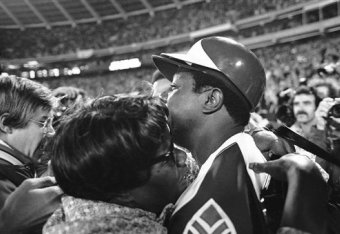
Pants on fire! McDougald didn’t kill Score’s career

0000 PantsOnFire03 HerbScore

The real story of Herb Score and Gil McDougald isn’t as simple as you might still think.

When Anthony Rizzo lined a base hit off Jameson Tallion’s head Monday, there must have been those who’ve watched baseball since before I was born who had two names in the center of their minds: Herb Score and Gil McDougald. As you might imagine they pop into those minds any time they’ve seen a pitcher drilled by a liner back to the box, in the head or otherwise.

Because, well, everybody knows that when McDougald, the Yankee jack-of-all-trades of the 1950s, caught hold of Score’s heater and drilled it right into the face of the Indians lefthander, that 7 May 1957 afternoon, that was it, kiss it goodbye for Score’s promising career. Right?

Wrong. Stop saying that, once and for all. Because that wasn’t quite it for the popular, talented pitcher who eventually became an even more popular Indians television broadcaster with a Yogi Berra-like flair for malaprops. (A classic: He makes the catch for the final out. And after three, the score, Cleveland 4 and the Indians 2.) And, a reputation as a gentleman who wouldn’t harm the proverbial fly.

“He’s such a nice guy,” one-time Indians third baseman Buddy Bell said of him, “that I’ll bet he makes the bed in his hotel when he wakes up in the morning.”

This is what is true: Until that afternoon, Herb Score was, essentially, Sandy Koufax before Koufax became Koufax. He’d just led the majors in strikeouts back-to-back, the 245 he punched out shattering Grover Cleveland Alexander’s record for a rookie pitcher and standing as the rookie record until Dwight Gooden broke it in 1984. His 9.7 strikeouts-per-nine rate led the majors, and he won the American League’s Rookie of the Year award pretty handily.

Score struck out 263 in 1956, again leading the majors as did his 9.5 strikeouts per nine and his 2.78 fielding-independent pitching rate. (ERA minus defense behind you.) He was also a 20-game winner in ’56. His rookie wins above a replacement-level player were 5.6, considered All-Star level or better; in ’56, he had 7.3, just shy of what WAR considered a Most Valuable Player-caliber season. He was an All-Star both those seasons, and his only blemishes seemed to be walks and wild pitches; he led the majors in the latter both years.

“Herb Score is the toughest pitcher I’ve faced,” Hall of Famer Mickey Mantle was quoted once as saying. “I just can’t hit him.” (Not entirely true: Mantle hit .250 against Score lifetime, with two homers, five runs batted in, and an .859 OPS.)

Score was in his fifth game of the 1957 season when McDougald’s liner flattened him. He had 39 strikeouts, a 9.8 strikeouts-per-nine rate, and a nifty 2.00 earned run average against his 2.50 FIP, not to mention 39 strikeouts in 36 innings.

2019-04-11 HerbScore02

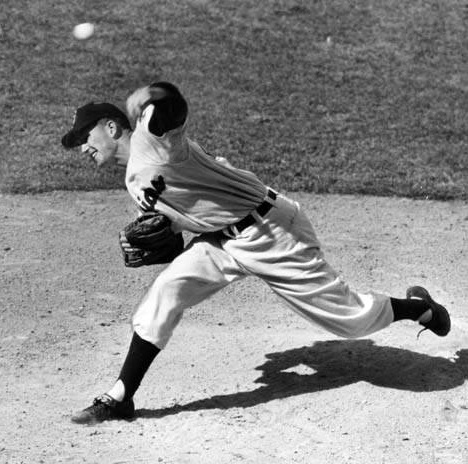
Score in motion, long before the fateful line drive . . .

Score was pitching in the top of the first and had just gotten rid of Hank Bauer on a ground out to third base when McDougald, playing shortstop that day, came up. On 2-2 he caught hold of a low fastball and drilled it, and Score hit the mound in a heap with his hands over his face after the ball ricocheted.

But every eye in Cleveland’s old Municipal Stadium (a.k.a. the Mistake on the Lake) was on the stricken Score. Indians outfielder Rocky Colavito, Score’s roommate and best friend, hustled in and slid his glove under Score’s head after Score turned in agony from his left side to his back.

Score was taken by ambulance to a hospital. Hall of Famer Bob Lemon relieved Score and finished the game, the Indians winning, 2-1, with Colavito himself pushing both Indian runs home: in the seventh, when his sacrifice bunt attempt turned into a throwing error to third allowing Vic Wertz to score the tying run (Bauer had an RBI single in the top of the seventh); and, in the eighth, when he worked out a bases-loaded walk.

McDougald finished the game, but couldn’t contain his grief, either.

“I heard the thud of the ball hitting his head,” he remembered in 1994, to New York Times columnist Ira Berkow, “and then saw him drop and lie there, bleeding, and I froze.  Someone hollered for me to run to first. When Score was taken off the field on a stretcher, I was sick to my stomach. I didn’t want to play anymore.”

Yankee manager Casey Stengel insisted McDougald stay in the game. McDougald obeyed his manager but added, “If Herb loses his eye, I’m quitting baseball.”

Score didn’t lose his eye as things turned out happily enough, but McDougald incurred a truckload of fan abuse over the liner, fans often yelling “Killer” at him when he batted during Yankee road games. Score wasn’t one of his judges, though. Indeed, when the two men met for the first time after Score’s hospitalisation, as Score himself told a reporter, “I talked to Gil and told him it was something that could happen to anyone. It’s just like a pitcher beaning a batter. He didn’t mean it.”

Score’s sister, Helen, was living in Florida at the time and didn’t know what happened to her brother until after the game ended and she returned home from her government job. “When I got home, a lady said my mother had been calling,” she told the Palm Beach Post in 2018. “I got in touch with her and Mom said, ‘It’s bad, but he’s got the finest doctors in the world and they will do everything that they can. You need to go down to the church and say your prayers for Herb, but more than that to pray for Gil McDougald. That man is a hurting man’.”

2019-04-11 HerbScoreGilMcDougald

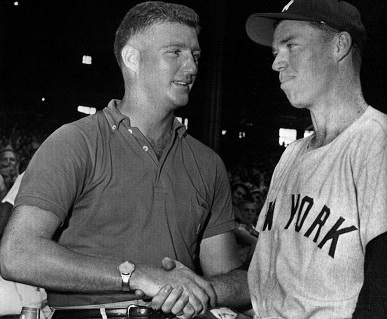
It wasn’t for publicity alone when Score shared this handshake with McDougald later in 1957.

McDougald tried to get updates from the hospital but personnel claimed they were ordered not to say a word to him or even to let him visit Score. (The only visitor Score was allowed, the Post said, was his fiancee, Nancy; the couple moved their planned 1957 wedding date up from October now that Score’s season was over.)

The versatile Yankee’s only reported solace came from Score’s mother, who told him likewise it wasn’t his fault. (A grateful McDougald visited Mrs. Score for years after their careers ended, whenever he was in Florida, the Post said.) But without losing his sight Score recovered and returned to the Indians in 1958.

After a pair of rough starts to open, he had a scoreless relief appearance to earn a save, then threw a shutout at the White Sox which included thirteen strikeouts, very much vintage Score. In his next game Score suffered a loss from an eight-and-a-third inning start in which he was tagged for three earned runs, but he suffered something a lot worse.

As Score himself would remember long after his career ended, it was a cold and wet night and he started feeling forearm soreness. In the seventh inning, he said, he bounced a pitch in front of home plate and his elbow flared on him.

Told he’d torn an elbow tendon, Score sat it out on doctor’s orders for thirty days, then took a relief turn against the Senators in Washington, where he’d first incurred the injury. The game started well, with Score striking out five of his first eight batters, until with two out in the ninth he “felt like someone stabbed me in my left arm.” He got a pop out to end the game on a lob of a pitch, but only pitched on and off the rest of 1958 hoping an off-season’s rest would resolve the elbow.

It didn’t. The theories began abounding; you can get the drift just from broadcaster Jimmy Dudley: “I still insist Herb never got over the effect of that blow to the eye. That would change anyone, and he changed his motion so he would protect his eye. I firmly believe that.”

Score firmly rejected that theory for the rest of his life. The evidence—you know, that pesky evidence—backs him completely. The elbow tendon tear, not the McDougald liner,  was the injury that ultimately finished him as a pitcher. His pitching motion changed trying to overcome any lingering elbow issue. Put down all the juicy speculations and lamentations and let Herb Score tell it himself:

Before I hurt my arm, I could go through an entire season and never scuff the toe plate [of his spiked shoe]. Later, I was ripping up a toe plate every game because I was dragging my foot . . . I couldn’t get out of the habit of dragging my foot, and that wrecked my entire motion to home plate . . . The reason my motion changed was because I hurt my elbow, and I overcompensated for it and ended up with some bad habits.

Score was never again the pitcher he was in 1955-56. After a very down 1959 and a 7.61 spring training ERA in 1960, there were those who believed the Indians gave him special coddling, including a few teammates, with only Rocky Colavito standing up for him.

Score actually had the infamous Colavito-for-Harvey Kuenn trade to thank for getting a trade of his own to a place he dearly wanted to go if the Indians’ infamous then-general manager, Frank Lane, wanted to be rid of him almost as badly as he wanted Colavito out of his sights. To the White Sox, whose manager Al Lopez was Score’s first Indians manager, and whom Score believed could help him get back on the right pitching track.

According to Terry Pluto, in The Curse of Rocky Colavitowhen Indians vice president Nate Dolin asked Score if he’d like to go to the White Sox, Score didn’t flinch:

I told him that it would be the best thing that could happen at this point in my career. Al Lopez had caught more games than anyone in major league history until Bob Boone broke his record . . . Al Lopez had had as much success with pitchers as any manager ever. I knew if anyone could help me, it was Al Lopez.

If it wasn’t for Dolin, Score and Lopez wouldn’t have their reunion. Lane was only too willing to deal Score—but not to Lopez, who’d resigned as the Indians manager after the 1956 season. Lopez accused the team’s management of not standing up for injury-addled third base star Al Rosen, who’d played through injuries down the stretch to furious booing from the stands and criticism in the press.

Pluto also wrote that Lane may have feared that Lopez could indeed revive Score, and that a revived Score could haunt the Indians for seasons to come. But in the heat over the Colavito trade, Dolin confronted Lane:

[Dolin] said something like, “If you have just one ounce of compassion in that bucket of venom you call a heart, you’ll send Herb to the White Sox.” Lane knew that because of the Colavito trade, Dolin still wanted to tear his limbs off and feed them to a family of hungry grizzlies.

For his part, Lane couldn’t let Score go to the White Sox without taking a gratuitous and  nasty slap at the clean-living, forthright pitcher:

Herb’s troubles are more psychological than physical. Maybe a change of scenery will help him. Lopez won’t be any more sympathetic toward Herb than [Indians manager Joe] Gordon was. But Herb will think he is and that may make a difference. Herb has a great imagination.

Colavito’s annual tangles with Lane over contracts, to say nothing of Colavito believing and telling the GM to his face that he was a proven liar (Pluto has cited chapter and verse), made him trade bait. But Score though there was another reason Lane was so anxious to be rid of the pair: “Part of it,” he said, “was that Lane believed ballplayers should be rowdy, hard-living, hard-drinking guys. But that wasn’t Rocky or myself.”

Lopez couldn’t help Score as things turned out, and Score spent the rest of his career between the White Sox and the minors until he bottomed out at Triple-A Indianapolis in 1963.

People asked me why I went to the minors to pitch. I still believed that my arm might come back. I was only thirty. I didn’t want to be sitting somewhere when I was sixty and wondering, ‘What if I had pitched one more year, would I have found it?’ Now I know. I have no doubts. I tried everything, and I pitched until they pretty much tore the uniform off my back.

The only place Herb Score sat at sixty was the same place where he began sitting in 1964, in the broadcast booth doing Indians games on television, until the end of the 1997 World Series. Voices of the Game author Curt Smith quoted a friend thus: “So what if he’s never been a Hall of Fame announcer? Look at it this way. Wouldn’t the city of Cleveland have turned somersaults over the last twenty years just to have ball clubs as decent as their announcer?”

Gil McDougald wouldn’t be quite the same player after the line drive, either. After a pair of very down seasons in 1959 and 1960, the Yankees left McDougald available for the expansion draft that created the second Washington Senators and the Los Angeles Angels. But McDougald elected to retire before that draft, exhausted, he said eventually, of the travel “and the attitude of the baseball people . . . they acted like they owned you and that they were giving you the moon and the stars.”

In fact, his own fate was hit by a line drive two years before his own nailed Score. McDougald was hit behind his left ear by a batting practise liner, in a genuine freak accident, as he eventually told Berkow, while he was behind a screen at second base talking to Yankee coach Frank Crosetti.

I saw a ball lying on the ground nearby and reached to pick it up, my head going just beyond the screen. Just then Bob Cerv hit a ball that hit me in the ear. I collapsed and everyone came running over. They carried me off the field, and I was out of action for a few games.

The doctors told me I’d be all right. Well, I wasn’t. The blow had broken a hearing tube. At first it just affected one ear, my left. One time I’m getting needled by some fan at third base, and I turned to [Phil] Rizzuto . . . and said, “Too bad I didn’t get hit in the right ear, then I wouldn’t have to hear this guy.”

A father of four, McDougald already had a dry cleaning business doing well. He eventually became Fordham University’s baseball head coach—until his right ear went deaf as well, ending his coaching career and forcing him to sell his dry cleaning and building maintenance business.

Berkow told McDougald’s story in 1994 with sad grace in “McDougald, Once a Quiet Yankee, Now Lives in Quiet World.” That, plus the happy followup Berkow wrote after McDougald underwent a successful cochlear implant to restore his hearing enough to allow him to function again, are collected in Berkow’s Summers in the Bronx: Attila the Hun and Other Yankee Stories.

If you think Herb Score spent the rest of his life lamenting what Gil McDougald didn’t take away from him, after all, think again, as Score told Pluto in 1993:

People tell me that I was unlucky. Me? Unlucky? I started with a great team in the Indians and played under a great manager in Al Lopez. Then I went from the field to the broadcasting booth at the age of thirty, and thirty years later I’m still doing the games. If you ask me, that’s not unlucky. That’s a guy who has been in the right place in the right time.

McDougald spent the last years of his life advocating for the hearing-impaired and for the manufacturer of his cochlear implant. After the implant surgery, during an office visit to the audiologist who programmed it after he healed from the procedure, with his wife and one of his children at his side, McDougald wept for joy.

As he told Berkow later, while his home bustled with children and the grandchildren “who came to see Grandpa hear,” as his wife put it, he found the words to describe the gift: “They’ve turned the music on.”

Score retired after the 1997 World Series. He survived a near-fatal 1998 road accident, but then suffered a stroke in 2002, and died in 2008. McDougald died of prostate cancer two years later.

Traded for Gil Hodges, then to hell and back for Bill Denehy

2019-04-05 BillDenehy

“Met fans who remember me ask, ‘Oh, Bill Denehy. You’re the guy who was traded for Gil Hodges, aren’t you?’ ‘I am,’ I tell them with great pride.”—Bill Denehy.

With eleven games left in the 1967 season, Mets manager Wes Westrum, who’d succeeded Casey Stengel, resigned. Third base coach Salty Parker took the bridge to finish the season, but the Mets had a permanent candidate in mind.

They wanted Gil Hodges, the much-loved Brooklyn Dodgers icon, who finished his playing career as a knee-injured Original Met before becoming the manager of the expansion Washington Senators. But it would cost the Mets to get Hodges, since he’d signed a contract extension that would take him through the end of 1968.

So the Mets traded righthanded pitcher Bill Denehy—who shared a 1967 Topps rookie baseball card with future Hall of Famer Tom Seaver—to the Senators. If you ask Denehy today whether any Met fans who remember him ever suggested he could be called the man who really made the 1969 Miracle Mets possible, he says no . . . while laughing heartily.

Then, he tells the backstory, which begins with his having left an impression on the parent Senators when he pitched well against their minor league teams while rising through the Mets’ system. To get the Hodges deal done required a little Yankee panky—specifically, former 1930s teammates Johnny Murphy (relief pitcher) and George Selkirk (outfielder), now major league general managers.

“The Senators were trying to extract as much as they could for giving up Hodges,” Denehy says by telephone from his Florida home.

They got $100,000 in cash and they wanted a player. Johnny Murphy was then the general manager of the Mets, and George Selkirk was the general manager of the Senators, but they didn’t really like each other. Selkirk was pushing for the additional player. Mr. Murphy told me they offered three additional players to choose instead of me, but Selkirk insisted it be me. What the Mets didn’t tell them was that I hurt my arm in May and was sent to the minor leagues and got a couple of cortisone shots.

The injury in question occurred when Denehy threw a hard slider to Hall of Famer Willie Mays in his fourth major league start. “It felt like someone stuck a knife in my shoulder,” he once said. Back in the minors in Florida during ’67, he underwent a procedure to have a dye shot into his arm and shoulder and it showed the torn muscle. The Mets’ then-team physician, Dr. Peter LaMotte, didn’t affirm that diagnosis; the Mets also failed to pass the information to the Senators.

Going to the Senators for Hodges may have been the least among strange, sad deals Denehy has seen, handed himself, and been handed in the decades since.

Bill Denehy today is legally blind. It began when he awoke one morning in January 2005 unable to see through his right eye, thanks to what proved a torn retina. Caught frozen without medical insurance, since he was two weeks from beginning a new job after leaving his incumbent job, Denehy needed help from a church group to undergo the surgery at a University of Florida eye facility.

Surgery performed by the same doctor who operated on boxing legend Sugar Ray Leonard’s torn retina proved unsuccessful. “He said my retina tear was worse than Sugar Ray’s was,” Denehy says, adding that he’s since incurred two more retina holes, a macular hole, and required a stent for his left eye.

Friendly and sounding far younger than his 73 years, Denehy believes up to 57 cortisone shots in 26 months that he was given as a young pitcher caused his eventual visual loss. As he wrote (with Peter Golenbock) in his memoir, Rage: The Legend of Baseball Bill Denehy (Central Recovery Press; 280p, $16.95), “I didn’t know any better.”

This was before the dangers of cortisone were made public. I knew Sandy Koufax was taking them for his arm, and Sandy was my hero, so I figured what was good for Sandy was good for me. I found out years later that nobody should take more than ten cortisone shots in a lifetime. I was later told that if you take more than ten shots in a lifetime, your corneas will go weak and you risk going blind. I wish someone had said something back then.

“I have my hand out in front of me a foot, and I can’t see my fingers,” Denehy says on the phone. “If I bring them in, if I stuck my thumb on my nose, and then just turn my hand where my palm is facing me, I can see my fingers there.

“But I can’t read or write,” he continues. “I’ve got the television on mute right now, and all I see is whiteness and black things moving. I don’t know whether it’s a person or it’s a game or whatever on there. I can’t go to the computer. I can’t read any type of thing. Telephone numbers are difficult for me. I used to have five by seven cards with big numbers written down for telephone numbers, but that’s gone by the wayside now. I’m in the final stages now of what we call in blindness—darkness.”

Administered to excess, cortisone is also linked to glaucoma, the disease that put paid to Hall of Famer Kirby Puckett’s playing career in 1996, ten years before his premature death from a stroke. Puckett isn’t known to have taken cortisone often if at all during his twelve-season career, but it was revealed that glaucoma ran in his family.

2019-04-05 BillDenehySenators

Short-lived Senator Denehy, following The Trade.

Does Denehy think baseball’s medical personnel during his career simply didn’t know the full extent of cortisone’s potential dangers? Or does he think they saw players then as mere commodities to hustle back to the field posthaste, regardless of actual or long-term health? “Great question,” he replies. “I think it was a little of both.”

He once joined a 2004 legal action involving the cortisone issue, filed by former White Sox catcher Mike Colbern, who died in March. “Baseball gave us illegal drugs and too many cortisone shots,” Colbern told Douglas J. Gladstone for A Bitter Cup of Coffee, “but never kept medical records in order to keep us playing.”

Denehy is one of 634 still-living, short-career former major leaguers who were frozen out when a 1980 agreement between baseball government and the Major League Players Association re-aligned the game’s pension plan to vest health benefits after one day’s major league service time and a retirement allowance after 43 days’ major league time. The deal didn’t include players whose careers occurred between 1949 and 1980.

Colbern, one-time Met shortstop Al Moran, and former Houston second baseman Ernie Fazio (who died in 2017), the first signing by the Astros’ franchise (born as the Colt .45s), led a 2003 class action suit against baseball, after a 1997 agreement to provide $10,000 pensions to select former Negro Leagues players who saw some Show time but still didn’t qualify for the 1980 pension re-alignment.

The suit accused baseball of discrimination (Colbern stressed the players didn’t want to deny the Negro Leaguers) and also charged battery and negligence against baseball for allowing team doctors and trainers to administer multiple cortisone shots without informing players of cortisone’s risks. Several hundred players including Denehy joined the suit.

It lost on appeal to the 9th U.S. Circuit Court of Appeals in 2006. Baseball government, ESPN said at the time, “argued that the former players were essentially looking for a handout they didn’t deserve.”

Denehy still hopes to help change that for players such as himself. Players such as David Clyde, the mishandled Rangers pitching phenom of the 1970s. And, Jim Qualls, the Cub center fielder remembered if at all for busting Seaver’s bid for a perfect game in the ninth inning in 1969. And, Carmen Fanzone, a third baseman frozen behind Hall of Famer Ron Santo with the Cubs but who made a second career as an in-demand jazz trumpeter.

In 2011, then-commissioner Bud Selig and then-Players Association executive director Michael Weiner announced a re-alignment of the 1980 pension re-alignment: Players frozen out of the original re-alignment would get $625 for every 43 days major league time, with the 43 days representing a quarter and a limit of sixteen quarters, good for $10,000 before taxes. The bad news: If a player dies before collecting the last of those payments, the remaining payments can’t be passed on to their widows and children.

“My feeling is that we should get a pension that is indicative of the service time in the big leagues,” says Denehy of the pension re-alignment, for himself and for those among his 634 fellow former players frozen out of the deal. “We earned the time, okay? When they dropped it down to 43 days active service time, every one of us prior to 1980 that had more than 43 days should have gotten a pension.”

One possible reason for the pre-1980 players’ freeze-out? Stressing that it was strictly hearsay, Denehy spoke of a sense that many if not most of the players in question were merely September call-ups, with baseball and the players’ union believing they “didn’t really earn their way onto a major league roster.”

That might have been true for a few of the players but certainly not all of them. Denehy pitched in three major league seasons, for the Mets, the Senators, and the Tigers, and he made each of those teams directly out of spring training.

When he reported to the 1967 Mets’ spring camp, Denehy didn’t figure in their pitching plans until the day Jack Fisher, the one-time Orioles “Baby Birds” rotation member, had to miss a spring start when his little daughter was injured in a fall. Denehy got the start instead, zipping through three innings and posting a strong enough spring to go north with the Mets to open the season.

He got his first major league start on 16 April 1967, against the Phillies, striking out eight including the first Show batter he faced, Johnny Briggs. The eight punchouts matched Seaver for a Mets rookie record that stood until Matt Harvey broke it in 2012. Other than six walks against those eight strikeouts, Denehy’s only other blemish in the game came when Dick Allen blasted a two-run homer in the bottom of the fifth.

“That wasn’t a home run,” Denehy chuckles. “That was a moon drive.” The rising liner sailed until hitting a Coca-Cola sign atop Connie Mack Stadium’s second deck. Without the sign, Denehy says, “that ball would have landed in Delaware.”

Three starts later, facing Hall of Famer Juan Marichal and the Giants, Denehy threw the fateful slider to Mays. The knife in the shoulder the pain resembled would prove nothing compared to the one the quick-tempered, admittedly self-destructive, injury-plagued Denehy would stick into himself a few hundred times over.

The physical pain from his baseball injuries prodded him to more serious drinking plus marijuana and cocaine. Out of baseball, he tried real estate, insurance, and radio broadcasting, before becoming a pitching coach in the Red Sox system. (His charges included the young Roger Clemens.) By 1987, Denehy’s marriage collapsed, unable to bear the weight of his addictions and his furies any longer.

He was the University of Hartford’s baseball coach from 1984-1987. (One of his players was future Hall of Famer Jeff Bagwell.) He rebuilt the team into a potential powerhouse before a bench-clearing brawl with the University of Connecticut brought out the worst of the inner clash between Denehy’s passion to win and his fear of failure, the clash that helped ruin him.

By his own admission a runaway train, Denehy remarked out of frustration after the brawl that he hoped a particular UConn assistant coach got car bombed—he swears he was trying to say he hoped the coach’s car would be blown up “like a balloon,” but he was cut off before he say that second part. After his firing, Denehy tried to pitch once more, in the short-lived Senior Professional Baseball Association in Florida in 1989.

But he failed a physical exam, and settled for becoming a colour commentator on league broadcasts, with Lou Palmer—the first on-air ESPN broadcaster—handling play-by-play. His eventual memoir collaborator, Peter Golenbock, in The Forever Boys, said Denehy’s in-game interview of former Mets Rookie of the Year Jon Matlack—pitching for the St. Petersburg Pelicans—drew a threat from former Tiger pitcher Milt Wilcox to slap Matlack with a kangaroo court fine.

2019-04-05 DenehySeaverCard

The rookie card, appraised by some collectors’ sites as worth up to $7,000 in mint condition.

Two subsequent road accidents caused Denehy injuries from a dislocated jaw and broken ankle to neck and back issues. He lapsed back into marijuana and cocaine until it throttled his plan to launch a national radio talk show discussing addiction and sports. He sobered up for good and  reconciled with his children and his parents.

“I haven’t really reconciled that well with my ex-wife,” he chuckles, “but my daughters and I, we talk all the time, and it’s really good.” More than good. When Denehy was bilked out of a reported $17,000 (he thinks it may have been as much as $30,000) by his now-former caretaker, Donna Sue Santella, one of his daughters worked with his bank to get the charges Santella’s accused of running up off his accounts.

It was easier facing Dick Allen and Willie Mays than facing the losses Santella admitted in an affidavit to inflicting on him. “Very simply, first of all I feel extremely violated that she worked for me for 25 months and we found out she was stealing for fifteen months,” Denehy says. He now has a new caretaker, thanks to Florida’s department of children and families who steered him toward an agency that bonds and vets its caretakers fully.

“I want to make sure that anyone who has a handicapped person or a senior citizen that’s in their family, or just a good friend, if they need assistance, they go through an agency that is bonded and vetted to make sure that person who’s going to assist them doesn’t have any kind of record or has done this before,” he says.

Denehy admits he’s had “a bad tendency” to trust the wrong people, from his pitching days to the Santella case. “And, again, my message is that you be very, very careful,” he says. “You can’t go on in life without being able to trust people. But, make sure that it’s done over time, and make sure that you can talk to other people, so that you don’t feel people are taking advantage of you.”

He still loves baseball deeply and pays close enough attention to the games and the issues around them. He’s interested especially in proposals to move the pitcher’s mound, an idea now under experiment in the independent Atlantic League. He thinks the mound should be moved back—but not quite in the way the ordinary fan or even the commissioner’s office think it should.

But he prefaces his theory with a challenge, saying that “if you ask a hundred people what’s the distance between the rubber and the plate,” they actually answer incorrectly.

The distance is 60 feet, six inches, right? Wrong, Denehy says. “It’s actually 59 feet and one inch from the pitching rubber to home plate. It’s sixty feet, six inches, to the back apex of home plate, where they’ve got a seventeen-inch square that’s cut off the corners to make the lines that go down to first and third base.”

And he would move the rubber back the length of the plate, to make the distance a true sixty feet, six inches. The reason? Not on behalf of more balls in play or artificial pace-of-game concerns—but safety.

If you’re someone like [Aroldis] Chapman for the New York Yankees, he throws over a hundred miles an hour. But—he has a seven-foot stride. So in fact when he’s releasing the ball, he’s not even fifty-nine feet, one inch from home plate, he’s fifty-two feet, one inch from home plate . . . Just look at the number of players over the last couple of years who’ve been hit in the wrist and everything, broke their wrists or broke their arms. Because they don’t have enough time to get out of the way of a pitched ball. 

And if a batter hits a 121 mph liner off a pitch thrown at 100 mph, Denehy says, “anyone who’s ever pitched and tries to throw as hard as you can, when you follow through your glove is at your side and your throwing arm is crossing your opposite hip. At 121 miles an hour, at fifty-two feet, one inch, you don’t have enough time to react to be able to get your glove up to [stop] a ball that’s hit at your face.”

The night before our conversation, the Cubs’ Anthony Rizzo lined a base hit off the head of Pirates starting pitcher Jameson Tallion. “I’m fine,” Tallion said after the game. “I’m unlucky I got hit and lucky I seem to be OK coming out of it.” It wasn’t the first time Tallion was ever hit by a line drive on the mound.

“Either a batter or a pitcher is going to get killed,” Denehy says. “And that’s going to be too damn late for baseball to come in and make a reactionary change in something that doesn’t have anything to do with batting average or pitching statistics, it has to do completely with safety.”

Like many, Denehy casts an interested eye upon the current trend of teams opening their checkbooks for lucrative, somewhat long-term contract extensions for their best young players, forestalling their first free agency seasons by several years. He thinks the owners have their own pocketbooks in mind, of course, but the players signing such extensions—even if they could have bagged more on the open market—aren’t exactly “heading for the breadlines,” either.

Referring to Bryce Harper’s mammoth new contract with the Phillies, which wasn’t an extension but a free agency signing, Denehy is emphatic. “He wanted to play baseball,” Denehy says. “And not be involved in any more negotiations, no more opt-outs, no more bonuses, he wanted to sign a deal where for the rest of his career he could do the one thing he loved more than anything else, which wasn’t making money, he wants to play baseball, and I say good for him.”

Denehy also cautions against assuming that the highest-salaried player on a team will become the automatic team leader. Often as not, the lower salaried players prove to be the team’s true leaders, though Denehy likes to point to one well-paid Hall of Fame teammate who became a leader quietly but authoritatively—Al Kaline, who once turned a salary raise down because he believed he didn’t earn it.

Kaline was once the highest-paid Tiger and the first to sign a six-figure season’s contract. “Al Kaline was extremely soft spoken,” Denehy says. “Any time we had a team meeting, any time we had anything that, you know, caused the team to get together to give their opinion . . . Al would sit at his locker and vote just like he was—Bill Denehy. He wasn’t someone who would complain, he wasn’t someone who really wanted to put his opinion out there, he was the ultimate team player. But just because you get the most amount of money, doesn’t mean that you’re going to become the team leader in the clubhouse.”

But he hopes most to see baseball finally resolve the 1949-1980 players’ pension issue once and for all. “I don’t think any one of us are at a point where we’re asking for something that we haven’t earned.

“You know, I don’t think they owe me because of all the cortisone shots that they gave me, I don’t think that they owe me for the tear that I had in my shoulder,” Denehy continues. “All I’m asking for is what I earned, and that was the service time that I got in. If they do that, make me just a regular pension, I will continue to stay happy and promote this great game of baseball.”

2019-04-05 BillDenehyTomSeaver

Denehy (left) with Seaver, spring 1967: “We were Prospect A and Prospect A-1. I’m not sure who was which.”

Regretting only that he didn’t think to get a second opinion about his original shoulder injury, Denehy refuses to allow his blindness to interfere with living.

“I’m Irish,” he says, laughing. “I have faith in a higher power. I’ve got some really good friends. I went back to my fiftieth high school reunion in 2014, I was absolutely amazed at the number of classmates who came up to me that weekend and said how proud they were of me, you know, being from our class and getting to the big leagues. And I still stay in touch with a good dozen of them, a couple of them almost every day a phone call to see what’s going on.”

The only other thing to sadden Denehy is the fate of Seaver, who’s retired from public activities following a diagnosis of dementia and isn’t likely to be part of this year’s fiftieth anniversary commemorations of the 1969 Mets. The two pitchers first met when pitching for the Mets’ then-AAA farm in Jacksonville, Florida, before both made the Mets in spring 1967.

“We went north, we were like Prospect A and Prospect A-1, I’m not sure who was which,” he continues. “Our lockers were next to each other in the clubhouse. I knew [Seaver’s wife] Nancy. Every time I was around Tom, he always treated me, while we were teammates, and even after I was out of the game, he treated me as a friend and a former teammate.”

When Denehy worked as a baseball reporter for Enterprise Radio in 1980, the network assigned him to cover Opening Day in Cincinnati, when Seaver was with the Reds. Knowing Seaver didn’t really like to talk on Opening Day, Denehy arrived a day early with an idea.

“They were having their practise,” Denehy says, “and I went up to him. We all called him Soup back then. I said, ‘Hey Soup, I need a favour from you.’ And he says, ‘What’s that?’ And I said, ‘I’m covering the game tomorrow for Opening Day, you know, for this network, it’s my first job, and I’d like to get an interview from you, but I realise you don’t do it tomorrow on your Opening Day, so maybe we could do it today.’

“And he put an arm around me and said, ‘Hey, listen. You’re a friend and a former teammate. Show up tomorrow at 10:30 in the clubhouse, here, and you and I will go underneath the stands and I’ll give you my comments on Opening Day.’ And he did that, and I was able to broadcast it.”

Denehy pauses a quick moment before finishing his thought. “That’s how much I think of that man,” he says. “I’m very sorry to hear about his illness.”

Pants on fire! Gibson didn’t drill home run hitters as often as you think

0000 PantsOnFire01

If Bob Gibson tried to hit those who dared hit him for distance, he didn’t succeed even close to as often as his reputation suggests.

During an otherwise pleasant forum discussion, one member said this in the middle of a stream, regarding hit batsmen, replying to my assertion (about which I wrote) that Chris Archer deserved a suspension for drilling Derek Dietrich: “I’ve read/watched enough interviews with [Bob] Gibson to know he wasn’t just ‘brushing back’ batters—especially those who had hit a donga off him the time before. He was damn well trying to hit them.”

The mythology around the Hall of Fame righthander includes that Gibson took no quarter from any hitter and thought nothing of letting them have it if he thought they got too ornery at the plate. Gibson himself helped to foster the mythology, as he once told—well, one more time: Roger Angell isn’t baseball’s Homer; Homer was ancient Greece’s Roger Angell:

I did throw at [Mets outfielder] John Milner in spring training once. Because of that swing of his—that dive at the ball. I don’t like batters taking that big cut, with their hats falling off and their buttons popping and every goddam thing like that. It doesn’t show any respect for the pitcher. That batter’s not doing any thinking up there, so I’m going to make him think. The next time, he won’t look so fancy out there. He’ll be a better looking hitter.

“He had that hunger, that killer instinct,” said Joe Torre, a Gibson teammate in St. Louis and eventually his boss for a time, when Torre managed the Mets and named Gibson his pitching coach. “He threw at a lot of batters but not nearly as many as you’ve heard . . . Any edge you can get on the hitter, any doubt you can put in his mind, you use. And Bob Gibson would never give up that edge.”

Maybe not.

But Gibson is only number 84 on baseball’s all-time plunk parade. He hit 102 batters lifetime and averaged seven per 162 games lifetime. Look up the plunk parade. (And, quit laughing when you see a pair of knuckleballers, Tim Wakefield and Charlie Hough, in the top ten: the pitch is hard to control, has a mind of it’s own if the elements cooperate, and you shouldn’t be surprised that it’s liable to give a hitter a kiss now and then.) Don Drysdale, who lived on intimidation likewise, is in the top twenty.

Since my respondent in that forum talk insisted that Gibson was damn well trying to hit batters “especially those who had hit a donga off him the time before,” I just had to look it up. Crazily enough, I looked at the game logs for his entire major league career, all 528 games in which he pitched, all 482 times as the starting pitcher.

I fear my forum friend is going to be rather disappointed. Buckle up, it’s going to be a bit of a ride.

1960—Gibson didn’t have such a game until he faced Warren Spahn and the Braves on 12 September 1960. In the second inning, Gibson hit Wes Covington with a pitch to open the inning. The next batter, Joe Adcock, smashed a two-run homer.

The same two batters opened the fourth, with Covington drawing a walk and Adcock smashing a double to right. After Johnny Logan popped out foul, Chuck Cottier scored Covington with a sacrifice fly and Spahn himself doubled home Adcock to knock Gibson out of the game. One hit batsman, one home run, and the home run was hit after the plunk.

1961—Two games in which Gibson surrendered a homer and hit a batter. 17 April, vs. the Dodgers—Gibson surrendered a homer to Hall of Famer Duke Snider in the third, and hit Snider with a pitch when Snider batted again in the fifth. 3 May, vs. the Pirates—Gibson hit Rocky Nelson with a pitch leading off the fourth, and Nelson hit a two-out homer in the eighth for the only Pirate run of the game.

So far, the former Duke of Flatbush is the only one to take a hit from Gibson after taking him long distance.

1962—For the first time in his career, Gibson has four such games.

10 May, vs. the Giants—Gibson hit second baseman Chuck Hiller with a pitch in the fifth; Hiller was 0-for-2 in the game before that point. After Hall of Famer Willie Mays flied out to follow, fellow Hall of Famer Willie McCovey hit a three-run homer; with the Cardinals now down 5-0, Gibson was taken out of the game right after that bomb.

18 July, vs. the Cubs—In the top of the seventh, Gibson plunked Hall of Famer Ernie Banks with two outs, then surrendered a base hit to Hall of Famer Ron Santo before George Altman flied out for the side. The only Cub run of the game was courtesy of Hall of Famer Billy Williams hitting a solo bomb . . . in the top of the fourth; the Cardinals scored the pair that ultimately meant the game on Ken Boyer’s two-run double in the bottom of that inning.

Banks followed Williams in the lineup that day. If Gibson wanted revenge for Williams’s home run, why did he wait until the seventh to plunk Banks but not Williams?

7 September, vs. the Reds—The Cardinals jumped Bob Purkey for a pair of runs in the top of the first; in the bottom of the second, Gibson plunked Reds left fielder Marty Keough with two out before retiring the side. The game ended up in extra innings and in the tenth Hall of Famer Frank Robinson hit the game’s only home run and, after Jerry Lynch followed with a base hit, Gibson was lifted; the Reds won the game when Vada Pinson hit an RBI double in the bottom of the 11th off Curt Simmons.

11 September, also vs. the Reds—Gibson and Purkey went at it again. This time, Gibson hit the first batter of the game Eddie Kasko and paid for it promptly with an RBI triple (Don Blasingame) and a sacrifice fly (Pinson), putting the Cardinals in a 2-0 hole before they came up to the plate. In the top of the ninth, Kasko got even with Gibson, hitting a three-run homer to make it 6-2, Reds, before Purkey shook off a one-out infield error to finish the Cardinals off.

So far, Gibson has pitched seven games in his career in which he surrendered a home run and hit a batter in the same games, and only once has he hit a batter who homered off him previously in any game.

1963—The Cardinals make noise in the pennant race, hoping among other things to send Hall of Famer Stan Musial into retirement with a bang. Alas, they didn’t make it, but the Dodgers did, going on to sweep the Yankees in the World Series. How about the 1963 games Gibson pitched in which he was taken deep and hit a batter in the same games?

22 June, vs. the Dodgers—In the top of the second, Tommy Davis opened the scoring with a leadoff bomb off Gibson. Davis batted three more times in the game and, in order, walked and flied out to right twice. Gibson’s hit batsman in the game was former Yankee Moose Skowron . . . leading off the top of the seventh. (The Cardinals tied the game at one in the fifth on a run-scoring balk and got what proved the winning run in the sixth when Charlie James homered off Dodger rookie Nick Willhite.)

9 August, vs. the Braves—This time Gibson hit shortstop Roy McMillan twice—once after Denis Menke opened the bottom of the second with a double, and once after Menke hit a three-run homer with nobody out in the bottom of the third to put the Braves up 6-0. You can argue Gibson’s frustration over being in a 6-0 hole, of course, and Menke wasn’t exactly known as a power hitter, but Gibson could have waited to see Menke again (which he did, in the bottom of the fifth) instead of drilling McMillan a second time.

The final score was 6-3, Braves . . . and Gibson himself cut the deficit in half when he hit a two-run triple in the top of the fifth. But Menke himself didn’t pay for what proved the difference-making bomb.

28 August, vs. the Giants—Actually, Gibson didn’t hit anyone in this game . . . and the Giants took him deep four times in the game, including Hall of Famer Orlando Cepeda and catcher Tom Haller hitting back-to-back bombs off Gibson in the bottom of the fourth, with Haller’s the second bomb he’d hit in that game. Haller batted twice more in the game; Gibson might have pitched him tight the first of those at-bats, allowing Cepeda to steal second, but he hit nobody in the game.

So far, still, Duke Snider’s the only one to get hit by Gibson his next time up after hitting one out, and by now that drill is two years old.

1964—The Cardinals won the pennant at literally the last minute, after the infamous Phillies collapse down the stretch and a closing weekend that could have sent the National League race into a three-way playoff.

Gibson himself factored in the closure, losing to the Mets’ stout little lefthander Al Jackson to open the final set, and the Cardinals losing again before Gibson on two days’ rest beat the Mets while the Reds lost to the Phillies, giving the Cardinals the pennant.

Now, what of the games in which he was hit for distance and plunked a hitter in the same contest?

9 May, vs. the Mets—In the Mets’ new Shea Stadium playpen, Gibson faced future pitching coach Galen Cisco. And guess who turned up playing shortstop for the Mets? Old Roy McMillan, whom Gibson drilled in the bottom of the second after catcher Jesse Gonder led off with a base hit. I don’t know whether or why Gibson would have a particular animus against McMillan, either.

By the time Gonder led off the bottom of the eighth with a home run the Cardinals had five runs on the board. (It might have been six but Dick Groat was thrown out at the plate trying to score behind Julian Javier on Bill White’s double.) Gibson also drilled Mets second baseman Ron Hunt in the ninth, but the Mets rookie was already earning his reputation for taking one for the team and Gonder wasn’t even close to looming in that inning.

15 July, vs. the Dodgers—With the Cardinals in the hole 7-1 by the top of the seventh, Gibson with one out drilled veteran Dodger infielder Junior Gilliam—who came into the game as a replacement at third base for the bottom of the sixth. The next batter, Dodger center fielder Willie Davis, hit a two-run homer.

With the Cardinals rallying in the bottom of the seventh, Gibson was lifted for a pinch hitter. The Dodgers went on to win the game with a four-run ninth, courtesy of home runs off reliever Ray Washburn—a three-run shot from Ron Fairly and a solo from Tommy Davis.

19 July, vs. the Mets—Gibson started the second game of a doubleheader versus Frank (Yankee Killer) Lary, the former Detroit righthander picked up by the Mets mid-season. This time, the Mets jumped early, with Gonder hitting a two-run homer in the top of the first with Hunt aboard. (After stealing second off his leadoff single, Hunt survived a pickoff thanks to a throwing error.)

It was the only home run in a wild enough game that ended with the Cardinals winning, 7-6. Gibson did hit Hunt with a pitch . . . in the top of the fourth, after Hunt got a second single in the game during a three-run Mets third.

So far, our survey says: Gibson has pitched twelve games in which he’s surrendered home runs and hit batters in the same game . . . and Duke Snider is still the only batter to hit one out off Gibson and get drilled his next time up. But if you look at that 19 July 1964 game against the Mets, you could make a case that maybe Ron Hunt annoyed Gibson enough reaching base without going long in two straight plate appearances prior that Gibson let him have it.

Could.

1965–This was Gibson’s first 20 game-winning season. But it wasn’t a good season for the defending World Series-winning Cardinals, who were struck by issues not of the players’ making going in and finished seventh, in a year the National League race belonged mostly to the pennant-winning Dodgers and the tight-on-their-trail Giants, who lost the pennant by two games.

They lost Series-winning manager Johnny Keane to the Yankees, thanks to one of the most notoriously underhanded double-switches in baseball history—after the Yankees fired Yogi Berra following that thriller of a seven-game Series. They spent 1965 getting used to new skipper Red Schoendienst. And they were demoralised after general manager Bob Howsam attempted salary cuts on several of his World Series-winning players.

Those are other stories for other times. We’re continuing our look at Gibson the homer-hating head hunter who wasn’t, quite, so far . . .

17 June, vs. the Pirates—Gibson plunked first baseman Donn Clendenon with two out in the top of the first; Pirates righthander Vernon Law answered by plunking Javier to lead off the bottom of the frame. In the fourth, Clendenon struck back with a leadoff single and Hall of Famer Willie Stargell promptly hit a two-run homer.

Stargell batted three more times in the game, striking out to end a 1-2-3 fifth, grounding out to end the seventh, and driving in the insurance run with a two-out RBI single in the ninth. Not once was he hit by a pitch after that fourth-inning bomb.

2 July, vs. the Mets—Gibson had a re-match with Frank Lary this time; the Mets had dealt Lary to the Braves during the 1964 stretch, for a kid pitcher named Dennis Ribant, then re-acquired Lary during spring training before dealing him to the White Sox not long after this game. (When the White Sox released him after the season, Lary retired.)

McMillan is still the Mets’ shortstop here . . . you guessed it: Gibson drilled him with one out and one on (Lary, a leadoff single) in the bottom of the fifth with the Cardinals up, 4-1. Former Cardinal Johnny Lewis sent the Mets’ second run home later in the inning with a base hit scoring Lary.

The Cardinals were up 6-2 in the bottom of the ninth when former Giant Chuck Hiller, now the Mets’ second baseman, hit a two-out homer, before Gibson got his old buddy McMillan to ground out to end the game.

31 July, vs. the Dodgers—This time, Gibson is up against Hall of Famer Don Drysdale, whom you’ll recall places way higher on the all-time plunk parade than Gibson does.

Now, unless you think Gibson was the Hunter Strickland of his time, there was no cause for him to drill Willie Davis in the top of the first to load the bases with nobody out a year after Davis took him deep. Gibson got the next three outs in order to strand the ducks on the Dodger pond, and the Cardinals had a 2-0 lead when Lou Johnson and Jim Lefebvre homered back-to-back in the top of the sixth to put the Dodgers up, 3-2.

Johnson and Lefebvre batted back-to-back in the eighth and popped out and flied out, respectively, in a 1-2-3 inning. Not a plunk between them. With Drysdale lifted for Ron Perranoski in the seventh, it looked like the Dodgers would bank a win until Hall of Famer Lou Brock walked it off with a two-run single in the ninth.

15 August, vs. the Reds—With one out and Hall of Famer Frank Robinson aboard in the top of the second, Gibson plunked Deron Johnson and paid for it—Johnny Edwards worked out a walk to load the bases, Leo Cardenas singled Robinson home keeping the ducks on the pond, and—after Reds starter Sammy Ellis looked at strike three—Pete Rose singled home Johnson and Edwards, before 1969 Mets hero-to-be Art Shamsky struck out for the side.

The Cardinals took the lead back in the top of the second, including Gibson himself hitting a three-run homer. But Johnson got revenge in the bottom, tying the game with a solo home run. He batted three more times in what turned into a 12-7 Cardinals win—flying out (off Gibson), doubling (off Gibson), and ending the game (off reliever Hal Woodeshick) with a fly out.

Edwards and Vada Pinson also homered in the game. The next time Edwards batted after his bomb, Gibson . . . walked him intentionally—in the inning Pinson led off by going long.

20 August 1965, vs. the Mets—Gibson beat Al Jackson and two relievers in this game. In the Mets third, with one out and one on, guess who got drilled again—Roy McMillan, whom Gibson struck out in the first. All things considered, there wouldn’t have been a jury on earth to rule McMillan unjustified if he felt like tearing apart Gibson limb by limb.

Charley Smith, the Mets’ third baseman, accounted for the only Mets run when he led off the bottom of the fourth with a home run. Smith batted twice more in the game, with a pop out to shortstop in the sixth and a game-ending fly out to center field.

For once in his life, Gibson himself got plunked when batting against Jackson with two out in the top of the fifth. (McMillan must have wanted to offer to have Jackson’s children right then and there.) The bad news for the Mets is that that mistake opened the door to a five run inning—a single, a double steal (Gibson to third, Brock to second), an RBI triple (Dick Groat), an RBI single (Curt Flood), and another RBI triple (Ken Boyer).

10 September, vs. the Phillies—This began as a match between a pair of Hall of Famers, Gibson and Jim Bunning. It ended in a 5-4 win for the Phillies, enduring their own struggles in the season that followed that heartbreaking pennant collapse.

With one out in the Philadelphia fourth, Gibson hit Johnny Callison with a pitch. Wes Covington promptly singled and Callison scored when Cardinals catcher Tim McCarver let a pitch get away, before Dick Stuart drove in Covington with a single for a 2-1 Phillies lead.
2019-04-10 BobGibson

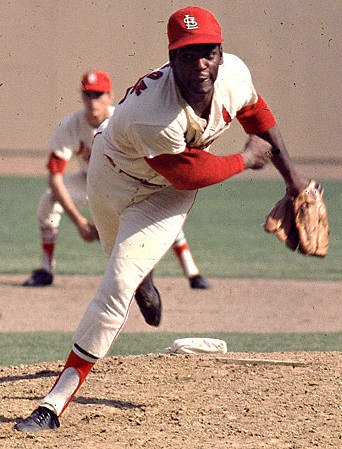
Gibson on the mound at the peak of his Hall of Fame career.

The game was tied at two in the bottom of the sixth when Stuart hit a two-out two-run homer; the Cardinals tied it at four in the eighth but the Phillies walked it off with Cookie Rojas’s RBI single off Woodeshick. Gibson never got another crack at Stuart in the game; he was removed for a pinch hitter in the seventh.

Survey says: Seventeen games lifetime to this point in which Gibson’s surrendered at least one bomb and hit at least one batter in the same game. Duke Snider is still the only man to get a Gibson drill after homering in a game. Snider retired after the 1964 season, but you could be tempted to wonder whether he was aware of his unique status when it came to dealing with Gibson.

Gibson led the National League in home runs surrendered on the season, by the way—with 37. He hit eleven batters on the year, too.

1966—With the Dodgers and the Giants going at it hammer and tongs in their last great pennant race against each other that decade, the Cardinals improved to sixth place. Gibson would be a 20-game winner for the second time, with a 21-12 won-lost record. He made his third All-Star team and won his second Gold Glove while he was at it.

14 May, vs. the Braves—Both Gibson and Braves starter Denny Lemaster went the distance with the Braves with Lemaster throwing a 3-0 shutout. With two on and one out in the fifth, Gibson plunked Mack Jones, 1-for-2 with a single to that point, to load the bases with Hall of Famer Henry Aaron coming up.

Aaron popped out foul and Joe Torre struck out to end the threat. Jones eventually accounted for the first Atlanta run with an RBI ground out in the seventh. With two out in the eighth Hall of Famer Eddie Mathews hit Gibson for a home run and Lemaster himself singled in the Braves’ third run later in the inning.

Gibson faced the Braves four more times that season and hit nobody with a pitch in those games.

22 May, vs. the Reds—Gibson beat Jim O’Toole and two Reds relievers, 4-3. Pinson homered off Gibson with two out in the bottom of the first; he flied out, struck out, and walked during the rest of the game but didn’t get hit by a pitch.

18 August, vs. the Dodgers—It was Gibson vs. Drysdale again with the Dodgers winning, 3-1. Willie Davis broke a one-all tie in the third with a two-out homer, then flied out in the sixth and grounded out to lead off the eighth. In the interim, Gibson hit . . . Lou Johnson with a pitch with one out in the fourth.

Now it’s twenty games in which Gibson surrendered a bomb and hit a batter in the same game. And Duke Snider still sits lonely at the top of that hit parade.

1967—This time, El Birdos (so nicknamed by Cepeda, who joined them in 1966) win the pennant . . . despite Gibson missing a month and a half after Hall of Famer Roberto Clemente fractured his leg with a line drive. Of course, Gibson would return to make life miserable enough for the Cinderella Red Sox in the World Series.

Gibson gave up ten bombs and hit three batters on the season. He didn’t pitch a single game that involved both a home run and a hit batsman at all, never mind in the same contest. Poor Snider.

1968—It looked like it was going to be deja vu all over again until Curt Flood misjudged Jim Northrup in Game Seven of the World Series, spoiling what had been Gibson’s magnificent Year of the Pitcher season (his 1.12 ERA; his thirteen shutouts) and Series pitching until then. It would be the last time Bob Gibson was seen in a World Series. Meanwhile, back in the jungle . . .

15 April vs. the Braves—The Cardinals won, 4-3, but Gibson lasted through seven with three runs surrendered before coming out, including Aaron’s two-run blast in the seventh. The man aboard, Atlanta infielder Sonny Jackson, got there thanks to . . . a Gibson plunk.

2 June, vs. the Mets—Game one of a doubleheader, Gibson vs. Al Jackson and one reliever in a 6-3 Cardinals win.

Bottom of the first: Second and third and one out, and Gibson drilled Mets catcher J.C. Martin. Bottom of the seventh: Ed (The Glider) Charles led off with a home run, for whatever that was worth. Charles batted against Gibson in the bottom of the ninth . . . and singled with two out, only to be stranded with unlikely World Series hero Al Weis (followup single) when Gibson ended the game by striking out former Cardinal Jerry Buchek.

11 September, vs. the Dodgers—Gibson went all the way to win his 22nd game of the year despite surrendering four earned runs . . . including veteran Willie Crawford’s game-opening bomb.

Crawford led off the third popping out to third base. Leading off the fifth, by which time the Cardinals had a cozy 5-1 lead, Gibson hit Crawford with a pitch. That wasn’t exactly the same as that 1961 plunk of Snider, since Crawford went through an in-between plate appearance unscathed. Crawford joins Snider—with an asterisk.

1969—Year one of divisional play. The Cardinals finish fourth in the NL East in the Year of the Miracle Mets. And when owner Gussie Busch—who was, otherwise, good to his players—dressed his players down as ingrates in spring training, in front of the press and his brewery directors, after the resolution of a pension plan dispute that threatened a possible strike or lockout, his players seethed.

“The speech demoralised the 1969 Cardinals. The employer had put us in our place. Despite two successive pennants, we were still livestock,” Curt Flood would remember. Shortly after that, the Cardinals traded Orlando Cepeda for Joe Torre, who was far from washed up, and who was well liked, but the deal meant beginning the breakup of the classic 1967-68 winners.

Meanwhile, on the mound with Gibson . . .

8 April, vs. the Pirates—Gibson went the distance in his first 1969 start, a 6-2 loss. Stargell cracked a leadoff homer in the top of the second, then singled in the fourth. Then Gibson hit Stargell with a pitch in the sixth—after Clemente singled home a run.

30 May, vs. the Reds—Gibson vs. Jim Maloney, still the Reds’ best pitcher despite increasing shoulder troubles. Again Gibson went the distance and lost, this time 4-3. But the Cardinals led 3-0 in the top of the seventh when Hall of Famer Johnny Bench hit a three-run homer to tie the game. Bench faced Gibson once more in the game without getting drilled but with a fly out to center to end the top of the ninth.

Bobby Tolan, however, did get a Gibson plunk with two out in the top of the eighth. And the Reds won the game in extra innings when, of all people, relief pitcher Clay Carroll smacked a solo homer off Gibson in the top of the tenth before shaking off a one-out walk in the bottom to end the game and pick up the win.

Survey says: Twenty-five games lifetime in which Gibson has surrendered one or more homers and hit at least one batter in the same game. Duke Snider’s still the only man to get a plunk his next time up after hitting one out. Willie Crawford and Willie Stargell have homered but gone unscathed in at least one plate appearance before getting theirs in the same game. Call it the Willie Asterisk if you like.

1970—Curt Flood refused to report to the Phillies when traded to them for Dick Allen, who saw coming to St. Louis as his overdue liberation following the nightmare of his Phillies seasons. And as Flood prepared his reserve clause challenge, the Cardinals finished fourth in the NL East again.

As for Bob Gibson, who’d win his second of two Cy Young Awards, lead the league with 23 wins (his final 20-game winning season), and lead the league in fielding-independent pitching (your ERA when your defenses are removed from the equation) for the third consecutive and final time . . .

21 April, vs. the Cubs—The Cubs beat Gibson and two relievers, 7-4, dropping seven earned runs on Gibson. With the Cubs taking a 2-1 lead in the bottom of the first (Torre opened the scoring with an RBI single off Cubs starter Bill Hands in the top), Gibson hit Ernie Banks with a pitch with the two runs home already (on an RBI triple and a sacrifice fly) and former Phillie Johnny Callison having just hit a two-out single.

The Cardinals made it 4-2 in the top of the seventh, but in the bottom Billy Williams hit a three-run bomb and Callison hit a two-run shot to send Gibson out of the game.

8 May, vs. the Braves—The Braves won, 8-7, hanging relief pitcher Chuck Taylor with the loss, even though the Cardinals led three times in the game despite of Gibson surrendering seven earned in five and a third.

Gibson’s hit batsman in the game was Atlanta second baseman Felix Millan. In Millan’s next plate appearance, in the bottom of the sixth, he pushed runners to second and third with a ground out right before Aaron hit a three-run homer to tie the game at seven. Gibson surrendered a followup base hit to Rico Carty before he was lifted for Taylor, who surrendered what proved the winning run when Hal King homered with two out in the seventh.

Now it’s 27 lifetime games in which Gibson’s surrendered a bomb and hit a batter. Duke Snider’s still alone for getting a plunk his next time up after hitting one out; the two Willies still hold the only asterisk.

1971—The Cardinals were back in the pennant race this time, finishing seven games behind the NL East-winning Pirates and seven ahead of the third place-tied Cubs and Mets.

21 April, vs. the Giants—Another matchup of Hall of Fame pitchers, Gibson vs. Gaylord Perry, with the Cardinals winning  5-3. McCovey hit a two-run homer in the bottom of the fourth; Gibson plunked the next batter in the lineup, Dick Dietz. Later in the game with the Giants behind 5-2, Ken Henderson homered solo off Gibson with two out.

McCovey faced Gibson twice more in that game, grounding out in the sixth and flying out to end the eighth. Henderson was 0-for-2 with a walk before he homered.

17 July, vs. the Expos—Behind a pitcher named Ernie McAnally, the Expos beat Gibson and the Cardinals 5-3; Gibson surrendered all five runs and two were unearned. Former Dodger Ron Fairly hit a two-run homer right after Rusty Staub’s RBI double in the top of the third; Fairly hit a sacrifice fly his next time up in the fifth, then got a Willie-asterisk plunk when he led off the top of the eighth.

Gibson had one other plunk in the game—hitting former Met pest Ron Hunt to lead off the top of the fifth. Hunt got even by coming all the way around to score on a throwing error off Boots Day’s followup sacrifice bunt attempt. Before that, Hunt grounded out twice; he was replaced by Gary Sutherland at second base in the bottom of the fifth.

30 July, vs. the Phillies—The Cardinals took this one, 4-3, with Gibson going all the way to beat Chris Short, once the Phillies co-ace with Jim Bunning but not the same since a 1969 back injury.

Gibson opened the bottom of the first by hitting leadoff man Denny Doyle with a pitch. One of baseball’s least threatening hitters (sixteen home runs lifetime), Doyle got revenge in the third with a one-out solo homer and hitting a trio of singles in the fifth, seventh, and ninth, the last of those pulling the Phillies to within a run before Gibson ended the game by getting Larry Bowa to ground out.

18 August, vs. the Reds—The Big Red Machine shut out Gibson and the Cardinals, 5-0. The Reds started the scoring in the bottom of the third, when—after Rose walked but was thrown out stealing—future Red Sox World Series hero Bernie Carbo bopped a solo homer.

In the bottom of the fifth, with Carbo due up third in the inning, Gibson hit . . . Rose, who promptly stole second successfully before Carbo struck out. The Reds went on to put four more on the scoreboard that inning, crowned by George Foster’s two-out, two-run triple. Carbo batted twice more in the game, hitting a single and flying out, without once taking a Gibson plunk.

Survey says: 31 games lifetime in which Gibson has surrendered a homer and hit a batter in the same game. Duke Snider still sits alone but add Ron Fairly to the Willie-asterisk group, now numbering a measly three.
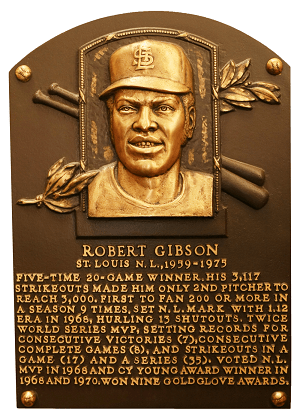
2019-04-10 BobGibsonHOF1972—The Cardinals slip back to fourth in the NL East this time. Gibson’s season overall is better than his 1971 season, his ERA back below 3.00 and a 19-11 won-lost record.

25 April, vs. the Braves—The Braves took this one, 9-3, behind Hall of Famer Phil Niekro. Gibson surrendered six of the nine runs, one unearned.

He opened the bottom of the first by plunking Felix Millan. That’d teach him: after Ralph Garr forced Millan at second, he stole second. After Aaron struck out, though, Carty singled home Garr and Earl Williams hit a two-run homer, before Darrell Evans walked and subsequently scored on a misplayed fly ball to left.

Knucksie hit Lou Brock with one out in the top of the second. After Niekro and Millan flied out to open the bottom of the inning, Garr singled and Aaron smashed a two-run homer.

The rest of Williams’s game included a ground out, an inning-ending pop out, and an RBI single. The rest of Aaron’s game included a fifth-inning leadoff strikeout, then a walk and a run scored in the seventh.

15 May, vs. the Pirates—The Pirates won, 4-1, with both Gibson and Dock Ellis going the distance. Ellis himself tied the game at one in the bottom of the fifth with a run-scoring force out. Clemente finished the day’s scoring with a three-run homer in the bottom of the seventh.

Clemente was 0-for-3 until he teed off and didn’t get to bat again in the game. But two batters after Clemente’s bomb, Gibson plunked Oliver, who’d had a 1-for-2 day until taking that one. In between the bomb and the plunk, Stargell popped out to first base.

That’ll be 33 games for Gibson surrendering a bomb and hitting a batter. Snider still sits alone, and Crawford, Stargell, and Fairly still have the only three Willie asterisks. If that’s enough to give you the willies . . .

1973—Back to a second place finish for the Cardinals, in the season where the Mets started September at rock bottom and ended up winning the weak division before beating the Big Red Machine in a testy League Championship Series and almost winning the World Series in seven games against the Mustache Gang Athletics.

Gibson had a solid season with his 2.77 ERA, though he missed almost all of August and September on the disabled list. Otherwise . . .

20 May, vs. the Expos—Game one of a doubleheader in Montreal, the Expos win, 4-1. Gibson led off the bottom of the second by hitting Mike Jorgensen with a pitch, and Bob Bailey, the next man up, promptly smashed a two-run homer. The rest of Bailey’s game: inning-ending ground out in the third, leadoff single in the sixth, inning-ending fly out in the eighth.

26 June, vs. the Phillies—Also game one of a doubleheader, in Philadelphia, and it was a 10-3 massacre with Gibson responsible for eight runs, all earned, and the carnage only began when he wild-pitched Doyle home while working to Del Unser in the bottom of the first.

With two outs and two on in the bottom of the fifth, Gibson hit Hall of Famer Mike Schmidt with a pitch. Guess he got even with Schmidt for rapping . . . an RBI single his previous time up, making the score 4-2, Phillies at the time. In the sixth, Unser hit a three-run homer to make it 8-3; Gibson was out of the game after that inning.

Make it 35 games for Gibson surrendering a bomb and hitting a batter. Snider’s still alone. Crawford, Stargell, and Fairly still have the Willies.

1974—Gibson’s age begins showing at last thanks to his bothersome knees, despite the Cardinals finishing a game and a half behind the NL East-winning Pirates.

5 April, vs. the Pirates—The Cardinals held on for a 6-5 extra-innings win, and this is the only 1974 game in which Gibson surrenders a homer and hits a batter. With two out in the first, Gibson hit Al Oliver. With two out in the third, Richie Hebner hit a two-run homer.

Hebner flied out in the fifth, then led off the seventh with a solo homer off Gibson. A fly out (Oliver), a base hit (Stargell), and a strikeout (Richie Zisk) later in the seventh, Gibson drilled Dave Parker. Hebner got to hit a leadoff double in the tenth, scoring on Stargell’s single to put the Pirates up 5-4, before RBI singles by Tim McCarver and Ted Sizemore in the bottom got the Cardinals the win.

In 1975, Gibson came to the end of the line as the Cardinals finished tied for third with the Mets in the NL East. He didn’t pitch a single game in 1975 in which he surrendered a home run and hit a batter; he hit four batters all year long.

Thirty-six times in 528 major league games Bob Gibson surrendered at least one home run and hit at least one batter in the same game. He only ever hit one such bombardier the next time the man batted in the game; he hit three such bombardiers not the next time up but in a later plate appearances in games in which they homered first; and he surrendered home runs after hitting batters with pitches in fourteen lifetime games.

He wasn’t just ‘brushing back’ batters—especially those who had hit a donga off him the time before. He was damn well trying to hit them. 

And he failed more often than not.

Even if you assume Gibson was good for a brushback pitch either right after a home run or to the same home run hitter the next time up against Gibson, the only hitter ever to get hit by a Gibson pitch the next time up against him was Duke Snider. And the only three hitters ever to get hit by Gibson pitches not immediately but still in later plate appearances in the same games were Willie Crawford, Willie Stargell, and Ron Fairly.

The only thing left to wonder, really, is just what Bob Gibson held against Roy McMillan.

Let the kids play—unless they hit you into the river

2019-04-07 RedsVPirates

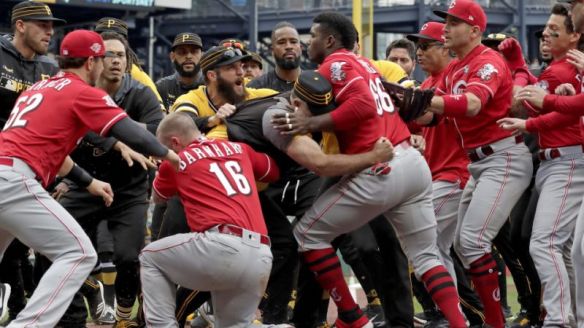
This is what happened Sunday after Chris Archer threw at Derek Dietrich for enjoying a little too much the blast he sent into the river two innings earlier . . .

Too much is more than enough and has been too long. Chris Archer needs to be suspended. Not six games, which is nothing for a starting pitcher who goes to the mound every five days. Six starts should be about right. Because this nonsense about “the unwritten rules” and “respect” is just that. Nonsense.

So what if the Reds’ Derek Dietrich lingered at the plate a few seconds before running the bases after hitting one into Pittsburgh’s Allegheny River in the top of the second Sunday afternoon? Archer, the Pirates pitcher who thinks nothing of a few elaborate little celebratory moves of his own when he strikes hitters out, decided, so everything.

Not to mention, so hypocrisy. Because before the game the Pirates tweeted a small montage of Archer’s moves with baseball’s “Let the Kids Play” promotional slogan as a tag line. Apparently, Archer believes in letting the kids play unless they send splash hits into the river on his dime, or at least on his fat enough two-seam fastball.

And the next time Dietrich batted, in the top of the fourth, Archer threw one toward his hip that sailed just behind his back. On the first pitch of the plate appearance. Anyone who thinks there was no intent involved in that pitch should probably surrender his or her credentials as a baseball commentator or analyst.

So should anyone who was surprised that Reds manager David Bell pounced immediately on the umpire who issued a mere warning, or that the Reds were unamused enough by Archer’s intent to pour out of their dugout and bullpen in hand with the Pirates pouring out of theirs.

“I was trying to go in,” Archer said. “I air-mailed a couple balls today, a couple that I was trying to elevate, a couple that I yanked when righties were up there. Another one that I just yanked. I missed—missed my spot.” Like hell he did.

“It’s just completely unacceptable for anyone to try to intentionally hurt one of our players,” said Bell, who knew what everyone in PNC Park with eyes could tell. “It’s that simple. And it was obvious.”

The pitch was about as unintentional as the driller Hunter Strickland threw into Bryce Harper’s hip two years ago. Archer’s sole saving grace, if that’s what it was, is that he wasn’t looking for revenge over an almost three-year-old pair of home runs. But he was looking for something to take the edge off his ego being flown into the river.

Which makes Nationals reliever Sean Doolittle a prophet without honour yet. “I promise you, they’re not disrespecting the game,” Doolittle said last fall of the bombardiers who hit long distance and celebrate it on the spot. For the pitchers who surrender those bombs, Doolittle had a further message: “If you got your feelings hurt, that’s on you. If a guy hits a home run off me, drops to his knees, pretends the bat is a bazooka, and shoots it out at the sky, I don’t give a shit.”

The Sunday scrum’s highlights involved Yasiel Puig, who’s having a slow start to his own season but who doesn’t suffer either fools or those throwing at his teammates gladly. He had to be restrained by teammate Joey Votto and Pirates catcher Francis Cervelli after trying to headlock Pirates bench coach Tom Prince, then broke away pouring back into the crowd in the front of the infield before being restrained again.

“When people watch the ball go far away or do bat flips,” Puig said after the 7-5 Pirates win, “like I do before, in the next (at-bat) try to strike out the guy. Don’t try to hit the guy, because we can’t defend you back because we can’t hit you with a bat or nothing.”

Pirate relief pitcher Felipe Vasquez made two mistakes. One was coming onto the field without his uniform top on to join the scrum, which got him ejected along with Bell, Puig, Reds pitcher Amir Garrett, and fellow Pirates pitcher Keone Kela. The other was what he said about the Dietrich river bomb.

“He shouldn’t have done that. That’s against the principles. If you do something like that, you’re going to pay for it,” said Vasquez. “We’re trying to play the game like we have to, respect the game. He shouldn’t do it. (Votto) can do it because he’s been here a long time, but for a guy like that, he’s not supposed to do something like that . . . I think it was a little too much.”

Oh. You’re only allowed to have fun based upon your major league service time. (The 29-year-old Dietrich has returned from being designated for assignment during the offseason, and he’s bounced between the Show and the minors quite awhile.) Vasquez must be a regular riot at weddings, checking to see who’s been friends the longest with the happy couple before pronouncing who shall or shall not be allowed to bust what moves on the dance floor.

If that’s the Pirates attitude, they should play baseball in business suits. Come to think of it, they wore throwback uniforms on Sunday, replicas of their late 1970s-early 1980s uniforms, the ones that made them look like a cheap beer-league softball team. They’d have looked better in the business suits.

But they’d be better off remembering the words of their own Hall of Fame legend, Willie Stargell: “The umpire doesn’t say, ‘Work ball’.” Those defending Archer should ask themselves why baseball should be all business on the field but off the field, when it comes time for players to get their fair market value, suddenly it’s a game, to be played, again?

So Dietrich couldn’t resist admiring a shot he and everyone in the park knew was going to land in the drink? Big deal. The next time up, put your ego to one side and just get his ass out. It really is that simple.

The Pirates won the game but Dietrich had the last laugh, after all. In the top of the eighth, he hit one that settled for landing in the right center field seats. They can’t all be splash hits.

The hard-earned honour of Henry Aaron

2019-04-08 HenryAaron715

8 April 1974: Henry Aaron, swinging into history.

It really has been forty-five years since Henry Aaron laid waste to Al Downing’s 1-0 service and Babe Ruth’s career home run record. Forty-five years since Milo Hamilton’s immortal holler, through the din of Fulton County Stadium, “There’s a new home run champion of all time, and it’s Henry Aaron!”

Forty-five years since Aaron rounded the bases, accepting handshakes from every Dodger infielder, and plunged into a crowd at home plate that included, somehow, and much to his surprise, his parents. Forty-five years since Vin Scully, the Dodgers’ broadcaster whose team was the victim as Aaron swung into history, purred inimitably:

He means the tying run at the plate now, so we’ll see what Downing does . . . Al at the belt now, and he delivers, low, ball one. And that just adds to the pressure, the crowd booing. Downing has to ignore the sound effects and stay a professional and pitch his game . . . One ball, no strikes, Aaron waiting, the outfield deep and straight away. Fastball — and a high drive into deep left center field, Buckner goes back, to the fence, it is gone!!! . . . (long pause during crowd noise and fireworks) . . .

What a marvelous moment for baseball, what a marvelous moment for Atlanta and the state of Georgia, what a marvelous moment for the country and the world. A black man is getting a standing ovation in the deep South for breaking a record of an all-time baseball idol. And it is a great moment for all of us, and particularly for Henry Aaron, who was met at home plate not only by every member of the Braves, but by his father and mother . . . It is over, at 10 minutes after nine in Atlanta, Georgia, Henry Aaron has eclipsed the mark set by Babe Ruth.

Forty-five years, since the unconscionable pressure of mental cases plying Aaron with hate mail for daring to even think about passing the Sacred Babe; of racists plying him with hate mail and death threats enough to require police and even FBI protection for the unassuming outfielder whose career wasn’t bigness as much as it was sustained excellence.

And, alas, forty-five years, since his own team strove to cheapen a one-time-only achievement by putting the gate ahead of the game.

Aaron entered 1974 needing one homer to tie and one more to pass Ruth. The Braves entered 1974 bent on making damn well sure he could do both before the home audience alone, the Braves’ first homestand due to begin after a season-opening visit to Cincinnati. Boy, wouldn’t that have been great for the gate at the old Launching Pad!

Three New York sportswriters (for the record: Dick Young, the New York Daily News; Dave Anderson, the The New York Times; Larry Merchant, the New York Post) said not so fast, post haste. They denounced the plan without softening their prose or apologizing for their stance, and ramped up a drumbeat on behalf of convincing then-commissioner Bowie Kuhn to thwart  the plan.

Furman Bisher of the Atlanta Journal-Constitution led an equally passionate counterattack and denounced the New York writers as “meddling Manhattan ice-agers” who would do better to demand the cleanup of Times Square before criticizing the sainted Braves one of whom was about to blast the Big Fella out of the books without wearing a uniform from New York.

What the Braves wanted to do hadn’t exactly been unheard of in baseball to that point, alas. When Stan Musial struck toward his 3,000th career hit, the Cardinals were playing the Cubs in Wrigley Field and Musial shot number 2,999 his first time up in the second game of the set. Cardinals manager Fred Hutchinson elected to sit Musial in the final game of the set, with the Cardinals due for a home-stand to follow, unless he needed Musial to pinch hit.

W.C. Heinz, once a New York Sun sportswriter who’d since turned to magazine writing, put it this way to Red Smith (then of the New York Herald-Tribune):

Maybe I’m speaking out of turn, but it seems to me Hutch is sticking his neck out. His team got off to a horrible start and now it’s on a winning streak and he’s got a championship game to play tomorrow, without his best man because of personal considerations. Not that the guy hasn’t earned special consideration, but from a competitive point of view I think it’s wrong. If the Cardinals lose tomorrow, Hutch will be blasted. He’ll be accused of giving less than his best to win and it will be said the club rigged this deliberately for the box office, gambling a game away to build up a big home crowd.

As things turned out, the Cubs were up 3-1, the Cardinals had a man on second, and Hutchinson sent Musial up to pinch hit. Musial hit the sixth pitch of the sequence for an RBI double. Hutchinson lifted him for a pinch-runner; the Cubs stopped the game to pay Musial tribute; and, the Cardinals kept the rally alive and went on to win the game.

Musial was allowed to do it the right way, after all. Back home in Sportsman’s Park the following night, Musial got an elongated standing O from the home audience and thanked them with a drive over the right field pavilion.

Smith would have something to say, too, when Kuhn stepped in and ordered the Braves not to even think about sending out a lineup lacking Aaron:

He explained to [Bill] Bartholomay what self-interest should have told the Braves’ owner, that it is imperative that every team present its strongest lineup every day in an honest effort to win, and that the customers must believe the strongest lineup is being used for that purpose. When Bartholomay persisted in his determination to dragoon the living Aaron and the dead Ruth as shills to sell tickets in Atlanta, the commissioner laid down the law. With a man like Henry swinging for him, that’s all he had to do.

2019-04-08 EstellaAaronHenryAaron

Estella Aaron made bloody certain her baby wouldn’t make history without a hug and kiss from Mom.

Thus did Aaron appear in the Opening Day lineup against Jack Billingham, a Reds pitcher against whom he’d already had four home runs lifetime. Aaron merely drove one over the left field fence in that very first plate appearance to tie Ruth, vindicate Kuhn, Young, Anderson, Merchant, and anyone who believes in honest competition, and receive a pleasant commemoration from Kuhn after he finished rounding the bases.

Braves manager Eddie Mathews, a Hall of Fame third baseman and longtime Aaron teammate as it happens, sat him for the second game of the set, provoking Kuhn to order Mathews to put Aaron back into the lineup for the series closer. Aaron missed fair and square, when the Reds’s Clay Kirby struck him out twice and lured him into a ground out. And home went the Braves.

The first time up against Downing, in the second inning, Aaron walked and scored on an error. Come the fourth, Aaron squared Downing up for the milestone mash. Once a Yankee comer but turned journeyman by a few injuries, Downing earned his living with a fastball that tailed away from right-handed hitters and crawled in on left-handed hitters. This time, it didn’t tail away.

And with one smooth, unadorned, unaffected swing, the ball sailed parabolically into the left center field bullpen.

With the same swing, Aaron demolished all the mental cases, all the racists, and (there were a few) all the baseball Luddites to whom shoving Ruth to one side in the career bomb record books was even more blasphemous than Roger Maris shoving Ruth to one side in the single-season record book thirteen years earlier.

But Aaron also demolished his own team’s shabby pretentiousness and, running four bases, stood foursquare for earning his milestones the old fashioned way. And once he made his way through the home plate crowd of adoring teammates, he got hit with a big kiss on his face from his mother, Estella. “I don’t remember the noise,” Aaron said later.

Or the two kids that ran on the field. My teammates at home plate, I remember seeing them. I remember my mother out there and she hugging me. That’s what I’ll remember more than anything about that home run when I think back on it. I don’t know where she came from, but she was there.

On 8 April 1974 Atlanta, the South, the United States, and the world learned where Henry Aaron came from. To remember how honorably as well as how courageously he got to meet, greet, and pass Ruth would be nothing less than his due.

“I don’t want anybody to forget Babe Ruth,” Aaron said modestly. “I just want them to remember Henry Aaron.” I think he’s gotten his wish a thousandfold.


A different version of this column was published in 2014.—JK.