WS Game Two: Hunted, pecked, pricked, poked

Max Fried

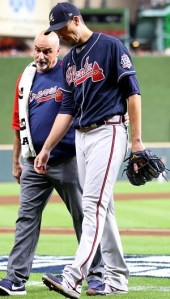
Max Fried—getting stung repeatedly in the second hurt almost worse than if he’d been bludgeoned.

If you look purely at the line score of World Series Game Two, you’d think the Braves had their heads handed to them in the bottom of the second. But if you watched the game, you know the Astros dismantled them, almost too simply, and with some inadvertent help from the Braves themselves, to win 7-2 Wednesday night.

As a matter of fact, when the game began you could have been forgiven for thinking it might turn into a bit of a pitching duel despite the teams swapping a run each between the bottom of the first and the top of the second—one on a solo home run, one on a sacrifice fly.

Overall that’s about how the game shook out—if you didn’t include the Astros’ hunt-peck-prick-and-poke of four runs out of Braves starter Max Fried in the bottom of the second, after he fooled Carlos Correa into looking at a particularly nasty third-strike curve ball. Jose Altuve’s eighth-inning home run almost seemed a by-the-way insurance run.

“We didn’t want to go to Atlanta down by two,” Altuve said postgame. “So we left everything we had in there tonight. Obviously, very important win to tie the Series to keep going from there.”

“Obviously, I’m not happy about it.” said Fried. “Playoffs is a big momentum game. You’ve got to do everything you can to keep the crooked number off the scoreboard.”

It might actually have hurt less if he’d been bludgeoned than it did the way he was pecked in the second. And, if Astros starter Jose Urquidy hadn’t brought his A game to the mound, leaving the Braves mostly unable to hit him even if they’d swung warehouse gates.

Fooling Correa into the strikeout must have seemed aberrant even to a pitcher who struck out six in five innings’ work and walked only one batter. The second inning made Fried’s outing look far worse than it was in the long run, but a true shelling it wasn’t. It was like getting stung by angry hornets one after the other a few times before he finally slithered out of it.

It started with Kyle Tucker spanking a base hit up the middle and Yuli Gurriel punching one through the shift-opened right side for a base hit to follow up at once, sending Tucker to third. Fried jammed Jose Siri into a slow tumbling grounder to the far left side of the mound, but Tucker came home when they couldn’t get the swift Siri at first.

Then Martin Maldonado, a catcher so prized for his work behind the plate that Astro manager Dusty Baker bears with his pool noodle of a bat, punched one through the left side for a base hit. The problem now was the Braves’ usually sure-handed, sure-armed defense.

Left fielder Eddie Rosario came up with the ball and threw to third in a bid to stop Siri if they couldn’t stop Gurriel from scoring. Only third baseman Austin Riley came trotting down the line to serve as the cutoff man, and shortstop Dansby Swanson got caught unable to get to third covering in time because he was in short left. Rosario’s throw thus sailed wild and Siri sailed home with the fourth Astro run of the night. Ouch!

Maldonado went to second on that throw and took third when Braves catcher Travis d’Arnaud let one escape with Altuve at the plate in an 0-2 count. Altuve flied out with Maldonado having to hold at third, but Michael Brantley pulled a base hit to right on which Maldonado could have walked home safely, making it 5-1.

Innings like that are as common to the Astros when they’re swinging right as you might think the big bombing innings would be. But they were the best in the game this year at avoiding strikeouts at the plate and hitting in most directions out to the field.

They may also have picked up on Fried tipping pitches. No, they’re not pulling another Astro Intelligence Agency trick or three. The rules since Astrogate’s explosion and aftermath include maximum replay room security. But the Astros were known without and before any Astrogate shenanigans for picking up even the tiniest tells from opposing pitchers and exploiting them mercilessly.

Fried’s habit of wiggling his glove fingers around the ball in his hand rapidly as he prepares to throw to the plate, like an amphetamine-driven lobster clawing its dinner down to manageable bites, may well have handed the Astros inadvertent but invaluable pitch  intelligence. After the second, Fried quit the glove snapping for the most part—and retired the next ten hitters he faced.

When Yordan Alvarez walked and Correa sent a base hit to left opening the bottom of the sixth, Braves manager Brian Snitker hooked Fried in favour of Dylan Lee. After Tucker forced Correa at second with Alvarez taking third, the Braves’ defense faltered into the sixth Astro run.

Gurriel grounded sharply to Swanson at shortstop. He threw to second baseman Ozzie Albies hoping to start an inning-ending double play. Albies lost the ball as he turned to throw on to first. Tucker was ruled safe until a review was called—did Albies have control of the ball to get the out while losing it as he drew the ball out of his glove to throw on?

Several television replays showed Albies lost control of the ball after all, but not by as much as first surmised. The safe call held, and Alvarez scored, but Albies’s throw wasn’t in time to get Gurriel at first. Lee shook off a rather daring double steal to set up second and third by striking Siri out. Snitker brought in Jesse Chavez, and Chavez got Maldonado to fly out for the side.

The Braves got their second run in the top of the fifth when Freddie Freeman singled d’Arnaud home. Other than that, both bullpens kept each side behaving itself except for Altuve sending Drew Smyly’s first pitch of the bottom of the seventh into the Crawford Boxes, before the veteran reliever fell into and squirmed out of his own bases-loaded jam with no further damage.

Maybe the true shock of the evening was the Braves handing the ball to Kyle Wright for the bottom of the eighth. Wright’s a 26-year-old pitcher with a 6.56 fielding-independent pitching rate in four seasons. He had a 9.64 FIP and a 9.95 ERA in two brief starts on the regular season while up and down from the minors.

Throwing that against the Astros was something like offering to assure Hall of Famer Henry Aaron would face nothing but batting practise pitchers by decree, right? Wrong. Wright shocked the entire ballpark by striking the side out in order—including Maldonado and Altuve looking at third strikes after Siri opened with a three-pitch swinging strikeout.

“It was so encouraging to see Kyle tonight,” said Snitker postgame, even if he was thrown up as a sacrificial lamb in a lost game. “Just getting in there for that one inning and getting him out there and experiencing this atmosphere because he could play a huge part going forward. I thought he threw the ball extremely well.”

Wright lived on effective curve balls and sinkers Wednesday night. Snitker was inspired enough to ponder possibilities for Wright to spot start or even open a bullpen game during the Atlanta leg. With Charlie Morton gone thanks to that fibula fracture, Snitker needs to get even more creative with his pitching arrays now. Wright’s surprise may lift some of that burden a hair or two.

“He was locating,” said catcher d’Arnaud postgame. “His sinker was moving a lot. His curveball was moving a lot. He did a tremendous job. When I caught him in a rehab game for me, he looked exactly the same as he did that day. It was fun working with him, and it was great seeing him have the success today, especially in the World Series.”

With the tied Series moving to Atlanta for three possible games, thus switching the Braves to a home field advantage, it’s comforting to know that near the end of a night the Braves were pecked to death they might have found the Wright stuff, for however long.

WS Game One: Flash! Bash! Alakazam!

Jorge Soler

Soler swings into history and toward a Game One Braves win . . .

Yordan and Eddie Tonight, the Miniseries? The show went on, but they weren’t exactly the stars of the show Tuesday night.

Oh, they performed rather splendidly. But they turned out the headliners blown off the stage by the fourth-lowest opening performer and a wild animal act.

Which is just what Jorge Soler did with the third pitch of World Series Game One from Astros starter Framber Valdez. And, what the Braves bullpen did to the Astros the rest of the way in an emphatic enough 6-2 Braves win.

Fresh off his marquee performance against the Red Sox toward the Astros’ American League pennant, Valdez could only watch with everyone else in the Minute Maid Park house as Soler became the first player in major league history to open a World Series opener with a home run.

The audience could only watch, too, with a hybrid of frustration broken up only occasionally by their usual racket while four Braves relief pitchers kept the Astros to their only runs of the game. Not to mention helping guarantee the Braves a temporary home field advantage at least.

Valdez fell behind Soler 2-0 when he threw a sinker that dumped enough ballast en route the plate that it had altitude enough for Soler to send it on hefty flight into the Crawford Boxes above the left field scoreboard. A ground out (Freddie Freeman), an infield single (Ozzie Albies, beating out a grounder wide of the mound’s left side), and a quick theft of second later, Austin Riley split the left center gap with the RBI double.

The game wasn’t even half an hour old, and already fans of both teams must have asked, Yordan who? Eddie what?

That was before the Braves more or less snuck a third run home in the second—back-to-back opposite-field singles (Travis d’Arnaud to right, Joc Pederson to left), a long fly to the center field wall enabling two tag-ups and second and third, and Soler’s grounder to short getting Pederson caught in a rundown while d’Arnaud crossed the plate.

And, before Eddie Rosario pulled a leadoff base hit to right in the third and—following a come-back-on-message visit to Valdez from Astros pitching coach Brent Strom—Adam Duvall turned a hanging changeup into a cruise missile straight into the Crawfords and sent Valdez out of the game.

“It was my first World Series game, so I’m not going to tell you that I didn’t feel the pressure,” Valdez admitted postgame. “I think just being behind in the count so much is what hurt me more than anything in this game.”

In between Soler’s Series-opening history mark and Duvall’s two-run rip, Morton too a hard smash from Yuli Gurriel off his leg to open the Houston second. The ball ricocheted to Freeman at first for a simple enough out. Morton pitched on, getting the next two outs to end the second and then striking Jose Altuve out called on a particularly nasty curve ball.

“That one got me good,” Morton’s said to have told his catcher d’Arnaud of the Gurriel comebacker that ended up ending his season. “I’m sorry,” Morton told any and everyone who happened by after his exit and after the game ended.

He’d looked distinctly uncomfortable before throwing Altuve that out pitch. He looked pained but determined after it. Pained enough to come out of the game. He turned out to have pitched to three Astros on a broken fibula that means the end of his postseason and the Braves having to do what they’ve done best in an injury-dominated year—skip out of the way at the last second when disaster comes careening down the street.

A 37-year-old veteran channeling his inner Bob Gibson (1967: tried to pitch on after fellow Hall of Famer Roberto Clemente ripped one off his leg; fracture kept him out thirteen weeks)—and apologising for it postgame. “[I]f that doesn’t tell you everything you need to know about Charlie Morton,” said Freeman postgame, “I’m not sure what does.

Morton’s been there, done that. His career’s first half was as much big and small injuries costing him a lot of his prime time as it was pitching like a craftsman in six postseasons with one World Series ring and a splendid-enough 3.35 lifetime postseason earned run average to show for it. The man is nothing if not a walking exercise in pain management.

“I didn’t think it was broken,” d’Arnaud said. “I just thought he took a line drive off of his leg. But to go out there and strike out the next guy with a broken leg, it blows my mind.” Actually, it turns out Morton’s first X-rays showed no break, but he probably stressed his leg into the break while working on Altuve.

This is the Braves’ lot in 2021 so far. They incurred, dodged, withstood, and found ways to sneak through disaster to get to the postseason in the first place, never mind the World Series. A leg fracture taking their elder starting pitcher out for the rest of the way? Tell them about it. It wouldn’t shock them if they woke up on Game Two day having been kidnapped for the unreachable ransom.

Charlie Morton

Charlie Morton, escorted from the field in the third.

“No kidding. I don’t want to know what’s next,” said manager Brian Snitker after Game One. “But this is what we do, right?” Right. Nothing to it. Hit them with a tidal wave. Send them another hurricane riding the oblivion express. To these Braves those are just sun showers and some autumn breezes.

So far. It’s not that the Braves push their luck by design or premeditation. But you can’t help wondering just how many times they can still just wave their magic bats, gloves, or arms, and—flash! bash! alakazam!—make the other guys disappear.

Snitker had to reach for one of those arms a lot sooner than he might have expected going in. He brought AJ Minter in to take over for Morton. Minter pitched two and two thirds that would have been shutout ball if shortstop Dansby Swanson, usually one of the most sure-handed, sure-footed of the breed, hadn’t inadvertently kicked Astro center fielder Chas McCormick’s hard one-out, first-and-third grounder aside, enabling Kyle Tucker (one-out double) to score the first Astro run.

Luke Jackson followed Minter with one and two-thirds scoreless pitching before handing off to Tyler Matzek with lefthanded swinger Michael Brantley coming up with two outs in the seventh. He shook Brantley’s base hit off to strike Alex Bregman out looking for the side. But he couldn’t do a thing about Alvarez’s leadoff triple to the rear of right center opening the bottom of the eighth.

Alverz came home almost predictably when the next Astro batter, Carlos Correa, grounded out to second. After Matzek struck Tucker out on a somewhat violent swing, Gurriel ripped a drive off the left center field wall whose carom Rosario played perfectly, before throwing in perfectly to nail Gurriel at second trying to stretch the hit.

Or was it? At first glance it looked as though Gurriel’s drive hit on or above the yellow line atop the wall, which would have meant home run. Several television replays confirmed what the umpires on review ruled for certain—the ball struck the wall clearly if just barely below the line. Hocus pocus!

Not that it would have mattered in the end. The Braves landed an extra insurance run in the top of the inning, when Swanson wrung himself into a one-out walk and Soler on a check swing squibbed one into no man’s land beyond the mound that Astros reliever Ryne Stanek couldn’t get on a dive. Enabling Swanson to take third, before Freeman popped out to short right with Swanson on the run home and sliding in safely around Astro catcher Martin Maldonado’s backswinging tag attempt. Shazam!

So the Braves’ M&M Bulls didn’t do it with quite the howitzer heft by which they pinned the Dodgers to the wall winning National League Championship Series Game Six. But they did just what they had to do and kept the Astros from even thinking about a Game One overthrow regardless.

Will Smith shook a leadoff walk to pinch-hitter Aledmys Diaz off in the bottom of the ninth to get three straight ground outs—two force outs at second base, and a ground out to second—and that ended the game.

Abracadabra!

“Our team doesn’t worry,” said Astros manager Dusty Baker postgame, “and our team’s very confident. We have the knack of bouncing back after losses, after tough losses because they don’t quit, they don’t give up, they don’t get down. That’s the secret of sports.”

Beware, Mr. Baker. Your very confident Astros are up against a team that’s had to bounce back from tougher losses than Game One.

These Braves had to bounce back from losing their junior franchise face to a season-ending injury, after losing key young pitcher to a re-injured Achilles tendon and a key bomber to domestic violence protocols. Not to mention losing their leadoff hitting right fielder to COVID for the entire division series and most of the NLCS.

So the Braves will have to find a few more creative ways to survive losing their elder starter and clubhouse sage for the rest of the Series, too? Big whoop. Bad as losing Morton is, this, too, comes right into this year’s wheel house. They’d surely rather not, but where other teams crumple under the weight of forced creativity, these Braves thrive on it. So far.

ALCS Game Five: Nuts to that

Chris Sale

“I was good for five, then sucked for one. I left my nuts out on that mound.”—Chris Sale, after ALCS Game Five.

It’s bad enough when the move you make gets turned into disaster. It’s worse when the move you don’t make explodes in your face—and puts you on the threshold of postseason elimination.

Red Sox manager Alex Cora, more creative and fearless than many managers in baseball today, learned the hard way in the top of the sixth in American League Championship Series Game Five Wednesday evening.

He needed to keep the Astros to a 1-0 lead on a night the usually formidable, tenacious, but suddenly feeble Red Sox bats had nothing to show against Astros starting pitcher Framber Valdez.

Valdez would carve them like turkeys over most of his eventual eight innings’ work other than one seventh-inning slice. But it was Astros left fielder Yordan Alvarez who stuffed the Red Sox birds first and almost foremost.

With Jose Altuve opening the sixth with a walk, Michael Brantley aboard when Red Sox first baseman Kyle Schwarber couldn’t hold onto Xander Bogaerts’s throw from shortstop, and second and third when Alex Bregman was thrown out at first on a clunking grounder back to Red Sox starting pitcher Chris Sale, up stepped Alvarez.

The same Alvarez responsible for the game’s only scoring with a first-pitch leadoff home run into the Green Monster seats in the top of the second. The same Alvarez who nailed a long one-out single off the top of the Monster sending Bregman to third in the top of the fourth, before Sale struck Carlos Correa and Kyle Tucker out swinging to end that inning.

This was one time today’s version of Casey Stengel might have been served far better if he’d decided no way would Alvarez get a third crack at Sale, and ordered the intentional walk to load the bases, setting up a prospective inning-ending double play.

Cora would have had far better odds letting Sale pitch instead to Correa, whom he’d struck out twice on the day already. But he let Sale pitch to Alvarez first. And Alvarez shot a line drive the other way down the left field line, sending Altuve and Brantley home with the second and third unanswered Astro runs.

Cora lifted his stout starter—who’d pitched five innings of one-run, seven-strikeout, two-hit baseball until he walked out for the sixth. Sale wouldn’t blame Cora, though. “I was good for five, then sucked for one,” said the lefthander still getting his wings back into tune after recovering from Tommy John surgery. “I left my nuts out on that mound tonight, that’s for sure.”

You have to give Sale credit for a somewhat unique way to express his self-verdict. You may yet end up giving him the blame for writing the Red Sox’s 2021 postseason epitaph.

Whatever Sale left on the mound, the Red Sox bullpen had enough of their nuts handed to them, coarsely chopped, for six more runs and a 9-1 Astros win that sends the ALCS back to Houston, with the Astros having two chances to go to the World Series and the Red Sox needing to beg, borrow, steal, sneak themselves two. Whatever works.

Ryan Brasier relieved Sale to let an RBI single tack a fourth run onto Sale’s jacket before allowing two of his own, on Jose Siri’s shallow floating single to right sending Tucker and Yuli Gurriel home.

Hansel Robles’s throwing error on a pickoff attempt in the top of the seventh let Altuve have second on the house and set Brantley up to fire an RBI single up the pipe, before getting Bregman to dial Area Code 6-4-3 and stepping aside for Darwinzon Hernandez.

Hernandez dropped a called third strike in on Alvarez, of all people, to end the inning. He yielded to Hirokazu Sawamura after a one-out walk to Tucker in the eighth. Sawamura surrendered a single to Gurriel and wild-pitched him to second but bumped his way out a first-and-second jam striking Siri out and getting Altuve to line out to left for the side.

But Martin Perez came on for the ninth and found himself with two on, nobody out, when Alvarez bounced sharply right back to the box and Perez knocked the ball down, chased briefly, grabbed it, and threw Alverez out.

Then Cora ordered the free pass—to Correa, who hadn’t exactly bedeviled the Red Sox on the night. And when Red Sox second baseman Christian Arroyo took Tucker’s grounder on the dead run in and threw home to force a sliding Brantley out at the plate, it was impossible to forget the intentional walk that wasn’t back in the sixth. Especially when Gurriel promptly punched a base hit to center, sending Bregman and Correa home too handily.

The only Red Sox answer for any of that mayhem was Rafael Devers sending a one-out, none-on tracer into the Monster seats in the bottom of the seventh. Otherwise they spent the evening doing what the Astros did earlier in the set, showing futility with men in scoring position (0-for-4) while the Astros looked more like the earlier-set Red Sox. (6-for-15.)

What compelled Cora to send Sale back out for the sixth? The Red Sox manager to his credit has rarely if ever shown an allergy to hooking a starter before that starter can get hooked.

“I understand how people think,” Cora said postgame, “but there were two lefties coming up too in that pocket, right? Brantley, who he did an amazing job early on, and we had Alvarez. Still, he is Chris Sale. He is a lefty. He has made a living getting lefties out.”

Sale did strike Brantley out twice before the sixth. But it couldn’t and shouldn’t have escaped Cora’s usually fine-tuned eye that Alvarez was manhandling Sale entirely on his own before the sixth.

Nor should it have escaped Cora’s analytically-inclined eye that, since Alvarez showed up in the Show at all, the Astros left fielder has .580 slugging percentage against lefthanded pitching—the highest lefthander-on-lefthander slugging percentage in the majors over that span.

Cora may also think twice before using Perez in high leverage again. The lefthander’s regular-season 4.82 fielding-independent pitching rate should have been flashing “danger, Will Robinson” as it was. But Perez only appeared in high leverage 32 percent of his season’s assignments. In the Game Four ninth, Brantley tore a three-run double out of him to put the game beyond reach at last.

We’ll learn the hard way, too, whether using his Game Six starter Nathan Eovaldi to open the Game Four ninth in relief will end up hurting, not helping. Especially with Eovaldi now going out to pitch not to send the Red Sox to the World Series but to stay alive at all.

Sure, the Red Sox got jobbed when plate umpire Laz Diaz called ball two on what should have been inning-ending strike three, enabling the Red Sox a better shot at coming back to win. But giving the Astros an unnecessarily extra look at the tenacious righthander may yet burn Cora and the Sox.

First things first. If the Red Sox want a little extra inspiration and moral support, Cora can’t afford to outsmart himself again. Then, they ought to dial the 2019 Nationals.

Winning that World Series, the Nats proved you can wreck the Astros in their own house even once back-to-back, never mind twice in the biggest set of them all. To get to that biggest set this time, the Red Sox now need all of that kind of help that they can get.

A principled Peter

2019-11-12 PeteAlonso

Pete Alonso hit one for the record book on 28 September, but the NL Rookie of the Year struck a bigger blow for respect on the 9/11 anniversary.

It’s not that Pete Alonso didn’t have the kind of season that deserved the honour. But sometimes baseball award voters are human enough to pick a winner based on something equal to and maybe a little better than his performance—even performance that would blast in neon, as Alonso’s did this year.

Voting Alonso the National League’s Rookie of the Year, they may have thought both.

Alonso’s season performance by itself would have been enough to nail him the award, even if you can make the case that Braves pitcher Mike Soroka—who got the one first place vote Alonso didn’t get—had at least an equivalent season on the mound.

Breaking the rookie season home run record (with a major league-leading 53), creating 126 runs and using only three outs a run to do it, and producing 220 (100 scored, 120 driven in) runs on the season, gets you attention in a big enough hurry. So do three out of a possible six National League Rookie of the Month awards, which Alonso won in April, June, and September.

So does helping put the game back into the game with your enthusiasm, on a team that needed it in the worst way possible this side of the world champion Nationals. The Mets lacked for sharks, baby and otherwise, but thanks to Alonso they became abundant in jersey stripping on game-ending, game-winning hits during their surprising post-All Star break run.

So does a shameless and welcome display of emotion such as Alonso—who’d made the Mets out of spring training on a non-roster invitation—showed when he nailed Soroka’s rotation mate Mike Foltynewicz on the next to last regular season night in New York for the record, then couldn’t hide the tears when he returned to first base.

But so does finding the way to elude baseball government’s edict against special haberdashery commemorating the 9/11 atrocity, as Alonso did for that very anniversary. The Mets and a few other teams wanted to wear such hats; baseball government said no, stick with the official commemorative patches on the sides of the uniform hats.

Alonso said not so fast.

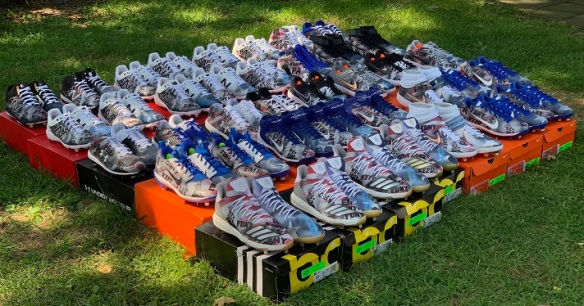
Telling no one but his fellow Mets what he was up to, Alonso gathered up the shoe sizes of his teammates, manager, and coaches, then arranged for special commemorative cleats to be made for the game by Adidas, New Balance, and other top athletic shoemakers. It isn’t every major league rookie who delivers the kind of audacity that ennobles his team and his game.

2019-09-13 Mets911Shoes

The shoes that put the Mets’ best feet forward on 9/11.

The cleats featured American flag striping, the initials of first responder agencies, a small image of New York firefighters raising an American flag at Ground Zero, and a silhouette of the Twin Towers. Making the major league rookie salary of $550,000 for the season, not to mention winning $1 million as this year’s Home Run Derby champion at the All Star break, Alonso paid for every pair of the special cleats himself.

“For me, this season has been an absolute fantasy. I just want to give back. I want to help,” said Alonso, a Florida first grader when the atrocity happened. “I don’t just want to be known as a good baseball player, I want to be known as a good person, too. And I just want to really recognize what this day is about. I don’t want it to be a holiday. I want it to be a day of remembrance of everything that happened. It was an awful day.”

He hatched his podiatric plot well in advance of the 9/11 anniversary, and it’s not exactly impossible that the Mets being so unified as a team on the matter might have kept baseball’s customarily capricious official leadership from sanctioning the team.

It probably didn’t hurt, either, that a little favour fell upon the Mets from the Elysian Field gods that night. Their surprising bolt out of the post All-Star gate could only get them to within three games of the National League’s second wild card, proving that even the subordinate gods work must work within a budget, but they could at least spend a little extra on the 9/11 anniversary itself.

Thus did the Mets, wearing Alonso’s subversive commemorative cleats, shut the Diamondbacks out on . . . nine runs and eleven hits, including six home runs, two (Todd Frazier, Brandon Nimmo) back-to-back in the Mets’ five-run first, and with Frazier and Jeff McNeil each hitting a pair of them before the carnage was finished.

The following night, the Mets again nailed eleven hits off the momentarily hapless Diamondbacks, but this time they were good for eleven runs, the big blow the first of Juan Lagares’s pair of blasts, in the bottom of the third. The center fielder checked in with the bases loaded, nobody out, and the Mets up 1-0 on an unearned run, then hit a full count service from Alex Young into the left field seats.

And any threats of fines or disciplinary measures against Alonso or the Mets over the commemorative shoes went unfulfilled.

Yordan Alvarez, the Astros’ phenom bombardier, was named the American League’s Rookie of the Year unanimously, beating out Orioles pitcher John Means, Rays second baseman Brandon Lowe, White Sox outfielder Eloy Jimenez, and Blue Jays second baseman Cavan Biggio—the son of Astros Hall of Famer Craig Biggio.

By arriving in a June callup after decimating the two highest minor league levels, Alvarez has the second-shortest Rookie of the Year season behind Hall of Famer Willie McCovey. And, as Alonso did in the National League, Alvarez won a trio of American League Rookie of the Month prizes. (June, July, August.)

He premiered by teeing off against another Oriole pitcher, Dylan Bundy. He went on to tie the rookie record for the most home runs in 100 games or fewer, hit righthanders and lefthanders with equal deadly force, and followed an almost invisible American League Championship Series by hitting .412 with one bomb in the Astros’ seven-game World Series loss.

The third Rookie of the Year in Astro history—Hall of Famer Jeff Bagwell won the award in 1991; Carlos Correa (2015) became the first Astro to win it after they were moved into the American League—Alvarez is Alonso’s near-opposite, the strong, silent type. He shares Alonso’s essential humility, but you’re not likely to see him shred the jersey away of any Astro nailing a game-ending hit. Yet.

“He’s a quiet man by nature,” says his manager A.J. Hinch, “and his demeanor is very low key. But he’s always in tune with other players and other people and the information.”

Alonso is the Mets’ sixth Rookie of the Year, following Hall of Famer Tom Seaver (1967), Jon Matlack (1972), Darryl Strawberry (1983), Dwight Gooden (1984), and Jacob deGrom (2014), and only the second Mets position player (after Strawberry) to win the prize. His race for the prize might have been a lot closer, maybe even lost by a hair, if the Padres’ phenom Fernando Tatis, Jr. hadn’t been held to 84 games thanks to the injured list.

Interesting synergy. This year’s Rookies of the Year belong to a pair of teams born from the same expansion draft, for 1962. Neither of whom could possibly have imagined the day to come when one would be the team to be named later when a third expansion team, the Brewers, would be traded to the National League.

But Alonso played all but one game in 2019. And it took the Mets’ often-criticised general manager Brodie Van Wagenen, a former players’ agent, to convince the club to take Alonso north with them when spring training ended, rather than do as too many other clubs have done with promising youth and bury him one more year in the minors for the sake of extended team control.

Unlike in days of Mets future past, there’s a realistic chance that they might be able to lock Alonso down on a longer-term commitment when his first free agency comes within not-so-distant sight. They’ll be freed of major commitments to too-oft-injured Yoenis Cespedes (in danger of missing all of 2020 as well off multiple-ankle and knee surgery) and aging Robinson Cano well enough when that day arrives.

Assuming Van Vagenen makes no more trades that involve importing still-onerous contracts, such as the deal that landed Cano in the first place, the Mets would be able to keep Alonso in the blue and orange for a long enough time to come. Assuming Alonso continues the kind of performance he showed exponentially in 2019, it would be manna for a franchise that often forces its fans to dine on quail.

And in this case we’re not talking strictly about Alonso’s performances at the plate or at first base, where he shook away the periodic hiccup to establish himself as more than capable afield. Whether Alonso proves the equal of Mets legend Keith Hernandez, who revolutionised the position by making it one of infield leadership as well as fielding virtuosity, remains to be seen, but he showed the potential for either or both.

He showed more than the right stuff in uniform. First, he sent a tenth of his Home Run Derby prize money to a pair of 9/11-inspired charities, the Wounded Warriors project (which aids post-9/11 military wounded) and the Stephen Siller Tunnel to Towers Foundation, named for the firefighter who lost his life on 9/11 trying to save lives in the World Trade Center.

Then, he plotted and executed his end-run around official baseball’s official strictures against any 9/11 commemorative gear above and beyond the hat patches. The gesture couldn’t possibly restore the lives lost in the atrocity but they could and did at least indicate to the city battered by it almost two decades earlier that someone playing baseball in a New York uniform understood that baseball’s transcendence sometimes has to wait its turn behind spiritual transcendence.

It wasn’t given to Alonso to electrify the Citi Field audience this 9/11 the way Hall of Famer Mike Piazza did in the Mets’ first game back in the late Shea Stadium after the original atrocity. When Piazza swung on 0-1 against Braves pitcher Steve Karsay with pinch runner Desi Relaford aboard in the bottom of the eighth and hit it far enough over the center field fence to ricochet off a television camera posted on a scaffold. And, prove the game winner for the Mets.

With his family and his fiancee in the house, Alonso had to settle for sending Foltynewicz’s 2-1 service over the center field fence in the bottom of the third on 28 September, pushing him past Aaron Judge as the single-season rookie home run champion and bringing the Citi Field crowd to its feet not just because of the blast itself but because he couldn’t keep his emotions from overflowing in its immediate wake.

With the memory of his 9/11 commemorative subterfuge likely still fresh, the crowd refused to turn off the love as Cano flied out to deep center for the side and the Mets re-took the field. And Alonso stationed at first base finally couldn’t contain himself, lowering his head and crying shamelessly, the magnitude of his accomplishment overwhelming him in disbelief.

It was the perfect night for nice guys to defy Leo Durocher. While Alonso swung his way into the record book, on the opposite coast the Astros’ Hall of Famer-to-be Justin Verlander threw his way into it.

Verlander struck out the Angels’ right fielder Kole Calhoun in the bottom of the fourth for career strikeout number 3,000, and struck Calhoun out again in the bottom of the sixth for season strikeout number 300. Lifting a page from the late Ernie Broglio, Calhoun can say at least that he played with a couple of Hall of Famers and helped put at least one pitcher there.

Unlike Alonso, alas, Verlander’s entry into history came with a p.s. The fourth-inning strikeout went for a wild pitch, enabling Calhoun to first base, where Calhoun stayed only long enough for the next Angel batter, shortstop Andrelton Simmons, to hit one into the left field bullpens. It didn’t stop the Astros from winning the game, but sometimes you just can’t slip further into the books without one misstep.

Verlander’s a very well seasoned veteran and Alonso is a freshly-initiated kid with, hopefully, a long enough career ahead of him. Maybe, if the Mets don’t relapse and see the core of Alonso, deGrom (still young at 31), McNeil, Nimmo, Michael Conforto, J.D. Davis, Seth Lugo, and Amed Rosario as a young enough core to build around and not fool around with, including a postseason or three.

Maybe even a postseason taking the Mets to face the Astros in a World Series. Maybe. If astronauts first walked the moon when the Mets won their first Series at the tender age of eight, and the Nationals could win this year’s World Series entirely on the road, it reminds you of one of baseball’s truly unimpeachable laws: Anything can happen—and usually does. So who’s to say?

Alonso’s uniform number—20—is deemed by Bible scholars to indicate the perfect waiting period, and by numerologists to indicate infinite potential in relationships and diplomacy. Of course. He fell into the perfect waiting period to make his Show debut this season—no waiting, right out of spring training—and, proving that good things indeed come to those who wait, to break Judge’s rookie home run record on the next-to-last day.

His potential on and off the field appears infinite enough. For now you get the parallel pleasure of seeing that not only does the right player swing for the record book, and play to earn a major award, but every so often he proves to be the right man for both.

The Washington bury-go-round

World Series - Houston Astros v Washington Nationals - Game Five

In his potentially final appearance as an Astro, Gerrit Cole pitched a Game Five masterpiece.

Hours before Game Five, the World Series weight on Nationals manager Dave Martinez’s shoulders went from that of the world to that of the universe. Scheduled starting pitcher Max Scherzer’s Saturday night neck spasms turned into a Sunday wakeup with his neck locked so tight he couldn’t lift his right arm and needed his wife’s help just to wash and dress.

Putting the Game Five fate of the Nats into the hands of Joe Ross. Who pitched a gutsy turn ruined only by a pair of two-run homers en route a 7-1 Astro win. On yet a third straight night in Washington that suggested the Nats left their offense behind in Houston after Games One and Two.

Hadn’t they manhandled Gerrit Cole in Game One? Hadn’t they out-scored the Astros 17-7 in Houston? That was then, this was Sunday night, and the Nats’ futility at the plate since the Series moved to Washington remained chronic enough to consider fitting them with GPSs to find their directions home when they did get men on in Game Five.

Now three games worth of the Astros outscoring the Nats 19-3 in Nationals Park suggests this World Series still has a chance of being only the second Series ever in which no home team wins a single game. Maybe an outside chance, but a chance nevertheless.

Ross brought the house down just walking out of the dugout for a pre-game round of stretches and limberings-up in the outfield. He sent it nuclear when he shook off George Springer’s leadoff walk to lure Jose Altuve into dialing Area Code 6-4-3 in the top of the first.

But after Yuli Gurriel bounced one high off Ross’s own glove for an infield hit leading off the second, Ross couldn’t stop Yordan Alvarez—getting his first start in the Washington leg after sitting two out due to the lack of designated hitter in the National League park—from hitting a 2-1 pitch almost into the middle of the left center field seats.

It was something Alvarez only waited for all Series long. “All my teammates were saying: ‘Today’s your day. Today’s your day’, ” he told reporters after Game Five. “And it happened.” Nobody ever accused his teammates of being dummies.

And in the fourth, with Alvarez aboard on a two-out single, home plate umpire Lance Barksdale called ball on what should have been strike three, outside corner, side retired with Carlos Correa at the plate. Two fouls and a wild pitch later, Correa hammered one into the left field seats.

Barksdale has a reputation as one of the better plate umpires in the business, but on Sunday night he called enough balls strikes and enough strikes balls against both the Nats and the Astros that calls began ringing out of the park and aboard Twitter for everything short of a federal investigation.

Postgame, the calls began ringing forth all over the Web to get the robots perfected, calibrated, and into service as soon as feasible. Who knows whether the Astros will get jobbed on critical calls in Houston? Who wants to take that chance too much longer?

“Just because the game itself is full of errors shouldn’t give leeway to its arbiters to be judged by that standard,” writes ESPN’s Jeff Passan. “Baseball is an extraordinarily fast game—so fast that umpires should have assistance. Technology has made their jobs even more difficult, exposing them when they miss a call and airing their conversations about those missed calls. Automated balls and strikes are their savior, not their enemy.”

With Donald Trump himself in the ballpark watching the game, it was tough to miss the irony when fans began chanting, “Lock him up! Lock him up!” in the bottom of the seventh. Not at President Tweety but at Barksdale.

Juan Soto, the Nats’ young star who’d found the home leg of the Series as trying as he’d found Game One a personal party in Houston, caught hold of enough of a 2-2 Cole service with one out to launch it just past a leaping Jake Marisnick’s reach and over the center field fence in the bottom of the seventh. A ground out later, Ryan Zimmerman worked a walk on a ball four that looked like it should have been an inning-ending strike.

Up stepped Victor Robles, heretofore one of the Nats most prominently seen in Washington with an invisible bat. In a Series full of full counts as it was, Cole and Robles wrestled to yet another full count with Anthony Rendon on deck. Then Cole threw Robles a nasty looking slider. The ball clearly crossed out of the zone off the low outside corner. Barksdale decided ball four was strike three, side retired.

If you were watching the game on television you could hear an extremely audible, “Come on, Lance! It’s the World Series! Wake up!” That was a miked Martinez. Even Astro fans in the stands—and there were many, including one wearing a Nolan Ryan jersey from his tour with the 1980s Astros, when their jerseys looked like striped orange-shaded pajama tops more than baseball uniforms—joined the calls to lock him up.

There wasn’t a Nat in the house who’d accuse Barksdale of costing them Game Five; Cole especially, but with just a little help from his friends Joe Smith and Ryan Pressley in the final two innings, did a splendid enough job of that. The third highest-scoring team in the Show on the regular season looked so lost at the plate in Game Five, with or without men on, that the GPS couldn’t help.

“Lance didn’t lose us the game tonight,” Zimmerman said. “Gerrit Cole beat us.”

The Nats’ bullpen did a splendid job of holding the fort after Martinez decided Ross had had it for the night. In a slightly surprising move, after Tanner Rainey all but zipped through the sixth with three fly outs, Martinez reached for Sean Doolittle, one of his only two reliable back-of-the-game men, for the seventh. And Doolittle coaxed Correa into dialing Area Code 5-4-3 after a leadoff single before shaking off a walk to get the side without damage.

Then Martinez decided Daniel Hudson was good to go for a second inning’s work after Springer’s leadoff double led to taking third on a ground out, an intentional walk to Michael Brantley, and Gurriel punching him home with a single through the right side of the infield. Despite having Wander Suero warm and ready.

A four-run deficit is still manageable after seven and a half. Except that the Nats once again couldn’t do anything with a man on base, this time Yan Gomes leading the bottom of the eighth off with a single. But it’s still manageable in the ninth. Until Martinez sent Hudson back out for the top of that inning.

And after a one-out single and a swinging strikeout, Hudson threw Springer a fastball with plenty of speed but no movement down the middle of the plate. Springer practically had no choice but to send it into the left field seats. Leaving even gimpy-kneed Astro reliever Ryan Pressly to put the Nats out of their miseries in order in the bottom of the ninth.

Forget the home run for a moment. The Nats would surely need Hudson in Games Six and (if the Series gets there) Seven. Suero took over after Springer’s launch and coaxed Altuve into an inning-ending lineout on a measly two pitches. They’d better hope they find their bats in Houston and make Hudson unneeded too soon in Game Six even with Monday’s travel day.

For Astros manager A.J. Hinch, who’s one of the more thoughtful men in his job today, it was simply a question of keeping his and his players’ wits about them no matter how badly they’d been bopped until they dropped in Houston last week.

“We feel like we’re in every game,” Hinch said. “We’ve had games where we’ve come from behind. We’ve had games where we’ve stretched the lead. We’ve had games like today where we just methodically kept going with big swings and we look up and we have a comfortable win.

“We took a pretty heavy punch in the gut when it came to the first two games,” he continued. “The Nats came out hot . . . And when you take a step back, and you’re like, ‘We’re still in the World Series and it’s still a race to four wins.’ You win that first win.” And the second. And the third.

It’s even easier when you have an Altuve hitting .360 in the Series and still threatening to break Darin Erstad’s record for hits in a single postseason. And, when you have Brantley hitting .400. And, when you have super-rook Alvarez and cagey veteran Springer re-discovering their previously missing batting strokes.

And, when you have a Cole—in what was his final performance as an Astro, potentially—who tightens up his case for the largest free-agency contract for a pitcher in the game’s history yet with a masterpiece of a Sunday night soiree.

But it still ain’t that easy, Clyde. “When we won in 2017, and then didn’t win last year, you remember how it feels,” Springer told The Athletic‘s Jayson Stark. “You remember the goodness that comes. The fun. The honor. To celebrate with your teammates and your friends and all that stuff. Once you get a taste of that, you never want it to go away.”

The Astros yanked themselves back to within a game of their second such taste in three years on Sunday night. And there went Martinez’s likely pre-Game Five hope that Ross and/or someone else could or would prove as surprise a World Series hero as had such previous until-then obscurities as Howard Ehmke (1929), Johnny Podres (1955), Don Larsen (1956), and Moe Drabowsky (1966).

No Series record-setting strikeout performance for Ross, as the end-of-the-line Ehmke did in Game One of the 1929 Series for the Philadelphia Athletics. No shutout heroics, as Podres, the number four man in the Brooklyn Dodgers’ rotation, did in Game Seven of the 1955 Series. Don’t even think about a perfect game such as Larsen delivered for the Yankees in Game Five, 1956.

And don’t even think about a Nat reliever, any Nat reliever, delivering what Drabowsky—until that point a veteran relief rat and superior prankster—delivered for the Orioles in relief of Dave McNally: eleven strikeouts, including striking out the side back-to-back in the fourth and fifth innings, in Game One, 1966.

Martinez wasn’t destined to be that fortunate. But now a World Series that went into Game Five at Defcon Three, before Scherzer’s literal pain in the neck bumped it up to Defcon Two-Five, goes to Houston with the Nats at straight Defcon Two. Even with Strasburg, taking a lifetime 1.34 postseason ERA into Game Six, starting the first of two potential elimination games.

As always, history doesn’t always favour one or the other going to Game Six. Ten teams have lost the first two World Series games before winning the next three, and three—the Cardinals (1987), the Braves (1991), and the Yankees (2001)—lost those Series, anyway. The Cardinals’ loss remains unique in World Series lore: every game won by the home team.

But so far so does this Series: it’s only the third time the road team has won the first five games. It last happened in the 1996 Series that the Yankees eventually won in Game Six, when the set moved back to New York. Now, for the fun part, or at least the part the Nats hope to make fun: they’d like to be the first to win a World Series entirely on the road.

The real road. The 1906 Series between the 116 game-winning Cubs and the “Hitless Wonders” White Sox was not only one of the greatest Series upsets of all time, the White Sox winning in six, but almost every game in that Series was won by the visiting team. (The White Sox won Game Six at home.) But let’s be real: it’s not as though the White Sox had to jump anything traveling farther than a crosstown trolley car to get from one ballpark to the other.

So if the Nats find a way to pillage and plunder the Astros in Games Six and Seven the way they did in Games One and Two, they’ll become the first team ever to win a World Series entirely on the bona fide road, with miles and miles between Nationals Park and Minute Maid Field. It ain’t just a trolley hop, kiddies.

But if Strasburg proves too human and the Nats don’t find the bats they left behind on Tuesday night, forget the trolley hop. They’ll go home for the winter in hearses.