WS Game Two: Hunted, pecked, pricked, poked

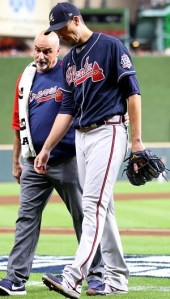
Max Fried

Max Fried—getting stung repeatedly in the second hurt almost worse than if he’d been bludgeoned.

If you look purely at the line score of World Series Game Two, you’d think the Braves had their heads handed to them in the bottom of the second. But if you watched the game, you know the Astros dismantled them, almost too simply, and with some inadvertent help from the Braves themselves, to win 7-2 Wednesday night.

As a matter of fact, when the game began you could have been forgiven for thinking it might turn into a bit of a pitching duel despite the teams swapping a run each between the bottom of the first and the top of the second—one on a solo home run, one on a sacrifice fly.

Overall that’s about how the game shook out—if you didn’t include the Astros’ hunt-peck-prick-and-poke of four runs out of Braves starter Max Fried in the bottom of the second, after he fooled Carlos Correa into looking at a particularly nasty third-strike curve ball. Jose Altuve’s eighth-inning home run almost seemed a by-the-way insurance run.

“We didn’t want to go to Atlanta down by two,” Altuve said postgame. “So we left everything we had in there tonight. Obviously, very important win to tie the Series to keep going from there.”

“Obviously, I’m not happy about it.” said Fried. “Playoffs is a big momentum game. You’ve got to do everything you can to keep the crooked number off the scoreboard.”

It might actually have hurt less if he’d been bludgeoned than it did the way he was pecked in the second. And, if Astros starter Jose Urquidy hadn’t brought his A game to the mound, leaving the Braves mostly unable to hit him even if they’d swung warehouse gates.

Fooling Correa into the strikeout must have seemed aberrant even to a pitcher who struck out six in five innings’ work and walked only one batter. The second inning made Fried’s outing look far worse than it was in the long run, but a true shelling it wasn’t. It was like getting stung by angry hornets one after the other a few times before he finally slithered out of it.

It started with Kyle Tucker spanking a base hit up the middle and Yuli Gurriel punching one through the shift-opened right side for a base hit to follow up at once, sending Tucker to third. Fried jammed Jose Siri into a slow tumbling grounder to the far left side of the mound, but Tucker came home when they couldn’t get the swift Siri at first.

Then Martin Maldonado, a catcher so prized for his work behind the plate that Astro manager Dusty Baker bears with his pool noodle of a bat, punched one through the left side for a base hit. The problem now was the Braves’ usually sure-handed, sure-armed defense.

Left fielder Eddie Rosario came up with the ball and threw to third in a bid to stop Siri if they couldn’t stop Gurriel from scoring. Only third baseman Austin Riley came trotting down the line to serve as the cutoff man, and shortstop Dansby Swanson got caught unable to get to third covering in time because he was in short left. Rosario’s throw thus sailed wild and Siri sailed home with the fourth Astro run of the night. Ouch!

Maldonado went to second on that throw and took third when Braves catcher Travis d’Arnaud let one escape with Altuve at the plate in an 0-2 count. Altuve flied out with Maldonado having to hold at third, but Michael Brantley pulled a base hit to right on which Maldonado could have walked home safely, making it 5-1.

Innings like that are as common to the Astros when they’re swinging right as you might think the big bombing innings would be. But they were the best in the game this year at avoiding strikeouts at the plate and hitting in most directions out to the field.

They may also have picked up on Fried tipping pitches. No, they’re not pulling another Astro Intelligence Agency trick or three. The rules since Astrogate’s explosion and aftermath include maximum replay room security. But the Astros were known without and before any Astrogate shenanigans for picking up even the tiniest tells from opposing pitchers and exploiting them mercilessly.

Fried’s habit of wiggling his glove fingers around the ball in his hand rapidly as he prepares to throw to the plate, like an amphetamine-driven lobster clawing its dinner down to manageable bites, may well have handed the Astros inadvertent but invaluable pitch  intelligence. After the second, Fried quit the glove snapping for the most part—and retired the next ten hitters he faced.

When Yordan Alvarez walked and Correa sent a base hit to left opening the bottom of the sixth, Braves manager Brian Snitker hooked Fried in favour of Dylan Lee. After Tucker forced Correa at second with Alvarez taking third, the Braves’ defense faltered into the sixth Astro run.

Gurriel grounded sharply to Swanson at shortstop. He threw to second baseman Ozzie Albies hoping to start an inning-ending double play. Albies lost the ball as he turned to throw on to first. Tucker was ruled safe until a review was called—did Albies have control of the ball to get the out while losing it as he drew the ball out of his glove to throw on?

Several television replays showed Albies lost control of the ball after all, but not by as much as first surmised. The safe call held, and Alvarez scored, but Albies’s throw wasn’t in time to get Gurriel at first. Lee shook off a rather daring double steal to set up second and third by striking Siri out. Snitker brought in Jesse Chavez, and Chavez got Maldonado to fly out for the side.

The Braves got their second run in the top of the fifth when Freddie Freeman singled d’Arnaud home. Other than that, both bullpens kept each side behaving itself except for Altuve sending Drew Smyly’s first pitch of the bottom of the seventh into the Crawford Boxes, before the veteran reliever fell into and squirmed out of his own bases-loaded jam with no further damage.

Maybe the true shock of the evening was the Braves handing the ball to Kyle Wright for the bottom of the eighth. Wright’s a 26-year-old pitcher with a 6.56 fielding-independent pitching rate in four seasons. He had a 9.64 FIP and a 9.95 ERA in two brief starts on the regular season while up and down from the minors.

Throwing that against the Astros was something like offering to assure Hall of Famer Henry Aaron would face nothing but batting practise pitchers by decree, right? Wrong. Wright shocked the entire ballpark by striking the side out in order—including Maldonado and Altuve looking at third strikes after Siri opened with a three-pitch swinging strikeout.

“It was so encouraging to see Kyle tonight,” said Snitker postgame, even if he was thrown up as a sacrificial lamb in a lost game. “Just getting in there for that one inning and getting him out there and experiencing this atmosphere because he could play a huge part going forward. I thought he threw the ball extremely well.”

Wright lived on effective curve balls and sinkers Wednesday night. Snitker was inspired enough to ponder possibilities for Wright to spot start or even open a bullpen game during the Atlanta leg. With Charlie Morton gone thanks to that fibula fracture, Snitker needs to get even more creative with his pitching arrays now. Wright’s surprise may lift some of that burden a hair or two.

“He was locating,” said catcher d’Arnaud postgame. “His sinker was moving a lot. His curveball was moving a lot. He did a tremendous job. When I caught him in a rehab game for me, he looked exactly the same as he did that day. It was fun working with him, and it was great seeing him have the success today, especially in the World Series.”

With the tied Series moving to Atlanta for three possible games, thus switching the Braves to a home field advantage, it’s comforting to know that near the end of a night the Braves were pecked to death they might have found the Wright stuff, for however long.

WS Game One: Flash! Bash! Alakazam!

Jorge Soler

Soler swings into history and toward a Game One Braves win . . .

Yordan and Eddie Tonight, the Miniseries? The show went on, but they weren’t exactly the stars of the show Tuesday night.

Oh, they performed rather splendidly. But they turned out the headliners blown off the stage by the fourth-lowest opening performer and a wild animal act.

Which is just what Jorge Soler did with the third pitch of World Series Game One from Astros starter Framber Valdez. And, what the Braves bullpen did to the Astros the rest of the way in an emphatic enough 6-2 Braves win.

Fresh off his marquee performance against the Red Sox toward the Astros’ American League pennant, Valdez could only watch with everyone else in the Minute Maid Park house as Soler became the first player in major league history to open a World Series opener with a home run.

The audience could only watch, too, with a hybrid of frustration broken up only occasionally by their usual racket while four Braves relief pitchers kept the Astros to their only runs of the game. Not to mention helping guarantee the Braves a temporary home field advantage at least.

Valdez fell behind Soler 2-0 when he threw a sinker that dumped enough ballast en route the plate that it had altitude enough for Soler to send it on hefty flight into the Crawford Boxes above the left field scoreboard. A ground out (Freddie Freeman), an infield single (Ozzie Albies, beating out a grounder wide of the mound’s left side), and a quick theft of second later, Austin Riley split the left center gap with the RBI double.

The game wasn’t even half an hour old, and already fans of both teams must have asked, Yordan who? Eddie what?

That was before the Braves more or less snuck a third run home in the second—back-to-back opposite-field singles (Travis d’Arnaud to right, Joc Pederson to left), a long fly to the center field wall enabling two tag-ups and second and third, and Soler’s grounder to short getting Pederson caught in a rundown while d’Arnaud crossed the plate.

And, before Eddie Rosario pulled a leadoff base hit to right in the third and—following a come-back-on-message visit to Valdez from Astros pitching coach Brent Strom—Adam Duvall turned a hanging changeup into a cruise missile straight into the Crawfords and sent Valdez out of the game.

“It was my first World Series game, so I’m not going to tell you that I didn’t feel the pressure,” Valdez admitted postgame. “I think just being behind in the count so much is what hurt me more than anything in this game.”

In between Soler’s Series-opening history mark and Duvall’s two-run rip, Morton too a hard smash from Yuli Gurriel off his leg to open the Houston second. The ball ricocheted to Freeman at first for a simple enough out. Morton pitched on, getting the next two outs to end the second and then striking Jose Altuve out called on a particularly nasty curve ball.

“That one got me good,” Morton’s said to have told his catcher d’Arnaud of the Gurriel comebacker that ended up ending his season. “I’m sorry,” Morton told any and everyone who happened by after his exit and after the game ended.

He’d looked distinctly uncomfortable before throwing Altuve that out pitch. He looked pained but determined after it. Pained enough to come out of the game. He turned out to have pitched to three Astros on a broken fibula that means the end of his postseason and the Braves having to do what they’ve done best in an injury-dominated year—skip out of the way at the last second when disaster comes careening down the street.

A 37-year-old veteran channeling his inner Bob Gibson (1967: tried to pitch on after fellow Hall of Famer Roberto Clemente ripped one off his leg; fracture kept him out thirteen weeks)—and apologising for it postgame. “[I]f that doesn’t tell you everything you need to know about Charlie Morton,” said Freeman postgame, “I’m not sure what does.

Morton’s been there, done that. His career’s first half was as much big and small injuries costing him a lot of his prime time as it was pitching like a craftsman in six postseasons with one World Series ring and a splendid-enough 3.35 lifetime postseason earned run average to show for it. The man is nothing if not a walking exercise in pain management.

“I didn’t think it was broken,” d’Arnaud said. “I just thought he took a line drive off of his leg. But to go out there and strike out the next guy with a broken leg, it blows my mind.” Actually, it turns out Morton’s first X-rays showed no break, but he probably stressed his leg into the break while working on Altuve.

This is the Braves’ lot in 2021 so far. They incurred, dodged, withstood, and found ways to sneak through disaster to get to the postseason in the first place, never mind the World Series. A leg fracture taking their elder starting pitcher out for the rest of the way? Tell them about it. It wouldn’t shock them if they woke up on Game Two day having been kidnapped for the unreachable ransom.

Charlie Morton

Charlie Morton, escorted from the field in the third.

“No kidding. I don’t want to know what’s next,” said manager Brian Snitker after Game One. “But this is what we do, right?” Right. Nothing to it. Hit them with a tidal wave. Send them another hurricane riding the oblivion express. To these Braves those are just sun showers and some autumn breezes.

So far. It’s not that the Braves push their luck by design or premeditation. But you can’t help wondering just how many times they can still just wave their magic bats, gloves, or arms, and—flash! bash! alakazam!—make the other guys disappear.

Snitker had to reach for one of those arms a lot sooner than he might have expected going in. He brought AJ Minter in to take over for Morton. Minter pitched two and two thirds that would have been shutout ball if shortstop Dansby Swanson, usually one of the most sure-handed, sure-footed of the breed, hadn’t inadvertently kicked Astro center fielder Chas McCormick’s hard one-out, first-and-third grounder aside, enabling Kyle Tucker (one-out double) to score the first Astro run.

Luke Jackson followed Minter with one and two-thirds scoreless pitching before handing off to Tyler Matzek with lefthanded swinger Michael Brantley coming up with two outs in the seventh. He shook Brantley’s base hit off to strike Alex Bregman out looking for the side. But he couldn’t do a thing about Alvarez’s leadoff triple to the rear of right center opening the bottom of the eighth.

Alverz came home almost predictably when the next Astro batter, Carlos Correa, grounded out to second. After Matzek struck Tucker out on a somewhat violent swing, Gurriel ripped a drive off the left center field wall whose carom Rosario played perfectly, before throwing in perfectly to nail Gurriel at second trying to stretch the hit.

Or was it? At first glance it looked as though Gurriel’s drive hit on or above the yellow line atop the wall, which would have meant home run. Several television replays confirmed what the umpires on review ruled for certain—the ball struck the wall clearly if just barely below the line. Hocus pocus!

Not that it would have mattered in the end. The Braves landed an extra insurance run in the top of the inning, when Swanson wrung himself into a one-out walk and Soler on a check swing squibbed one into no man’s land beyond the mound that Astros reliever Ryne Stanek couldn’t get on a dive. Enabling Swanson to take third, before Freeman popped out to short right with Swanson on the run home and sliding in safely around Astro catcher Martin Maldonado’s backswinging tag attempt. Shazam!

So the Braves’ M&M Bulls didn’t do it with quite the howitzer heft by which they pinned the Dodgers to the wall winning National League Championship Series Game Six. But they did just what they had to do and kept the Astros from even thinking about a Game One overthrow regardless.

Will Smith shook a leadoff walk to pinch-hitter Aledmys Diaz off in the bottom of the ninth to get three straight ground outs—two force outs at second base, and a ground out to second—and that ended the game.

Abracadabra!

“Our team doesn’t worry,” said Astros manager Dusty Baker postgame, “and our team’s very confident. We have the knack of bouncing back after losses, after tough losses because they don’t quit, they don’t give up, they don’t get down. That’s the secret of sports.”

Beware, Mr. Baker. Your very confident Astros are up against a team that’s had to bounce back from tougher losses than Game One.

These Braves had to bounce back from losing their junior franchise face to a season-ending injury, after losing key young pitcher to a re-injured Achilles tendon and a key bomber to domestic violence protocols. Not to mention losing their leadoff hitting right fielder to COVID for the entire division series and most of the NLCS.

So the Braves will have to find a few more creative ways to survive losing their elder starter and clubhouse sage for the rest of the Series, too? Big whoop. Bad as losing Morton is, this, too, comes right into this year’s wheel house. They’d surely rather not, but where other teams crumple under the weight of forced creativity, these Braves thrive on it. So far.

On living rent-free in one’s head

From Sandy Koufax, Game Seven, 1965 World Series . . .

Moments, acts, and people living rent-free in one’s head don’t always have to be the ones that broke your heart. When an online baseball group member asked fellow members for such moments, I found it impossible not to think of a truckload of such moments. Of course, many will betray my age. I’ve been betrayed by worse.

Fair disclosure: I don’t lack for non-baseball moments living rent-free in my head. Things such as the first time I wrote with a fountain pen, my first unaccompanied-by-elder jaunt around the New York subways, my first airplane flight, my first experience with a Gibson guitar, my first crack-of-dawn in Air Force basic training, my first paid published newspaper by-line, my first turn on radio.

But ask me about baseball and I probably have enough tenants living rent-free in my head to fill an apartment house. Half way, at least:

* Hall of Famer Sandy Koufax. On two days’ rest. A second shutout with nothing but a fastball left after 359 innings that year. Game Seven, 1965 World Series.

* Willie Davis. Three errors. Top of the fifth, Game Two, 1966 World Series—costing Koufax a win in what proved his final major league game.

* Donn Clendenon ripping a home run over the left field auxiliary scoreboard in Shea Stadium, right after Cleon Jones was awarded first base for the shoe-polish plunk, Game Five, 1969 World Series.

* One not-so-foggy Christmas Eve, 1969: Curt Flood writing to commissioner Bowie Kuhn that he didn’t believe he was just a piece of property to be bought and sold at will.

* Oakland owner Charlie Finley’s capricious attempt to fire infielder Mike Andrews over a couple of errors not entirely of his own making, Game Two, 1973 World Series—and Shea Stadium sign man Karl Ehrhardt, the next day, greeting the first A’s fielding miscue with a sign: YOU’RE FIRED! 1973 World Series.

* Carlton Fisk’s “body English” home run to win Game Six, 1975 World Series.

* ‘Twas the day after Christmas, and all through the house, baseball went ballistic when arbitrator Peter Seitz ruled in favour of Andy Messersmith. 1975.

* Reggie Jackson. Three pitchers. Three pitches. Three swings. Three bombs. Game Six, 1977 World Series.

Tommy Lasorda deciding it was safe for Tom Neidenfuer to pitch to Jack Clark with first base open and the Dodgers one out from forcing a seventh 1985 NLCS game—and Jack the Ripper deciding how unsafe it was with what proved a pennant-winning three-run homer three-quarters of the way up the left field bleachers.

* Don Denkinger. If you have to ask . . . (Even if it wasn’t his fault the Cardinals imploded in Game Seven.)

* Mookie Wilson and Bill Buckner. If you still have to ask . . .

* Phillies pitching coach Johnny Podres forgetting to tell Mitch (Wild Thing) Williams to abandon the slide step (which Podres put on in the first place to keep Hall of Famer Rickey Henderson from grand theft) and pitch straight, no chaser to Joe Carter, Game Six, 1993 World Series.

* Derek Jeter and The Flip.

* Mike Piazza’s mammoth blast in the bottom of the eighth, in the first Mets home game following baseball’s break after the 9/11 atrocity.

* Dusty Baker handing Russ Ortiz the game ball somewhat ostentatiously, when lifting him in Game Six, 2002 World Series, and Scott Spiezio making Felix Rodriguez pay for it to start the Angel comeback that forced the Game Seven they won.

* Alex Gonzalez and the double play hopper bounding off his glove, eighth inning, Game Six, 2003 NLCS—with the Cubs five outs from going to the World Series they wouldn’t reach yet.

* Alex Cora. Dodger Stadium. Eighteen-pitch plate appearance ending in a two-run homer. May 2004.

* Dave Roberts. David Ortiz. Game Four, 2004 ALCS.

* Curt Schilling and the bloody sock game, Game Six, 2004 ALCS.

* “Back to Foulke—Red Sox fans have longed to hear it! The Boston Red Sox are world champions!”

* Albert Pujols vs. Brad Lidge, Game Five, 2005 NLCS. (The only thing keeping Pujols’s blast in the building was the retractable roof bracing of Minute Maid Park.)

* Pujols, three bombs after the sixth inning, in a kind of reverse cycle (three-run homer, two-run homer, solo homer), Game Three, 2011 World Series.

* David Freese. Game Six, 2011 Series.

* Kung Fu Panda. Three bombs. Game One, 2012 Series.<

. . . to Mookie Betts, Game Six, 2020 World Series.

* Madison Bumgarner. Game Seven, 2014 Series. In relief.

* “Now, that’s announcing yourself . . . Game on!” crowed Tom Verducci, the Sports Illustrated prose poet working as a Fox Sports commentator, when Noah Syndergaard dropped Alcides Escobar on the first pitch, leading off Game Three, 2015 Series.

* Lucas Duda unable to make a simple throw home to finish what should have been a Game Five-winning double play to send the 2015 Series back to Kansas City.

* The Cubs. Finishing their 108-year rebuilding effort. 2016 World Series.

The first Angels home game following the tragic death of pitcher Tyler Skaggs. Every Angel wearing Skaggs’s uniform number 45. Mike Trout opening the 13-0 proceedings with a two-run homer. Pitchers Taylor Cole and Felix Pena combine on a no-hitter. July 2019.

* Unaware that a standoff between a narcotics suspect and Philadelphia police left six officers wounded during the game . . . Bryce Harper. Bottom of the ninth. The Phillies down two runs with the bases loaded. The mammoth ultimate grand slam flying past the foul pole into the second deck. Harper running it out as though he had a process server on his tail. August 2019.

* Howie Kendrick. Salami. 2019 NLDS.

* Kendrick, ringing the foul pole and the Astros’ bell, Game Seven, 2019 World Series.

* “The Rays are going to ask for the biggest hit in the life of Brett Phillips.” Game Four, bottom of the ninth, last year’s World Series.

* The Mookie Monster. Last year’s World Series.

And I have many more apartments to fill before my eventual date in the Elysian Fields.

The pennant-winning Rays do several favours

Your American League champion Tampa Bay Rays, with Randy Arozarena (right front) holding his ALCS MVP award.

For those of you who still love to ponder baseball in economic terms alone, have your fun now. The third-lowest 2020 payroll in the Show just finished off the third-highest—after knocking off highest to have the opportunity. Shout it out loud. The Rays win the pennant! The Rays win the pennant!

They who have the gold don’t always rule. For that matter, neither do they who have the platinum.The Tampa Bay Rays—lucky to have a couple of steel pieces amidst a cache of aluminum, tin, and Reynolds Wrap—are one trip shy of the Promised Land as of Saturday night.

After pushing past the New York Yankees’s platinum a little over a week earlier, the Rays  melted the Houston Astros’ gold into a 4-2 win in Game Seven of the American League Championship Series. Playing twelve games in thirteen days, the Rays beat both in final win-or-be-gone games. That only begins to describe their flair for the impossible.

This collection of bargains enough to make you think Woolworth’s was reincarnated as a baseball team became the first in major league history to stand on the threshold of a postseason series sweep, lose the next three straight, then win the first elimination game they’d face in the set.

They became the first to send out a starting pitcher against another starting pitcher with whom he’d collaborated previously to win a seventh World Series game. Charlie Morton got the better of Lance McCullers, Jr. with five and two-thirds innings of two-hit shutout ball on his part and just a little help from the friends he says are an honour to play and compete with.

They became the first to feature a rookie hitting a seventh bomb just in the postseason, when left fielder and series MVP Randy Arozarena sent Lance McCullers, Jr.’s 2-2 fastball over the right center field fence in the bottom of the first—after McCullers hit Manuel Margot with the first pitch of the inning.

They had Mike Zunino—a Seattle trade surrender whose steady defense got undermined by a few passed balls in Game Six but whose power is steady enough when he isn’t injured—provide the rest of their Saturday night scoring with a one-out, full-count launch into the left field seats of McCullers in the second and a one-out sacrifice fly off Jose Urquidy working relief in the sixth.

And, after manager Kevin Cash hooked Morton with a better too soon than too late attitude, the Rays’ bullpen wavered and bent only in the eighth, when Carlos Correa—who’d hit Nick Anderson for the game-winning bomb in Game Five—knocked a bases-loaded two-run single off Pete Fairbanks, who then got Alex Bregman to climax his series-long futility with a furiously swinging strikeout.

If Morton follows through on earlier hints that he might actually retire at 37, he’ll retire as a member in good standing of one elite club. Name the five pitchers who’ve had multiple scoreless starts in postseason winner-takes-it-all games. The answers: Morton plus Madison Bumgarner, Bret Saberhagen, Hall of Famer John Smoltz, and Hall of Famer-to-be Justin Verlander.

Saturday night was Morton’s fourth time out in such a game and his third as a starter. In every one of them, he never threw a pitch while his team was behind. The modest righthander who starts his delivery slow motion before his right arm becomes a whip, whom the Rays could afford because his injury history made him a bargain, really has been late-career better than advertised. If you needed a reminder, he rid himself of thirteen of his twenty batters on three pitches or less.

Arozarena also became the first rookie to hit seven homers in a single postseason. He may have been the only one who wasn’t counting. “I try not to pay attention to the statistics,’’ he said postgame, “but with the Iinternet and everyone bringing it up, you’re kind of aware of it. Honestly, I don’t pay attention to the statistics outside of me and what I can control.”

When Fairbanks shook off Yuli Gurriel’s one-out single to right to strike Josh Reddick out and get Aledmys Diaz to fly out to Margot in right, it would have touched off an all-night party in Tampa Bay if not for the coronavirus social distancing protocols. Those protocols also kept the jubilant Rays from much more than what Zunino said was confetti-tossing and Silly String shooting.

“We’ve done a great job to make it as fun as possible . . . but there’s nothing better than popping bottles and having that seep in and burn your eyes,” the catcher said post-game. That’s one reason why even the World Series winner, whomever it may prove to be, might be the first to reach the Promised Land and holler out, “Wait ’till next year,” hopeful that the pandemic recedes enough to let baseball get back to whatever normal it can achieve.

“Probably more so this year than any other year, the motivation is doing it for each other,” Morton said. “You adhere to protocols; you’re social distancing from families at home. Telling their kids they can’t hug them. This has brought out a level of humanity and empathy that you wouldn’t see in a normal season.”

It also kept baseball’s Public Enemy Number One in the wake of Astrogate from facing the slings, arrows, protest banners, and live catcalls sure to have greeted them on road trips if the pandemic hadn’t substituted cardboard cutouts for live fans.That was the biggest unexpected break the Astros—having enough with being exposed as illegal high-tech cheaters—could have received.

Fans settled for social media slappings plus masking and social distancing while greeting the Astros’ team bus live with slings, arrows, protest banners, trash cans (the mode by which they sent the illegally stolen signs to their hitters in 2017 and part of 2018) and live catcalls whenever the bus pulled into the road ballpark’s parking lot.

The Rays did the Astros and the rest of us another favour by pushing them home for the winter. Assume as you shouldn’t that the Los Angeles Dodgers send the Atlanta Braves home for the winter in Game Seven of the National League Championship Series Sunday. (The Braves aren’t going to go down without a fight, their Game Six futility to one side.) The Rays prevented a World Series dominated by too-much-is-more-than-enough talk about a grudge rematch.

There’s probably no way on earth Astrogate will be forgiven or forgotten for a long time to come. But the spectre haunting America of the Astros going back to the World Series this time around haunts no more. The last thing the Series needs when America needs the Series most is to be half dominated by Astrogate regurgitation and appetites for revenge.

Be certain the Astros will return to the Series in due course. When they do, they’re liable to be just about finished with what has to be done put Astrogate into the past at last—roster and organisation turnover. They have the makings of an impressive young bullpen and a few young positional talents ready to come into their own, too.

The Rays also did us all a bigger favour than even the foregoing. Not only will there be no losing team in the World Series, there’ll be only division winners squaring off. All that early postseason mess, all commissioner Rob Manfred’s apparent wet dreams about permanently expanded postseasons. Put it behind you for now.

Just pray that Manfred doesn’t take the wrong message from it and dance this mess around permanently. Reminder: the Rays had the American League’s best irregular season record. And real division champions—of however truncated an irregular season—will battle to get to the Promised Land. That’s the way it should always be.

The only thing left is for the Rays to come to terms with going from faceless to familiar. That could prove the simplest and most pleasant of their battles.

Whitey Ford, RIP: The Chairman takes his leave

“A couple of New York kids who made good,” Sandy Koufax’s biographer said of Koufax (Brooklyn-born) and Whitey Ford (Manhattan-born, Queens-raised), here sharing a handshake before Game One of the 1963 World Series.

When Jane Leavy researched and interviewed for her splendid biography of Hall of Famer Sandy Koufax, she discovered something about then-U.S. poet laureate Robert Pinsky. Pinsky had an animus against Koufax’s fellow Hall of Fame pitcher Whitey Ford.

Ford, who died Thursday at 91, was Leavy’s girlhood hero. Pinsky’s poem “Night Game” addresses Ford and Koufax, who met twice in the 1963 World Series with Koufax beating Ford twice. But over a decade earlier, Pinsky as a boy waited at Fort Monmouth, New Jersey to get Ford’s autograph.

Ford then was an emerging Yankee hero, a second place 1950 American League Rookie of the Year finisher who’d rolled a 2.51 ERA after his June call-up and beat Hall of Famer Robin Roberts to finish the Yankees’ World Series sweep of the Philadelphia Phillies’ “Whiz Kids” pennant winner.

Now, Ford pitched for the Army Signal Corps to fulfill his military obligation of the time. When Pinsky finally got to face Ford and asked for the autograph, Ford replied, “Not now, kid.”

When Pinsky told the story to Leavy while talking about “Night Game,” she called Koufax the morning after. After a couple of moments’ silence on the other end of the line, she noted, Koufax asked her, “Do you think he’d like a ball?” Two weeks later, Pinsky received the ball, autographed by Koufax and accompanied by a small, handwritten note saying, only, “Whitey’s really a good guy.”

“Ford subsequently redeemed himself in Pinsky’s estimation,” Leavy wrote, “with a plaintive, if belated, explanation for his youthful rudeness: ‘Soldiers don’t give autographs.’ (And in mine by asking for a copy of Pinsky’s poem. ‘He wrote nice about Sandy?’ Whitey said. ‘I’d like to see that.’)”

This was the same Whitey Ford who had a classic reaction when Koufax, winner of a spanking new Corvette as the 1963 World Series’s Most Valuable Player, left the awards banquet to discover the car parked on the sidewalk . . .with a $15 parking ticket attached to the windshield. “Sandy has only two flaws,” Ford cracked. “He can’t hit, and he can’t park.”

That from the pitcher who once cost the Yankees a run in a World Series game when he tagged and left third base too soon on what should have been a sacrifice fly by his Hall of Fame battery mate Yogi Berra.

The Los Angeles Times‘s Hall of Fame sportswriter Jim Murray handed Ford his enduring nickname, when he wrote rooting for the 1950s Yankees was like rooting for U.S. Steel with Ford—whose eight World Series Game One starts is a major league record—the chairman of the board.

A compact lefthander at 5’10”, Ford was most renowned for two things. Thing One: the likewise compact delivery that relied as much on his brains as his repertoire, an assortment of off-speed pitches he threw all around the strike zone, since he couldn’t even throw the proverbial lamb chop past a snail. Batters hit .235 off him lifetime.

“If it takes 27 outs to win,” his longtime manager Casey Stengel once said of him, “who’s going to get them out more ways than Mr. Ford?”

“He was like a master chess player who used his brain to take the bat right out of my hands,” recalled one-time Boston Red Sox outfielder Walt Dropo. “You’d start thinking along with him, and then Whitey had you because he never started you off with the same pitch in any one sequence.”

Thing Two: Mr. Ford’s sense of humour. A man who spends the bulk of his career cleaning up after his Yankee bestie Mickey Mantle’s messes almost as often as he befuddles hitters and pitches in the World Series (his 33 consecutive scoreless World Series innings remains a record) needs a sense of humour. And maybe a healthy supply of anti-migraine medication.

Ford wasn’t exactly allergic to the night life in his native New York (he was Queens-born), but he wasn’t exactly allergic to knowing when to shut it down, either. “His fellow rogues, Mickey, Billy [Martin], and Toots [Shor, the legendary New York sports restauranteur], were all gone,” New York Daily News writer Bill Madden wrote in his 2003 book Pride of October: What It Was to Be Young and a Yankee, “but he had survived, still the same wisecracking, self-assured son of the city.”

Wisecracking and practical joking. When Yankee infielders Joe Pepitone and Phil Linz were still barely past rookie status, according to teammate Jim Bouton in Ball Four, Ford and Mantle told the pair they’d finally arrived and were ready to go out on the town with the big boys. In Detroit, Ford and Mantle instructed Pepitone and Linz to dress to kill, hail a cab, and head to the Flame where they were to ask for Mantle’s table.

Pepitone and Linz did as instructed. They dressed to kill. They hailed their cab. And discovered the hard way that the Flame—once a legendary Detroit jazz and rhythm and blues hot spot (among others, assorted future members of Motown’s legendary Funk Brothers house band had played the place)—was now a ramshackle wreck with the glass blown out and maybe two surviving toasted tables remaining.

Ford’s playful side extended to making sure the Yankee bullpen didn’t get bored when members weren’t called upon to warm up and get ready to go into a game. “I think it should be known,” Bouton wrote on 5 April, in the journals he kept to compose Ball Four, “that when Whitey Ford was pitching for the Yankees he set up a table with a checkered tablecloth in the bullpen. On the table there was an empty wine bottle with a candle in it. Also hero sandwiches. Whitey Ford had style.”

Ford was a thinking craftsman on the mound and a practical joking, fun-living fellow off it.

And influence. A month and a half later, Bouton had to record: “Hot flash! Whitey Ford’s Italian restaurant in the bullpen has a real rival in the Baltimore bullpen: wienie roasts.”

When Whitey and Joan Ford married in April 1951 in Long Island City’s St. Patrick Church, Stengel arranged a little surprise for the couple: he loaded the entire Yankee team, including Joe DiMaggio, onto a bus following an exhibition game to hit the church. One Yankee was too nervous to get off the bus, like his fellow rookies, so the newlywed Fords went out to greet him.

That’s how he met Mickey Mantle for the first time. The friendship that must have made Ford wonder often enough whether the devil was punking him started on a bus outside his wedding church. “Years later,” Ford said, “Mickey told me the highlight of that day for him was meeting Joan, not me.”

The ever-quick Ford got a measure of vengeance when his first grandchild was born. When his son-in-law phoned in the dead of night to announce the birth to Grandpa, Ford called Mantle—who went into the Hall of Fame with him in 1974—first thing in the morning. “You’re not going to believe this,” he said. “Last night for the first time in my life I slept with a grandmother.”

In Pride of October Madden wrote that Ford wasn’t always comfortable having been the sole survivor among the little night-owl group of himself, Mantle, and Martin. The only time Ford was ever uncomfortable with Stengel—who judiciously managed him as an every-fifth-day pitcher to save him for the bigger games of Yankee races and the Series—was when Casey neglected to align his 1960 Series rotation to let Ford pitch more than twice, which probably did cost them that Series as much as Bill Mazeroski’s winning home run.

Ford was also uncircumspect about his late-career ball doctorings. Admitting he turned to chicanery in a bid to hang on as long as he could until elbow and arm miseries forced him to call it a career in 1967, Ford swore he never did it during his Cy Young Award-winning 1961 or his likewise 20 game plus-winning 1963.

“Well,” he added puckishly, “maybe a little.”

“For a long time,” Bouton revealed, “Whitey got away with throwing a mud ball that was positively evil.” If the grounds crews wetted the infield or the mound a little too generously, or he and/or his late-career catcher Elston Howard could mix saliva and dirt surreptitiously, Ford would get a tiny mud load on balls. One-time Los Angeles Angels pitcher/flake Bo Belinsky once said, “If a mud ball was left for me on the mound, I had two outs waiting right there.”

“Ford could make a mud ball drop, sail, break in, break out, and sing ‘When Irish Eyes are Smiling’,” Bouton continued.

Eventually the opposition, particularly Bill Rigney, the manager of the Angels, got wise to him and he had to quit using the mudder.

Then he went to his wedding ring. He gouged such sharp edges into it that we used to kid him about having lost the diamond out of it. He’d scuff up the ball with the ring and make it do all the things the mud ball did, except maybe now the song was different. He got by with the ring for a couple of months . . .

After that, Ellie Howard sharpened up one of the buckles on his shin guard and everytime he threw the ball back to Whitey he’d rub it against the buckle. The buckle ball sang two arias from Aida.

Madden convinced Ford to show him around the Astoria, Queens neighbourhood where he grew up as the son of a Con Edison electrical worker. Ford pointed to a yellow-bricked apartment building where he’d lived ten years and adjacent to where his wife-to-be lived as a girl. “I was sixteen and she was twelve,” Ford said. “She had great legs. That’s what attracted me most about her. We moved three or four times when I was growing up there. I guess every time the rent was due.”

Some of Ford’s boyhood acquaintances and friends in that predominantly Irish, Italian, and Polish neighbourhood grew up to go into baseball as he did, including future coaches Tony and Al Cuccinello and future Minnesota Twins pennant-winning manager Sam Mele. One who didn’t go into baseball was a kid named Anthony Benedetto, whose family owned a nearby beauty salon.

“It wasn’t until he after he left the neighbourhood,” Ford said, “that he changed his name to Tony Bennett. Kind of like me, going from Eddie to Whitey, only I think his new name did a lot more for him than mine did for me.”

Baseball-Reference shows ten major league players (including two who eventually became managers) named Whitey. Be assured that if you just say “Whitey” in any gathering, they’ll remember Ford first. But neither they nor even longtime Yankee fans will remember him as quickly as his widow, two of his three children (his son, Thomas, died in 1999), and his grandchildren.

Once during an Old-Timers Day ceremony, Ford and Berra watched the Yankee Stadium video board display a tribute to Yankees past who had passed away that year. Yogi turned to Whitey and said, “Boy, I hope I never see my name up there!”

Ford can now tell Berra in the Elysian Fields, “Yogi, I never wanted to see your name up there, either!” Even at 91, Ford’s family and baseball fans alike weren’t quite ready to see his name up there, either.