Music from the Elders

2019-10-07 MaxScherzer

Not even Mother Nature could rain on Max the Knife’s parade Monday night.

Forget the starters-as-relievers plan that imploded with whatever impostor crawled into Patrick Corbin’s uniform Sunday. Come Monday, the Nationals wanted, needed, and all but demanded one thing.

On a day the Nats were one of four teams facing postseason elimination they needed Max Scherzer to be as close to Max Scherzer as possible. In the worst way possible. In the rain, even.

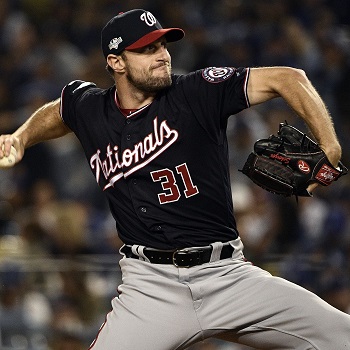
From the moment after Dodgers third baseman Justin Turner belted a two-out solo homer in the top of the first until he finally ran out of fuel while squirming out of a seventh-inning jam, Scherzer was a little bit more. For six and two-thirds to follow he was Max the Knife.

“It was amazing just playing behind him,” said third baseman Anthony Rendon after the Nats locked down the 6-1 Game Four win. “Max did what Max does.”

Elder Ryan Zimmerman, who wielded the heavy tenderiser in the bottom of the fifth, was a lot more succinct. “That’s the guy,” he said almost deadpan. Except that Zimmerman was also the guy. This was the night the Nats played sweet music from the elders. Above and beyond what they demanded going in.

Scherzer slew the Dodgers with what seemed like a thousand off-speed cuts mixed in with a few hundred speed slices and the Dodgers left unable to decide whether he’d dismantled them or out-thought them. Maybe both at once. Zimmerman was the third among division series teams’ oldest or longest-serving players Monday to do the major non-pitching damage keeping them alive without respirators to play another day.

An hour or so earlier, ancient Yadier Molina tied (with an eighth-inning single) and won (with a sacrifice fly) to get the Cardinals to a fifth game against the Braves. Great job, Yadi. Could the Nats top that? Zimmerman’s electrifying three-run homer answered, “Don’t make us laugh.”

All of a sudden the Dodgers’ stupefying sixth-inning assault in Game Three seemed like little more than a somewhat distant nightmare. Just as swiftly the Dodgers looked like the doddering old men on the field. Their average age is a year younger than the Nats’ but suddenly they looked in need of walkers and wheelchairs.

Scherzer and Zimmerman did their jobs so thoroughly that manager Dave Martinez didn’t even have to think about risking his or his club’s survival with a call into the Nats’ too-well-chronicled arson squad. If he had anything to say about it, the last thing he wanted was anyone not named Sean Doolittle or Daniel Hudson on call.

“I knew I needed to make a full-on start,” said Max the Knife after the game. “I know there’s times in the regular season where you’re not fresh, where you come into a game and you got to conserve where you’re at—try to almost pitch more—and today was one of those days.”

At first it seemed the Nats were trying to conserve . . . who know precisely what. Especially when it didn’t seem as thought they had that many solutions for Dodger starter Rich Hill’s effective enough breaking balls the first two innings. Or, for figuring out ways to avoid loading the bases twice, as they did on Hill and his relief Kenta Maeda in the third, and getting nothing but Rendon’s game-tying sacrifice fly to show for it.

But with that one-all tie holding into the bottom of the fifth, and Julio Urias in relief of Maeda, Trea Turner led off with a bullet single to left and Adam Eaton sacrificed him to second. Rendon singled Turner home to break the tie, Howie Kendrick lined a single to left center, and it looked like the Nats would content themselves with doing things the small ball way.

Then Dodger manager Dave Roberts lifted Urias for Pedro Baez. Zimmerman—the elder into whom enough were ready to stick a fork, though he’d said often enough he’d like to play one more year even as a role player—checked in next. Despite losing the platoon advantage. After he looked at a slider for a strike on the floor of the zone, he turned somewhat crazily on a fastball practically up in his face.

And, he sent it through the outfield crosswinds and onto the green batting eye past the center field fence.

“That’s what you play for, that’s what you work for all season and off season,” said Zimmerman, who hasn’t has as many such moments recently as he’d prefer but who’s still a much loved figure in his clubhouse and among the Nats’ audience. “Stay positive, the guys rallied around me, it’s nice to be back at all.”

2019-10-07 RyanZimmerman

Let the old men be kids again: Zimmerman after his crosswind-splitting three-run bomb.

The Nats went on to tack their sixth run of the night on when Rendon hit another sac fly, this time to the rear end of center field, this time enabling Turner to come home. Greater love hath no Nat than to sacrifice himself twice for the dance. Unless it was Scherzer graduating from his tank next to E to living on pure fumes pitching the top of the seventh.

He got Corey Seager to fly out to right but surrendered a base hit through the right side to rookie Matt Beaty. Rookie Dodger second baseman Gavin Lux wrestled his way to an eight-pitch walk, and rookie catcher Will Smith looked at one strike between four balls for ducks on the pond, but pinch hitter Chris Taylor (for reliever Ross Stripling) threatened to walk the second Dodger run home until Scherzer struck him out swinging on the eighth pitch of the segment.

Then, after scaring the Nats and the Nationals Park crowd audibly with a hard liner down the right field line and foul by about a hair (every known replay showed how close it missed), Joc Pederson grounded one to second base, where late-game fill-in Brian Dozier picked it and threw him out. Launching Scherzer into one of his own patented mania dances into the dugout in triumph.

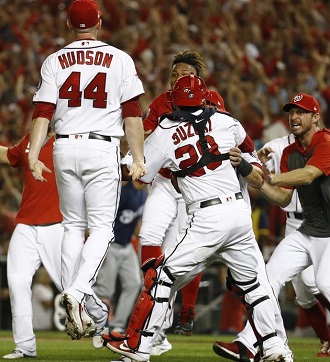
“My arm is hanging right now,” Max the Knife said after it was all over but the flight back to Los Angeles and a Game Five showdown between Stephen Strasburg and Walker Buehler. “That pushed me all the way to the edge—and then some.” Good thing Doolittle had four outs to deliver and Hudson, two, to close Game Four out with a flourish of their own.

In a game culture so heavily youth-oriented over the past few years Scherzer and Zimmerman must seem anomalous. “We’re a bunch of viejos,” Scherzer told a postgame presser about themselves and their fourteen teammates over the age an earlier generation considered the cutoff for trust. “We’re old guys. Old guys can still do it.”

That wasn’t easy or necessarily guaranteed. Scherzer’s season was compromised by an attack of bursitis and an upper-back rhomboid muscle, forcing him to miss the last of July and most of August. When he returned, after a couple of short but effective enough starts, he almost looked older than his actual 34 years.

He still kept his ERA to 2.92 and still led the Show with a 2.45 fielding-independent pitching rate, but entering the postseason there were legitimate questions about how much he might still actually have left past this year. Like Zimmerman, Scherzer would far rather let himself decide when he’s ready for his baseball sunset.

Max the Knife proved Exhibit A in favour of Martinez’s original starter-as-reliever division series scheme, striking out the side swinging in the eighth in Game Two. And Corbin’s Game Three implosion put the S-A-R idea to bed for the rest of the series, if not the postseason.

Zimmerman is, of course, the one Nat remaining who’s worn their colours since they were reborn in 2005, after long and often painful life as the Montreal Expos. They picked him fourth overall that year; he had an impressive cup of coffee with them down that year’s stretch and stuck but good.

His hope to age gracefully in baseball terms has been thwarted too often by his body telling him where to shove it when he least wants to hear it. He refuses to go gently into that good gray night just yet; he accepts his half-time or part-time status with uncommon grace.

“I really don’t think these are his last games,” Scherzer told the reporters with Zimmerman sitting at his right. “Only you think this is his last games.”

“The last home game [of the regular season], they tried to give me a standing ovation,” Zimmerman said. “I mean, I feel good. I think we’ve got plenty to go.”

“I feel young,” Scherzer said, turning to Zimmerman, “and I’m older than you.”

Scherzer is older than Zimmerman—by two months. But they looked as though they’d told Father Time to step back a hundred paces when they pitched and swung Monday night. Only after the game did they creak like old men.

Zimmerman started only because Martinez wanted to use the platoon advantage against the lefthanded Hill, and he struck out twice. But when he came to the plate as Roberts sent him the righthanded Baez in the fifth, Martinez had a decision: let Zimmerman swing anyway or counter with lefthanded Matt Adams off the bench.

Martinez stayed with Zimmerman. And in that moment Zimmerman became Washington’s King of Swing, leaving Scherzer to settle for being Washington’s King of Sling. Enabling the Nats to live at least one more day. And the way they grunted, growled, and ground Monday night, the Dodgers may yet have a fight on their hands in Los Angeles come Wednesday.

Just don’t expect to see Scherzer out of the pen Wednesday. Even he’s not crazy enough to even think about that scenario. The next time Max the Knife wants to be on the mound it’ll be to pitch for a pennant.
With the sixth you get steamrolled

2019-10-06 PatrickCorbin

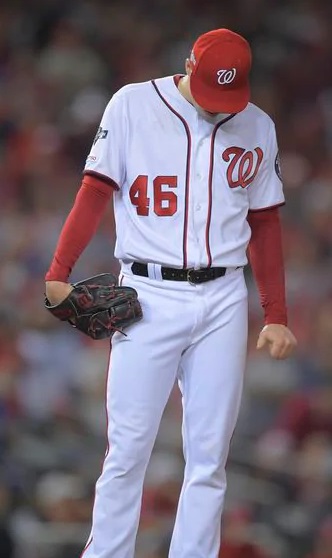
Patrick Corbin, the third man in the Nats’ starters-as-relievers plan, was the first and worst to be torched.

There is one bright side to the Nationals being bludgeoned 10-4 by the Dodgers Sunday night. It means they still have a shot in their National League division series. Because they’ll send Max Scherzer to the mound for Game Four. And all they need is Scherzer to be as close to Scherzer as possible.

If he is, the Nats have a fighting chance. And, Stephen Strasburg on regular rest for Game Five in Dodger Stadium. If he isn’t, they’ll look even more like baseball’s version of a Harold Stassen presidential campaign.

For the time being, though, they might want to can the starter-as-reliever strategy no matter how testy most of their bullpen is. They need Scherzer to pitch them as deep as possible without getting drowned. While praying manager Dave Martinez shakes Sunday off enough not to push anything resembling a panic button.

Certainly not the one he pushed Sunday afternoon, when he lifted his mostly cruising starter Anibal Sanchez after only 87 pitches, five innings, nine strikeouts (mostly on changeups, power worshippers), and a 2-1 lead, the last courtesy of Juan Soto’s monstrous two-run homer past the center field fence in the bottom of the first.

All of which followed Sanchez wriggling unscathed out of a ducks-on-the-pond first inning jam. If the only thing spoiling Sanchez’s gig was Max Muncy’s two-strike launch into the right center field bleachers with two out in the top of the fifth, surely Martinez could have kept Sanchez aboard for one more inning.

Well, maybe not. Whenever Sanchez gets a third crack at a lineup the other guys nail a .923 OPS against him. Maybe Martinez really didn’t have that much of a choice if he wanted to protect a 2-1 lead. Especially knowing his bullpen not named Daniel Hudson or Sean Doolittle were the second most self-immolating group in Washington aside from the federal government.

So Martinez reached for Corbin, the third man in his starter-as-reliever series plan. Maybe it was the right move, but there’s no maybe about how wrong the result ended up. Martinez surely thought the third verse would be the same as the first two.

Then he discovered an impostor in Corbin’s uniform.

Whoever was in Nats number 46 Sunday night, the Dodgers battered him for six runs in the top of the sixth and tied a postseason record with seven two-out runs total in the inning, keeping the Nats to only a two-runs-worth reply the rest of the way.

“Anibal was at 87 pitches. He gave us all he had,” said Martinez after the Nats were put out of their misery at last. “We were at a good spot in the lineup, where we thought Corbin could get through it. And his stuff was good . . . But he had every hitter 0-2. He just couldn’t finish.”

If the stuff was good, the command was hit by a mutiny. And then the Dodgers added insult to immolation when Russell Martin, who started the sixth-inning mischief with a two-run double bounding off the left center field fence, batted on 2-1 with David Freese on first in the top of the ninth and Hunter Strickland on the mound—and sent it into the seats above the left field bullpen.

The Nats must be wondering just what they ever did to Martin to make him treat them so disrespectfully. “You try to feast on mistakes,” Martin said after the game. “And he made a few mistakes.”

After actual or alleged Corbin knocked out two strikeouts following Cody Bellinger’s leadoff single, David Freese singled to right for first and third. And Martin on 2-2 sent a nice, low enough slider to the back of left center, leaving room to spare for Bellinger and Freese to come home. Corbin promptly walked pinch hitter Chris Taylor and the Dodgers knew this was an impostor. Enough for another pinch hitter, Enrique Hernandez, to lash a two-run double deep to left.

Feast on mistakes? To these Dodgers this Sunday night Corbin, or whoever snuck into his uniform, looked like a luau.

“That was one of those things,” Muncy said, “where once one guy started doing it, the next cat picked up on it and it just kind of rolled throughout the inning.” Steamrolled, that is.

Corbin didn’t flinch when a swarm of reporters crowded his locker after the game. “It just stinks,” he said in a voice so low, from so much pain, that you might have missed it unless you were in the front row of the swarm. “I feel like I let these guys down.”

The Nats put Muncy aboard on the house, a wise move considering he’d accounted for the first Dodger run in Sanchez’s final inning with a shot into the right center field bleachers. The wisdom lasted only long enough for Martinez to get the impostor out of there, get Wander Suero in, and and get another jolt when Justin Turner hit one into the left center field seats.

Of course, having nobody in the bullpen more reliable than Hudson and Doolittle complicates things. In a four-run hole the Nats weren’t about to burn either of those two. But bringing Strickland in to deal with the Dodgers in the ninth was almost like hiring Ma Barker to command the FBI. Martin’s launch off him was the ninth bomb Strickland’s surrendered in twelve lifetime postseason innings.

“[R]emember the crick that remains in your neck from watching the delicious meatballs Hunter Strickland has been serving up for weeks,” wrote the Washington Post‘s Barry Svrluga. “He is now a symbol of this battered bullpen and is slipping into ‘He Who Must Not Be Named’ territory.”

“We just have to keep plugging away,” Nats catcher Kurt Suzuki told reporters after the game. “You definitely feel confident. You have the lead. You still have to finish it. That is a good lineup over there. They did their job tonight.”

Suzuki and his Nats need Scherzer to do as close to his normal job as possible Monday. And if they find a ransom demand for the real Patrick Corbin, pay it.

Martinez surprises with Max the Knife

2019-10-05 MaxScherzer

Could that someone out of the pen be Max the Knife?

Bet on it: it doesn’t happen if Matt Williams was still the Nationals’ manager. Bet a little on it: it might not even happen if Dusty Baker was still the manager. Davey Johnson, maybe. But it happened through the courtesy of incumbent Dave Martinez.

And it got him a return to Nationals Park with their National League division series against the Dodgers tied at one apiece. The Nats ain’t ready for the last dance just yet. And if they keep this up, they just might get one in the World Series in due course. Might.

Williams was too wedded to The Book, whatever he thought it was, to have even thought about bringing Max Scherzer in from the bullpen in National League division series Game Two. Compared to Williams, Baker was John Coltrane, but I’m not sure even Baker might have gone there, either.

Johnson’s the man who once inserted one relief pitcher into right field and the other on the mound (Roger McDowell and Jesse Orosco, or was it Jesse Orosco and Roger McDowell), then rotated them between the positions until his Mets won the damn game. Johnson just might have reached for Scherzer Friday night.

But Martinez did, in the eighth inning. “We weren’t expecting that,” lamented Dodgers manager Dave Roberts after the Nats finished the 4-2 win they’d started. The Dodgers and just about everyone else in the solar system.

After a long season that only began with the distinct appearance of Martinez awaiting his call to the guillotine as its victim, not its operator, who the hell did he think he was Friday night, Casey Stengel?

The good news was Scherzer striking out the side in the eighth. The bad news was, the Nats still have an honest to God bullpen, and they’re still one of the shakiest bunches this side of the old Soul Train dancers. Daniel Hudson got the ninth inning gig and got himself the bases loaded—partly because Martinez took the gamble of putting the winning run aboard with two out to set up a possible force—before swishing Corey Seager out to end it.

And before Max the Knife came in for the eighth, Sean Doolittle, usually the Nats’ closer, relieved Stephen Strasburg for the seventh and, after striking out MVP candidate Cody Bellinger to open, threw Max Muncy a dead center meatball that Muncy drove dead over the right field fence to close the Nats’ lead to a single run.

Good thing Doolittle’s pinch hitter Asdrubal Cabrera smacked Dodger reliever Dustin May’s first service into right center field with second and third for the fourth Nats’ run. Better thing that Martinez was only too willing to say screw the protocols and reach for Scherzer for the eighth. Best thing that Scherzer got Gavin Lux, pinch hitter Chris Taylor, and Joc Pederson on three straight Duke Ellingtons: It don’t mean a thing if it ain’t got that swing.

It’s one thing to go all-hands-on-deck in a win-or-be-gone play-in like a wild card game. It’s something else, seemingly, to load your bullpen with your grand starting pitchers in a division series. If you still want Scherzer to start Game Three for you in Washington, it’s entirely doable after Scherzer worked only the one inning without even thinking about asking what the hell he was doing strolling in from among the arson squad.

“All the chips are on the table,” Scherzer said after the game.

Except that Martinez hinted powerfully enough that it’d be Anibal Sanchez likely to start Game Three—with Patrick Corbin available in the bullpen. Nobody around the Nats thinks it’s such a beyond-sane idea. Certainly not Scherzer.

“I’ve been in these situations before where you’re pitching on two days’ rest in all-star games and different times in the postseason,” he told reporters after Game Two. “I know that on two days’ rest, you’ve got one inning in you. So, I said whatever the situation is, I’m ready to pitch.”

Remember: that’s the man who refused to let something so trivial as a black eye and a swollen face stop him from taking his next turn and throwing a ten punchout, four-hit gem in a doubleheader nightcap in late June. A man who’ll pitch when, never mind until he’s black and blue in the face isn’t going to flinch over coming out of a postseason bullpen for a quick round.

Oh, goody (not), the Dodgers must be thinking. Remember last year. They were undone in a World Series when the Red Sox started David Price twice and closed with him once, started Chris Sale once and closed with him once (the Series winner, as it happens), and started Eduardo Rodriguez once and drew him in from the pen twice. Hello, Yogi, wherever you are around the Elysian Fields, it’s threatening to get late early out there again.

Strasburg didn’t seem to mind that Max the Knife stole some of his thunder on a night when he needed to be a little beyond his best himself. You can afford to be sanguine when your mates pry three runs out of a Clayton Kershaw who still can’t seem to find and sustain the best of his best in postseason play, while you’re busy punching out ten in six innings, surrendering three measly hits, and one measly earned run.

And it helps even more when you now have a postseason career 0.64 ERA while allowing but one run so far this October. This keeps up, we’re going to be saying Strasburg’s name in the same postseason sentences as those of Sandy Koufax, Bob Gibson, Mickey Lolich, Orel Hershiser, Curt Schilling, Madison Bumgarner, and Justin Verlander.

You may also be saying other names to refer to the Nats before long. Ringling Brothers and Scherzer and Strasburg Circus. Brother Martinez’s Traveling Salvation Show. The Mothers of Inversion. The Dodgers could be describing them with the last of those with “of Inversion” replaced by a twelve-letter compound euphemism for “maternal fornicator” before long.


Can you top this?

2019-10-02 WashingtonNationals

Can the American League wild card game possibly beat the National League’s for surrealism?

An Athletics fan of my acquaintance in a Facebook baseball group told me this morning that, even in the dump of a Coliseum, the American League wild card game between the A’s and the Rays looked to be an absolute sellout. This is good.

Whether the A’s and the Rays come up with anything such as happened in the National League game Tuesday night is anybody’s guess until they play. And, hopefully, each team’s fans pray devoutly, it won’t be the kind of late twist of fate that squirted the Nationals to overthrow a win the Brewers looked to have in the safe.

Until Tuesday night it was the Nats who tended to suffer on wrong side of the pennant race’s or the postseason’s slings, arrows, slapsticks, anguishes, and surrealities. Then one unexpected skip on the grass of a bases-loaded eighth-inning single gave the Nats a deep taste of how it feels to be on the winning side of even one of those.

Maybe the Elysian Fields demigods decided at long enough last that, considering the toxic surreality that is Washington’s number one business—also known as the nation’s largest organised crime family—the nation’s capital and those who live there and root for the Nats deserved even a brief reprieve.

The history minded in the capital could see the ghosts of the last time a bad hop won something big for Washington baseball. Two bad hops in fact, both on the dime of Giants third baseman Freddie Lindstrom, one enabling the ancient Senators to tie and the other enabling them to win Game Seven of the 1924 World Series.

These Nats haven’t yet reached that close to World Series rings, of course. But after Juan Soto’s liner skipped surrealistically beyond the otherwise well positioned glove of rookie Brewers right fielder Trent Grisham, you might forgive the Nats and their fans if they permit themselves thoughts that, this time, they just might not get kicked to the rocks below after being led up the mountain to gaze upon the Promised Land.

The A’s and the Rays have a next-to-impossible act to follow Wednesday night. The Nats merely have a division series date with the Dodgers starting Friday in Los Angeles. They’ve crossed the Red Sea. Now comes the trek across the desert. As the man on the radio used to say, it won’t be easy, Clyde.

Some star-crossed teams can say at least that their signature transdimensional disasters were spread out over decades. The Nats have gotten theirs within just sixteen years of life adjacent to the Potomac. Their Montreal forebears never knew even a sixteenth of that. Maybe the 1994 strike costing them a clear postseason path.

Why, those Montreal forebears were even managed by Gene Mauch in their infancy and never had the chance to endure the kind of thing that sketched Mauch’s name into unfair infamy with the 1964 Phillies and the 1986 Angels. Lucky them.

But those now-ancient Expos never looked like the walking dead after a 19-31 season start, resurrected themselves after an embarrassing series loss to this year’s equally self-resurrected Mets, then romped to at least the first league wild card until they nearly blew it in September, either.

Those Expos never had the chance to go to four winner-take-all games before Tuesday night and lose every last one of them.

Those Expos were never betrayed by jumping out to a 6-0 lead in the first three innings of one of those games only to start swinging like they were trying to hit six-run homers on every pitch thrown to them or start pitching like they were trying to strike out the side on single pitches and enabling the Cardinals to overthrow them. The 2012 Nats thought of that.

Those Expos were never betrayed by their own manager hooking a sharp young pitcher with reserves still in the tank and two outs from a complete-game division series shutout, then failing to reach for Stephen Strasburg on call in the pen with the season absolutely on the line in another division series. Matt Williams dreamed that one up in 2014.

Those Expos didn’t get bastinadoed out of the race by the Mets when their skipper absolutely refused to betray The Book, whatever the hell it was at the time, and finally got caught completely out of the loop when his half-crazed closer tried to choke his right fielder in the dugout the weekend they were eliminated mathematically from the race. Williams conjured that one up, too, in 2015.

Those Expos didn’t out-score the Dodgers 24-19 in a division series only to lose Game Five on a four-run Dodger seventh and a slightly surrealistic Clayton Kershaw save. That brilliant idea came to the 2016 Nats.

Those Expos didn’t push a division series to a Game Five and then watch in horror when their catcher committed a passed ball, then threw wild past first, then got caught in catcher’s interference before the next batter up got hit by a bases-loaded pitch to finish a four-run fifth against them. 2017 Nats.

They may or may not miss baseball in Montreal but they probably don’t miss having avoided those kinds of disasters, either. Until Tuesday night, moving them to restore Washington baseball began to resemble the capital’s only known non-government-involved case of being careful what you wished for.

Long, long ago, it used to be said with only partial actual accuracy: “Washington—First in war, first in peace, and last in the American League.” Prior to Tuesday night it looked an awful lot like “Washington—First in war, first in peace, and first to disaster in the National League.”

For seven innings Tuesday it looked like they were going to get chaperoned right off the grounds of the postseason dance before they could even present their tickets, never mind get that last dance with the prettiest girl. And the odds looked reasonable that Brewers closer Josh Hader would make damn sure their tickets would be voided when he opened by striking out Victor Robles on a full count.

Except that Hader didn’t bring his customary authority to the door. Then, it was hitting pinch hitter Michael A. Taylor (for Strasburg, who’d pitched three scoreless relief innings in the Nats’ all-hands-on-deck bullpen plan) with a pitch that got his hand and bat one after the other in a split nanosecond. Then, Hader found enough to strike Trea Turner out and set the Brewers a mere four outs from going to Los Angeles, instead.

But venerable veteran Ryan Zimmerman pinch hit for Adam Eaton and slashed a broken-bat base hit right up the pipe, with Andrew Stevenson, a far more swift set of legs, sent out to run for him. Then, after forcing him back from 3-0 to a full count, with “M-V-P!” chanting pouring down from the stands, Hader walked Anthony Rendon to load up the pillows for Soto.

Then it was Soto’s frozen rope into right. It was Grisham, whose leadoff walk preceded Yasmani Grandal’s two-run homer in the top of the first that the Nats back onto their heels too early, hustling in from deep positioning to pick it off. It was the ball taking that odd skip away from Grisham’s otherwise well positioned glove. It was Taylor and Stevenson driving home at the speed limit and Rendon right behind them before Grisham’s relay throw hit his cutoff man.

And it was Brewers third baseman Mike Moustakas taking the relay throw just ahead of Soto’s arrival at third and starting the brief rundown that bagged Soto at second for the side. And what proved the end, when Nats manager Dave Martinez—who almost mismangaed himself right out of a job in May—reached for Daniel Hudson, who shook off a one-out single to get two air outs for the game.

These Brewers ironed up and fought hard enough after Christian Yelich inadvertently kneecapped himself for the rest of the year that even Nats fans ached for them for just a moment. They’d gotten a sad taste of the kind of thing that used to bedevil the Red Sox before the turn of the century, the Dodgers in Brooklyn from pre-Pearl Harbour through 1955, and the Cubs from the (Theodore) Roosevelt Administration until 2016.

The kind of thing, too, that usually happened to the Nats, not by them.

The realist may say, “Don’t count your Dodgers before they’re hatched,” but the optimist, given a license renewal Tuesday night, has a day and a half window to tell the realist to sit the hell down, shut the hell up, and stop spoiling the fun. Even if the Dodgers end up keeping the fun to a day and a half window, it’s a window Nats fans wouldn’t dare to close, and you can’t blame them one lick.

The A’s and the Rays may feel like the Rolling Stones tasked with trying to follow James Brown on television’s legendary The T.A.M.I. Show in 1965. Come to think of it, by comparison to following the Nats, the Stones may have had it easier. May.

Dancing Nats skip to a division series

2019-10-01 TrentGrisham

It was Trent Grisham’s first error of the season. After 70 flawless chances in 42 major league games.

The Nationals had the plan for the National League wild card game. Max Scherzer would start. All hands would be on deck in the pen including Stephen Strasburg in case Scherzer got into hot water, and Patrick Corbin in case Strasburg fell into the soup.

It’d be their big rotation guns against the Brewers’ bullpenning game. With Christian Yelich out of the picture thanks to that busted kneecap, the Brewers would be short of power while the Nats would abound with it. Right?

It wasn’t in the plans for Scherzer to get taken deep early before settling in. Or, for the Nats to take a three-run deficit into the bottom of the eighth, have to tangle with the Brewers’ best bullpen arm, Josh Hader, and turn it into a one-run lead on a misplayed, bases-loaded, bases-clearing single. By a rookie right fielder who hadn’t committed an error on 70 chances in 42 previous major league games in the outfield. Right?

Oh, sure, they planned that Juan Soto, the boy wonder, would be one of the big men in the absolute clutch. So does every Nats fan and observer. Even on a night when it began to look as though the Nats began thinking the clutch was something you had to pump in an ancient car.

They just didn’t imagine Soto would whack the line single that sent the Brewers home for the winter, 4-3. Any more than the Brewers imagined right fielder Trent Grisham, though playing deep, wouldn’t be able to come up with the ball and keep the Nats to maybe a single run on the play. Any more than Grisham could imagine being a postseason hero in the first inning and a postseason victim in the eighth.

But it wasn’t in Grisham’s plans, either, to see the ball take a bizarre little skip under his glove and off to his right as he hustled forward and extended his glove down to take the likely hop. He reached to good position, then he saw the horrific skip away. Just like Leon Durham did in the 1984 National League Championship Series. Just like Bill Buckner did in the 1986 World Series.

Even as he retrieved the ball to start the rundown play that nailed Soto for the third out, Grisham would be forgiven if he wanted to lift up the Nationals Park right field grass, crawl under it, and leave behind nothing but a sign saying do not open until spring training.

He didn’t do that, but he did stand up and fess up to a rookie mistake. “I was getting ready to throw to home,” he said after the game. “Came in off-balance, it took a little funky hop on me because I came in off-balance. I didn’t really gather myself and the ball got by me.”

Said Brewers manager Craig Counsell, “The inning was an ugly inning. Crazy things happen.”

To think the Dancing Nats, whose celebratory dugout rug cutting after big hits has become their season’s trademark, skip on to a division series date with the Dodgers. Crazy things, indeed.

Certainly it wasn’t in the Brewers’ plans to have no further solution for Scherzer as he shook off the early-inning bombs, or Strasburg as he flicked any hints of mischief away like annoying mosquitoes, or Daniel Hudson off whom they got nothing but a one-out single in the top of the ninth before a fly out to center sent the Nats Park crowd nuclear.

Apologies, John Lennon, wherever you are. Baseball is what happens when you’re busy making other plans, too.

Just like that, the Brewers’ heroic late September driving despite losing Yelich—playing like a threshing machine bound to overcome the imploding Cubs, getting about as close as the thickness of a sheet of paper to snatching the National League Central—meant nothing but getting the chance to let a game they almost had in the vault slip to the Nats.

“We finally caught a break,” said Scherzer, knowing only too well the Nats’ previous futility in winner-take-all games. “Man, this is so good for this city, and the team, and this organisation. It’s getting the monkey off your back. It gives you a reason to believe.”

For Grisham, by his own admission, the eighth inning is “gonna sting. It’s gonna sting for a long time.” His teammates did their best to remove the sting, he said, with plenty of words of encouragement and assurances that they might not have reached even the wild card game without him.

“I can take solace in what a lot of these guys said to me, especially a lot of the older veteran guys,” Grisham continued, talking to reporters after changing clothes, his voice calm, his manner matter-of-fact. “I have a lot of faith in them and trust what they said to me . . . I just ended up making an error. It’s not my first, and it’s not going to be my last.”

Remember his composure facing up to it after the wild card game. It was worth more than any brickbat heartsick Brewers fans are liable to swing in his direction. Remember that when men young or old try their best and fail, that’s all it is. Failure isn’t pretty but it isn’t a moral or character lapse.

The Nats didn’t expect Scherzer to get into hot water right out of the chute. They got the Brewers leading the majors in walks, but they didn’t expect Mad Max to walk Grisham on 3-2 to open the game before former Dodger Yasmani Grandal hit one into the Nats’ bullpen in right to end a six-pitch battle.

And they sure didn’t expect Eric Thames to open the top of the second defying the scouting reports—which command he be fed a diet of off-speed pitches to keep him from making mischief—and sending the second of Scherzer’s two straight curve balls over the right center field fence.

“Sometimes you just have to tip your hat and move on,” said Scherzer after the game.

Their only answer for long enough was Trea Turner with two outs in the bottom of the third, sending Brewers starter Brandon Workman’s only serious mistake of the evening into the left field seats. And after five innings’ and six strikeouts worth of work, plus a bottom of the fifth in which the Nats put two on and abandoned them, exit Scherzer and enter Strasburg. And Strasburg worked three mostly effortless innings, striking out four.

Effortless enough that the Dodgers may not get to wait as long as they’d prefer to deal with him in the division series, perhaps as soon as Game Two. With Corbin prepared to open against them. And Scherzer in Game Three on regular rest. (Memo to the Dodgers: Be careful what you plan for.)

The Brewers sent their vaunted enough bullpen out to continue nullifying the Nats. And for most of the game the Nats looked as though they were putting good at-bats together but spoiling them by seeming often as not to try to hit six-run homers with key swings.

Then the game got to Hader, who’s normally about as welcome out of the Brewers bullpen for his opponents as a case of hiccups is to a glass blower. And when he opened the bottom of the eighth by striking Victor Robles out after first falling behind 2-0, it began to look as though the Brewers had figured out every known escape hatch to use against the Nats.

Except that Hader’s pitch command looked suspect enough. And proved suspect enough when Michael A. Taylor pinch hit for Strasburg, worked his way to a full count, then got hit by a pitch. No, he didn’t. The ball hit the bat knob. No, it didn’t. Actually, it clipped Taylor’s hand and the bat knob. And in that nanosecond order. The review took a few minutes but the hit batsman call stood.

It may yet stand as the single most powerful plunk of all time.

At first it looked like it might end up otherwise, though, when Hader struck Turner out swinging. Then Ryan Zimmerman, the Nats’ elder statesman, who’d like to play one more season even as a role player, pinch hit for Adam Eaton, who’d been 0-for-3 on the night. The elder slashed a single right up the pipe for first and second. And Anthony Rendon, to the shower of a rollicking “M-V-P!” chant down from the stands, wrestled his way into a full-count walk.

Then it was Soto. With a foul off to open. Ball one far enough outside for a Washington Metro train to pass without bumping anything on either side. Then, the line drive that ducked and eluded the hapless Grisham’s glove. And ended up putting paid to the Brewers’ 2019.

Before the Brewers and the Nats suited up Tuesday night, Yelich actually let it be known he was half hoping for a shot at a World Series moment like Kirk Gibson’s in the 1988 World Series. The broken battler willing himself to one big swing where it mattered most and hurt the other guys most.

Just the way Gibson willed himself to pinch hit in the bottom of the ninth of Game One, sent Hall of Famer Dennis Eckersley’s hanging slider into the right field bullpen to win it, and pumped his right arm and fist more to urge a body that belonged in traction around the bases than to celebrate.

“I’ve seen it, yeah,” Yelich said. “I wouldn’t even be capable of doing that kind of run right now. We’re a long, long, long ways away from that happening, but you never like to rule anything out.”

Having fought so tenaciously after losing Yelich to get to Tuesday night in the first place, the Brewers didn’t exactly like having their postseason ruled out too soon, either. And, having fought back from an early 19-31 plotz that threatened to lay their season almost entirely to waste, these Nats didn’t intend for their postseason to be ruled out too soon, either.