Dancing Nats skip to a division series

2019-10-01 TrentGrisham

It was Trent Grisham’s first error of the season. After 70 flawless chances in 42 major league games.

The Nationals had the plan for the National League wild card game. Max Scherzer would start. All hands would be on deck in the pen including Stephen Strasburg in case Scherzer got into hot water, and Patrick Corbin in case Strasburg fell into the soup.

It’d be their big rotation guns against the Brewers’ bullpenning game. With Christian Yelich out of the picture thanks to that busted kneecap, the Brewers would be short of power while the Nats would abound with it. Right?

It wasn’t in the plans for Scherzer to get taken deep early before settling in. Or, for the Nats to take a three-run deficit into the bottom of the eighth, have to tangle with the Brewers’ best bullpen arm, Josh Hader, and turn it into a one-run lead on a misplayed, bases-loaded, bases-clearing single. By a rookie right fielder who hadn’t committed an error on 70 chances in 42 previous major league games in the outfield. Right?

Oh, sure, they planned that Juan Soto, the boy wonder, would be one of the big men in the absolute clutch. So does every Nats fan and observer. Even on a night when it began to look as though the Nats began thinking the clutch was something you had to pump in an ancient car.

They just didn’t imagine Soto would whack the line single that sent the Brewers home for the winter, 4-3. Any more than the Brewers imagined right fielder Trent Grisham, though playing deep, wouldn’t be able to come up with the ball and keep the Nats to maybe a single run on the play. Any more than Grisham could imagine being a postseason hero in the first inning and a postseason victim in the eighth.

But it wasn’t in Grisham’s plans, either, to see the ball take a bizarre little skip under his glove and off to his right as he hustled forward and extended his glove down to take the likely hop. He reached to good position, then he saw the horrific skip away. Just like Leon Durham did in the 1984 National League Championship Series. Just like Bill Buckner did in the 1986 World Series.

Even as he retrieved the ball to start the rundown play that nailed Soto for the third out, Grisham would be forgiven if he wanted to lift up the Nationals Park right field grass, crawl under it, and leave behind nothing but a sign saying do not open until spring training.

He didn’t do that, but he did stand up and fess up to a rookie mistake. “I was getting ready to throw to home,” he said after the game. “Came in off-balance, it took a little funky hop on me because I came in off-balance. I didn’t really gather myself and the ball got by me.”

Said Brewers manager Craig Counsell, “The inning was an ugly inning. Crazy things happen.”

To think the Dancing Nats, whose celebratory dugout rug cutting after big hits has become their season’s trademark, skip on to a division series date with the Dodgers. Crazy things, indeed.

Certainly it wasn’t in the Brewers’ plans to have no further solution for Scherzer as he shook off the early-inning bombs, or Strasburg as he flicked any hints of mischief away like annoying mosquitoes, or Daniel Hudson off whom they got nothing but a one-out single in the top of the ninth before a fly out to center sent the Nats Park crowd nuclear.

Apologies, John Lennon, wherever you are. Baseball is what happens when you’re busy making other plans, too.

Just like that, the Brewers’ heroic late September driving despite losing Yelich—playing like a threshing machine bound to overcome the imploding Cubs, getting about as close as the thickness of a sheet of paper to snatching the National League Central—meant nothing but getting the chance to let a game they almost had in the vault slip to the Nats.

“We finally caught a break,” said Scherzer, knowing only too well the Nats’ previous futility in winner-take-all games. “Man, this is so good for this city, and the team, and this organisation. It’s getting the monkey off your back. It gives you a reason to believe.”

For Grisham, by his own admission, the eighth inning is “gonna sting. It’s gonna sting for a long time.” His teammates did their best to remove the sting, he said, with plenty of words of encouragement and assurances that they might not have reached even the wild card game without him.

“I can take solace in what a lot of these guys said to me, especially a lot of the older veteran guys,” Grisham continued, talking to reporters after changing clothes, his voice calm, his manner matter-of-fact. “I have a lot of faith in them and trust what they said to me . . . I just ended up making an error. It’s not my first, and it’s not going to be my last.”

Remember his composure facing up to it after the wild card game. It was worth more than any brickbat heartsick Brewers fans are liable to swing in his direction. Remember that when men young or old try their best and fail, that’s all it is. Failure isn’t pretty but it isn’t a moral or character lapse.

The Nats didn’t expect Scherzer to get into hot water right out of the chute. They got the Brewers leading the majors in walks, but they didn’t expect Mad Max to walk Grisham on 3-2 to open the game before former Dodger Yasmani Grandal hit one into the Nats’ bullpen in right to end a six-pitch battle.

And they sure didn’t expect Eric Thames to open the top of the second defying the scouting reports—which command he be fed a diet of off-speed pitches to keep him from making mischief—and sending the second of Scherzer’s two straight curve balls over the right center field fence.

“Sometimes you just have to tip your hat and move on,” said Scherzer after the game.

Their only answer for long enough was Trea Turner with two outs in the bottom of the third, sending Brewers starter Brandon Workman’s only serious mistake of the evening into the left field seats. And after five innings’ and six strikeouts worth of work, plus a bottom of the fifth in which the Nats put two on and abandoned them, exit Scherzer and enter Strasburg. And Strasburg worked three mostly effortless innings, striking out four.

Effortless enough that the Dodgers may not get to wait as long as they’d prefer to deal with him in the division series, perhaps as soon as Game Two. With Corbin prepared to open against them. And Scherzer in Game Three on regular rest. (Memo to the Dodgers: Be careful what you plan for.)

The Brewers sent their vaunted enough bullpen out to continue nullifying the Nats. And for most of the game the Nats looked as though they were putting good at-bats together but spoiling them by seeming often as not to try to hit six-run homers with key swings.

Then the game got to Hader, who’s normally about as welcome out of the Brewers bullpen for his opponents as a case of hiccups is to a glass blower. And when he opened the bottom of the eighth by striking Victor Robles out after first falling behind 2-0, it began to look as though the Brewers had figured out every known escape hatch to use against the Nats.

Except that Hader’s pitch command looked suspect enough. And proved suspect enough when Michael A. Taylor pinch hit for Strasburg, worked his way to a full count, then got hit by a pitch. No, he didn’t. The ball hit the bat knob. No, it didn’t. Actually, it clipped Taylor’s hand and the bat knob. And in that nanosecond order. The review took a few minutes but the hit batsman call stood.

It may yet stand as the single most powerful plunk of all time.

At first it looked like it might end up otherwise, though, when Hader struck Turner out swinging. Then Ryan Zimmerman, the Nats’ elder statesman, who’d like to play one more season even as a role player, pinch hit for Adam Eaton, who’d been 0-for-3 on the night. The elder slashed a single right up the pipe for first and second. And Anthony Rendon, to the shower of a rollicking “M-V-P!” chant down from the stands, wrestled his way into a full-count walk.

Then it was Soto. With a foul off to open. Ball one far enough outside for a Washington Metro train to pass without bumping anything on either side. Then, the line drive that ducked and eluded the hapless Grisham’s glove. And ended up putting paid to the Brewers’ 2019.

Before the Brewers and the Nats suited up Tuesday night, Yelich actually let it be known he was half hoping for a shot at a World Series moment like Kirk Gibson’s in the 1988 World Series. The broken battler willing himself to one big swing where it mattered most and hurt the other guys most.

Just the way Gibson willed himself to pinch hit in the bottom of the ninth of Game One, sent Hall of Famer Dennis Eckersley’s hanging slider into the right field bullpen to win it, and pumped his right arm and fist more to urge a body that belonged in traction around the bases than to celebrate.

“I’ve seen it, yeah,” Yelich said. “I wouldn’t even be capable of doing that kind of run right now. We’re a long, long, long ways away from that happening, but you never like to rule anything out.”

Having fought so tenaciously after losing Yelich to get to Tuesday night in the first place, the Brewers didn’t exactly like having their postseason ruled out too soon, either. And, having fought back from an early 19-31 plotz that threatened to lay their season almost entirely to waste, these Nats didn’t intend for their postseason to be ruled out too soon, either.
A real Saturday night special

2019-09-08 AaronBarrett

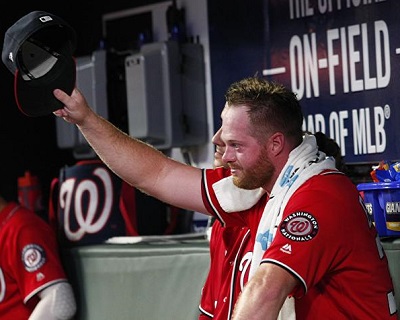
Eyes red after weeping for joy, Nationals reliever Aaron Barrett tips his cap from the dugout Saturday night.

Even down the stretch of the stretch, some things transcend ratings and standings. Aaron Barrett became one of them Saturday night.

When the Nationals righthander was sent out to pitch the bottom of the fifth, it may have been enough that he could be up for the assignment at all, never mind working a scoreless inning in a game that eventually became a ninth-straight Braves win.

And it wasn’t low leverage, either, despite the end of the Braves’s batting order looming. This wasn’t a mop-up assignment on either end of a ferocious blowout or to hold fort in a lost cause. Barrett relieved Nats starter Austin Voth with the Nats down a mere 2-1 and Ronald Acuna, Jr. looming as the third man scheduled to hit.

Maybe Barrett’s kind of comeback was the kind that moves a manager to trust his heart equal to trusting his stuff. It isn’t every major league pitcher who survives Tommy John surgery and a followup broken humerus bone to throw even one pitch, never mind a scoreless inning.

Barrett didn’t exactly start the gig the right way, walking Adeiny Hechevarria on four straight to open the inning. But he made sure Hechevarria was the only Braves runner of the frame. He got Braves starting pitcher Julio Teheran to foul out to first on 1-2. And then came Acuna, who was perfectly capable of spreading the Braves’ lead and the Nats’ concurrent miseries with a single swing.

The husky righthander with the doll-like face under his beard went right back to work. He caught Acuna looking at a strike one two-seam fastball on the upper inside corner. He got Acuna to swing right over a second two-seam fastball that hit the floor of the strike zone. He caught Acuna looking at a sweetly diving slider that landed smack dab on the low outside corner.

It was Barrett’s first major league punchout in 1,499 days, but the way he did it would leave a neurosurgeon envious of that kind of precision.

And when he got Ozzie Albies—who homered in the first—to loft a changeup to moderately short center field for the side, Barrett wiped tears from his eyes with the front of his Nats jersey as he stepped down from the mound toward the dugout. Where manager Dave Martinez and his grinning teammates high-fived and embraced him. Then Barrett took a seat, clutching the towel Martinez handed him, and wept unashamedly into that towel.

A three-run Atlanta sixth, including back-to-back homers by Brian McCann and Matt Joyce, still lurked ahead. So did a Nationals run scoring on a seventh-inning double play, and so did Juan Soto sending a two-run double to the back of center field in the eighth.

So, unfortunately, did the Nats falling ten games behind the Braves in the National League East with the 5-4 loss, while keeping a two-game grip on the league’s first wild card, while the Braves added to a 20-4 string since 11 August and a thirteenth straight home win, the Show’s most since the Indians did it in their pennant-winning 2016.

None of which really overthrew Barrett’s first major league inning in four years. “After the outing was over,” he managed to say after the game, “I’m just walking off and all the emotions just hit me. Just, ‘You did it, man. You did it’.”

He’d been one solid element of the 2014 Nats bullpen with a 2.66 ERA, a 2.59 fielding-independent pitching rate (FIP), a 10.8 strikeouts-per-nine rate, and 49 punchouts in 40 2/3 innings. But he had a rough seventh-inning appearance in Game Four of that year’s division series sweep at the Giants’ hands, walking the bases loaded, then wild-pitching tying run Joe Panik home with Pablo Sandoval at the plate.

He pitched in terrible luck in 2015: a 2.21 FIP against a 4.60 ERA in forty appearances before going down to Tommy John surgery. Then, in his first return, his humerus bone snapped hard enough that those who were there could hear it resemble a gunshot, according to MLB.com’s Nats beat writer Jamal Collier. Thomas Boswell of the Washington Post described it as “look[ing] like his elbow had ‘exploded’.”

Barrett subsequently began the long trek back up from the lowest minor leagues until his 2.75 ERA and 62 strikeouts in 52 1/3 innings at Harrisburg (AA) this year earned him the callup to the Nats. His wife, parents, in-laws, brothers, and physical therapist were at SunTrust Park Saturday. (Barrett lives just outside Atlanta itself.)

They plus thousands of Nats fans hope this is a comeback that sticks, that Barrett even at 31 continues his pitching career at all, never mind in the Show. They surely know others haven’t been that fortunate. Including one whose pitching arm humerus bone betrayed him likewise in 1988.

Dave Dravecky survived cancer in that bone to make a gutsy return to the Giants the following season, beating the Reds with an eight-inning performance. His very next start, against the Expos: the humerus broke while he delivered a pitch to Hall of Famer Tim Raines, sending Dravecky down in a tumbling heap. Season over.

During the subsequent on-field celebration when the Giants beat the Cubs in the 1989 National League Championship Series: arm broken again. X-rays showed the cancer came back as profoundly as Dravecky himself. Career over. Two years later: arm and shoulder amputated. He found a second career as a Christian motivational speaker and writer, often collaborating with his wife, Jan.

Things like that remind you to live in the moment and make it count for as long as you have the moment. Aaron Barrett plans to do just that. Even if he might have a Comeback Player of the Year award in his 2020 to come. With his spirit, don’t rule it out. “You dream about the moment,” Barrett told Collier. “You picture the moment, you try to visualize what it’s going to be like, and you know whatever moment or whatever happens, it’s unlike anything you envisioned.”

He may or may not have envisioned catching Ronald Acuna, Jr. with his pants down for strike three. But doing it only sweetened the rare soils from which Barrett hopes to continue emerging to stay.

Discouraged even when the Mets win?

2019-09-04 AmedRosarioJoePanik

Amed Rosario and Joe Panik (2) celebrate the Mets’ Wednesday win over the Nats. So why does it still feel discouraging?

Four months ago, Dave Martinez couldn’t live five minutes without yet another pundit or sports talking head measuring him for the electric chair. Four minutes after the Mets blew one to the Nats in the bottom of the ninth that they led by six in the top, on Tuesday night, Martinez can live like a skipper who has about a 99 percent chance of seeing the postseason even by way of the National League’s first wild card.

Even if he and his Nats lose the afternoon after.

And a few moments before the Nationals started their off-the-charts Tuesday overthrow, Martinez had only one message for his players: “If you let this game go like this, it’s not going to be good,” as he put it in his post-game press conference. Kurt Suzuki in the bottom of the ninth finished making damn sure the game didn’t go like that. He also made sure that what was left of the Nationals Park crowd went from chaos to bedlam while he was at it.

After Suzuki’s three-run homer landed halfway up the left field seats Tuesday night, the Mets looked like they wouldn’t live another five minutes without someone, anyone, preparing to stage an intervention on behalf of the Crisis Addiction Anonymous organisation for which this year’s Mets ought to be the founding fathers.

“It kind of just seemed like a bad dream,” said Mets outfielder Brandon Nimmo, who accounted for two of the Mets’ ten Tuesday runs with a fourth-inning sacrifice fly and a ninth-inning homer.  “I don’t know. That’s hard to do even in a Little League game I feel like, come back from [six] runs down in the bottom of the ninth against guys throwing 99 mph. I don’t really have words for it.”

Mets fans thought it was bad enough watching the Mets blow a seven-run lead in what looked like a blowout in the making against the Braves in Atlanta while almost letting the Braves win it at the eleventh hour? That was just a hard day’s night of a 10-8 win. Tuesday night’s 11-10 loss after the Mets had the damn game locked in the vault was they should have known better. And didn’t.

“We had a six-run lead,” lamented Mets manager Mickey Callaway, whose own neck looked as though it were being measured for a guillotine in May. “Major league pitchers got to be able to hold that.”

How could Martinez and his Dancing Nats, the guys who’ve been baseball’s best since 23 May and think nothing of turning the dugout and the clubhouse into Soul Train after epic home runs or hard-earned wins, know that their still-testy, still-implosive bullpen was going to be taken off the Tuesday night hook by a Mets bullpen that would have fought the Chicago Fire with incendiaries instead of water and other retardants?

A Wednesday matinee between the two, their final meeting of the regular season, promised to be an anticlimax if the Nats won. Or, if the Mets’ self-immolating bullpen incinerated themselves and the Mets yet again. Well, some promises are made to be broken, after all. Some.

Come Wednesday, Luis Avilan struck out Juan Soto swinging after Jeurys Familia surrendered an RBI single (to ex-Met Asdrubal Cabrera) and a two-run double (to Anthony Rendon); Seth Lugo—who wasn’t allowed to work a second inning Tuesday night, with results that will still live in Mets infamy—got his usual two-inning gig and shook off a pair of hits with no runs; and, Justin Wilson pitched a spotless bottom of the ninth.

And the Mets held on to win 8-4. Which cynics, meaning practically any Met fan on the planet, might suggest means it just isn’t safe anymore to trust these Mets with any lead more than four runs. They even had another six-run lead in the middle of the sixth—and let the Nats get a little frisky in the bottom of the inning.

They tied the Nats at a run in the top of the third when spaghetti-bat outfielder Juan Lagares, of all people, led off and hit Nats starter Anibal Sanchez’s hanging cutter over the center field fence. They doubled their pleasure in the top of the fourth when aging second baseman Robinson Cano, returning fresh from the injured list, blasted a first-pitch splitter the other way, into the Mets’ bullpen in left center, with right fielder Michael Conforto (leadoff double) aboard.

And they kicked the train into overdrive when Pete Alonso sent his National League-leading 45th bomb inside the left field foul pole with one out in the top of the fifth.

But with Mets starter Zack Wheeler labouring through five innings and 101 pitches despite surrendering nothing more than Nats shortstop Trea Turner’s two-out RBI single in the bottom of the second, Callaway decided he had no choice but to open the bullpen, and Familia came forth to open the Washington sixth.

Once the Mets’ effective closer, Familia hasn’t been the same since the Mets’ defense blew three World Series saves for him in 2015, or since Conor Gillaspie homered off him to help the Mets lose the 2016 wild card game, not to mention a domestic violence suspension and a blood clot putting paid to his 2017 before the Mets traded him away during 2018.

This season Familia’s been somewhere between lost and implosive, though he had a recent stretch of serviceability before he turned a two-all tie into an eventual 5-2 loss to the Phillies with a little help from a walk to Rhys Hoskins and, in due course, a three-run double by Scott Kingery on Sunday.

Now he took the mound in Nationals Park, walked Gerardo Parra and pinch hitter Andrew Stevenson back-to-back, and struck Turner out swinging. But he threw Cabrera—still bent on making the Mets pay for failing to re-sign him last winter—a creamy pitch that got turned into an RBI single. And he threw Rendon more fodder for the Nats third baseman to solidify a Most Valuable Player case in a walk year, Rendon driving one to the back of right center for a two-run double.

After Avilan dispatched Soto for the side, it took until the top of the eighth for the Mets to thicken the cushion, when Jeff McNeil squirted an RBI single through the right side for the seventh Mets run. The Mets made a push against returning Nats reliever Sean Doolittle in the top of the ninth but Doolittle managed to strand first and third with no scoring damage.

Then Wilson got a ground out, a line out, and shook off a walk to Suzuki—after spinning him around and into the dirt on the first pitch, perhaps just a little reminder against getting too comfy following Tuesday night’s discomfort—to end the game by getting Victor Robles to force Suzuki at second.

You’re encouraged to see a team recover that swiftly from a disaster like Tuesday night. Whether or not it means said team has one more run of derring-do in them before the regular season’s over. But maybe the Mets picked up a piece of Tuesday night news out of Pennsylvania that helped remind them it could always be worse.

Because as bad as it was for the Mets Tuesday night, it was absolutely worse for their Syracuse Mets AAA affiliate. The Mets blew a six-run lead in the ninth? The S-Mets blew a seven-run lead in the eighth, with the International League’s North Division title at stake in a tiebreaking game. But the S-Mets bullpen let the Scranton-Wilkes Barre RailRiders overthrow them, 14-13.

The Mets have been playing for a mere second National League wild card that looks more and more distant the deeper the stretch drive runs. Playing with dynamite, or matches at least, isn’t the way to reach it.

By and large the big boys have reminded the Mets how invincible they aren’t when they look like champions in the making but do it mostly at the expense of the bottom crawlers. Taking two of three from the first NL wild card-leading Nats, just like sweeping the American League second wild card-tied Indians last month, may yet prove aberrational.

Hi! We’re the Mets! And we’re crisis junkies. So who’s going to be the first Met to stand up, make the confession, and begin the recovery process?

The Mets have now won twelve of their last sixteen series, and have won the season series against the Nats, 12-7, but they don’t make you feel too encouraged anymore when they win. And the Nats don’t make you feel discouraged even when they lose two of three. (Even when you think they might think about joining CAA themselves.) Not until they open against the Braves Friday night, anyway.

The Mets hang themselves on the Nats’ gallows

2019-09-03 KurtSuzuki

Trea Turner (7) gives Kurt Suzuki the Gatorade shower. The Nats bullpen should pay for his filet mignon dinners for a year after he helped the Mets bullpen stop the Nats’ intended self-hanging Tuesday night.

These Mets can hang with the big boys. We just forgot to remind ourselves it means hanging themselves. Adolf Eichmann himself didn’t hang from a gallows as big as the one the Mets’ bullpen built in Nationals Park Tuesday.

It takes a rare enough talent to blow a game your team has in the bank. But it takes genius to blow one your team secured in Fort Knox. Just when you thought the Mets’ pen began swearing off arson, and even meaning it, they remind you why you shouldn’t trust them with even a tea light.

Actually, let’s get the facts right. The Nats’ bullpen built the gallows for themselves in the top of the ninth. And they were in not necessarily dire shape but not necessarily pronounced revived fully, especially with overworked closer Sean Doolittle on the injured list.

Then the Mets’ bullpen yanked the Nats’ hapless bulls away from the rope and said, “Thanks large for saving us the trouble! Let us help you to the largest ninth-inning comeback in your franchise history. Least we can do for you building such a nice gallows for us!”

And when Kurt Suzuki, the Nats’ catcher, hit the game-ending three-run homer after Paul Sewald, Luis Avilan, and Edwin Diaz couldn’t get more than one out all inning long, it yanked the noose so tight the Mets looked decapitated as well as hanged.

(The last team to yield five runs or more in the top of the ninth and score more runs than that in the bottom of the ninth? The Red Sox, in June 1961. Against a different Washington franchise. What a difference over half a century makes.)

It didn’t matter that the Mets thumped Nats ace Max Scherzer for four runs in the fourth, beginning with ex-Nat Wilson Ramos extending his hitting streak to 26 games with an RBI double. Any more than it mattered that the Nats pried runs out of Jacob deGrom in the first, the sixth, and the eighth.

But it suddenly mattered even less that Pete Alonso made the score 10-4 in the top of the ninth when he finished a four-run inning with a two-run homer. And, less than that that two Nats relievers—Roenis Elias and Daniel Hudson—got strafed for the four runs before Juan Guerra finally ended that destruction by getting Michael Conforto to fly out for the side.

Because what really matters is three Mets relievers in the bottom of the ninth—Paul Sewald, Luis Avilan, and Edwin Diaz—making a chump out of their manager Mickey Callaway, who’s looked like a chump a little too often this year.

Callaway thought Seth Lugo working a perfect eighth before the five-run Met ninth meant it was perfectly safe for a change not to extend him for a second inning to protect a six-run lead. It was like telling a Brinks guard it was perfectly safe to let Bonnie and Clyde into the bank vault to double check their safe deposit box.

With Victor Robles leading off beating out an infield hit, Sewald got Howie Kendrick to fly out for the first and only Nats out of the inning. Because Trea Turner hit a 1-2 meatball to the back of right field for a double. And after Asdrubal Cabrera singled up the pipe for first and third, Anthony Rendon, the Nats’ should-be MVP front runner, singled home Turner.

Callaway then reached for Luis Avilan to pitch to Juan Soto, whose RBI double in the first opened the game’s scoring in the first place and whose two-run homer in the eighth pulled the Nats back to within a single run just before the Mets started their ninth-inning runaway-that-wasn’t. Soto singled to right to load the pads for Ryan Zimmerman pinch hitting for Matt Adams.

Out went Avilan and in came Edwin Diaz, who only looked in his last couple of outings as though he’d ransomed his once-deadly slider out of its kidnappers’ clutches. In his previous seven outings, he’d surrendered only two earned runs in five and two-thirds total innings. Maybe not close to the Diaz who was lights out in 2018 but not exactly the one who’d dissipated most of this season, either.

The problem was, only the first two of those gigs could be called high-leverage gigs. Diaz hadn’t seen anything like that in over two weeks until Tuesday night. And it showed when Zimmerman hit the second pitch of the plate appearance to deep right to send home Cabrera. But Diaz gamely wrestled Suzuki for seven pitches, a 3-1 count after opening with a swinging strike, then a pair of fouls.

The eighth pitch caught so much of the plate Suzuki could have been tried by jury for neglect if he didn’t send it over the left field fence.

Just like that, the Nats’ worries after losing to the Mets on Labour Day—especially filling their number-five starting rotaton spot after the Mets abused Joe Ross for two and a third, on a day Noah Syndergaard might as well have been the Invisible Man so far as the Nats were concerned—were over. For another day, at least.

With one swing Suzuki silenced the traveling 7 Line Army—a gang of Mets fans whose doings include making numerous road trips including to Washington this week, and who often sounded louder than Nats fans on Monday. In one half inning the poor 7 Liners got silenced almost as fast and hard as they’d been hot and loud in the top.

And Suzuki also punctuated a cold reality about these Mets. That magnificent post-All Star run not only ended ignominiously when they finally got to take on the bigger boys, it now looks like a cruel tease of a dream.

Their apparent crisis addiction remains their number one enemy. You thought the Mets were suddenly beginning to be exposed when they blew a set in Atlanta that they could have won, and won the third game of that set despite opening what looked like a blowout and managing to survive the Braves cutting the margin to a pair?

Who says a team that can blow a seven-run lead they’d built by the fourth inning against the Braves can’t blow a six-run lead they’d built in the top of the ninth against the Nats? Who were only too happy to dance over the Mets’ Tuesday night corpses? The backside of that, of course, is who says a team of Dancing Nats can’t pick themselves up from a six-run deficit at the eleventh hour?

And don’t discount the revenge factor when you think about that. It now seems like centuries ago, but the Mets overthrew the Nats in the bottom of the ninth to open a two-of-three Mets series win in New York last month. They did it almost the reverse of what the Nats did Tuesday night, with a three-run homer to tie and an RBI single to win. But it still left the Nats feeling deflated.

The Mets have been deflating themselves lately. After sweeping the Indians in New York they dropped back-to-back sweeps to the Braves and the Cubs, also in New York, before taking three of four from the Phillies before coming to Washington. That’s now a 3-8 record since 23 August.

Tuesday night may or may not demoralise the Mets completely. But it turned their hopes for even a second wild card into unreality. It probably, really was a sweet dream that they could have played and thought like contenders even for that card for as long as they did.

The Nats reminded the Mets in the worst way possible what happens when a contender real or alleged decide the other guys have no business hanging themselves while the Mets happen to be in the house.

But the Nats better be careful themselves. They have better teams to face yet. And those teams won’t be so inclined to stop them if the Nats insist on building and hanging on their own gallows.

Limits to crisis addiction

2019-08-11 SeanDoolittle

This time, Sean Doolittle wasn’t at the mercy of his 2019 nemeses, the Mets.

Seek the clinical definition of “crisis junkie,” and you shouldn’t be surprised to find that the definition includes, “New York Mets.” As white hot as they’ve been since the All-Star break, the Mets have not been in complete recovery from crisis addiction.

Every crisis junkie believes it’ll take just one turn of luck, the cards, or both to escape his or her latest crisis. On Sunday afternoon, down three going to the bottom of the ninth, the Mets had more than enough reason to believe theirs was coming in from the Nats bullpen. Sean Doolittle.

Doolittle—whom they’d battered for four runs to win at the last minute Friday night and bullied otherwise all season long. With the top of the order due up for the Mets and the Citi Field crowd giving Doolittle a standing ovation as he arrived on the mound.

Doolittle—who got Jeff McNeil to line out hard to right, struck out Amed Rosario swinging, and got Michael Conforto to ground out into a right-side shift. Crowning a scoreless two-and-a-thirds relief job by Doolittle plus Daniel Hudson and Wander Suero before him.

If it was a monkey off Doolittle’s back after his season-long futility against the Mets, the Nats could still be forgiven if they felt that even this 7-4 win, snapping the Mets’ eight-game winning streak, didn’t necessarily feel like a win.

Even if the Mets spotted the Nats three unearned runs in the top of the first, on a throwing error to first and a dropped ball at the plate that would have kept Juan Soto from scoring that third run: Mets catcher Wilson Ramos had him cold by several feet before the ball fell from his mitt.

Because the Mets broke their weekend habit of fourth-inning ties by tying it at three in the bottom of the second—on a pair of one-out singles, a two-out RBI single, a sneak-attack, bases-loading, two-out bunt by Mets starting pitcher Jacob deGrom, and a two-run double. By then the Nats must asked, if they hadn’t the previous two nights, “What the hell do we have to do to put these pests away?”

They may not be the only team in the league tempted to keep cases of Raid in the dugout or pest control crews on call when they face the Mets.

For their part, the Mets may not quite be ready to send themselves to a twelve-step program for crisis addiction. Because if that’s what’s keeping them white hot and helping them prove they can hang with the big boys—even those addled otherwise by the injured list and by self-immolating bullpens, just as the Mets were earlier in the season—they’ll work with it.

The twelve steps could wait until the season was over or the Mets fell out back out of the races. Whichever came first. Couldn’t they?

“It’s magic!” crows a Met fan of my acquaintance. He’s probably echoed by a few million Met fans who prefer seeking extraterrestrial causes for both the heights of success and the depths of failure. You’d think they couldn’t bear to admit that playing heads-up baseball when the Mets needed to play it the most had anything to do with their post-All Star break success.

Let the Nats pull back ahead 5-3 in the seventh on a two-out, two-run double by Asdrubal Cabrera that followed a little shakiness out of the Mets’ bullpen? The Mets weren’t going to let that stand without an answer if they could help it. Conforto’s seventh-inning sacrifice fly off Nats reliever Hunter Strickland said as much.

But for a brief moment it looked as though the Nats were going to pay the price for their manager’s unconscionable brain freeze right after that. How could Dave Martinez not have challenged Pete Alonso being ruled hit by a pitch when the pitch hit the batter, not the ball, with every television replay available showing as much?

A called strikeout later, ex-Nat Wilson Ramos drilled a frozen rope right into Gerardo Parra’s glove in left to strand two Met runners and make Martinez look like a genius for a few moments. Better not to let Alonso have another swing with two aboard. Except J.D. Davis loomed and could crunch one. Strickland nailed Davis with a called strikeout before the Ramos line out. That’s called dodging the atomic bomb.

Unfortunately for the Mets, the net result is also called wasting yet another stellar deGrom start. He shook off the three unearned in the first to all but have his way with the Nats, but that first inning drained him enough that he wasn’t likely to pitch more than five innings. All odds favoured even the Mets’ shaky bullpen against the Nats’ shakier pen.

Until Jeurys Familia—once the Mets’ closer, this year a prodigal son having a horror of a season—found his old self at just the right hour to strike out the side in the top of the eighth. And Wander Suero sandwiched a grounder back to the box between two strikeouts in the bottom of the eighth.

Then Doolittle was up and throwing in the Nats bullpen and the Mets could just taste the gift coming. In a way, that was part of their problem Sunday. They looked as though they were trying to hit six-run homers in about half their plate appearances. They looked as if they wanted to get to the win without navigating the traffic on the way all day long.

Didn’t quite work out that way. Now, before they got another crack at Doolittle they had to get past the Nats in the top of the ninth. And they trusted Edwin Diaz, command struggles and all and with almost a full week’s rest in the bargain, to perform that assignment. With the dangerous top of the Nats order to greet him.

Diaz shook off a one-out walk to Adam Eaton and didn’t let Eaton stealing second stop him from catching Anthony Rendon, having a four-hit day to that point, looking at strike three. But up stepped Victor Robles, a late-game insertion to center field, after Parra was moved to left following Juan Soto’s ankle turn on a seventh-inning baserunning out, after ex-Met Asdrubal Cabrera doubled home a pair to break the three-all tie in the first place.

On 2-1 Diaz hung a slider to Robles. And Robles hung it over the left field fence. And after Matt Adams grounded out to second for the side, Diaz walked into the dugout looking as though he’d been told his favourite pet was kidnapped and left for dead. Pitching coach Phil Regan spoke gently to him and hugged him, like a father comforting a heartbroken son.

And this time Doolittle stood up well enough to his season-long bullies.

Yet considering their Friday and Saturday night surrealistics, Sunday afternoon’s loss probably didn’t feel like a loss to the whole of the Mets, either.

With apologies to Vin Scully, in a second half that has been so improbable, the impossible happened. Friday night the Nats put a boot on the Mets’ throat in the top of the ninth, and the Mets yanked it away in the bottom of the ninth. Also known as the last minute. On Saturday night, the Mets had to settle for the Nats putting the edge of a shoe against their neck and bumping it to one side in the eighth. Also known as the next-to-last minute.

Friday night the Mets overthrew two three-run deficits and Strasburg becoming the Nats’ all-time franchise strikeout leader to win. Saturday night they overthrew a two-run deficit in the fourth and a one-run deficit in the eighth to win. They’d tied against Strasburg and Patrick Corbin alike. When it came time for the running of the bullpens, the Mets ended up looking a little less like bull.

And on both nights Citi Field rocked and rolled as if this was a postseason series. It didn’t escape the Nats’ eyes and ears, either. Strasburg’s in particular.

“They pull for their team,” the righthander said, calmly but firmly, after Friday night’s shock. “And I don’t know if they come play us again, but I hope all the fans are watching the game cause it gets into crunch time and those things really carry teams and get us to the next level.”

Actually, the Mets are scheduled for one more trip to Washington, down the stretch, a 2-4 September set to end the season series between the two teams. If this weekend doesn’t make or break either the Mets’ or the Nats’ seasons, by the time that Monday-Wednesday meeting comes to pass either team could be looking closer at a wild card slot or an early winter vacation.

Theoretically, both teams could also be nipping at the heels of the National League East-leading Braves by then, too. If not sooner. The Braves are a .500 team for August so far, and after winning four straight after the All-Star break they’re 12-13 since. They’re no longer a necessarily impossible target.

But the Mets since the All-Star break restored reasons for the throngs to rock their ballpark. The Nats had a 5-6 homestand before their current road trip, but if Strasburg was calling out Nats Nation to give the team a little more in the way of the Mets’ current kind of crowd incentive, since they’re not quite dead and in the coffin just yet, Nats Nation would be wise to heed.

Even taking two of three from the Nats stands the Mets well with a trip to Atlanta looming. A Mets win Sunday would probably have made them feel invincible no matter where they traveled afterward. Ending the day at 21-7 since the All-Star break still leaves them baseball’s hottest team since that break.

A Nats loss Sunday—compounded by Max Scherzer’s continuing absence, the continuing rehabs of both Ryan Zimmerman and Howie Kendrick, and the likelihood that pending free agent Rendon may be playing his last weeks in Nats fatigues—might have made them feel as though the string to be played out was closer to resembling the clothesline from which they’d hang to dry.

The Nats have a slightly more balanced schedule the rest of the season. Starting with a weekday set against the Reds at home, they get to mix sets against the flotsam and jetsam with sets against the big boys. The Mets should be so lucky. Theirs isn’t that well balanced a schedule the rest of the season. They might have felt charmed Friday and Saturday, but Sunday should have re-grounded them enough.

Enough to remind them that crisis addiction isn’t always the way to stay in a wild card race after you’ve returned from the living dead to get back into one. Especially with bigger enough fish than the Nats swimming into the waters in which they’re about to bathe the rest of the season.

Walk through the door of your friendly neighbourhood Crisis Anonymous. Say it loud and humble. “Hi, we’re the Mets. And we’re crisis junkies.” Step one. Take it ASAP.