Some of us tried to warn you

Shohei Ohtani

Torn UCL. Possible Tommy John surgery. Baseball’s unicorn is only human, after all. What will be Ohtani’s most sensible future?

I was thisclose to dining on a full crow dinner and saying I was wrong two years ago. About what? About the sustained viability of Shohei Ohtani as a two-way player, an above-average pitcher and above-average hitter.

That was then: the New York Post‘s Joel Sherman and MLB Network’s Brian Kenny argued loud enough over Shohei Ohtani’s likely life as a two-way player who was above average in both directions. Kenny said it was time to think of keeping Ohtani in one way (as a hitter) and Sherman went apoplectic.

“Why would you stop him from doing one or the other?” Sherman all but demanded. “[Because] one could damage the other,” answered Kenny, the author of Ahead of the Curve: Inside the Baseball Revolution.

“So, you would like one of the fifteen to twenty best starting pitchers in baseball to stop starting because you’re worried about something that could happen?” Sherman rejoined, perhaps bypassing for the moment that Ohtani had already had Tommy John surgery and missed all of 2019 on the mound—and missed the final half of September that year as a designated hitter after surgery on his bipartate patella.

This is now: what could happen has happened. What began with his pitching arm “bothering” him awhile since the All-Star break has turned into a second ulnar collateral ligament tear and a very possible second Tommy John surgery to come. Waiter, cancel that crow dinner. Just bring me a bourbon and Coke Zero, light ice, and a reuben sandwich.

And forget about what Wednesday night’s devastating revelation means for Ohtani’s open market. Forget the babillion dollars he was likely to command in the off-season to come. Maybe that was the season’s biggest story, especially after the Angels rolled a pair of hollowed-out dice and declined to trade him for a rebuilding beginning at this year’s deadline. Now, that story’s on ice. For how long, who knows?

I’ve said it before. The split second you hear about a pitcher dealing with “arm fatigue,” you can bet your mortgage on it being something a lot more serious. Ohtani dealt with it in the preceding few weeks. “[I]t’s possibly fair to second guess whether the Angels should have proactively reined Ohtani in more at times,” writes The Athletic‘s Sam Blum.

“Possibly fair?” People who first-guessed whether the Angels should have reined Ohtani in proactively at times had their heads handed to them. Sherman tried to do that to Kenny. I took a few in the chops myself for my own similar suggestion.

Go ahead, say the “arm fatigue” didn’t stop Ohtani from throwing his first major league shutout at the Tigers on 27 July.  But then you must acknowledge that the Angels pushed it for three straight years. In one way you couldn’t blame them. They had so little else to offer, and had already so wasted the prime of future Hall of Famer Mike Trout, the no-questions-asked best position player of the 2010s, that they couldn’t resist pushing their and baseball’s greatest unicorn to the most outer of his outer limits.

He won the American League’s Most Valuable Player award in 2021. He was leading the league in home runs as he went down and the talk kept up that he might be able to bust Aaron Judge’s single-season AL home run record just a year after Judge set it in the first place. On the mound, he kept up his 11.4 strikeouts-per-nine rate and his 3.04 strikeout-to-walk rate.

Let’s not forget, too, that the only one having more fun watching Ohtani has been Ohtani himself having more fun doing it than we’ve had watching it. You’ve heard of a smile that could get a city through a power blackout? Ohtani’s is a smile that could get half the country through one. Even when Clayton Kershaw picked him off almost by mistake in last year’s All-Star Game, Ohtani’s smile out-shone the lights in Dodger Stadium when both he and Kershaw laughed their fool heads off.
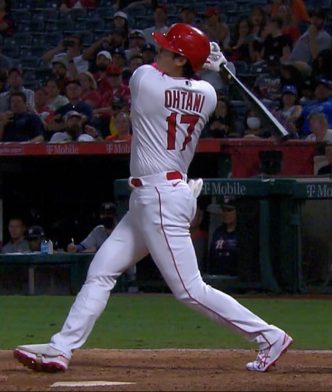
Shohei Ohtani

He found love on a two-way street. Will he lose it on the Tommy John highway?

Was it that easy to be blinded by the light? Even allowing that Angels owner Arte Moreno has long been far more concerned with putting fannies in the Angel Stadium seats than putting sensibly-built winning baseball teams on the field in front of those seats, was it that simple to be blinded by the Ohtani light?

All those delicious comparisons of Ohtani to Babe Ruth tended to omit two key elements: 1) Ruth was never a full-time two-way player except in one season (1919); Ohtani’s done it almost his entire major league life. 2) When Ruth was a fuller-time pitcher, it was in an era where hard-throwing pitchers were outliers and Ruth wasn’t exactly the type to try throwing the proverbial lamb chop past the proverbial wolf.

There was always the concurrent risk that Ohtani could be injured at the plate or on the bases, too. Once upon a time, he fouled one off his foot that rebounded to hit his surgically-repaired left knee—on the leg that’s his landing leg when he pitches. Any time Ohtani incurred a bang, a bump, or a cramp on the mound or at the plate, Anaheim, America, and the world lit up.

This isn’t just a bang, a bump, or a cramp. Not even if Ohtani did complain about a few finger cramps in recent days. This is a young man’s career and what remains of his team’s credibility on the line now. This is also a scrambler for the rest of the Show. Teams calculating just how much they could afford to seduce Ohtani this winter and start making their 2024 pennant race plans accordingly now must remake/remodel those calculations.

Especially if Ohtani must undergo his second Tommy John surgery. If so, he won’t be seen on the mound all next year as well as the rest of this season. If the Angels have any brain cells left to rub together, they’ll shut him down fully the rest of this year. He can’t afford to do further damage with even one hard swing at the plate or one hard slide on the bases.

I’m not going to deny it. It’s been mad fun watching Ohtani the unicorn doing things even the Babe himself didn’t do, or at least didn’t do quite as well as Ohtani has done them. Until Wednesday night, Ohtani threatened to join Ruth as the only man to set a single-season home run record while pitching full time as well. Ruth did that with the 1919 Red Sox—with 29 home runs. Nobody was really betting against Ohtani hitting maybe 63 this year.

Maybe the most surreal of his uncornery this year was Ohtani receiving four intentional walks as a pitcher. Ruth only ever had that happen twice in a season. (1919.) Schoolboy Row (1947) and Chad Kimsey (1931) are the only other pitchers to get four free passes at the plate in a season. And Ohtani was the first pitcher to get even one free pass at the plate since Hall of Famer Jim Kaat (1970).

On the mound, Ohtani was leading the entire Show with a 5.8 hits-per-nine average and the American League with a 143 ERA+. At the plate, he was leading the entire Show with those 44 bombs and a 183 OPS+, a 1.069 OPS, and a .664 slugging percentage. According to my Real Batting Average (RBA) metric (total bases + walks + intentional walks + sacrifice flies + hit by pitches, divided by total plate appearance), Ohtani this year is batting Boeing: .737. That, folks, is Ted Williams territory: the Splinter’s lifetime RBA is .740.

The problem with all that kind of mad fun is that it takes a toll. Either we didn’t really stop to think about it; or, we didn’t give two tinkers’ damns while watching it, dropping our jaws over it, imagining the language on his eventual Hall of Fame plaque over it, you name it. Joe and Jane Fan forget baseball players are only human and not machinery. They thought Ohtani was Superman with an immunity to kryptonite.

The money? Ohtani’s already earned enough in the Show to have no money worries the rest of his life. (When this season ends, it’ll be $39.6 million.) He’s never been about the money, anyway. What he’s been about was the pleasure in overachievement. One way or the other, he’ll get his money when he recovers, even if it may not be as ionospheric as thought before Wednesday. Even if he has to begin with a one-year, Sho-us deal to start over.

But if he has to undergo his second Tommy John surgery, would Ohtani accept a life as a one-way player that might mean a longer baseball career than he might have if he continues his two-way thrust? It may take more time to know that answer than it would take for him to recuperate from the second TJ.

On last year’s Opening Day, I got to watch up front with my son in Angel Stadium when Ohtani launched the season by pitching four-and-two-thirds, one-run, four-hit, one-walk, nine-strikeout (including Astros face JosĂ© Altuve thrice) ball. I’ve seen enough otherwise on the screen (am I really that old that I almost wrote “the tube?”) to know this guy was a unicorn even among unicorns.

Those of us who feared disaster in the offing should take no pleasure in what’s happened now. No matter how hard we took it up the tailpipes when we warned about it a few years ago. Now we ask just how much of his baseball future Ohtani may have sacrificed on behalf of pitching weekly, batting nightly, for a team whose maladministration didn’t deserve him any more than they deserved Mike Trout’s prime.

Who cares now whether Ohtani will throw a no-hitter and hit four home runs in the same game eventually? He’s already performed a nasty sacrifice on behalf of thrilling the living you-know-what out of us and sustaining what little credibility his team has left.

Shut him down fully the rest of this season. Don’t even let him swing the bat. Let the still-young man (29) regain his health properly. For everything he’s done on behalf of a franchise that doesn’t deserve him, if not a game whose administration doesn’t, Ohtani should get every consideration possible now.

The pioneer Hall case of Tommy John

2020-05-23 TommyJohnLAD

Tommy John on the mound; as a Dodger, he asked Frank Jobe not just to think about but to perform,  for the first time, the  groundbreaking surgery that’s borne his name since.

To this day, my favourite Tommy John story involves a 24 August 1987 game in old Anaheim Stadium. John, a New York Yankee starter then, squared off against Hall of Fame starter Don Sutton for the California Angels. The eyes of just about everyone in the ballpark, the broadcast booths, and the press boxes were trained upon the evidence of things barely seen—like evidence itself.

Put it this way: Sutton was once a barely-apologetic ball doctor. “Sutton has set such a fine example of defiance,” Baltimore Orioles pitching coach Ray Miller once told Thomas Boswell, “that some day I expect to see a pitcher walk out to the mound with a utility belt on—you know, file, chisel, screwdriver, glue. He’ll throw a ball to the plate with bolts attached to it.”

In the same article (“Salvation by Salivation”), Boswell described John as “the elegant Rhett Butler of outlaws. In the fine Whitey Ford tradition of mudballers and scuffballers, the gentlemanly John can turn a tiny scratch into a double-play grounder.” John himself told Boswell he had four basic pitches “plus eight illegal ones.”

The Yankees’ mercurial (shall we say) owner, George Steinbrenner, watched that game from his Tampa home aboard the Yankees’ cable superstation. Despite the Yankees holding an early 1-0 lead, The Boss was unamused enough by what he saw from Sutton to call manager Lou Piniella in the Yankee dugout demanding he arrange for Sutton’s immediate frisk, arrest, arraignment, trial, conviction, and execution. Not necessarily in that order

“George,” Piniella replied, “do you know what the score is? If I get the umpires to check Sutton, don’t you know that the Angels are going to check TJ? They’ll both get kicked out. Whatever they’re doing, TJ is doing it better than Sutton. So let’s leave it alone.” Wise counsel. The Yankees went on to win, 3-2, though neither Sutton nor John got a decision in the game.

They did, however, provide the har-har postscript, enunciated by an unnamed scout cited in Bill Madden and Moss Klein’s Damned Yankees: “Tommy John against Don Sutton. If anyone can find one smooth ball from that game, he ought to send it to Cooperstown.”

Which is where a lot of people would like to send John. The Hall of Fame’s Golden Era Committee will consider John’s case again this fall, when they convene again to determine who was left out that shouldn’t have been left out, including the man for whom the White Sox once traded John to the Dodgers, Dick Allen. If the committee elects both, this may be the first time players traded for each other went to Cooperstown together.

On their playing records, Allen has an overwhelming if too often underappreciated case as a peak value Hall of Famer. John’s case isn’t that cut and dried—if you consider him strictly as a pitcher. But if you consider him as a pitcher and a baseball pioneer, John’s case becomes a lot more vivid.

As a pitcher, John was brainy and lived on excellent control and—once then-Dodgers pitching coach Red Adams caught hold of him and convinced him—a deadly sinkerball that didn’t travel fast but moved like a ballroom dancer in a lusty cha-cha-cha.

His pitching record shows a good pitcher who was occasionally terrific with slightly more than a quarter century’s worth of major league pitching on his resume. Old-schoolers love to point to his 288 lifetime pitching wins and remind you that there but for the grace of the surgery that bears his name went his shot at 300 wins and a guaranteed Hall of Fame election.

They also point to that 26-year resume, but the key is that it took John that long to reach 288 credited wins. Those who still hang on the pitching win at face value forget for a moment that, in John’s case, it averages out to eleven wins a season.

What about Nolan Ryan and the 27 years it took him to land 324 wins and his average twelve wins a year? you say? Well, what about all that black ink on Ryan’s resume, his strikeouts and no-hitters, all seven of them, especially? Unless you are Nolan Ryan or close enough, you’re not going to Cooperstown even by way of the traditionalist vote unless you can show—as Jacob deGrom did winning the National League’s last two Cy Young Awards—that those eleven wins don’t really reflect just how well you pitched.

By earned run average, fielding-independent pitching (FIP), walks and hits per inning pitched (WHIP), strikeouts per nine innings, walks per nine, home runs surrendered per nine, and strikeouts versus walks, this is Tommy John’s average season against Jacob deGrom’s pair of Cy Young Award seasons:

Pitcher ERA FIP WHIP K/9 BB/9 HR/9 K/BB
Tommy John 3.34 3.38 1.28 4.3 2.4 0.6 1.78
Jacob deGrom 2.05 2.32 0.94 11.2 1.9 0.6 5.82

Which man averaging eleven pitching wins a season is the better pitcher, then? (The one thing they have in common: both are impossible to hit out of the yard.)

John has been sent to Cooperstown, in a sense. He and Dr. Frank Jobe, the surgeon who performed the first ligament replacement surgery on the elbow whose owner gave the surgery its name, were honoured formally by the Hall of Fame in 2013. But Tommy John strictly as a pitcher isn’t a Hall of Famer no matter how close he got to credit for 300 wins. Tommy John as a pioneer, however, is something else entirely.

2020-05-23 TommyJohnCWS

Tommy John before the White Sox traded him to the Dodgers.

Argue all you wish that he was comparable to the man or woman who discovers they were the millionth or ten millionth customer at a tony restaurant or crossing a fabled bridge. There’s still something to be said for being in the right place at the right time.

Until the Dodgers decided they needed pitching help, and were willing to send Allen to the White Sox to get it, John held down a slot in the middle of a starting rotation respectably. He was an All-Star once, and he tied for the American League league in shutouts twice. The Dodgers got what they traded for until John’s left arm went dead in July 1974.

It was, indeed, John’s good fortune that Jobe was the Dodgers’ team physician. Jobe joined the team a few years earlier, under the wing of his boss at the Southwestern Orthopedic Medical Group, Robert Kerlan, and may actually have had ideas about elbow ligament replacements a few years before John offered him a test case at last. When rest and then a little therapy came up empty, John asked Jobe to try surgery.

Jobe’s idea about elbow ligament replacement emerged, according to numerous articles about the man, after he’d seen it succeed in finger movement procedures and thought somewhat logically that there was no reason why it couldn’t do likewise for an elbow. But the opportunity didn’t present itself until John took himself out of that July 1974 game in pain, and Jobe told him “there was a chance to put the elbow back together, but that it was going to take the rest of the season.”

“Let’s do it,” John said. “Those three words,” Jobe eventually said, “made baseball history.”

John spent all of 1975 rehabilitating the repaired elbow and thus walking into virgin territory. There was no map or chart to guide him. He was baseball’s Admiral Byrd, undertaking a polar expedition with no clue as to what awaited him in those frozen outbacks, or whether he’d even survive. Like Byrd, John did far better than he or anyone else expected.

This is Tommy John’s record before and after the surgery that wears his name forever:

Tommy John, career ERA FIP WHIP K/9 BB/9 HR/9 K/BB
Pre-Surgery (1963-74) 2.97 3.16 1.21 5.3 2.6 0.6 2.01
Post Surgery (1976-1989) 3.66 3.56 1.34 3.4 2.2 0.6 1.55

His gaudy-looking 2.97 ERA before the surgery masks that John never had the kind of peak numbers that make a peak-value Hall of Famer. He was 31 with all or parts of twelve seasons on his arm when he underwent the surgery; his return, including three 20+ win seasons out of the first five following the surgery, indicated an unexpected and brief peak.

Pre-surgery, he struck out two batters for every one he walked, and a 5.3 strikeout-per-nine rate isn’t that of a strikeout machine. John depended more on the glove men behind him than he did on his own pitching to get outs. You’d expect that of a brainy sinkerballer. Still, his ERA (considerably), his FIP (slightly), and his WHIP (slightly) were lower before the surgery.

Five times John’s FIP was -3.00, but only once after the surgery would he achieve that again. His ERA was under 2.00 only once in his career—in 1968, the vaunted Year of the Pitcher, when the American League’s ERA was 2.98, the White Sox team ERA was 2.75, and John tied with Gary Peters for the lowest FIP (2.83) on the staff.

When The Cooperstown Casebook author Jay Jaffe examined John last fall, taking a look at the coming Golden Era Committee ballot, he made an observation based on whether John would or could have achieved the 300-win milestone:

One can play “what if” and surmise that John might have gotten to 300 wins, and thus automatic enshrinement, had he not missed a year and a half due to his elbow injury, but it’s entirely possible that his elbow (or another body part) would have instead given way in his late 30s or early 40s, after he’d made a few million dollars in free agency, at an age when rehabbing might have seemed less appealing than when he was 31.

Indeed. Jaffe also reminded his readers that, for all his career longevity, John made only four All-Star teams in 26 seasons, never once led his league in a single pitching Triple Crown category, and never won the Cy Young Award. (He did finish second twice in Cy Young voting, but two second-place finishes in 26 seasons isn’t enough to push a pitcher into the fraternity of underrated Hall of Famers.)

If you can look at wins above a replacement-level player without wanting to throw things at your desk or screen, WAR doesn’t help John’s case. He has practically the same number of WAR (31.1) before the surgery as he earned (31.0) after it.

Baseball Reference defines a 5.0+ WAR season as All-Star caliber or better; John had four such seasons out of 26. Three of them posted before the surgery, and only one of them got him an All-Star selection. He had one after the surgery and wasn’t even a topic in the All-Star pickings that year. Tommy John made four All-Star teams but three weren’t the ones he should have made. Overall, he averaged 2.6 WAR per season before the surgery and 2.8 per season after it.

And what about the scuffballing? I don’t remember umpires accosting John on the mound too often over such accusations. John was suspect but almost never the subject of a warrant. His peers knew. Oriole pitcher Mike Flanagan showed Boswell a fresh ball, then used a broken-open coat hanger to put three identical scratches into the meat. “Tommy John could make this ball sing ‘The Star Spangled Banner’,” Flanagan cracked

But when Boswell wrote that John could take the tiniest scratch and get a double play grounder, it probably acknowledged in reality that John was brainy enough on the mound to grok the most obvious trick: take the ball returned to the mound after being in play, instead of being switched out promptly for a fresh ball, then spot the scuff or scratch and go for the gusto.

He probably didn’t have to do anything to the ball himself. Not like Ford with the rasp in his wedding ring and, later, his catcher Elston Howard scraping balls on his shin guard buckles before returning them to Ford. Not like Gaylord Perry with his actual or alleged K-Y jelly—and who’s to say that, half if not more of the time, Perry’s once-famous mound routine that only looked as though he was lubing up was just that, a look, meant to pay the bogeyman’s rent in the hitter’s head?

If Tommy John’s overall pitching record isn’t a Hall of Fame record by itself, you should know the reason he does belong in Cooperstown as well as I do. A good and sometimes terrific pitcher by himself doesn’t equal a Hall of Famer; a good and sometimes terrific pitcher before and after what was a career-ending injury, until Tommy John and Frank Jobe collaborated on maybe the single most radical orthopedic procedure in baseball history, does.

Nobody in his or her right mind might have expected him to last more than a few seasons after the operation, in that time and place, but John pitched fourteen years worth of major league baseball after returning, including in a few World Series, and for at least half of them he was still a solid middle-of-the-rotation starting pitcher.

It might be a simple quirk of fate or fortune that he got to be the first to undergo that operation, but it was up to him to show whether he could pitch at all after it, never mind fourteen seasons. He did, and he proved that a ruptured elbow ligament didn’t have to be a baseball death sentence. Even if not every pitcher who undergoes it does as even as he did after as before it.

Being “honoured” by the Hall in 2013 isn’t enough, either for John or for Jobe, the surgeon who took the shot when he asked for surgical relief in the first place. Their collaboration should earn both Tommy John and Frank Jobe full plaques in Cooperstown at last.