The Mets finally support Jacob deGrom

Jacob deGrom

These meatheads couldn’t get me even three runs a start even if I offered to pay for them to bribe the other teams into taking dives. Now they get me six, and I’m supposed to be trying to beat them? Just. So. Mets.—What Jacob deGrom could have been forgiven for thinking before he went to work against his old team on Friday night.

Having been a Met fan since the day they were born, I’ve seen enough cringe to last three lifetimes and two Hall of Fame careers. Enough so that I’ve earned the stripes required to tell today’s Met-fans-come-lately (say, strictly this century) that even the Mets deserve not to be written off entirely for a season over one bad inning . . . in April.

Friday night almost changed my mind.

When Jacob deGrom was the best Mets pitcher this century, winning two Cy Young Awards on merits that (among other things) should have shattered the myth of the pitcher “win,” he did it despite getting an average of 3.3 runs to work with per inning pitched in his starts. He could have taken the Mets to court and sued for non-support, and no judge would have remanded him to the nut farm.

“So are you still asking why we’re ignoring wins?” The Athletic‘s Jayson Stark asked, then answered. “[T]here isn’t a single entry on the state sheet that tells us less about how this man has pitched than the entry that most people used to check first. That’s why.”

“Jacob deGrom’s issue wasn’t that he ‘didn’t know how to win’.” It was that he didn’t know how to not be on the 2018 New York Mets,” wrote Anthony Castrovince, in A Fan’s Guide to Baseball Analytics. That was deGrom’s issue in 2019, as well.

So. After more injury miseries and one change of address, deGrom finally showed up in Citi Field Friday night. The Mets thanked him for his distinguished previous service with a video presentation that had the righthander very appreciative. “It was really cool,” he said after the game. “Like I said before, this is where it all started. And then coming back here, I thought it was going to be a very special day. So thankful to the Mets for playing that. And you know, like I said, these fans were great to me when I was here. And you know, that was a really nice thing they did.”

What a difference three years makes. The Mets got deGrom six runs to work with before the first inning was over. There was just one little problem with that, before you start thinking about old times’ sake. They gave him the runs to work with before he even had to take the mound.

DeGrom pitches for the Rangers now. (More injury miseries kept him from pitching more than nine games for the Rangers between 2023-24.) It’s not that he would have objected to getting six runs for a cushion before he even had to go to his office, but you couldn’t blame the man if he allowed himself even one moment to think: These meatheads couldn’t get me even three runs even if I offered to pay for them to bribe the other teams into taking dives. Now they get me six, and I’m supposed to be trying to beat them? Just. So. Mets.

Of course, deGrom could have laughed like Figaro that he might not have wept. The Rangers hit the plate against young Mets starter Jonah Tong, a pitcher with promise getting perhaps a too-early education in shaking it off and starting over. That’s after his first major league start found him sitting prettily enough with twelve runs to work with after two innings. (Against the Mighty Marlins, 29 August, en route the Mets’ 19-9 Fish fry.)

Now, in his third major league start, Tong started by walking Josh Smith, striking Wyatt Langford out, walking Joc Pederson, and getting Jake (Whata) Burger to fly out to center field, pushing Smith to third. Two out, two on. And then . . . and then . . .

And then along came Jung. Josh Jung, lining a single to right to send Smith home and Pederson to third. Then came Alejandro Osuna to poke a first-pitch single into shallow enough left to sent Pederson home. Then came a walk to Jonah Heim to load the pads for Cody Freeman to shoot a 2-2 fastball into right for a two-run single. Then came a full-count fastball for Michael Helman to line down the left field line for a two-run double. And then came Huascar Brazoban to lure Smith into flying out for the side.

The Mets did manage to pry three runs out of their old buddy in the bottom of the third, when Francisco Alvarez greeted him with a home run to open, then a single and a double turned to Juan Soto and Pete Alonso going back-to-back with sacrifice flies. The Rangers made it 8-3 to stay when Dylan Moore yanked a two-run homer off Mets reliever Gregory Soto in the top of the seventh, before deGrom’s evening ended.

DeGrom sports a neat 2.82 ERA and a staggering 0.92 walks/hits per inning pitched rate this season. Neat enough for a guy who turned 37 while we blinked in his absence. A guy who enjoyed getting another chance to pitch in front of Mets fans once again. “[T]he fans were great to me tonight,” he said of the ovation he got pregame and after his evening looked over. [He pitched seven strong.] They were great to me when I was here. So I always enjoyed taking them out in front of this crowd. So tonight was just as special.”

But getting six runs to work with from the Mets right off before pitching against them, deGrom must have felt unable to decide whether to call for a glass of champagne or the Looney Limousine.

A stupid anniversary

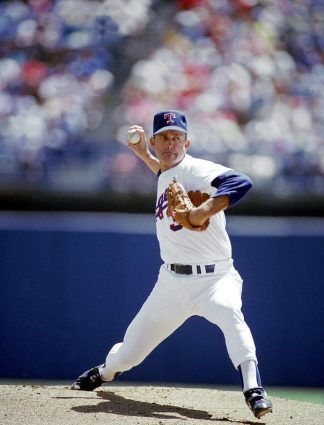
Nolan Ryan

This is the way to remember Nolan Ryan—as a great pitcher, not the guy who got buried alive in a nasty brawl with the White Sox.

At the rate it turns up on social media discussions, and not merely on its anniversary, Hall of Fame pitcher Nolan Ryan is going to be remembered purely for the day he drilled Robin Ventura into charging the mound. As if nothing else he accomplished in a quarter-century plus pitching career mattered half as much as putting a temporarily brain-damaged third baseman in his “place.”

As if Ventura got the worst in a Ryan headlock that triggered a bench-clearing brawl between Ryan’s Rangers and Ventura’s White Sox in which Ryan got far worse than he inflicted upon Ventura. As if Ryan, in what proved his final season, was some sort of saint and Ventura some sort of bandit. As if there hadn’t been tension between the two teams for going on four full years.

It’s time to put the whole damn business to bed where it belongs. There were far more important things to think about to open this August. Things like Blake Snell’s no-hitter, Jack Flaherty’s Dodger debut, the sad end to yet another season from yet another injury to Hall of Famer-in-waiting Mike Trout. Things like the White Sox losing a twentieth straight game. Things like José Abreu hitting two bombs his first game back from his grandmother’s death and Freddie Freeman’s Guillain-Barre syndrome-afflicted little son home from the hospital.

But no. Who needs those when you can bring up the Ryan-Ventura brawl, a textbook exercise in celebrating false masculinity and baseball brain damage, on its anniversary, which is rendered meaningless anyway for how often it gets brought up all year long on one or another social media outlet?

Ryan was of the school of thought that taught the outer half of home plate was the pitcher’s exclusive property. You won’t find that anywhere in baseball’s written rules, of course. Generations of pitchers have been taught that; generations of hitters have been taught likewise. Well, now.

The Ryan-Ventura brawl was impregnated by a 1990 White Sox rookie named Craig Grebeck. He’d go on to make a useful career as a defense-first utility infielder. But in spring training 1990 he shocked a lot of people—probably including Ryan, probably including his own team—when he homered against the Rangers on a first pitch. He pumped his fists rounding the bases.

Come the regular season, Ryan faced Grebeck and surrendered one of (read carefully) the nineteen major league home runs Grebeck would ever hit in a twelve-season career. Again, Grebeck pumped his fists rounding the bases. Back on the bench, Ryan asked pitching coach Tom House about him.

Told that it was Grebeck, a not so tall player who looked then like a boy entering middle school, Ryan is said to have told then-Rangers pitching coach Tom House, according to Ryan biographer Rob Goldman, “Well, I’m gonna put some age on the little squirt. He’s swinging like he isn’t afraid of me.” The next time Grebeck faced him, Ryan hit him in the back with a pitch. “Grebeck was 0-for the rest of the year off him,” House remembered.

Fat lot of good that did The Express: Grebeck actually finished his career with a .273/.429/.545 slash line and a .974 OPS against the Hall of Famer. It wasn’t exactly a powerful one (three singles, two walks, three strikeouts, but four runs batted in, somehow), but Ryan didn’t exactly age Grebeck with the first of only two drills he’d hand Grebeck lifetime, either.

What it did, though, was begin some very tense times between Ryan’s Rangers and Grebeck’s White Sox. The White Sox’s batting coach, Walter Hriniak, was teaching his charges to cover that outer half of the plate. House insisted that was a root but Ventura himself said otherwise. “At the time in baseball the (strike) zone was low and away, and that was where pitchers were getting you out,”he said. “We weren’t the only team doing it. It was the kind of pitch that was getting called, so you just had to be able to go out and get it.”

What followed:

17 August 1990: Ryan hit Grebeck with one out in the third, Grebeck’s first plate appearance of the game. Two innings later, White Sox starter Greg Hibbard hit Rangers third baseman Steve Buechele with two outs. (The game went to extras and the Rangers won, 1-0, when Ruben Sierra walked it off with a line drive RBI single in the thirteenth.)

6 September 1991: Ryan hit Ventura in the back on 1-2, also in Arlington, three innings and a ground out after Ventura doubled Hall of Famer Tim Raines home with nobody out in the top of the first and scored on Lance Johnson’s subsequent two-out single. It started a rough day for Ryan, who surrendered two more runs (both on third-inning sacrifice flies) en route an 11-6 White Sox win.

2 August 1993: This was two days before Ryan and Ventura’s rumble in the jungle: Rangers pitcher Roger Pavlik hit White Sox catcher Ron Karkovice with one out in the third. (Ventura posted a first-inning RBI single to open the scoring; Rangers left fielder Juan Gonzalez answered with a two-run homer in the bottom of the first. Subsequently, White Sox relievers Bobby Thigpen and Jason Bere each hit Rangers third baseman Dean Palmer, while Rangers shortstop Mario Díaz also took one from Thigpen.

Ventura and assorted White Sox teammates of the time insisted Ryan was throwing at hitters and often hitting them on a routine bases. Two days later, Ryan and Ventura went at it. Among the pleasured by Ventura charging Ryan was Sox pitcher Black Jack McDowell: “Ryan had been throwing at batters forever, and no one ever had the guts to do anything about it. Someone had to do it. He pulled that stuff wherever he goes.”
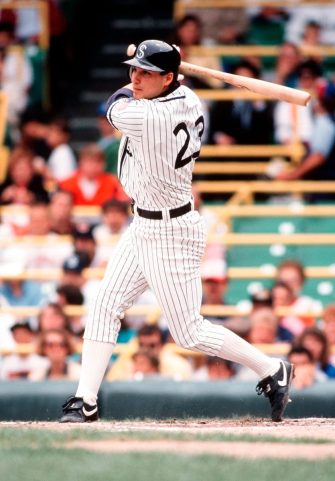
Robin Ventura

And this is the way to remember Robin Ventura—a great third baseman, not the guy who charged the mound indignantly when Ryan hit him with a 1993 pitch after a few seasons of White Sox-Ranger knockdown-and-plunk tensions.

“We had a lot of going back and forth that season,” says Ventura. “Guys were getting hit regularly, and it was just one of those things where something was going to eventually happen.” It probably involved other Rangers and White Sox pitchers, too.

Ryan was as notorious for his career-long wildness (he led his league six times and the entire Show three times in wild pitches, and averaged twelve per 162 games lifetime) as for his seven no-hitters, his 5,714 lifetime strikeouts, and his 2,795 walks. (They’re also number one on the Show hit parade.) He may have gotten away with throwing at hitters, but he was actually pretty stingy when it came to actually hitting them.

He retired averaging seven hit batsmen per 162 games. Seven. If he’d actually hit seven men a year for his entire career, it would give him 31 more drilled than he actually compiled (158). He actually had eleven seasons in which he hit five batters or fewer; hitting Ventura on that fine 4 August 1993 was the only hit batsman Ryan had in thirteen 1993 starts before he finally called it a career.

That doesn’t exactly sound like one of the most merciless drillers the game’s ever seen. Ryan only ever led his league in hit batsmen once (1982, when he was an Astro), and that’s one more than Hall of Famer Bob Gibson—too often the unjustified first name in, ahem, manly intimidation—ever did. Believe it, or not. Ryan is number sixteen at this writing on the all-time plunk parade. Gibson, you might care to note, is tied for 89th on the parade with (wait for it) 102. And he averaged (wait for it again!) . . . six per season.

“If you look at the replays, the ball wasn’t really that far inside,” House told Goldman.

It was just barely off the plate and it went off Ventura’s back. Robin was starting toward first base when he abruptly turns and charges the mound instead. And the closer he got to Nolan, the bigger he looked. If you watch it in stop action, you can see Ryan’s eyes were like a deer’s in a headlight. So everybody was surprised by what Nolan did next: Bam! Bam! Bam! Three punches right on Ventura’s noggin!

Actually it was about six. Now for the part everyone still gaping in awe over Ryan’s manly deliverance of a lesson to Ventura forgets: Both teams swarmed out of their dugouts, but the White Sox got to Ryan so swiftly that they drove him to the bottom of a pileup from which the White Sox’s Bo Jackson had to extricate Ryan before some serious damage was done to the veteran righthander.

“All I remember,” Ryan eventually told Goldman, “is that I couldn’t breathe. I thought I was going to black out and die, when all of a sudden I see two big arms tossing bodies off of me. It was Bo Jackson. He had come to my rescue, and I’m awful glad he did, because I was about to pass out. I called him that night and thanked him.” (The two were friendly rivals since then-Royal Jackson hit Ryan for a 1989 spring homer and his teammates hailed Ryan the next day—from the spot where Jackson’s bomb landed, as Ryan went through an exercise routine on the field.)

Ryan otherwise actually got the worst of it when all was said and done. Jackson extracted a man “visibly winded,” Goldman wrote. Ryan wasn’t the only one thankful for Jackson. “When Nolan didn’t come out of the pile, I got concerned,” said his wife, Ruth. “With his bad back, sore ribs, and other ailments, he could easily have suffered a career-ending injury.”

Somehow, Ryan remained in the game. Ventura was ejected for charging the mound. Of all people, his pinch runner was . . . Craig Grabeck. Ryan picked Grabeck off first before he threw a single pitch to the next batter, Steve Sax, who grounded out to end the inning.

The Rangers went on to win, 5-2. Ryan insists to this day that if Ventura had stopped shy of the mound rather than finish the pursuit and grab his jersey, “I wouldn’t have attacked him.” But he also felt embarrassed by the brawl. So much so that, Goldman recorded, when the Ryan family returned home from a postgame family dinner, Ryan declined when one of his sons—who’d videotaped the scrum—asked Dad if he wanted to see it again.

Ryan’s no, Goldman noted, was “firm.”

Said the Dallas Morning News headline the day after: Fight Gives Game a Big Black Eye.

Now, if rehashing that brawl isn’t to Nolan Ryan’s taste, it ought to be lacking likewise for the idiots who insist on reliving and re-viewing it on social media—and not just on its anniversary. I could be wrong, but it seems that social media outlets can’t last two weeks, and possibly less, without at least one jackass posting the video of the scrum.

Pitching to the inside part of the strike zone is part of the art, even if there’s no written rule saying the outer half of the plate is the pitcher’s exclusive property. You can delve as deep as you want and discover there were plenty of pitchers who lived so firmly on the inside that they, too, earned unfair reputations as headhunters.

Not everyone is as shameless as shameless as fellow Hall of Famer Early Wynn insisting he’d knock his grandmother down if she “dug in” against him. Well, guess what. Grandma’s Little Headhunter hit only 64 batters in a 23-season career and averaged only three per 162 games lifetime. He even had eleven seasons where he hit three batters or less.

Once upon a time, Bob Gibson signed an autograph for a fan who told him, in the earshot of baseball writer Joe Posnanski, “Oh, do I remember the way you pitched. I remember all those batters you hit. They were scared of you. The pitchers today, they couldn’t hold a candle to you.”

Gibson did want the edge every time he took the mound. He did look as ferocious as his reputation on the mound, though that may have been as much a byproduct of his nearsightedness as anything else he brought to the mound, including an innate and justifiable sense that a black pitcher in his time and place needed the edge just that much more. He did pitch inside as often as he thought he had to to keep batters off balance.

But when that fan departed with his autograph, Gibson turned to Posnanski and probably sounded wounded when he asked, “Is that all I did? Hit batters? Is that really all they remember?” (If it is, they didn’t see him pitch his way to the Hall of Fame.)

A few years ago, in another online forum, I was addressed directly by a fan who objected to my recording that, among other things, Gibson didn’t hit as many home run hitters after their bombs as people think they remember: He wasn’t just ‘brushing back’ batters—especially those who had hit a donga off him the time before. He was damn well trying to hit them. 

Well, I was crazy enough to look it up. Here’s what I wrote then:

Thirty-six times in 528 major league games Bob Gibson surrendered at least one home run and hit at least one batter in the same game. He only ever hit one such bombardier the next time the man batted in the game; he hit three such bombardiers not the next time up but in later plate appearances in games in which they homered first; and he surrendered home runs after hitting batters with pitches in fourteen lifetime games.

For the record, the one batter Gibson hit in the next plate appearance following the homer was Hall of Famer Duke Snider. The three bombers he’d hit later in those games but not in their most immediate following plate appearances: Hall of Famer Willie Stargell plus longtime outfielders Willie Crawford and Ron Fairly.

Is that all I did? Hit batters? Is that really all they remember?

Is that all I did? Sock Robin Ventura six times in a headlock before I got buried alive in the bottom of a pileup in my last year in the bigs and I needed Bo Jackson to save my sorry behind?

Ryan is a Hall of Fame pitcher. Ventura had an excellent career that shakes him out as the number 22 third baseman ever to play the game. They both deserve far better than to be remembered first for a hit-by-pitch and brawl that lowered both men’s dignity a few levels. The fans who “celebrate” the brawl every week or two, never mind on its anniversary? They deserve to be condemned.

“I loved every challenge of playing third base”

Adrián Beltré

He hit home runs on one knee, he was a human highlight reel at third base. Welcome to Cooperstown!

Of all the stories that abounded this weekend about Adrián Beltré, on the threshold of his induction into the Hall of Fame, there’s one which may be forgotten except by Angel fans left (as almost usual) to ponder what might have been. It’s the story of the Angels pursuing Beltré as a free agent after he spent five often injury-plagued seasons in Seattle.

Essentially, Angels owner Arte Moreno wanted Beltré in the proverbial worst way possible, after the Dodgers who reared him were willing to let him escape to the Mariners in free agency—despite Beltré having just led the Show with 48 home runs in 2004—because then-owner Frank McCourt didn’t want to pay what the Mariners ultimately did.

Beltré went from the Mariners to the Red Sox on a one-year, prove-it kind of deal. When that lone Boston season ended in October 2010, Moreno kept Beltré in his sights. But nothing the Angels presented Beltré impressed him enough to sign with them. He opted to sign with the Rangers instead. Moreno was so unamused he ordered his then-general manager Tony Reagins to deal for Blue Jays outfielder/slugger Vernon Wells.

Well. The Angels learned the hard way (don’t they always?) that Wells was damaged goods. The fellow they sent the Jays to get him, bat-first catcher Mike Napoli, would join Beltré for a hard-earned trip to a World Series that would break their hearts, before moving on to help Cleveland to a pennant and the Red Sox to the 2018 World Series triumph.

Meanwhile, before leaving Seattle for a one-year, show-us deal with the Red Sox, Beltré by his own admission finally learned he could have a shipload of fun playing baseball without losing the focus, the discipline, or the outlying durability that were going to make him a Hall of Famer in the first place. With the Rangers, he finished his ascent into what Baseball-Reference calls the number four all-around third baseman ever and, concurrently, built and secured a reputation as a team-first Fun Guy.

Nail his 3,000th lifetime major league hit? Party time—for the whole team and then some. “After he got 3,000 hits he had a party,” says Rangers in-game reporter Emily Jones to The Athletic‘s Britt Ghiroli and Chad Jennings. “It was like our clubhouse moved to this place. Every clubbie. Every trainer. Every massage therapist. He was extremely inclusive.”

“He was the oldest guy on the field,” says his former Rangers teammate Elvis Andrus, “but acted like the youngest.”

Beltre’s fun-loving rep went hand in glove with being a veteran clubhouse leader to whom even his manager often deferred. “If he stared at you some kind of way,” says Ron Washington, now managing the Angels but then managing the Rangers, “you knew he meant business. A couple of times, I got off my perch to go get (on a player). He would stop me and say, ‘Let me get it, skip’.’

“I saw him chew veterans,” says one-time Rangers batting coach Dave Magadan, “like they were 19-year-old rookies.”

But he also never forgot teammates, even after he retired. Lots of players can make their teammates go with the flow during arduous seasons. Beltré made them friends. Even if he might chew them out one day, he’d re-cement the friendship side by asking, “You know why I did that, right?”

Former Rangers teammate Mitch Moreland remembers taking a group of later Athletics teammates to a Seattle restaurant to which Beltré had taken a host of Rangers once upon a time. “I called (Beltré) and I was like, ‘Hey, what was the guy’s name at Metropolitan? I’m going to take the boys there’.”

He goes, “Oh, I got you.” So, he called the guy up, set it up. I took the whole team over there, we ate, and I got ready to get the bill, and Adrián had picked it up. For the Oakland A’s. After he was retired.

What of the once-familiar running gag involving Beltré’s real distaste for having his head touched and teammates—usually spearheaded by Andrus—going to great lengths to touch it and get away with it? “I still do,” Andrus says. “He still doesn’t like it. That’s what I am going to try to do at Cooperstown . . . I need to touch his head. I need to touch his head while he’s talking!”

He didn’t get anywhere close to that. Hall of Famer David Ortiz did, right smack at the podium.

But no matter. The third baseman who declined a grand farewell tour didn’t need any further validation for his place in the Hall of Fame. Those who do, however, should marry his 27.0 defensive wins above replacement level player (WAR) to his Real Batting Average (total bases + walks + intentional walks + sacrifice flies + hit by pitches, divided by total plate appearances) among Hall third basemen whose careers were in the post-World War II/post-integration/night-ball era:

HOF 3B PA TB BB IBB SF HBP RBA
Mike Schmidt 10062 4404 1507 201 108 79 .626
Chipper Jones 10614 4755 1512 177 97 18 .618
Eddie Mathews 10100 4349 1444 142 58 26 .596
Scott Rolen 8518 3628 899 57 93 127 .564
George Brett 11625 5044 1096 229 120 33 .561
Ron Santo 9397 3779 1108 94 94 38 .544
Wade Boggs 10740 4064 1412 180 96 23 .538
Adrián Beltré 12130 5309 848 112 103 97 .533
Paul Molitor 12167 4854 1094 100 109 47 .510
Brooks Robinson 11782 4270 860 120 114 53 .458
HOF AVG .555

He’s not higher there because a) he drew far less unintentional walks than most of the men on that list; and, b) that aforementioned durability led him to playing through injuries insanely enough to cause him a few so-so seasons that pulled his numbers down somewhat. But as a defensive third baseman he’s the second-most run-preventive player (+168) who ever worked that real estate . . . a mere 125 behind a guy named Robinson.

“I loved every challenge of playing third base,” said the first third baseman in Show history to nail 400+ home runs and 3000+ hits. “I was hooked. Those hot shots, slow ground balls, double plays, I couldn’t get enough of them.” Come Sunday, the Cooperstown gathering almost couldn’t get enough of Beltré, either.

Not now, Snakes

Arizona Diamondbacks

The Diamondbacks fell in this World Series, and losing the final three at their own Chase Field really stings. But . . .

Stop right there. I mean you, everyone who thought “Bill Buckner” the moment Diamondbacks center fielder Alek Thomas over-ran Jonah Heim’s top of the ninth RBI single into an extra Rangers run, two outs before Marcus Semien slammed an exclamation point down upon the season and the Diamondbacks’ fate.

For one thing, the Diamondbacks still had three outs to play with coming at the plate. For another thing, these Snakes were that resilient bunch who usually found ways to overcome when absolutely necessary, no?

Not this time. Just as they couldn’t quite close a Game Four blowout into a possible tie and overthrow, they couldn’t turn a near-eleventh hour Game Five deficit into another tie or overthrow. It hurt even more losing the World Series with a three-sweep at home after splitting the first pair in Arlington.

At last, as Semien’s two-run homer off Diamondbacks finisher Paul Sewald disappeared over the left center field fence in the top of the ninth, that Diamondbacks resiliency failed them even as the Rangers’ equal resiliency hurtled them to the Promised Land in five arduous World Series games.

“I definitely could have done a better job of getting in front of the [Heim] and calming down and just fielding it,” Thomas said postgame, refusing to shrink away, “but I think I rushed it and just didn’t get the glove down. I think I made an error on that two times last year and this year, and I think by now I should learn my lesson on how to go about that ball. But definitely gonna work on that in the offseason, make sure that doesn’t happen again.”

Long before Thomas had his moment of ill fate, the Diamondbacks failed to rise to several occasions. Their gallant starting pitcher Zac Gallen took a no-hitter through six innings while his Rangers counterpart Nathan Eovaldi pitched into and out of heavy traffic yet refused to surrender so much as a single run.

They loaded the bases on Eovaldi in the first and the fifth and left them that way. They had to know Eovaldi didn’t have his best stuff to throw and couldn’t do more than four hits despite also drawing five walks on the veteran righthander.

Then the most they could do against the Ranger bullpen was a seventh-inning walk, an eighth-inning base hit, and nothing else to show for it while that pen struck them out five times, including Ketel Marte looking at strike three from Josh Sborz to end Game Five and the Series whole.

“To get a taste of postseason baseball and the World Series,” said veteran Snakes designated hitter Tommy Pham, “if this doesn’t motivate you, I don’t know what will. This is a young team. There’s a core you can build around. And now everybody knows what it takes to get here.”

Pham surely didn’t mean backing into the postseason in the first place, as the Diamondbacks did claiming a wild card slot after finishing well back of the National League West-owning Dodgers on the regular season. Once they got there, though, they swept two division winners (the Brewers, the Dodgers) out of the wild card and division series rounds, then fought the Phillies to a seven-game National League Championship Series conquest.

Then they ran into the Rangers. Except for their 9-1 Game Two win, for the Diamondbacks this was like running into a pack of snake hunters unwilling to show much in the way of mercy. Even when they fought back from a 10-1 blowout in the making to make it 11-7 in Game Three, the Rangers were too much for the Diamondbacks to handle.

These Snakes didn’t have the star power of their 2001 World Series-winning predecessors. They kind of liked it that way, too. “I felt like we’re definitely a bunch of misfits,” said relief pitcher Ryan Thompson after Game Five ended.

That’s what makes us special. We got a bunch of young guys who are hungry, doing it for the first time. We got a bunch of veterans who have been there, done that, but not quite won the whole thing. It’s awesome being able to put our names on the map.

Gangs of misfits have won World Series in the past, with or without star power. The 1934 Cardinals, that shameless brawling Gas House Gang, was one. The Bronx Zoo Yankees of 1977-78 were another. The 2004 Red Sox called themselves the Idiots as though it were a badge of high honour. The 2010 Giants—managed by now-triumphant Rangers manager Bruce Bochy—thought of themselves as a bunch of morons.

What these Diamondbacks had was future star power. Corbin Carroll, Gabriel Moreno, Zac Gallen, Merrill Kelly, and Thomas himself. You could say it wasn’t their fault the Rangers hunted, pecked, pounded, pricked, and pulverised them. But you’d also have to say these Diamondbacks made enough of their own mistakes to enable that Ranger romp, too.

You credit the Rangers for such seizures. But you hand it to the Diamondbacks for making a showing for themselves before the World Series arrived. In a sane world, ruled by a sane commissioner and group of owners, they wouldn’t have reached the postseason in the first place.

But under the way things are set now, the Diamondbacks made the most of their entry. They left the Brewers looking brewed to a fare-thee-well. They left the Dodgers to a winter of self-re-examination. Then they ran into a Texas chainsaw massacre, more or less. There was no shame in that.

Oh, sure, they looked foolish a few times. Especially when manager Torey Lovullo talked early in the postseason about all those “receipts” the Diamondbacks kept to stick right back up the rears of those who doubted, the cynics who figured they were due for an early and painful postseason exit, the snorters who figured the big bad Phillies would make rattlesnake stew out of them.

They outlasted the Phillies. It wasn’t really easy to do. But the Rangers were another proposition entirely. The Diamondbacks really didn’t stand much of a chance no matter how bravely they hung in for five games, no matter that this Series matched two of baseball’s best defensive teams on the season.

The Rangers were only too happy to stuff those Diamondbacks receipts right back where they came from. But the Diamondbacks have no reason for shame otherwise.

“I’m so proud of what they’ve done,” Lovullo said. “And we have to step back for a minute and tell ourselves that we’ve done a lot of really amazing things this year. And then we got on this really fun ride through the course of the postseason. You just never want it to stop.”

But that’s the problem. They can never rescind the rule that somebody has to lose games.  The good news further is that the Diamondbacks are a comparatively young franchise and lack the kind of snake-bitten history that once plagued such antiquities as the Cubs, the Red Sox, and even the 63-year-old Rangers. And still plagues the Guardians, who haven’t won a World Series since the Berlin Airlift.

Barring unforeseen calamity or brain damage, the Diamondbacks will be back soon enough. For now, let them mourn lost opportunity while celebrating how they got to have the chance in the first place.

Frank Howard, RIP: The gentlest giant

Frank Howard

“Sometimes,” said a minor leaguer whom the Bunyanesque bombardier managed, “I think he’s too good for this game.” About Frank Howard, now gone, the gentlest giant of them all.

All of a sudden there’s a pall overhead. The one Washington Senator above all who didn’t want to move to Texas to become a Ranger has gone to the Elysian Fields at 87. The gentlest giant. The guy whose nickname Capital Punishment was as much a misnomer as The Killer was attached to his contemporary Harmon Killebrew.

Frank Howard. The behemoth whose home runs were conversation pieces long before that phrase was attached to the blasts hit by the likes of Dick Allen, Dave Kingman, Mike Schmidt, Darryl Strawberry, Albert Pujols, and Shohei Ohtani.

The third of six Ohio Howard children who had scouts bird-dogging him in the mid-to-late 1950s offering six-figure bonuses but who insisted that the money be divided as $100,000 for himself and $8,000 toward a new home for his parents, a condition only the Dodgers were willing to heed.

The 6’8″ galoot who became a Senator in the first place because of Sandy Koufax.

Howard had come forth as a Dodger who had that intergalactic power at the plate matched only by an inconsistency or three. The National League’s 1960 Rookie of the Year could break a game open with one swing but chased too many balls out of the strike zone. The giant with a fine throwing arm who moved too slow for an outfielder.

The guy who had enough trouble being the first Frank Howard without shaking off enough early career hype that sometimes called him the next Babe Ruth. The guy who assessed himself to Sports Illustrated too realistically despite a 1963 World Series performance that included a 450-foot home run off Whitey Ford en route the Dodgers’ sweep:

I have the God-given talents of strength and leverage. I realize that I can never be a great ballplayer because a great ballplayer must be able to do five things well: run, field, throw, hit and hit with power. I am mediocre in four of those—but I can hit with power. I have a chance to be a good ballplayer. I work on my fielding all the time, but in the last two years I feel that I have gotten worse as a fielder. My greatest fear was being on the bases, and I still worry about it. I’m afraid to get picked off. I’m afraid to make a mistake on the bases, and I have made them again and again, but here I feel myself getting better.

Howard ended up asking Dodger general manager Buzzie Bavasi for a trade after the 1964 season. As things happened, Bavasi was also hunting a solid lefthanded pitcher to plug in any spaces left by the possibility that Koufax—who’d been shut down for the year in August 1964, and diagnosed publicly with an arthritic pitching elbow (it turned out that was for public consumption)—would only be able to pitch once a week if at all.

Bavasi sent Howard plus infielder Ken McMullen and pitchers Phil Ortega and Pete Richert to the Second Nats in exchange for lefthanded pitcher Claude Osteen, infielder John Kennedy, and $100,000. Osteen became the reliable number three starter behind Hall of Famers Koufax and Don Drysdale; the Dodgers won the next two National League pennants plus the 1965 World Series.

Howard settled for becoming a marquee attraction in the nation’s capital. His old Dodger teammate Gil Hodges managed the Senators, convinced Howard to try a slight uppercut in his swing that might stop him hitting hard grounders, and turned him loose to become one of the American League’s power kings after shaking off two initial Washington seasons disrupted by injuries here and inconsistency there.

Then came the Year of the Pitcher (1968)—and Howard’s leading the entire Show with 44 home runs and a .550 slugging percentage, not to mention 330 total bases. He’d hit 48 out in 1969 (with another Show-leading 340 total bases) and 44 out in 1970. A new Senators manager finally convinced him to stop swinging at pitches that didn’t look hittable, which hiked his walk totals and gave him the plate discipline he wished aloud he’d learned a decade earlier. A manager named Ted Williams.

(“Somebody’s getting him out,” snorted Seattle Pilots manager Joe [Ol’ Shitfuck] Schultz during a meeting to discuss how to pitch Howard. “The bastard’s only hitting .306.”)

Howard also moved from the outfield to first base as often as not, and while he was no defensive virtuoso his bat continued to thrill fans and terrorise pitchers. When Alvin Dark managed the Indians, he had a habit of switching his bullet-throwing lefthander Sudden Sam McDowell and an infielder during Howard’s plate appearances (Howard tended to kill McDowell) and then back after Howard was done.

Later, as a minor league manager, Howard was legendary for his generosity with the kids he managed whom he knew barely earned peanuts. Stories abounded of Howard stopping the team bus out of nowhere and ducking into a truck stop or a package store, whipping out his money clip, and buying cases of brewskis. (He made a considerable fortune owning a few choice Wisconsin shopping centers.)

Profiling him while managing the Spokane Indians (then a Brewers farm team) in 1976, Thomas Boswell quoted one of his talks to his minor league charges:

Boys, in this game you never play as long as you want to or as well as you want to. And sooner than any of you thinks, your day will come to get that pink slip that says, “Released.” When they pull those shades, they pull ’em for a lifetime. When it’s over, no one can bring it back for you. It’s a short road we run in this business, so run hard.

That from the man who lamented near the end of his own playing career, “By the time you learn to play this game properly, you can’t play anymore.” (“We lead the league,” Spokane third baseman Tom Bianco told Boswell, “in hustle, rules, and meetings. We even had a meeting after a rainout to go over the rain.”)

He left the Spokane bridge for a shot at major league managing. He had the Padres for two years; he had the Mets for one. “The players took advantage of him,” then-Padres general manager Jack McKeon said when they fired him. “Frank just couldn’t stop being nice.”

A man like that becomes a Washington institution even after his playing career ends and he relocates to northern Virginia and keeps in touch with the city that embraced him like a son and brother. He becomes one of three men to be cast in bronze outside Nationals Park, even though he never played for this franchise of Nats, joining Hall of Famers Walter Johnson (representing the ancient Senators) and Josh Gibson (representing the Homestead Grays who played much of their time in D.C.).

He might even leave Washington with a memory they’d never forget amidst a small closet full of Hondo hammers. With Bob Short shamelessly hijacking the team to Texas after the 1971 season, Howard came up to hit in the sixth inning of the Senators’ final game, against the Yankees. Leading off against Mike Kekich in the bottom of the sixth, Howard swung on 2-1 and planted one to the back of the bullpen behind the left field fence.

“I just wish the owners of the American League could see this, the ones who voted 10 to 2 to move this club out of Washington,” said Senators radio broadcaster Ron Menchine as Howard came down the line to cross the plate.

He comes out again. . . Hondo threw his helmet into the stands, a souvenir of the big guy’s finest hour in Washington . . . The crowd screaming for Howard to come out again . . . and here he comes again!! . . .  A tremendous display of the enthusiasm of Washington fans for Frank Howard . . . Hondo loves Washington as much as the fans love him. It’s 5-2 . . .

The Senators took a lead to the top of the ninth and asked Joe Grzenda to close it out. He got two quick ground outs right back to himself. Then the heartsick RFK Stadium crowd that was restless all day long finally burst. They poured onto the field with Yankee second baseman Horace Clarke at the plate and rioted. The umpires finally called a forfeit to the Yankees. The stadium resembled the aftermath of a terrorist attack.

Howard hit the final Senators home run and the first Rangers home park home run, which also happened to be the first major league hit to be nailed in old Arlington Stadium. But he had no illusions. “A guy just does the best he can,” he told SI. “We’re aware you can’t peddle a poor product to the public. It’s nice to think that these people’s first memory of major league baseball might be my home run, but I really hope that their memory is the win.”

He never lost his baseball introspection even as he never lost his love affair with fans who sought him out long after his last swing, his last shot to the Delta Quadrant. “When people look back on their careers, they say they wouldn’t change a thing. I would have,” he once said. “I would have made the adjustments. I would have given myself the chance to put up big numbers.”

Divorced from his first wife, he remarried happily in 1991. Howard left more than long ball memories. He had family and friends to love and remember. He left behind memories of a man who was so personable, gentle, and generous, that one of his Spokane players could and did say, “Sometimes I think he’s too good for this game.”

More than “sometimes.”