So much for a young man’s game

2019-10-08 ZimmermanScherzer

Ryan Zimmerman (left) and Max Scherzer looked older at a postgame presser than they looked playing Game Five of the Nats’ division series against the Dodgers Monday night.

Once upon a time, a generation insisted you couldn’t trust anyone over thirty. Even that was pushing it; to hear some of them talk (I know, because it was my generation, even if the words never quite came out of my own mouth) you’d have thought trusting anyone over 25 was begging for trouble.

At times in recent years it’s seemed as though baseball’s unspoken but unbreakable mottos include not trusting anyone over thirty. Well, now. If thirty is baseball’s new forty, then baseball’s geriatric generation’s been doing a lot of heavy lifting this postseason and beyond. Without walkers, wheelchairs, canes, or portable respirators, even.

It’s hard to believe because it seems like yesterday, sometimes, that he was a hot draft, but Stephen Strasburg—in the Nationals’ original starters-as-relievers postseason scheme—got credit for the win in the National League wild card game with three spotless relief innings. At the ripe old age of 31.

Strasburg also pitched six with a single earned run against him in division series Game One against the Dodgers and takes a lifetime 0.94 postseason ERA into his Game Five start in Dodger Stadium Wednesday. The Nats aren’t exactly a mostly-young team but they’re putting their fate into thirtysomething hands.

That may be the problem. Even with the professiorial beard he wears now, Strasburg doesn’t look his age yet. He still looks like a lad on the threshold of sitting for his final exams in freshman year. He isn’t even close to being as grizzled as Max Scherzer. Few among even his fellow old Nats do.

If you believe in respecting your elders (never mind how often your elders have betrayed your respect, as often they have), things get better from there. Consider, if you will:

* Two 35-year-old Nats, Max Scherzer and Ryan Zimmerman, delivered the primary goods Monday night to push the Nats-Dodgers division series to a fifth game Wednesday. Max the Knife shook off a first-inning solo homer to go six and two-thirds scoreless including a crazy escape from a seventh-inning, ducks-on-the-pond jam, and Zimmerman jolted Nationals Park with a three-run homer into the crosswinds in the bottom of the fifth.

In those hours both Scherzer and Zimmerman looked as though they’d done it for the first time in their lives. Maybe there is such a thing as baseball’s fountain of youth.

* An ancient Cardinals catcher, Yadier Molina, tied Game Four of their division series with the Braves with an eighth-inning RBI single, then won the game with a sacrifice fly in the bottom of the tenth. And, a followup bat flip the young’uns should envy.

* Another Cardinal ancient, Adam Wainwright, pitched maybe the best exhibition of pressure baseball of his life in Game Three. It went for nothing, unfortunately, since Wainwright left the game with the Cardinals behind 1-0. But Wainwright will tell his eventual grandchildren about the noisy standing O Grandpa got as he tipped his hat to the Busch Stadium faithful.

* On the other hand, if it took a young Braves whippersnapper (Dansby Swanson) to tie the game in the ninth, it took an old fart of 31 (Adam Duvall) to pinch hit immediately after and drive home what proved the winning runs with a single up the pipe. And I didn’t notice Duvall carrying a portable oxygen tank with him.

* “We got Verlandered,” Rays manager Kevin Cash said memorably after Pops Verlander, all 36 years old of him, threw seven shutout innings their way in Game One of their division series. And if you think 29 might as well be 30 and therefore on the threshold of dismissability, be reminded the Rays got Coled the following day. As in, Gerrit Cole’s seven and two-thirds, fifteen-strikeouts shutout innings.

* Abuelo Edwin Encarnacion, like Verlander an ancient 36, tied Game One between the Yankees and the Twins with an RBI double in the bottom of the first. A 30-year-old fart named D.J. LaMahieu put the Yankees up by a pair with a bottom-of-the-sixth home run; a 35-year-old creaker named Brett Gardner hit one out one out later, and the Yankees routed the Twins in Game One and the division series sweep.

Lest you think the postseason’s been the sole triumphant province of the senior citizenry, be reminded sadly that Nelson Cruz—all 39 years old of him, who had the regular season of a player young enough to be his grandson (41 home runs, 290 total bases, 1.031 OPS, 4.3 wins above a replacement-level player), and who hit one out to make a short-lived 2-0 Twins lead in Game One—ended Game Three on the wrong side when he looked at a third strike from all 31 years old worth of Yankee closer Aroldis Chapman.

Just as there’s a rule in sports that somebody has to lose, there’s a parallel rule that says sometimes one old man has to beat another old man to win.

A prehistoric Ray, Charlie Morton, took 35 years to the mound on Monday and threw five innings of one-run, three-hit, nine-strikeout baseball at his former Astros mates to keep the Rays alive, barely. And the Rays abused likewise 35-year-old Zack Greinke—who’d pitched like anything except a nursing home denizen since joining the Astros at the new single-season trade deadline—for six runs including three home runs in three and two-thirds innings’ work.

The Yankees only looked like old men when it seemed you couldn’t visit one New York-area hospital this season without finding a group of Yankees among the emergency room patients. The Astros only looked like old men likewise regarding Houston-area clinics this year. Except to their opponents, it’s funny how they don’t look like old men when they play baseball.

Pops Verlander’s getting another crack at the Rays in Game Four. Strasburg the Elder has to tangle with a whippersnapper named Walker Buehler in Game Five. The eyes of us seniors will be upon them.

Unfortunately, there are those elders who behave occasionally like the ancient Alice Cooper lyric: “I’ve got a baby’s brain/and an old man’s heart.” Molina did after he sent the Cardinals toward Game Five. Hands around his throat in a choke gesture aimed at the Braves. In a series pitting two of baseball’s more notorious Fun Police departments, that puts a new twist on police brutality and underscores why respecting your elders is  easier said than done often enough.
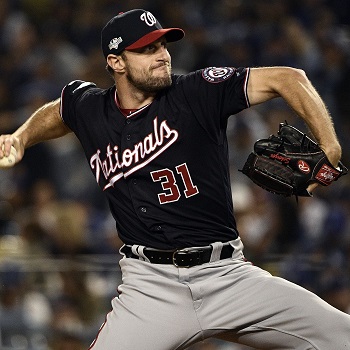
Martinez surprises with Max the Knife

2019-10-05 MaxScherzer

Could that someone out of the pen be Max the Knife?

Bet on it: it doesn’t happen if Matt Williams was still the Nationals’ manager. Bet a little on it: it might not even happen if Dusty Baker was still the manager. Davey Johnson, maybe. But it happened through the courtesy of incumbent Dave Martinez.

And it got him a return to Nationals Park with their National League division series against the Dodgers tied at one apiece. The Nats ain’t ready for the last dance just yet. And if they keep this up, they just might get one in the World Series in due course. Might.

Williams was too wedded to The Book, whatever he thought it was, to have even thought about bringing Max Scherzer in from the bullpen in National League division series Game Two. Compared to Williams, Baker was John Coltrane, but I’m not sure even Baker might have gone there, either.

Johnson’s the man who once inserted one relief pitcher into right field and the other on the mound (Roger McDowell and Jesse Orosco, or was it Jesse Orosco and Roger McDowell), then rotated them between the positions until his Mets won the damn game. Johnson just might have reached for Scherzer Friday night.

But Martinez did, in the eighth inning. “We weren’t expecting that,” lamented Dodgers manager Dave Roberts after the Nats finished the 4-2 win they’d started. The Dodgers and just about everyone else in the solar system.

After a long season that only began with the distinct appearance of Martinez awaiting his call to the guillotine as its victim, not its operator, who the hell did he think he was Friday night, Casey Stengel?

The good news was Scherzer striking out the side in the eighth. The bad news was, the Nats still have an honest to God bullpen, and they’re still one of the shakiest bunches this side of the old Soul Train dancers. Daniel Hudson got the ninth inning gig and got himself the bases loaded—partly because Martinez took the gamble of putting the winning run aboard with two out to set up a possible force—before swishing Corey Seager out to end it.

And before Max the Knife came in for the eighth, Sean Doolittle, usually the Nats’ closer, relieved Stephen Strasburg for the seventh and, after striking out MVP candidate Cody Bellinger to open, threw Max Muncy a dead center meatball that Muncy drove dead over the right field fence to close the Nats’ lead to a single run.

Good thing Doolittle’s pinch hitter Asdrubal Cabrera smacked Dodger reliever Dustin May’s first service into right center field with second and third for the fourth Nats’ run. Better thing that Martinez was only too willing to say screw the protocols and reach for Scherzer for the eighth. Best thing that Scherzer got Gavin Lux, pinch hitter Chris Taylor, and Joc Pederson on three straight Duke Ellingtons: It don’t mean a thing if it ain’t got that swing.

It’s one thing to go all-hands-on-deck in a win-or-be-gone play-in like a wild card game. It’s something else, seemingly, to load your bullpen with your grand starting pitchers in a division series. If you still want Scherzer to start Game Three for you in Washington, it’s entirely doable after Scherzer worked only the one inning without even thinking about asking what the hell he was doing strolling in from among the arson squad.

“All the chips are on the table,” Scherzer said after the game.

Except that Martinez hinted powerfully enough that it’d be Anibal Sanchez likely to start Game Three—with Patrick Corbin available in the bullpen. Nobody around the Nats thinks it’s such a beyond-sane idea. Certainly not Scherzer.

“I’ve been in these situations before where you’re pitching on two days’ rest in all-star games and different times in the postseason,” he told reporters after Game Two. “I know that on two days’ rest, you’ve got one inning in you. So, I said whatever the situation is, I’m ready to pitch.”

Remember: that’s the man who refused to let something so trivial as a black eye and a swollen face stop him from taking his next turn and throwing a ten punchout, four-hit gem in a doubleheader nightcap in late June. A man who’ll pitch when, never mind until he’s black and blue in the face isn’t going to flinch over coming out of a postseason bullpen for a quick round.

Oh, goody (not), the Dodgers must be thinking. Remember last year. They were undone in a World Series when the Red Sox started David Price twice and closed with him once, started Chris Sale once and closed with him once (the Series winner, as it happens), and started Eduardo Rodriguez once and drew him in from the pen twice. Hello, Yogi, wherever you are around the Elysian Fields, it’s threatening to get late early out there again.

Strasburg didn’t seem to mind that Max the Knife stole some of his thunder on a night when he needed to be a little beyond his best himself. You can afford to be sanguine when your mates pry three runs out of a Clayton Kershaw who still can’t seem to find and sustain the best of his best in postseason play, while you’re busy punching out ten in six innings, surrendering three measly hits, and one measly earned run.

And it helps even more when you now have a postseason career 0.64 ERA while allowing but one run so far this October. This keeps up, we’re going to be saying Strasburg’s name in the same postseason sentences as those of Sandy Koufax, Bob Gibson, Mickey Lolich, Orel Hershiser, Curt Schilling, Madison Bumgarner, and Justin Verlander.

You may also be saying other names to refer to the Nats before long. Ringling Brothers and Scherzer and Strasburg Circus. Brother Martinez’s Traveling Salvation Show. The Mothers of Inversion. The Dodgers could be describing them with the last of those with “of Inversion” replaced by a twelve-letter compound euphemism for “maternal fornicator” before long.


Life comes in threes for these Mets

2019-08-09 MichaelConforto

Michael Conforto, seconds from being stripped topless and bathed in Gatorade bucket ice, after his RBI finally beat the Nats Friday night in the ninth.

The question before the Citi Field house, and practically all of baseball Friday night, was whether the resurrected Mets—who’d done it mostly on the backs of the bottom crawlers—could hang with the big boys. Even if Friday night’s big boys out of Washington were picking themselves up by their own bootstraps after an almost-as-nightmarish first half.

The answer came in two parts.

Part one: a comeback from three down against Stephen Strasburg, the Nats’ best starting pitcher with Max Scherzer still in drydock over his bothersome back, in the bottom of the fourth. Part two: Another comeback from three runs down, and a game-winning RBI, off a Nats reliever the Mets turned into their personal pinata all season long.

Sean Doolittle against the rest of baseball in 2019: nine runs surrendered. Sean Doolittle against these Mets before he went to work in the bottom of the ninth: nine runs. The Mets as a team hit .385 against Doolittle in 2019 before Friday night, good for a ghastly 10.13 ERA for Doolittle against them.

The kid corps took care of business in the third. The old men took care of most of it in the ninth, including four straight inning-opening hits including a game re-tying three-run homer. Until Michael Conforto, all of a five-year young veteran, drove home old man Juan Lagares for a 7-6 win that was both the first for the Mets in a game they trailed after eight this and surrealistic even by the standards of this year’s surrealistic Mets.

Conforto barely rounded first when his celebrating teammates stripped him topless in celebration of the absolute first game-ending hit of his career. Then hit him with the Gatorade bucket ice shower. That’s how crazy this one went, right down to the proverbial wire. It didn’t exactly begin with things looking even reasonable for the Mets.

And it almost ended after an unreasonable lapse in the top of the ninth sent them three down for the second time. Apparently, the Mets didn’t get the memo saying they were supposed to tuck their tails between their legs and take it like a manperson from the almost-equally re-upstart Nats. Whoever intercepted the memo should be named the game’s most valuable player.

For the first three innings Strasburg was perfect and Mets starter Marcus Stroman, in his first gig in Citi Field, was out of character. Strasburg threw stuff that found his fielders invariably and picked up a punchout per inning. Stroman, the homecoming import from Toronto, forgot he was the John Coltrane of the ground ball and blew away seven on strikeouts, including five straight from the first to the second.

Alas, in the top of the third it began to look like the resurrected Mets couldn’t really hang with the Washington resurrected. The Nats hung up a three-spot in the top thanks in part to Anthony Rendon’s RBI triple flying just past a pair of oncoming Mets outfielders, one of whose knees (Jeff McNeil) had an unexpected and unwanted rendezvous with another’s (Conforto) face. And, thanks in larger part to Juan Soto sailing one parabolically over the right field fence.

Maybe the Nats would escape having to deal with the Mets without Scherzer, after all. Maybe an inning saying “take this, peasants!” would stick a barb into the newly upstart Mets.

But in the bottom of the third Nats first baseman Matt Adams, who’s not exactly the second coming of Mets broadcaster Keith Hernandez at first base, as it is, inexplicably let leadoff walker McNeil escape unscathed, failing to throw him out at second despite all the time on earth to do it off Amed Rosario’s ground out. And after Conforto popped out to Rendon next to third base, up stepped Rookie of the Year candidate Pete Alonso.

In four seconds flat, Strasburg’s sinking changeup traveled from the end of Alonso’s bat over the heads of Hernandez and the rest of the Mets’ broadcast team (Gary Cohen and ex-pitcher Ron Darling), stationed behind the fence for a change, and into the left field seats. Making Alonso the first Mets rook to clear the fences in four straight games since Larry Elliott in 1963.

And five pitches later, J.D. Davis caught hold of a Strasburg four-seamer coming just inside the zone and drove it the other way into the upper deck behind right. Tie game. Just like that. “Who you callin’ peasants, peasants?!?”

Stroman seemed so impervious to the Nats trying to make his life difficult the second time around the order that, after he walked Trea Turner and surrendered an almost prompt single to Adam Eaton for first and second and two out in the fifth, he slipped a full-count cutter right beneath Rendon for swinging strike three, the side, and his eighth punchout of the night.

Then the Nats got a little more frisky in the sixth. A leadoff double down the right field line by Soto. A single by Adams that eluded Alonso diving into the hole for first and third. And a sharp grounder to third by Kurt Suzuki that looked like the Mets would concede the lead run to turn the double play.

Mets third baseman Todd Frazier was having none of that. He threw home as if premeditated. Catcher Wilson Ramos blocked the hopper perfectly, held the ball, and Soto was in the rundown. The lone mistake was the Mets making the extra throw to nail Soto, allowing Adams to third and Suzuki to second. With one out. But Brian Dozier hit a laser to shortstop. And Rosario made as though he’d been studying Hall of Famer Ozzie Smith. He leaped and speared the laser with a hearty overhead glove snap as if he’d been praying for this one all night long. Then Stroman struck out Strasburg himself for the side.

Bullet dodged? Try howitzer. This was the Met defense that could have been tried by jury for treason not a fortnight ago? And maybe nobody in Citi Field was happier or making more racket than Stroman’s mother, resplendent in a blue Mets alternate jersey, jumping and whooping it up from her seat.

The Nats dodged a howitzer of their own in the bottom of the sixth. With first and third they caught a phenomenal break when plate umpire Mark Carlson called ball four on Davis, on a pitch that missed the inside of the zone and on which Davis checked his swing. But first base umpire Tripp Gibson rang Davis up, erroneously, as an overhead replay showed vividly.

Conforto running on the pitch stole second to set up first and third. But if the Mets went on to lose this game, that blown strike would likely have haunted them the rest of the weekend. Maybe the rest of the season, too, depending.

But the Nats pulled Strasburg’s kishkes away from the long knives when Ramos grounded to third, Rendon threw a little wide to first, and Adams bellyflopped like an appendicitic whale behind the base, somehow keeping his toe on the pad and the ball in his mitt, long enough for the side. It would have been the play of the game if the Nats somehow pried a win out of the Mets after saving that would-have-been tiebreaking run.

And in the top of the seventh it looked as though they’d do just that, when Rendon—after a leadoff walk to Turner pushed Stroman out, bringing in lefty Justin Wilson to strike out Adam Eaton—hit Wilson’s first service into the left field seats. “Go figure,” Hernandez purred on the broadcast. “Wilson has poor numbers against Eaton and strikes him out. He has good numbers against Rendon and Rendon hits one out.”

That’s Andujar’s Law, folks: In baseball, there’s just one word—you never know.

But did the Mets know they were done for yet?

They may have had a suspicion when Strasburg, sent back for the bottom of the seventh, took care of Frazier, newly minted Met second baseman Joe Panik (signed after the veteran Giant was designated for assignment, following their acquisition of Scooter Gennett from the Reds), and pinch hitter Luis Gillorme.

Then they thought, not quite yet, after Robert Gsellman worked a reasonably effortless three-and-three top of the eighth. And one of the Nats’ new bullpen toys, former Blue Jay and Dodger Daniel Hudson, opened the bottom by fooling McNeil completely with a changeup hitting the low inner corner. But Rosario gunned a slightly hanging breaking ball to the back corner of the left field grass for a one-out double.

Conforto pushed him to third with a jam-shot ground out up the first base line. After Hudson fed Alonso a diet of high fastballs that Alonso kept fouling off like they were castor oil, alas, Hudson threw him something good enough only to be whacked on the ground to short for the side.

Gsellman went back to open the ninth. The shaggy righthander wrestled Turner to a full count, something into which Turner is very good at wrestling himself when he begins down in the count, then watched Turner foul off a trio before lining a base hit to right. And then Eaton, who’d had nothing to show for four previous plate gigs against Gsellman, pushed a tiny bunt off to the left of the plate from which nobody could throw him out. Even with a shotgun for an arm.

First and second, nobody out, and Rendon at the plate with a .500+ lifetime batting average against Gsellman. But Rendon almost promptly flied out to right, allowing Turner to take third on the play. Prompting Mets manager Mickey Callaway—once beleaguered, now riding the unlikely post All-Star break Mets success—to reach for lefty Luis Avilan to work to the lefthanded Soto, who was one triple short of the cycle.

Not tonight. Avilan struck Soto out on a lazy looking changeup. Up stepped the lumbering Adams, 2-for-4 on the night to that point. Eaton stole second on 1-0, but Avilan pushed Adams to 1-2 before a changeup missed for 2-2.

But then Avilan threw Adams a changeup that hit the dirt and bounced off the veteran Ramos, himself an ex-Nat. Ramos and Avilan each looked as though they’d fallen asleep on their feet as Ramos barely moved back toward the plate and Avilan inexplicably failed to get there in time to cover, as Turner hustled home with the sixth Nats run.

Then Avilan struck out Adams for the side. Leaving the Mets with Doolittle as their last, best hope to save their own kishkes. To lose this one stood a good chance of cutting their momentum and morale completely in half. And Doolittle and his Nats knew it.

But the Mets knew they had the lefthander by the short and curlies almost before he went to work in the bottom of the ninth. The whole season’s record against him was evidence enough.

Sure enough, Davis opened rudely enough by whacking a double to left. And Ramos promptly sent him to third with a line single up the pipe. And Frazier tied the game with a mammoth rip down the left field line and just fair past the foul pole. The way Citi Field went berserk you’d have thought they were watching the resurrection of the 1969 Mets from half a century ago.

Panik, the newest Met, promptly singled to center, only to be forced at second when Lagares’s bunt floated in the air, leaving Panik stuck to determine whether it would hit the ground before running, allowing Rendon hustling in from third to throw as Doolittle in front of him bent over to give him room, getting Panik by several steps. And McNeil flied out to right almost at once.

Two out, extra innings against these relentless Nats looming. Right?

Wrong.

Rosario shot a tracer to left center for a hit setting up first and second. Then Conforto caught hold of a 2-2 inside fastball and sent it on a high line to right, far enough to elude the onrushing Eaton and bound off the fence with Lagares atoning for the busted bunt by scampering home with the winning run.

These Mets can hang with the bigger boys when they need to. They’ve got arguable the toughest schedule remaining among National League contenders and re-contenders. Until Friday night, a Met journey of a thousand miles was more liable to begin with two flats and a busted transmission than a smooth-running vehicle.

They repaired the flats and un-busted the transmission in reasonably record time. Pulling themselves to within a game and a half of the Nats in the National League’s wild card standings at long enough last.

Don’t ask if anything could possibly be wilder than this one’s finish. Both teams know you probably ain’t seen nothing yet. And you might see everything before this set’s finished.

“We are now in crunch time”

2019-08-07 PeteAlonso

Pete Alonso a second from starting the Mets’ barrage against the Marlins Wednesday. He says it’s crunch time. Do the Mets continue to crunch, or will they be crunched?

Somebody post guards at the Citi Field clubhouse entrance. Have them ask for I.D. Check it against all known club records. Because whoever these guys are, are we really sure these are the Mets?

Are these the Mets who looked so caught between bewitched, bothered, and bewildered that their hapless, in-over-his-head manager was getting more votes of confidence in three months than a beleaguered (and often two jumps short of overthrow or assassination) head of foreign state gets in a year?

Are these the Mets whose starting pitchers finished their assignments having to try their level best not to sneak into the clubhouse to call the arson squad after the bullpen gates opened and forward came yet another arsonist?

Are these the Mets whose rookie general manager challenged the rest of the league, “Come and get us,” then looked shell shocked (and lost his temper when he threw a chair at manager Mickey Callaway in a closed-door meeting) after the rest of the league, mostly, did just that?

Are these the Mets who could hit anytime but when it really mattered the most, who had defenders either out of position or losing their grip even if left in proper position, until they couldn’t stop enemy grounders or run down enemy flies with walls, bridges, and butterfly nets?

Except for two deals on or close to the new single mid-season trade deadline, and maybe a couple of DFAs along the way, these are those Mets.

Before the All-Star break, they were ten games under .500 and nobody could still decide whether Callaway still needed to be sent to a new line of employment known as unemployment alone or whether the rookie GM needed to join him there, as part one of a complete top-to-bottom de-lousing.

Since the All-Star break: the Mets are 19-6. They’re 13-1 since taking a second of three from the Padres on 23 July. They’ve not only yanked themselves back, improbably, into the National League wild card hunt, they’ve yanked themselves back into the National League East conversation.

And it’s right on the threshold of a six-game test that will determine once and for all whether these Mets have merely shaken away first-half growing pains and proven smart to stand 99 percent pat at the trade deadline, or whether they’ve revived themselves into a big, fat, air-out-of-the-tires letdown.

It’s not that beating up on such clubs as the Pirates, the White Sox, and the Marlins is doing it entirely the easy way; each of thoseis capable of making things just a little challenging for any contender assuming they’re pushovers on the way to glory.

But while the Mets just finished a sweep of the Fish in New York with a 7-2 Wednesday scaling that featured four home runs—including a pair of two-run jobs from Michael Conforto and Rookie of the Year candidate Pete Alonso hitting his third bomb in three consecutive games following a somewhat surprising launch drought—trouble comes to town Friday.

Trouble named the Nationals. Trouble more specifically named Stephen Strasburg, against whom the newest Met, Marcus Stroman, gets to square off in his first Citi Field start. Trouble named the Nats having rehorsed almost the same as the Mets after they, too, spent too much of the first half looking lost and bullpen-burned.

So far this season the Mets have the upper hand on the Nats at 8-5 in the season series. But that was then: the Mets slapped around a Nats group who looked almost as addled as they did, especially during a late May sweep in Washington. This is now: Nobody’s been as good as the Mets since the All-Star break, but the Nats being 13-11 since the break doesn’t exactly qualify them as pushovers, either

On the other hand, the Nats are 8-7 to the Mets’ 13-1 on the threshold of the weekend set. They’re hoping Strasburg pitches like the guy who’s 8-1 with a 2.18 ERA lifetime in Citi Field and a 2.48 ERA overall against the Mets in his career Friday night.

The Mets, for their part, hope their tuning up against the mostly bottom-crawlers since the break has them primed to pry a few runs out of Strasburg before getting into a bullpen that’s improved enough in the past month and a half but might still have its vulnerabilities enough to count.

On deadline day the Nats gave the bullpen a repair job, not a complete overhaul. They imported three serviceable relief arms—Roenis Elias, Daniel Hudson, and Hunter Strickland—but they lost a game they needed to win badly enough the same night, 5-4 to the Braves in ten innings.

Including that loss they’re exactly 3-3 on the threshold of Friday night, including back-to-back wins against the likewise unexpectedly resurgent Giants. But with the Mets showing baseball’s best record since the All-Star break, the Nats likewise face a slightly bigger test. They went 3-4 against the NL East-leading Braves in July. Not a good sign.

Especially with the Braves looking quite a bit less since the break than they looked before it. The runaway NL East train has gone from express to local: like the Nats, the Braves gave their bullpen a bit of a remake at the trade deadline, importing Shane Greene and Mark Melancon. Like the Nats, the Braves since the All-Star break are 13-11 and 3-3 in their last six games, including a split with the AL Central-leading Twins.

On second thought, it may not be as difficult as Met fans might fear for the Mets to get past the Nats and the Braves for the next six games. But if they don’t beat Strasburg Friday night, it won’t necessarily be simple business for the Mets even if Max Scherzer’s errant back means they won’t have to think about him again until early September.

Another piece of good news for the Mets going in: they have what Alonso calls “a ton more home games in August and September.” ‘Tis true. They’ve played 63 games on the road so far this year and only 51 at home. They have twelve more home games this month and seventeen in September.

But look at most of their coming opponents after the coming six with the Nats and the Braves: After three with another bottom-feeding rebuilder (the Royals), the Mets get the Indians, the Braves again (this time at home), the Cubs (home), the Phillies (road, though the Phillies may still be teetering away by that time), the Nats again (road), the Phillies again (home), the Diamondbacks (home), the threshing-machine Dodgers (home), and—after road sets with the Rockies and the Reds—they finish at home against the Marlins and, to end the regular season, the Braves.

The Braves need to do better than their 14-10 July to keep the pace theirs. Turning their 3-3 August beginning into something resembling their staggering 20-7 June would be huge. With Dansby Swanson not expected back from the injured list until later this month, and veteran godsend Nick Markakis not expected back until some time near mid September, that might be easier said than done.

No wonder Alonso could and did tweet, “We are in crunch time . . .Hard work has really been paying off this second half. The rest of the season is going to be a really fun, wild, memorable ride.” He may have made the understatement of the year for the Mets, as understated as his home runs have been conversation pieces.

Half a century ago to the season, another band of Mets rode a second-half surge to a once-in-a-lifetime miracle. Alonso tweets like a young man who believes in miracles. The Mets since the break have played like a team that believes likewise.

It’s better than burying them alive as just about all of us were ready to do when May and June ended, of course, but “crunch time” now means the Mets will either crunch or be crunched.