The Machine is winding down?

Albert Pujols, hitting the 661st home run of his major league career last September to pass Willie Mays. His wife says he’ll call it a career when his contract ends after the 2021 season.

“Since the time he was a child, [he] would eat, sleep, and breathe this sport,” wrote Deidre Pujols on Instagram Monday. Right after she announced that that day would be day one of her husband, Albert’s final season as a major league baseball player. The loving husband responded to his wife’s post with three heart emojis.

The game and those who love it are liable to respond with a lot more than that. Tears included. Not just because of what Pujols was and the no-questions-asked Hall of Fame greatness he personified, but because of what injuries—almost all involving his feet and legs—made of the second half of his career.

But will he retire after this season, really?

Mrs. Pujols subsequently updated the post. “Today is the first day of the last season (based on his contract) of one of the most remarkable careers in sports!” it now reads. Then, she updated it again, saying she wanted only to send him into this season with blessings.

His ten-year, gigabucks Angels contract expires after this season. His tenure has been so injury addled that there came times Angel fans wondered if the Cardinals, who declined to re-sign the first baseman after the 2011 season, hadn’t slipped a whoopee cushion under their tails.

Under normal circumstances nobody likes to see the greats hit their decline phases. Were there more heartbreaking sights than Babe Ruth as a feeble Boston Brave? Walter Johnson, Warren Spahn, Satchel Paige, Robin Roberts, Whitey Ford, and Henry Aaron showing their ages at last?

Those men at least enjoyed the shorter declines. Pujols’s body turned his into a decade. Willie Mays’s kicking-and-screaming decline lasted seven years, heartbroken that he could no longer play the game he loved the way he did for so long. Steve Carlton spent almost half a decade jumping from team to team trying to find the left arm that went AWOL after almost two decades of Hall of Fame excellence. Pujols beat him and everyone else by almost double.

Last year, Pujols finally met and passed Mays on the all-time home run list. Earlier that pan-damn-ically truncated season, Pujols received a text from Mays: “It’s your time now. Go get it.” On 13 September, Pujols finally got it to tie. He turned on Rockies reliever Carlos Estevez’s 1-1 fastball and drove it just the way he did it in the truly glory years, half way up the left field seats on a parabola down the line.

Five days later, Pujols turned on Texas reliever Wes Benjamin’s fastball right down the chute on 1-2 and drove it into the visitors’ bullpen in Angel Stadium to pass Mays.

For a few brief, shining moments, Angel fans were reminded of treasures not really theirs to know, and Cardinal fans from a distance were reminded of what they were so fortunate to see for eleven transdimensional seasons. Watching a transdimensional talent who never stopped believing he absolutely had to get better.

The three-run detonation off Brad Lidge in the 2005 National League Championship Series, kept inside Minute Maid Park only by the retractable roof bracing wall. The reverse cycle of homers in Game Three of the 2011 World Series, every one of them after the sixth inning: the three-run homer, the two-run homer, the solo blast. The deadly lifetime postseason record. All those seasons as the game’s greatest righthanded hitter as well as a very run-preventive first baseman.

And, the sweet way Pujols paid tribute to the Cardinals legend who’d long befriended him, when Hall of Famer Stan Musial died in 2013. “I know the fans call me El Hombre, which means The Man in Spanish,” Pujols insisted, “but for me and St. Louis there will always be only one Man.”

Pujols was so emphatic about it that, when he became an Angel and the organisation festooned southern California with billboards announcing El Hombre‘s arrival, El Hombre blew his sombrero. He insisted very publicly that only one player should ever be called The Man, and his name wasn’t Albert Pujols. It takes longer for mob hit men to disappear their victims than it took the Angels to dispose of those billboards.

You think that was for showing and not for blowing? Few players have had as deep a reverence for baseball’s history as Pujols has had. That depth enabled Pujols to befriend Musial and mentor Mike Trout, “who might be the only position player this century to match [Pujols’s] level of peak greatness,” says The Athletic‘s Fabian Ardaya.

When Pujols said of Trout last year, ““We have the best player in the game, and five or six years from now, he’s going to be making history, too,” he didn’t have to be told Trout’s already made some history of his own. He knows it. He respects it. He mentored Trout into becoming the Angels’ team leader not by way of claiming the role for himself but by what he does on the field and how he lives off it.

Pujols himself lives a well-apportioned life away from baseball. Among other things, when not raising his own family, he and his wife have worked arduously with Down’s syndrome children—among whom is their own daughter, Isabella—and against human trafficking.

His lower body ruined what should have been a kinder, gentler, simpler decline phase. It’s left him prone to as much criticism under ordinary, non-milestone circumstances as he received high praise whenever the vintage Pujols made the periodic cameo. If the Angels looked foolish for signing him long-term and extraterrestrial salary after the injuries began to chip him down, they never once doubted Pujols was giving the best he had with whatever he had left.

““He plays through discomfort,” former general manager Billy Eppler told MLB.com after he tied Mays. “He endures a lot and doesn’t talk a lot about it. But I can tell you that he’s definitely someone that wants to play and fights through a lot of adversity to make sure he’s out there and contributing to the club.”

Even those whose admiration for him didn’t crumple the way his injuries forced him to crumple hoped somewhere, somehow, several times the past few years, that Pujols would swallow his formidable pride, leave the rest of his formidable money on the table, let nothing further tarnish his near-singular legacy, and sink into that ten-year services contract he still has with the Angels following his retirement.

“It has been so hard to watch one of the greatest players in the history of baseball fade like this,” wrote another Athletic scribe, Joe Posnanski, almost a year ago. “Each year, I hope against hope for Pujols to be Pujols one more time. Sadly, that just isn’t how time works. He is 40 now and a decade past his prime. It hasn’t been a sad career, though; far from it. It has been extraordinary. It has been an inspiration.”

It’s not unfair to say Pujols’s contract hamstrung the Angels when administrative tunnel vision didn’t when it came to re-tooling the team back to contention. Neither is it unfair to say that spending that much for a well-established Hall of Famer who hadn’t yet been hit with his physical issues didn’t have to mean the Angels ignoring their other issues, either.

Like his final Cardinals regular season, Pujols’s first Angel season was solid, if below his former standard. His 2011 postseason and how he helped the Cardinals win that outer-limits World Series may have deked people into thinking he’d only had one off year but plenty of petrol left in reserve.

Then plantaar fascitis in his heel kept him to 99 games in 2013 and a staggering enough fall from even that 2012 performance. Further injuries below his waistline made sure he’d look like an imitation of himself from then on, despite a few shining hours, a few significant milestones, a few moments in which he looked exactly the way he did over those impeccable St. Louis years.

But he didn’t hold a gun to the Angels’ heads and tell them to waste their remaining resources, either. The Angels have been an anti-model franchise during most of Pujols’s tour with them. If Pujols calls it a career after the season to come, the Angels, their fans, and their critics won’t have Pujols to blame for what wasn’t his fault in the first place.

This is Pujols according to my Real Batting Average metric (TB + BB + IBB + SF + HBP / PA):

PA TB BB IBB SF HBP RBA
Career 12,394 5923 1331 312 115 108 .628
With the Cardinals 7433 3893 975 251 68 77 .708
With the Angels 4961 2030 356 61 47 31 .509

That’s what the injuries did in turning what should have been a natural decline phase into a hard-lived one.

Albert Pujols was a .708 batter as a Cardinal. His career RBA with a normal decline phase should have lined him up to finish at the top of the heap of Hall of Fame first basemen who played their careers in the post-World War II/post-integration/night-ball era. If his .628 holds by the end of this year, it’ll plant him in between Jeff Bagwell and Willie McCovey, and Pujols was the better all-around first baseman among those three plus first base RBA leader Jim Thome.

Pujols’s other nickname has been The Machine. Unfortunately, even machines have finite lives to do what they were built to do. They don’t all decline as sadly as this one did. Even if this one’s going make what promises to be a singular Hall of Fame acceptance speech in 2027. With Stan Musial smiling broadly upon him from the Elysian Fields, if not blowing him a chorus of “Take Me Out to the Ball Game” on his ubiquitous harmonica.

“Why did he quit?” Joe DiMaggio’s brother, Tom, once said when asked why the Yankee Clipper would call it a career after thirteen war-disrupted seasons and a persistent heel issue that turned into back trouble. “He quit because he wasn’t Joe DiMaggio anymore.”

Maybe the gigabucks Pujols earned as an Angel kept him from quitting precisely when he wasn’t really Albert Pujols anymore. Maybe his pride did it. Maybe both. Maybe, come the next off-season, it’ll be impossible at last for Pujols to tell himself he can be day-in, day-out great again. Maybe he’ll tell himself at last it’s time to let his whole record take him out of the box and into Cooperstown.

And maybe the Angels will find ways to a) make the game’s best player since Pujols joined the team proud; and, b) reach the postseason to send Pujols into retirement in a blaze of glory.

We can dream, can’t we?
From mile-high madness to St. Louis serenity

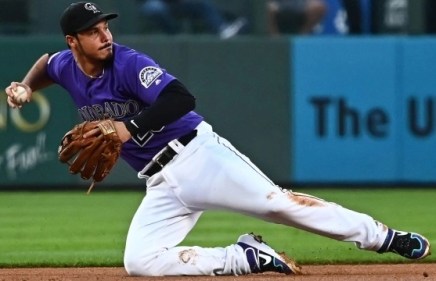
Like should-be Hall of Famer Scott Rolen before him, Nolan Arenado’s a top third baseman the Cardinals will take happily off an unappreciative team’s hands.

More often than Joe and Jane Fan think, baseball players and those playing other team sports discover that all the money on their paychecks isn’t quite as handsome as winning. It’s the reason such ballplayers otherwise wedded to the teams who reared them swallow pride and paychecks and look out of town when winning isn’t going to happen soon.

The Cardinals are only too willing to show more than cursory interest in such men. They’re baseball’s Emma Lazarus; they might as well engrave the top of Busch Stadium’s entrance with, “Give us your sick-and-tired, your not-so-poor, your huddling supermen yearning to breathe free and win championships.”

They’ll even take your money gladly to take him off your hands.

They’ve just gotten the Rockies to give them sick-and-tired, not-so-poor, huddling super third baseman Nolan Arenado for an apparent bag of mixed nuts. They even accepted the Rockies sending along $65 million dollars for the privilege of taking Arenado off their hands and books.

And, with a few former glitterati due to come off the payroll books after 2021, a couple of big moves that plain didn’t work out for the Cardinals will be gone as well. It’ll make the Cardinals the National League Central favourites and perhaps the only club in the division who can hold up against the monsters of the East and West if they reach the 2021 postseason.

It turns their formerly unassuming off-season into a bristling one. It might make them tempted to think about extending Arenado further depending on what he does with two opt-outs his deal has after 2021 and 2022. And, it adds Arenado to a rather distinguished roll of prior tired, huddling supermen who found baseball a lot more agreeable when they got to play adjacent to the Gateway Arch.

Once upon a time the Padres got fed up with their high-and-wide flying shortstop’s agent and decided to deal him. Then-Cardinals manager Whitey Herzog went to San Diego to talk to the man personally. That kind of personal touch got the Cardinals a Hall of Fame shortstop whose defensive value was equal to his acrobatics and good for big parts of three pennants and a World Series ring. You still know Ozzie Smith as the Wizard of Oz.

Not long after that, Jack Clark bristled over the Giants’ brittle Candlestick Park and their dismissals of him as just too fragile to play major league baseball. They dealt him to the Cardinals, where they moved him to first base for his health’s sake. Jack the Ripper hit the home run that sent the Cardinals to the 1985 World Series and swung big for their 1987 pennant winner until an ankle injury kept him out of that Series and helped keep them from winning it.

Should-be Hall of Famer Scott Rolen got sick and tired of the Phillies’ seeming lack of winning interest and dismissing him despite his play saying what he didn’t like trumpeting on his own behalf. The Cardinals said, “Give us your sick and tired third baseman.” They traded for and signed Rolen to a new deal. They also sent him to four All-Star teams and won a World Series with him.

One fine day Matt Holliday, traded from Colorado to Oakland, discovered the Athletics decided they couldn’t afford his like and traded him to the Cardinals. He shone enough in left field and at the plate for the Birds on the Bat that they made sure he couldn’t take a free agency hike just yet. And, like Rolen, Holliday went to four All-Star teams and won a World Series in St. Louis fatigues.

Another fine day, for the Cardinals at least, the Diamondbacks decided two years ago that they couldn’t or wouldn’t afford to keep franchise-face first baseman Paul Goldschmidt. The Cardinals channeled their inner Monty Hall—Let’s make a deal! They landed Goldschmidt for Luke Weaver and a pair of bodies and signed Goldschmidt in due course to a succulent nine-figure extension. They’ve been to a pair of postseasons with him, too.

Landing Arenado means the Cardinals want a little more than just postseason entries. And Arenado isn’t as treacherous looking going into what’ll be his age-30 season as you might fear. He has five years left on his Colorado-signed extension. He might lose a couple of counting stats weighted heavily on the home side but he might even things out with road performances enabled better by not playing at ionosphere level.

He’ll be able to keep swinging smoothly for extra base hits and doing things at third base unseen since Rolen, Adrian Beltre, Mike Schmidt, and Brooks Robinson, a human vacuum cleaner who no longer has to worry whether his bag will explode in the middle of a flying leap, a running throw, or a swan dive across the line.

Among active third basemen, Arenado is second only to Evan Longoria (thirteen seasons) for total defensive runs saved above his league average, but Arenado has an excellent chance to surpass Longoria at the hot corner and at the plate by the time he reaches his fourteenth major league season.

Matter of fact, let’s look at that pair plus Manny Machado, the $300 million plus man in San Diego, according to my Real Batting Average (RBA): total bases + walks + intentional walks + sacrifice flies + hit by pitches divided by plate appearances:

Player PA TB BB IBB SF HBP RBA
Nolan Arenado 4558 2227 362 58 50 22 .597
Evan Longoria 7380 3108 645 81 89 69 .541
Manny Machado 4989 2211 387 41 36 21 .540

Arenado also has an OPS (on-base percentage plus slugging percentage) 83 points higher. (I’ll bet you didn’t think Longoria and Machado were that similar at the plate, either.) Arenado’s OPS is also 65 points higher than Machado, who’s only 17 defensive runs behind him.

What he won’t have is Rockies general manager Jeff Bridich to kick, jerk, or slap him around anymore. Arenado bristled when Bridich treated his old infield partner Troy Tulowitzki like a chump over trade rumours, failed to include Tulowitzki in any such discussions, then dealt the shortstop to the Blue Jays. (Where he went to a pair of postseasons before injuries ended his career out of town.)

When Bridich told the Denver Post early last week that nothing came of the Rockies “listening” to other teams about Arenado, the third baseman slapped back. “Jeff is very disrespectful. I never talk trash or anything,” he told a Denver television station. “I play hard, keep my mouth shut. But I can only get crossed so many times.”

Kind of reminds you about Giancarlo Stanton and the Miami Marlins two years ago. He’d signed a then record-dollar thirteen-year deal a couple of years before that only to watch the Fish swimming wild and directionless like killies scrambling to escape the incoming sharks. He spoke publicly of that, then called them a circus when they decided he could just suffer along no matter what. Then they dealt him to the Yankees.

Nobody knows whether the 2020 irregular season that ended with the Marlins in second place in the NL East was as fluky as the rest of baseball, but Stanton did get as far as back-to-back postseasons with the Yankees and missed reaching the 2019 World Series by one ALCS-winning home run courtesy of Houston’s Jose Altuve.

The Rockies weren’t half as crass as the Marlins if no less dismissive. When they signed Arenado to his extension, they promised that wouldn’t stop them from tooling up all around. By the end of a losing 2019, following back-to-back seasons good for nothing more than wild cards and too-early postseason exits, though, Arenado smelled a coming rebuild, if not a coming tank.

Bridich awoke Saturday morning to a roasting by Denver Post baseball writer Mark Kiszla. “[S]o insecure he tries to bully every conversation with Ivy League arrogance as thin as his college baseball resume,” Kiszla wrote, “[Bridich] got ripped off by the Cardinals in a trade that appears so lopsided that Commissioner Rob Manfred should consider voiding the deal before it becomes official.”

Once upon a time, Arenado wanted nothing more than to stay a Rockie for life, the way should-be Hall of Fame first baseman Todd Helton was. “I want to win,” he has told Sports Illustrated. “If we win here, that’s why I signed, right? To win here. But if we’re not gonna win, I’d rather play for a winner. I don’t care where it is. I’d rather win a World Series than have my number retired.”

More than a few eyes are now cast upon Rockies shortstop Trevor Story, who may also have noticed too much of the treachery around Arenado and begun to wonder whether that mile-high baseball air has vaporised common baseball sense even further.

If he’s not careful, Kiszla warned, Story “could be the next knucklehead to be fooled by this team’s hollow promise to build a champion around him. My advice? Story demand a trade ASAP to a major-league city where winning matters.”

A city like St. Louis, perhaps. It wouldn’t be past the Cardinals to ponder a shortstop upgrade, take note of the Rockies leaving Story to waste, and deal a couple of sacks of mulch for him while deciding Kolten Wong is more than worth keeping at second base and moving Paul DeJong to the bench or onward.

You don’t want to relieve your sick-and-tired, your not-so-poor, your huddling Hall of Fame supermen to be (assume he keeps his health following that shoulder injury last year and Arenado’s on the Hall track), allowing them to breathe free and win with you? The Cardinals are only too happy to take them off your hands, relieve your headaches, and cause you a few when you meet them in mortal combat.

They might not even be adverse to keeping their eyes upon the West Coast. That’s where  baseball’s still-best all-around player, loyal as he is to the franchise that raised him, may start thinking in a couple of years while he’s still young enough that knocking Hall of Famers out of the record books or off the WAR charts isn’t enough. He may ask at last what can compensate for being a Trout out of water with no winning to show for his extraterrestrial efforts.

Nobody with a brain would put it past the Cardinals to think about reeling that Trout in. Just don’t expect them to include painkillers in the deal.

Yadier Molina, talking through his sombrero

Does Molina (here getting an attaboy from Cardinals ace Jack Flaherty) also think the annual Gold Glove should be a lifetime achievement award?

You thought Yadier Molina was too intelligent to play a race card? You didn’t hear him when the Gold Glove finalists were announced and the longtime St. Louis Cardinals anchor didn’t make the cut.

“Respect to all the finalists in the 2020 National League catcher!” Molina began a furious Instagram post during the week. “Now . . . I see an injustice to those who decide or not . . . I don’t know if it’s @mlb or whoever but it’s clearly that they don’t want this Boricua Jibarito to draw with the great @johnnybench_5 . . . or me at 38 years I’m still the best.. ask every catcher in the mlb and they’ll tell you!!!”

The problems with Molina’s fury only begin with his apparent forgetfulness that another Boricua Jibarito—English translation: Puerto Rican little yokel—hold the major league record for catchers with thirteen Gold Gloves. You may have seen his Hall of Fame plaque: Ivan Rodriguez.

Molina has nine Gloves. Hall of Famer Johnny Bench has a National League record ten. If there’s a move among Gold Glove voters to deny a Puerto Rican little yokel a tenth Glove, it’s not as apparent as Molina thinks.

Under normal circumstances, the Gold Gloves would be chosen by about 75 percent managers and coaches and 25 percent statistics, surface and sabermetric alike. In pandemic-pressed 2020, the Gloves candidates were chosen by statistics (surface and sabermetric alike) alone. And they say Molina at 38 years old isn’t the best behind the plate this year, and maybe anymore.

Specifically, Rawlings, who present the Gloves every year, elected to use strictly the Society for American Baseball Research’s Defensive Index. This has only been a decade or so overdue, unless you’d like to continue seeing Gold Glove winners chosen past their primes on reputation more than real results or by highlight reels over hard season-long truth by managers and coaches with familiarity bias.

The National League’s Gold Glove catching finalists are Tucker Barnhart (Cincinnati Reds), Willson Contreras (Chicago Cubs), and Jacob Stallings (Pittsburgh Pirates). Molina thinks he’s still better than the rest of the National League pack when he didn’t even make the top five Glove candidates in a year the numbers alone picked the contenders.

The numbers say Molina committed five errors in 42 games, the five being his most in a season since 2017, a year in which he won the Glove. They also say three passed balls in 42 games equaled his full-season total from 2014, another year in which he won the Glove. They say Molina tied for the fifth-most wild pitches escaping him this year with fourteen and finished seventh in the league in defensive runs saved.

He may take this as adding insult to injury, but Molina was easier for baserunners to commit crime against than Austin Nola (Philadelphia Phillies) and Austin Hedges (Cleveland Indians) this year. He hasn’t been as high as second among arresting officers behind the plate since 2010, and he hasn’t been as high as the number four handcuff clapper since 2017.

What Molina seems to have wanted—especially becoming a free agent hoping for one more, maybe two-year payday—is a Lifetime Achievement Gold Glove. As if there haven’t been too many Gold Gloves awarded on just that basis when all else was said and done. At this writing he’s the number one active catcher for games caught, catching putouts, catching assists, total zone runs for catchers, and fielding percentage.

Handling pitching staffs? The pitchers who’ve thrown to Molina lifetime have a 3.68 overall ERA teaming with him. That puts him ahead of Rodriguez; the pitchers who threw to I-Rod lifetime had a 4.68 overall ERA teaming with him. It puts him behind freshly-minted Hall of Famer Ted Simmons (3.65), Bench (3.52), Berra (3.41), and Carter (3.31). Essentially, he’s handled pitching staffs the way you should expect a Hall of Fame catcher to handle them.

Unfortunately for him, the Gold Glove doesn’t reward lifetime achievement. That’s what the Hall of Fame is for. (For all we know, maybe Rawlings strikes a Palladium Glove for lifetime achievement one of these days.) And Molina knows exactly what we know, that his Hall of Fame case rests entirely on his work behind the plate. As a hitter, Pudge, Simba, the Little General, Yogi, and The Kid he ain’t and never was. (And why didn’t someone think to give Bench his own nickname and not make him share with Gene Mauch?)

If Molina wants to play another couple of years and a team thinks he can do so—most likely as a solid veteran presence and the shepherd of its next generation behind the plate—let him have that one more payday. But when he says the Gold Glove people just don’t want some Puerto Rican little yokel meeting the great Bench while some other Puerto Rican little yokel has more Gold Gloves in his trophy case than even the great Bench, Molina is talking through his sombrero.

Bob Gibson, RIP: Disabusing prejudice and pretense

Bob Gibson gets the better of fellow Hall of Famer Al Kaline during the 1968 World Series.

How terrible is this? Bad enough for the St. Louis Cardinals that were sent home for the winter by the San Diego Padres Friday night, when  former Cardinal Trevor Rosenthal struck out the side all called in the top of the ninth Friday night.

Worse: The greatest pitcher in Cardinals history lost his battle with pancreatic cancer at 84 concurrently, on the anniversary of setting a record striking out seventeen Detroit Tigers in Game One of the 1968 World Series. Losing a Bob Gibson who was at least as good a man as he was a pitcher on such an anniversary stings even deeper.

Calling Gibson a tenacious, relentless, intimidating competitor on the mound is probably the first way he’s remembered, complete with the gags and exaggerations that have long since been both cliche and deceptive. Remembering that he was an intelligent man who was his own kind of sensitive and suffered fools no more happily than plate-crowding batters should be equal.

We remember the peculiar elegance of Gibson on the mound even past the severity of his otherwise handsome face as he began a pitch. It only began with the full back-swing of his long arms starting his windup and the leg kick that bent and lifted his knee even with the lettering on the front of his uniform.

There was that half turn that showed half his number 45 on his back, the slight incline of his body as he actually began to throw, then, especially, that whip-like arm movement down and across his body, glove arm extending up behind his shoulder like an eagle’s wing in flight.

There were his legs looking a split second as though they’d give way until he swung his right leg over and across his left, almost in a football punter’s kick, landing to keep him from sprawling to the ground as he finished his delivery in three steps but still keeping him erect enough to field a ball batted back toward the mound if need be.

Like his fellow Hall of Famers and contemporaries Sandy Koufax and Juan Marichal, you could remove Gibson’s uniform and still identify him immediately, even from the highest seat in the park. A notoriously swift worker on the mound, Gibson at full delivery speed often seemed like an armada of men aiming to paralyse hitters and a solitary man rushing to catch the last train before he’d be late for work.

“Bob Gibson pitches,” Vin Scully once said of him, “as though he’s double-parked.”

Said his longtime Cardinals catcher and life-long friend Tim McCarver, who learned how to tease for positive effect from men like Gibson himself, “Bob Gibson is the luckiest pitcher in baseball. He’s always pitching when the other team doesn’t score any runs.”

That’s only a slight exaggeration. Gibson did pitch 53 lifetime shutouts in 482 lifetime starts, and he did lead the National League three times including with thirteen during his out-of-the-box 1968, the year of his spectacular 1.12 earned run average. In the Year of the Pitcher, that was both a staggering achievement and only somewhat flukish. (His lifetime ERA pre-1968: 3.12, His lifetime ERA post-1968: 3.01.)

“You can’t say it was flukish, although some people have said that,” Gibson told Hall of Fame writer Roger Angell, during Angell’s visit to his home outside Omaha that produced a remarkable 1980 New Yorker profile. (It’s been republished twice, in Late Innings and Game Time.) “Just say it was totally unusual. Everything I threw that year seemed to go where I wanted it. Everything was down, all year.”

Baseball imposed a few rule changes including a lower mound after that Year of the Pitcher. “The next year,” Gibson admitted, “was a terrific struggle. I had a good season, but I never worked so hard in my life, because so many of my breaking pitches were up. I’ll never know, but I doubt seriously I’d have had another 1.12 ERA, even if they’d left the mound where it was. I’d like to think I’d really perfected my pitching to that point, but I’ll never know.”

Off the mound, Gibson was both a gentle, friendly needler on the days he didn’t pitch and a self-aware man who found some of the gentlest and wittiest ways of deflating racial prejudice when it confronted him directly or made itself manifest in his presence.

“In a world filled with hate, prejudice, and protest, I find that I too am filled with hate, prejudice, and protest,” he wrote in his memoir, Stranger to the Game. He chose to fight it on human terms and not on the terms of the rioter, the vandal, or the vigilante. Coming to the Cardinals as they were still feeling racial growing pains as the 1950s crossed into the 1960s, Gibson and his fellow black teammates chose to tease and teach at once, not inflame.

McCarver, the son of a Memphis police officer, once got a very solid taste of such teaching, as described in David Halberstam’s October 1964. “Hey, Timmy,” Gibson hailed, “do you know how a white boy shakes hands with a Negro?” When McCarver said no, Gibson drew in Curt Flood as his straight man, played the role of the white boy, then shook hands with Flood—and immediately looked at his hand a moment before wiping it on his pants.

“You’ve done it before, haven’t you, Tim?” Gibson asked. McCarver thought twice and realised Gibson was right, and admitted as much. That routine and other subtleties were Gibson’s ways of encouraging whites willing to know him as a man to be better friends as well as teammates. “For him,” Halberstam wrote, “friendship was based not just on ability, it was based on what kind of a man a teammate was; how he treated others, what he really believed in.”

He also knew how to disabuse fans of their pretenses. Asked once why he disdained the idea of himself or any baseball player as a role model to a fan’s son, Gibson answered the inquiring father, “Why do I have to be an example for your kid? You be an example for your own kid.”

Gibson gave Angell another, more telling take on such disabuses. Fans, he told Angell, “always know so much, to hear them tell it, and they always think baseball is so easy.”

You hear them say, “Oh, I was a pretty good ballplayer myself back when I was in school, but I got this injury . . . ” Some cab driver gave me that one day, and I said, “Oh, really? That’s funny, because when I was young I really wanted to be a cab driver, only I had this little problem with my eyes, so I never made it.” He thought I was serious. It went right over his head.

It was remarkable in its own right that Gibson could use an eyesight problem in a joke aimed at deflating an annoying fan. Considering his fatherless boyhood of too much illness too often—rickets, pneumonia, bronchitis, asthma (one of Gibson’s few known commercial product endorsements was for Primatene Mist)—the wonder may be that he lived to pitch his way into the Hall of Fame at all, never mind life as full a life as he lived until pancreatic cancer struck him in 2019.

“Bob Gibson is a nice man, but he’s quiet,” McCarver told Angell for that 1980 profile, “Distance.”

He doesn’t enjoy small talk. He doesn’t like to waste his time with anything that’s weak or offhand. He wants to deal from strength all the time . . . He’s very proud, you know, and he had a ghetto upbringing, so you could understand why he was so sensitive to bigotry . . . Any relationship you get into with Bob is going to be intense. He’s a strong man with strong feelings.

Bob Gibson and his wife, Wendy, at the unveiling of a statue honouring Gibson in his native Omaha.

Gibson retired to his native Omaha, where he helped start a successful bank that did most of its business in Omaha’s black community but was governed on his impetus by an inter-racial board of directors. He also opened a successful restaurant (Gibby’s) near his alma mater, Creighton University, which hired inter-racial workers and managers.

His enduring—and very exaggerated—image as a hard-throwing kind of baseball samurai who treated the game as total warfare was belied when Angell asked him about late-career changes to his approach. “Pitching,” Gibson replied, “is about ninety per cent thinking.”

I threw hard when I was younger, but I didn’t know how to get people out. I don’t care how hard you throw, somebody’s going to hit it if you don’t think out there. It’s not all that detailed—you don’t think three or four pitches ahead. But one pitch might set up the next two you throw—it depends on what the guy does with it. You know. If he misses a fastball by a foot, then he’ll see another one. If he fouls it off or just misses it, he’ll probably get a breaking ball next. It isn’t exactly scientific, or anything.

Still, Gibson’s image as an executioner has never really dispelled. In the hour after his death, a social media friend of mine referenced what he thought was Gibson once having said he’d knock his own grandmother down at the plate. Hall of Famer Henry Aaron actually said Gibson would do just that. Another Hall of Fame pitcher, Early Wynn, once did say, unapologetically, that he would do just that.

Gibson might talk about batters he’d knocked down and why. He also once admitted his competitive spirit included making sure his daughters as little children could still never beat Daddy playing tic-tac-toe. But never even in jest did he suggest he’d knock one of his children, one of his wives (his first marriage produced two of his daughters; his second marriage produced his third and endured until his death), his mother, his grandmother, or any other relation.

Angell once called Gibson a compulsive truth teller. Such a man would understand the one-time lament of one-time Hell’s Angels president Sonny Barger about their histrionic press coverage in the 1960s: “All that bullshit, hell, ain’t the truth bad enough for ’em?”

I finally lost my own patience with the exaggerations when I saw a forum entry insisting flatly that anyone hitting a home run off Gibson (he surrendered 257 lifetime and averaged surrendering 17 a year) was guaranteed to take one in the ribs, the back, the shoulder, or any other extremity Gibson could reach.

Aside from having seen Gibson pitch often enough when I was growing up to know how exaggerated the image was, it was very much like a trans-decade version of the classic party telephone game—where you whisper something to the person next to you and, by the time it comes back to you from around the circle of friends, it’s nowhere near what you said in the first place.

So I looked it up. In a seventeen-season career, Bob Gibson only ever hit one batter the absolute next time up after he hit one out off him—Hall of Famer Duke Snider, in April 1961. More to the point: Thirty-six times in 528 major league games, Gibson surrendered at least one home run and hit at least one batter in the same game, and only three times was it the same batter who hit one out against him. He also retired with 102 lifetime hit batsmen. Placing him at number 85 on the all-time plunk list.

For the record, the three bombers who got drilled after homering off Gibson—not their next times up but in much later plate appearances in those same games—were Willie Crawford, Ron Fairly, and Hall of Famer Willie Stargell. He also surrendered home runs after hitting batters with pitches in . . . fourteen games lifetime.

If Gibson was trying to hit batters after they dialed nine on his dime, he failed miserably. He was unapologetic about pitching inside and insisted that if a plate crowder got hit inside it was his fault for over-crowding the plate, but he wasn’t exactly trying to drill holes in home run hitters’ bodies or heads. And this was a pitcher with outstanding control of a whistling fastball and a nasty, knee-trembling slider.

As a matter of fact, Gibson hit only two men with pitches more than four times—both light-hitting middle infielders, Ron Hunt and Roy McMillan. In fact, McMillan’s sixth came in a 1965 game, when his career as a fine defensive shortstop was winding down with the New YOrk Mets . . . and Gibson got plunked by Jackson when he batted in the top of the fifth. All things considered, you wouldn’t blame McMillan if he said he wanted to have Jackson’s children right then and there.

Gibson once spent a few seasons working as a pitching coach for another friend and former teammate, Joe Torre, now a Hall of Fame manager but then managing the then-hapless Mets and Atlanta Braves. That didn’t last; he found it difficult to connect with a new generation of pitchers with fat contracts and little else beyond just throwing hard without thinking. His post-baseball business success didn’t satisfy him half as much as playing baseball did.

“Yes,” his second wife, Wendy, told Angell in 1980, “he’s still looking for something, and don’t know if the right thing for him will ever come along. It’s sad.” Told of that observation, Gibson denied sadness.

I just think I’ve been spoiled. When you’ve been an athlete, there’s no place for you to go. You’re much harder to please. But where I am right now is where the average person has been all along. I’m like millions of others now, and I’m finding out what it’s like. I don’t think the ordinary person ever gets to do anything they enjoy nearly as much as I enjoyed playing ball. I haven’t found my niche now that that’s over—or maybe I have found it and I don’t know it. Maybe I’ll still find something I like as much as I liked pitching, but I don’t know if I will. I sure hope so.

I never had the impression Gibson was a spoiled man. I saw him on the mound and, whenever he re-appeared on the public radar, as that perhaps too self-aware man who asked for few things more than that you engage him as a man, that you not insult him by admiring the pitcher while disdaining the man, because of his colour or otherwise, and that you be as straight, no chaser with him as he’d be with you, even teasing you to teach you.

It’s enough to make me wish I’d gone to Gibby’s one night, while I lived in Omaha during my Air Force service, and met the man first and the former pitcher second. I would have liked and respected him without seeing him one more time on the mound, the retired assassin who wore a chain around his neck with a gently bejeweled number 45, the man who mingled around his integrated business and crowds with firm ease.

The man who was wary of the duplicities of the sports press yet was so pleased by Roger Angell’s revelatory profile that he sent Angell a photograph that he inscribed, “The world needs more people like you.”

The Elysian Fields now have Gibson, and the Lord’s angels now end his suffering, grant him eternal peace, and reunite him with such favourite teammates as Lou Brock and Curt Flood, and such favourite managers as Johnny Keane and Red Schoendienst. They also remind us how blessed we were to have had him as long as we did, though it doesn’t make our loss any less profound and sad.

The power of positive Padre-ing

It didn’t need a meal and a stewardess a la Willson Contreras, but Fernando Tatis, Jr.’s Thursday bat flip was second only to hitting two bombs in two innings helping the Padres steal the Thursday Show.

Clayton Kershaw channeling his future Hall of Famer self to pitch eight innings, strike thirteen out, walk one, scatter three hits, and refuse to let a single Milwaukee Brewer even think about coming home? Fun, and who cares?

The Oakland Athletics having a ball on the Chicago White Sox bullpen’s dollars and walking as much as swatting their way to a division series for the first time in fourteen years? More fun, and who cares again?

Marcell Ozuna joyously pantomiming a selfie up the first base line after he launched a mammoth two-run homer against Atlanta reliever Raisel Iglesias, driving the Fun Police and the boring old farts out of their skulls while helping the Braves to their first postseason series win since the immediate wake of 9/11? Marvelous. And who cares yet again?

The Slam Diego Padres thinking they were twelve outs from winter vacation one moment and deciding that being swept out of a wild card series by the St. Louis Cardinals was not a viable option? Now you’re talking.

Yes, it’s possible that the Padres and the Cardinals fighting baseball’s equivalent of the Battle of the Bulge right down to the final out, with Fernando Tatis, Jr. playing George Patton, just to force a third wild card game, was the most must-see baseball on a Thursday that was overloaded with must-see.

If we weren’t going to get a continuing opportunity for the 29-31 Brewers to push onward and possibly (underline that, gang) meet the 29-31 Houston Astros in the World Series, and thus make a first class chump out of Commissioner Nero and his hopes that this sixteen-team-opening postseason becomes a permanent blight on the concept of championship, the least we could get was some plain fun ball.

The Padres made sure it was the very least and absolute most when they out-wrestled, out-bopped, out-slapped, and out-lasted the Cardinals, 11-9, in Petco Park, the lair where the big bats normally went to die at the mercy of the infamous Dreaded Marine Layer. The one that floated into San Diego and turned booming home runs into bloated, crashing fly outs. Or, once in awhile, turned those bombs into measly dropping base hits at best.

These Padres couldn’t care less about that marine layer. They’ll just drive their long balls right through it and part it the way God parted the Red Sea. And they won’t even let it bother them that they can finish five innings, sit in the hole 4-2 against the Cardinals, and sit concurrently twelve outs from being swept into early winter vacation.

The Cardinals tack up two more in the top of the sixth? Tatis will just have to hit a three-run homer followed by Manny Machado hitting a solo bomb in the bottom to tie it. Then the Padres will keep the Cardinals from scoring in the top of the seventh, Wil Myers will hit one over the left field fence to open the bottom of the seventh, and—two outs after a walk to Austin Nola—Tatis will send one over the right field fence for a 9-6 lead.

“I feel like we needed that big swing for the entire team to get us going,” said Tatis—who hit four homers only three other extra-base hits from 2-27 September—about that first bomb. “We were missing a lot with runners in scoring position. I feel like whoever did it first, we were going to feed off that. Thank God I did it first, but I’m just happy the team clicked and we won the game.”

Padres reliever Drew Pomeranz has to plunk Matt Carpenter to open the St. Louis eighth and Tatis himself has to throw offline on the next play to set up second and third for Harrison Bader and Kolten Wong to hit back-to-back sacrifice flies and close the Cardinal deficit back to a single run? No problemo. Jurickson Profar will be more than happy to bop a two-out single in the bottom of the eighth and Myers will be even more than that to hit one over the center field fence.

Then Paul Goldschmidt leading off the top of the ninth hit an 0-1 bomb against an old Cardinals buddy, reliever Trevor Rosenthal, once a lights-out closer, but addled since by injuries and picked up by the Padres from the New York Mets’ scrapyard. For several brief, none-too-shining moments, it looked as though walking Carlson and letting Yadier Molina single Carlson to second meant Rosenthal was going to let the Cardinals re-tie at least and make the bottom of the ninth either a Padres last stand or a Padres plotz.

No chance. Pop out to second, swinging strikeout, and ground out to first. And pandemonium wherever Padres fans were watching since the pandemic-mandared empty ballparks came into force. Even the broadcasters working remotely from ESPN’s Connecticut headquarters let their enthusiasm for a game like that spill into the next work stations where another team was still covering and calling Kershaw and company.

“We’re in the playoffs. The game was not done, the job was not done until we get those 27 outs, we cannot back down, we cannot settle,” Tatis went on to say about his second homer. “There was a lot of game left. I was wanting to keep motivating my teammates, just to let them know, to keep on. They are a team that they’re going to answer back, so we’ve got to keep doing the work.”

How could the Dodgers and the Brewers possibly top the Friars roast? These Padres just did in one three-inning stretch what they’d never done in any postseason series—hit five over the fences. They never came back from four or more runs behind in any previous postseason—but they came back from 4-0 Thursday.

Tatis and Myers also became the first teammates to swing for the Delta Quadrant twice in a single postseason game since—wait for it!—Hall of Famers Babe Ruth and Lou Gehrig in Game Three of the 1932 World Series. The one in which Ruth is still alleged to have called his shot. Neither Tatis nor Myers thought of calling theirs, but don’t bother us now, brothers and sisters.

For that matter, the last time the Cardinals blew a four-run lead in a postseason game was Game Four of the 1982 World Series, a series they won. Not to mention that in the past eight years the Cardinals won 139 times straight in games where they scored nine or more runs. Until Thursday.

“We played a great lineup, a great team,” said Cardinals starter Adam Wainwright, who lasted three and two thirds and two runs worth Thursday, “and they came at us over and over and over again and we never backed down. We answered back almost every time. Every time we put them in a hole they came right back.”

The Friars’ work is never done yet. They still have to push, shove, and rumble past Jack Flaherty Friday. Flaherty started the irregular season brilliantly enough, then faltered mostly due to one horrific nine-run battering inflicted by the Brewers in mid-September. But he’s still Jack Flaherty. And he’s no pushover. Yet.

But that won’t diminish what the Padres did Thursday and all season long. Lots of teams made baseball fun again this year. These Padres made those guys resemble funeral home staffs. Even when you beat them, which happened 23 times against 37 times they beat the other guys, they wouldn’t let you go without feeling like the whole game was a party.

Oh, yes. Before I forget. When Tatis launched his second bomb, he delivered a lovely bat flip two steps out of the batter’s box. It wasn’t even close to requiring a meal and a stewardess on board, as Willson Contreras’s flip a week ago, but it spun like a Lockheed Constellation engine’s propeller warming up nonetheless.

The joyous leaping forearm bumps among Tatis and Myers and their mates after they crossed the plate were just as rich and just as much fun. Take that, Bambino, wherever you are!