“Let him hear you, he’s listening.”

Heliot Ramos

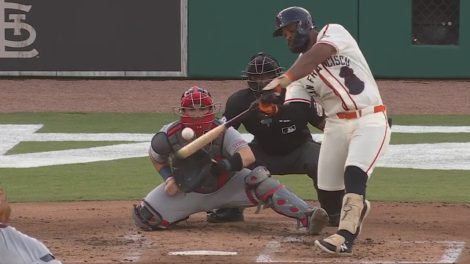
Willie Mays played with Gary Mathews.. Who played with Edgar Martinez.. Who played with Ichiro.. Who played with Tim Beckham.. Who played with Blake Snell.. Who played with Heliot Ramos.. Who homered tonight while playing CF for the Giants… In Willie Mays’ first pro ballpark. Baseball!—Jayson Stark, Hall of Fame baseball writer.

In the first professional baseball park where the late Hall of Famer Willie Mays played as a Birmingham Black Baron, it was illegal until 1963 for white and non-white players to play on the same field. On Thursday, white and non-white players converged for the San Francisco Giants and the St. Louis Cardinals to play an official major league game.

None but the blind or the bigoted pretends racism is eliminated from American life entirely. But the Giants and the Cardinals, playing a game umpired by the Show’s first all-black umpiring crew, managed to keep it outside the gates of a ballpark where Hall of Famer Reggie Jackson played on the first interracial team Rickwood Field hosted.

That was then: Jackson’s parent club, the then-Kansas City Athletics, moved its AA-level minor league team into Birmingham at the insistence of its owner, Charles Finley, a Birmingham native who could be flagrantly wrong about many things but stood on the side of the angels when it came to racism. Jackson remembers only too well.

“I walked into restaurants and they would point at me and say, ‘The n—–s can’t eat here’,” Jackson said aboard the Fox Sports pre-game broadcast.

I would go to a hotel and they’d say, “the n—–s can’t stay here.” We went to Charlie Finley’s country club for a welcome home dinner and they pointed me out with the N-word, “he can’t come in here.” Finley marched the whole team out . . . Finally, they let me in there and he said, ‘We’re going to go eat hamburgers. We’ll go where we’re wanted.’

Coming back here is not easy. The racism when I played here, the difficulty of going through different places where we traveled—fortunately, I had a manager and I had players on the team that helped me through it—but I wouldn’t wish it on anybody.

This is now: The Negro Leagues are recognised formally (and appropriately) as having been major leagues. This year, the known statistics of Negro Leagues players and managers (surely there will be more to exhume, however long it might take) began becoming integrated into major league statistics at last.
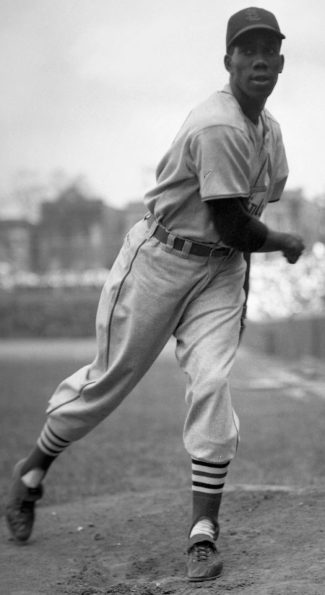
Bill Greason

The Rev. Bill Greason, former Birmingham Black Baron who got to pitch very briefly for the Cardinals in 1954.

Thursday evening, the oldest former Negro Leagues player, pitcher turned minister Bill Greason (99), was escorted to halfway between the mound and the plate by Cardinals coach and former player (and the National League’s 1985 Most Valuable Player) Willie McGee to throw a ceremonial first pitch. To Ron Teasley, Jr., whose father is the second-oldest living former Negro Leaguer.

Greason was six years Willie Mays’s senior when they were Black Barons teammates. “He was a determined young man,” the former pitcher told Ken Rosenthal. “He had the gifts, the talent, and he was sensitive to listening to those who were older than he was. It was a tremendous blessing, and we turned out to be real close. Like brothers.” Just the way Mays would look toward former Newark Eagles star Monte Irvin when Irvin was a third-year Giant and Mays a nervous Giants rookie.

Mays’s number 24 was painted in large white numerals behind the plate. A Giants uniform with his number hung in the Giants’ dugout. The Giants and the Cardinals—wearing the uniforms of, respectively, the San Francisco Sea Lions (West Coast Negro Baseball League, 1946) and the St. Louis Stars (Negro National League, 1920-1931)—wore circular patches on their jerseys with Mays’s surname and number.

Mays’s son, Michael, urged the Rickwood crowd to make some noise for his father before the game. “Birmingham, I’ve been telling y’all,” the younger Mays said, “if there was any way on Earth my father could be here, he would. Well, he’s found another way . . . Let him hear you, he’s listening. Make all the noise you can.” The Wil-lie! Wil-lie! chant just about drowned every other sound out.

Mays had issued a statement Monday saying his health would keep him from attending the game. The following day, he died at 93. America couldn’t decide whether to grieve over yielding Mays to the Elysian Fields or be grateful that he remained among us as long as he did.

“In a sense, Mays was too good for his own good,” wrote George F. Will in tribute.

His athleticism and ebullience—e.g., playing stickball with children in Harlem streets–encouraged the perception of him as man-child effortlessly matched against grown men. He was called a “natural.” Oh? Extraordinary hand-eye coordination is a gift. There is, however, nothing natural about consistently making solid contact with a round bat on a round ball that is moving vertically, and horizontally, and 95 mph. Because Mays made the extraordinary seem routine, his craftsmanship and intelligence were underrated.
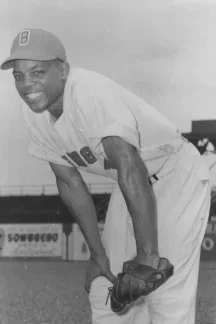
The late Willie Mays, as a young Birmingham Black Baron. (Photo: Birmingham Public Library.)

The arguable greatest position player ever to play major league baseball may have been watching and listening from his Elysian Fields roost on Thursday, but he surely lamented his Giants losing by one run to the Cardinals. Not for lack of trying.

The Athletic‘s irrepressible Hall of Fame writer Jayson Stark couldn’t resist pointing out: “Willie Mays played with Gary Mathews.. Who played with Edgar Martinez.. Who played with Ichiro.. Who played with Tim Beckham.. Who played with Blake Snell.. Who played with Heliot Ramos.. Who homered tonight while playing CF for the Giants… In Willie Mays’ first pro ballpark. Baseball!”

That would be Ramos tying the game at three-all when he took hold of a two-on, one-out, one-strike service from Cardinals starting pitcher Andre Pallante and launched it the other way, over the painted Budweiser ad on the right field fence.

The Cardinals kind of snuck back into the lead an inning later on a sacrifice fly (Nolan Gorman) and a run-scoring (Alec Burleson) wild pitch (from Giants reliever Randy Rodriguez), and padded it to 6-3 in the bottom of the fifth when Brendan Donovan sent home his third run of the game, singling up the pipe to score Burleson. The Giants got two back in the top of the sixth on an RBI single (Wilmer Flores) and a sacrifice fly (Nick Ahmed), but that was the end of the game’s scoring.

The all-black umpiring crew even managed to behave, from Alan Porter behind the plate onward. Perhaps wisely, they confined the otherwise dubious C.B. Bucknor to second base, where he couldn’t possibly commit half the mischief he normally does when he’s assigned to call balls and strikes.

For one evening Rickwood Field became the Show’s oldest park in which to play a game; built originally in 1910, it’s two years older than Fenway Park and four older than Wrigley Field. It also became the place where racism’s ghosts were made unwelcome, even as few, perhaps, beyond the assembled former Negro Leaguers, might have guessed whom its most troublesome ghost might have been.

The once all-white minor league Birmingham Barons, to whose games Mays listened as a youth, had a radio play-by-play announcer from 1932-1936 named Bull Connor, who just so happened to be Birmingham’s commissioner of public safety at the same time. “Pretty good announcer, too,” Mays once remembered of him, “although I think he used to get excited.”

That pretty good announcer eventually ordered fire hoses and attack dogs turned upon student civil rights demonstrators, in 1963, the horror of which helped speed the writing, passage, and acceptance of the 1964 Civil Rights Act. Connor is long gone. So is the legal framework by which Jim Crow wreaked his infamy. But only that.

There remain miles to go yet before racism’s cancer is eradicated entirely from too many hearts and minds, still, who might have remained oblivious Thursday night to what its absence can achieve, even on a baseball team. Thursday was one more round of chemo, but an instructive and endearing one.
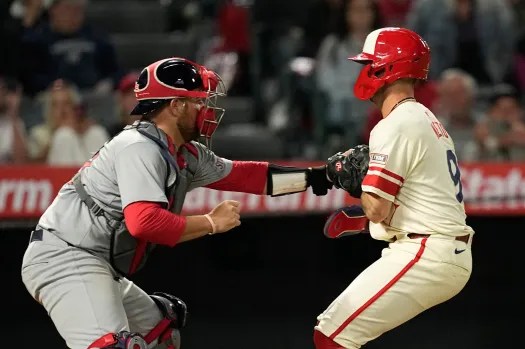
A murder-suicide squeeze?

Pedro Pagés, Zach Neto

Cardinals catcher Pedro Pagés (left) must have pitied Angels shortstop Zach Neto caught cold on the suicide squeeze that wasn’t on Tuesday . . .

Ron Washington must have returned to managing with the idea that the job credentials now require he be in shape enough to throw players under the proverbial bus. Even if it wasn’t their fault his orders couldn’t be executed without at least one fatality.

The Angels manager who called for a bases-loaded suicide squeeze Tuesday had only one thought after Luis Guillorme tried to obey orders on a pitch you’d have required a door for making contact: It was all Guillorme’s fault.

Cardinals reliever JoJo Romero couldn’t find the strike zone with a search party. It took the lefthander a full count to strike the Angels’ eighth-inning leadoff man Jo Adell out. Zach Neto went to a full count before doubling down the right field line, before Romero walked Kyren Paris and Nolan Schanuel to set up the ducks on the pond.

Lefthanded-hitting Guillorme at the plate and Neto on third were given their suicide squeeze orders on a 1-1 count. Romero went into his delivery and Guillorme squared to bunt with Neto charging down the line for home. Except the pitch was well out of Guillorme’s reach, and Neto was a dead man.

Guillorme hadn’t been an Angel for a full week. Washington’s postgame comments must have made him feel as though the nearest available cave wasn’t deep enough for him to hide. “He didn’t do the job,” the manager said. “It wasn’t anything I did wrong. He didn’t do the job. I would have rather went to the ninth inning with a 6-6 lead than gone to the ninth inning the way we did.”

Aside from the brain fart that let Washington speak of a 6-6 lead, he was even more wrong about the erratic Romero: “Wild? He was throwing the ball in the strike zone,” the manager insisted. “Why are you making excuses? He was throwing the ball in the strike zone. (Guillorme) did not get the bunt down. Period.”

I’ve watched the video several times. Romero’s slider went at least two full feet or better outside the zone. Unless Washington thought Guillorme had heretofore untapped diving talent—or looked in the moment like the late behemoth Frank Howard (all 6’7″ and airplane-like arm span of him)—the only way Guillorme might have reached that pitch would have been to throw his bat toward it.

The ball was outside far enough that, even if Guillorme could have gotten the farthest end of his bat on it the ball might have ticked foul, forcing Neto back to third. In that instance, any element of surprise (perhaps the key element in executing a suicide squeeze) would have dissipated likewise. Of course, with the way Romero was throwing Guillorme might have gone from there to draw the game-tying bases-loaded walk, but we’ll never know now.

It’s only fair to say Washington’s intentions were the best. He had lefthander-vs.-lefthander with the bases loaded. He had his man facing a pitcher whose money pitch, a sinkerball, might have been ideal for dropping a suicide squeeze bunt if the pitch came to the plate in the zone. He was trying to avoid a rally-killing, inning-ending double play.

Now it’s even money who was further out of the zone, Romero and his pitches or Washington and his vision. All that’s left to determine is whether Washington turned the play into baseball’s first known murder-suicide squeeze.

With Neto heading home full speed ahead, any thought of Guillorme laying off the pitch was futile. Cardinals catcher Pedro Pagés had set up for a pitch toward the outside corner and was thus in decent position to snare a ball going as far out of the zone as Romero’s pitch went. He had only to hop up to his left and lay his mitt in front of the ball to take it. It looked almost as though Pagés pitied Neto when he stopped the Angels shortstop cold with the sorry-about-that tag.

Four pitches later—you guessed it, another Romero full count—Guillorme struck out swinging to finish the rally killing. The veteran the Angels picked up in a trade with the Braves earlier this month still took one for his manager after the Cardinals banked the 7-6 win. “He made a good pitch. What else can you say?” Guillorme said of Romero. “I tried to get the bat on it. But he made a good pitch.”

It was made good only because Guillorme tried to reach the unreachable. In further fairness it was only the exclamation point on a day when the Angels were as attractive in the field as ten head of cattle with mad cow disease.

Second inning: Angels starting pitcher Reid Detmers wild-pitched Cardinals right fielder Dylan Carson home, before third baseman Cole Tucker threw home wildly off a ground ball, enabling Cardinals second basman Nolan Gorman to score.

Third inning: Detmers let Cardinals first baseman Paul Goldschmidt and designated hitter Alec Burleson pull off a double steal with Carson at the plate. The pair of them had one stolen base between them all year until then and weren’t exactly road runners to begin with. Detmers ended up walking Carson and striking Gorman out, but then he fed Pagés a meatball good enough for Pagés to bag his first major league hit—a three-run double.

The Angels fought their way back, somehow, especially when their catcher Logan O’Hoppe blasted Cardinals starter Sonny Gray for a three-run homer in the fourth and left fielder Taylor Ward send Schanuel home with a sacrifice fly in the fifth. Burleson wrecked the five-all tie with a two-run homer off Angels reliever Amir Garrett in the top of the seventh, but Kevin Pillar—he whom the Angels picked up at the junkyard after Mike Trout went down with his knee injury—pulled the Angels back to within a run with a two-out RBI single.

That set up the 7-6 score Washington wanted Guillorme to close back up with the suicide squeeze. The one Guillorme couldn’t execute on a pitch impossible to reach. The one that prompted Washington to throw Guillorme so far under the proverbial bus he might actually have passed below another bus behind it before coming to a skidding stop.

Whitey Herzog, RIP: The Rat that roared

Whitey Herzog

The White Rat on the Cardinals’ bridge. Winning three pennants and a World Series before a later, lackluster edition prompted him to walk.

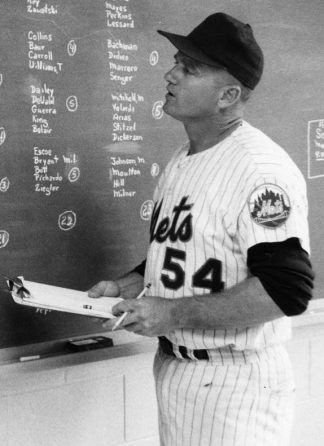
It’s forgotten often enough, but Whitey Herzog was supposed to be the man who succeeded Gil Hodges on the Mets’ bridge if that time should have come. It came when Hodges died of a heart attack during spring training 1972. But the White Rat ran afoul of the Mets’ patrician chairman of the board M. Donald Grant well before that.

Herzog, who died Monday at 92, ran the Mets’ player development after one season as the Mets’ rather animated third base coach (1966)  and one managing in the Florida Instructional League (1967). He was  part of bringing the Mets such talent as pitchers Gary Gentry and Jon Matlack, first baseman John Milner, third baseman Wayne Garrett, and outfielders Amos Otis and Ken Singleton.

But his role in the first try at bringing eventual Miracle Met outfield acrobat Tommie Agee to the Mets from the White Sox got Herzog in big trouble with Grant. Then-Mets general manager Bing Devine, who’d hired Herzog in the first place, led a Mets contingent to the 1967-68 winter meetings and cobbled a deal to get Agee in exchange for veteran outfielder Tommy Davis and a decent but not spectacular relief pitcher named Don Shaw.

Shaw posted a 2.98 ERA and a respectable 3.44 fielding-independent pitching rate in forty 1967 appearances. The Mets had a crowded bullpen then, and Shaw was attractive to other teams including the White Sox, though. The Mets wanted Agee in the proverbial worst way possible. For reasons lost to time, Shaw was also one of Grant’s particular pets.

“Gil Hodges wanted him,” Herzog would remember. “Bing, [personnel director] Bob Sheffing, and I all wanted him, and we had the deal set.”

But Bing said we’d have to wait until Grant flew in to approve it.

The deal leaked to the papers, and when Grant hit town, he was furious. “How could you think about trading my Donnie Shaw?” he asked.

And he killed the deal. We eventually got Agee anyway [for Davis, pitchers Jack Fisher and Billy Wynne, and catcher Buddy Booker], but Grant’s decision cost us a good man—Bing Devine. ‘I don’t really believe they need a general manager around here,’ he told me.

And he went back to the Cardinals.

It wasn’t the last time the White Rat dealt with the kind of team lord who meddled without knowledge aforethought. Snubbed by the Mets upon Hodges’ death (they named Hall of Famer Yogi Berra to succeed Hodges, instead), Herzog took his first managing gig with the Rangers for 1973.

Owner Bob Short promised Herzog that high school pitching phenom David Clyde would be allowed to go to the minors for proper further development after two major league starts to goose the hapless Rangers’ home gate. Clyde did pitch well in those first two starts. Then Short reneged on his promise.

“You could have renamed the owner Short Term for the way his mind worked,” Herzog remembered in his memoir, You’re Missin’ a Great Game. When I had the pleasure of interviewing Clyde a few years ago, I asked him whether Herzog was the only man in the Rangers’ organisation who wanted to do right by him.

“As far as I know,” replied Clyde, the lefthander who now fights for pension justice for over 500 pre-1980, short-career major leaguers frozen out of the 1980 pension realignment, “that’s the absolute truth.”

Herzog didn’t survive 1973 in Texas; he was cooked the moment Billy Martin was fired by the Tigers that August and Short could snap him up post haste. The White Rat was brought aboard in Kansas City in 1975, after managing the Angels a year, and he managed the Royals to three straight postseasons in a five-year tenure. In each one, the Yankees thwarted his Royals.

Then he ran afoul of Royals owner, Ewing Kauffman and GM Joe Burke, with whom he’d also tangled in Texas. He despaired of trying to build the kind of bullpen that would help him get past the American League Championship Series, and he despaired equally of trying to convince the Royals brass that he knew what he was talking about when he advised them  several key players now had drug issues.

The Royals faced the problem by shooting the messenger. It cost them in nasty headlines and four players (outfielders Willie Mays Aikens, Jerry Martin, and Willie Wilson; pitcher Vida Blue) behind bars after the 1983 season.

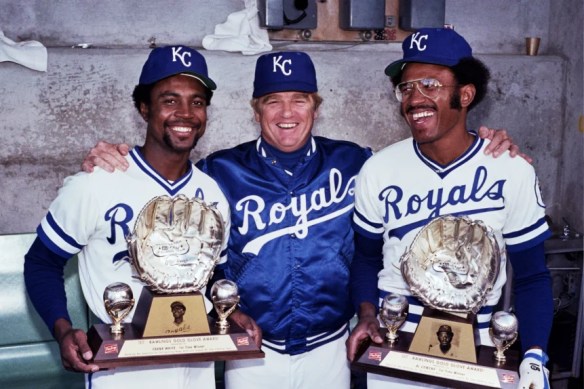
Whitey Herzog, Frank White, Al Cowens

Herzog with two of his Gold Glove-winning Royals, second baseman Frank White and outfielder Al Cowens. The Royals rewarded the Rat’s warnings of drug problems on the team with a firing squad and paid an embarrassing price a few years later.

In the interim, Cardinals owner Gussie Busch hired Herzog to manage them. Herzog told Busch bluntly his team needed a near-complete overhaul. So Busch put his money where Herzog’s mouth and mind were and named him the GM in addition to being the field skipper.

Herzog overhauled those Cardinals into three-time pennant winners with a 1982 World Series title in the bargain. He also savoured his relationship with Busch, who gave him free reign to visit any time to talk business. (“Draw me up a Michelob, Chief,” the White Rat often hailed Busch on the phone before his visits, “I’m coming up.”)

He rebuilt the Cardinals into a team suited ideally for old Busch Stadium’s canyon dimensions and pool table playing field, for fast grounders, line drivers, swift runners, defensive acrobats (especially Hall of Fame shortstop Ozzie Smith), and maybe one or two power swingers (a George Hendrick here, a Jack [the Ripper] Clark there) to drive them home. And, for control pitchers who knew how to pitch to the ballpark. Just the way he did in Kansas City.

His pitching management was especially effective with his bullpens. Unlike most managers, Herzog paid attention to what was done in the bullpen as well as on the game mound. He knew what others didn’t: relievers throw voluminously enough getting ready to come in. If he warmed a reliever up without bringing him into the game, he gave the man the rest of the day or night off.

The White Rat (so nicknamed because the Yankees thought his hair resembled that of a former Yankee pitcher with the same nickname, unlikely 1951-52 World Series hero Bob Kuzava) was a marriage of old-school tenacity and newer-school depth, though people often forgot the latter while worshipping the former. He told things the way he saw them, charming many and outraging about as many.

He disliked interleague play and the expanded postseason, believing (correctly) that the former was fraudulent and the latter penalised the best teams even if one of them should end up with the final triumph. He also stood well ahead of the pack when—after the Don Denkinger blown call on the play at first in the bottom of the ninth, Game Six, 1985 World Series—he began calling for postseason instant replay. Denkinger himself came out for replay as well, soon enough. Would Herzog have come out in favour of Robby the Umpbot?

“What they’re fighting about,” he wrote about the Missourians who could still see photos of the fateful play in bars and restaurants for years to follow, “is as old as the game: What’s more important, getting it correct, or following the idea that the ump’s always right, no matter how far his head’s gone up his ass?” (Angel Hernandez, call your office.)

Herzog eventually forgave Denkinger, sort of: at a dinner honouring the 1985 Cardinals, team members were presented new Seiko wristwatches . . . and Herzog himself presented Denkinger one in Braille.

Whitey Herzog

A marginal player on the field, Herzog turned what he learned early from Yankee manager Casey Stengel into a Hall of Fame path that started as a Mets third base coach and, after a year, director of player development.

He didn’t flinch when handed players described most politely as “eccentric”; he embraced them. He treated one and all the same whether praising them or telling them off. He rejected officially what he called the “buddy-buddy” relationship between manager and player(s), but he’d still take a player or three out fishing to help them get their minds clear when struggling for spells.

“I tend to like my players,” he wrote in You’re Missin’ a Great Game. “As long as they knew who was boss, as long as they respected my knowledge of the game when I put the uniform on, I didn’t see any reason not to bring my personality into the situation. It’s one of my resources; why shouldn’t I use it?

“Herzog had only four rules,” wrote Thomas Boswell, when Herzog walked away from the Cardinals in July 1990. “Be on time. Bust your butt. Play smart. And have some laughs while you’re at it.”

Only when those Cardinals stopped half or more of the above did Herzog do the unthinkable. In the same piece, Boswell led with, “They say you can’t fire the whole team, so you have to fire the manager. Nobody told Whitey Herzog.”

On Friday, he fired his team.

Technically, Herzog resigned. But it amounted to the same thing.

The White Rat got sick and tired of watching the St. Louis Cardinals play baseball in a way that offended his sensibilities and injured his enormous pride, so he quit—with a flourish of dignified self-recimination worthy of a disgraced British prime minister.

“I’m totally embarrassed by the way we’ve played. We’ve underachieved. I just can’t get the team to play,” said Herzog. “Anybody can do a better job than me . . . I am the manager and I take full responsibility.”

Translation: They quit on me. So I’m quitting on them. Get me a new team.

Herzog would get a new team when the Angels hired him to examine their farm system up and down. Herzog discovered the Angel system had plenty of good and the parent club needed only a little pitching fortification while letting that good young talent make its way to Anaheim. Then, after winning a power struggle with another Angel exec, Herzog himself took a hike.

“He was the one who gave us a chance to do anything with guys like Tim Salmon and Jim Edmonds and Garret Anderson,” said successor Bill Bavasi. “The attitude before Whitey came in was that those guys weren’t good enough, that we didn’t have any good young players in the system, but Whitey said, ‘Yes you do, leave ’em alone.’ I’ll always be grateful for that and the fact he was willing to share everything he knows.”

When he turned 90, the White Rat talked to St. Louis Post-Dispatch writer Rick Hummel  and trained fire at commissioner Rob Manfred’s game-shortening lab experiments. He might have neglected the broadcast commercials that are at the core of baseball’s lengthening games, but he had most of everything else he mentioned right.

He keeps talking about the three-batter rule for [relief] pitchers. Stupid. And then the tenth inning rule [the free cookie on second to open each extra half-inning]. Stupid. Seven-inning doubleheaders. Stupid. None of that is going to shorten the games at all, until we can lower the amount of pitches that they throw.

Baseball has probably had enough prophets without honour to stock an entire organisation. Herzog’s a prophet with honour but it’s almost as though electing him to the Hall of Fame was a way of saying, “Congrats, Rat, now go back to your fishing boats and shut the hell up.”

He’ll enjoy the afterlife of the just in the Elysian Fields, fishing happily when never failing to miss a great game. It’s we remaining on this island earth who’ll miss the White Rat among us, watching our game, fuming over its self-destructions, but still loving its pleasures, its teachings, its remaining tamper-proof fineries.

How to avenge an unwarranted plunk

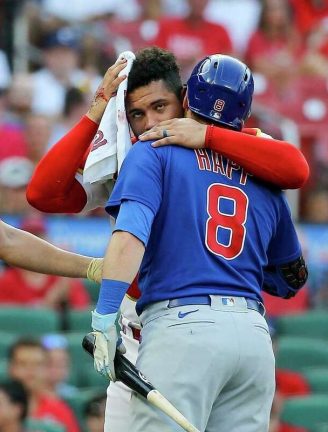
Willson Contreras, Ian Happ

Contreras and Happ embracing, after Happ’s backswing caught Contreras on the coconut, quite accidentally—which didn’t stop Cardinals starter Mike Mikolas from buzzing, then drilling Happ in wrongful retaliation Thursday.

Memo to: St. Louis Cardinals. Subject: The Backswing Bop.

Dear Cardinals: We don’t care how long, how deep, and how bristling is your ages-old rivalry with the Cubs. Nobody checks in at the plate looking to conk a catcher on the coconut with a backswing, no matter what kind of swing he has, long, short, whatever. And, no matter that the catcher is set up so far inside for an inside pitch that he might have been lucky if his head didn’t meet the batter’s lumber.

P.S. When your conked catcher and the batter in question—who happen to be former Cub teammates— hug on the catcher’s way off the field, right then and there you should take it to mean peace, and let’s play ball.

You do not want your starting pitcher taking the perverted law into his own hands going back to work by buzzing that batter upstairs before planting one squarely on his backside. Not if you want to keep your pitcher in there instead of seeing him thrown out of the game, turning things over to an unprepared bullpen that’s liable to get pried, pricked, pounded, and poked for ten runs over the eight and a third innings to come.

Unfortunately, that’s exactly what happened after Cardinals starter Miles Mikolas threw one up and in to Cubs left fielder Ian Happ, in the top of the first, making the count 3-1, before drilling Happ squarely in the top of his right rump roast on the next pitch. There were actually two things wrong with that drill.

Thing one: Mikoas was dead wrong to even think about sending “messages” to Happ and the Cubs at all. Happ wasn’t even close to trying with malice aforethought to catch Willson Contreras on the cranium with his backswing. Their hug as a cut and bleeding Contreras left the game told each other, I didn’t mean to hit you, dude. I know, dude. We’re good.

Thing two: Doing it with two out and resurgent Cody Bellinger on deck was an invitation to potential trouble of the kind having nothing to with machismo retaliation and everything to do with the scoreboard kind. The only kind the Cubs were willing to pursue.

It was also liable to produce exactly what it did produce immediately, Mikolas getting tossed from the game. To the none-too-subtle outrage of the Cardinals’ broadcast team who seem to believe accidents deserve assassination attempts in reply. Come on! You gotta be kidding me! You have got to be kidding me! Have a little feel for baseball. Have a little feel for the game. That’s awful.

What’s awful is a pitcher not seeing his catcher’s injury was unintentional and throwing twice straight at the batter, the second one hitting him. No “feel for the game” justifies throwing at a batter over a pure accident. What did Mikolas expect for playing that kind of enforcer? The Medal of Honour?

“[The umpires] had a meeting and decided to toss me,” a seemingly unrepentant Mikolas said postgame. “The umpires can believe what they want to believe. That was their choice. They believed there was intent there and that’s all umpires need.”

One pitch a little too far up and in, followed by the next pitch bounding off Happ’s posterior, was rather convincing evidence. So, exit Mikolas (and Cardinals manager Oliver Marmol); enter Dakota Hudson, who wasn’t going to get a lot of time to heat up because Mikolas didn’t leave the game on account of being injured.

Hudson promptly surrendered a base hit to Bellinger and walked Cubs right fielder Seiya Suzuki on five pitches before walking shortstop Dansby Swanson with the bases loaded and surrendering a ground-rule, two-run double to designated hitter Christopher Morel, before Cubs catcher Yan Gomes grounded out for the side.

The Cubs extorted three more runs out of Hudson before his day’s work was done, on a pair of third-inning RBI singles and a run-scoring fourth-inning forceout. Hudson’s relief, Andrew Suarez, was greeted rudely when Cubs center fielder Mike Tauchman planted a 2-2 fastball over the center field fence opening the top of the sixth, before a pair of one-out walks in the top of the seventh paved the way for Gomes to slash a two-run double.

During all that, the Cardinals had nothing much to say other than Contreras’s successor, Andrew Knizner, hitting Cubs starter Justin Steele’s first offering of the bottom of the fourth into the left field seats. Not until Knizner batted in the eighth with one out and Cardinals first base insertion Alec Burleson on second (leadoff double) and hit another one into those seats.

It made Knizner the first catcher to enter a game off the bench instead of in the starting lineup and hit a pair over the fences since . . . Cubs manager David Ross, as a Brave on 14 June 2009. “You don’t have much time get ready,” Knizner said postgame. “You just trust your instincts.”

The Cubs said, well, we’ll just see about that in the top of the ninth. Especially after late catching insertion Miguel Amayo was hit by a pitch before being forced at second to set up first and third, from which point Tauchman beat an infield hit out enabling Morel to score the tenth Cub run.

The 10-3 score held up, bringing the Cubs back to .500. They’d sent their own message back to the Cardinals. You want to drill one of ours because of an accidental shot in the head, we’re going to drill you the right way—with hits and runs.

Not even Mikolas (and, apparently, possibly-departing Cardinals pitcher Jack Flaherty) appearing to invite them to come out of their dugout for, ahem, a little chat, could sway them into anything but answering on the field, at the plate, on the mound.

Contreras’s wound was closed with special glue. “I feel good and I want to make sure I’m ready to go tomorrow,” he told reporters. “I wanted to stay in. It was bleeding really bad. It was bad for me because I wanted to stay in there.” Officially, he’s listed day-to-day at this writing.

Having now won eight of their last nine games, the suddenly-hot Cubs have not been without their problems thus far this season. Going back to nursery school with a willfully juvenile opposing pitcher wasn’t one of them.

On Freese and perspective

David Freese

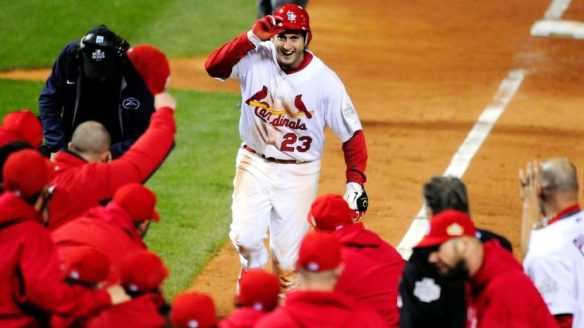
David Freese comes down the third base line after sending the 2011 World Series to a seventh game with a leadoff blast in the Game Six bottom of the eleventh.

If there’s one sub-pastime that animates baseball faithful almost as much as the game itself, it’s arguing. Especially about who belongs in the national Hall of Fame, and who doesn’t. Now you’re about to ponder a twist you probably never thought you’d have to consider.

You may never hear of any Hall of Famer declining the honour because he felt honestly that his career really didn’t justify it. But now there’s David Freese, the biggest of the big from the 2011 World Series, who’s turning down his election to the Cardinals’ team Hall of Fame because he feels his career doesn’t justify it.

The Cardinals aren’t the only team whose greatest moments were often written by others than their national Hall of Fame legends. But I’d be willing to bet they’re the only one who’ve just had one of those authors turn their own team Hall of Fame down. If I’m wrong, I’d be glad to know whom else.

This is a team who’s had enough big moments to stock a warehouse. Including, but not limited to, Hall of Famer Grover Cleveland Alexander (who was or wasn’t hung over) fanning Hall of Famer Tony Lazzeri with the bases loaded in the 1926 World Series, an inning before the Redbirds threw Babe Ruth out stealing to end it—with Hall of Famer Lou Gehrig on deck while Bob Meusel was at the plate.

There was Hall of Famer Enos Slaughter’s mad dash home in the 1946 World Series. There was Hall of Famer Bob Gibson’s perseverance in Game Seven of the 1964 World Series, then busting Hall of Famer Sandy Koufax’s single Series game strikeout record in 1968. There was Jack (The Ripper) Clark’s monstrous three-run homer to snatch a pennant from the Dodgers who were an out away from forcing a seventh 1985 National League Championship Series game.

There was Hall of Famer-in-waiting Albert Pujols’s glandular home run off Brad Lidge that only staved off the Cardinals’ elimination in the 2005 NLCS; and, his three bombs in 2011 World Series Game Three—starting in the sixth inning, finishing in a kind of reverse cycle. (A three-run shot, a two-run shot, and a solo shot.)

And, almost superceding the entire foregoing, Freese in Game Six of that Series. You had to have some kind of mojo working to supercede all that. Freese had it that night. When he hit a game-tying, opposite-field triple with the Cardinals down to their final strike in the ninth; then—in the bottom of the eleventh—sent the Series to a seventh game (which his team also won) by hitting a full-count, leadoff homer straight over the center field fence.

It added the World Series MVP to a trophy case that already included Freese’s being named the 2011 NLCS MVP as well. He’d done bloody well splendid for a kid who’d grown up a Cardinals fan, gave up on the game before college, but took it up again to become the Padre for whom the Cardinals traded aged Jim Edmonds only because they needed a third baseman with a little pop in their minor league system.

Then he earned the starting 2011 third base job, missed time early when hit on the hand by a pitch, and returned to play out the season with a Cardinals team that more or less backed into the postseason when the Braves collapsed as the Cardinals managed to reheat just enough.

“[S]ure, he might trade his career for a Hall of Fame career, but then again he might not,” wrote The Athletic‘s Joe Posnanski in 2020, recounting his own sixty top baseball moments. “There are 270 players in the Baseball Hall of Fame. There is only one player who grew up in St. Louis and got to live the dream again and again for the team he grew up loving. I suspect David Freese is pretty happy with how it turned out.”

Freese’s happiness has been won hard enough. He’s spent a lifetime battling clinical depression, including a lapse into alcoholism as a way to battle it. He kept quiet about that battle until well after he’d left the Cardinals: he didn’t take it to the public until eight months after he married Mairin O’Leary and—after two seasons as an Angel—had become a Pirate.

David and Mairin Freese

Freese with his wife, Mairin. They met and married after he left St. Louis and began putting his inner burdens—including the outsized weight of the hometown sports hero—in their proper places.

“It’s been fifteen-plus years of, ‘I can’t believe I’m still here’,” Freese told USA Today‘s Bob Nightengale then. “You win the World Series in your hometown, and you become this guy in a city that loves Cardinal baseball, and sometimes it’s the last guy you want to be. So you start building this façade, trying to be something I was not. And the whole time, I was scared to death what was going to happen to me after baseball.

” . . . Who knows where I was headed, but as long as I was here, I had so many friends here, I wasn’t good at just saying no. I wanted to please people, make everyone happy, and that became impossible.”

He came to his hard-earned inner peace only after the Cardinals traded him away. (Then-manager Mike Matheny told him candidly it might be the only way he could begin remaking himself.) He had one or two more moments in the postseason sun, as a Dodger in 2018. He hit a pair of leadoff bombs—in Game Six of that NLCS and in Game Five of a World Series the Dodgers lost in five to a Boston Rogue Sox team of replay room reconnassance rapscallions.

Then, he retired after the 2019 season. Long after he’d begun enjoying life outside baseball, including learning the piano and becoming an avid traveler with his wife and two young sons. “Freese no longer saw his stupefying 2011 postseason as a cross to bear from behind the wall of depression,” I wrote in 2020.

He looked forward to taking his . . . son to a live Cardinals game in due course. Not to mention showing the little boy what Daddy delivered in Game Six. And all that postseason, including a still-record fifty total bases and 21 runs batted in.

. . . The guy who made St. Louis baseball the happiest place on earth in 2011 fought hard enough to get to happiness with how his baseball legacy turned out in the first place.

That’s the guy who took an honest look at his career and, still at peace and happiness with how it turned out, decided he was honoured that Cardinal fans voted him into the team’s Hall of Fame but that they gave the honour to the wrong player.

Lots of not-so-greats have come up bigger than their own selves in baseball’s biggest hours. Such men as Al Gionfriddo, Dusty Rhodes, Don Larsen, Moe Drabowsky, Al Weis, Donn Clendenon, Gene Tenace, Brian Doyle, Bucky [Bleeping] Dent, Dave Henderson, Mickey Hatcher, Sid Bream, Mark Lemke, Tony Womack, Edgar Renteria, Scott Spiezio, David Eckstein, Steve Pearce.

They don’t all get the chance to prove publicly that they were better men than their isolated moments at the top of baseball’s heap. This weekend, Freese struck a big blow for putting a brief spell of baseball greatness into the kind of perspective that comes only from a man who made himself greater than his signature professional achievement.