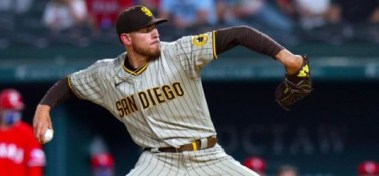
“Some no-hitters are simply games that go your way”

Tyler Gilbert

Tyler Gilbert gets the congratulatory Gatorade shower . . . that he should have given his teammates, instead.

Tyler Gilbert had a night to remember Saturday, all right. He became only the fourth pitcher in National/American League/American Association history to pitch a no-hitter in his first major league starting assignment.

The company Gilbert joins includes Theodore Breitenstein (1891 St. Louis Browns, AA; the league folded at season’s end), Bumpus Jones (1892 Reds; he surrendered one run in a game in which he walked four), and Bobo Holloman. (1951 Browns, AL, and not the same franchise as the 1891 Browns.)

It took 62 years between Jones and Holloman, then 68 years between Holloman and Gilbert. Pitching a no-hitter is tough enough as it is. Pitching one in your first big-league start seems somewhere between finding the pillar of salt known as Lot’s wife and swimming the full Pacific solo. Right?

“Some no-hitters are pure dominance,” writes ESPN’s David Schoenfield, “and some are simply games that go your way and you get your name in the record books alongside two guys named Bumpus and Bobo.”

Let’s be real. On Saturday night, Gilbert had a game that went his way to get his name in the record books next to a couple of guys named Bumpus and Bobo. I’m not going to say Gilbert did bupkis to leave the Padres with bupkis, but he had more than a little help from his friends.

(He also had a lot of un-premeditated help from the Padres: Fernando Tatis, Jr. was still a day from leaving the injured list where that shoulder dislocation landed him. Gilbert didn’t even have to think about the biggest stick in the Padres’ lumberyard.)

Considering he was responsible for 23 percent of the outs directly, Gilbert had a lot of help from his friends. He faced 28 batters, struck five batters out, but walked three of them, the direct opposite of Holloman’s direct game performance. “[The Padres] a couple hard-hit balls, but I was glad somebody was there to catch them,” Gilbert admitted post-game.

A couple? Gilbert’s fielders took care of 77 percent of the outs (nine ground outs including a pair of double plays; thirteen fly outs); Holloman walked five, struck out three, and his fielders were responsible for 85 percent of the outs. (Twelve ground outs, eleven fly outs.)

And, since this was a National League game, with no designated hitter in the Diamondbacks lineup, Gilbert had to make four plate appearances in the game. He grounded out to the hole at shortstop once, struck out once, and dropped a pair of sacrifice bunts.

The first bunt set up second and third to be followed by a walk and an inning-ending double play. The second pushed Nick Ahmed to third after Ahmed opened the inning with a double. Ahmed scored the seventh Arizona run in due course on a long single down the left field line. That’s one wasted out, one push of a man to third to come home on a long single, and thus direct responsibility for a quarter of a run.

The Snakes did the bulk of their scoring early enough and often enough with a five-run first: an RBI double (Ketel Marte); an RBI single (David Peralta); and, a three-run homer (Drew Ellis). They added the sixth run with a leadoff single (Pavin Smith) and an immediate RBI triple (Josh Rojas) in the fifth.

All on the dollar of Joe Musgrove, who became the twelfth pitcher in Show history to pitch a no-hitter and have a no-hitter against him in the same season. Musgrove’s in pretty intriguing company himself that way—three of those twelve pitchers (Pud Galvin, 1880; Bob Feller, 1951; Juan Marichal, 1963) are Hall of Famers.

But are you really going to call a pitcher who takes care of only 23 percent of the other guys’ outs and does nothing other than a sacrifice bunt that pushed a runner to third base the guy most responsible for the triumph?

“For all of the consternation about the deluge of no-hitters in 2021,” wrote ESPN’S Jeff Passan after Corey Kluber nailed the season’s sixth no-hitter in late May, “the act itself—recording 27 outs without allowing a single hit—remains a miracle.”

In Gilbert’s case, just as in Holloman’s case, it also remains a testament to the efficiency of his defense and the evening potency of the Diamondbacks lineup. Kluber, Musgrove, Carlos Rodon, John Means, Wade Miley, and Spencer Turnbull did more to earn their no-hitters earlier this year than Gilbert did.

I recorded that after Kluber’s no-no, in May, but it’s worth seeing again, adding Gilbert for the full context. I include the fielding-independent pitching rates of each of those pitchers at the time they threw their no-hitters, indicating whom among them was the most likely to turn the trick. I also assign a Win Factor based on their strikeouts divided by the sum of the ground and fly outs in the game. Here they are:

Pitcher Game Score K GO FO WF FIP
Joe Musgrove 3-0 10 10 7 .588 2.88
Carlos Rodon 8-0 7 10 10 .350 1.91
John Means 6-0 12 3 12 .800 3.25
Wade Miley 3-0 8 15 5 .400 3.24
Spencer Turnbull 5-0 9 12 6 .500 2.77
Corey Kluber 2-0 9 9 9 .500 3.57
Tyler Gilbert 7-0 5 9 13 .227 2.79

Gilbert had the least direct responsibility for his no-hit performance among the seven, while Means had the most with Musgrove the second-most. Gilbert by FIP was more likely to pitch a no-hitter than four among the seven but less likely to do it than Rodon and Turnbull. On the other hand, Means lived almost as dangerously as Gilbert with those twelve fly outs in his game.

There are no game logs available to analyse Theodore Breitenstein’s and Bumpus Jones’s no-hitters, but we do have one to analyse Bobo Holloman’s. His yields a .125 win factor—three strikeouts, as noted earlier, but the Browns managed to divide the field labour evenly otherwise: twelve ground outs and twelve fly outs. Holloman’s 4.57 FIP also made him the least likely of any of the four rooks to throw a no-hitter in his first Show start. By far.

Gilbert on earth and Holloman in the Elysian Fields can still take heart that they did at least something on their own to produce no-hitters. They didn’t pitch no-nos in which they did nothing to earn them.

Ken Holtzman did, once, in 1969. Four years to the day after Cincinnati legend Jim Maloney’s oddity (a no-hitter with eleven strikeouts and ten walks), Holtzman’s Cubs beat the Braves, 3-0 . . . with Holtzman striking nobody out, walking three, and needing twelve ground outs and fifteen fly outs to get out alive, never mind with no hits against him.

Essentially, Holtzman did nothing direct to contribute to that win. (He didn’t even do anything at the plate to, ahem, pitch in, either: he went 0-for-3 with a pop fly out to the infield and a pair of ground outs.) But Holtzman took the headlines regardless, and his teammates congratulated him heartily when it should have been the other way around.

Congratulate Gilbert regardless. But once the ball left his hand and those bats, the job was out of his hands entirely. Gilbert should also thank God his fielders knew what they were doing out there to do the most at keeping the Padres off the bases.

There’s only one thing more weird than declaring a pitcher a “winner” in a game where he had little enough to do with his team’s scoring and the other guys’ lack of it. That’s declaring him a “loser” when a) he wasn’t responsible for his team’s lack of scoring; b) he didn’t throw the fat pitch that turned into a game-losing hit; c) he wasn’t in the game when the guy who reached base against him scored what proved the winning run; or, d) or his defense could have been tried by jury for criminal neglect in the field.

But there’s Gilbert with a no-hitter and a win on his record. A no-hitter and a win for which he did only 23 percent of the work needed to deliver without factoring his team’s batting on the night. A win toward which he contributed—without scoring or driving it in—to one fourth (it takes four bases to make a run, remember?) of fourteen percent of his team’s seven runs on the night when he showed up at the plate.

If that’s a “winner,” I’m the headless man in the topless bar.

Clean, legal, case closed

Manny Machado, Tommy Edman

Machado (left) checks on Edman after the Sunday drop slide that blew enough social media up Monday.

Manny Machado isn’t now and never has been a controversy-free baseball player. He’s one of those players who can trigger an uproar  without doing or saying a thing. Sometimes all he has to do is smile.

But it isn’t every day that a man to whom controversy seems as natural as playing third base kicks up a little storm for doing the right thing. Especially when it’s something fundamental he was taught very early in his career.

On Sunday, the Padres’s third baseman reached base in the fourth inning, when the Cardinals’ own third baseman Nolan Arenado committed a very rare (for him) throwing error. Then, Machado ran toward second on a Jake Cronenworth ground ball to Cardinals second baseman Tommy Edman.

Edman fielded the ball cleanly while still a few steps behind the proper basepath. Then he stepped into Machado’s path with thoughts about starting a double play. He got the force tag on Machado. At that moment, Machado dropped into an almost excuse-me, soft slide that still upended Edman to keep him from throwing the none-too-fast Cronenworth out at first.

You couldn’t blame Edman for looking about as thrilled as a dental patient after he recovered from the upending. But the first thing Machado did immediately after the slide was move to see whether Edman was injured on the play. (He wasn’t.)

Whether Machado went rogue yet again ran over social media and enough of the sports press well into Monday. That was after Cardinals starting pitcher Kwang Hyun Kim told reporters he thought Machado should have been called for interference, which would have made Cronenworth out at first. Kim also seemed surprised Cardinals manager Mike Schildt didn’t argue for a review to get the call.

It wouldn’t have done Schildt any good if he’d tried, and he probably knew it. The written rules give the baserunner the right of way on the proper basepath, and you can watch the play fifty times from fifty angles and see nothing indicating Machado interfered with Edman fielding the ball in the first place.

Machado was well prepared to execute such a play. His long-enough-time Orioles manager Buck Showalter taught him the play. “I’m still trying to figure out what the story is,” Showalter told The Athletic‘s Dennis Lin.

Showalter told Lin the play was routine business in the Yankee system from his years managing in that system and finally the Yankees themselves. If the runner executes the drop-slide, it breaks up double plays no matter how far you get caught before second base and with little damage otherwise. Showalter indicated to Lin that not only were players taught how to do it running the bases but infielders were taught to be prepared for such drop-slides.

“The first thing I did,” Padres manager Jayce Tingler told Lin, “was I gave him a high-five. I thought it was a play, honestly, that won the game.”

The Padres entered the bottom of the fourth in the hole 2-0. Machado’s reach on the Arenado error led the inning off. After the force out during which Machado kept Edman from turning the double play, Kim walked Tommy Pham and surrendered a bases-loading line single up the middle to Austin Nola—before walking two runs home back-to-back enabling the Padres to tie the game.

Genesis Cabrera relieved Kim and surrendered a sacrifice fly (Patrick Kivlehan) and an RBI single (Ivan Castillo) back to back before catching Trent Grisham looking at strike three for the side. The Cardinals got a run back when Paul Goldschmidt scored as Yadier Molina dialed Area Code 4-6-3 in the top of the sixth, but Grisham made the game 5-3 with a two-out RBI double in the bottom of the inning. The Padres bullpen made sure the game finished with that score.

Tingler may well have been right. Machado’s slide as Edman crossed right into his proper basepath just might have won the game for the Padres, or at least set up their best chance to win.

Kim had more or less cruised through the first three innings, shaking off only a two-out base hit in the third while otherwise striking out the side. If he was staggered by the Machado slide enough that he couldn’t believe his manager didn’t demand a review and an interference call, on a play for which no interference and no foul play was involved at all, maybe the Padres pounced from there on a pitcher who just might have taken himself out of of his own concentration zone.

Showalter asked aloud whether Machado gave the Padres the best chance to win, and whether it was a clean play? Then, he answered his own question. “Of course it did,” he told Lin. “Outs are precious, and the game, as much as home runs seem to be there, it’s still about ninety-foot increments—who can keep the other team from getting ninety feet and who can gain ninety feet by something offensively. It should be embraced. It’s a great, thinking man’s baseball play.”

According to Lin, Machado’s former Oriole teammate Adam Jones called the play a legal and intelligent play. Also according to Lin, Jones’s comment got a resounding agreement from an old shortstop-turned-coach-and-manager—a fellow named Larry Bowa, who wasn’t exactly renowned for subtlety or gentility as a player or a leader.

The old Bowa might even have thought Machado’s comparatively dainty slide showed Edman a little too much mercy. Compared to Bowa in his time, the typical hard-nosed player often resembled a marshmallow stick figure.

Machado has faced accusations of dirty play in the past. Even if Tingler himself says it’s become a tired narrative. But Sunday’s play reminded too many fans of the play they think destroyed Red Sox second baseman Dustin Pedroia’s career back in 2017, the takeout slide at second that injured Pedroia at the back of his left knee. What they don’t remember is that that by itself didn’t put paid to Pedroia’s career.

The tenacious second baseman actually—and perhaps foolishly—managed to gut 105 games out in all 2017 and finished with a .369 on-base percentage plus six defensive runs saved above his league average at second base. But he could play only three games in 2018 and six in 2019, before sitting 2020’s pan-damn-ically mandate irregular season out and retiring three months ago.

“It’s funny,” Pedroia told NBC Sports Boston’s John Tomase after his retirement conference. “I remember when I got the first MRI after the play, a doctor said, ‘Hey, man, you could not only ruin the rest of your career but the rest of your life with this injury. You tore all the cartilage off on your medial compartment on your femur and your tibia. Your cleat just got stuck, and it’s a bad deal.’

“And I said, ‘Well, can I play’,” Pedroia continued. “And he said, ‘Yeah, you could try to. It’s going to go. When it goes, you’ll know.’ So I just remember everyone there saying, ‘Hey, we need you.’ So it was a no-brainer. If I had to do it all over again, it wouldn’t even be a question. Of course I would.”

In other words, Pedroia knew the risk of trying to continue playing despite the severity of the injury. We’ll never know for dead last certain whether some sort of knee surgery at the time instead of trying to continue despite that injury might have saved and enabled continuing his career.

About the play itself? In the immediate moment after the actual play, Pedroia himself told anyone who’d listen that he never once believed Machado intended that slide to be either dirty or injurious. Indeed—just as he’d do with Edman on Sunday—the first thing Machado did after coming to his feet was try to aid Pedroia. Machado also sent Pedroia a post-game text apology to Pedroia, who replied that he knew Machado wasn’t trying to injure him.

Without now mentioning Machado by name, Pedroia told Tomase, “Unfortunately, I just got caught in the wrong position and that was it. But I think I’m at peace with everything knowing that I did my best and the training staff and the doctors did everything we possibly could’ve to try to continue to play baseball.”

That effort earned Pedroia serious points in the guts-and-glory department. It also forced him in the end into the partial knee replacement last December that guaranteed he can never run again.

Machado was no more responsible for ending Pedroia’s career than Yankee infielder Gil McDougald was for ending onrushing Indians pitcher Herb Score’s in 1957. Score recovered from McDougald’s liner into his face, returned in due course, looked like his old self opening 1958, then blew his elbow out on a cold, wet night. He sat ten days, then tried foolishly to pitch through it, and by his own admission changed his motion to overcompensate for it “and ended up with some bad habits.”

Score hung on with the Indians until they traded him to the White Sox following the infamous Colavito-for-Kuenn deal in 1960. He didn’t regroup any better with the White Sox or in their minor league system, finally retiring to the Indians broadcast booth in 1964. It didn’t stop Cleveland from believing McDougald drilled a hole into Score’s career any more than the actualities stop Boston and elsewhere from believing Machado plowed a hole into Pedroia’s career.

But that was then, this was Sunday, and Lin would remind you that Nationals shortstop Trea Turner executed an almost exact match slide against the Mets, earlier this season,  though Mets shortstop Francisco Lindor actually stopped short of Turner and didn’t tumble over Turner onto the ground.

Nobody went boo or ballistic over that play, by the way.

“If [Machado] would’ve stopped and they threw to first and threw back to second and tagged him, nobody would’ve said a word,” Showalter told Lin. “If he had let him tag him softly up top, like most people do, nobody would’ve said a word. But because he tried to figure out a way to keep that from happening, I mean, it should be extolled.”

For all we know, too, there may be those willing to rag and bag Machado because the actual slide made him resemble a large sack of dog food falling nonchalantly and accidentally off a low warehouse shelf.

If Machado just stopped short like a good little boy and let that nice Edman consummate the double play he was “entitled” to consummate (some of the social media flappers can make you think that’s what they’re thinking), his critics would probably rag and bag him for not trying to bust up that double play by any means necessary. Hell if you do, hell if you don’t.

Tatis and Bauer continue defunding the Fun Police

Fernando Tatis, Jr.; Trevor Bauer

Trevor Bauer (27) wasn’t thrilled about surrendering bombs to Fernando Tatis, Jr.—but Bauer didn’t mind Tatis trolling him over them, either.

If the Dodgers and the Padres are really brewing baseball’s best rivalry since the Dodgers and the Giants, or the Yankees and the Red Sox, you can count on one less Fun Police officer overloading the Tabasco sauce. Turns out that the sense of humour of Trevor Bauer, Dodger pitcher, includes taking his lumps in the troll department.

Padres shortstop Fernando Tatis, Jr. accounted for the only two runs Bauer allowed Friday night with a pair of delicious looking home runs. He hit the first in the top of the first, sending a slightly hanging cutter clean over the left center field fence on the second pitch of the game.

After rounding first, Tatis put his right hand over his eye as he turned around toward the mound, then turned to continue running it out. When he hit the second bomb in the top of the sixth, following a six-pitch, full count wrestling match, Tatis crossed the plate with a move made familiar to UFC fans by Conor McGregor. It just so happens to be the move Bauer himself busts after he has a particularly controlling inning’s work.

By his own admission Bauer missed the hand-over-eye move, which referenced Bauer’s own one-eyed pitching against the Padres during a spring training contest, but he couldn’t help noticing the Padres dugout covering single eyes after Tatis’s second homer landed about three or four rows up the left center field bleachers.

Bauer didn’t mind any of the moves at all. In fact, talking to reporters after the game, which the Dodgers yanked out to win 5-4 despite Tatis’s mayhem, the righthander whose own trolling stones make him as controversial as he is colourful sent a message to every other pitcher on the third stone from the sun who thinks letting the kids play is tantamount to heresy.

“I like it. I think that pitchers who have that done to them and react by throwing at people, or getting upset and hitting people or whatever — I think it’s pretty soft,” Bauer told reporters after the game. “If you give up a homer, the guy should celebrate it. It’s hard to hit in the big leagues. So, I’m all for it. And I think it’s important that the game moves in that direction, and we stop throwing at people because they celebrated having some success on the field.”

Where was Bauer when the Cardinals got soft on Nick Castellanos a couple of days after Castellanos smashed a home run off Jack Flaherty? When Jack Woodford drilled him with a pitch, then bumped him as he crossed the plate beneath a sliding tag attempt, before Castellanos sprung up from his slide, barked a bit at Woodford, then started walking away from the plate area when Yadier Molina returned to the plate area and gave Castellanos a shove by his neck—when Castellanos wasn’t even looking behind him?

Rest assured, Bauer would have had a lecture to deliver Madison Bumgarner two years ago, after Max Muncy launched one of his first-inning services into McCovey Cove. “Don’t watch the ball—run!” Bumgarner barked. Rounding first and heading to second as he ran it out, Muncy by his own admission hollered back, precisely, “If you don’t want me to watch the ball, go get it out of the ocean.”

Perhaps if Bauer was a Dodger then, he’d have been the first to buy the blue T-shirt that hit the ground flying after that, with “Go Get It Out of the Ocean” emblazoned in white, over an upside-down reproduction of the flying baseball that’s part of the Dodgers’ official team logo.

Bauer knows Tatis has reasons enough to celebrate his handiwork lately. Friday night’s flogs came one night after the kid who’s must-see television did what no major leaguer had done before—hit a pair of bombs on the 22nd anniversary date of his father hitting a pair of salamis in the same inning against the same opponent.

Friday night also made Tatis the first player to hit a pair of bombs on back-to-back nights against Cy Young Award-winning pitchers, says the Elias Sports Bureau. On the anniversary of Pop’s pops, Tatis wreaked his two-bomb havoc on Clayton Kershaw’s dollar.

Tatis returned Bauer’s compliment, whether or not he’d actually heard Bauer say it immediately. “Payback time,” the lad told reporters, referencing Bauer’s one-eyed-jack pitching in that spring game.

It’s just fun. When you know you’re facing a guy like that — he’s doing his stuff, he’s having fun on the mound, and when you get him you get him, and you celebrate, too. He’s a hard guy to deal with.

Bauer didn’t even mind when Padres first baseman Eric Hosmer got even in the sixth for what Bauer did in the fourth. Hosmer struck out awkwardly in the fourth and Bauer delivered his pulling-the-sword-out bit, “sword” considered contemporary baseball lingo for the broken swing a hitter often delivers when he’s been fooled like a rookie on a pitch. In the sixth, though, Hosmer nearly drilled a hole in Bauer with a hard liner up the pipe, then pulled a sword of his own out after reaching first.

Once again, Bauer had no intention of ducking into a nearby phone booth and changing from your everyday not-so-mild-mannered pitcher into the Fun Cop ready to clunk all miscreants with his nightstick and drag them off to the hoosegow.

“That’s what it is to be a competitor,” the righthander said. “I’m gonna go at you. I’m gonna get you sometimes, and you’re gonna get me sometimes. We can have fun, we can celebrate it while we’re still competing at the highest level. I just thought that was important to note tonight.”

I’ve been saying for how long that pitchers need to start thinking, “Hey, you got me good this time. Have your fun. I’ll get you out the next time, and I’ll have my fun?” I’m not even close to the only one. There was Sean Doolittle two years ago, when he was still a hard-toiling and popular National. “If a guy hits a home run off me, drops to his knees, pretends the bat is a bazooka, and shoots it out at the sky, I don’t give a shit,” he said emphatically in an interview I cited at the time.

When you’re in the backyard as a kid playing and falling in love with the game and you crush the ball? You do a celebration. You stand and watch it like Ken Griffey, Jr. You don’t hit the ball and put your head down and run as fast as you can. That’s not fun. It’s okay to embrace that part of a game.

To which I wrote, myself, “I hope a lot of hitters drop to one knee and point their bats to the sky like bazookas when they hit one out. I hope a lot of pitchers start channeling their inner Dennis Eckersley and start fanning pistols after they strike someone out. I’d kill to see a hitter moonwalk around the bases after hitting one out. Let’s see more keystone combinations chest bump or make like jugglers after they turn a particularly slick and tough double play.”

The new Murphy’s Law ought to be, “Celebrate!” Said Dale Murphy himself, in one of his first essays as a contributor to The Athletic. It must have sent the Fun Police to the whiskey bottles when Murphy called out Bumgarner over that Muncy waterball:

Admiring a home run is OK. Bat-flipping is OK. Emotion is OK. None of that is a sign of poor sportsmanship or disrespect for an opponent. It’s a celebration of achievement — and doing so should not only be allowed, but encouraged. Pitchers can shout excitedly after an important out. They can pump their fist after a clutch strikeout. Players, fans—and basically any rational-thinking human—will understand that no harm is intended by these spontaneous expressions of joy.

Wouldn’t you love to know what Bauer thought, when the Rangers decided it was right and proper to wait, until near the end of the final game of their final season series against the Blue Jays in May 2016, to repay Jose Bautista for an epic bat flip the previous October?

Bautista hit a monstrous three-run homer in the seventh to give the Jays a 6-3 lead that held up to send them to the previous American League Championship Series. He flipped his bat whirlybird style as he left the plate to run it out. Rogers Centre went nuclear. The Rangers pitcher who surrendered that bomb, Sam Dyson, spoke as a Fun Policeman after the game.

“Jose needs to calm that down, just kind of respect the game a little more,” Dyson said after the game. “He’s a huge role model for the younger generation that’s coming up playing this game, and I mean he’s doing stuff that kids do in Wiffle ball games and backyard baseball. It shouldn’t be done.” (I couldn’t resist rejoining, “That’s how many kids playing Wiffle ball who grow up to hit postseason-advancing skyrockets?”)

Bautista was hit by a pitch late in that mid-May 2016 game. Then, he delivered a hard slide at second to let the Rangers know he didn’t appreciate the too-long-delayed “message.” Then he had to bear the brunt of the followup brickbats when Rougned Odor swung on him. Pretty soft? The Rangers were squishy cowards in tough guy clothing behind Mommy’s dress when Matt Bush—a relief pitcher who wasn’t even a Ranger in October 2015—delivered that seven-months delayed drill.

Bauer has his faults. Misogynistic harassment of women online is known to be one of them. But he’s never been accused of being physically abusive with any woman he’s dated or associated with. The Dyson who demanded Bautista “just kind of respect the game a little more” is the one who got suspended for this season for abusing his former girlfriend.

You can hear the Old Fart Contingent [OFC] who didn’t or don’t play the game fuming about Respect For The Game, too. Most of the same OFC want to see players treat baseball like Serious Business on the field or at the plate or around the bases—but they  become the first to scream, “It’s a [fornicating] game!” when it’s free agency contract time.

Bauer and Tatis have just fired off significant shots in what should be a continuing, baseball-wide campaign to defund the Fun Police. The defunding shouldn’t be limited to players alone.

No-hit Joe from El Cajon

Joe Musgrove

Joe Musgrove, about to end the Padres’ 8,205-game no-hitter drought.

Right off, what does Joe Musgrove have in common with Cy Young? You can look it up: they both threw their first no-hitters for their hometown teams. More or less.

Musgrove grew up in El Cajon, California, a twenty-minute drive to San Diego if traffic behaves, rooting for the Padres. As a Padre he wears the uniform number of his favourite Padre growing up, Jake Peavy. Young’s first of three no-hitters was for the Cleveland Spiders; he’d grown up in Canton, Ohio, about an hour’s drive from Cleveland.

Breaking out to start 2021 with a distinct resemblance to a Cy Young Award winner in his first Padres start is nothing compared to what Musgrove did Friday night in Arlington.

He not only broke the Padres’ record-setting stretch of 8,205 regular season games without a single no-hitter on the ledger, but if he hadn’t plunked Joey Gallo in the fourth inning he’d have had a perfect game. If Musgrove has any regret from a night allowing none, he might be thinking he’d like to have that one pitch back.

Because, otherwise, he didn’t walk a batter and nobody reached on an error. He threw 112 pitches (average 12 pitches per inning), he’d retired the first eleven Rangers in order before catching Gallo with his first pitch and two outs, then retired the next sixteen he faced in order.

He struck out ten and benefited from ten ground outs and seven outs in the air including three line outs. Making him responsible directly for 59 percent of the game’s outs and thus more responsible for the outcome than his teammates. This no-no was more the real deal than many prove to be.

It also means that the end of the Padres’ no-hit drought means every Show franchise has had at least one no-hitter on its resume. Who better to nail it than the kid from Grossmont High in El Cajon?

Musgrove had only four full counts all night, each the only such heavy count of its inning, and only the third inning was truly work for him, going 2-2 on each batter before getting them out with a called strikeout (Jose Trevino), a fly out to the back of right center field (Eli White), and a ground out (Leody Taveras) to shortstop playing in short right in a shift.

I’ll resist the temptation to ask why Rangers manager Chris Woodward didn’t entertain a thought about ordering Taveras to think about bunting into that delicious open real estate left prone by the defensive shift. Uh, no, I won’t.

It’s not as though the third inning is a definite sign of something like a no-hitter brewing. And if it was, so what? They give you a gift like that, you say thank you, accept it, and unwrap it. If it was the later innings, so what again? Unwritten rules be damned, you need baserunners, you get them by hook, crook, and anything else you can think of. Especially if the other guys are foolish enough to lead you into overwhelming temptation.

As it happens, the Padres were already the proud possessors of a 3-0 lead in the third inning. They hung two up in the second, courtesy of Wil Myers’s RBI double and Tommy Pham’s sacrifice fly; they posted the third in the third when Manny Machado sent an RBI double to the rear of left center field.

That proved all Musgrove needed to work with. And when the ninth inning came around, Musgrove would have had an immaculate inning if he’d struck out all three Rangers he faced. Sort of. He had to settle for getting pinch-hitter David Dahl to line out to second on 1-1, for getting Taveras to ground out right back to the box on 0-2 with a foul off before the grounder, and for getting Isiah Kiner-Falefa to ground out to shortstop on 0-1.

The Globe Life Hangar audience roared approval. And Chris Young, the former pitcher turned commissioner’s office executive turned Rangers general manager, and coincidentally the last Padre to take a no-no as far as the ninth (in 2006, when Joe Randa hit a one-out bomb over the center field fence), couldn’t help himself, either.

“It was obviously a special night for Padres baseball and San Diego fans . . . just unfortunately at the expense of the Texas Rangers,” said Young answering a telephoned question. “But that’s OK.”

If there’s one thing which remains universally true in baseball, it’s that the home crowd and sometimes even the home brass finds itself appreciative when the other guys’ pitcher threatens to finish a no-hitter, never mind up and doing it.

I’m old enough to remember the Shea Stadium crowd suddenly shifting their loyalty when Hall of Famer Jim Bunning took his perfect game into the seventh on Father’s Day 1964. The Mets suddenly became the enemy in their own brand-new playpen and Bunning became the hero they wanted to see finish what he started. To the point where he got a standing ovation from a packed park when he batted late in the game.

Bunning’s fellow Hall of Famer Sandy Koufax had that experience only once: he pitched his 4 June 1964 no-no against the Phillies in Connie Mack Stadium. He pitched his three other no-nos—against the Original Mets (1962, which some wags said was doing it the too-easy way), the Giants (1963), and the Cubs (practise makes perfect, 1965)—in front of the home audience.

So did Hall of Famer Bob Feller. His first two no-nos: on the road in Chicago and New York. The third: At home. Hall of Famer Nolan Ryan was also a no-hit road rat: of his seven, he pitched four on the road: two as an Angel (against the Royals and the Tigers), and two as a Ranger. (Against the A’s and the Blue Jays.) Cue up the Creedence Clearwater Revival classic “Travelin’ Band.”

Musgrove would have to pitch a second no-hitter against the Rangers on the road to equal one unusual feat: Justin Verlander’s three no-hitters include two against the Jays, both of which were pitched in Toronto. Verlander isn’t the only pitcher to no-hit the same team twice (hello, Addie Joss and Tim Lincecum), but he’s the only one to do it in their sandbox.

“For him to do it growing up in San Diego and this being his team,” said Padres manager Jayce Tingler after Musgrove’s jewel, “it’s about the perfect story written.” Well, it might have been even more so if it happened in the home yard, but the Padres will take what they can get.

They had an inkling Musgrove would prove just the number three man they’d need while they spent much of the off-season overhauling their starting rotation. They dealt for Blake Snell and Yu Darvish so swiftly you almost missed the Darvish deal. A few weeks later, they had Musgrove coming aboard. He rewarded their faith by throwing six shutout innings at the Diamondbacks en route a 7-1 Padres win.

Who knew it was just a warmup for the Big One so far? Musgrove, too, will take it where he can get it. Especially since he’s gone from a World Series champion (with the 2017 Astros, a Series now considered tainted, though the pitchers aren’t exactly to blame for the Astro Intelligence Agency sign-stealing shenanigans) to a Pirate (the Astros traded him in the January 2018 deal that brought them Gerrit Cole) and, now, back home to San Diego.

“I think a no-hitter, regardless of where you’re playing, is really special,” he said after the game. “But it almost seems like this was meant to be . . . The city of San Diego has shown me so much love, even before I came to the Padres, just a San Diego kid who made it to the big leagues. So it feels even better to be able to do it in a Padres uniform and selfishly be able to do it for my city and have everyone know that the kid from Grossmont High threw the first no-hitter.”

The Padres won’t be home again until 16 April, when they host the Dodgers and the Pirates in succession. Bet on it. When Musgrove takes the mound during that homestand, the racket of love will be one of the noisiest rackets in San Diego baseball history. The man from nearby El Cajon will drink every drop appreciatively.

The Padres shop at Woolworth Bay and Tiffany-Mart

Yu’re kidding, right?

They may not necessarily shoot the wounded in baseball, not much, anyway. But show me one or two teams hurting actually or allegedly and I’ll show you one team standing ready with a bag of salt for those wounds.

The American League champion Tampa Bay Rays prefer to continue as baseball’s version of Woolworth’s, a bargain-basement store with a bargain-basement approach. The Chicago Cubs seem to prefer being Tiffany on the outside but Wal-Mart on the floor inside. The San Diego Padres don’t mind going to either store.

The Padres went to Woolworth’s and spent a pair of major league youths and minor league prospects to walk home with lefthanded pitcher Blake Snell—last seen pitching in the 2020 World Series, of course. He’ll have elite rotation company in San Diego silks for 2021, too.

The Rays also went to Tiffany-Mart and tricked a salesperson into taking a moderately successful major leaguer and four teen prospects several years from maturity for the privilege of walking home with righthander Yu Darvish and his personal catcher Victor [Beta] Caratini.

In both transactions the Padres came away with gems. In one they surrendered a pair of young Showmen who could go either way and a couple of minor leaguers who could go likewise. In the other, they fleeced in broad daylight as it’s become more evident that, whatever the Cubs want to call it, there’s something suspicious in Wrigleyville.

“This,” tweeted ESPN’s Buster Olney, “is what a salary dump in a pandemic looks like. The Cubs aimed to transfer debt.

Debt? The gigarich Ricketts family? Let’s give them the momentary benefit of the doubt, as Bleed Cubbie Blue writer Sara Sanchez is willing to do for a moment. “The pandemic hit just as the Wrigley Field renovation, the team’s investments in Wrigleyville, and Marquee Sports Network came together,” she writes. “Everything was finally open for business to recoup some of the estimated $750 million the Ricketts family had invested in the neighborhood – and then, it was all shut down.”

Then, she says, more or less, halt right there: “Let’s not kid ourselves — neither the Ricketts nor anyone else in baseball has opened their books, which is unlikely to change in the near future, and none of us know if those losses are actual losses or just falling short of projected revenue . . .”

[W]hether you believe the Ricketts’ claim that they had actual losses, or the [Major League Baseball Players Association]’s claim that those are projected revenue losses, it really doesn’t matter because the front office has clearly been given a mandate to shed costs. It does not matter that you cannot balance a multi-hundred million (or billion, as Kaplan claims) dollar loss on the backs of peanut vendors or even Cy Young contenders. Believing in that financial frame is how you get a deal like this.

FanGraphs’s Craig Edwards is a little more blunt, in an essay titled “Padres give up prospects for Yu Darvish while the Cubs give up”: “[W]hile even a Darvish-less Chicago should still contend in a weak NL Central, there are only two players on the roster under team control beyond next season who project to be worth more than two wins: [pitcher Kyle] Hendricks, who turned 31 last week, and [outfielder] Ian Happ. The Cubs’ payroll for next season has now dropped below $140 million with no signs that ownership plans on increasing it; if there is another championship window on the horizon, it’s unclear when it will open.”

The Rays have been such a basement operation that some wags believe they’ve been living on salary dumping or at least taking to extremes the time-tested maxim that it’s better to deal a year or two too soon than a year or two too late. But it doesn’t get them off the hook entirely for dealing a former Cy Young Award winner to the team that promptly hit Tiffany-Mart and snatched what some call the National League’s should-have-been 2020 Cy Young Award winner.

Trading Snell, The Athletic‘s Keith Law writes, “only further underscores the fact that the situation in St. Petersburg is untenable.”

The team’s owner will not spend on players. He has said the stadium situation is the cause, limiting their revenues, and that argument has some merit; they don’t draw, and the stadium — ugly and hard to access — is at least a large part of their problem. Perhaps a new stadium on the Tampa side of the bay would help, but the team and/or MLB would have to pay for it — as they should, since it would profit the Rays and indirectly profit the league as a whole (or at least the teams that pay into revenue sharing). Perhaps they need to relocate to Nashville or Portland. But the current situation isn’t working. The Rays went to the World Series and immediately traded their best pitcher, a recent Cy Young winner, rather than paying him what amounts to fourth starter money in 2021. The MLBPA shouldn’t stand idly by and watch one of the few employers of major-league players all but refuse to pay them major-league salaries. The Rays made a damn good baseball trade here, but baseball is worse off for it.

Law isn’t exactly kinder or gentler about the Cubs dumping their best pitcher and his personal catcher, either. “Why the Cubs are operating on a shoestring is beyond me,” he writes, “but I can’t believe this was a baseball operations decision.”

It was likely forced by ownership, even though the Cubs were a playoff team this past season and had a very good chance to be a playoff team in 2021, even with their offensive flaws. This move makes them less expensive but not better now, and not better for several more years. What a swift, shocking fall for a team that less than five years ago seemed primed to compete for not just one but multiple championships.

And what a clearer picture it presents as to why Theo Epstein took a hike toward taking 2021 off to regroup himself.

Which isn’t to say that the Padres aren’t rolling some serious dice of their own, of course. Walking home from the shopping spree with Snell and Darvish has legions of fans drooling over the possiblity that the world champion Los Angeles Dodgers aren’t the only powerhouse in the National League West now.

But the Padres have been there, done that before, and not necessarily come up smelling as sweet as the San Diego waterfront air. They may be behaving like a West Coast discipleship of the New York Yankees, but even the Empire Emertus hasn’t been immune to big moves imploding on them, either.

Remember 2015? Padres acquired James Shields and Craig Kimbrel to go with additions of [Wil] Myers, [Matt] Kemp, & [Justin] Upton,” reminds Halo Life, a blog customarily dedicated to the Los Angeles Angels. “Big moves at the time. They were the talk of the winter. 74-88 record following season.” Halo Life says, Deja vu. It says here we’ll know when we get there.