“The best job in the world” deserves better

Rob Manfred

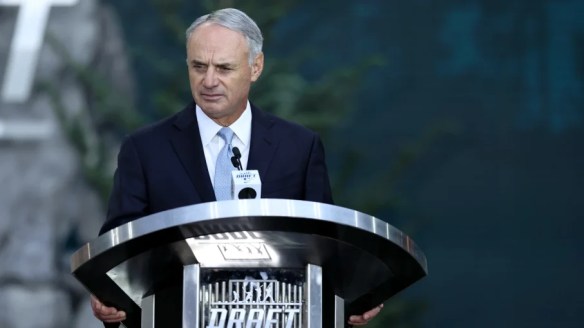
Rob Manfred at last month’s draft in Seattle—where the commissioner couldn’t quite understand why he was booed so lustily by the crowd.

I saw it first from Even Drellich, the Athletic writer whose Winning Fixes Everything proved the most in-depth exposure of Astrogate and what developed it. Commissioner Rob Manfred’s re-election for another term of office is all but a done deal when the owners vote next week. Manfred has said publicly he’d like another term in the job, which he considers “the best job in the world” to have.

A commissioner’s re-election window begins nine months prior to his term’s designated expiration date. Drellich says the owners’ vote will come smack dab at the opening of that window. If the owners have enough of a contingency among them who don’t have oatmeal for brains, Manfred should be denied. If.

He’s overseen a continuous climb in baseball’s revenues since he took the job in 2015, disrupted only by the coronavirus pan-damn-ic. That by itself may be enough to win him another five-year term. But it’s time to consider yet again an observation upon which I’ve leaned shamelessly that was first sketched by longtime New York Times writer George Vecsey: The common good of the game isn’t the same thing as making money for the owners.

The 2021-22 owners’ lockout said, guess again. When Manfred laughed during the first announcement of canceled games, assuredly he did not laugh like Figaro that he might not weep. I’ll say it again: When Manfred called it a “defensive lockout,” it sounded like Vladimir Putin pleading that he’s only defending Mother Russia from Ukraine’s “aggression.”

His handling of the Oakland/Las Vegas debacle as much as said, Oh, yes it is. He failed to school himself deeply enough on the core of that debacle, a capricious owner who tried and failed to strong-arm Oakland after reducing his team to compost, but discovered Las Vegas and its Nevada parent state didn’t have to be strong-armed to fall hook, line, and stinker into giving him a new ballpark.

The commissioner was caught pants down when he said mid-June that there was “no Oakland offer, OK? They never got to a point where they had a plan to build a stadium at any site.” Oakland mayor Sheng Thao said, that’s what you think. Last weekend she laid down the law to the commissioner in person. Oops.

Of course, John Fisher wanted Oakland to build him a big real estate development with a ballpark thrown in for good measure. Of course Oakland’s political (lack of) class finally said, not happening that way. Manfred has stood for continuing the nebulous push of municipalities building ballparks at taxpayers’ expense.

He has stood there even when it turns from a questionable proposition to a downright disaster. Atlanta’s Turner Field was only two decades old when the Braves decided the city limits were just too much and it was time to strike for the burbs. Double oops.

“[T]hey abandoned . . . Turner Field for suburban Cobb County in large measure because the county agreed to commit hundreds of millions of tax dollars to the project,” wrote CBS Sports’s Dayn Perry. “That tally is more than $350 million (and probably growing), which means Cobb taxpayers will never come close to getting that back.” Not even if the Braves own the National League East (again) for the foreseeable future.

Those are just too-obvious manifestations. Manfred has been baseball’s Professor Pepperwinkle, using the game as a lab and those who play and administer it as the experimental rats. For every one change he has ordered or shepherded that’s been good for the game, you can find several that have been worth either a laugh or a lament.

The universal designated hitter has been one of the good ones. Sorry, but I’m going to die on the hill that says however much fun it is to see the extreme outliers who can actually handle themselves at the plate, they were just that, outliers. When pitchers as a class hit a mere .162 from the end of the dead ball era through the end of the 2021 season, the universal DH was long overdue.

The ghost runner on second base to open extra half innings has been one of the terrible ones. So has the three-batter minimum for relief pitchers, especially when a manager is barred from lifting a pitcher right then and there who doesn’t have it and might be dangerously wild. So have the expanded wild cards and postseasons that dilute championship play even further.

The jury may still be out on the pitch clock. But it does present issues ranging from the sublime to the dangerous, especially concerning pitchers’ arms. Manfred’s inability thus far to commit to turning it off in the postseason’s late innings suggests he’d rather sacrifice the integrity of a championship round than one inch of his stubbornness.

We should also have noticed that the truest reason for lengthening games was never even a topic in Manfred’s mind: reducing the broadcast commercials between half innings to a single minute each. Smart negotiating could have brought that about without costing the owners money. They were no further endowed with vision on that than Manfred.

It’s also difficult to determine which has become more cringe-inspiring: the garish City Connect and All-Star Game uniforms; or, the presence of small advertising patches on uniform sleeves. It’s not impossible to say that the former are merely grotesque but the latter suggest the future baseball uniform might become the next best thing to a NASCAR jumpsuit.

Manfred has also shown far too much tendency to put his foot in his mouth and worry about the actualities after the screaming dissipates. Remember his dismissal of the World Series trophy as “a hunk of metal,” addressing questions of whether he would or could vacate the 2017 Astros’ World Series triumph once Astrogate erupted?

Fast forward to last month. Manfred now said he made a boo-boo giving 2017-18 Astros players immunity in return for spilling about the Astro Intelligence Agency. “Once we gave players immunity, it puts you in a box as to what exactly you were going to do in terms of punishment,” he told Time. “I might have gone about the investigative process without that grant of immunity and see where it takes us. Starting with, I’m not going to punish anybody, maybe not my best decision ever.”

But he did that to himself. The memo he sent down after the Red Sox and Yankee incidents of using AppleWatches and other devices in their dugouts to steal signs made clear he’d punish front offices, not players. He dropped a hammer on Astros owner Jim Crane and then-general manager Jeff Luhnow, but he let the cheaters in the dugout and on the field get away with murder.

Sort of. To this day, those 2017-18 Astros still playing major league baseball hear it from fans in the stands. Conversely, and unfairly, Astros second baseman Jose Altuve hears it despite it being shown authoritatively—and discussed in both Drellich’s book and Andy Martino’s previous Cheated: The Inside Story of the Astros Scandal and a Colorful History of Sign Stealing—that Altuve was “the one player that didn’t use” the stolen signs.

Now, back to the Oakland debacle. That fine day Nevada’s state legislature elected to spend $380 million of their citizens’ money on a Las Vegas ballpark for the A’s, A’s fans staged a “reverse boycott.” They poured into the decrepit RingCentral Coliseum to protest, among other things, Fisher’s gutting of the team while hiking ticket prices, doing squat to improve anything at the old dump, then all but saying it was all the fans’ fault.

Commissioner Pepperwinkle’s response? “It was great. It’s great to see what is this year almost an average major league baseball crowd in the facility for one night. That’s a great thing.” Ask him how a 27,759-strong crowd turned out to be a little over three times the average RingCentral Coliseum crowd for one particular event, and he was probably stuck for an answer.

Wait—no, he wasn’t. “The ballpark’s not in good shape,” he said. “The ballpark is not a major league facility. I’ve said it repeatedly.” Ask him how it was allowed to devolve in the first place. Now he might be stuck for an answer.

Someone should present these and more to the owners when they gather to vote upon whether Manfred gets another term. It may be asking them to think beyond their competence, and beyond their faith that the common good of the game is making money for them. But at least they won’t be able to plead ignorance.

The Las Vegas Athletics of Oakland

Oakland Athletics

Will the owners do the right thing and block John Fisher’s final betrayal of the fan base he abused?

Now we know Nevada governor Joseph Lombardo lacks either a brain or a veto pen when he needs both. We’re about to discover—or rediscover, as the case probably is—whether major league baseball owners have brains and vetoes enough to do what Nevada’s legislature and governor couldn’t or wouldn’t do.

Lombardo signed off on the state pledge of $380 million tax dollars toward building the Las Vegas Athletics of Oakland a new playpen on the fabled Las Vegas Strip. That, as more than a few social media crawlers have snarked, makes Lombardo the rookie of the year. Not.

The only thing left to plunge the knife all the way into Oakland’s back are the owners. Are they willing to rubber-stamp A’s owner John Fisher and baseball commissioner Rob Manfred’s insistence on finishing Fisher’s betrayal of Oakland and, by the way, waiving the $1 billion dollar relocation fee the A’s would normally have to pay MLB to make the move?

You’d better not ask Manfred about that. All indications are that the commissioner has long surrendered Oakland as a lost cause without bothering himself to ponder that the cause wasn’t lost, it was discarded witlessly. And A’s fans smothered in frustration, rage, and sorrow alike have learned the hard way what Manfred thinks of them after all.

Almost 28,000 fans poured into RingCentral Coliseum Tuesday in a “reverse boycott” aimed at letting the world know the A’s atrocity wasn’t their doing. That they weren’t the ones who let the team and the ballpark—whose usefulness disappeared years if not decades before the A’s might—turn into the city dump.

Manfred himself didn’t see the game. He was occupied with dining with some of the owners after their week of meetings ended in New York. But he did see the game’s coverage. And it impressed him this much: “It’s great to see what is, this year, almost an average Major League Baseball crowd in the facility for one night. That’s a great thing.”

Was Commissioner Nero even mildly aware that Fisher reduced the A’s to rubble while trying and failing to strong-arm Oakland and its home Alameda County into handing the A’s a new home practically on the house? That Oakland called his bluff and compelled Fisher to think about sticking it to Las Vegas and its home Nevada?

“I think if you look at the A’s record over time and the economic circumstances, including the state of the stadium that they’ve operated in for a very long time, they had a very good record up through the pandemic,” he said.

Translation: Oakland wasn’t willing to just build Fisher a delicious real-estate development in Howard Terminal with a new ballpark thrown in for good measure. Except that that wasn’t the only option Fisher blew sky high. “Wasn’t Fisher committed to Fremont not that long ago?” asked The Athletic‘s Tim Kawakami—in April. “Then to San Jose? Then to rebuilding at the Coliseum? Then to the Laney College site? Then to Howard Terminal . . . ? This is the Death Lineup of squandered and blundering stadium efforts.”

Kawakami then was perversely optimistic that Fisher would fall on his face in Las Vegas and thus be compelled to sell the A’s if only because he wouldn’t be able to meet Manfred’s deadline of getting new digs by 2024 or else. Except that Fisher and Manfred and Fisher’s parrot David Kaval picked their Nevada marks well. Nevada’s cactus juice-for-brains lawmakers and governor fell for it hook, line, and stinker.

Oakland itself (the city, that is) isn’t entirely innocent. They were quite prepared to make $375 million worth of commitments to a new A’s stadium if only Fisher and Kaval left it at that. But no. Fisher and Kaval insisted on pushing the $12 billion Howard Terminal development project. That, said mayor Sheng Thao, turned the simple into the too-complex.

“There was a very concrete proposal under discussion,” Thao’s spokeswoman Julie Edwards said in a formal statement, “and Oakland had gone above and beyond to clear hurdles, including securing funding for infrastructure, providing an environmental review and working with other agencies to finalize proposals.

“The reality is the A’s ownership had insisted on a multibillion-dollar, 55-acre project that included a ballpark, residential, commercial and retail space. In Las Vegas, for whatever reason, they seem satisfied with a nine-acre leased ballpark on leased land. If they had proposed a similar project in Oakland, we feel confident a new ballpark would already be under construction.”

If you need me to explain why Fisher and Kaval are settling for just the ballpark in Las Vegas, remember my beach club in Antarctica? You can have it for a song now. Maybe just a short medley.

Thao’s statement said, essentially, spare us the crocodile tears, Mr. Commissioner. “I feel sorry for the fans in Oakland,” Manfred says.

I do not like this outcome. I understand why they feel the way they do. I think the real question is what is it that Oakland was prepared to do? There is no Oakland offer, OK? They never got to the point where they had a plan to build a stadium at any site. It’s not just John Fisher . . . The community has to provide support, and at some point you come to the realization that it’s just not going to happen.

“This,” tweeted retired (and one-time A’s) pitcher Brandon McCarthy, “is [fornicating] pathetic. How is this not disqualifying? This toad is the steward of a glorious sport, dripping with history and he feels entitled to mock fans who are making their voices heard as he sits by and caters to hiding billionaires?”

Why does Manfred think Oakland “has to support” a team reduced to pathos by its owner, in a ballpark allowed to become a dump for too many years, with its host city responsible for building a new ballpark and just handing it to the team on whatever terms the team demands—even and including a $12 billion development where the ballpark would have been oh-by-the-way?

All that was Fisher’s doing. He did his level best to make things unpalatable for A’s fans. Including but not limited to the abject gall of inflating prices after last year’s A’s finished 60-102; two years and more worth of shipping or letting walk any viable A’s players who now perform well for other teams; and, ten years worth of fielding baseball’s 26th highest payroll with only one postseason game win to show for it.

(For the curious, the win was Game Three of the 2000 American League division series against the Astros—when courageous Liam Hendricks was still an Athletic, and kept a late two-run lead intact pitching the final two innings to nail the game.)

“[T]he A’s could have made money in Oakland,” writes Mark Normandin in Baseball Prospectus, using Tuesday night’s “reverse boycott” game as a classic example, “but chose not to.”

They stopped trying a long time ago, and began to try even less after that. No matter how many executive fingers are pointed at the fans in Oakland for not attending games, it doesn’t change that there is money to be made if you simply give the fans a reason to give it to you. Nearly 28,000 people paid an average of $29 just to show up on TV and tell John Fisher he sucks and should sell the team; do you know how much more positive energy and money could be out there for the A’s if they had a team worth paying to see? This is a city that, after all the team has done to them, was still willing to give them hundreds of millions in taxpayer funds to stick around even longer!

All that stands in the way of the A’s hosing Las Vegas and the entire state of Nevada now are the owners. (You think $380 million tax dollars is a fortune? Just wait until the almost-inevitable cost overruns begin to make themselves manifest. Three guesses whom the A’s and MLB will try to stick with those bills.)

I say again: I’d love nothing more than major league baseball in Las Vegas. But not like that. Not by way of a taxpayer hosing. Not a team whose often colourful history was betrayed by an owner who treated the team and its fans who’ve loved them like nuisances. I don’t want major league baseball in Vegas that badly. I’m perfectly happy having the Triple-A Aviators.

An optimist may now be described as someone who thinks enough owners will a) wake up and decide, after all, that there’s something transparently stupid about billionaires unwilling to build their teams’ own digs without a taxpayer soak; and, b) show enough spine, accordingly, to stand athwart Fisher (and Manfred, their hired hand, after all), yelling “Stop!”

Clocks and Clouds

Over a week ago, Mets pitcher Max Scherzer felt as though he’d awakened one fine morning to discover he had super powers. Very well, that’s a slight exaggeration. But after he’d spent two innings against his old team, the Nationals, striking out five despite surrendering a single run, Scherzer felt the newly-mandated pitch clock gave him, well…

“Really, the power the pitcher has now—I can totally dictate pace,” he crowed then. “The rule change of the hitter having only one timeout changes the complete dynamic of the hitter-and-pitcher dynamic. I love it. It’s a cat-and-mouse game. There’s rules, and I’ll operate within whatever the rules are. I can come set even before the hitter is really in the box. I can’t pitch until eight [seconds], but as soon as his eyes are up, I can go.”

Not so fast. Come last Friday, Scherzer faced the Nats once again and learned the hard way that he might have competition in the New Tricks Up Their Sleeves Department. With a man on first, he thought he could catch Victor Robles off guard the split second home plate umpire Jeremy Riggs re-set the pitch clock, after Robles stepped out of the box with his only allowable step-out during a plate appearance before stepping back in. Scherzer started to throw at that very split second. Riggs called a balk.

“He calls time, I come set, I get the green light,” Max the Knife told reporters post-game. “I thought that was a clean pitch. He said no. We have to figure out where the limit is.”

Baseball’s government thinks it did it for him. Hours after Scherzer’s little experiment was neutralized, MLB sent a memo to all 30 teams saying forthrightly that pitchers can’t throw “before the batter is reasonably set in the batter’s box.” Come Saturday, another Mets pitcher, Justin Verlander, discovered he’ll have to do something about his long-normal routine around the mound between pitches.

“Today I got on the mound a couple times and looked up and it was like, I only had seven seconds,” the future Hall of Famer said, after pitching three innings against the Marlins, surrendering a single run, and having to adjust his mound strolling. “If me and [Mets catcher] Omar [Narvaez] weren’t on the same page, it could have been a problem.”

When this spring training’s exhibition games began, Padres third baseman Manny Machado became baseball’s first to earn a 10-year, $350 million contract extension for opening with an 0-1 count on him before he even began a plate appearance. Okay, that’s a joke. But Machado did have strike one called on him when facing Mariners pitcher (and former Cy Young Award winner) Robbie Ray and failing to be in the batter’s box when eight seconds on the clock passed.

“I’m going to have to make a big adjustment,” Machado said with a hearty laugh after that game. “I might be 0-1 down a lot this year. It’s super fast. It’s definitely an adjustment period.”

Pitchers have 15 seconds to throw a pitch after receiving the ball back with the bases empty and 20 with men on base. Batters must be set and ready after 8 seconds are gone. And the pitchers aren’t the only ones looking to circumvent some of the new rules imposed by baseball’s attention-deficit commissioner. The notorious defensive infield shifts are now against the law, too, at least to the extent that there must be an infielder each on either side of second base itself at all times. Well, now. A few teams have already tried their own end run around that.

The Red Sox, for one. They thought they could get away with moving their left fielder to the shallowest patch of the right field grass against notorious all-or-nothing slugger Joey Gallo, now with the Twins. They got away with it long enough for Gallo—who’d torn one through the right side of the infield for a base hit earlier—to hammer a 3-1 service into the right field bleachers.

I’m reasonably certain I’m not the only one who thinks commissioner Rob Manfred didn’t stop to think that there was a reason for games going well over three hours having nothing to do with the actual play and everything to do with broadcast dollars. It never seems to have occurred to him that it wasn’t pitcher or batter gamesmanship, but two-minute-plus broadcast commercials after every half inning and during mid-jam pitching changes.

It seems to have occurred to Commissioner ADD less that he and his bosses might have landed the same delicious dollars by just limiting the spots to before each full inning and adjusting the dollars accordingly. Since it’s been established long and well enough that Manfred’s true concept of the good of the game is making money for it, that should have been child’s play for anyone applying brains.

And, speaking of dollars, try not to delude yourselves that MLB’s new so-called Economic Reform Committee will be for the good of the game, either. How about the Committee to Horsewhip Owners Who Actually Spend on Their Teams and Want to Win? The Committee to Immunize the Bob Nuttings and Bob Castellinis and John Fishers From Their Economic Malfeasance?

Manfred has pleaded that oh, but of course he’s after nothing more and nothing less than “a crisp and exciting game.” He’s been bereft, apparently, of the sense that baseball’s flavors come as much from the tensions in its pauses as from the cracks of the bats, the thwumps! of the pitches into the catchers’ mitts, and the brainstormings on the field and in the stands during jams.

Thus far, the games are shorter—by a measly 22 minutes. But the potential for such unintended consequences as, at extreme, a World Series-ending strikeout on a pitch clock violation is almost as vast as Manfred couldn’t stand single games having become. Those supporting the new arbitrary havoc like to say Manfred merely scoped what “the fans” wanted. It’s not inappropriate to ask, “which fans?”

Think about this: Hall of Fame pitcher Juan Marichal was fabled for an array of about sixteen different windups and ten different leg kicks, including the Rockettes-high kick that was his most familiar visual hallmark. The new pitch clock may actually come to erode the presence of pitchers who are that much fun to watch (I’m talking about you, Luis [Rock-a-Bye Samba] Garcia, among others) even if they’re not a barrel of laughs against whom to bat.

It might also erode the presence of batters who are as much fun before they swing as while they swing. What’s next—a base-running clock, mandating batters have x number of seconds before they’d better start hauling it around the bases on home runs? Oops. I’d better not go there. We don’t want to give Commissioner ADD any more brilliant ideas.

Note: This essay was published first by Sports-Central.

Three-ball blues

The Ball

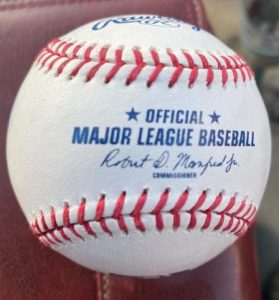
This is the baseball I landed during batting practise before Opening Day at Angel Stadium this year. (I gave it to my son who attended with me.) Who knew if it was juiced or drained?

Signing with the Mets for two years and $86 million was good with and for Justin Verlander. But it may not be the most important thing he did outside pitching the decisive World Series Game Six. The most important thing the future Hall of Famer did this year was buttonhole a baseball official before a game against the Yankees in June and demand, “When are you going to fix the [fornicatin’] baseballs?”

It’s not the first time he complained. In 2017, Verlander was just one of several who noticed and complained that balls used that postseason were a little too smooth for comfort. And it got worse instead of better. By 2021, Major League Baseball had two kinds of baseballs, one slightly heavier than the other, and thus containing a little more life than the other.

With a lot of help from Meredith Wills, an astrophysicist and baseball fan whose passion is examining the makeup of baseballs and who’s discovered the Show can’t get it straight or consistent, Insider exposed 2021’s two-ball tango. The Insider reporter who delivered Dr. Wills’s discoveries and alarms, Bradford William Davis, has now seen and raised: in 2022, baseball played its own version of “Three Ball Blues.”

That vintage blues song discussed pawn shops, the traditional sign for which is three golden balls. The lyrics include the old joke inside the pawn business: “It’s two to one, buddy, you don’t get your things out at all.” Baseball’s three-ball blues may mean it’s two to one on getting its integrity back after engaging its own kind of cheating—still inconsistent and often juiced balls.

Not necessarily in the final game scores. Davis and Wills suggest powerfully that baseball’s government wanted a little more oomph on behalf of a lot more hype, with certain events such as the Home Run Derby, the postseason, and maybe even Aaron Judge’s chasing and passing Roger Maris as the American League’s new single-season home run king.

Verlander was far from the only player to complain. Davis says Giants outfielder Austin Slater fell upon that 2021 Insider story, sought to collect balls to send Wills for analysis, and was ordered by “a top executive in the commissioner’s office” to back off.

“The warning,” Davis says, “sent in the form of text messages that Insider reviewed, came via a [Major League Baseball Players Association] official who was relaying the league executive’s displeasure.” Displeasure over what? Being caught red-handed delivering inconsistently-made baseballs about which the game’s own commissioner seems distinctly under-alarmed?

Rob Manfred told reporters before the All-Star Game that, yup, we had two balls in 2021, but it was the fault of a pandemic-times issue in Rawlings’s Costa Rica manufacturing plant: closues and supply chain issues, as Davis translates, meant MLB’s plan to stay with a new, lighter, deader ball was compromised when it had to “dip into a reserve stock of the older, heavier, livelier balls for some 2021 games.”

MLB claimed random distribution between the two 2021 balls. Davis’s 2021 reporting via Dr. Wills brought forth suspicions that MLB wasn’t just doing it randomly, that at times they were sending balls to certain places for certain series depending on what they thought might be the gate: say, a game between a pair of also-rans might get the deader ball but a game between a pair of big rivals or contenders might get the livelier ball.

Now Manfred told that July conference think nothing of it, we’ve got it knocked, we’re sticking to the deader ball, and every ball made for 2022 will be consistent. Not so fast, Dr. Wills discovered, according to Davis: “Major League Baseball did not settle into using a single, more consistent ball last season, Wills’ research suggests: the league used three.”

By the time Manfred made that statement in July, Wills had already found evidence that at least a handful of those older, livelier, “juiced” balls — the ones that the “new manufacturing process” purportedly replaced — were still in circulation. Though these juiced balls are from 2021 or earlier, according to manufacturing markings, they were in use in 2022; Insider obtained two of them from a June 5 Yankees match against the Tigers.

Over the next few months, Wills and Insider—with whom Wills exclusively shared her research—worked together to collect game balls for her to painstakingly deconstruct, weigh, and analyze. What she found was striking: In addition to that small number of older juiced balls and the newer dead balls, Wills found evidence that a third ball was being used at stadiums across the majors.

Davis says Wills’s data indicates production on the third ball began six months before Manfred promised 2022 as a single-ball season. “This new third ball’s weight,” Davis writes,

centers somewhere between the juiced ball the league phased out last season and the newly announced dead ball: It is, on average, about one-and-a-half grams lighter than the juiced ball and one gram heavier than the dead ball. According to the league’s own research, a heavier ball tends to have more pop off the bat, meaning the third ball would likely travel farther than a dead ball hit with equal force.

Aaron Judge

Aaron Judge had no clue whether he’d be pitched a dead, lead, or Super Ball while chasing Roger Maris this year.

Wills calls it “the Goldilocks ball: not too heavy, not too light—but just right.” But this isn’t the Three Bears we’re talking about here. This is about the possibility that hitters didn’t know going in when one hefty swing would send a ball over the fence but another such hefty swing with the same square, powerful contact might result in a sinking line drive, a dying quail, or a long out.

In other words, Judge—who’s just signed a nine-year/$360 million deal to remain a Yankee, after betting big on himself during his contract walk year—had no clue just what he was going to hit, and I don’t mean fastball, curve ball, slider, cutter, or sinker. Nobody knows for certain whether or how many such Goldilocks balls Judge sent into the Delta Quadrant. And that’s allowing for him being strong enough to hit a clump of seaweed into the second deck.

“But we do know,” Davis writes, “that the league keeps track of information that would permit it—if it wanted—to know which balls get used in each game. According to two sources familiar with MLB’s ball shipment process, the league not only directs where its balls are sent, it also knows which boxes its game compliance monitors–league employees tasked with ensuring each team adheres to league rules–approve and use before each game starts.”

Baseball government people were handed the net results of Dr. Wills’s reseach and all but waved it away with an all but run-along-girlie-you-bother-me statement:

The 2022 MLB season exclusively used a single ball utilizing the manufacturing process change announced prior to the 2021 season, and all baseballs were well within MLB’s specifications. Multiple independent scientific experts have found no evidence of different ball designs. To the contrary, the data show the expected normal manufacturing variation of a handmade natural product.

Rawlings itself, co-owned by MLB since 2018, issued a similar statement:

This research has no basis in fact. There was no ‘3rd ball’ manufactured and the ball manufactured prior to the 2021 process change was fully phased out following the 2021 season. All balls produced for the 2022 season utilized the previously announced process change.

While storage conditions during research can easily impact ball weight measurements, a one-gram difference in ball weight would be within normal process variation. We continue to produce the most consistent baseball in the world despite the variables associated with a handmade product of natural materials.

Davis demurs. “While lighter and less bouncy than the balls used before Rawlings switched up its manufacturing in 2021,” he writes, “the Goldilocks balls have a weight profile that makes them livelier and more batter-friendly than the dead balls that the league says it now uses exclusively.”

To which Manfred says, essentially, Integrity of the game? Shut up and get back to shortening the times of games without even thinking about cutting down the broadcast commercials. Any time Manfred comes up with something reasonable—the universal designated hitter, slightly larger bases, the advent of Robby the Umpbot—he comes up with or allows about five or more unreasonable things to counteract.

Differing baseballs aren’t just “unreasonable.” They strike at the very core (pun intended) of competition at least as profoundly as something like Astrogate did, on both sides of the ball. Pitchers who don’t know whether they’ll be given a grippable ball to pitch have just as much skin in this game as hitters who don’t know whether they’ll square up a dead, lead, or Super Ball.

The men who play the game, the fans who pay to see them play, the team builders  tasked with putting the teams on the field, and the managers who have to run the games and make the moves that mean distinction or disaster, deserve as level a field as possible.

The era of actual/alleged performance-enhancing substances was considered criminal for undermining the level playing field. Tanking teams are considered criminally negligent for providing something less than truly competitive product. Likewise, when it comes to honest competition, inconsistently-made baseballs should be considered weapons of mash  destruction.

Enough, already

Pete Rose

Pete Rose, shown before a Reds game in Great American Ballpark in 2018. His letter to commissioner Rob Manfred should receive a single-word answer.

Last Friday, TMZ revealed Pete Rose sent a letter to commissioner Rob Manfred four days earlier. Just how TMZ obtained the letter is open to speculation. Some might suspect someone in Manfred’s office leaked it; some might suspect Rose himself. Neither suspicion is implausible.

If you’re inclined toward charitable thought, Rose’s letter is a letter of apology, an acknowledgement of accountability, a plea for forgiveness from a man who’s been punished enough via the opprobrium he still receives as baseball’s most prominent exile.

But if you temper charity with realism, it’s yet another example of what The Athletic‘s Ken Rosenthal describes as words ringing hollow from a man who can’t get out of his own way. A man who still doesn’t get it. A man whose most stubborn remaining partisans still don’t get it, either.

“[F]or Rose,” Rosenthal writes, “untrustworthy behaviour is nothing new.

He spent the first fourteen years of his ban denying that he bet on baseball, including in his 1989 autobiography, Pete Rose: My Story. He served five months in prison in 1990 for filing false income tax returns. A secret meeting in Milwaukee with former commissioner Bud Selig in 2002, during which he admitted betting on baseball as a manager for the first time, also apparently went awry. News of the meeting leaked, and Rose promptly followed it with an appearance at a sports book in Las Vegas.

Two years later, Rose released a second autobiography, My Prison Without Bars, as the Hall of Fame prepared to induct two new members, Dennis Eckersley and Paul Molitor. Rose said the timing wasn’t his fault. Nothing is ever his fault . . .

For all Manfred knows, he could reinstate Rose and then be subjected to some other bombshell. Rose has admitted to betting on baseball only after his playing career ended. But in June 2015, ESPN obtained copies of betting records from 1986 that provided the first written corroboration Rose had gambled on games as the Reds’ player-manager. It’s always something.

In August, the proof that it’s always something reared grotesquely enough after Manfred agreed to allow Rose to take part in the Phillies’ commemoration of their 1980 World Series title. Rose made it far less about that 1980 team and far more about himself.

It took nothing more than Philadelphia Inquirer reporter Alex Coffey doing nothing worse than her job, asking Rose whether his presence—considering that only the statute of limitations kept him from facing consequences over an early-1970s extramarital affair with a teenage girl—thus sent a negative message to women. Saying he wasn’t at Citizens Bank Park to talk about that, Rose added, “It was 55 years ago, babe.”

“Put aside for one moment (and only one) the message Rose’s cavalier dismissal and term of address to Coffey,” I wrote then. “Consider that his presence Sunday sent a negative message to women and men as well as baseball. For a few grotesque moments the Phillies looked like a team that couldn’t have cared less about anything beyond a cocktail of nostalgic self-celebration and the ballpark gate.”

That’s the Rose effect. He makes it all about him. In the same moment, he can and often does make it impossible to look for what he insisted to Manfred should be sought and kept under full focus.

That’s the man who hired on as a baseball predictions analyst for online sports betting site UpickTrade last year and told a presser, “For those people who are worried about the Hall of Fame, you’ve got to remember I got suspended in 1989. That’s 32 years ago. I’m not going to live the rest of my life worried about going to baseball’s Hall of Fame.” (Suspended?)

Until he is, that is. “Despite my many mistakes,” Rose wrote to Manfred now, “I am so proud of what I accomplished as a baseball player—I am the Hit King and it is my dream to be considered for the Hall of Fame. Like all of us, I believe in accountability. I am 81 years old and know that I have been held accountable and that I hold myself accountable. I write now to ask for another chance.”

A man who hung around as a player above and beyond his actual shelf life on behalf of the self-elevating pursuit of Ty Cobb’s career hits record is only slightly more hubristic than the teams enabling him to do it regardless of his actual on-field value. The publicity factor overrode the honest competition factor often enough then and still does, often enough.

Hubris often leads to tunnel vision. It did for Rose. He couldn’t (wouldn’t?) get that he could have retired right after that 1980 Phillies world championship with a no-questions-asked Hall of Fame case even if it meant falling short of Cobb by about 632 hits. There were people (including Rose himself, sometimes) who believed he had some preternatural entitlement to pass Cobb despite his actual playing value.

Rose’s wins above replacement-level [WAR] from his rookie 1963 in Cincinnati to his 1983 World Series ring with Philadelphia: 80.4. Rose’s WAR from 1981-86, when he finally surrendered to Father Time and took himself out of the Reds lineup to stay: -0.8.*

Rose being a Hit King shouldn’t make a single bit of difference to Manfred. Not now, not ever. Rose’s pride in his playing accomplishments shouldn’t make a single bit of difference. Nor, for that matter, should any of MLB’s promotional deals with this or that online legal gambling operation. (Don’t go there, Roseophiles: Gambling isn’t the only legal activity for which your employers can discipline or fire you for indulging on the job. Just ask anyone who ever lost a job for showing up high as a kite, wired up the kazoo, or bombed out of his or her trees.)

There’s only one thing Manfred should consider. It’s called Rule 21(d). The rule against betting on baseball. The rule that makes no distinction between whether you bet on or against your team. The rule that calls for permanent, not “lifetime” banishment. The rule that prompted the Hall of Fame itself—faced with the prospect of Rose’s election despite his MLB-mandated punishment—to enact its own rule barring those on baseball’s permanently ineligible list from standing for election on any Hall ballot.

Rose “can continue pleading to Manfred, appealing to public sympathy. But Rose, to borrow a term from horse racing, one of his favorite sports, is getting left at the gate,” Rosenthal writes. “His race for Cooperstown remains permanently stalled, and it’s no one’s fault but his own.”

Accordingly, the commissioner’s sole answer to Rose now and forever should be, “No.” As for any and everyone else, the answer now and forever should be, but probably won’t be, Enough, already.

——————————————————————————————————

* By contrast, Hall of Famers Henry Aaron, Nolan Ryan, and Cal Ripken, Jr. pulled up on the positive side of the WAR ledger when they broke revered career records. Aaron, the year he broke Babe Ruth’s career home run record: 2.1. Ryan, the year he broke Hall of Famer Walter Johnson’s career strikeout record: 2.6. Ripken, the year he broke Hall of Famer Lou Gehrig’s consecutive games played streak: 3.9.

Come to think of it, when Ryan threw a bullet past Hall of Famer Rickey Henderson to record lifetime strikeout number 5,000—with then-commissioner A. Bartlett Giamatti in the ballpark itching to pump his fist celebrating the milestone—he was having an All-Star caliber 5.1 WAR season in the bargain.

Ryan, of course, was an outlier even among outliers, a point forgotten often enough and conveniently enough by the ill-informed who insist on comparing pitchers since to him and wondering why simply no one has his one-of-a-kind endurance.