We can’t have nice things for too long

Emmanuel Clase

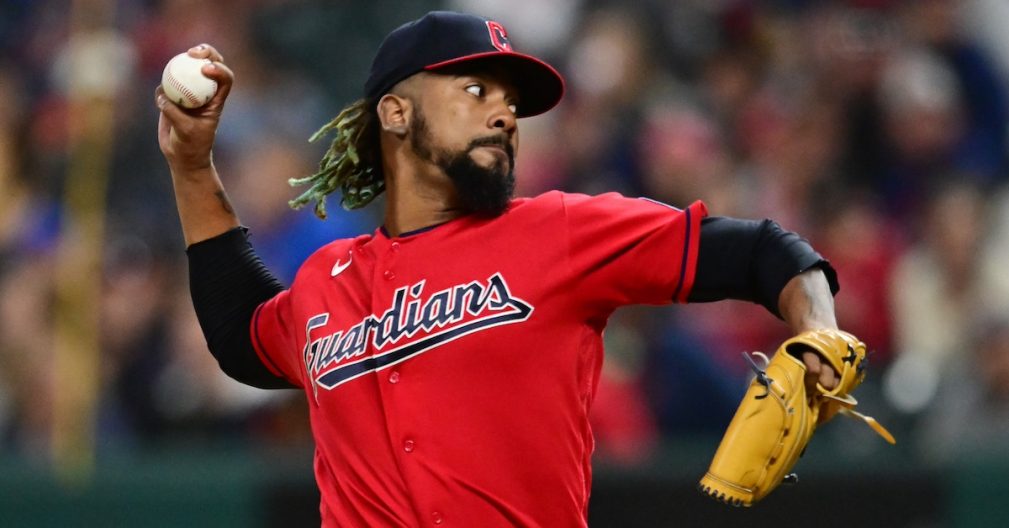
Emmanuel Clase, whom the feds charge masterminded a pitch-rigging scheme for bettors and his fellow Guardians pitcher Luis Ortiz.

How tempting is it to define the present era as the one that tells us we can’t have nice things? And, the one that delivers the message more brutally after each of the rare nice things we get.

Baseball just delivered us a postseason for the ages, even if you don’t hold with the wild card system. Put that to one side a moment and admit it. The game we love spent a month showing us that, any time we care to write the game off as a self-immolating bore, it’ll be more than happy to disabuse us.

Think about it. When you get seven postseason sets ending with winner-take-all games, you’ve been blessed to the tenth power. When you get more than one extra-inning postseason hair raiser without the disgrace of Manfred Man (who’s not allowed anywhere near the postseason—yet), you’ve been blessed that big again.

When you get utter cream-always-rises defiance against the wild card system, putting nobody in either League Championship Series except teams whose butts were parked in first place at season’s end, you’ve been blessed above and beyond whatever it was you had the right to expect.

When you get Shohei Ohtani spending one postseason game striking ten out from the mound and hitting three out at the plate, then spending World Series Game Three reaching base nine times—five with the near-complete consent of the Blue Jays who seemed to prefer death to Ohtani’s singular controlled mayhem—your cups runneth over.

When you get a postseason seeing regular-season supermen continue their feats of derring-do and damage (can we forget Cal Raleigh crowning a 60-homer regular season with five intercontinental ballistic missle launches while the Mariners were in the postseason? Freddie Freeman’s eighteenth-inning walkoff?), and heretofore dismissable Clark Kents turning into assorted breeds of Supermen (Addison Barger, Miguel Rojas, call your offices), your bowls, barrels, vats, and tanks runneth over, under, sideways, down, and back.

In other words, this postseason couldn’t have been more entertaining, exciting, and exemplary if it had been coordinated, produced, and directed by Bill Veeck, Casey Stengel, Kevin Costner, and The Chicken.

No, that beyond good deed couldn’t go unpunished, could it? Can we have (demand) this Sunday back?

First there came the should-be-frightening revelation that, according to a popular podcast, Bryce Harper—he who told commissioner Rob Manfred firmly enough to get the you know what out of the Phillies clubhouse if he wanted to talk salary cap, though the two shook hands and shook it off later on—was threatened by “one of Manfred’s deputies,” who said, supposedly, “Don’t ever disrespect [the Commish] like that again. That’s how people end up in a ditch.”

“If this threat is true,” wrote Yardbarker‘s David Hill, “the next labor stoppage could get ugly fast.” If that threat is true, we don’t have to wait for a lockout or a strike to get ugly fast. It’s just become ugly fast.

And how about the ugly-fast-enough revelation that two Guardians pitchers, relievers Emmanuel Clase and starter Luis Ortiz, on administrative leave since late July on pitch-rigging suspicions, have just graduated from suspicion to formal charges of fraud, conspiracy, bribery, and money laundering? Charges “stemming,” as the federal indictment out of Brooklyn says, “from an alleged scheme to rig individual pitches that led to gamblers winning hundreds of thousands of dollars, according to an indictment unsealed by federal prosecutors Sunday.”

The U.S. Attorney’s Eastern District office in Brooklyn said Sunday that Clase’s involvement in the pitch-rigging plot goes back to May 2023, with Ortiz joining up last June. It didn’t exactly cripple the Guardians’s season to lose the pair, especially when they ended up snatching the American League Central from the unexpectedly rising/unexpectedly sputtering Tigers.

But then came the postseason. The Tigers nudged the Guardians out of the picture in a wild card series. From there, aside from the usual off-season doings, undoings, maneuverings, and meanderings, the question around the Guards became when the other shoes would drop around Clase and Ortiz.

They dropped Sunday, all right. The indictment says Clase arranged with a gambler to throw particular pitches for ball counts so the bettor could bet on those pitches (it’s called proposition betting) and reap the financial reward. The indictment says further that gamblers won almost half a million betting on pitches thrown by the Guardians pair, while the pitchers themselves earned kickbacks for helping the bettors clean up.

Clase and Ortiz, said Eastern District U.S. Attorney Joseph Nocella, Jr., “deprived the Cleveland Guardians and Major League Baseball of their honest services.”

They defrauded the online betting platforms where the bets were placed. And they betrayed America’s pastime. Integrity, honesty and fair play are part of the DNA of professional sports. When corruption infiltrates the sport, it brings disgrace not only to the participants but damages the public trust in an institution that is vital and dear to all of us.

“While the pervasiveness of legalized gambling has upended the sports world, the allegations against Clase and Ortiz are the most severe for the sport since Pete Rose agreed to a lifetime ban for betting on baseball in 1989,” ESPN’s Jeff Passan wrote. “MLB’s rules against gambling on the sport are strict, and Clase and Ortiz could face lifetime bans similar to the one delivered last year to San Diego Padres infielder Tucupita Marcano, who placed nearly 400 bets on baseball.

Nocella’s office described Clase as the scheme’s mastermind, saying he’d throw balls instead of strikes and sliders instead of cutters on first pitches, with gamblers betting on each pitch to be called balls or traveling under specific speeds. The indictment said further that such proposition bets would be stacked in parlays often as not, meaning bigger winnings.

But the indictment also charges that Clase gave money to gamblers to bet on his own behalf, texted with them while games were in progress, and was joined up by Ortiz after he  came to the Guards in a winter 2024-25 trade, Passan said.

Among others, Clase helped gamblers win $27,000 apiece on one Clase pitch faster than 94.9 mph in an interleague game with the Mets. “Weeks later,” Passan said, referring to the indictment, “bettors added a leg to a parlay for a pitch to be a ball slower than 94.95 mph—and won $38,000 when Clase spiked a slider at least five feet in front of home plate.”

By last April, Clase asked for and got kickbacks for throwing specific pitches. He even asked one winning bettor to send kickback money to his native Dominican Republic “for repairs at the country house.” Last June, Ortiz joined the scheme by agreeing to be paid $5,000 to throw a first second-inning pitch for a ball call, with Clase getting $5,000 himself for arranging it, the indictment charges.

The same month, Ortiz agreed to open the third inning with ball one for $7,000. The indictment also says bank security cameras caught Clase withdrawing $50,000 cash, $15,000 of which went to one bettor in a group who placed $18,000 on that pitch.

Ortiz’s attorney denied in a formal statement that his client would do anything to influence a game improperly, “not for anyone and not for anything.”

Clase was making $4.9 million for 2025 and stood to make $6.4 million for 2026, with a pair of team options for 2027 and 2028 at $10 million each. Ortiz wasn’t near six figures yet so far as I could determine, but he wasn’t exactly improverished, either. Why on earth would either man slide into a shady side profession that could end their baseball lives if convicted and banished?

Maybe we shouldn’t ask. Maybe it won’t matter, at least until the case goes to trial, barring any for-now-unknowable chance of one or both pitchers coming to take plea deals and then throwing themselves upon the mercy of the courts of law and public opinion.

Maybe it won’t mean a thing until or unless baseball decides to take a second, third, and fourth look at its cross-promotion deals with legal sports books. Yes, those were supposed to encourage fan betting alone. Baseball’s prohibitions against players, coaches, managers, and team personnel betting on the sport remain stringent.

Oops. Manfred took a presidential gumshoe in the gluteus to declare Rose’s “permanent” and wholly justified banishment applied only while he was alive on earth—thus making Rose eligible to appear on the Hall of Fame’s next Classic Baseball Era Committee ballot.

But five months after Ohtani’s original interpreter Ippei Mizuhara went to the federal calaboose for stealing $17 million of Ohtani’s money to support an out-of-control gambling habit, it might be wise to review and perhaps repel those cross-promotions. Which might require the kind of spine this commissioner displays very selectively.

When an uppity player told Manfred where he can take his salary cap talk, the commissioner’s office ironed up to slap him down. But when an uppity president behaving like the school bully crooked his finger and demanded Rose be sent to Cooperstown as soon as last week, regardless that Rose earned his banishment, Manfred’s spine went Vaseline.

The stove isn’t the only thing that’s hot. It won’t shock me if baseball tempers get a little hot for a good while. That’s the risk whenever baseball’s witless remind us that we can’t have nice things for very long.

Baseball’s unlocked. But . . .

“I believe that God/put sun and moon up in the sky./I don’t mind the gray skies/’cause they’re just clouds passing by.” So wrote Duke Ellington, and sang Mahalia Jackson, in his 1943 magnum opus reworked for 1958’s album  Black, Brown, and Beige. The lyric was part of a segment called “Come Sunday.”

Come Sunday, this Sunday, the gray skies yield metaphorically as spring training finally begins. And, early-series cancellations notwithstanding, there will indeed be 2,430 regular season baseball games played in a 162-game schedule this year. It might mean a tighter calendar, of course. But, given that, does it now feel as though spring has arrived properly at last?

Baseball’s owners’ lockout, which ended 26 years of labour “peace” needlessly, ended Thursday. Commissioner Rob Manfred called it a “defensive lockout.” Those who believe that might as well believe Vladmir Putin decided to defend himself against Ukranian “aggression.”

The owners could very well have elected to let baseball continue operating while they negotiated and hammered out a new collective bargaining agreement. The now-concluded 99-day lockout was and will ever be on them entirely. But they had the players right where the players wanted them. Sort of.

The players now have the owners accepting the largest hike in the so-called competitive balance tax—too long used by the owners as a de facto salary cap—since the tax was born after the 1994-95 players’ strike. They also have the owners accepting the largest jump ever in the minimum major league player’s salary, and a pre-arbitration bonus pool for young players emerging as early stars that’s worth $230 million new money just over the time span of the new CBA.

Yet the Major League Baseball Players Association’s vote for accepting the terms was a mere 26-12. The Athletic‘s Evan Drellich writes that it was “telling” for “roughly a third of the executive board [feeling] there was more to accomplish right now, in continued negotiations in 2022, not in the future.”

There’s the warning from Hall of Fame baseball writer Jayson Stark: The new competitive-balance tax threshold may not necessarily mean putting the “competitive balance” all the way into it:

You know those seven teams that came within $8 million of going over the [old] threshold last year? They’re likely to do that same thing this year—other than the Mets, who are already well north of it. But if all those teams spend another $20 million or so apiece, that’s a notch in the win column for players, except for one thing . . . teams that weren’t spending money before still have no incentive to spend now.

“All this does is just increase payroll disparity,” said one longtime club official. “Just because the Phillies go up $10 million doesn’t mean a team like the Marlins goes up $10 million.”

In other words, there’s still room enough for continuing tanking. Maybe that was why that one-third of the union’s executive board felt there was still more to get done now, if not yesterday. Remember Hall of Fame shortstop Derek Jeter took a hike from running the Marlins almost a fortnight ago, saying, essentially, that he didn’t sign up to preside over the Fish only to see their “direction” resemble a killifish and not a barracuda.

What, then, of commissioner Rob Manfred, who is probably the single worst salesman in baseball and barely sold it when he proclaimed at a Thursday press conference that he was “thrilled” the lockout was over and a new deal was done?

At least three questions presented to him inquired about future mended relationships between MLB and those who actually play baseball. Manfred actually doffed his stegasaurus-in-the-china-shop cloak to admit he hasn’t been so successful at promoting “a good relationship with our players. I’ve tried to do that. I have not been successful at that.”

Gee, what gave him the clue? Standing with almost no apology for the precept that the general good of the game is making money for the owners? Allowing the owners to go 43 days worth of silent after their lockout began? Dismissing the World Series championship trophy as “a piece of metal” while not quite holding all the Houston cheaters accountable when Astrogate tainted their 2017 World Series title and outraged as large a percentage of players as it did fans?

Saying it was Mike Trout’s fault Trout wasn’t considered baseball’s face outside the game itself? Abetting the owners trying to cheat the players out of their proper pro-rated 2020 salaries during the pan-damn-ically short season? Tinkering like Rube Goldberg with the game’s play, from the free cookie on second base to open each half inning to the three-batter minimum for relief pitchers?

Manfred did at least observe that the new deal should give the owners and the players more than a little room to move on working out such things as doing away with draft-pick compensation for players reaching free agency; and, on establishing a joint committee aimed at addressing issues involving field competition. But . . .

“The committee can implement rules changes with 45 days notice,” writes another Athletic staffer, Ken Rosenthal, “and with the league holding a majority of members, Manfred can push through any changes he desires. Will he do it, continuing the league’s chest-pounding, zero-sum style? Or will he and league officials show greater understanding that players are the product, and become better listeners?”

They’ve barely understood, if at all, that no fan has ever paid his or her way into a ballpark to see their team’s owner. “Recent history suggests that when the owners give in one area, they take from another, which again leaves the middle class of players vulnerable,” Rosenthal warns. “Don’t hold your breath waiting for the league to suddenly become more benevolent to its most valued employees, though even a mildly less aggressive approach would be helpful.”

But Rosenthal points to at least one team administrator not named Steve Cohen (the deepest-of-deep-pockets owner of the Mets whom enough owners fear for his willingness to invest in his team and its organisation) who has more than a clue. “It’s paramount,” said Twins president Dave St. Peter on a Zoom call to writers covering the team, “that we as an industry do a better job of building trust with our players.”

Coming in the wake of such petty tacks as scrubbing players from MLB’s own Website early in the lockout, St. Peter’s words may sound encouraging on the surface. But it’s wise to remember a remark once made often enough by the maverick journalism legend Sidney Zion: Trust your mother, but cut the cards.

Try not to get too hopped up over the new service-time adjustments, either, which mean rookies finishing with the Rookie of the Year or in second place for the award get a full year’s service time even if he didn’t spent the entire season in the Show. “[A]ny system based on counting days is a system that can be manipulated,” Stark warns. “So why do we suspect we could be back in this same, uncomfortable place in five years, trying to remind the powers that be again that there’s something wrong with a sport that rewards teams for not putting its best players on the field.”

For the moment, we can revel in a few things. The entire baseball family, from the teams to the fans, is watching to see the swift enough movement of the game’s remaining free agents. And we’ll be spared at long enough last the overwhelming, century-plus-old futility of pitchers at the plate wasting outs (those who can hit have always. been. outliers), now that the designated hitter will be universal instead of everywhere but the National League.

At long enough last, we should see a cutback in basepath injuries thanks to coming new bases that will be—relax, ladies and gentlemen—a mere three inches larger than the bases have been in the past, but designed with more give that may mean less leg injuries taking players out for two-thirds of a season or longer.

That twelve-team postseason format? With three wild cards per league? The good news is that the odds of a team with a losing record making the postseason under it aren’t great. Since the first wild-card game in 2013, Stark says, if this format had been in play only once might a sub-.500 team have burglarised its way into the postseason: 2017. (The Angels, the Rays, or the Royals.) And, the extra-card clubs would still average 87 wins.

“So despite this expansion,” Stark continues, “the baseball playoffs will still be the most difficult to make among the four major professional sports.” And still rather profitable for the owners, who stand to pull down $85 million postseason from ESPN with the third wild card. They may also change the trade deadline atmosphere, as Stark observes: “More buyers. Fewer sellers. Less incentive for teams hovering near contention in July to hold those depressing closeout sales.” May.

Myself, I remain in favour of something else: eliminating the wild cards entirely, adding two more major league teams to make sixteen-team leagues, and doing away with regular-season interleague play. But with or without the third of those, 1) divide each sixteen-team league into four four-team conferences; 2) best-of-three conference championships; 3) best-of-five League Championship Series (you know, the way the LCS was from 1969-85); and, 4) leaving the World Series its best-of-seven self.

Goodbye postseason saturation, welcome home genuine championship.

For now, I hope, too, that the remaining 525 pre-1980, short-career players maneuvered out of the 1980 pension realignment won’t be forgotten much longer, either. The lockout also suspended the annual stipend the late MLBPA director Michael Weiner and former commissioner Bud Selig got them—$625 per 43 days’ major league service time, up to $10,000 a year. (It would have been paid normally in February.)

Which would, of course, require what they once called the vision thing. This commissioner and his bosses tend to lack that. Today’s players have it, but they could use a lot more depth. Doing right further for those pre-1980 men whose playing careers were short, but who supported the union in its most critical early years, toward the end of reserve era abuse, and the rightful advent of free agency, would show vision even philosophers only imagine having.

The Show’s coming back?

2020-05-11 CodyBellinger

Where have you gone, Cody Bellinger—and Mike Trout, Jacob deGrom, Max Scherzer, Aaron Judge, Mookie Betts, Ronald Acuna, Jr., Clayton Kershaw, Justin Verlander, and Christian Yelich? A nation turns its quarantined eyes to you . . . but . . .

Baseball, the sport that more or less invented social distancing (if you don’t count the batter, the catcher, and the home plate umpire in a close enough cluster), is about to return to America, so it is said. At least the Show will. This brings good news, bad news, and very bad news.

The good news is, the proposed July return acknowledges a nation in dire need of respite from the coronavirus’s toll in human life and human mischief and exhausted of asking, “Where have you gone, Cody Bellinger—and Mike Trout, Jacob deGrom, Max Scherzer, Aaron Judge, Mookie Betts, Ronald Acuna, Jr., Clayton Kershaw, Justin Verlander, and Christian Yelich? A nation turns its quarantined eyes to you.”

The bad news is, there’ll have to come bristling debate on part of the proposal: will the players get only their cuts of a half-and-half league revenue split, or will they get their normal if prorated-for-time 2020 salaries?

The very bad news is that slightly more than half season to come may leave room for some of Commissioner Rob Manfred’s mischief. The proposal approved by major league owners and submitted to the Major League Baseball Players’ Association includes that the postseason will begin with fourteen teams, courtesy of two more wild cards each in the American and National Leagues.

Manfred has only sought such a postseason expansion for almost as long as he’s been Bud Selig’s successor, of course. Bad enough that some of his thoughts about redressing play-of-game issues have run the gamut from nonsense to more nonsense. Worse is that he has no apparent thought that play-of-postseason requires even more serious redress.

Even if the proposed structure for this year is one time only, well, we’ve heard it before when baseball’s governors tried things once—and let them linger regardless of their wisdom or enhancement of the game.

The postseason is already long enough. And we’ve suffered long enough, too, the thrills and chills of teams fighting down the stretch to the very last breath to determine who’s going to finish . . . in second place.

The original wild card advent legitimised the second place finisher as a championship contender, which was bad enough, and removed the time-honoured incentive of the first place finish as the sole legitimate entree into postseason play. Manfred appears to be witless to comprehend it even as he further exposes himself a man to whom the common good of the game equals little more than making money for it.

You guessed it: here I go yet again. But a three-division league giving a round one bye to the division winner with the best record of the three, while the other two slug it out in a best-of-three division series, with that winner playing the bye team in a best-of-five League Championship Series, would a) produce far more of a genuine league champion and b) far fewer viewers turning off or avoiding television sets or radios on the road to the best-of-seven World Series.

All that said, there are a couple of things to come in the short 2020 season that Manfred, the owners, and the players alike would be wise to make permanent. Rosters are proposed to expand from 26 to 30. Sound as a nut. Make it permanent.

The designated hitter will come to the National League for the short 2020. Good. Make it even more permanent. Pitchers batted for a .128/.159/.163 slash line in 2019. That is unacceptable production no matter what you think of “tradition,” and baseball history is nothing if not full enough with traditions that deserved to be and were killed. OK, you asked for it: Thomas Boswell’s wisdom, one more time . . .

It’s fun to see Max Scherzer slap a single to right and run it out like he thinks he’s Ty Cobb. But I’ll sacrifice that pleasure to get rid of the thousands of rallies I’ve seen killed when an inning ends with one pitcher working around a competent No. 8 hitter so he can then strike out the other pitcher. When you get in a jam in the AL, you must pitch your way out of it, not ‘pitch around’ your way out of it.

As a result, some weaker pitchers survive in the NL. But survival-of-the-unfittest isn’t good for the evolution of a league. Over time, high-quality hitters migrate to the AL, where they can have longer, richer careers by finishing as a DH. That is the main reason the AL has dominated interleague play in this century.

Depending upon the team’s up-and-down lineup possibilities, I’d far rather have what amounts to an extra leadoff hitter or cleanup hitter in that spot than a gang of spaghetti bats who might maybe hit one to the back of the yard as often as Halley’s Comet shows up. Assuming they don’t get injured swinging or running the bases and taken out of action when you need their arms the most.

I don’t want Jacob deGrom, Max Scherzer, Stephen Strasburg, Jack Flaherty, Clayton Kershaw, Walker Buehler, Josh Hader, Noah Syndergaard (when he returns), or Jon Lester wasting time at the plate no matter how many home runs they’ve hit once in a blue moon. I want them strictly on the mound missing bats or luring outs. That’s why they’re paid what they’re paid.

Beyond that? I’m not going to complain about the possible electronic strike zone, I want the balls and strikes called right, too, which means by the rule book and not according to Angel Hernandez’s mood on a particular afternoon or evening.

But I’m going to complain that Manfred and company continue underrating and underdiscussing umpire accountability, which still seems not to exist much if at all. More’s the pity. When the Korean Baseball Organisation sends an entire ump crew to the country’s minors for re-training after a few too many complaints about a few too many individual strike zones, the American Show needs to pay attention. And the Hernandezes, Joe Wests, and C.B. Bucknors ought to be made to watch their behinds.

MLB’s return will mean empty stadiums to begin with gradual re-openings, not to mention one-time mixed-league divisions based on geography to a great extent and special considerations for keeping players, coaches, managers, umpires, and grounds crews safe. It may sound like a pain in the sliding pants, but it may also beat the living hell out of the alternative, which we’ve had restlessly enough for over a month and counting.

And, like anything else, desperate times call for desperate or at least temporarily ameliorative measures. The only thing we have to fear is that the least appealing of them might become permanent and the most appealing and truly necessary among them might become memories after the season ends.