The new Yankee bats are barrels of fun

Baseball Bugs

Contrary to social media bleating, this is NOT one of the new Yankee bats . . .

They resemble elongated bowling pins upon first glance, those new and legal Yankee bats, perhaps the kind that would be spotted on a bowling lane . . . built for Paul Bunyan. Don’t laugh. Wielding those curious new bats among their regular lumber on Saturday against the Brewers, the Yankees resembled a gaggle of Bunyans at the plate. It began (ahem) right off the bat against former Yankee Néstor Cortés.

Three pitches. Three long enough solo home runs.Two outs later, another solo smash. That was just in the bottom of the first, against the guy they traded to make a Yankee out of postseason Brewers victim Devin Williams.

OK, let’s get more detailed. After the Brewers did nothing with a one-out walk to Christian Yelich from newly-minted Yankee starter Max Fried in the top of the first, Paul Goldschmidt—erstwhile Diamondback and Cardinal, now manning first base for the Yankees and leading off, of all things—watched a first-pitch, four-seam fastball travel well enough into his wheelhouse to drive it to the rear end of the bullpen in left center field.

One pitch, one bomb, one run.

Newly-minted Yankee Cody Bellinger—erstwhile Dodger and Cub, who hasn’t really been the same since a shoulder injury during the Dodgers’ 2020 run to the World Series title—watched another first-pitch, four-seam fastball rising in the middle of the zone, but not high enough that he couldn’t yank it into the right center field seats about six rows past the bullpen wall.

Two pitches, two bombs, two runs.

Aaron Judge—the Yankees’ bona-fide Bunyan, all 6’7″ of him, beginning his tenth season in the sacred pinstripes—watched Cortés switch things up a little, having learned the hard way abour first-pitch fastballs not always obeying orders. The lefthander opened with a cutter. It got even more into Judge’s wheelhouse than that fastball got into Goldschmidt’s. And it disappeared into the left center field seats.

Three pitches. Three bombs. Three runs. Who knew the Yankees were just getting warmed up? (And, did Goldschmidt feel even a small kind of déjà vu all over again, since he’d once hit three out against the Brewers by himself, as a Cardinal?)

Cortés then showed the Brewers what they thought they’d traded for when he struck (All That) Jazz Chisholm, Jr. out looking and got Anthony Volpe to ground out right back to the mound. Up stepped Austin Wells, who’d opened the Yankee season with the first known leadoff bomb ever hit by any major league catcher last Thursday.

Wells was kind enough to wait until Cortés opened up with a pair of cutters off the inside part of the plate for a 2-0 count before Cortés threw him a fastball and he drove it over the left center field fence. It took back-to-back walks and a called punchout on Trent Grisham to stop the bleeding. The tourniquet proved unable to contain it for very long.

From there, after Fried almost handed the Brewers a quick enough tie on the house, what with a one-out hit batsman, an RBI single, a run scoring on an infield error, another base hit, and a run scoring when Fried threw Yelich’s grounder offline, the Yankees had more treats in store.

They began with Volpe, who turned out to have been the inspiration for the new elongated bowling-pin bat. Yankee fans watching the broadcast on television got the skinny from broadcast institution Michael Kay when Chisholm batted in the first:

The Yankee front office, the analytics department, did a study on Anthony Volpe, and every single ball it seemed like he hit on the label. He didn’t hit any on the barrel, so they had bats made up where they moved a lot of the wood into the label, so the harder part of the bat is going to actually strike the ball. It’ll allow you to wait a little bit longer.
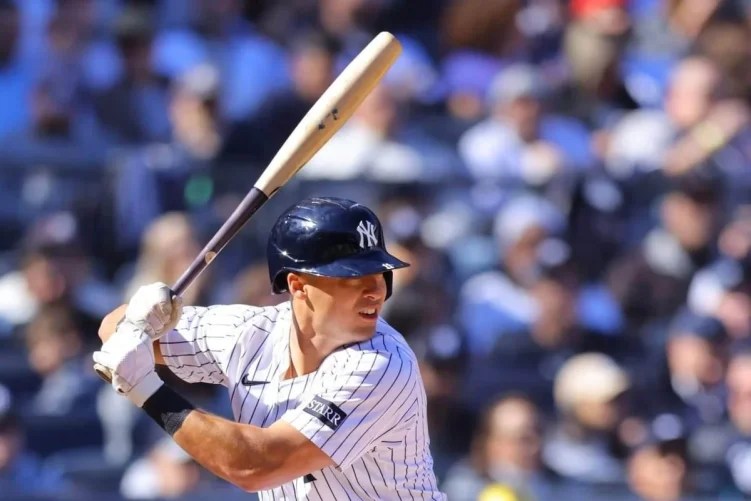
Anthony Volpe

. . . but this is, in the hands of the man whose plate performances got the Yankee brain trusts—oh! the hor-ror!—thinking. (Volpe rewarded them by hitting one of the nine Yankee bombs against the Brewers Saturday.)

The woofing and warping began aboard social media (cheaters! cheaters!) until someone, who knows whom, slipped into the bellowing the fine and legitimate point that the rule book doesn’t quite outlaw such bats. I give you Rule 3.02: The bat shall be a smooth, round stick not more than 2.61 inches in diameter at the thickest part and not more than 42 inches in length. The bat shall be one piece of solid wood. You might note that it says nothing about just where the thickest allowance must be.

You might also note that there do remain baseball traditions immune to change. Suspecting the Yankees of crime is one of them. But you don’t have to be a Yankee cultist to wonder why it was (and is) that nobody else thought of creating such bats within the rules before the Yankees got the a-ha!

You might also note, further, that Cortés wasn’t exactly unfamiliar to the Yankees, since he’d been one of them fo five of the past six seasons. “Nestor (had) been here for years,” said Judge postgame. “He’s one of the best lefty pitchers in the game. He’s going to go out there and throw strikes and attack you. We just tried to go out there and be aggressive in our zone. Goldy and Belli, they were aggressive and got things going there. This place was rocking once I got up there.”

So. When Volpe batted the secone timd in the bottom of the second, he had Judge and Chisholm aboard and two out. This time, he waited until he had a full count before swinging and hammering a Cortés cutter over the left field fence. Now the game was 7-3, Yankees. And the party wasn’t even close to being over.

Fried survived a miniature jam in the top of the third, but Cortés didn’t survive walking Yankee designated hitter Jasson Domínguez to open the bottom. Connor Thomas came in to pitch. Grisham singled Domínguez to second, Thomas plunked Goldschmidt, Bellinger beat out an infield hit to send Domínguez home and load the pillows for Judge—who sliced salami on a 2-1 up-and-in cutter.

Then Chisholm wrung his way up from a few fouls to hit a 1-2 service into the right field seats. Making it 13-3, Yankees, which turned to 16-4 (erstwhile Phillie Rhys Hoskins poked an RBI single in the top of the fourth) in the bottom of the fourth, when Bellinger sent Grisham home on a sacrifice fly after Goldschmidt doubled him to third, but Judge followed with a two-run homer over the center field fence.

Judge’s third major league three-bomb day and his first since 2023. Eight home runs on the day for the Yankees so far, tying a franchise record they’d break when pinch-hitter Oswald Peraza hammered Brewers reliever Chad Patrick for a one-out, two-run homer in the bottom of the seventh. Making it 20-6 (the Brewers scored two in the sixth); the Brewers had at least an RBI double (Jake Bauers) and a two-run homer (Brice Turang) in them before the carnage finally ended.

“You think you’ve seen it all in baseball,” said Brewers manager Pat Murphy postgame, “and you haven’t because we saw it today—three pitches, three homers. Usually, you wake up from that. You go, ‘Wow. God. That can’t ever happen.’ It just did.”

The game was so disastrous for the Brewers that Murphy finally sent Bauers forth to pitch the bottom of the eighth, hoping to spare his pitching staff any further humiliation. The first baseman didn’t do any worse on the mound than the real pitchers, either. He shook off a two-out hit batsman and followup walk with a pop out for the side. He’d even gotten Judge to fly out in the eighth, an inning after Judge’s bid for a four-bomb day came up short enough in the sixth that he settled for a double.

He had to settle for becoming the fourth Yankee ever to have three three-bomb days, joining Hall of Famers Lou Gehrig (he had four of them) and Joe DiMaggio, plus third baseman Álex Rodríguez. “Anytime you get mentioned with those guys and what they’ve done in the game, and the careers they’ve had,” Judge said postgame, “it’s pretty special.”

Not that the Yankees were perfect on the day. Their five errors, which weren’t half as disastrous as their Game Five fifth inning in the World Series, hung Fried with four unearned runs among the six he did surrender on the day. Still.

“What a performance,” Yankee manager Aaron Boone summed up. “Kind of a weird, crazy game.” Kind of a crazy way to describe a massacre, too.

The All-Star Game was Clayton’s place

Clayton Kershaw, Blake Grice

National League All-Star starter Clayton Kershaw with fan Blake Grice, who touched Kershaw by telling the future Hall of Famer he was meeting him for Grandpa’s sake.

By right, this year’s All-Star Game start for the National League should have belonged to the Marlins’ Sandy Alcantara (he leads the Show’s pitchers with 5.3 wins above replacement level and his 1.76 ERA). And if the game were played someplace other than Dodger Stadium, it might have been Alcantara’s to start.

Braves manager Brian Snitker, managing the NL All-Stars as the previous season’s World Series skipper does, had his own idea. Especially since this was the first All-Star Game in Dodger Stadium since Jimmy Carter was still in the White House, and a Dodger icon was having an All-Star worthy season himself.

So Snitker elected to hand the opening ball to Clayton Kershaw. A Hall of Fame lock, approaching the sunset of an off-the-charts career, starting the All-Star Game in his home ballpark. You could imagine Snitker thinking to himself that you couldn’t pay to pre-arrange more serendipitous circumstances. Even with his own All-Star Max Fried among his pitching options.

It was a class gesture by the defending World Series-winning manager. Only one thing could have seen and raised, and that one thing was Kershaw himself. By most reports, one of the first things the 33-year-old lefthander did when Snitker called him to say the opening ball was his was to call Alcantara himself.

“He was awesome about it. I was really thankful about that,” Kershaw said, after the American League hung in for a 3-2 win through no fault of Kershaw’s own.

He let himself take the entire atmopshere in, even foregoing his usual pre-start intensity that compels teammates, coaches, and even his manager Dave Roberts to say nothing much more than “hello” to him. (He even let Roberts share lunch with him on Tuesday.) About the only thing Kershaw did remotely work-related was study some American League scouting reports.

One he didn’t have to study was Shohei Ohtani (Angels), whom Kershaw retired thrice when pitching last Friday. Wary of opening the All-Star Game with one of his signature breaking balls, Kershaw pumped a fastball that doesn’t have its former speed and Ohtani—interviewed before the game, promising to swing on the first pitch—smacked a broken-bat floater up the pipe into short left center for a leadoff single.

Then, having Aaron Judge (Yankees) 1-2, Kershaw suddenly couldn’t think of what to throw next. Some described him as buying time when he lobbed a throw to first. He bought more than he bargained for. He’d caught Ohtani having a snooze. Ohtani had drifted away from the pad and Kershaw’s lob turned into the first All-Star pickoff in fourteen years.

The two-way Angel could only laugh. Kershaw could only grin after first baseman Paul Goldschmidt (Cardinals) tagged Ohtani out. Dodger Stadium went nuclear. Kershaw finished striking Judge out, walked Rafael Devers (Red Sox), and lured Vladimir Gurrero, Jr. (Blue Jays) into an inning-ending ground out. The man who wanted to take it all in from start to finish then ducked out of sight and to a press podium under the ballpark.

Shohei Ohtani, Clayton Kershaw

All they could do was grin and laugh after Kershaw (right) picked Othani off first while working to Yankee bombardier Aaron Judge.

While the National League took an early 2-0 lead with Mookie Betts (Dodgers) singling home Ronald Acuña, Jr. (Braves; leadoff double off AL starter Shane McLanahan [Rays]) and—after a double play grounder by Manny Machado (Padres)—Goldschmidt hammering one into the left center field bleachers, Kershaw finished his press conference with a ten year old boy raising a hand.

“What’s up, dude?” Kershaw asked pleasantly.

The boy introduced himself as Blake Grice and told Kershaw how much his late grandfather loved both him and the Dodgers’ long-enough-retired broadcast deity Vin Scully and had wanted to meet them both. (His family had passes courtesy of MLB itself.) “So this moment is important to me,” the boy continued, “because I’m meeting you for him.”

The father of four children himself, Kershaw couldn’t resist when he heard that and saw the boy’s tears of likely gratitude for getting to do something for his grandpa in the presence of a Dodger icon who’s been the closest the Dodgers have had to longtime eminence Sandy Koufax.

“Come here, dude,” Kershaw beckoned. He hugged the boy, gave him a clap on the back, and said, “Great to meet you. Thanks for telling me. That took a lot of courage to tell me that. Your grandad sounded like an awesome guy.” When Kershaw asked Blake if he had a parent with him, the boy’s father held up his cell phone. Kershaw beckoned him forward and he snapped a photo of the pitcher and the boy speaking for Grandpa.

It was more than enough to atone for the prayers thousands of fans in the ballpark and perhaps the millions watching on television must have had that, despite going down to its ninth straight All-Star loss and 21st such loss in 25 such games, the National League didn’t tie the game in the bottom of the ninth.

That’s because the latest to emerge from baseball’s apparent laboratory of mad science would have had the game decided in favour of the Home Run Derby winner’s league if nine full innings ended in a dead heat. (On Tuesday it would have been the National League, thanks to Juan Soto [Nationals] winning the Derby.) Thank God and His servants Branch Rickey and Jackie Robinson that that didn’t come to pass.

The AL overthrew the NL lead with one out in the fourth when Giancarlo Stanton (Yankees) batted with Jose Ramírez [Guardians] aboard (leadoff single) and took Tony Gonsolin (Dodgers) far into the left center field bleachers. Byron Buxton (Twins) following at once found himself ahead in the count 2-1 when he caught hold of a Gonsolin fastball up and drilled it into the left field bleachers. Just like that, Gonsolin had surrendered 882 feet worth of home run travel.

Buxton admired game MVP Stanton’s blast from the on-deck circle and thought to himself, “I ain’t matching that.” Until he damn near did. “I don’t even know if you can put it in words how hard [Stanton] hit the baseball,” Buxton said after the game.

It made all the difference when the game otherwise became a pitching duel of sorts between eleven American League pitchers (including Framber Valdez [Astros] getting credit for the “win” despite striking nobody out in his inning’s work) and nine National League pitchers including the hapless Gonsolin tagged for the loss and, officially, a blown save.

For just the sixth time in four decades an All-Star pitcher got to start the game in his home ballpark. And for a few shining moments on the mound, Kershaw gave his home park’s audience a thrill topped only by the one he gave a ten-year-old boy looking to do his grandpa in the Elysian Fields a favour that couldn’t be done while the older man still lived on earth.

None of the highest highs or the comparatively few lows he’s endured in fifteen major league seasons have let Kershaw forget that baseball at core is about rooting, caring, loving. He had the parallel chance to remind a Dodger Stadium audience about it and to affirm it for a ten-year-old boy. He didn’t flinch at either opportunity.

A little hustle in the muscle

Dominic Smith

Dom Smith diving across first after Cardinals reliever Giovanny Gallegos (65) was late covering on Smith’s smash up the line and well behind the base in the top of the ninth Monday. Gallegos then tried but couldn’t nail trail runner Jeff McNeil at the plate, kicking the Mets’ overthrow win into overdrive.

It looked simple enough. Mets outfielder Mark Canha down to his and the Mets’ final strike Monday night with third baseman Eduardo Escobar aboard on a one-out base hit. Cardinals reliever Giovanny Gallegos 0-2 on Canha and ready to land the last punch(out).

The good news for the Mets is that they ended up landing the final punch with a two-run homer finishing a 5-2 overthrow into which they hustled themselves after they’d been down to their final strike. Aided and abetted unexpectedly by Gallegos a moment late and two bucks short covering first base on what could have been a game-ending dazzler.

Thus did the first showdown between the leaders of the National League East and Central grind, sprint, and launch its way to the finish in the Mets’ favour. You could almost feel the Cardinals bawling themselves out that it didn’t have to go that way the moment Mets reliever Edwin Diaz struck Cardinals outfielder Harrison Bader out after a two-out walk.

It came to this because the Mets wasted a delicious pitching duel between Max Scherzer and the Cardinals’ Miles Mikolas, trading shutouts for seven innings, after Mets reliever Tyler May couldn’t put Mendoza Line-hitting Tyler O’Neill away and surrendered a two-run single for his trouble with the bases loaded and one out in the bottom of the eighth.

But now Canha wasnt quite so ready, fighting back to a full count, before he hit a bouncer up the third base line to Nolen Arenado, the Cardinals’ third baseman to whom a play like this, even on the short run, was something he could do upside down if necessary.

Arenado on the not-so-hard run whipped a throw across the infield to first base. The ball soared right past first baseman Paul Goldschmidt and Escobar soared home to put the Mets on the board at last, with Canha taking second on the play and Jeff McNeil checking in at the plate.

Canha came out for pinch runner Travis Jankowski. McNeil sent an RBI double deep to right. And Mets manager Buck Showalter sent Dom Smith up to pinch hit for smart catching/modest-hitting Tomas Nido. Smith shot one up the first base line that Goldschmidt stopped one way or the other, diving across the line as he speared it fair.

But when Goldschmidt hustled a throw to the pad he had no target. Gallegos bounced off the mound a moment too late for the out as Smith dove onto the pad and Jankowski and McNeil cross the plate safely, McNeil himself diving home a split second before Cardinals catching insertion Andrew Kinzner could get a tag on him off Gallegos’s throw home.

“The second he hit it, I thought it was a foul ball,” said Gallegos post game. “Then I saw the ball bounce back to first, and that’s when I broke.”

“That’s a mental mistake,” said Cardinals manager Oliver Marmol. “Can’t excuse it. He knows it; we know it: He’s got to cover first.”

“Dom probably ran the fastest 90 (feet) of his life there,” said McNeil. “I knew it would be close at first base. I ended up scoring. It was a lot of fun.”

Smith wouldn’t exactly disagree. “You try to hustle as hard as you can to beat him,” he said. “I saw the closer didn’t get over right away. I just ran as hard as I could. I knew I had a step on him. I felt slow but I tried to run hard.” Don’t fight the feeling next time, either. It could be worth another pair of runs in another eleventh-hour effort.

It put the Mets up 3-2, brought lefthander T.J. McFarland in to relieve Gallegos for the Cardinals, and brought lefthanded-hitting Brandon Nimmo to the plate for the Mets. McFarland threw Nimmo a sinker that didn’t quite sink below the inner middle of the zone, and Nimmo sunk it on a high line inside the right field foul pole.

“It was worth the wait,” said Mets manager Buck Showalter after they banked the game. “It really was. It was fun to watch.”

“We’re a resilient team,” Smith said, “and I feel like we’re in it till the last pitch every night. Even the games that we don’t come up with a win, I feel like we make it tough on our opponents when they do beat us. I think it showed our DNA and what we’re about.”

And it almost (underline that) erased the pitching duel that kept Busch Stadium in thrall most of the night. Scherzer may have struck ten out in his seven innings but he appreciated his mound opponent just as much. Appropriately.

“Tip your hat off to Miles tonight,” he said of Mikolas, whose own seven-inning effort was five punchouts and four scattered hits. “That’s baseball. It was a great game. Sometimes you run into a buzz saw and he did his job tonight. I’m pitching on pins and needles there. I have to make every pitch. I was thinking even a solo shot might lose it.”

He didn’t have to worry as much as he thought. Monday night left Max the Knife number five on the career survey with his 106th double-digit-strikeout game, not to mention 33 punchouts and a measly eight walks in 25 innings pitched this season thus far.

If only he could pitch in Busch Stadium more often than he does. In his previous five gigs there, he’s gone seven innings or more each without a single run being pried out of him. He also has an ongoing 21-straight shutout inning streak against the Cardinals, and now that he has seven starts of ten strikeouts or more against them he’s behind only Hall of Famer Sandy Koufax in that department.

This is the pitcher the Cardinals have never tried to sign when he was on the open market despite his roots being in Missouri. Now they can look forward to this plus two more seasons of potential continuing torture at his right hand. Even if he might still need Met bats in the ninth to keep the bullpen from trashing his best efforts after he departs for the day or night.

“Everybody had a hand in that rally and that’s the cool thing,” he said of the Mets’ ninth-inning grind-out. “When you see your offense go off like that and just find a way to scratch across extra runs.” Catching one of the other guys asleep just enough when there’s first base to cover critically doesn’t exactly hurt, either.