Queen Elizabeth II, RIP: Take her out to the ballgame

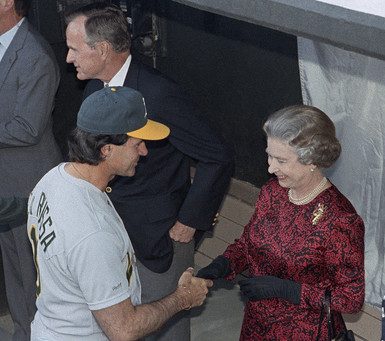
Tony La Russa, Queen Elizabeth

Hall of Fame manager Tony La Russa greeting Queen Elizabeth II in the dugout (with President George H.W. Bush in the background) before the A’s played the Orioles in May 1991, during the queen’s visit to the U.S. On that day, La Russa’s pitcher Dave Stewart threw HRH a nyukleball.

Her late majesty Queen Elizabeth II had something not customarily associated with royalty, namely a fair sense of humour. Dave Stewart, then an  Athletics pitcher, sort of learned when Elizabeth and her husband Prince Phillip visited the United States in 1991 and attended a game between the A’s and the Orioles.

The game was 15 May 1991 at Baltimore’s old Memorial Stadium. Stewart didn’t start the game for the A’s but Bob Welch did. Before the game, the royal couple visited the dugouts and chatted with assorted players, including Stewart, a pitcher whose success on the mound with the A’s was equal only to his countenance taking a sign. The countenance that suggested he might bite your bat barrel or your head off before trying to bust one past you.

Stewart discovered Her Royal Highness’s good humour even if decorum compelled her not to let it loose too readily. “I remember like it was yesterday,” the former righthander whose uniform number 34 becomes a retired number come Sunday told USA Today‘s Bob Nightengale.

We were all lined up to meet her in that procession. So Three Stooges was one my favorite comedies . . . So when she passed (in line), I did like a Three Stooges thing: ‘Queenie, nyuk nyuk.’ She laughed. Well, cracked a smile . . . Put it like that. The rest of the team was cracking up. It was cool for me. I’m sure it was for everybody too, but I had to go act like a god-dang fool.

Let the record show the A’s beat the Orioles 6-3, despite Orioles first baseman Randy Milligan hitting a pair out against Welch, a pair of leadoff blasts in the fourth and sixth innings; and, with a little help from Oriole starter Jeff Ballard picking Hall of Famer Rickey Henderson off second only to see it turn into a run on a dubious fielding error.

Let the record show further that Prince Philip may have had a better time at the game than his wife. Sitting in a luxury box with then-president George H.W. Bush, defense secretary Dick Cheney and then-baseball commissioner Fay Vincent, according to the San Jose Mercury-News, Philip pored through a media guide and kept binoculars in front of his eyes as he scanned the field and the play. Elizabeth “sat primly and looked bored.”

If you’re my age, you may remember enough of the world thought she was kidding around when she named the Beatles as members of the Order of the British Empire in 1965. I can remember enough hoopla indicating enough among the British political and social class objected anywhere from strenuously to amusingly to returning their own M.B.E.s.

My thought approaching age ten was that Her Majesty must have been tempted to breach her well-known composed self and style to slap the twits silly. Ed Sullivan, through whom the Beatles graduated from mere phenomenon to universe shakers in early 1964, did it for her, when he introduced the Beatles at Shea Stadium in August 1965: Honoured by their country . . . decorated by their Queen . . . and loved here in America!

Twelve years after Sullivan’s bouquet came the espionage novel that probably provoked both mirth and melancholia in the former motherland, William F. Buckley, Jr.’s Saving the Queen. His protagonist—a CIA operative on assignment to plug up the Buckingham Palace leaks through which American atomic secrets were being snuck—included in his operation a sexual tryst with a fictitious British queen.

Well, now. I’ll let the late Mr. Buckley himself take it from here, from an essay republished in A Hymnal: The Controversial Arts (1979):

There is something wonderfully American, it struck me, about bedding down a British queen: a kind of arrant but lovable presumption. But always on the understanding that it is done decorously, and that there is no aftertaste of the gigolo in the encounter. I remember, even now with some trepidation, when [Saving the Queen] came out in the British edition. The first questioner at the press conference . . . was, no less, the editor of The Economist, and he said with, I thought, a quite un-British lack of circumspection, “Mr. Buckley, would you like to sleep with the Queen?” Now, such a question poses quite awful responsibilities. There being a most conspicuous incumbent, one could hardly wrinkle up one’s nose as if the question evoked the vision of an evening with Queen Victoria on her Diamond Jubilee. The American with taste has to guard against a lack of gallantry, so that the first order of business becomes the assertion of an emancipating perspective which leads Queen Elizabeth II gently out of the room before she is embarrassed. This was accomplished by saying, just a little sheepishly, as [protagonist] Blackford Oakes would have done, “Which queen?”—and then quickly, before the interrogator could lug his monarch back into the smoker—“Judging from historical experience, I would need to consult my lawyer before risking an affair with just any British queen.”

The reaction of monarch with the subdued but not invisible sense of humour is not on record to the best of my knowledge, though I’d be happy if proven wrong. Especially so considering that in the novel itself the queen is the seductress and the spy the seduced. Elizabeth was known discreetly for playfulness with her husband but not believed to have been anything on the make in her premarital youth.

A consummation even more devoutly to be wished might be her response to Mr. Buckley’s eventual revelation that his friend David Niven, the distinguished British actor, answered his request for a blurb to appear with the novel’s paperback edition: Probably the best novel ever written about fucking the Queen.

Needless to say, the blurb never appeared except in a Buckley recollection or three. I suspect Elizabeth’s good humour might have deflected contortions enough, remembering she probably confronted far more grave lapses of decorum over her unprecedented seventy-year reign.

Including too many among her own offspring, for one of whom it would be high praise if nyuklehead was the worst sobriquet attached to him. The good news is that he’s not the one who ascended the predominantly ceremonial British throne upon his mother’s death. If the sins of the parents be visited not upon their children, surely the sins of the children should not be visited upon their parents.

Which enables Elizabeth to an eternal reward I pray includes frequent escort to the Elysian Fields and an afterlife education telling her that, unlike what she seems to have thought that 1991 day in Baltimore, a queen renowned as something of a thinking person should appreciate the thinking person’s sport.
Clowns to the left of me, jokers to the right

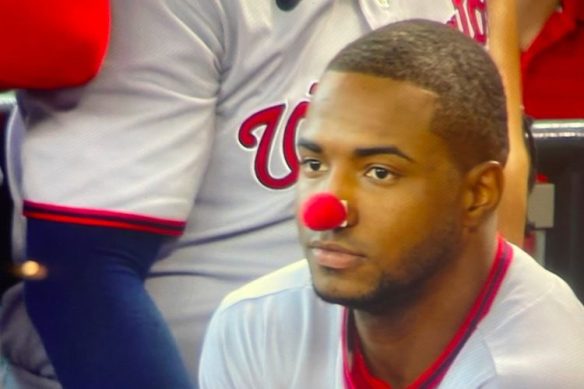
Victor Robles

That was a clown dismissal, MadBum . . .

Grumpy Old Men Dept.—It’s tough to determine which stung Madison Bumgarner more, Victor Robles hitting one over the fence and savouring it visibly on his dollar or Robles responding with a classic troll when Bumgarner dismissed him as a clown: Perhaps if MadBum wishes not to be clowned, he might ponder the thought that surrendering 24 homers a year on average goes a long way toward denying such wishes. Earth to MadBum: that was a clown dismissal, bro.

Busted Dept.—I’d like to go on record yet again as saying and believing that a player who’s sent from promise to unfulfilled promise because of injuries incurred while he actually plays the game isn’t a bust. I’d also like to go on record in that regard as saying anyone who claims otherwise and matches such players to those who either can’t cut it after all or squander their talent (drugs, too much high life, too little conditioning and work ethic, etc.) should be dismissed as a damn fool.

Glove Story Dept.—Amidst most of the high-fiving among Yankee fans over the team acquiring left fielder Andrew Benintendi from the Royals in exchange for a pitching prospect trio, maybe 99 percent of the chatter pointed to Benintendi’s on-base machinery this year and maybe one percent pointed to his equivalent gift for preventing runs.

I get Yankee fans trying to swallow that this guy was once a rival on the Red Sox, but they should be very mindful of Benintendi’s ability to break the other guys’ backs with his legs and glove in left field. Their Yankees may yet need him to save a pennant the way he helped do for the 2018 Red Sox:

Giant Steps Dept.—That was then: the Giants not looking to deal away veterans. This may be now: the Giants may order about face! to the rear, march! on that. Various reports indicate the recent Giants fade has “other teams” keeping one eye on that possibility—including prospective free-agent veteran pitcher Carlos Rondon and outfielder Joc Pederson. But will the eyes have it?

Relief Dept.—It’s enough that Juan Soto is on the trade market, apparently. But Nationals general manager Mike Rizzo, also apparently, insists that he’s also not going to use moving Soto as a tack to unload a bad or at least compromised contract—such as pitcher Patrick Corbin’s remaining $50 million. You’d love to think that even the forthright Rizzo wouldn’t really play that game. Memo to teams interested in Soto: Trust your mother but keep the spare tire inflated properly.

You’ll Be Happier with a Hoover Dept.—The Astros got beaten, swept, and cleaned this week. By the Athletics. The dead-in-the-(AL)-West Athletics. In Oakland, where the A’s were 17-30 before the first-in-the-West Astros came to town. They even beat Luis (Rock-a-Bye Samba) Garcia and Cristian Javier while they were at it. And, won each game by exactly two runs. Break up the A’s?

You Can Be Sure Dept.—From self-described king of the Mets’ Twitter underground, handling himself METSMENACE, after the Mets swept the Yankees in a two-game set with Max Scherzer punching out six including Aaron Judge thrice: “It’s a good thing [Jacob] deGrom wasn’t in the dugout when Scherzer was giving high fives from hell or he’d be out for another 9 months.” As if Max the Knife would be that blind.

Bronx Savings Bank Dept.—In one way, Andrew Benintendi didn’t lose a thing being traded to the Yankees: the Royals were scheduled to fly to New York for a weekend set with the Empire Emeritus, so he was going to the Bronx one way or the other. The only thing he has to change is his field wardrobe. This is what’s known at times as the perfect storm. But what if the Yankees use the Royals for target practise and Benintendi proves one of the best marksmen this weekend?

Portside Dept.—The Red Sox insist they have no intention of trading either of their left-side infield mainstays, Xander Bogaerts (shortstop) and Rafael Devers (third base). They insist despite recent struggling that they’d prefer to buy and sell at once for the coming trade deadline, maybe selling other veterans and buying a few long-term pieces. Says Red Sox Nation: Heavy sigh of relief. Says experience, and not just regarding Boston: Is that just the same old song? Don’t touch that dial.

Jeremy Giambi, RIP: What broke him?

The Flip

Jeremy Giambi’s brief major league career was defined too powerfully by The Flip, but he was an on-base machine in Oakland until he was traded under dubious circimstances.

Sad enough that Jeremy Giambi was reported dead at 47 two days ago. Sadder still was the Los Angeles County coroner affirming what Giambi’s former Athletics teammate Barry Zito hinted in a text message to San Francisco Chronicle writer Susan Slusser.

Giambi, Zito texted, “was an incredibly loving human being with a very soft heart and it was evident to us as his teammates that he had some deeper battles going on. I hope this can be a wake up call for people out there to not go at it alone and for families and friends to trust their intuition [w]hen they feel somebody close to them needs help. God bless Jeremy and his family in this difficult time.”

At his best, Giambi was an on-base machine with a little power and a preternatural ability to wear pitchers out comparable to his brother, Jason. He wasn’t particularly swift afoot and he was defensively challenged, but in two and a third full seasons in Oakland he posted a .369 on-base percentage, including .391 in 2001, his seond and last full season there.

The bad news was that year’s American League division series and Giambi getting nailed at the plate famously, when the Yankees’ Hall of Fame shortstop Derek Jeter executed The Flip, running down from his cutoff position and across the lower infield, over the foul line, to grab an errant throw toward the plate and back-flip to catcher Jorge Posada to get Giambi a second before his foot hit the plate.

Giambi would have tied the game at one each if he’d scored. Depending upon the angle you see, there are those who argue he might actually have been safe on the play. But the play cemented Jeter’s image as a game-changer and thwarted the A’s from tying the game at one each at minimum. (The Yankees went on to win, 1-0.)

For years to follow Giambi was questioned over going home standing up instead of sliding on the play. (A’s catcher Ramon Hernandez could be seen raising and lowering his hands adjacent to the play, the signal for urging a runner to slide.) Most likely he—and maybe everybody else in the Oakland Coliseum—didn’t see Jeter coming at all, never mind having a prayer of getting him out.

As I write I’ve seen no published indication that the play, the aftermath, and even the questioning affected Giambi in any negative way. The 2001 A’s manager, Art Howe, told Slusser on Wednesday, “I know how hard Jeremy played every single day. I know our fans remember him for that non-slide, but I think it’s a shame anyone even thinks about that. He was a good kid, he was well liked, and he gave me everything.”

A’s GM-turned-president Billy Beane now remembers Giambi as “a fun guy, a good guy, and an underrated player, particularly an underrated hitter. He was quite frankly an important piece of probably the best team we’ve had since I’ve been here, that 2001 team.”

This is now, but that was then, as Michael Lewis recorded in Moneyball: The Art of Winning an Unfair Game: Beane sent three-eighths of his starting lineup “and a passel of pitchers” out of town by 23 May 2002, including Giambi, after Beane became “erratic” in his behaviour and steaming mad with his front office and the team’s coaches following a mid-month sweep by the Blue Jays in Toronto.

Just before the Toronto series the team had been in Boston, where Jeremy Giambi had made the mistake of being spotted by a newspaper reporter at a strip club. Jeremy, it should be said, already had a bit of a reputation. Before spring training he’d been caught with marijuana by the Las Vegas police. Reports from coaches trickled in that Jeremy drank too much on team flights. When the reports from Boston reached Billy Beane, Jeremy ceased to be an on-base machine and efficient offensive weapon. He became a twenty-seven-year-old professional baseball player having too much fun on a losing team. In a silent rage, Billy called around the league to see who would take Jeremy off his hands. He didn’t care what he got in return. Actually, that wasn’t quite true: what he needed in return was something to tell the press. “We traded Jeremy for X because we think X will give us help on defense,” or some such nonsense. The Phillies offered John Mabry. Billy hardly knew who Mabry was.

. . . After he’d done the deal, he told reporters that he traded Jeremy Giambi because he was “concerned he was too one-dimensional” and that John Mabry would supply help on defense. He then leaned on Art Howe to keep Mabry out of the lineup. And Art, occasionally, ignored him. And Mabry started to swat home runs and game-winning hits at a rate he had never before swatted them in his entire professional career. And the Oakland A’s began to win.

The 2002 A’s were 20-25 before the Giambi-for-Mabry trade, including losing fourteen out of their prior seventeen games. Giambi was hardly to blame; at the time of the trade, he was hitting .274 with a .390 on-base percentage and a .471 slugging percentage. Two months after the trade, the A’s stood at 60-46.

Maybe Beane really wanted to send the message that even a .390 on-base percentage was expendable if he was the same fellow in losing as he was in winning.

Maybe Giambi didn’t go into black-band mourning after losses often enough for Beane’s taste. Maybe Beane didn’t grok that it doesn’t always do any favours to insist you must sink into a vale of tears following a loss. Maybe he forgot it’s often best to just shake off the loss because you get to play another day, another season, after all.

“Everyone,” Lewis noted, called Beane a genius for seeing Mabry’s heretofore hidden abilities, never mind that the deal was anything but comparable to a lab experiment: “It felt more as if the scientist, infuriated that the results of his careful experiment weren’t coming out as they were meant to, waded into his lab and began busting test tubes.”

Giambi with the 2002 Phillies hit a mere .244 but posted a .435 on-base percentage and—with twelve homers and ten doubles among his 38 hits—a .538 slugging percentage. Mabry’s line with the 2002 A’s: .275/.322/.523, with eleven home runs and thirteen doubles among his 53 hits. But Mabry went 0-for-2 in the 2002 postseason while Giambi and the Phillies didn’t quite make it there.

Both men moved on after that season, the Phillies trading Giambi to the Red Sox and Mabry signing with the Mariners as a free agent. Giambi incurred injuries and was finished as a major leaguer after 2003. He was the first incumbent or former major leaguer to cop to using actual/alleged performance-enhancing substances, but 52 homers in six major league seasons (17 per 162 games, average) doesn’t exactly make a case for their doing him any favours.

(That Vegas pot bust—at a McCarran Airport checkpoint while he was traveling to Phoenix —ended up a big nothingburger: Giambi’s pot was confiscated, he was issued a simple citation, and released to continue his travel.)

Who knows whether some heretofore undetected combination of criticism over The Flip and the true reason behind his trade out of Oakland didn’t start puncturing part of the younger Giambi’s psyche?

The former’s easily discarded; Giambi wasn’t the 2001 division series goat, and Jeter was a division series hero coming from nowhere to make an unlikely play. Giambi said in a 2020 interview that “maybe I should have slid” but he didn’t necessarily commit to that thought even two decades later.

Those are things we can’t analyze. Obviously, I think about it. I don’t dwell on it, but I think about it. I think that’s part of our competitive nature. I mean, we were going to win a World Series. I know that was the first round, but we always felt like we had to go through the Yankees, and if you got through the Yankees, you had a pretty good chance, at that time. They were the team to beat.

The trade issue may or not be discarded or defined so easily just yet.

Who knows, either, whether it was too difficult not being able to post anything close to his older brother’s major league numbers and compensation? (Tainted or not, Jason Giambi per 162 games hit almost twice as many homers, and finished his career with 388 more home runs and $130 million more career earnings.)

We don’t, yet. Nor do we know what in his post baseball life piled onto the issues his former teammate Barry Zito—himself a haunted man as a pitcher in both grand success and bewildering failure—referenced.

For now, we know only that an apparently likeable, fun-loving fellow with an apparent heart of gold saw fit to end his life with a gunshot into his chest. Whatever drove Jeremy Giambi to end his life, may the Lord have mercy upon his apparently haunted soul and grant him peace.

Genius playing with mental blocks?

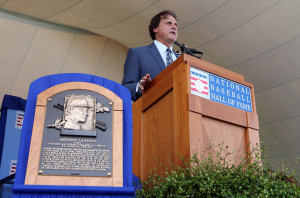
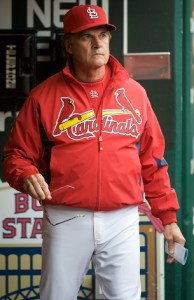
Tony La Russa

Even Hall of Fame managers aren’t always the geniuses they’re cracked up to be.

No baseball manager is a perfect specimen, whether he lucks into the job, performs it long enough and well enough, or gets himself elected to the Hall of Fame because of his actual or reputed job performance. Many have been the managers whose reputations for genius are out of proportion to their actual performances.

Even the certified geniuses made their mistakes. Maybe none was more truly egregious than Casey Stengel’s failure to set up his rotation so his Hall of Fame lefthander Whitey Ford could start three 1960 World Series games instead of two. Unless it was Tommy Lasorda deciding it was safe to let Tom Niedenfeuer pitch to Jack Clark, with first base open and the Dodgers one out from forcing a seventh 1985 National League Championship Series game.

Maybe it was Dick Williams, placing public perception ahead of baseball to start gassed ace Jim Lonborg instead of a better-rested arm in Game Seven, 1967 World Series. Unless it was Gene Mauch, the Little General panicking down the 1964 stretch (with the Phillies, using his two best pitchers on too-short rest and blowing a pennant he had in the bank), or in Game Five (with the Angels) when he was an out away from winning the 1986 American League Championship Series.

Regardless of his foibles since what proved his first retirement, Tony La Russa still has an outsize reputation as one of the most deft ever to hold the manager’s job. He’s been called a genius. He’s been called one of the smartest baseball men of the last half-century. They point to his Hall of Fame plaque, the 33 years he managed prior to returning to the White Sox this season, eleven division titles, six pennants, and three World Series rings.

Those plus his longtime reputation for volumnious pre- and post-game thinking and analysis (observed perhaps most deeply in a chapter of George F. Will’s Men at Work: The Craft of Baseball) still allow La Russa absolution from his most egregious errors.

He threw his 2021 White Sox star Yermin Mercedes under the proverbial bus, and maybe even invited the Twins to retaliate the following day, after Mercedes swung on 3-0 (violating La Russa’s fealty to the Sacred Unwritten Rules) in the eighth inning of a White Sox blowout, and hit a home run . . . off a middle infielder sent to the mound.

La Russa is still considered one of the smartest of the Smart Guys whatever they think of Mercedes’s homer or La Russa’s definition of “sportsmanship.” (They don’t always stop to ponder what La Russa thought of the Twins’s “sportsmanship” in giving up the ghost with two innings left to close even a fat deficit and sending a position player to the mound with real pitching still available to them.)

Perhaps they haven’t read Keith Law, writing in The Inside Game last year: “Sometimes you do all the right things and are stymied by bad luck. Other times you do everything wrong and are subsequently rewarded for it. That’s outcome bias.” There’s a case to be made that La Russa’s reputation, and maybe even his Hall of Fame case, is a little more than half a product of such outcome bias.

It’s hard to argue against a manager with three decades plus on his resume plus those division titles, pennants, and three Series rings. But maybe it’s easy to forget or dismiss how often La Russa either outsmarted or short-sighted himself when the games meant the absolute most.

“Tony, stop thinking,” Thomas Boswell wrote, after La Russa’s Athletics were swept out of a 1990 Series they could have tied in four and gone on to win, instead of being swept by a band of Reds upstarts who didn’t know the meaning of the words “shrink under pressure.”

If the A’s had picked an usher at random to manage them in this Series, they’d have been better. The usher would have brought in [Hall of Fame reliever Dennis] Eckersley to start the eighth inning of Game Two with a 4-3 lead. The usher would have brought in Eckersley to start the eighth inning of Game Four with a 1-0 lead. And this Series would be two-all.

La Russa could write a book on why did he did what he did. But the bottom line is that every manager in the Hall of Fame would have brought in the Eck. Twice Tony didn’t and twice the A’s lost. This time, the goat’s horns stop at the top.

Outcome bias didn’t help La Russa then, a year after he’d won his first Series. But it sure helped him after a 2011 Series he won despite himself. Because smart baseball men don’t do even half of what La Russa did to make life that much tougher for his Cardinals than it should have been.

Tony La Russa

La Russa’s 2011 Cardinals won a World Series despite the skipper’s missteps.

Smart baseball men don’t take the bats out of the hands of future Hall of Famers with Game One tied at zero. La Russa took it out of Albert Pujols’s hands by ordering Jon Jay to sacrifice Rafael Furcal, guaranteeing the Rangers wouldn’t let Pujols swing even with a swimming pool noodle, walking him on the house. (The next batter got lured into dialing Area Code 5-4-3.)

Smart baseball men don’t lift better clutch hitters (especially those shaking out as Series MVPs) with late single-run leads for defensive replacements who might have to try a lot harder to do the later clutch hitting with insurance runs to be cashed in—and fail. La Russa did that lifting David Freese (after he scored a single tiebreaking run) for Daniel Descalso (grounded out with two in the eighth) in Game Two.

Smart baseball men don’t balk when their closers surrender two soft hits in the Game Two ninth with a groin-hobbled bopper due up and a double play possibility very distinct. La Russa balked. He lifted Jason Motte for Arthur Rhodes with Josh Hamilton coming up. Rhodes gave the lead away and Lance Lynn gave the game away—on back-to-back sacrifice flies.

Smart baseball men don’t look past three powerfully viable and available bullpen options with their teams down a mere 1-0 and reach for . . . a known mop-up man, with the opposition’s hottest Series bat due up. La Russa learned or re-learned the hard way in Game Four. Mike Napoli thanked him for offering Mitchell Boggs as the sacrificial lamb—Napoli hit the first pitch for a three-run homer. (Final score: Rangers 4, Cardinals 0.)

Smart baseball men don’t snooze for even a moment and forget to flash the red light when their batter (Pujols, in this case) signals their baserunner Allen Craig to try for a steal in the Game Five seventh.  Craig got arrested by half a mile, inviting another free pass to the bopper and—following a base hit setting up second and third when the batter advances on the throw to third—another free pass and an inning-ending fly out.

Smart baseball men also don’t let a little (ok, a lot of) crowd noise interfere with getting the pen men up that he wants to get up in the bottom of the Game Five eighth—after ordering one relief pitcher tough on righthanded hitters to put a righthanded hitter aboard on the house, yet, instead of getting the second out—then try sneaking a lefthanded pen man past a righthanded danger who sneaks what proves a game-winning two-run double.

They don’t try to make the Case of the Tangled Telephone out of it, either, after they end up bringing in the wrong man when nobody claimed to hear them ordering the guy they really wanted to get ready. (La Russa wanted Motte but got Lynn. Oops.)

Neither do smart baseball men drain their benches in the eighth of even a do-or-die Game Six. La Russa did. It compelled his Cardinals to perform their still-mythologised ninth and tenth inning feats of down-to-their-final-strike derring-do without a safety net beneath them. Freese took one and all off the hook with his eleventh-inning, full-count, game-winning, Richter scale-busting leadoff bomb.

The Cardinals won that Series despite their skipper. (And, because they pinned the Rangers in Game Seven, after allowing a 2-0 first-inning lead on back-to-back RBI doubles. They made it impossible for La Russa to overthink/mis-think/mal-think again after they tied in the bottom of the first and scored four more from there.) La Russa was thatclose to blowing a Series his Rangers counterpart sometimes seemed to do everything within reach to hand him.

Fairness: La Russa did plenty right and smart winning those division titles. He did plenty right and smart winning the 2006 Series in five. (It didn’t hurt that he knew what he had turning his resident pest/Series MVP David Eckstein loose.) That was two years after nobody could have stopped the Red Sox steamroller from plowing the Cardinals in four, following their self-yank back from the dead to take the last four ALCS games from the Empire Emeritus.

But the 2011 Series got La Russa compared in the long term to . . . Bob Brenly, the Diamondbacks manager who won the 2001 World Series in spite of his own mistakes, too. Batting his worst on-base percentage man leadoff; ordering bunts ahead of and thus neutralising his best power threat; overworking and misusing his tough but sensitive closer, even throwing him out a second straight night after the lad threw 61 relief pitches the night before. (You’re still surprised Scott Brosius faced a gassed Byung-Hyun Kim and tied Game Five with a home run?)

Lucky for Brenly that he had one Hall of Fame pitcher (Randy Johnson) and another should-have-been Hall of Fame pitcher (Curt Schilling, his own worst enemy) to bail him out. Brenly hasn’t managed again since the Diamondbacks fired him during a 2004 skid to the bottom of the National League West.

When La Russa retired three days after that 2011 Series ended, he didn’t announce it until after the Cardinals’ championship parade and after he called a meeting with his players. “Some grown men cried,” he said of the meeting, adding, “I kind of liked that because they made me cry a few times.”

The smartest men in baseball with even half La Russa’s experience don’t invite comparisons to comparative newcomers who trip, tumble, and pratfall their way to World Series rings. Three Series rings keeps him a Hall of Fame beneficiary of the outcome bias Law described. It’ll probably keep La Russa cushioned with the White Sox for now, despite his early tactical mistakes.

And, despite the perception the Mercedes incident leaves that he’d rather burn his players in the public eye than handle real or alleged issues the mature way. (Name one manager who ever invited the other guys to retaliate for a real or alleged rookie mistake.) All that previous outcome bias won’t save him, if he costs himself his clubhouse and the White Sox turn from early-season surprise to season-closing bust.

No, it wasn’t Baldelli’s fault

Luis Arraez

This off-balanced throw from third by Luis Arraez finished what Travis Blankenhorn’s bobble at second started for the Twins Wednesday. Neither was the manager’s fault.

Sometimes you can believe to your soul that second-guessing is in a dead heat with cheating as baseball’s oldest profession. Twins manager Rocco Baldelli may be re-learning the hard way since Wednesday’s 13-12 loss against the Athletics.

All Baldelli did was make one smart move in the top of a tenth inning the Twins shouldn’t have had to play in the first place . . . and watch in horror with every Twin fan in creation when it blew up in his face in the bottom of the tenth. Through absolutely no fault of his own.

Baldelli inserted a speedy young pinch runner, Travis Blankenhorn, for his slower free half inning-opening cookie Josh Donaldson. He found himself with a swift and fresh two-run lead after Byron Buxton, who may yet prove the Twins’ answer to Mike Trout, hit a two-run homer to return the Twins a two-run lead.

With Donaldson out of the game Baldelli shifted his second base incumbent Luis Arraez to third and inserted Blankenhorn at second. Bottom of the tenth: the pillows stuffed with A’s after Twins reliever Alex Colome walked veteran Elvis Andrus to load them up after he opened the inning with two outs and nobody on.

Then A’s left fielder Mark Canha whacked a none-too-sharp grounder right to Blankenhorn. And Blankenhorn—with double play obviously on his mind—lost his grip on the ball as he made a right-arm motion to throw without the ball secure in hand, the ball hitting the ground and A’s inning-opening free cookie Matt Chapman coming home.

And then Arraez double-clutched before throwing Ramon Laureano’s grounder with his right leg slightly unbalanced. The throw sailed wide enough behind first base to pass a train through the space, but this time the only things passing through were Andrus and pinch-runner Tony Kemp scoring the tying and winning runs.

The A’s ought to send Colome roses for really enabling the sweep that shouldn’t have been. Twin Territory ought to knock it off with hanging the goat horns on Baldelli’s none-too-bald head.

This game had no business getting to the extra innings in the first place. Not until Colome opened the bottom of the ninth by hitting Laureano with a pitch, continued by surrendering a one-out base hit to Matt Olson roomy enough for Laureano to take third, and finished by surrendering a game-tying sacrifice fly to Chapman. Picking Olson off for the side with Stephen Piscotty at the plate didn’t quite atone for Colome’s original sin.

“It’s just baseball and it’s hard to understand,” said Laureano, taking the simpler view. “We were still loose and having fun, so we knew we would win.”

“The way the first two games went and then neither team could hold either down,” said A’s manager Bob Melvin after putting his gift an an eleven-game A’s winning streak safely in the bank, “it was almost like it was going to go down to the last at-bat regardless. And then you know what? You put a ball in play. At that point in time it’s not about walks and strikeouts and all that. Put it in play and something good can happen.”

That’s a matter of opinion, of course. Put a ball in play and something terrible can happen, too. If you’re an A’s fan, something wonderful happened. If you’re a Twins fan, you might want to think back to why the game shouldn’t have gotten to the extras in the first place.

For Baldelli to want some extra speed on the bases to open the top of the tenth wasn’t even close to the dumbest baseball move you’ll see. Blankenhorn had an .844 stolen base percentage in the minors. He was also a rangy enough second baseman who projected as a potential plus defender particularly adept at turning double plays.

You want to blame Baldelli for a rookie mistake, feel free. But a rookie mistake is just what Blankenhorn committed on the Canha grounder. A guy who turned 120 double plays in the minors should have remembered not to count his double plays before he turns them.

Arraez hasn’t played half the Show games at third that he’s played at second, and he isn’t the rangiest man on the planet at either position. But what he reaches or comes right to him, he handles under normal circumstances. Over three Show seasons Arraez entered Wednesday’s game with a measly four errors.

“In extra innings, if you don’t find a way to put a run on the board, you’re going to end up losing a lot of those games,” Baldelli told reporters after the game. “Doing everything possible to put that first run on the board is, I think, instrumental to finding ways to win those games.”

He did just what he thought possible opening the tenth and got immediate return when Buxton turned on Lou Trivino’s meatball up and drove it about seven rows into the high left center field seats.

And that was after Buxton spent the earlier portion of his evening going 2-for-5 with a double and taking an Olympics-like dive to spear Olson’s long sinking liner for the side, in the bottom of the sixth, preserving what was then a 10-9 Twins lead. Not to mention Nelson Cruz’s two-bomb night.

The Twins’ Wednesday starting pitcher, Kenta Maeda, the former Dodger, blamed himself for the disaster, after surrendering seven runs (three in the second, four in the third) to tie his career worst. “I could not set the tone,” he mourned. “If I had done that, we would have gotten that W.”

Yet the Twins hung up three-spots in the third, fifth, and sixth, after Donaldson himself hit A’s starter Frankie Montas’s first pitch over the left field corner fence in the top of the first.  That’d teach him.

“It’s been a hell of a trip, and not in a good way,” Baldelli said of the Twins’ now-concluded road trip, which involved postponements against the Angels due to COVID concerns followed by a loss to those Angels and now three straight losses to the A’s.

“Today was a game where we’re finding ways to not win games, even games that we should be winning,” he told the postgame questioners. “What we saw today is something we haven’t seen a ton from our group, and I stand in the front of it and take responsibility for all of it. It was a very difficult day.”

It wouldn’t have been that difficult if his man on the mound held fort in the ninth and his tenth-inning smarts weren’t rendered dumb by an anxious rook and an off-balance leg at third. Those mistakes can make Casey Stengel resemble Clyde Crashcup.