Sure. Censor fans. That’s the way to solve the A’s.

RingCentral Coliseum

Ryan Noda’s two-run homer flew to this general location Friday night. MLB.com thought you didn’t need to see the protest banners by frustrated A’s fans when sending it forth as a highlight—until the censored clip went viral and howls forced the site to restore the original.

Not brilliant. MLB.com got caught with its censorship pants down all the way around its ankles Saturday. Apparently, someone at the network was not amused that a) the Athletics actually have fans at all; and, b) fans at Friday’s game against the Reds — all 6,423 of them — were likewise unamused at the condition into which their ten-thumbed owner John Fisher has rendered them.

The live game broadcast Friday had no funny business. When A’s first baseman Ryan Noda smashed a two-run homer in the bottom of the seventh, to shave a Cincinnati lead down to 8-5, the flight of the ball into the right field seats passed very visible protest banners draped from a railing.

The banners demanded Fisher sell the A’s, presumably to interests who’d be reasonable about building the A’s a new, hazard-and-poisons-free ballpark in Oakland rather than failing to strong-arm Oakland into all but handing them a new ballpark on a plate as a kind of by-the-way portion of a ritzy new real estate development.

But MLB.com decided those hunting game highlights didn’t need to see such nonsense. It allowed an awkward-looking edit of Noda’s blast to circulate without so much as a hint of the protest linens in sight. The edit probably made those who hadn’t seen the live broadcast wonder if they’d lost their ball-tracking skills. The edited footage went viral. Only then did MLB.com restore the original footage.

“We were unaware of the edit,” said an unnamed MLB.com spokesman to the San Francisco Chronicle‘s A’s beat writer Matt Kawahara. “When it came to our attention, we corrected it as it isn’t consistent with our policy.” If you buy that, my Antarctican beach club just shaved another couple of thousand off the sale price.

This is hardly the first time baseball’s government or an individual team’s administration has played the censor. Following are just some such examples:

In 1964, the White Sox tried to stick veteran relief pitcher Jim Brosnan with a contract clause prohibiting him from writing for publication without the organization’s prior approval of what he wrote. Brosnan already wrote a pair of somewhat controversial, from-the-inside best-sellers, The Long Season (about his 1959 between the Cardinals and the Reds) and Pennant Race (about the Reds’ surprise pennant), all by his lonesome, even. He’d also written other magazine articles since.

Brosnan essentially told the White Sox where to stick it and retired to a life of writing, advertising, and sportscasting, until his health declined and he died at 84 in 2014.

Censorship in baseball isn’t new by any means. The White Sox wanted Jim Brosnan to submit to team approval before writing for publication; then-commissioner Bowie Kuhn tried to suppress Jim Bouton based on a small magazine excerpt. Both pitchers told both overlords where they could plant it.

In 1970, commissioner Bowie Kuhn tried directly and clumsily to suppress another veteran pitcher’s book, Jim Bouton’s Ball Four, his deep diary of his 1969 between the expansion Seattle Pilots and the Astros to whom he was traded late that August. Having read nothing but a brief magazine excerpt from the book, Kuhn demanded Bouton sign a statement saying it was all the doing of his nefarious editor Leonard Shecter. Undeterred, Bouton all but demanded Kuhn plant it where the sun didn’t have a chance.

The sore-armed right-hander, who’d taken to throwing the knuckleball to keep his career alive, after arm issues began eroding him circa 1965, retired after a send-down to the Astros’ minors. Bouton became a sportscaster for local New York news, tried a comeback in 1977-78 that ended after a few gigs with the Braves, and re-retired to a kind of renaissance life of writing, co-creating Big League Chew gum, restoring an old ballpark here and there, and ballroom dancing with his second wife, before cerebral amyloid angiopathy took hold of him after a 2012 stroke. He died at 80 four years ago.

As the 1980s moved forward, Yankee fans became anywhere between more restless and more revolted over owner George Steinbrenner’s ham-handed rule. The Boss took to ordering Yankee Stadium security to confiscate protest banners for openers and their creators for continuers. And that was only for openers. As a 1989 Banner Day gathering began under the right field stands, it included a fan named Bob DeMartin, dressed in a monk’s robe and a Yankee cap, brown beads and sandals, carrying a Grim Reaper’s scythe from which hung the sign, “Forgive him, Father, for he knows not what he does.”

DeMartin was removed from the House That Ruthless Rebuilt post haste. According to the New York Times sports columnist Dave Anderson (the second sportswriter ever to win the Pulitzer Prize for distinguished commentary, after his colleague Red Smith), Yankee Stadium ops director Bill Squires removed DeMartin because his garb and sign were “sacriligious.”

“Maybe so,” Anderson wrote, “but if God is a Yankee fan, He had to be chuckling at that sign along with all those who saw it. To many, it was more charitable than sacrilegious.”

Early in the 1980s, Karl Ehrhardt, the crafty Mets fan known as the Sign Man for his well-made game-punctuating signs over the previous decade and a half, found himself on the wrong side of the Mets administration. He’d been critical of the Mets’ dissipation in the second half of the 1970s (WELCOME TO GRANT’S TOMB went one of his fabled signs, referring to imperious, patrician front office leader M. Donald Grant), and the Mets quit inviting him to team functions outside Shea Stadium. So Ehrhardt removed himself from the ballpark for most of the rest of his life.

And, when the 2021 American League Championship Series moved to New York, Yankee Stadium security decided a fan named David Taub—showing up for the game dressed as Oscar the Grouch in a trash can, referencing the Astros’ illegal, off-field-based electronic sign-stealing operation of 2017-18—didn’t need to be allowed into the park. The security guard who rousted Taub claimed the Astros complained to baseball government about protest signs and implements on the road. The Astros claimed neither they nor commissioner Rob Manfred were “aware” of any such complaints.

The price for that Antarctican beach club just dropped another couple of thousand.

No fans in baseball are as frustrated as A’s fans. Unless you count Angel fans who only thought they would be done with the Arte Moreno nightmare at last. A’s fans have more than enough reason to be, thanks to their owner willfully breaking the team in half during his tenure while trying and failing to get Oakland to hand him a new ballpark on a plate and casting his none-too-lonely eyes upon Las Vegas.

Las Vegas seems blind enough to go like lambs to the proverbial slaughter handing Fisher what he wants, a new home without it costing him one thin dollar either in its development or the A’s resurrection to competitiveness. And Manfred seems more interested in getting Fisher what he wants, fans and taxpayers be damned, than getting a true reading of the room—or should that be a funeral parlor?—in which A’s fans commiserate and mourn.

But MLB.com’s clumsy bid to censor those A’s fans still willing to come to their sewage mistreatment plant of a stadium shouldn’t go quietly, either.

This essay was written originally for Sports-Central.

Be careful what you wish for, Las Vegas

Once the white elephant was deployed in defiant pride by th Athletics’s Philadelphia ancestors. Today’s Athletics have been reduced to white elephants by more than just a spring training cap logo. Their indifferently clumsy ownership may want to do to Las Vegas taxpayers what Oakland finally wouldn’t let them do. 

Would I like to see a major league baseball team in Las Vegas, where I’ve lived since 2007? You might as well ask me if I’d like to play my guitar at the Village Vanguard. But something smells not. quite. right. about the Athletics saying they really weren’t kidding about getting the hell out of Oakland. Apparently, they’re buying 49 acres of Las Vegas Strip-adjacent land to prove it.

Talk to any A’s fan who hasn’t been alienated completely by their team in the past decade. Two themes seem to emerge above others: 1) The Oakland Coliseum—oops, RingCentral Coliseum—is a toxic waste dump disguised as a ballpark. 2) The A’s are owned and operated by a Gap heir and board member who’d move heaven, earth, and two adjacent planets to see issues solved at those stores but barely a pebble to see issues solved with his baseball team.

Sewage backups, feral cats, and now possums and their poopings in a Gap store? The sanitation, hazmat, animal control, and exterminator teams would arrive faster than a Nolan Ryan heater. Sewage backups, feral cats, and possums and their poopings in the Coliseum? Nine months might be a conservative time estimate. And that’s just the stadium.

The A’s themselves need work above and beyond containing waste and pests. You think you know the teams that have turned tanking into a refined dark art? You haven’t had as good a look at the A’s as you should have. John Fisher’s ownership group bought the A’s in 2005. The price: $180 million. Today, the A’s are worth a reported $1.18 billion. That value, writes Sports Illustrated‘s Stephanie Apstein, is six parts Fisher’s refusal to spend on O.co. and half a dozen parts his refusal to spend on his team or its brains.

Once upon a time the A’s under the command of Billy Beane were masters of living frugally without living in the dumps. Beane and his discovered players of low expense but high performance prospects and built a once-consistent American League West threat. That was then, this is now. From Moneyball to Funnyball. Except the A’s are as funny as a pickpocket in a nudist colony.

Apstein reminds us the entire A’s roster will earn $56.8 million. It’s MLB’s lowest 2023 player payroll. They also have only two players locked down for 2024. To most baseball fans, the off-season can be just as vigorous as the playing season. To A’s fans, the off-season can be, and usually is, the winter of their malcontent. A day without yet another Athletic swapping his green and gold for less toxic colours is considered a holiday.

Be careful what you wish for, Las Vegas.

Ancient history tells us that ancient Philadelphia Athletics owner Ben Shibe—observed by New York Giants legend John McGraw as being so in debt he had a white elephant on his hands—decided the A’s symbol would be a white elephant on its hind legs, as if climbing a ladder, defiant and determined. There would be periods when the A’s were a herd of elephants plowing the American League when the Yankees didn’t.

Three cities and eleven decades later, the A’s—who trampled the league in the early to mid 1970s, the late 1980s, and the West for much of the Aughts—are a white elephant once more. No matter what the pachyderm’s greenery shows on their uniform sleeves. A few years ago, the A’s put a strolling white elephant on the crown of their spring training caps. Their ownership now makes it a symbol not of defiant pride but defiant deviation down.

How far down? Can you think of another fan base willing to boycott a baseball game at which fewer people are expected to show than at a retro car show in a fast-food parking lot featuring Pontiak Azteks? A’s fans plan to turn up for a 13 June game with the Rays—they who opened the season 13-0, a winning streak that included three whacks and two consecutive bushwhacks (11-0 scores, back to back) on the Elephant—to show there remain A’s fans aplenty in the Bay Area.

They just don’t feel like being fleeced by an ownership unwilling to build them even an AAAA level team and unable to find ways to build a ballpark without further fleecing or, at least, having the incumbent dump upgraded to merely passable.

“We created this reverse boycott,” says the organising group, Rooted in Oakland, “to put a halt to the narrative that the A’s must leave Oakland and move to Las Vegas because there are no fans left in Oakland. This is simply untrue, given the A’s have the lowest payroll in MLB, the organization raised ticket prices after a losing season, and the ownership group has abandoned the current fans while focusing all attention on Las Vegas.”

Those with carrot juice for brains ask, “Where are all those mourning and outraged A’s fans now?” Those with brains for brains answer, “In which alternate universe do you expect fans to turn up at a sewage treatment plant to see a team that’s been unbuilt long enough to the point where they might challenge the 1899 Cleveland Spiders for the worst single-season winning percentage in major league history?”

(That would be .130, if you’re scoring at home. As of this morning’s standings, the A’s have a .157 winning percentage. They’re 3-16. Look to your non-laurels, 1962 Mets.)

The Fisher group wanted to soak Alameda County taxpayers for a brand new ballpark at Howard Terminal. County and city officials who don’t have carrot juice for brains said not so fast. Hence the A’s—who once employed the Yankees’ Hall of Fame legend Joe DiMaggio as a coach—turned their lonely eyes to Las Vegas, with the full faith and blessing of baseball’s attention-deficit commissioner to whom the good of the game is either making money for it or making somebody else pay for it.

Beware when you see the stories reading that the A’s plan to build a $1.5 billion retractable-roof, 35,000-seating capacity ballpark on the Vegas land they’re buying from Red Rocks Resorts. If the A’s and Commissioner ADD have their way, they’ll probably build none of it. The new ballpark—oh, for funsie sake, let’s call it the future Henderson Field (for Hall of Famer Rickey Henderson, not for Las Vegas’s growing suburb)—is likely to be financed by a hybrid of tax dollars, between Las Vegas’s hotel room taxes and such other local sources as fund the Las Vegas Stadium Authority.*

How many A’s dollars will go into it is unknown for certain at this writing. What’s known for certain: Just on paper, the ballpark land and plan is probably more valuable than the team. Fisher himself is said to be worth $2.5 billion. But indifference proves to be its own malignancy upon a baseball team. The A’s are in dire need of radical chemotherapy.

It’s not as though they have a consistently sterling Oakland legacy. For every season of triumph (the 1972-74 World Series winning streak; the late-1980s AL West ogreship, etc.) there’ve been seasons in hell. They only began with Charlie Finley treating his team like a father who delights in humiliating rather than guiding his children. They only continued with  Billyball’s blowing a young pitching staff out before their time.

But then their Philadelphia ancestors experienced repeated highs followed by repeated nadirs, too. En route Oakland, they stopped in Kansas City, first to become a virtual Yankee farm team (under Arnold Johnson’s ownership); then, to become a plaything to be kicked, beaten, shredded, and embarrassed, and also rebuilt to be a winner in due course—after Finley could get them out of Kansas City as soon as feasible.

Las Vegas may plunge eyes wide shut into building something state-of-the-art for a team about whom the state of its art is as artful (with apologies to a long-deceased political scientist named Willmoore Kendall) as the assassination plot in which everyone in the room is killed except the intended victim.

Perhaps if Commissioner ADD is as hell bent on getting the A’s the hell out of Oakland as its blithely clumsy ownership and administration has been for nigh on a decade, he might think to impose a single but profound condition upon them: “Sell this team to someone who actually knows baseball and believes a major league team requires major league talent on and off the field.” Well, Las Vegas is a city of dreams, isn’t it?

*  Update: Several hours after I wrote the foregoing, I learned the A’s may be asking Las Vegas, through whatever means, to kick at least $500 million toward a new ballpark. I won’t be shocked if or else! is implied there.

Sal Bando, RIP: One grave mistake

Sal Bando

Sal Bando, a solid third baseman and peacemaker/keeper for the Swinging’ A’s, but the eventual American League player representative helping change the player pension plan in 1980 with a grave error.

“Sal Bando,” said Hall of Famer Reggie Jackson about the third baseman for the 1970s Athletics, “was the godfather. Capo di capo, boss of all bosses on the Oakland A’s. We all had our roles, we all contributed, but Sal was the leader and everyone knew it.” In more ways than one.

When then-commissioner Bowie Kuhn decided to put the brakes on A’s manager Dick Williams’s seemingly endless mound conferences in a World Series, Williams chose Bando as his end-run around Kuhn’s edict. This enabled Bando to visit Hall of Famer Catfish Hunter as often as he wanted or needed to settle Hunter down.

“Take him away,” said the Mustache Gang’s 1973 traveling secretary Jim Bank of Bando, who died of cancer Friday at 78, “and that team was nothing.”

That team was also saved a few moments when mere testiness might have turned grave. The early-to-mid-1970s A’s were known as the Swinging’ As, partially for beating everyone else on the field and partially for swinging on each other almost at will, or the drop of a single brickbat. Bando himself had to thwart a few such swings including one that involved more than a flying fist.

After the A’s beat the upstart Mets in the 1973 World Series—and it took seven games to do it—shortstop Bert Campaneris, fuming over Jackson being named the Series MVP despite Campaneris having an arguable better Series, grabbed a table knife during the team’s closed victory dinner and headed for Jackson.

Bando headed Campaneris off at the pass. After enough Series hoopla, including the unconscionable bid by owner Charlie Finley to scapegoat hapless second baseman Mike Andrews over a pair of errors in the Game Two twelfth, the last thing Bando needed was one teammate trying to shish kebab another.

“Because no media was there to document it,” wrote Jason Turbow in Dynastic, Bombastic, Fantastic: Reggie, Rollie, Catfish, and Charlie Finley’s Swingin’ A’s, “the incident was quickly lost amidst the annals of team drama. What really could be said? This, apparently, was how the A’s relaxed.“

“[T]hey didn’t have many rules,” wrote the late Jim Bouton in I Managed Good But, Boy, Did They Play Bad. “Oh, maybe they weren’t allowed to punch each other in public. No punching a teammate, I suppose, in a nightclub. Fighting only allowed in the clubhouse. No screaming at each other when the wives are around. And don’t embarrass the manager to more than two wire services during any homestand.” (Ancient evenings, of course. Today, Bouton would write, “Don’t embarrass the manager to more than two social media sites.”)

A rock-solid third baseman who was too often underrated for his sterling defense (he retired with 8.5 defensive wins above replacement-level among his 61.5 total WAR, and with +35 defensive runs above his league average), Bando couldn’t resist when manager Dick Williams made good on his threat to step down over Finley’s abuses after the ’73 Series and Alvin Dark—a former A’s manager canned after he refused to go along with ginning up an incident and fine against pitcher Lew Krausse—was hired to succeed him.

“When you have a championship club, you don’t make many changes,” Bando told a reporter after Dark’s formal reintroduction. “I hope he doesn’t have too many strict rules, because we haven’t had many the past two years and we don.” As Bouton went on to continue, “[It] doesn’t mean the A’s won the championship just because they had long hair, or their manager had long hair, or their manager was permissive and let them do things their own way.”

That was maybe ten or fifteen percent of the reason. The other 85 percent was because they had a lot of good baseball players. Williams could have tried his long hair, his mustache, and his lack of rules with the Cleveland Indians, for instance, and he would have gotten a lot of long-haired .220 hitters. In fact, there would have been a lot of people blaming his permissive ways for why the Indians didn’t do so good.

Bando, Willliams would remember in his own memoir, No More Mr. Nice Guy, was “the only player I ever socialised with. I’d invite him to my hotel suite after games or during an offday, and we’d just talk baseball. The rest of the [A’s] saw this and figured I must be all right.” Small wonder they didn’t exactly plan a celebration when the fed-up-with-Finley Williams wanted out.

Bando also criticised Finley unapolgetically for his notorious meddling in their off-field lives and for his weaknesses in delivering television contracts to broadcast the team on their own home turf. “In another town, someplace back East,” Bando told The Sporting News in May 1973, “we might be heroes. Here we’re not even something special.”

The Messersmith ruling ended the reserve era near 1975’s end. Bando was one of seven A’s refusing to sign 1976 contracts, electing to play their lawful options out to become free agents at the end of that season. When Finley’s subsequent bid to fire-sale Hall of Fame reliever Rollie Fingers plus pitcher Vida Blue and outfielder Joe Rudi was blocked by Kuhn, and Finley ordered manager Chuck Tanner not to play the three, Bando intervened, threatening a team strike until Finley caved.

The third baseman signed as a free agent with the Brewers, then still in the American League. A player-coach in due course, he finished his playing career in Milwaukee as the team’s and then the American League’s player representative. Which is where Bando made perhaps his worst mistake, even ahead of eventually letting Hall of Famer Paul Molitor escape as a free agent in 1991 when Bando was the Brewers’ general manager.

When the Major League Baseball Players Association joined with the owners to revamp the player pension plan in 1980, the result was 43 days major league service time to qualify for a pension and one day’s major league service time to qualify for health benefits. But it excluded players with major league careers shy of the previous four-year vesting requirement even if they had 43 days or more major league time.

Their redress since has been a 2011 deal between then-MLBPA director Michael Weiner and then-commissioner Bud Selig, giving them $625 per quartet for every 43 days’ worth of MLB time, up to four years’ worth. And, a fifteen percent hike in that stipend as a result of last winter’s lockout settlement. The kickers: It’s still not a full pension, and the players can’t pass the money to their families upon their deaths.

Today, there are 514 pre-1980, short-career players without full baseball pensions. The most recent such affected player to pass was Bill Davis, a first baseman/pinch hitter who played in part of two 1960s seasons with the Indians and one with the expansion Padres.

Bando and his National League player rep counterpart, Montreal Expos pitcher Steve Rogers, voted in favour of the 1980 change and the exclusion. Various surviving affected players even now suspect the reasons included perceptions that they were mere September callups. But a majority of the affected players actually made teams out of spring training, or came up to play in the Show in months prior to September in various seasons.

The solid third baseman who didn’t suffer Charlie Finley’s act gladly suffered a momentary lapse of reason that left several hundred players with short careers but long vision in supporting their union on the undeserved short end of a big economic stick.

A man smart with his own money during his playing days, working off-seasons in banking before the free agency era, then creating a successful investment firm after his playing days ended, should have been smart enough to know better.

Genius playing with mental blocks?

Tony La Russa

Hall of Fame manager Tony La Russa has announced his retirement. His pacemaker put paid to his second term on the White Sox bridge. Will that term tarnish his legacy?

With Tony La Russa’s second retirement now a done deal, retrospectives of both the career that put him in the Hall of Fame and the second act that tarnished his reputation only somewhat abound. White Sox owner Jerry Reinsdorf wanted to atone for firing La Russa the first time around, in 1986, but it’s fair to say what began with intrigue devolved to sorrow despite a successful 2021 but enhanced by a 2022 disaster.

I wrote of La Russa’s earliest mishaps in his second act last year. I republish much of that essay here, with a few adjustments befitting the present occasion, and wish him well as he steps away for the second and final time. 

No baseball manager is a perfect specimen, whether he lucks into the job, performs it long enough and well enough, or gets himself elected to the Hall of Fame because of his actual or reputed job performance. Many have been the managers whose reputations for genius are out of proportion to their actual performances.

Even the certified geniuses made their mistakes. Maybe none was more truly egregious than Casey Stengel’s failure to set up his rotation so his Hall of Fame lefthander Whitey Ford could start three 1960 World Series games instead of two. Unless it was Tommy Lasorda deciding it was safe to let Tom Niedenfeuer pitch to Jack Clark, with first base open and the Dodgers one out from forcing a seventh 1985 National League Championship Series game.

Maybe it was Dick Williams, placing public perception ahead of baseball to start gassed ace Jim Lonborg instead of a better-rested arm in Game Seven, 1967 World Series. Unless it was Gene Mauch, the Little General panicking down the 1964 stretch (with the Phillies, using his two best pitchers on too-short rest and blowing a pennant he had in the bank), or in Game Five (with the Angels) when he was an out away from winning the 1986 American League Championship Series.

Regardless of his foibles since what proved his first retirement, Tony La Russa still has an outsize reputation as one of the most deft ever to hold the manager’s job. He’s been called a genius. He’s been called one of the smartest baseball men of the last half-century. They point to his Hall of Fame plaque, the 33 years he managed prior to returning to the White Sox last season, eleven division titles, six pennants, and three World Series rings.

Those plus his longtime reputation for volumnious pre- and post-game thinking and analysis (observed perhaps most deeply in a chapter of George F. Will’s Men at Work: The Craft of Baseball) still allow La Russa absolution from his most egregious errors.

He threw his early 2021 White Sox star Yermin Mercedes under the proverbial bus, and maybe even invited the Twins to retaliate the following day, after Mercedes swung on 3-0 (violating La Russa’s fealty to the Sacred Unwritten Rules) in the eighth inning of a White Sox blowout, and hit a home run . . . off a middle infielder sent to the mound.

La Russa is still considered one of the smartest of the Smart Guys whatever they think of Mercedes’s homer or La Russa’s definition of “sportsmanship.” They don’t always stop to ponder what La Russa thought of the Twins’s “sportsmanship” in giving up the ghost with two innings left to close even a fat deficit and sending a position player to the mound with real pitching still available to them.

Perhaps they haven’t read Keith Law, writing in The Inside Game in 2020: “Sometimes you do all the right things and are stymied by bad luck. Other times you do everything wrong and are subsequently rewarded for it. That’s outcome bias.” There’s a case to be made that La Russa’s reputation, and maybe even his Hall of Fame case, is a little more than half a product of such outcome bias.

It’s hard to argue against a manager with three decades plus on his resume plus those division titles, pennants, and three Series rings. But maybe it’s easy to forget or dismiss how often La Russa either outsmarted or short-sighted himself when the games meant the absolute most.

“Tony, stop thinking,” Thomas Boswell wrote, after La Russa’s Athletics were swept out of a 1990 Series they could have tied in four and gone on to win, instead of being swept by a band of Reds upstarts who didn’t know the meaning of the words “shrink under pressure.”

If the A’s had picked an usher at random to manage them in this Series, they’d have been better. The usher would have brought in [Hall of Fame reliever Dennis] Eckersley to start the eighth inning of Game Two with a 4-3 lead. The usher would have brought in Eckersley to start the eighth inning of Game Four with a 1-0 lead. And this Series would be two-all.

La Russa could write a book on why did he did what he did. But the bottom line is that every manager in the Hall of Fame would have brought in the Eck. Twice Tony didn’t and twice the A’s lost. This time, the goat’s horns stop at the top.

Outcome bias didn’t help La Russa then, a year after he’d won his first Series. But it sure helped him after a 2011 Series he won despite himself. Because smart baseball men don’t do even half of what La Russa did to make life that much tougher for his Cardinals than it should have been.

Smart baseball men don’t take the bats out of the hands of future Hall of Famers with Game One tied at zero. La Russa took it out of Hall of Famer-in-waiting Albert Pujols’s hands by ordering Jon Jay to sacrifice Rafael Furcal, guaranteeing the Rangers wouldn’t let Pujols swing even with a swimming pool noodle, walking him on the house. (The next batter got lured into dialing Area Code 5-4-3.)

Smart baseball men don’t lift better clutch hitters (especially those shaking out as Series MVPs) with late single-run leads for defensive replacements who might have to try a lot harder to do the later clutch hitting with insurance runs to be cashed in—and fail. La Russa did that lifting David Freese (after he scored a single tiebreaking run) for Daniel Descalso (grounded out with two in the eighth) in Game Two.

Smart baseball men don’t balk when their closers surrender two soft hits in the Game Two ninth with a groin-hobbled bopper due up and a double play possibility very distinct. La Russa balked. He lifted Jason Motte for Arthur Rhodes with Josh Hamilton coming up. Rhodes gave the lead away and Lance Lynn gave the game away—on back-to-back sacrifice flies.

Smart baseball men don’t look past three powerfully viable and available bullpen options with their teams down a mere 1-0 and reach for . . . a known mop-up man, with the opposition’s hottest Series bat due up. La Russa learned or re-learned the hard way in Game Four. Mike Napoli thanked him for offering Mitchell Boggs as the sacrificial lamb—Napoli hit the first pitch for a three-run homer. (Final score: Rangers 4, Cardinals 0.)

Smart baseball men don’t snooze for even a moment and forget to flash the red light when their batter (Pujols, in this case) signals their baserunner Allen Craig to try for a steal in the Game Five seventh. Craig got arrested by half a mile, inviting another free pass to the bopper and—following a base hit setting up second and third when the batter advances on the throw to third—another free pass and an inning-ending fly out.

Smart baseball men also don’t let a little (ok, a lot of) crowd noise interfere with getting the pen men up that he wants to get up in the bottom of the Game Five eighth—after ordering one relief pitcher tough on righthanded hitters to put a righthanded hitter aboard on the house, instead of getting the second out—then try sneaking a lefthanded pen man past a righthanded danger who sneaks what proves a game-winning two-run double.

They don’t try to make the Case of the Tangled Telephone out of it, either, after they end up bringing in the wrong man when nobody claimed to hear them ordering the guy they really wanted to get ready. (La Russa wanted Motte but got Lynn. Oops.)

Neither do smart baseball men drain their benches in the eighth of even a do-or-die Game Six. La Russa did. It compelled his Cardinals to perform their still-mythologised ninth and tenth inning feats of down-to-their-final-strike derring-do without a safety net beneath them. Freese took one and all off the hook with his eleventh-inning, full-count, game-winning, Richter scale-busting leadoff bomb.

The Cardinals won that Series despite their skipper. (And, because they pinned the Rangers in Game Seven, after allowing a 2-0 first-inning lead on back-to-back RBI doubles. They made it impossible for La Russa to overthink/mis-think/mal-think again after they tied in the bottom of the first and scored four more from there.) La Russa was thatclose to blowing a Series his Rangers counterpart sometimes seemed to do everything within reach to hand him.

Fairness: La Russa did plenty right and smart winning those division titles. He did plenty right and smart winning the 2006 Series in five. (It didn’t hurt that he knew what he had turning his resident pest/Series MVP David Eckstein loose.) That was two years after nobody could have stopped the Red Sox steamroller from plowing the Cardinals in four, following their self-yank back from the dead to take the last four ALCS games from the Empire Emeritus.

But the 2011 Series got La Russa compared in the long term to . . . Bob Brenly, the Diamondbacks manager who won the 2001 World Series in spite of his own mistakes, too. Batting his worst on-base percentage man leadoff; ordering bunts ahead of and thus neutralising his best power threat; overworking and misusing his tough but sensitive closer, even throwing him out a second straight night after the lad threw 61 relief pitches the night before. (You’re still surprised Scott Brosius faced a gassed Byung-Hyun Kim and tied Game Five with a home run?)

Lucky for Brenly that he had one Hall of Fame pitcher (Randy Johnson) and another should-have-been Hall of Fame pitcher (Curt Schilling, his own worst enemy) to bail him out. Brenly hasn’t managed again since the Diamondbacks fired him during a 2004 skid to the bottom of the National League West.

When La Russa retired three days after that 2011 Series ended, he didn’t announce it until after the Cardinals’ championship parade and after he called a meeting with his players. “Some grown men cried,” he said of the meeting, adding, “I kind of liked that because they made me cry a few times.”

The smartest men in baseball with even half La Russa’s experience don’t invite comparisons to comparative newcomers who trip, tumble, and pratfall their way to World Series rings. Three Series rings kept him a Hall of Fame beneficiary of the outcome bias Law described. New York City mayoral legend Fiorello H. La Guardia liked to say, “When I make a mistake, it’s a beaut.” La Russa could say the same thing, plausibly, about a fair number of his own mistakes.

That outcome bias probably kept La Russa cushioned with the White Sox for the time being, despite his early tactical mistakes. And, despite the perception the Mercedes incident left that he’d rather burn his players in the public eye than handle real or alleged issues the mature way. (Name one manager who ever invited the other guys to retaliate for a real or alleged rookie mistake.)

What made La Russa a Hall of Famer—his long-time, widely-analysed, widely-discussed ability to think ahead, to know each man on his roster and handle them as individuals without losing the team, his ability to sense and out-think his managerial opponent—was almost eroded by what ESPN’s Buster Olney calls his “own surprising decisions—including, on multiple occasions, to order intentional walks to hitters despite the fact that White Sox pitchers were ahead in the count—fuel[ing] the narrative that La Russa was the wrong manager for the team. La Russa strongly defended his choices, sometimes sounding defensive, but even some of his peers found the two-strike intentional walks indefensible.”

Last year’s White Sox scored a division title under La Russa’s hand. This year’s White Sox were done in by a slow start and rash of injuries neither of which were their skipper’s fault, but two-strike free passes were only a portion of the in-game La Russa decisions that fell under fire.

This was far, far from the years during which La Russa’s handle on matchups, on the thinkings of opposing managers, on handling a bullpen reasonably, made him a Hall of Fame skipper even with the aforesaid head-scratchers. The years that made him the third-winningest-ever major league manager and a four-time Manager of the Year winner.

Issues with his pacemaker finally took La Russa out of the game again at August’s end. But La Russa seems to know his day is done at last. (Formerly, he’d hoped to manage through the end of his contract at next season’s end.) His statement announcing his retirement isolates it:

Our team’s record this season is the final reality. It is an unacceptable disappointment. There were some pluses, but too many minuses. In the major leagues, you either do or you don’t. Explanations come across as excuses. Respect and trust demand accountability, and during my managerial career, I understood that the ultimate responsibility for each minus belongs to the manager. I was hired to provide positive, difference-making leadership and support. Our record is proof. I did not do my job.

As daring as it was for La Russa to come out of retirement for a final try, never mind that nobody in baseball but Reinsdorf clamoured for it, it’s admirable that he leaves holding himself to the very accountability he describes. We can think of times and places when it wasn’t so, of course. But maybe La Russa, too, isn’t quite too old to learn.

He gets my Vogt

Stephen Vogt

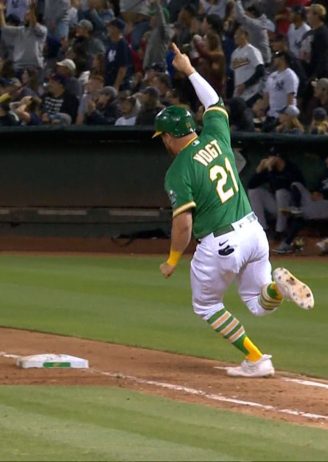
Stephen Vogt runs out the game-tying bomb he hit toward an A’s walk-off win over the Yankees in late August. The 37-year-old veteran will retire at season’s end.

As legendary 20th century radio malaproprietess Jane Ace might say, we’ve been sitting on pins and cushions awaiting the milestones this season. Pick the season, show yourself who has a shot at reaching which one before the season ends. Nature of the baseball fan beast.

We’re waiting for in-prime Aaron Judge to meet and pass Roger Maris as the American League’s new single-season home run champion. We’re waiting for elder Albert Pujols, who busted Blake Snell’s no-hit bid in the seventh Wednesday, to join the 700 Club—and we don’t mean the one Pat Robertson founded, either.

Waiting for the stars to erupt further in the record books one way or the other is as old as the professional game itself, seemingly. But just as Meryl Streep didn’t bag Academy Awards without solid supporting casts off which to play, baseball’s big men don’t have room to be the big men without the not-so-big men around and behind them.

One of those journeymen will call it a career after the regular season ends. He won’t get a postseason epilogue; his Athletics are about as close to being there as a mouse to trapping the cat. Stephen Vogt is one of those little big men who deserves to be shown the love after a decade which personified the journeyman’s life.

His career began 0-for-32, from 2012 through 28 June 2013. Then, leading off the bottom of the fourth with the A’s ahead 5-0, Vogt sent an 0-2 service from then-Cardinal relief pitcher Joe Kelly down the right field line and over the fence. If you’re going to smash a career-opening slump that went year-to-year, you couldn’t do it better even in the cheesiest film script.

What began ending the longest career-opening position player’s hitless streak since another Athletic (Chris Carter) did it three years before Vogt teed off became a career that included two All-Star selections and clubhouse value to five teams including his return engagement in Oakland this year.

Vogt didn’t make a show of that slump-breaking, first-hit home run. Idolising Barry Bonds when he grew up, Vogt could only remember his father’s advice prior to his making the Show in the first place, after asking as a kid why Bonds stood watching before a home run cleared the fences. “Stephen,” the old man replied, “when you have 500 home runs in the major leagues, you can do whatever you want. Until then, you put your bat down and you run around the bases.”

He told a reporter he made one exception a few months after that first-hit homer, facing future Hall of Famer Justin Verlander in the 2013 American League division series—his first career game-winner, a bases-loaded RBI single—after fouling off seven in a ten-pitch plate appearance—for the 1-0 win over the Tigers that sent the set to Detroit tied at a game each.

Such moments have been few enough for the 37-year-old who’s caught, played first base, and played in the outfield in his Show decade, but he’s been one of those there-to-be-called-upon who inspired fan loyalty wherever he suited up. “I believe in Stephen Vogt!” became their rallying cry. Over a journey such as his, it has to be appreciated. (The A’s will honour his career before their season-ender against the Angels on 5 October.)

Vogt is realistic about a career that’s paid him a somewhat modest (in baseball terms) but much liveable $14 million.

“I haven’t always been the best player,” he said. “I’ve been one of the best players in the league, I’ve been one of the worst players in the league. I’ve been injured and everywhere in between, I’ve been DFA’d twice, I’ve been traded, I’ve been non-tendered, you name it. I’ve been the guy that knew he was going to have a job next year to the guy that had to fight for his job next year, and just always go out and earn it.”

A guy with that becalmed an attitude is a guy who earns respect without having to reach for the heavens or punch a hole in them. He’s also a guy who earns it on a self-resurrecting World Series champion even if he couldn’t contribute on the field because he was injured. That was Vogt earning a ring regardless with last year’s Braves.

“Vogter is one of the most inspiring players I’ve ever managed,” says Padres manager Bob Melvin, who once managed him with the A’s. “What he means to a clubhouse is immeasurable—two-time All-Star, beloved in Oakland. One of my all-time favorites. Definitely has a future in managing.”

Vogt has picked the brains of Melvin plus managers Mark Kotsay and Craig Counsell (for whom he once played in Milwaukee) along the way, perhaps with just that purpose in mind. He’s been a student of the game as long as he’s played it, and Melvin may not be out of line to suggest his baseball future. If nothing else, too, Vogt may become one of those skippers who knows how to keep his clubhouse engaged.

“He felt passionate about it and spoke up,” Kotsay told reporters, after the A’s beat the Mariners Tuesday. “Does he need to do that at this point in the season when he’s on his last fifteen games? No, he doesn’t. But that shows his character and his love for the game, his love for his teammates. It came across loud and clear.”

“Having him back this year is great,” says Sean Murphy, the A’s catching anchor now, who remembers Vogt mentoring him right out of the gate in spring training 2017 and taking him around to meet everyone the better not to let him feel like just another rook. “When I heard they signed him, I was like, ‘Yes, awesome, I can’t wait to play with him again’.”

“I had a coach tell me, ‘Every day you take the field, there’s a little boy or girl that’s at their very first baseball game and you need to show them the correct way to play’,” Vogt says,  “and I’ve taken that to heart. And every night, that’s why I run hard, that’s why I play hard. It’s the correct way to play baseball.”

We’re not waiting for Vogt to punch a hole in the heavens for a major milestone. But we might be waiting to hit the Net running or pick up what’s left of the newspapers or flip on the television news and learn that Vogt’s going to be somebody’s next manager.

For now, let’s do honour to the Stephen Vogts who didn’t have to be game breakers, postseason race difference makers, or record busters, but who were equal value to their teams than the ones who earn the MVPs or the Cy Young Awards or just plain break the games and the championships open wide enough.

With the Vogts among them, the big men who can’t do it all by themselves don’t have to do it all by themselves. They don’t have to try striking guys out with single pitches equaling three strikes or hitting six-run homers with every swing. The Vogts let them play the game with the least possible additional stress.

That’s what the A’s will honour iat the end of their otherwise deflated season. It’s a tribute the hint of which other clubs might care to take when it’s time for their own veteran journeymen to step away from the field.