On the other hand . . .

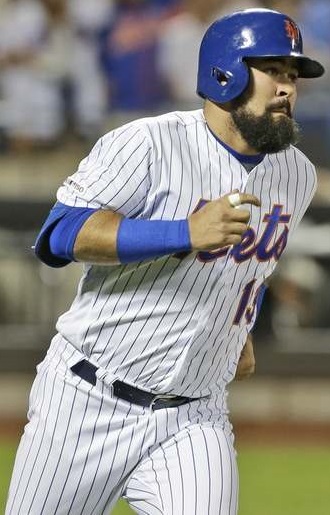
Javier Baez, J.D. Davis

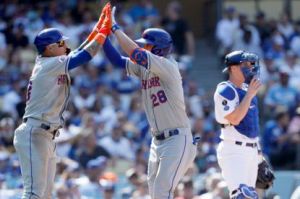
The Good Javy (left, after scoring on J.D. Davis’s [center] two-run bomb in the seventh) returned from the injured list and doubled down against the Dodgers Sunday afternoon.

This time, J.D. Davis didn’t shrink. Either with one man on or with the bases loaded.

This time, too, trade deadline addition Javier Baez came off the injured list, swung like a pro, scored like a pro, and doubled down, literally. He put a small shot of rocket fuel into a team looking like the living dead too often this month.

This time, the Mets may have left eight men on but they also sent seven runs across the plate. They’ve now done that only twice since 21 July. And, this time, too, they didn’t let the Dodgers take a single lead all Sunday long.

The bad news is that Sunday’s 7-2 win to stop the Dodgers’ winning streak at nine probably won’t be enough to salvage the Mets’ 2021. They’d need a finish from here that you can describe politely as miraculous to do that. Losing eleven games in the standings this 6-15 doesn’t leave room for miracles.

But let’s worry about that later. Right now, let’s savour Baez cashing in Brandon Nimmo (leadoff full-count walk, on which he sprinted up the line to first) with one out, sending one ricocheting off the left center field fence in the top of the first, with Nimmo gunning home all the way from first.

Let’s savour Davis shooting one the other way up the right field line to send Baez home, and Jonathan Villar with two outs punching a quail into short center, Davis scoring when Cody Bellinger’s throw in brought Dodger catcher Will Smith well out in front of the plate.

Let’s savour Villar trying to take second on the throw in and Smith throwing wild enough to let Villar have third on the house, before a foul out caught by Dodger starter David Price ended the inning at three for the Mets.

Let’s savour the Dodgers getting only a pair back in the fourth, when Bellinger reached Mets starter Marcus Stroman for a two-out, two-run line single to right, making Stroman pay for walking the bases loaded ahead of Bellinger—whose season has been compromised badly by a couple of nagging leg issues and not having been able to recuperate properly from off-season shoulder surgery.

Let’s savour the Mets catching Bellinger in an inning-ending rundown out, catcher to short, Baez playing his old position in Francisco Lindor’s absence, feinting a throw toward third to keep A.J. Pollock from even thinking about a score before tagging Bellinger as he tried turning back toward second.

Let’s savour Stroman managing to keep the Dodgers at bay long enough for Baez to hustle a single into a double after two swift outs in the top of the seventh and Davis, right behind him, hitting the first pitch he saw from Dodger reliever Phil Bickford on a line over the left field fence.

Let’s savour the Mets loading the pads with one out in the top of the ninth off Dodger reclamation project Shane Greene—Nimmo’s base hit to right, Pete Alonso taking another plunk for the team, then Baez taking another plunk for the team.

And let’s savour Davis yet again, a day after he’d swung through a Max Scherzer meatball with the bases loaded for a strikeout. This time, Davis recovered promptly from falling into an immediate 0-2 hole. He wrung his way from there to a walk on four straight balls, resisting the temptation to pull the trigger on a sinker that sunk just a little too far below the strike zone floor for ball four and Nimmo trotting home.

But let’s not fool ourselves. These Mets may have a few energy reserves left, but there’s just a little too much still missing to give them much more than prayers. On paper, they’re only seven games out of first in the National League East. On the field and at the plate, Sunday’s showing is what they’ll need only every day from now on, practically, to have the prayer of even a prayer.

It may require what they may not have the rest of the way.

So just spend today thinking about Baez maybe playing his way into an extension that would keep him around the keystone with Lindor, when Lindor returns days from now.

Think about the Good Javy re-joining Lindor to turn the second base region into the swamp where base hits get sunk into ground outs. Lindor may have struggled at the plate this year but he remained a shortstop Electrolux. (Thirteen defensive runs above the league average shortstop before he was injured.)

Think about the Good Javy who turns the plate into his personal game-changing playpen, providing an energy jolt through this team that not even Con Edison could deliver, just the way he did Sunday afternoon.

Don’t think about the Bad Javy who chases pitches that deserve to escape, the one who tries a little too often to hit eight-run homers on pitches that provide the power just by the bat giving them a kiss. Not until or unless he shows up again, that is.

Think about the Good Javy outweighing the Bad Javy enough to convince Mets owner Steve Cohen it’ll be worth it to keep him around and use him as the perfect out to purge Robinson Cano, who’s due back for 2022.

Don’t say the Mets “will eat” Cano’s money for the final two years of his deal. That meal already went through the digestive tract and out the other end. They accepted him as part of the deal when they wanted relief pitcher Edwin Diaz that badly from the Mariners. Once his current suspension ends, Cano’s going to get paid whether or not he suits up for the Mets again.

Cano isn’t the defensive second baseman he used to be. He hasn’t been the hitter he once was since 2016, either. That’s something to ponder especially if wisdom finally prevails otherwise and the designated hitter finally becomes universal to stay.

The Mets may not be that inclined to have back a 38-year-old millstone drydocked an entire season over actual/alleged performance-enhancing substances, his second such suspension in four years. The Good Javy showed up in time Sunday to start helping make that decision so simple for the Mets that even Joe Biden could make it without screwing the proverbial pooch into a blood bath.

Feud for thought

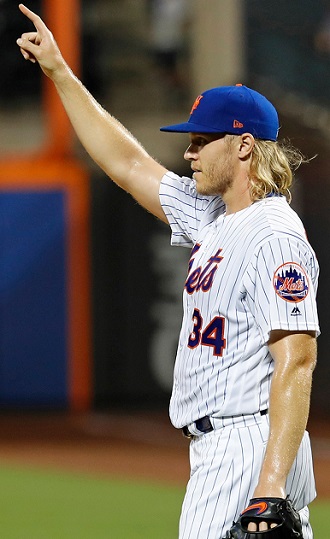
2019-09-15 NoahSyndergaard

Noah Syndergaard isn’t exactly being a prima donna when he insists throwing to Tomas Nido behind the plate is both his preference and better for him.

One of the first baseball legends I can remember reading about as a child is the 1927 feud between Pirates outfielder Kiki Cuyler and manager Donie Bush in 1927. I read about it in a pulp early 1966 paperback called Baseball’s Unforgettables, which had the ink-painted heads of Willie Mays and Sandy Koufax on the front jacket and cartoon baseball images—several of also which illustrated the chapters—surrounding them.

The way I read it in that book, Bush “stubbornly and foolishly” held a grudge against Cuyler for refusing a lineup shift out of his number three slot to bat second. Not to mention that the feud between the two may have cost the pennant-winning Pirates the World Series. And neither is entirely true.*

In his first season as strictly a manager (he’d been a player/manager for the 1923 Washington Senators), Bush wasn’t thrilled about the usually mild-mannered Cuyler’s defiance. But if Baseball’s Unforgettables quoted Cuyler as pleading, “Don’t do it, Skip, it’s a jinx for me,” Cuyler himself had a different take: as The Sporting News quoted him in his 1950 obituary, Cuyler didn’t think his kind of freer swinger really belonged in a lineup slot demanding more precise contact hitting.

According to Rob Neyer’s Big Book of Baseball Blunders, the argument didn’t do Cuyler any favours with Bush, but it came to a head not over the batting order but over a potential double play. On 6 August 1927, running from first, Cuyler elected not to slide into second on a double play attempt because he thought he had a better chance of obstructing the relay throw to first by arriving standing up.

The Pirates lost the game and fell three behind the Cubs. Bush didn’t buy Cuyler’s reasoning over the running play. Maybe marrying that to the batting order dispute prompted Bush, at last, to bench Cuyler for the rest of the season (save one early September game) and the Series. Then, the Pirates traded Cuyler to the Cubs after the season.

The legend became that benching Cuyler cost them the Series. The legend is bunk. Cuyler wasn’t the Pirates’ best player in 1927; the Hall of Famer wasn’t even their tenth-best player. (The two best the Pirates had in ’27: Hall of Fame outfielder Paul Waner and pitcher Ray Kremer.) The Pirates went 34-18 after the Cuyler benching to win the pennant. But the only team on the planet who could beat the 1927 Yankees might be the 1998 Yankees, if not this year’s Astros.

The worst thing the feud did was to alienate Donie Bush with the Pirates’ fan base. Cuyler was popular enough that Bush couldn’t recover his public image in Pittsburgh, and he resigned in August 1929. He’d have 65 years in baseball total before his death in 1972 while scouting for the White Sox.

My revisiting the Cuyler-Bush feud was instigated by the current apparent debate between Noah Syndergaard and the Mets. Syndergaard isn’t the first pitcher to think about having a particular catcher working with him or even about having a personal catcher. But the issue amplified Friday night.

That’s when Syndergaard took three shutout innings and a 1-0 Mets lead against Clayton Kershaw into the fourth, with Wilson Ramos behind the plate. After a leadoff groundout, Syndergaard and Dodgers star Cody Bellinger wrestled to a ten-pitch walk. Corey Seager singled Bellinger to third at once; then, A.J. Pollock singled through the right side of the infield to score Bellinger, and Gavin Lux, a rookie September call-up, smashed a three-run homer.

Syndergaard worked the fifth the better to keep Mets manager Mickey Callaway from having to turn to his rickety bullpen too soon. It didn’t keep the Dodgers from piling five more on at that bullpen’s expense. And it re-opened the question of whether Syndergaard should get to throw to his preference, backup catcher Tomas Nido, instead of regular catcher Ramos.

There were those who thought (and probably still think) that Syndergaard wrestling with the Mets over his catchers is going to be one more reason for the Mets to put him on the trading block at last after the season ends. There are those who thought (and probably still think) that forcing Syndergaard to throw to a catcher with whom he’s not comfortable may cost the Mets a by-now-too-slim shot at the postseason.

We’ll know soon enough whether the former proves true, but the latter? The Mets’ postseason chances went from new and much improved with that magnificent post-All Star break run to strikingly slim after losing one too many key contests despite a .600+ record in each of July, August, and September thus far.

What really ruined their postseason chances was their horrible, drama-dominant April through June. They looked like a Mess, acted like it often enough, and still have a few things from those three months returning to bite them in the butts just a little too often even in the middle of their second-half success.

Callaway remains under a white-hot microscope over his tactical missteps and strategic vision-challenges. Saturday’s next-to-the-eleventh hour shutout win against the Dodgers, 3-0, magnified it, when he was forced to pinch hit for one of his few relief jewels, Seth Lugo, with the bases loaded in the bottom of the eighth, where he could have double-switched Ramos out after the backstop ended the seventh and kept Lugo’s lineup slot eight slots away from arriving.

He got lucky with pinch hitter Rajai Davis, who hadn’t had a base hit since late August and took an 0-for-10 string to the plate. Davis yanked Dodger reliever Julio Urias’s 1-2 changeup down the left field line to clear the pads. And he said afterward that he didn’t want to leave the Mets without Ramos’s bat in the lineup.

There’s part of the issue. Ramos has been one of baseball’s hottest hitters since the All-Star break. Nido by comparison can’t hit with a hangar door. But have a look at how Syndergaard—and Cy Young Award defender and 2019 candidate Jacob deGrom—pitch when Ramos or Nido are their catchers:

To Wilson Ramos: G ERA BAA XBH K K/BB K/IP K/G
Jacob deGrom 19 2.68 .209 24 145 5.0 1.3 7.6
Noah Syndergaard 16 5.20 .258 32 97 4.4 1.0 6.1
To Tomas Nido: G ERA BAA XBH K K/BB K/IP K/G
Jacob deGrom 11 1.88 .202 18 91 7.0 1.2 8.3
Noah Syndergaard 10 2.45 .217 20 63 3.3 0.9 6.3

Syndergaard’s -2.75 ERA differential when throwing to Nido instead of Ramos bears out his argument in favour of Nido on purely pitching/defense terms. DeGrom’s differential is -0.80. DeGrom to Ramos still has a Cy Young Award-caliber 2.68 ERA. Syndergaard looks like a Cy Young Award-caliber pitcher with Nido behind the plate and like a Sayonara Award-caliber pitcher with Ramos behind the plate.

Syndergaard strikes batters out just a shard more often than he walks them with Ramos than he does with Nido—but he strikes them out a speck less throwing to Nido than to Ramos.

DeGrom is simply a better pitcher almost regardless of who’s behind the dish for him; you could send bullpen coach (and ex-major league pitcher) Ricky Bones behind the dish and deGrom will pitch like a Cy Young Award winner. If he’s striking out 8.3 hitters a start with Nido behind the plate, assuming deGrom’s average seven innings per start continues, he’s still striking out 7.6 per start with Ramos behind the plate.

While I was at it, I looked up the Mets’ other starters. Zack Wheeler’s ERA is 3.03 lower with Ramos behind the plate than with Nido. Marcus Stroman, who pitched his first truly quality start as a Met Saturday, has a -0.20 differential when throwing to Nido. It may not make a great difference if Stroman throws to Ramos.

(Where’s Steven Matz, you ask? Easy: Matz only threw to Nido once this season, in a relief appearance against the Phillies just before the All-Star break. You can leave Matz with Ramos behind the plate safely, especially with Matz’s turnaround second half. Matz in the second half has a 2.52 ERA and an 8.5 K/9 rate, both far above his first-half struggling. Matz-Ramos is one battery you don’t want to break up.)

Maybe we should look at the walks and hits per inning pitched (WHIP) when each catcher is behind the plate for deGrom and Syndergaard:

To Wilson Ramos G IP H BB WHIP
Jacob deGrom 19 114.0 87 29 1.02
Noah Syndergaard 16 97.0 96 22 1.22
To Tomas Nido G IP H BB WHIP
Jacob deGrom 11 72.0 53 13 0.92
Noah Syndergaard 10 66.0 52 19 1.07

It might have made plenty of sense if the Mets had spent more time reviewing the actual performance papers and decided that, yes, it would be smart to start Tomas Nido every time Jacob deGrom and Noah Syndergaard pitch. And, with the need for Ramos’s live bat as profound as it is, switch Ramos into those games after lifting deGrom or Syndergaard.

Dreaming, you say? This season, Ramos is hitting .314 when the games are late and close—and he’s hitting a whopping .379 with a 1.003 OPS in high leverage. And, yes, that’s mostly thanks to his bristling second half at the plate. Now, try to imagine the outcome of more than a few games if Nido was sent out to start with deGrom and Syndergaard regularly, and Ramos got switched into those games after those two pitchers were lifted.

Curiously, deGrom pitched a gem Saturday with Ramos behind the plate and outpitched Dodgers Cy Young candidate Hyun-Jin Ryu while he was at it: three hits and eight strikeouts in seven innings; nineteen called strikes and eleven swinging strikes; and, a 2-to-1 ground ball to fly ball rate.

But remember that even with Ramos catching him deGrom pitches like the ace he is. Syndergaard, who’s almost as talented, needs every break he can get. You can say Syndergaard is responsible for executing pitches, and you’d be right, of course. But ponder this, as New York Post writer Joel Sherman does:

Kershaw is the best pitcher of his generation and when he was Syndergaard’s age, he insisted on throwing to A.J. Ellis, a light-hitting backup. A main task of a manager is putting players in position to succeed—and that is not happening currently with Syndergaard.

Syndergaard’s not exactly being a prima donna by insisting he’s better off with Nido than with Ramos behind the plate. Kershaw, a Hall of Famer in waiting, really, wasn’t the first to think about personal catchers and he won’t be the last. And a lot of pitchers have credited their success to one or another particular catcher.

Hall of Famer Whitey Ford once said throwing to Hall of Famer Yogi Berra made him the pitcher he became. And those pesky statistics also bear out that every Yankee pitcher not named Ford when Berra was the regular Yankee catcher pitched better throwing to Berra than at any other time in their entire careers.

(You want to argue success? With Yogi as their regular catcher, the Yankees won nine pennants and seven World Series including five straight despite pitching staffs composed mostly of pitchers who shone as Yankees but were comparative non-topics elsewhere.)

That’s not quite the same as the personal catcher concept, of course, but it’s not something to dismiss too readily.

Tim McCarver had a fine playing career but a lot of it included being Steve Carlton’s preference behind the plate. Charlie O’Brien and then Eddie Perez were a lot more valuable to the Braves because Greg Maddux preferred pitching to one and then the other when the one left as a free agent. Those catchers weren’t exactly in Berra’s league but a pair of Hall of Famers must have known and seen something, right?

You can’t really say that obstinance over who catches whom will sign the Mets’ 2019 death warrant if they don’t make even the wild card play-in game. Of course, if by some alchemy the Mets do sneak into the second wild card and play the likely first card-winning Nationals in the play-in game, they should be broiled and basted if they send anyone not named Nido out to catch either deGrom or Syndergaard in that game.

No Syndergaard-vs.-Mets feud will cost the Mets. Any more than a Kiki Cuyler-Donie Bush feud really cost the 1927 Pirates. Those Pirates won the pennant without Cuyler down the stretch, but they were done in in the World Series by an immovable threshing machine. These Mets will have done themselves in with a first half that, for all their second-half perseverance, still seems like the insurmountable burden.


* Baseball’s Unforgettables also managed to get the spelling of Donie Bush’s name wrong—the book spelled it “Donnie.”

Born Owen Joseph Bush, his original nickname as a Tigers shortstop was Ownie, which teammate Ed Killian got changed to Donie based on Killian describing a pitch on which Bush struck out as a “donie” pitch, “donie” happening to rhyme with Bush’s original nickname. Teammates picked up on it—and began calling him Donie Bush.

Fringe benefits

New York Mets

Noah Syndergaard, giving J.D. Davis a high sign after Davis’s staggering fourth-inning catch Thursday night. Syndergaard had two answers for Tribal trolling . . .

It seems like ancient history to talk about it now. But once upon a time there was no social media for baseball people to troll each other. They had to settle for trolling by way of print or broadcast interviews. But they still learned the hard way that the flip side to “don’t feed the trolls” is “don’t poke the bear.”

David Cone ignored it at his peril during the 1988 National League Championship Series. The Indians ignored it to their peril Thursday.

Writing a (presumably ghosted) running NLCS commentary for the New York Daily News, Cone started tripping the Dodgers’ triggers when he said the Dodgers’ Game One starter, Orel Hershiser, “was lucky for eight innings.” Actually, eight and a third: Hershiser surrendered Darryl Strawberry’s one-out RBI single, pulling the Mets back to within a run.

But then Cone teed off on Dodgers’ closer Jay Howell.”We saw Howell throwing curveball after curveball,” Cone went on to write, “and we were thinking: This is the Dodgers’ idea of a stopper? Our idea is Randy [Myers], a guy who can blow you away with his heat. Seeing Howell and his curveball reminded us of a high school pitcher.”

Myers did bring heat and lots of it, never mind that he retired the Dodgers in order in the bottom of the ninth on a line out, a ground out, and a pop fly out, to save the 3-2 win. It was nothing compared to the Dodgers chasing Cone early in Game Two with five runs in two innings, en route a seven-game Dodgers triumph.

You don’t tug on Superman’s cape, you don’t spit in the wind, you don’t pull the mask off the old Lone Ranger, and you don’t mess around with the team that’s trying to pin your ears back in either a pennant race or in a League Championship Series. It’s to shudder what would have happened if Cone had teed off on Hershiser and Howell while that NLCS was played in the Internet social media era.

Cone learned the hard way in 1988. (It’s a shame Gene Garber wasn’t there to remind him of the uses of breaking ball-heavy relief pitchers, considering Garber’s breaking repertoire put an end to Pete Rose’s 44-game hitting streak a decade earlier.) So did the Indians Thursday night.

For a team that once had Hershiser on its own pitching staff (1995-1997) and went to a pair of World Series with him, the Indians didn’t exactly have a sense of trolling history when their social media people went off on the Mets Thursday afternoon. And it’s not brilliant to think about trolling a team that just took the first two of a three-game set from you, in their playpen or otherwise.

It’s a long season. We didn’t erase an 11.5-game deficit to roll over,” came the tweet from the Indians Thursday midday. “We split a series with one of the best teams in MLB at their home ballpark. We lost the last 2 to a fringe postseason team. We understand your frustration. Get it out here, but let’s renew the perspective.”

Noah Syndergaard, the Mets’ scheduled Thursday night starter, didn’t just feed the Tribal trolls, he cleaned, stuffed, and mounted them.

First, he he pinned the Indians’ ears back with six and a third perfect innings en route a rain-delayed, rain-short-ended Mets win, 2-0. Then, he replied with his own tweet: “We got some FRINGE for you right here, we call it a SWEEP in NYC. #LFGM.”

Leaning away from his customary pure power game and throwing as much of an array of off-speed breakers and changers as heat, Syndergaard was on such a roll, even after he turned aside first and second on a pair of singles in the sixth, that the only thing that could have stopped him was the two-hour plus rain delay that struck in the bottom of the sixth.

Married to whipping winds around the park, the rain which began about an inning earlier finally prompted the umpires to pull the teams off the field, as Mets catcher Wilson Ramos was at the plate with two outs and Michael Conforto aboard with a base hit. The winds were fierce enough that the Citi Field grounds crew needed to pin the tarp to the infield themselves until the weights could be brought out to hold it.

The Indians were pretty brassy to think about trolling a team who’d beaten them on their own fielding lapse Tuesday night and bludgeoned their bullpen to win the night before. But their rookie righthanded starter Aaron Civale was actually close to Syndergaard’s effectiveness—his only blemish hitting Pete Alonso with a pitch in the first—until he ran into trouble in the bottom of the fourth.

That’s when Joe Panik, a late Mets acquisition after his release by the Giants and very effective as a Met since, opened with a line single to right. One out later Conforto high-hopped a ground rule double over the high side fence down near the end of the left field line, before Ramos extended his hitting streak to sixteen games with a clean two-run double down the right field line.

The Indians even got sloppy in the field again Wednesday night, with the lone saving grace being that this time it didn’t cost them a ball game.

After play resumed and Mets reliever Jeurys Familia worked a scoreless seventh, Mets third baseman Todd Frazier grounded weakly up the first base line. Indians reliever Tyler Clippard, himself a former Met, fielded but threw the ball straight over first baseman Carlos Santana’s head.

The ball sailed into foul territory near the seats as Frazier rounded first and neared second, as right fielder Yasiel Puig scampered in to retrieve the ball. As Frazier rounded second Puig—whose arm is powerful but not always calibrated properly—threw across to third and right past the pad as Frazier arrived safely.

Clippard’s mistake might have been snaring the ball with his glove before getting a less than firm grip with his throwing hand. A barehanded grab might have put the ball into a better grip and he might not have sailed it above Santana’s attic.

The Tribe was lucky they had Tyler Naquin—who ended Syndergaard’s brief perfect game bid with a one-out single in the sixth—catching Ramos’s arcing line drive in perfect position to throw Frazier out at the plate by three feet. Consider it a small payback for what Mets left fielder J.D. Davis did to them in the fourth.

With one out, Indians center fielder Greg Allen sent one that looked like it was going for extra bases until Davis, on his thoroughbred running back on an angle to his left, extended his glove and made a Willie Mays-like one-handed, over-the-shoulder, slightly over his head basket catch. The Citi Field ovation was so thunderous Davis had to tip his cap under it.

“Just a crazy catch,” Davis told reporters after the game. “I don’t know how to describe it.”

The Indians thought they knew how to describe the Mets before the game. Except that the Mets are now 12-5 lifetime against the Indians in interleague play. And while the Indians did yank themselves back from the dead, once as far as eleven and a half back of the Twins in the American League Central, the Mets didn’t exactly yank themselves back from a little slump, either.

The lowest point for the Indians this season? Eleven and a half behind the Twins on 2 June. The lowest for the Mets? Fourteen and a half out of first in the National League East on 14 July. Low enough and tattered enough, it seemed, that the trade deadline run-up was almost dominated by speculation as to whether Syndergaard himself, or Zack Wheeler, would change addresses on or before the deadline.

Since the All-Star break? The Indians: 24-16. The Mets: 27-10. And even if interleague play continues making hash of pennant races, the Mets play in a far more tough division. Now the fringe contender is also only a game and a half out for the second National League wild card and nine out in the East.

And they also have a far tougher schedule the rest of the season. Except for another pair of sets with the Twins and one each with the Phillies and (ending the regular season, strangely enough) the Nationals, the Indians get a lot more bottom-dwelling competition the rest of the way than the Mets.

The fringe contenders just swept the Indians in three, helping to put or keep them three and a half behind the still AL Central-leading Twins, and leaving the Indians with a 2-5 record for their now-finished New York trip. The best thing about the trip was the Indians not having to change hotel reservations to meet the Yankees and the Mets.

Let us renew the perspective indeed.


The Mets simplify the hard way

2019-08-10 LuisGuillorme

Luis Guillorme defied his unimpressive rookie slash line to help stun the Nats Saturday night . . .

In ancient times Casey Stengel would see ancient Satchel Paige warming up in the enemy bullpen and exhort his Yankees, “Get your runs now—Father Time is coming.” This weekend, the Nationals’ mantra could be, “Get your runs A.S.A.P. Father Time’s predictable compared to these Mets.”

But the Nats don’t really want to know from Father Time, who may be coming sooner than they’d care to know.

Not when they followed a last-minute 7-6 loss Friday night with a 4-3 loss in the next-to-last minute Saturday night. It wasn’t quite the cardiac arrest Friday night was, but it was still enough to tempt them to think of keeping crash carts on call.

Perhaps deploying one out of their bullpen. And another to their manager’s office.

Dave Martinez just didn’t have the heart, or whatever else needed, to send Hunter Strickland—his new bullpen toy, but not even a topic Friday night—out for the eighth inning after Strickland manhandled the Mets in the seventh. But Strickland is two weeks removed from returning from a lat strain that kept him down four months, and Martinez didn’t want to overtax him. Even though he looked smooth enough Saturday night.

This time, his assigned closer Sean Doolittle wasn’t even a topic. Not after the Mets bastinadoed him for four runs in the ninth to win from three runs down Friday night. This Saturday night topic was now Fernando Rodney, the elder, whose previous comparative success against the Mets was two seasons behind and barely visible in the rear view mirror.

But there was Rodney and his trademark, CC Sabathia-like lopsided hat to start the New York eighth. And leading off was a Met rookie, Luis Guillorme, who brought all of a .156/.182/.188 slash line to the plate batting for center fielder Juan Lagares. It should have been meat for Rodney. Instead, he was dead meat.

On a full count, during the making of which Guillorme didn’t even wave his bat, and Rodney didn’t even hint toward throwing the changeup that was once his money pitch and was still reasonably effective, Rodney served Guillorme a meatball. And Guillorme provided the sauce. He sent his first major league home run clean over the right field fence to tie things at three.

Then late-game Mets second base insertion Joe Panik grounded one to short. Sure-handed, sure-footed Nats shortstop Trea Turner had it just as surely. But first baseman Matt Adams mishandled his uncharacteristic low throw, leaving Panik safe to move to second on a followup single lined up the pipe by Jeff McNeil for his first hit of the weekend.

Out came Rodney. In came Daniel Hudson, who’d worked a near-effortless eighth on Friday night. And, after Amed Rosario’s hard grounder pushed the runners to second and third, Pete Alonso checked in at the plate.

The Nats optimist said, we’ll have none of that nonsense this time around. That nonsense, of course, being Alonso drilling Stephen Strasburg for a two-run blast in the fourth Friday night.

The Nats realist said, pick your poison, Davey. Because putting Alonso on to load the pads meant facing J.D. Davis—who’d followed Alonso’s Friday night flog with his own game-tying solo jack in that same fourth. And, who hit one of two consecutive solo bombs in the Saturday night fourth, birthday boy (and former Nat) Wilson Ramos hitting the second of them to tie this game at two.

So Martinez picked Davis. The good news: this time, Davis didn’t reach the seats. The bad news: His fly to right was long and deep enough to send Panik home with what proved the winning run.

And if Martinez couldn’t bear to send Strickland out for a second inning’s work in the bottom of the eighth, Mets manager Mickey Callaway wasn’t as nervous as you might think about sending Seth Lugo out for a second inning’s work in the top of the ninth.

Lugo may have had command issues in the top of the eighth, magnified when Juan Soto hit his second homer of the night, a mammoth drive into the second deck in right, to put the Nats back ahead 3-2. But Callaway gambled that that was just Lugo getting really warmed up. He also wasn’t entirely sure about trusting Edwin Diaz, who’d warmed up during the eighth.

So Lugo, named the National League’s relief pitcher of the month for July, went out for the ninth. Noisy Citi Field and edgy Nats Nation, wherever they were, said their prayers accordingly.

But former Met Asdrubal Cabrera lined out to right.

And Victor Robles looked at strike three on the outer edge, on a night plate umpire Tripp Gibson gave Nats and Mets pitchers alike a very generous outer strike zone.

Then Gerardo Parra—maybe the Nats’ best pinch hitter and bench representative, entering the game with a .319 career batting average against the Mets—batted for Nats catcher Yan Gomes.

And, after Parra fouled off a 3-1 service, Lugo caught him looking at strike three.

All of a sudden, Soto’s two-run homer off Mets starter Noah Syndergaard in the top of the first seemed a small memory to plague Mets fans. Just the way Davis and Ramos’s fourth-inning destruction (setting a new Mets team record for consecutive multiple homer games) seemed to Nats Nation after Soto teed off in the top of the eighth.

Once again, the Mets found a way, any way,  past or around the Nats’ effective starting pitchers, in Saturday night’s case Patrick Corbin. Once again, the Mets got into a bullpen whose 10.10 ERA against them entering Saturday night meant giving them at least one definite victim against who they could fire whatever bullets happened to be handy.

And once again, the Nats couldn’t find a way to make anything stick, even on a night Syndergaard had to shake off an early explosion and some early inconsistency to keep them off the scoreboard further for the rest of his seven innings’ work. Not even on a night when Corbin was mostly his calmly effective self through six.

The Nats compelled the Mets to do things the hard way, late but their bullpen, retooling and all, showed it still had major kinks to un-kink. But the Mets didn’t exactly seem to object to doing things the hard way. It’s coming easier for them that way.

Now, it may not be a question of whether these still-somewhat-flawed Mets can hang with the big boys yet. But it may be a question as to whether these Nats will hang. With the big boys, or at the end of their own noose.

Marcus Stroman and other trade deadline thoughts

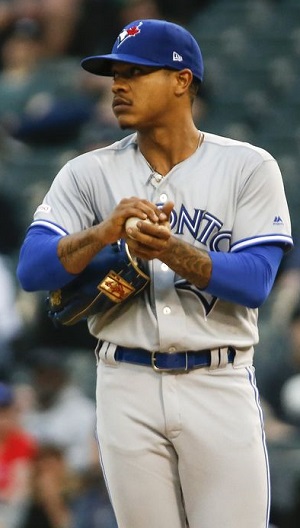
2019-07-30 MarcusStroman

Marcus Stroman to the Mets—method to madness or madness to method?

As regards the Mets dealing a pair of mixed-reviews pitching prospects to the Blue Jays for their staff ace Marcus Stroman, and the coming trade deadline in general a few observations. Beginning with the one that tells me it seems at least three-quarters of baseball never saw this Stroman deal coming.

Anyone who thought Stroman’s new address would be New York by this year’s new single trade deadline figured it would involve the Yankees, leaders in the American League East, and not the Mets, strugglers to stay within reasonable sight of even the second National League wild card.

Or, if Stroman was going to move on from Toronto, he’d be more likely to land with one or another viable 2019 competitor—say, the Braves, where I seem to recall some observers thought he’d make a better mutual fit if the Yankees really were convinced Stroman was good enough to pitch but not necessarily fit.

But Stroman, who makes his living largely by way of his ability to lure ground balls, is now a Met. So where do we and they go from here?

1. Former major league general manager Jim Bowden, who now writes for The Athletic, says the Mets have no intention of landing Stroman just to flip him for a better package by the close of trade business Wednesday. And the two pitching prospects going to the Jays—Anthony Kay and Simeon Woods-Richardson—are considered solid but not elite prospects, but the Jays believed they weren’t going to get better than them for Stroman when all was said and done.

2. The Mets aren’t a team of elite defenders especially around their infield this year, and yet Steven Matz—returning to the rotation after a brief spell in the bullpen to re-horse—pitched a complete-game 3-0 shutout Saturday night in which his calling cards were a deft blend of breaking and off speed stuff and putting his fielders to work, which for a change they did rather admirably behind him.

3. Matz’s performance may well have had a firm impact on the Mets’ pitching thought. May. They’ve tried since 2013 to cultivate an arsenal of power arms in the rotation and seen, when all is said and done, only Jacob deGrom live up to any expectations. They watched Matt Harvey’s injuries collapse him from a power pitcher to one in search of a new cause and, now, a new team. They’ve seen Noah Syndergaard and Zack Wheeler bring the power without delivering the consistent results.

If the Mets had eyes for Stroman before Matz took the mound Saturday night, Matz’s performance had to have told them it wouldn’t be a terrible idea to add another arm to the rotation that belonged to a young man who uses more than his arm to survive on the mound. Stroman isn’t a strikeout machine; he has the second highest ground ball rate among all Show starting pitchers.

4. Maybe acquiring Stroman begins to get the Mets re-thinking their incumbent defense, too, especially marrying him to Matz in their rotation. Rookie of the Year candidate Pete Alonso forced Dominic Smith off first base, but Smith in the outfield looks almost exactly like the un-natural he is out there even though he hits with authority. Rookie general manager Brodie Van Wagenen’s willingness to take aging Robinson Cano if he wanted closer Edwin Diaz from the Mariners last winter forced Jeff McNeil, their obvious second baseman of the future, likewise into an outfield where he’s about as comfortable as an elephant in front of a mouse much of the time.

5. Diaz has been a mess not entirely of his own making this season, mishandled, sometimes mis-deployed, and while the raw talent is still there the Mets are now rumoured to be shopping him. Cano has four years left on the contract the Mets took on from the Mariners, making him almost an immovable force. Whether the Mets’ contradictory ownership might be willing to take a bath on the deal in order to start moving defensive parts back where they belong is anyone’s guess.

6. With Stroman off the market eyes turned not just upon Syndergaard but the rest of this trade deadline’s pitching market.

The Giants’ unexpected resurgence means Madison Bumgarner isn’t likely to go anywhere the rest of the season, compared to a month ago when the observers and speculators pondered where, not if he’d move on. The Yankees need whatever starting pitching help they can get but the market now seems more constricted—and as much as they’re wary of dealing with the Mets, Syndergaard now might look like an attractive Yankee target. Might.

And the Nationals, like the Giants but at a higher level, have had an unexpected resurgence of late after they were all but written off as dying as late as early June. They ran into a buzzsaw in Los Angeles this past weekend, needing Stephen Strasburg to pitch the masterwork he did in seven Sunday innings to escape with even a single win, but now Max Scherzer—whom all the Smart Guys said had to go on the trade deadline block once upon a time, in large part to bring them badly needed bullpen relief—may find his barking back barking well enough into August.

At first glance, then, it would seem the Nats have a big problem as they prepare to square off against the National League East-leading Braves Monday night. Except that the Braves, who ran roughshod over the league before the All-Star break and still lead the Nats by five and a half games, have suddenly regressed to being only human. Not only have they lost seven of their last eleven, they’ve lost two critical elements—shortstop Dansby Swanson, resurgent veteran right fielder Nick Markakis—to the injured list. The Nats won’t have Strasburg or Scherzer to throw at the Braves this week but the Nats might still gain key ground, anyway.

7. The bullpen dominos began falling over this past weekend, too. Veteran Sergio Romo, once a key to a couple of Giants World Series winners, just went from Miami to Minnesota where the Twins, this year’s American League surprise, just bumped their bullpen up several notches by bringing him aboard. Jake Diekman went from Kansas City to Oakland, a sign the Athletics are gearing up for another wild card run. There are contenders aplenty who need help in the pen and few more than the Nats.

8. If the Jays are rebuilding in earnest, bullpen-longing eyes may be cast upon the surprising Ken Giles. After his 2017 World Series mishap (which wasn’t entirely his sole responsibility) and subsequent personal and mound meltdowns, Giles has rehorsed completely in Toronto. As in, a career year: a 1.54 ERA and a 1.60 fielding-independent pitching rate. Not to mention a 5+ strikeout-to-walk rate and a 14.9 strikeout-per-nine rate.

Yes, the Nats have eyes upon Giles and his Jays pen mate Daniel Hudson. But so may the Red Sox and any other contender who needs a bump among the bulls. Even the Twins, despite landing Romo, might still make a play for Giles at least or, if Giles eludes them, Norman, whose 2.87 ERA and June-July of only four earned runs in 21 innings’ work yanked his trade value up accordingly.

Bowden rates the Stroman deal a B+ for the Mets and a B- for the Jays. It wouldn’t hurt the Jays’ standing to try prying a slightly better haul back for Giles and/or Hudson. And although Giles is dealing with a slight nerve issue in his pitching elbow, wiping out the side as he did in a Saturday night assignment should make his suitors breathe a little easier, assuming they don’t fall tempted to overwork him while he works through it.

9. The Mets may or may not yet have a wild card long shot this year, but don’t kid yourselves: they were thinking as much about 2020 as now when they made their play for Stroman. And since Stroman is under team control through the end of 2020, don’t be surprised if they like what they see from him the rest of this season and start talking extension with him before 2020 begins.

Which might also mean that Syndergaard at minimum, and Wheeler at maximum, may yet have changes of address coming by Wednesday afternoon. And with whisperings that the Red Sox have eyes upon Diaz for their pen, which needs a little help but isn’t as badly mismanaged as the Mets pen has been this year, the Mets should be thinking smart and looking very closely at that Red Sox farm system.

Because the Mets could also use a third base upgrade from veteran Todd Frazier, who’s reliable but beginning to show his age. And as thin as the Red Sox system is for now, AAA third baseman Bobby Dalbec was named both the offensive and defensive player of the year for 2018 in the Red Sox’s minor league award valuations. If the Olde Towne Team wants Diaz for their pen that much, the Mets should all but demand Dalbec in the return haul.

10. Too many teams never quite do what they should when it counts. The Mets, alas, are notorious for that. Even when they’re winning.