AL dragons vs. NL dragonslayers

Houston Astros

The Astros celebrate winning the AL pennant Sunday night in New York. The AL’s dragons get to tangle with some NL dragonslayers from Philadelphia in the World Series.

Maybe the Astros would have found ways to beat the Yankees yet again regardless. Maybe it wouldn’t have mattered if Aaron Judge could have tied Game Four of the American League Championship Series with one intercontinental ballistic launch and sent it to extra innings.

The Astros won their third American League pennant at the Yankees’ expense Sunday night in Yankee Stadium. They did it in 2017, 2019, and now this year. But if Game Four proves to be free agent-in-waiting Judge’s final game as a Yankee, it couldn’t have ended more ignominously for him and for them.

The engaging, still-young man who pushed Roger Maris aside as the AL’s single-season home run champion, already 1-for-14 in the ALCS when he checked in against Astros reliever Ryan Pressly with two out in the bottom of the ninth, swung on a slider somewhat outside on 1-2.

The guy who can hit a ball of yarn past the Van Allen Belt grounded it right back to Pressly, who speared it one-handed coming off the mound toward first base. Pressly trotted a few steps further before underhanding it to Astros first baseman Yuli Gurriel for game, set, sweep, and the Yankees heading home for the winter.

It continued the second-longest Yankee pennant drought since 1979-1994. It made the Leaning Tower of 161st Street resemble the giant who’d carried an entire town on his shoulders from one end of the hemisphere to the other only to collapse under its weight at long enough last.

“I could sit here and make excuses about if a ball falls this way, a ball drops that way or a pitch is made here and there,” Judge lamented after Game Four ended. “But what it comes down to is they just played better than us.”

The Yankees spoiled themselves leaning on Judge as their in-house extraterrestrial. The Astros, say what you still will about them, didn’t make that mistake. They didn’t lean too heavily upon any single big man, either winning the second-most games in the regular season or sweeping their way to the coming World Series.

Leaning that heavily upon one big man merely held the Yankees’ other issues aloft too high. Their bullpen was injured and inconsistent. They lost key secondary elements such as D.J. LeMahieu and Andrew Benintendi to injuries. Anthony Rizzo and Giancarlo Stanton weren’t consistent second bananas to the Judge Show. If Harrison Bader proved a pleasant surprise at the October plate, it wasn’t enough to overcome Judge and Stanton combining to go 6-for-32 the entire postseason.

Oh, the Astros had some heroics of their own, of course. Yordan Alvarez looked like Paul Bunyan earlier in the postseason, enough so that enough thought he alone might be the one to blast the Astros forward. But he was awful quiet in the ALCS. There lay the Astros’ real secret weapon this time, though: if one guy falters, there are others too happy to pick up the slack.

Rookie Jeremy Peña said, “Sure, no problem-o.” A kid whose regular-season on-base percentage fell well enough short of just .300 tied Game Four in the top of the third, with two on aboard back-to-back inning-opening walks, when an ailing Yankee starting pitcher Nestor Cortes hung a cutter and Peña hung it down the left field line and over the fence fair past the foul pole.

“It’s surreal,” said Peña postgame, after he was named the ALCS’s Most Valuable Player. “You dream about this stuff when you’re a kid.” Nobody among his teammates cared two pins that he was a rookie stealing the thunder.

“If you’re in this clubhouse, you’re one of us,” said Lance McCullers, Jr., the Astros’ Game Four starting pitcher. “You don’t need to earn your stripes with us. You don’t need service time. If you’re in this clubhouse and you’re wearing this uniform, you’re one of us. It doesn’t matter if you’re here for a day or you’re here for seventeen years.”

“It’s been a blessing to play with this group,” said third baseman Alex Bregman, who’d sent Peña home with what proved the insurance run in the seventh, after yet another fielding mishap that came to define the Yankees’ postseason collapse the way their deflation from 15.5 games atop the AL East to a 10-18 August defined their regular-season descent from surreal to mere division champion.

Alvarez may not have provided strategic bombing in this ALCS, but after Yankee second baseman Gleyber Torres flipped what should have been a seventh inning-ending double play-starting toss past shortstop Isiah Kiner-Falefa, he re-tied the game at five each by swatting Peña home with an RBI single off Yankee reliever Jonathan Loaisaga.

Just like that, the Yankees handed the Astros the means to end the lead Bader handed his team in the bottom of the sixth, when the former Cardinal caught hold of Hector Neris’s first two-out pitch to him and sent it into the left field seats.

When Gurriel clutched Pressly’s underhand toss for the final series out, it handed baseball its first day with both pennants clinched since 1992. It handed the Astros yet another chance to give manager Dusty Baker yet another chance at the one thing that’s eluded him in his long and mostly distinguished managing career—a lease to the Promised Land.

Baker took on the Astros after Astrogate cost them A.J. Hinch, whose failure to put the brakes on the Astro Intelligence Agency’s illegal, off-field-based, electronic sign-stealing operation could have broken both the game and the organisation in half when it was exposed after the Astros fell to the Nationals in the 2019 World Series.

He might be the sentimental favourite come Series time—individually. The Astros will be up against a Phillies team that electrified their city and maybe most of the country with their own pennant conquest at home Sunday afternoon. Baker may be America’s manager but the Phillies may be America’s team this time. And Bryce Harper just may be America’s man within America’s team, if that’s the case.

No Astro delivered quite the transcendent blow Sunday that Harper did in the bottom of the eighth. Judge’s record-breaking 62nd home run merely broke a hallowed AL and Yankee team record and guaranteed his coming free agency riches. Harper’s deficit-overthrowing two-run homer held up to mean the pennant, in a rainy game that looked as though the Phillies and the Padres did more mud wrestling than ball playing.

The pitchers couldn’t grip properly or resist their landing feet sliding more than single inches on the muddy mound. The hitters changed batting gloves as often as they could. Batting helmets shone with rain water on top. New York wasn’t exactly paradise but Philadelphia’s Citizens Bank Park was practically a swamp. And no fan dared leave until it was done.

Harper stunned the Padres first by taking a tumbling Robert Suarez changeup on which he might have swung otherwise, once upon a time. He anticipated Suarez bringing a fastball soon enough, hoping only to find an outfield gap into which to send one, enough to bring J.T. Realmuto home from first with a tying run.

He got and did better than he hoped. He got a cutter hovering over the outer half of the plate and swung. The ball traveled about three or four rows the other way into the left field seats. The city that once hosted a record label proudly calling its brand of soul music The Sound of Philadelphia now had a new sound: bedlam.

The Biblical admonition goes that the last shall be first. The Phillies entered the postseason aboard the new three wild card system with the weakest regular season record of any postseason entrant and the eleventh-best record in the Show.

They’d survived an early season hump prompting their front office to throw out the first manager of the year. They’d survived injuries, including the two-month loss of Harper who needed the rest of the regular season to get his groove back. Both the Phillies and the Padres hit a partial re-set button at mid-season and burrowed their ways to their wild cards.

The Padres slew the NL dragons out of New York and Los Angeles. The Phillies slew those out of St. Louis and Atlanta. Then the Phillies won the pennant by taking four of five from the Padres. They ground, pushed, thumped, slashed, and thundered their way to the Series.

They reminded you that, when the dragonslayers meet each other, one of them gets fried.

They’re going to go up against an Astro team that still isn’t America’s favourite team thanks to the continuing taint of Astrogate. Never mind that only three position players from those 2017-18 cheaters remain with the team. Never mind mind that one (Jose Altuve) actually rejected being part of it. I say again, sadly: the taint won’t dissipate until the last member of the Astrogate teams no longer wears their uniform.

The Phillies haven’t won a World Series ring since the final months of the second George W. Bush administration. The Astros still hunt their first un-stained World Series rings. If the Astros think the Phillies can be taken as readily as the Yankees, the Astros may be in for a Series that’ll only feel as long as the Yankee winter now begun.

It’s phun unless you’re a Padres fan

Philadelphia Phillies

Rhys Hoskins (17) and the Phillies high, low, and any other five they can think of after waxing the Padres in NLCS Game Four . . .

After Saturday’s doings and undoings, the second-winningest regular season major league team is on the threshold of a potential World Series date with the eleventh-winningest regular season team. That’s about the full extent to which the Astros (the former) have anything in common with the Phillies (the latter).

Say what you will about Commissioner Rube Goldberg’s postseason array. I’ve said my share and then some. Permit me to share this, from an essay I wrote for the Internet Baseball Writers Association of America’s Here’s the Pitch newsletter, following the ends of each league’s wild card series:

Reviewing the 1948 national elections, for a spoken-word album hit called I Can Hear It Now, broadcast news titan Edward R. Murrow observed wryly that the people’s pulse was taken, they’d been told for whom they’d vote and by how many votes, “and, yet—it couldn’t hurt to watch the campaign, anyhow.” Postseason baseball this year is somewhat like that.

We haven’t been told unto death who’s going to claim the Promised Land and in how many games. (Yet.) And, it’s going to take a little bit longer thanks to a lot more artificially inflated competition this time around. But it couldn’t hurt to watch the games, anyhow.

That seems truer now, especially with regard to the National League Championship Series, in which the Phillies awoke Sunday morning one win shy of the aforesaid World Series date. It couldn’t hurt to watch them tangle with the Padres, also known as the tenth-winningest regular-season major league team, anyhow.

So far, it hasn’t hurt. Unless you’re a Padre fan.

Just when you think the Padres are going to piledrive the Phillies into the ground and back, these not-so-phutile Phillies find ways, means, and the moxie to overthrow the Padres and make it stick. For example, NLCS. Game Four Saturday night, overthrowing and thumping the Padres, 10-6.

The noise in San Diego’s Petco Park and Philadelphia’s Citizens Bank Park has been enough to make you think you’ve been time warped back to the peak of Beatlemania. The Phillies didn’t needed guitars, basses, and drums to do that. All they needed was to remind themselves—as first baseman Rhys Hoskins said they did, after the Padres jumped them for a four-run top of the first Saturday night—that they still had 27 outs with which to work.

Especially on a night manager Rob Thomson planned a bullpen game but had to be very careful not to let himself be forced into potential overwork assignments out of a couple of his bigger bullpen bulls, Seranthony Domínguez in particular. As things turned out, the Phillies didn’t need Sir Anthony to ride in, on his white horse or aboard any other means of transportation.

Thumping the Padres after getting thumped in the first inning can give you that kind of security entering Game Five, a game the Phillies expect Zack Wheeler—who manhandled the Padres over seven innings and one measly hit in Game One in San Diego—to start and mastermind. Facing that plus the Phillies’ all-and-a-little-of-everything bats might mean no more baseball in San Diego after Sunday afternoon.

But neither the Phillies nor the Padres, or anyone else in the ballpark or in front of a television set, expected that neither starting pitcher would get out of the first inning alive for the first time in postseason play since it happened to Guy Bush (Cubs) and Johnny Allen (Yankees)—on the day Iraq first became an independent nation. (Game Four, 1932 World Series, if you’re scoring at home.)

The Padres opened by making Phillies starter Bailey Falter live down to his surname, with Manny Machado hitting one into the left field seats with two outs, followed by a two-run double (Brandon Drury) and an RBI single (Ha-Seong Kim). Often as not that kind of opening inning endures. When the runs are scarce enough, as they’ve been this postseason for the most part, that kind of opening holds to the final curtain.

Then Hoskins smashed a two-run homer atop Kyle Schwarber’s leadoff single off Padres starter Mike Clevinger in the bottom of the first. After J.T. Realmuto walked to follow up, Bryce Harper yanked a double to deep right center field to send Realmuto home and yank the Phillies back to within a run. (Yes, that’s ten extra-base hits in ten postseason games this time around for him.)

Bryson Stott tied things at four with an RBI single in the bottom of the fourth. The bad news from there: Juan Soto, who’s been having his issues in the field this set and who hadn’t yet done much of the bombing for which he was known well enough when the Padres dealt for him big at the regular season trade deadline, finally struck big with a one-out, tie-breaking, two-run homer in the top of the fifth.

Leave it to Hoskins to see and raise in the bottom of the inning. With one out, one aboard, and Padres lefthander Sean Manaea left in inexplicably to face the righthanded Hoskins, in Manaea’s first postseason appearance following a season in which he’d lost his slot in the starting rotation, Padres manager Bob Melvin didn’t even think about one of his bullet-firing bullpen bulls and left Manaea in to face the consequences.

“I was going to try to get him one time around the lineup,” said Melvin, who’d also managed Manaea in Oakland including the lefthander’s 2018 no-hitter. “I thought his stuff was better. He had 95. He had swings and misses when he got into the zone, but he couldn’t locate it.”

The consequences came when Hoskins hit a hanging sinker over the left center field fence, followed by Realmuto wringing out another walk and Harper drilling another RBI double, this time into left center, and the Phillies re-took a lead they wouldn’t surrender. With or without a fight.

“We knew with a bullpen game, the possibility of multiple guys having to be put in positions that they’re not used to being in, that we were going to have to slug,” said Hoskins postgame. “We did that tonight.”

Harper’s double finally prodded Melvin to get Manaea the hell out of there, in favour of Luis García—most assuredly not the Astros’ righthander who combined to shut the Mariners out, sweeping their American League division series. But Nick Castellanos greeted García with a first-pitch, opposite-field RBI single. Welcome to the party.

The Schwarbinator did García worse with two out in the next inning, beginning the Phillies’ insurance purchase with a launch over the center field fence. Mammoth enough, but not quite that close to the absolute nuke he detonated in Game One in San Diego. Steven Wilson took over the mound for the Padres for the bottom of the seventh, and Realmuto overtook him leading off, sending a 1-1 slider that hung up enough for the Phillies catcher to hang it a few rows into the left field seats.

The only thing quiet about Game Four from there was the play on the field, both sides’ bullpens keeping each other’s bats from getting any more obnoxious. The Citizens Bank audience was just as noisy the rest of the way as they’d been when the Phillies picked up, dusted off, and started their return from the living dead in the bottom of the first.

Compared to all that, the Astros waxing the Yankees in the Bronx, 5-0, in their own American League Championship Series Game Three was about as thrilling as a seaweed salad. Even the reminder that the Astros have never lost a postseason game when scoring five runs or more seemed a big case of big deal.

From Hall of Famer-to-be Justin Verlander in Game One through Cristian Javier keeping them quiet in Game Three, the Astros have gotten just enough at the plate. They even accept Yankee gifts, such as a grave misread between Aaron Judge and Harrison Bader playing a first-inning pop that was followed at once by Chas McCormick bouncing a two-run homer off the top of the right field fence, into the seats, and off Yankee ace Gerrit Cole while he was at it.

That plus the rest of the game reminded one and all that, by hook or crook, the Astros fear no team. Certainly not the Yankees, whom they beat in seven in the 2017 ALCS and six in the 2019 ALCS. Maybe not even if these Yankees could send Sandy Koufax, Bob Gibson, and the 2014 edition of Madison Bumgarner up against them. Maybe.

The odds don’t favour the Yankees Sunday night, either. They’ve scored (count ’em) four runs all ALCS long so far. Their ALCS OPS is eleven points lower than the Astros’ ALCS slugging percentage alone. If these Yankees can’t hit in this ALCS—it seems their season-long dependency on record-breaking but now-slumping Judge has begun to slice their own baloney—the flip side is that these Astros can pitch as well as they hit.

If the Empire Emeritus gets waxed in Game Four in front of their home audience, the noise might be as loud as Philadelphia but it won’t be the kind the Yankees want recorded for posterity. (Especially not involving free agent-to-be Judge’s potential final game as a Yankee.)

The Phillies have the opposite problem. The Game Five noise in the Bank may reach the Omega Quadrant if they beat the Padres Sunday afternoon. Unlike the Astros and the Yankees, you can call both the Phillies and the Padres many things, but boring isn’t one of them. Whatever Philadelphia’s noise ordinances are, you won’t find one cop alive willing to enforce them.

Dangerous curves

Anthony Rizzo

Anthony Rizzo’s Game One home run is the only Yankee run to come home off a fastball so far this ALCS. The Astros are breaking them—a diet of breaking balls they can’t seem to hit, that is.

I don’t have a dog in the American League Championship Series hunt. I tend to admire individual Yankees and Astros and not to root for either team. As a personal preference, and in spite of Commissioner Rube Goldberg’s less-than-the-very-best-people postseason construction, the National League Championship Series tangling between the Phillies and the Padres is just a little more fun.

Not just yes but hell yes: I enjoyed seeing Aaron Judge smashing a 62-year-old American League single-season home run record. I enjoy every time I watched mighty mite Jose Altuve at the plate, especially knowing Altuve really was one of the few Astros who actually didn’t want any Astro Intelligence Agency-pilfered signs banged his way when he was at the plate.

And it’s still a kick seeing Justin Verlander defy his age (he’s Jack Benny’s age at this writing), pitching into the Cy Young Award conversation this season, then opening this ALCS by turning the far younger Yankees into his personal lab experiments in Game One. That, folks, is what a Hall of Famer does when he’s staring into Yankee eyes from the mound.

Don’t make the mistake of thinking merely that the Astros hit better than the Yankees to take their 2-0 ALCS advantage. The Astros can hit. They’ve been able to hit like F-15s or Stealth bombers since the first time they dispatched the Yankees from a postseason five years ago. Even the best pitchers in the business know they’re in for a fight when someone in Astro silks checks in at the plate

(Want to know one reason why Astrogate and the team’s largely, apologetically non-apologetic replies pissed people outside Houston off? Because we knew good and damn well they didn’t need an illegally installed closed-circuit television network and a front-office-down intelligence agency’s black-bag job stealing signs to do it. Those teams and this Astro team could turn seaweed into base hits and clumps of weeds into interstellar orbiting satellites.)

But here’s a bulletin for you. These Astros are also pitching the Yankees to death. That formidable Yankee offense has been manna to an Astro pitching staff whose mantra seems to be not just throw your best stuff as often as you can throw it but, also, those guys are vulnerable to curves, whether they’re on beautiful women or on the pitches coming out of your hands.

Several analyses I’ve seen indicate that this year’s Yankees will turn fastballs into powder but breaking balls will turn them to jelly by comparison. They hit .252/.357/.482 when seeing fastballs coming up to the plate but .221/.282/.401 when seeing breakers, whether curve balls, sliders, cutters, or changeups.

Don’t be shocked if there’s a sign in the Yankee Stadium home clubhouse before Game Three, a yellow diamond sign advising, “Dangerous curves ahead.”

Verlander threw breakers over half the time in Game One. Framber Valdez barely showed them any heat in Game Two; his repertoire for the evening consisted almost entirely of either “Dead Man’s Curve” or “Slip Slidin’ Away.” His relief (Brayan Abreu, Ryan Pressly) threw a combined 41 pitches and 36 were breaking balls. (Pressly threw 21 breakers including changeups out of 22 pitches closing the game out.)

The Yankees scored twice in each game. You’d think they’d catch the hints. Both RBI hits in Game Two (both in the fourth inning, too) came when the batters (Anthony Rizzo, run-scoring ground out; Gleyber Torres, beating out an infield grounder for a base hit) put breaking balls into play. In Game One, one of the two Yankee runs came likewise: Harrison Bader hitting a slider over the left center field fence in the top of the second.

Rizzo caught hold of a rising full-count fastball in the top of the eighth and pulled it into the right field seats. That’s only one of the four Yankee runs in the ALCS so far coming when the batter got himself a fastball to hit, and only one of the three Yankee plate appearances resulting in a run coming home involved contact with a breaking ball—and two of those came on contact soft enough.

Unless they want to see nothing but a diet of breakers—and unless that generous menu portion of breaking balls starts taking tolls on even well-seasoned Astro arms—the Yankees’ survival in this ALCS just may depend long term on whether they quit offering at every one thrown their way, force the Astros to show them the heat that matters most to them, or figure how to make contact with the breakers that can begin by getting more balls past the infield.

If they don’t, all these Astros have to do to keep these Yankees from doing damage is to send Jayne Mansfield’s corpse into their sights.

The Yankees rock and troll

Yankee Stadium

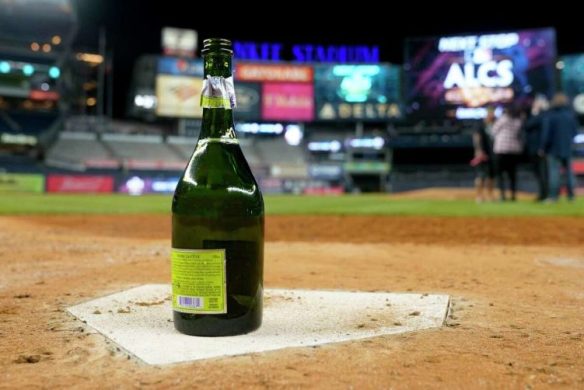
A spent champagne bottle placed on home plate after the Yankees won a trip to the ALCS Tuesday night. The Yankees had to celebrate their win in a hurry—they open against the Astros Wednesday night.

The good news is, Year One of Comissioner Rube Golberg’s triple-wild-cards postseason experiment isn’t going to have an all also-ran World Series, after all. It still yielded a pair of division-winning teams getting to tangle in the American League Championship Series.

The bad news is, those two division winners are still the Yankees and the Astros, after the Yankees sent the AL Central-winning Guardians home for the winter with a 5-1 win Tuesday that wasn’t exactly an overwhelming smothering.

What it was, though, was the game for which the Guardians shot themselves in the proverbial foot. Specifically, two Guardians, one of whom is old enough to know better and the other of whom needs a definitive attitude adjustment.

Guardians manager Terry Francona has more World Series rings this century (two) than Yankees manager Aaron Boone (none). Francona is considered by most observers to be one of the game’s smartest managers who’s made extremely few mistakes and learned from one and all; Boone is one of those skippers about whom second-guessing is close enough to a daily sport in its own right.

But when push came to absolute shove for rain-postponed AL division series Game Five, Boone proved willing to roll the dice Francona finally wasn’t.

After Gerrit Cole held the Guards off with a magnificent Game Four performance Sunday but the rain pushed Game Five from Monday to Tuesday, Boone was more than willing to throw his original Game Five plan aside—Jameson Tallion starting and going far as he could to spell the beleaguered Yankee bullpen—and let Nestor Cortes pitch on three days’ rest for the first time in his major league life.

Francona wouldn’t even think about changing his original Game Five plan, opening with his number-four starter Aaron Civale, who hadn’t even seen any action this postseason until Tuesday, then reaching for his bullpen at the first sign of real trouble. He wasn’t willing to let his ace Shane Bieber go on three days’ rest for the first time in his major league life.

Mother Nature actually handed Francona one of the biggest breaks of his life when she pushed Game Five back a day. Either he missed the call or forgot to check his voicemail. “I’ve never done it,” said Bieber postgame Tuesday, about going on three days rest. “But could I have? Sure.”

“It’s not because he can’t pitch,” said Francona after Game Five. “It’s just he’s been through a lot. You know, he had [a shoulder injury in 2021] and he’s had a remarkable year, but it’s not been probably as easy as he’s made it look.”

It might have been a lot easier on the Guardians if Francona handed his ace the chance to try it, with reinforcements ready to ride in after maybe three, four innings. Even year-old-plus shoulder injuries deserve appropriate consideration, of course. But Bieber surrendered a mere two runs in five-and-two-thirds Game Two innings. Francona’s hesitation when handed the chance helped cost him a shot at another AL pennant.

Civale didn’t have it from the outset. He had as much control as a fish on the line jerking into death out of the water. Giancarlo Stanton slammed an exclamation point upon it when he slammed a hanging cutter the other way into the right field seats with two aboard and one out.

The Guards’ pen did surrender two more runs in the game, including Aaron Judge’s opposite field launch the next inning. But they spread those runs over eight and two-thirds innings’ relief while otherwise keeping the Yankees reasonably behaved. They gave the Guards every possible foot of room to come back and win it.

That was more than anyone could say for Josh Naylor. The Guards’ designated hitter had already raised temperatures among enough Yankees and around a little more than half of social media, when his Game Four home run off Cole resulted in him running the bases with his arms in a rock-the-baby position and motion.

Naylor intends the gesture to mean that if he hits you for a long ball he considers you his “son” in that moment. It wasn’t anything new for him or for those pitchers surrendering the 20 bombs he hit on the regular season. And Sunday’s blast was the third time Naylor has taken Cole into the seats in his major league life. He was entitled to a few bragging rights.

Cole himself thought the bit was “cute” and “a little funny.” He wasn’t half as offended as that half-plus of social media demanding Naylor’s head meet a well-placed fastball as soon as possible. Yesterday, if possible. The Yankees found the far better way to get even in Game Five than turning Naylor’s brains into tapioca pudding.

“We got our revenge,” Yankee shortstop Gleyber Torres all but crowed postgame. Torres even did a little rocking of the baby himself in the top of the ninth, after he stepped on second to secure the game-ending force out. “We’re happy to beat those guys,” he continued. “Now they can watch on TV the next series for us. It’s nothing personal. Just a little thing about revenge.”

Naylor was also serenaded mercilessly by the Yankee Stadium crowd chanting “Who’s your daddy?” louder with each plate appearance. Every time he returned to the Guards’ dugout fans in the seats behind the dugout trolled him with their own rock-the-baby moves. And his most immediate postgame thought Tuesday was how wonderful it was that he’d gotten that far into their heads.

Some say it was Naylor being a good sport about it. Others might think he was consumed more with getting into the crowd’s heads than he was in getting back into the Yankees’ heads. The evidence: He went 0-for-4 including once with a man in scoring position Tuesday.

Oh, well. “That was awesome,” he said postgame of the Yankee Stadium chanting. “That was so sick. That was honestly like a dream come true as a kid—playing in an environment like this where they’ve got diehard fans, it’s cool. The fact I got that going through the whole stadium, that was sick.”

Josh Naylor

Rock and troll: Yankee fans letting Josh Naylor have it on an 0-for-4 ALDS Game Five night.

Did it cross his mind once that his team being bumped home for the winter a little early was a little more sick, as in ill, as in not exactly the way they planned it? If it did, you wouldn’t have known it by the way he continued his exegesis. “If anything, it kind of motivates me,” he began.

It’s fun to kind of play under pressure. It’s fun to play when everyone’s against you and when the world’s against you. It’s extremely fun.

That’s why you play this game at the highest level or try to get to the highest level: to play against opponents like the Yankees or against the Astros or whoever the case is. They all have great fanbases and they all want their home team to win, and it’s cool to kind of play in that type of spotlight and in that pressure.

Wouldn’t it have been extremely more fun if the Guardians had won? Did Naylor clown himself out of being able to play up in that spotlight and its pressure this time? Those are questions for which Cleveland would love proper answers.

So is the question of how and why the Guards didn’t ask for a fourth-inning review that might have helped get Cortes out of their hair sooner than later, after a third inning that exemplified the Guards’ hunt-peck-pester-prod limits.

They went from first and second and one out in the top of the third—one of the hits hitting the grass when Yankee shortstop Oswaldo Cabrera collided with left fielder Aaron Hicks, resulting in a knee injury taking Hicks out of the rest of the postseason—to the bases loaded and one out after Guards shortstop Amed Rosario wrung Cortes for a four-pitch walk. They got their only run of the game when Jose Ramírez lofted a deep sacrifice fly to center.

Now, with two outs in the top of the fourth, Andres Giménez whacked a high bouncer up to Yankee first baseman Anthony Rizzo, who had to dive to the pad to make any play. The call was out, but several television replays showed Giménez safe by a couple of hairs. Perhaps too mindful of having lost three prior challenges in the set, the Guardians’ replay review crew didn’t move a pinkie. Francona seemingly didn’t urge them to do so.

Never mind that it would have extended the inning and given the Guards a chance to turn their batting order around sooner, get Cortes out of the game sooner, and get into that still-vulnerable Yankee pen sooner. Francona’s been one of the game’s most tactically adept skippers for a long enough time, but not nudging his replay people to go for this one helped further to cost him an ALCS trip.

These Yankees don’t look proverbial gift horses in the proverbial mouths. An inning later, with Torres on first with a leadoff walk and James Karinchak relieving Trevor Stephan following a Judge swinging strikeout during which Torres stole second, Rizzo lined a single to right to send Torres home. That was all the insurance the Yankees ended up needing.

Especially when these so-called Guardiac Kids, the youth movement whose penchant for small ball and for driving bullpens to drink with late rallies, forcing the other guys into fielding lapses, winning a franchise-record number of games at the last minute, had nothing to say against three Yankee relievers who kept them scoreless over a final four solid shutout innings.

Especially when they actually out-hit the Yankees 44-28 and still came up with early winter. The trouble was, the Guards also went 3-for-30 with men in scoring position over Games One, Two, Four, and Five, and had nobody landing big run-delivering blows when needed the most. Their ability to surprise expired.

Now the Yankees have a chance for revenge against the Astros who’ve met them in two previous ALCSes and beaten them both times. They had to hurry their postgame celebration up considerably—the ALCS opens Wednesday night.

The Guardians could take their sweet time going home for the winter and pondering the season that traveled so engagingly but ended so ignominiously.

“Winning the division was the first part,” Hedges said postgame. “Wild-card round. Put ourselves in position to beat the Yankees. And we wanted to win the World Series, but that’s a good Yankees team. The cool thing is, now we have a bunch of dudes with a ton of playoff experience in the most hostile environment you can imagine.”

The Guards were bloody fun to watch for most of it. Then Cole, Stanton and Judge rang their bells in Games Four and Five, and they had nothing much to say in return. The Guardiac Kids were the babies who got rocked. There was nothing much fun about that.

Two relief tales from . . .

Two relief pitchers will miss postseason time thanks to circumstances unrelated to play on the field. One will miss the rest of his team’s postseason, however long it lasts, thanks to a self-inflicted injury. The other will miss his team’s postseason and say goodbye to that team. Neither man’s postseason had to end this way.

Astros reliever Phil Maton broke a bone in his right pinkie after his appearance in the team’s final regular season game. He’d surrendered two hits plus the only two runs the Phillies scored in that finale, and he was unamused, understandably. What wasn’t so understandable was Maton punching his locker in frustration.

Lockers aren’t any more forgiving that outfield walls or pitchers’ mounds when it comes to human flesh and bone piledriving into them. It doesn’t matter whether the flesh and bone combination is 20, 22, or 29 years old, the latter being Maton’s age. Those stiff, hard, stationary structures can do more damage to their attackers than Muhammad Ali did to his when answering a right cross.

Yankees reliever Aroldis Chapman had annoyed his team already with an injury from a tattoo he acquired, costing him almost a month’s worth of time over August and September, never mind that prudence and his team overseers probably couldn’t convince him to wait until winter vacation to think about another work of body art.

But Chapman’s decline this season prompted his replacement as the Yankees’ closer and, apparently, didn’t sit well with the howitzer, either. Thus did he fume about his demotion until Friday last, when the Yankees conducted a team workout preparing for the division series with what proved to be the Guardians. (Their first place finish rewarded the Yankees with a wild card series bye under the new, dubious postseason system.)

Chapman had told the team he’d be there. Until he wasn’t. To put things kindly, Yankee general manager Brian Cashman was far less amused than was Maton to have handed the Phillies a pair of hits and runs:

It was surprising at first, a little shocking, but after the shock wore off, when you add everything up, it’s not surprising. There’s some questions about whether he’s been in all-in or not for a little while. He’s maintained verbally that he’s in, but at times, actions don’t match those words.

Maton knew at once he’d been a damn fool. “It was a short-sighted move,” he told the press after that game, “and, ultimately, it was selfish. It’s one of those things that I hope doesn’t affect our team moving forward.”

He may be fortunate that the Astros have someone to step in. The Astros may be more fortunate. Bryan Abreu’s fielding-independent pitching rate for 2022 is 2.12, against Maton’s 4.33 FIP. It won’t parole Maton from the Dumbass Zone just because his absence may actually have done the Astros a small favour.

Cashman merely fined Chapman for his absence. He left the roster decision up to manager Aaron Boone. Boone wasted very little time in removing Chapman, despite the Yankee bullpen overall being in questionable enough shape as it was before it lost stretch-drive comer Scott Effross to forthcoming Tommy John surgery.

“I think he questioned whether or not he was going to be on the roster or not,” the manager told a reporter. “But he needed to be here . . . I think there’s a chance he absolutely could have been [on the roster]. We’re still actually getting ready to start those conversations now. He may have been. It’s a moot point now.”

The Yankees told Chapman—whose once-vaunted fastball still had the speed of light but wasn’t exactly invulnerable any longer, not with his 2022 marks of a 4.46 ERA and a 4.57 FIP—to go home to Florida for the division series.

That’s the official word. Unofficially, the word comes forth that, in effect, they’ve told him they’re not terribly inclined to think about bringing him back after he hits free agency this winter. Not with Clay Holmes having emerged as an All-Star reliever and the Yankees’ number one closing option.

It may be lucky for Maton that the Astros may not be injured (oops) by his absence as their postseason gets underway. (The AL West ogres, too, earned a round-one bye under the new system and will tangle with the pleasantly surprising Mariners in their division series.) They can absorb his D.Z. moment and hope he’s learned or re-learned something about self-control.

It’s anything but lucky for Chapman that the Yankees would have needed him to stay all in and step up as big as he could with most of the Yankee pen now in shambles. Holmes (shoulder strain) and Wandy Peralta (a back issues) are back for the division series, but Zack Britton (arm fatigue), Chad Green (Tommy John surgery), Michael King (elbow fracture), and Ron Marinaccio (shin injury) aren’t.

Chapman isn’t any D.Z. non-entity, of course. Not with his domestic violence history that caused enough people to question why the Yankees traded for him (from the Reds), traded him away (to the Cubs, for key contributor Gleyber Torres), then re-signed him in the first place, all within the same year.

When a howitzer that can fire 100+ mph shells gets a pass from domestic violence but finally runs around over an injury from an elective act and, then, shenks a team workout atop a questionable attitude as they prepare for a postseason, something seems badly imbalanced there. It might begin with a 34-year-old who still displays often enough the mind of a four-year-old.