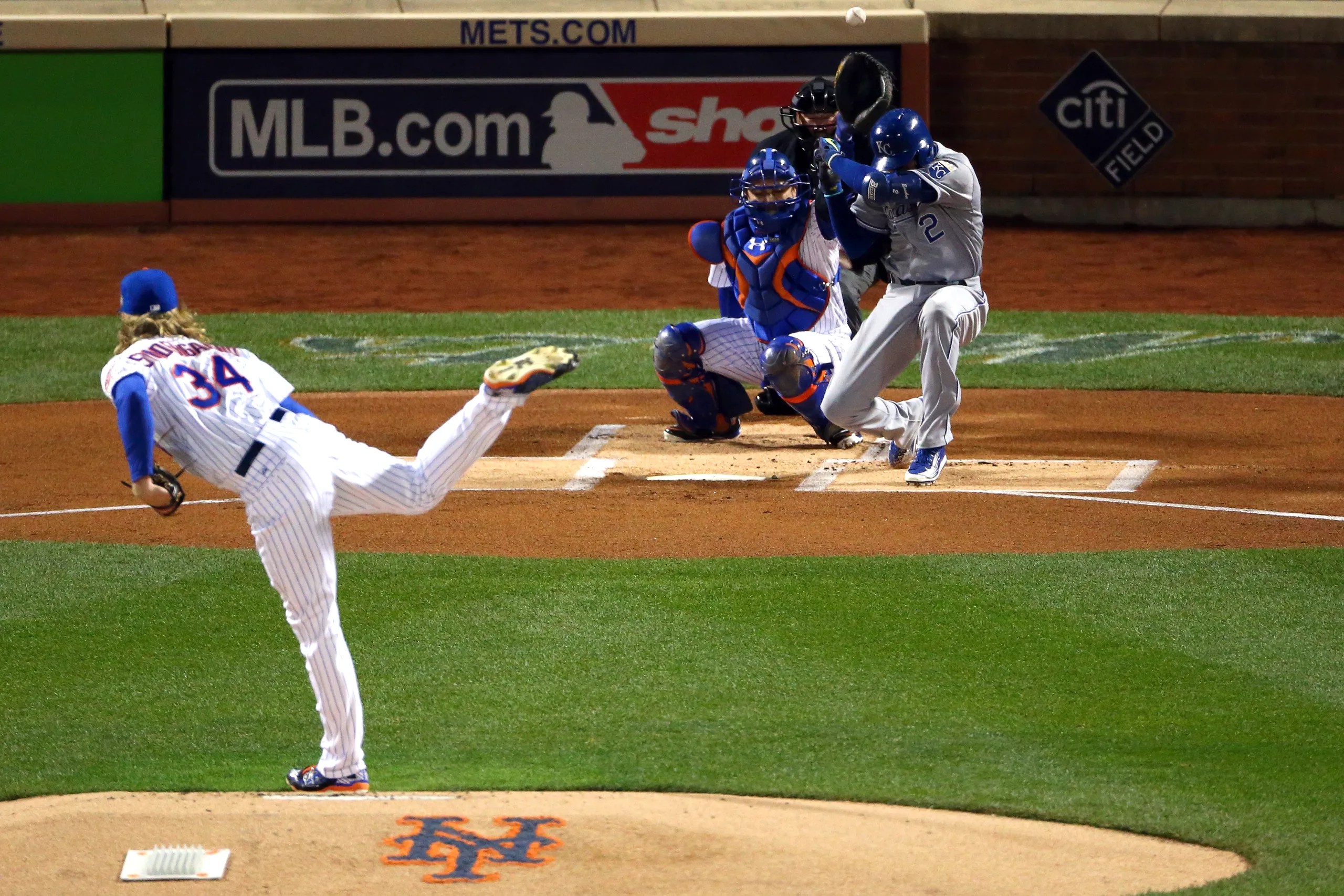
What Syndergaard wanted most

Noah Syndergaard

Met fans won’t forget Noah Syndergaard dropping Alcides Escobar to open Game Three of the 2015 World Series. Now the talented but oft-injured Syndergaard will be an Angel because the Mets’ administration slept at the switch after making his qualifying offer.

Go ahead and cling to the surface look if that’s your preference. Cling to the Mets showing Noah Syndergaard a qualifying offer and Syndergaard electing instead to let the Angels seduce him for a couple of million dollars more for next year, if it makes you happy. Cling to the narrative that Syndergaard’s heart with the Mets could be bought, if you must.

But now you must ask yourself concurrently just why it was that Syndergaard’s Mets heart was abandoned while the Angels swept in and swept him off their feet. Your answer is no further than New York Post writer Joel Sherman, who says the Angels had a plan for the power-pitching righthander coming back from Tommy John surgery—and the Mets apparently lacked one.

Oh, sure, the Mets plan to win if they can help it. But that’s it. When they tendered Syndergaard his qualifying offer, that was it, too. They had no general manager at that moment. They had no manager. They still don’t. They’ve got a pitching coach, Jeremy Hefner.

But nobody in the Mets’ organisation talked much of anything yet about how they were going to shepherd a starting pitching staff going forward. They didn’t talk about how they were going to manage Syndergaard’s work load during his first full season back after Tommy John surgery, recovery, and rehab.

Enter Angels general manager Perry Minasian. He knew Syndergaard wanted a deal and the physicals done before today’s qualifying-offer deadline, just in case the physicals didn’t wash, leaving Syndergaard a Mets fallback after all. He also knew what Syndergaard wanted beyond a solid-enough, prove-it-year’s deal.

Syndergaard wanted a plan. Minasian high tailed it to New York to present him one. “[F]or the best organizations these days preparing pitchers physically, for the season and for each game, is a collective effort across multiple departments,” Sherman writes.

There were efforts in the first year under [Steve] Cohen’s ownership to bulk up these areas, but [the Mets] still pale in comparison to clubs such as the Dodgers, Giants and Blue Jays, among many others.

Minasian . . . came to New York armed with details on, among other things, how his club would have him pitch to individual players on each team in the AL West. He spoke of the success the Angels enjoyed last year with a six-man rotation, which helped get Shohei Ohtani through a season of hitting and pitching healthy. Minasian said the plan would stay the same and showed Syndergaard how pitching in a six-man rotation would give more time for recovery and lower his overall inning total when all he had in 2020-21 in the majors was two one-inning stints to close out the past season. Minasian brought data to show what the Angels liked about his delivery and pitch mix and how to make them even more effective.

In other words, Minasian caught the Mets sound asleep at the Syndergaard switch. While the Mets just slid a qualifying offer under the righthander’s nose with nothing substantial behind it to show him anything resembling love or respect, the Angels’ GM—who goes back with Syndergaard to the Blue Jays, having been part of their drafting team when they first picked him—brought all three. Love, respect, and substance.

Minasian also brought it with the most aggressive and committed push among several contenders for Syndergaard’s prove-it season, including the world champion Braves, the Red Sox, and the Jays.

Sherman notes that the Angels weren’t exactly thrilled about having to lose a draft pick for signing Syndergaard, but they were less thrilled than that about the prices in the free agency starters’ store—and starting with a Syndergaard whom Minasian knew well enough would give them decent odds in the upside department before pondering another starter or two on that market

The Angels’ seduction, Sherman writes, mattered as greatly as the Mets’ apparent lack of it: “Syndergaard is going to pitch at 29 this year. He recognizes how vital it is that he performs well to set himself up to re-enter the market next year at 30 to try to score a lucrative, long-term pact. And here were the Mets not even talking to him throughout this process. Here they were without an infrastructure in place. Here they were unable to provide a detailed plan to him beyond the big picture that Cohen wants to win now.”

The Mets hired former Angels GM Billy Eppler—Minasian’s immediate predecessor—as Syndergaard’s deal with the Angels came forth. This can be called crossing one end of the street without bothering to see who’s coming down the block from the other end. This can also be called too little, too late. This can be called, further, that’s still so Mets.

Leaving Mets fans with memories of a stout, tenacious pitcher who could be lights out when healthy and who gave them one whale of a performance in the 2015 World Series: Syndergaard dropping plate-crowding, plate-overcomfortable Royals shortstop Alcides Escobar to open Game Three, the only game in the Series that the Mets’ then-porous defense couldn’t cost them.

God knows the Angels themselves need a starting pitching overhaul—again. If a year’s worth of Syndergaard at minimum helps it begin, the deal will have been worth it. If Minasian’s plan for him works well enough, the Angels might think of extending Syndergaard or Syndergaard will have a solid market when he hits free agency next winter.

If losing Syndergaard now means a swift enough kick to the Mets’ posterior on behalf of shaking them further out of their funk before and after any possible lockout, it might be worth it, too. Eppler’s hiring to the contrary, with these Mets that’s a glandular if.

Will Eppler get to run the Mets unimpeded?

Billy Eppler, Mike Trout

Then-Angels GM Billy Eppler—seen with Mike Trout, whom he signed to a glandular Angel-for-life extension in 2019—now gets to run the Mets without a contradictorily heavy hand above and undermining him.

The good news (yes, it’s good news) is that the Mets finally have a new general manager. The bad news is that an awful lot of people may be shaking their heads and lamenting, “They put on that crazy hunt to end up with this?”

Billy Eppler wasn’t exactly a resounding success when he held the same job with the Angels from 2015-2020. Not overall, anyway. In isolated moments he looked like a budding genius. In the big picture, he looked like another one of Angels owner Arte Moreno’s designated fall guys.

The budding genius side: Eppler did the heavy lifting when it came to making Mike Trout an Angel for life and for making Shohei Ohtani an Angel at all after his Japanese splash. He secured the game’s best all-around position player and his three American League MVPs and landed this year’s two-way sensation who just might shake out as this year’s AL MVP.

The fall guy side: Moreno’s contradictory penchant for splash signings, low enough budgets otherwise, and moves he pushed out of sheer fury after failures to strike  designated targets. Moreno is a lot more like Eppler’s one-time boss George Steinbrenner’s bad side than Angel fans often dare admit outright.

Before Met fans continue shrugging their shoulders and lamenting that this, too, is so Mets, ponder if you will that when the Angels hired Eppler in the first place—after he’d spent copious time as Brian Cashman’s assistant with the Yankees after running their scouting system a few years—Eppler went in with an arm and a half tied behind his back before he could make his first phone call.

Perhaps insanely, Moreno gutted just about his entire scouting system. He made international scouting director Clay Daniels pay with his head after some of Daniels’s subordinates were caught skimming signing bonuses. He pinked his overall scouting chief Eddie Bane over a series of bad drafts and free agency signings, even if one of Bane’s last solid moves was pressing the Angels to sign a kid named Trout in the first place.

Several of Eppler’s moves blew up through no fault of his own. Zack Cozart struggled as a new Angel in 2018 before a torn labrum killed the second half of that season and neck and further shoulder surgery killed much of his 2019 before he was traded away and ultimately retired.

Eppler made a number of reclamation-project free agency signings that failed miserably enough, as in former Met Matt Harvey plus Cody Allen, Trevor Cahill, Tim Lincecum, and Julio Teheran. With the best intentions Eppler looked foolish for those deals, just as he would for extending outfielder Justin Upton.

But Upton points to Eppler’s better side as well. Left to half by Moreno’s big-sign/low-budget-otherwise style, Eppler did what he could with whatever he was left to work with, and it wasn’t exactly his fault that his penchant for sharp trading and a sharp waiver-wire eye was made to look foolish by subsequent events.

Trading for Upton in the first place looked smart at first—before the extension and before the unanticipated injuries that have throttled Upton since 2019. Eppler also made several trades that made useful Angels out of Dylan Bundy (pitcher), Tommy La Stella (middle infield), Andrelton Simmons (shortstop), Felix Pena (pitcher), Patrick Sandoval (pitcher), and Max Stassi (catcher), for short whiles, anyway.

Eppler was also deft enough to land Brian Goodwin, Blake Parker, Noe Ramirez, and Hansel Robles off the waiver wire, getting some success from the group before they, too, petered away.

None of those moves translated into postseason trips for the Angels, of course, but you can look closely at just about all of them and discover the issues and baggage of most of those players didn’t arise until well after they arrived in Anaheim. But just as a manager takes the fall for “underachieving” or “shortfalling” teams, GMs take the fall when their moves turn out disastrous even through no fault of their own.

Essentially, the Mets played that postseason song-and-dance GM hunt to end up with a guy who’s been in and out of the reputed New York incinerator. (Remember Sandy Alderson saying it was just that overwhelming Apple heat that kept the Mets from bringing the best and the brightest aboard?) A guy who may not be cuffed and stuffed by a contradictory owner with a reputation for hard meddling.

It couldn’t have come at a stranger time. This may be so Mets—the former Angels GM taking the Mets’ helm as one of their key pitchers signs with the Angels. All Noah Syndergaard had to do—following his recovery/rehab from Tommy John surgery—was show a little enough of his classic Thor form in a pair of token gigs at season’s end, plus reject a Mets’ qualifying offer after the season, and the Angels take a flyer on his recovered self for a one-year, $21 million deal . . . pending physicals.

So Eppler gets to go to work right away redressing the Mets’ pitching depth issues. With all-world ace Jacob deGrom a question mark until he actually gets back on the mound next year, and their most reliable non-deGrom starter Marcus Stroman now a free agent, the Mets’ starting corps isn’t exactly a finalised 2022 product just yet.

Eppler will also have to step into the Mets’ efforts to convince middle infielder Javier Baez to keep his defensive virtuosity and reviving bat in Queens next to his keystone partner Francisco Lindor. He’ll have to start pondering moves to fortify their outfield. He’ll also have to think swiftly enough before any possibility that, with the current collective bargaining agreement due to expire and the owners threatening a lockout, the game shuts down for enough of a winter chunk.

But you can almost picture Eppler looking back upon his Angels tenure, then looking out now from his new perch with the Mets, and thinking to himself, “Jeez, I thought it was going to be impossible!” He may yet think that, compared to where he was, he’s in the next best thing to a professional jacuzzi now. May.

There’s another nice Mess they’ve gotten themselves into

Jacob deGrom

Losing Jacob deGrom for the season was the key blow, but the Mets lacked the ability to overcome that the Braves and the Phillies—squaring off critically this week—really had.

This is what 2021 became for the Mess (er, Mets). As MLB Network’s Jon Heyman points out rather cruelly, this year’s Mets have done what no Show team ever has done: spent the most days in first place (103) in a year they’ll finish with a losing record.

Look to your non-laurels, every St. Louis Brown ever, every Washington Senator before and after 1924, every Indian since the Berlin Airlift, every 1964 Phillie, every 1980s Brave, every 1987 Blue Jay, and even every 2007 Met.

Feel just a little better about yourselves, fellow 2021 collapsers in San Diego. Maybe you both fell out of contention officially and once and for all on the same day. But that exhausts whatever you actually had in common.

Well, ok. You both spent lavishly last offseason to augment, fortify, and strengthen. “It is a familiar formula,” the New York Post‘s Joel Sherman reminds us. “The teams that spend the most and/or add the most famous players are cheered and crowned in winter, often followed soon after by dismay in summer.”

Dismay? How about deflation? How about disaster? How about formerly gleeful prognosticators and impatient fan bases who feel again as though they’ve been walked up to the mountaintop, shown the Promised Land, and given a swift kick in the tail with a jackboot to crash on the rocks below?

Joe and Jane Padre Fan should count their blessings. They’re not half as accustomed to great expectations turning to gross vaporisations as are Joe and Jane Met fan. Joe and Jane Padre Fan adjacent to the pleasant, embracing San Diego waterfront expect no miracles but merely hope.

Joe and Jane Met Fan inside the belly of the New York beast, adjacent to the rumbling East River, expect everything—until they don’t. Even when the Mets held fast at the top of the none-too-powerful National League East heap this year, there was always the sense that, somewhere in New York or beyond, there was at least a minyan worth of Met fans thinking to themselves, “OK, when’s it going to happen?”

If you don’t know what “it” is, you haven’t watched the Mets for half as long as I have. And I was there to see them born with Abbott pitching to Costello and Who the Hell’s on first, What the Hell’s on second, You Don’t Want to Know’s at third, You Don’t Even Want to Think About It’s at shortstop, the Three Stooges in the outfield, the Four Marx Brothers on the bench, the Keystone Kops in the bullpen, and Laurel and Hardy on the coaching lines. I’m still not sure whether it was Casey Stengel or Ernie Kovacs managing that team.

Even by the standards of this year’s NL East, the division was the Mets’ for the taking—and they let the tellers reach for their own pistols to stick them up at the bank window. Meanwhile, the Braves and the Phillies open a series today in Atlanta. A measly two games separate them at the top of the division.

Too many Met injuries? Well, yes. But let’s look around.

The Braves lost a franchise player (Ronald Acuna, Jr.) trying for a leaping outfield catch dead middle through the season. One day later, they sat at 44-45. Since the All-Star break: 39-27. The Phillies almost lost a franchise player (Bryce Harper) at April’s end, hit in the face and wrist hard with a pitch, watched him struggle to get back into his full form through a wrist injury. At the All-Star break: 44-44. Since the All-Star break: 37-31.

Braves general manager Alex Anthopoulos simply reached out, plucked a few spare outfielders at or around the trade deadline, and found the unforeseen gems in Jorge Soler and (after wearing out his welcome in Los Angeles and Chicago) Joc Pederson.

Phillies general manager Sam Fuld might have shocked more than a few observers (and a lot more than a few Phillies fans) when he went trolling for pitching at the deadline—but he came away with Ian Kennedy for the bullpen and Kyle Gibson to augment the rotation.

As in, the rotation that already included Zack Wheeler pitching his way into this year’s Cy Young Award conversation after spending last year only beginning to make the Mets wish, possibly, that they hadn’t given up his ghost just yet. In case Joe and Jane Met Fan need it rubbed in a little further, Wheeler to date has a 2.63 ERA, a 7.14 strikeout-to-walk ratio, and a .216 opposition batting average against his former team.

Entering this week’s just about do-or-die set with each other, the Braves are fifth in the National League for team OPS to the Phillies at sixth. The Braves are sixth in the league with a team 3.95 ERA against the Phillies tenth with 4.41. They both play in home parks hitters love, but the Braves as of Tuesday morning were a .500 team at home while the Phillies as of Tuesday were seven below .500 on the road.

They’re both in better shape than the deflated Mess in New York. Losing deGrom for the season, after he dropped a few more jaws despite earlier injury interruptions, was a blow that couldn’t be cauterised or treated simply. That goes without saying.

But the Mets’ pitching staff not named deGrom got reminded rudely and the hard way that they could even pitch no-hit ball and still discover themselves betrayed. The Mets turned up lost or terribly inconsistent at the plate, almost with or without men in scoring position and showing a distinct knack for bats coming back to life only after it mattered the most.

Marcus Stroman in particular pitched like an ace among the remaining starters; Aaron Loup turned into the Mets’ most dangerous bullpen weapon; Javier Baez shook off his early shakes upon arrival in New York to perform according to his previous notices.

But Francisco Lindor remained a textbook and casebook study at shortstop while struggling to live up to his glandular extension at the plate for the first two-thirds of the season. Michael Conforto in his walk year may or may not have pressed too furiously under the weight of his hopes for either a Met future or a free agency pay day. Pete Alonso re-learned the hard way that his bomb sight meant too little when there wasn’t always someone for him to drive in or someone behind him to drive him in.

That was how the Mets collapsed in August, entered September on a roll showing 10-5 from 28 August-12 September, then went 1-10 from there through Tuesday morning.

It’s one thing to give the boo birds a taste of their own medicine. To this day too many sports fans and too many sports commentators alike equate defeat with moral and character failure. Too many sports fans and too many commentators alike think a loss, or even a losing record (with or without spending 64 percent of the year in first place), equals the end of what’s left of the free world.

But from the top down, these Mets also seemed more interested in blaming the outside than looking inward when trouble arose. It’s something else entirely to say it’s all the fans’ or the press’s fault that a genuinely talented team didn’t know how to overcome the injury bugs the Braves and the Phillies overcame—in a division that looked so modest most of the season that any team ironing up for it could steal it in broad daylight.

Still-new owner Steve Cohen’s growing pains must end after the season does. The end must only begin with finding a new general manager and president of baseball operations. (Preferably, men or women who have verifiable allergies to scandal.) Possibly a new manager, though incumbent Luis Rojas hasn’t been a bad manager so much as he’s been a befuddled one as often as not.

But the most important acquisition the Mets can make to begin their revival should be an unfogged, unclouded mirror. The kind that enables them to see clearly, without alternative, where the issues lay. The kind that might have them unwilling to break the dubious record this year’s model’s collapse enabled them to set.

Manny Machado teaches a hard-learned lesson

Manny Machado, Fernando Tatis, Jr.

Machado gestures emphatically while putting Tatis in his place in the fifth Saturday night.

More often than I care to admit, I miss the real fun stuff. That’s when I have to play catch-up as best I can with what I have.

On Saturday night, I watched my Mess (er, Mets) lose to the Phillies, 5-3, because the game was available to me on Fox Sports via Hulu.

But out in St. Louis, there were Padres veteran Manny Machado and boy wonder Fernando Tatis, Jr. having it out as the sides began changing in the middle of the fifth in St. Louis.

There, moreover, was Machado actually behaving like a team leader in the bargain. Go ahead and say it, until now you thought putting Machado and “team leader” in the same sentence was the equivalent of mining a diamond with a dental pick. But hear me out.

In both games, both sides spent enough time chirping over, shall we say, floating strike zones—the Mets and the Phillies about plate umpire C.B. Bucknor’s, the Padres and the Cardinals about their plate umpire Phil Cuzzi’s. That isn’t exactly new business when it comes to that pair of arbiters.

But the worst out of either the Mets or the Phillies  about Bucknor in Citi Field was chirping. In Busch Stadium, Tatis didn’t just take it when Cuzzi rang him up on a called, full-count, third strike from Cardinals starting pitcher Adam Wainwright leading off the top of the fifth.

The Padres led 2-0 at the time, in a game they absolutely had to win to stay alive in the National League wild-card race. First, Tatis gave an obviously frustrated sigh. Then, he bent his head over his left shoulder and made a few body-language movements plus some utterances . . . but he did it facing away from Cuzzi.

The bad news is that replays showed Cuzzi actually called the pitch right. It hit just under the strike zone ceiling. The worse news for the moment was Padres manager Jayce Tingler hustling out of the dugout to argue the call, trying to protect his player, but getting himself tossed post haste.

As Tingler got the ho-heave, Tatis returned to the dugout and banged the bench a few times in his frustration. Then, apparently, he continued grumbling about that third strike as the inning went forward, with Jake Cronenworth stranded on second following a one-out double. Machado is known to have befriended Tatis personally, but he’d also had more than enough of whatever bellyaching Tatis continued during the inning.

The next thing anyone knew, Machado could be heard hollering clearly enough at Tatis, Go play baseball! You play baseball. You can’t worry about that sh@t! You go play baseball! [Fornicate] that sh@t! Tatis must have tried to interject something about the disputed strike right there, because Machado then hollered, No, it’s not. It’s not about you! It’s not [fornicating] about you! Go [fornicating] play baseball.

Then the Padres’ veteran third baseman and their youthful superstar shortstop went back to the field to continue [fornicating] playing baseball.

The Padres lead held until the bottom of the eighth, when Cardinals third baseman Tommy Edman lofted a one-out sacrifice fly, first baseman Paul Goldschmidt wrung Padres reliever Emilio Pagan for a walk, and left fielder Tyler O’Neill hit a 2-2 cutter into the left field bullpen.

Perhaps ironically, two innings before that blast, O’Neill was no more thrilled with Cuzzi’s strike zone than any Padre on the night. He simply didn’t let mere frustration turn into a fuming that might require a Cardinal veteran or two dressing him down on the spot before the ump might throw him out.

“That was a great job by him not getting too animated there,” said Wainwright, who’d surrendered only a pair of RBI singles to Victor Caratini and Tommy Pham in the top of the fourth. “If we lose him right there, we probably lose the game . . . That was a lot of maturity by him to not get thrown out right there on some tough calls.”

O’Neill’s blast overthrew the lead Padres starter Yu Darvish handed the Padres bullpen after seven shutout innings during which he’d allowed a mere three hits while striking nine Cardinals out. The Padres had no answer in return against Cardinals reliever Giovanny Gallegos in the top of the ninth, with their own veteran first baseman Eric Hosmer striking out swinging on a slightly high fastball to end it.

Machado and Tatis had to be separated by Padres coach Ryan Flaherty before they returned to the field. Post-game, Tingler said only that the dustup wasn’t viewed “negatively” around the team that’s now lost 23 of their last 33 games after entering the season practically crowned the World Series winners-to-be by an awful lot of people now dining on roast crow.

“I’m sure people on the outside think it’s whatever they think, but we’re family,” Tingler told the press. “We’re not going to discuss the details, but we care. There’s passion, there’s frustration. Those are all emotions that are natural and those things happen. But it comes down to a group of men caring.”

The details were captured on more than one video that went slightly viral within moments of the dustup ending, as things turned out. Then the real focus became Machado, who once had a reputation for just the kind of petulance over which he’d now dressed Tatis down so dramatically and, shall we say, colourfully.

Those trying to score the dressing-down as just another example of Machado still being a self-centered pain in the rump roast might be shocked to discover a former Padre, Will Middlebrooks, tweeting very much otherwise in the immediate wake:

I know people will take the angle of “Machado is a bad teammate”…but you couldn’t be more wrong here. This was a leadership move. Let’s not forget FTJ is still 22. A phenomenal player, but still a lot to learn. Tatis can’t get tossed in the 5th inning of a game they need to win.

During an exchange featuring more than a few dissenting tweeters, Middlebrooks added, “History tells me that Machado had the experiences to know better. He’s grown up a lot and learned from his past.

The Padres didn’t make either Machado or Tatis available to the press after the game. But a week earlier, Machado spoke to Athletic writer Britt Ghrioli, during a weekend on which the Padres lost twice to the Dodgers. Machado only began by saying he’d learned some things at last.

There’s a time and place for everything. In Baltimore, I was young. I was just there to play. There were other guys that were leaders—Adam (Jones), J.J. (Hardy), (Matt) Wieters . . . Now, obviously, it’s different. Guys are looking up to me.

I think what’s happening now in this game is we are losing track of the older guys, the respect of the veterans, guys who have been here and done it a long time. You got to earn that respect; you got to earn that role. It’s not just given. A lot of players now are just expected to be the guy [when they reach the majors]. But I’m old-school baseball; I want to teach it how I was taught.

When you are young you make a lot of mistakes. You make mistakes as you grow and hopefully you learn from them, you gain experience. You [fornicate] up again, give your thoughts and learn from it again. That’s what it’s about. I messed up a lot at a young age, like a lot of people, but you take that and you try to learn from it. I’m at the point now where — I’ll be 30 [next year], I want to win. I just want to win.  And I think we can do that here.

“I would say Manny’s done a good job with all his leadership throughout the year,” Tingler said, though he refused again to speak of the deets involving the dugout dustup. “But I would say Manny being able to share his experience and share his past experiences of coming up in the league is a good thing.”

It hasn’t turned Machado into a grump refusing to let the kids play. He still has clear fun playing the game. It’s simply made him one of the adults in the room who knows from bitter experience when the kids can’t afford to get sent to bed without their supper and tries to stop it as best he can with what he has.

While all that happened, I was watching Phillies second baseman Jean Segura hit a pair of solo homers in the first and third off Mets starter Carlos Carrasco. I watched Mets center fielder Brandon Nimmo hit a one-out triple off the top of the right field wall and score on an infield ground out in the sixth to cut the deficit in half.

But I also watched Bryce Harper hit a two-run double in the seventh off Mets relief retread Brad Hand to put the game just out of the Mets’ reach. The other guys have now hit .357 off Hand since the Mets lifted him from the waiver wire at the beginning of this month.

And, after Mets reliever Miguel Castro sank into but escaped a bases-loaded jam with no further Phillies scoring in the top of the eighth, I saw Nimmo hit one over the right field fence to lead their half off but no further Met scoring the rest of the way.

It put the Phillies a mere game behind the Braves in the NL East, with the Braves losing to the Giants, 2-0, in San Francisco. It also kept the Mets five and a half out of first in the East but pushed them to seven games back in the wild card race. The Phillies knock on the door of improbability; the Mets—now losers of five straight—are only a step or three from going through the floor.

Catching up to the Padres and their once-unexpected adult in the room in St. Louis proved just as intriguing.

Luis’s pieces

Luis Rojas

If you want to know why Met fans call for manager Luis Rojas’s execution every other day, Tuesday night’s loss to the Cardinals handed the prosecution incontrovertible evidence.

Maybe it’ll be better all around if the Mets end up out of the postseason picture, after all. If the manner in which manager Luis Rojas ran Tuesday’s 7-6 loss to the Cardinals is any indication, the Mets would be lucky to get past a wild card game, never mind to it in the first place.

No, we’re not taking the Mets’ hitters off the hook for going a measly 4-for-14 with runners in scoring position. We’re not taking them off the hook for killing four rallies by hitting into double plays.

We’re not taking them off the hook for one of those double plays coming in the tenth inning, after a walk to Jonathan Villar added to the free cookie on second to start the inning. And we’re not taking Pete Alonso off the hook for hitting into two of those double plays plus striking out with first and second to kill a fifth-inning chance at tying or taking a lead.

But we’d like to know what on earth Rojas was or wasn’t thinking, after he lifted his starting pitcher Marcus Stroman following six innings of two-run ball in which his only troublesome inning was the fourth, when the Cardinals scored those two runs on a deep infield hit and a sacrifice fly.

Since Rojas entered the game knowing he wasn’t going to use either Seth Lugo or Miguel Castro, he brought Aaron Loup in for the seventh. Watching Loup use only seven pitches to get two fly outs and a swinging strikeout, it didn’t cross Rojas’s mind that Loup might have another healthy and even economical inning in him.

No, Rojas went instead to Jeurys Familia, who’d been less than effective in his previous two outings, rather than giving the ball to his usual eighth-inning option Trevor May. May might have been pried for three runs in his previous outing (against the Yankees, in the 9/11 anniversary game), but he’d been sharp and un-scored upon in nine of his prior ten gigs until then.

Familia surrendered a one-out walk (to Paul Goldschmidt) and a two-run homer immediately to follow (by Tyler O’Neil). Not until the Cardinals followed at once with Nolen Arenado singling and Yadier Molina reaching on catcher’s interference did Rojas finally remember May. And May only caught Dylan Carlson looking at strike three before getting Edmundo Sosa to ground out for the side.

Rojas also didn’t read the deep text when inconsistent Edwin Diaz pitched a scoreless ninth with only thirteen pitches needed. Sure, Harrison Bader led off reaching on an error, but the Cardinals handed Diaz and the Mets a present by ordering pinch-hitter Lars (Sometimes You Feel Like a) Nootbaar to sacrifice. After such Cardinal generosity, Diaz needed only two pitches to get rid of Tommy Edman on a ground out and four to get Goldschmidt to foul out for the side.

Then Javier Baez led off the bottom of the ninth against Cardinals reliever Geovanny Gallegos by hitting the first pitch of the turn over the left field fence to tie it up at four. Three Met outs later, Diaz might well have been able to pitch the tenth successfully, leaving Rojas the option of Heath Hembree for the eleventh.

But no. He lifted Diaz and sent Hembree out for the tenth. Hembree struck O’Neil out swinging to lead off. The Mets ordered Arenado to first on the house and got exactly what they bargained for, Molina hitting into a double play to end the inning. It only cost Hembree seven pitches (remember, you don’t have to throw four wide ones for an intentional walk anymore) to do it. There might have been no harm, no foul if Rojas sent Hembree back out for the eleventh, either.

“I can’t ask any more from the guys,” Rojas said post-game, when asked why he didn’t push his pen men just a little bit harder considering the time running out on the Mets’ hair-thin postseason chances.

“Right now, it would be unfair,” he continued. “I can’t put them in a situation where it would compromise anything else, their stuff, their health. You might run a guy out there and he might not be the same pitcher you’re asking the guy to be, as well. There’s just a lot of things that go into it. Ideally, the manager wants to pitch everyone every day, but there’s some other things that come into play when you talk. It’s the player’s feel, the pitching coach’s feel, my feel.”

Where was the feel when the best options Rojas played pitched so economically in their effectiveness that an extra inning from any of them might have made a phenomenal difference?

There came harm and foul when Rojas instead went to Jake Reed, a 28-year-old rookie not long returned from the injured list and not having thrown a major league inning since mid-August. The good news was Reed, too, pitching economically enough—eight pitches total.

But then there’s the bad news: 1) His third pitch was hit for a leadoff single, sending the free cookie on second to third post haste. 2) His sixth pitch was hit for an RBI single to break the four-all tie. 3) His eighth pitch was turned into a two-run single.

Then Rojas brought in Trevor Williams, his import from the Cubs and normally a starter but well between assignments and able to throw part or all of an inning if necessary. Williams shook off a base hit to get Goldschmidt to dial Area Code 6-4-3 for the side.

Now the questions would include why not have Williams open a clean inning (if you didn’t count the cookie on second) instead of opening it with a rusty rookie? Said Rojas: Well, Reed’s a reliever and Williams is a starter. There’ve been how many skippers burned alive when they went by The Book instead of what their eyes, ears, and actual numbers whispered in their ears?

Going his Book enabled Rojas to pull the lulu of the night—turning to spaghetti bat Albert Almora, Jr. to pinch hit in the bottom of the eleventh, after the Mets pulled back to within a run on an RBI double and a throwing error by Cardinals reliever Kim, and with Williams’s lineup slot due up.

He picked Almora over Luis Guillorme. After opening 0-2, Almora wrestled his way to a full count—and grounded out modestly to end it. Why Almora over Guillorme? “Against a lefty,” Rojas said, “not the right matchup.”

Which part of his Book did Rojas ignore, in deciding the righthanded Almora was his best chance to tie or win despite the fact that Almora’s been hitting like . . . a pitcher, this season? (Slash line: .115/.148/.173.)

Which part of that Book did Rojas ignore in deciding Guillorme the lefthanded bat had no business going to the plate in that spot . . . even with his .344 on-base percentage against portside pitching in 33 plate appearances this season?

(What’s the name of his Book, anyway? For Whom the Bell Tolls?)

Maybe Guillorme would have poked an RBI hit to tie or even win the game. Maybe he would have ended the game the same way Almora did; maybe he might have flied out to end it. But he’d have given Rojas and the Mets the absolute better shot at keeping the game alive or winning it.

The only time Rojas did set his Book to one side Tuesday night was taking Familia over May. As Casey Stengel might have said, there comes a time in every man’s life and he shouldn’t have had that one.

You want to know why frustrated Met fans call for Rojas’s summary execution after just about every other Met loss and sometimes after oddly-managed Met wins? Tuesday night was gilt-edged evidence for the prosecution.

This morning they’re thanking God and His servant Stengel that Tuesday night wasn’t a postseason game. They may even thank both if the Mets finally don’t make the dance at all. How sad is that?