A little hustle in the muscle

Dominic Smith

Dom Smith diving across first after Cardinals reliever Giovanny Gallegos (65) was late covering on Smith’s smash up the line and well behind the base in the top of the ninth Monday. Gallegos then tried but couldn’t nail trail runner Jeff McNeil at the plate, kicking the Mets’ overthrow win into overdrive.

It looked simple enough. Mets outfielder Mark Canha down to his and the Mets’ final strike Monday night with third baseman Eduardo Escobar aboard on a one-out base hit. Cardinals reliever Giovanny Gallegos 0-2 on Canha and ready to land the last punch(out).

The good news for the Mets is that they ended up landing the final punch with a two-run homer finishing a 5-2 overthrow into which they hustled themselves after they’d been down to their final strike. Aided and abetted unexpectedly by Gallegos a moment late and two bucks short covering first base on what could have been a game-ending dazzler.

Thus did the first showdown between the leaders of the National League East and Central grind, sprint, and launch its way to the finish in the Mets’ favour. You could almost feel the Cardinals bawling themselves out that it didn’t have to go that way the moment Mets reliever Edwin Diaz struck Cardinals outfielder Harrison Bader out after a two-out walk.

It came to this because the Mets wasted a delicious pitching duel between Max Scherzer and the Cardinals’ Miles Mikolas, trading shutouts for seven innings, after Mets reliever Tyler May couldn’t put Mendoza Line-hitting Tyler O’Neill away and surrendered a two-run single for his trouble with the bases loaded and one out in the bottom of the eighth.

But now Canha wasnt quite so ready, fighting back to a full count, before he hit a bouncer up the third base line to Nolen Arenado, the Cardinals’ third baseman to whom a play like this, even on the short run, was something he could do upside down if necessary.

Arenado on the not-so-hard run whipped a throw across the infield to first base. The ball soared right past first baseman Paul Goldschmidt and Escobar soared home to put the Mets on the board at last, with Canha taking second on the play and Jeff McNeil checking in at the plate.

Canha came out for pinch runner Travis Jankowski. McNeil sent an RBI double deep to right. And Mets manager Buck Showalter sent Dom Smith up to pinch hit for smart catching/modest-hitting Tomas Nido. Smith shot one up the first base line that Goldschmidt stopped one way or the other, diving across the line as he speared it fair.

But when Goldschmidt hustled a throw to the pad he had no target. Gallegos bounced off the mound a moment too late for the out as Smith dove onto the pad and Jankowski and McNeil cross the plate safely, McNeil himself diving home a split second before Cardinals catching insertion Andrew Kinzner could get a tag on him off Gallegos’s throw home.

“The second he hit it, I thought it was a foul ball,” said Gallegos post game. “Then I saw the ball bounce back to first, and that’s when I broke.”

“That’s a mental mistake,” said Cardinals manager Oliver Marmol. “Can’t excuse it. He knows it; we know it: He’s got to cover first.”

“Dom probably ran the fastest 90 (feet) of his life there,” said McNeil. “I knew it would be close at first base. I ended up scoring. It was a lot of fun.”

Smith wouldn’t exactly disagree. “You try to hustle as hard as you can to beat him,” he said. “I saw the closer didn’t get over right away. I just ran as hard as I could. I knew I had a step on him. I felt slow but I tried to run hard.” Don’t fight the feeling next time, either. It could be worth another pair of runs in another eleventh-hour effort.

It put the Mets up 3-2, brought lefthander T.J. McFarland in to relieve Gallegos for the Cardinals, and brought lefthanded-hitting Brandon Nimmo to the plate for the Mets. McFarland threw Nimmo a sinker that didn’t quite sink below the inner middle of the zone, and Nimmo sunk it on a high line inside the right field foul pole.

“It was worth the wait,” said Mets manager Buck Showalter after they banked the game. “It really was. It was fun to watch.”

“We’re a resilient team,” Smith said, “and I feel like we’re in it till the last pitch every night. Even the games that we don’t come up with a win, I feel like we make it tough on our opponents when they do beat us. I think it showed our DNA and what we’re about.”

And it almost (underline that) erased the pitching duel that kept Busch Stadium in thrall most of the night. Scherzer may have struck ten out in his seven innings but he appreciated his mound opponent just as much. Appropriately.

“Tip your hat off to Miles tonight,” he said of Mikolas, whose own seven-inning effort was five punchouts and four scattered hits. “That’s baseball. It was a great game. Sometimes you run into a buzz saw and he did his job tonight. I’m pitching on pins and needles there. I have to make every pitch. I was thinking even a solo shot might lose it.”

He didn’t have to worry as much as he thought. Monday night left Max the Knife number five on the career survey with his 106th double-digit-strikeout game, not to mention 33 punchouts and a measly eight walks in 25 innings pitched this season thus far.

If only he could pitch in Busch Stadium more often than he does. In his previous five gigs there, he’s gone seven innings or more each without a single run being pried out of him. He also has an ongoing 21-straight shutout inning streak against the Cardinals, and now that he has seven starts of ten strikeouts or more against them he’s behind only Hall of Famer Sandy Koufax in that department.

This is the pitcher the Cardinals have never tried to sign when he was on the open market despite his roots being in Missouri. Now they can look forward to this plus two more seasons of potential continuing torture at his right hand. Even if he might still need Met bats in the ninth to keep the bullpen from trashing his best efforts after he departs for the day or night.

“Everybody had a hand in that rally and that’s the cool thing,” he said of the Mets’ ninth-inning grind-out. “When you see your offense go off like that and just find a way to scratch across extra runs.” Catching one of the other guys asleep just enough when there’s first base to cover critically doesn’t exactly hurt, either.

Sixty years on, an eyewitness remembers the Original Mets

1962 Mets Yearbook

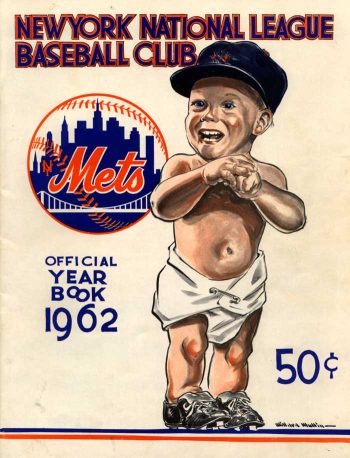
The first Mets yearbook, 1962, drawn by cartooning legend Willard Mullin—whose creation of the Brooklyn Bum in the 1930s proved he knew absurdism when he saw it.

In February 1962, Casey Stengel gathered his sort-of brand-new major league baseball team together, pointed toward the spring training field, and said, “Them are the bases.” Two months later, sixty years ago today, broadcaster Bob Murphy crooned from the booth in St. Louis, “Yes, sir, the New York Mets are on the air in their first great season.”

This year’s Mets awoke this morning after beating the Nationals in Washington three straight before losing 4-2 Sunday afternoon. Their ancestors of sixty years ago awoke that 11 April to lose an 11-4 blowout to the Cardinals in ancient Sportsman’s Park, freshly re-named Busch Stadium.

It began a life-opening nine-game losing streak. And, the birth of a legend. When they recorded their first-ever regular-season win, a handy 9-1 final against the Pirates, the immediate gag became, “Break up the Mets!” No such team setting a record for getting destroyed on the field ever seduced a locale as profoundly as the Original Mets seduced New York.

Still smarting from the exodus West of the Dodgers and the Giants (in whose ancient, rambling wreck of a Polo Grounds home the Mets played awaiting Shea Stadium’s birth), and probably saturated by what seemed decades of Yankee success and its attendant hubris, New York embraced the Mets with a season-long bear hug and a kind of pre-countercultural hysteria in the stands.

If the British played baseball and fielded such a team as the Original Mets, they’d have been considered the game’s progenitors of Monty Python’s Flying Circus. But the National League awarded New York the Mets in its first expansion, their original owner having been the lone stockholding vote against the Giants leaving town. The Mets became . . .

Well, I’ve said it before, but who can resist repeating it? Abbott and Costello performed “Who’s on First” several hundred times before they ended their partnership. Little did they know. The Original Mets seemed to have Abbott pitching to Costello with Who the Hell’s on first, What the Hell’s on second, You Don’t Want to Know’s on third, and You Don’t Even Want To Think About It’s at shortstop.

One minute, the outfield was reasonably competent (and often included Hall of Famer Richie Ashburn at the sunset of his fine career) and the infield (including future Hall of Famer Gil Hodges at first base, before knee injuries put paid to his playing career) was at minimum not bound for infamy. The next, they were the Three Stooges and the Four Marx Brothers.

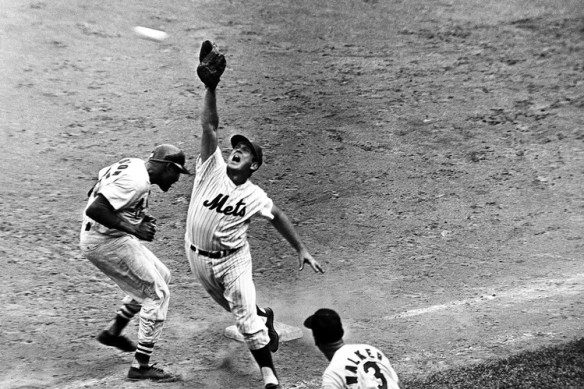
Except when otherwise genial Marv Throneberry played first base. “This,” wrote then-New York Herald-Tribune writer Jimmy Breslin, “was like saying Willie Sutton works at your bank.” He was a former Yankee prospect now a gangling Charlie Chaplin for Groucho, Harpo, and Chico. When he didn’t hit the long ball now and then (he once ruined the Pirates and relief legend Elroy Face with a game-winning three-run homer), he either made things unravel or things unraveled through him.

The bullpen could have been mistaken for a flock of ducks. (Daffy, that is.) The bench could have been mistaken for the Keystone Kops. There were those convinced that Ernie Kovacs was raised from the dead to take the managing job in the aging Stengel’s stead.

The Mets were impregnated of the bold but ultimately doomed Continental League project in 1959, a third major league brainchild of former Dodgers mastermind Branch Rickey, that attracted several wealthy men and women to buy franchises, including in New York. The majors surrendered. They agreed to expand, for the first time, two new teams each.

They also agreed not to let the new teams get their meathooks to within ten nautical miles of solid talent, and not to let them raid the established rosters without paying through their noses and their ears. (Paul Richards, general manager of the National League’s incoming Houston Colt .45s—you know them today as the American League West’s ogres, the Astros—said it most memorably, if coarsely, to his front office: “Gentlemen, we’ve just been [fornicated]!”)

Casey Stengel

Casey Stengel, on the dugout steps in the ancient Polo Grounds. He may or may not have been asking was he really there when all that happened.

One of the wealthy incomers was Joan Payson, the aforementioned Giants stockholding holdout. She was awarded the National League’s new New York franchise. Some believed she’d really bought herself a zoo with the animals holding the keys.

Among their earliest fans was a certain six-year-old boy in the north Bronx, whose firm but kind and generous maternal grandfather (himself a displaced Giants fan) consented to take me to the Polo Grounds to see the madness. For giving his grandson such a gift, there were those who might have accused Grandpa Morris of child abuse.

Naturally, the Mets lost to the Cubs, 6-3. Only the Mets could make that generation of Cubs resemble contenders. The 1962 Cubs finished 59-103, good for ninth place. (This, children, was before the age of divisional play.) Their saving grace was my Mets finishing 40-120. It may have been one of the few times That Toddlin’ Town offered thanks for the Big Apple.

I saw a game featuring six future Hall of Famers. Four of them played for the Cubs. One of them (Ernie Banks) cracked a two-out home run in the top of the fourth to cut an early Mets lead in half, then slashed a two-run single an inning later to finish overthrowing that early Met lead, and finished the Cubs’ scoring with a seventh-inning sacrifice fly.

Among the Hall of Famers on my Original Mets that day, only Ashburn factored in the scoring, coming home from a leadoff single in the third aboard former Dodger Charlie Neal’s one-out triple. An inning earlier, future Cub Jim Hickman singled Sammy Taylor home with the first Met run of the game; three innings later, Taylor returned the favour by singling Neal home for the final Met run of the game.

As Original Mets games go, there was none of the slapstick that dominated that first surreal season. The lone error of the game wasn’t all that hilarious, outfielder Frank Thomas merely mishandling a drive. There was a lot of the fast-famous LET’S GO METS! chanting during the game, so I couldn’t really complain. I got enough of the slapstick watching the Mets on WOR-TV that summer when not in day camp.

Maybe the more apt comparison should have been to The Ed Sullivan Show, where you were liable to see an elegantly passionate performance of classical music followed immediately by a wild animal act. The Original Mets were much like that. One inning of baseball that might plausibly compare to Prelude to the Afternoon of a Faun would be followed by twenty that compared plausibly to the clown cars of Ringling Brothers and Barnum & Stengel Circus.

“Come an’ see my amazin’ Mets,” Stengel often hectored the incoming Polo Grounds customers. “I been in this game a hundred years but I see new ways to lose I never knew were invented yet.”

Stengel managed the Yankees to ten pennants and seven World Series rings in twelve seasons. With him at the helm, and Hall of Famer Yogi Berra behind the plate, the Yankees actually had a kind of human side. With successor Ralph Houk at the helm, the Yankees merely became efficient and boring, other than occasional uproars such as the 1961 Roger Maris-Mickey Mantle home run chase. Their fans reflected it as a sense of entitlement that’s been handed down through subsequent generations.

The Mets simply played off that Yankee hubris and let the city soon to be called Fun City know there was nothing wrong with having mad fun. The madder the better. Stengel’s triple-talking wit, which some mistook for disengagement, did the invaluable favour of keeping his hapless Mets from indignation and himself from going mad.

Marv Throneberry

“Marvelous Marv does more than just play first base for the Mets. He is the Mets.”Jimmy Breslin, in Can’t Anybody Here Play This Game?

Perhaps the closest Stengel had to a kindred spirit was Ashburn, a longtime Phillies favourite (and one of the 1950 pennant-winning Whiz Kids) before coming to the Mets by way of the Cubs. “I don’t know what this is,” Ashburn observed of his Mets at one point during 1962, “but I know I’ve never seen it before.”

The downtrodden Dodgers of the 1930s inspired comparable loyalty but nothing much funnier than New York World-Telegram cartooning legend Willard Mullin drawing a caricature of circus legend Emmett Kelly, Jr.’s Weary Willie character to represent the Bums. The eternally downtrodden St. Louis Browns were about as funny as a tax audit until Bill Veeck got his hands on the team when it was too little, too late.

The likewise-downtrodden Washington Senators (who managed to win a pair of pennants and a World Series, somehow) had a legend—Washington: First in war, first in peace, and last in the American League—that wasn’t quite as true as it was iambically clever. (In sixty seasons before moving to Minneapolis, the Ancient Nats finished last in the American League exactly ten times.) And, occasional laughs.

“New York,” Veeck would write in The Hustler’s Handbook, “had nothing to prove to anybody. New York had the Broadway theatre, the Metropolitan Opera, the best art museums, the tallest buildings. New York had everything except a lousy ball club.”

Presented with as lousy a team as the most optimistic rooter could hope for, the city responded [to the Mets] with frightening passion. The more inept the club showed itself to be (and it reached pinnacles of ineptitude previously undreamed of), the closer the city hugged it to its ample bosom . . .

The Yankees always took the attitude that they were doing you a favour by permitting you to watch them perform. They would no more deign to court their customers than the Queen would deign to court her subjects when she grants her annual audiences . . .

It has only been with the rise of the Mets and the fall of the House of Houk that they have found it polite to provide entertainment. [1964] is the first year, I suspect, that they have seen a fan close up.

At this writing, it hasn’t worked. The Mets are a trip to the Fun House. The Yankees are still a board of directors meeting. I don’t know about your neighbourhood, but it had been years since anyone rioted on my block to attend a board of directors meeting.
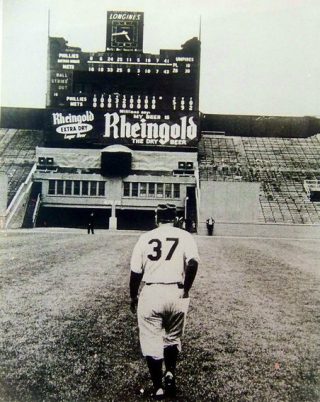
Casey Stengel

Casey Stengel leaving the field for the clubhouse after the Mets’ final home game at the Polo Grounds, 18 September 1963. The original Eddie Grant memorial monument stone stands in front of the center post supporting the building housing offices and clubhouses. The Mets’ clubhouse is on the right; the visiting Phillies’ clubhouse, on the left. Rheingold Beer sponsored the Mets’ broadcasts from 1962-1973. The Rheingold sign blinked the ‘h’ for a hit or the ‘e’ for an error after official scorers ruled on close or tough plays. The Polo Grounds came down in early 1964; Rheingold died in 1976. Sad irony: the original Brooklyn brewery, like the Polo Grounds, was succeeded by an apartment complex.

The method behind the madness was Mets president George Weiss (Stengel’s general manager in those dominant Yankee years) stocking the Original Mets with names familiar enough to National League fans and a few unknown, untried entities to hold fort while men such as farm director Johnny Murphy built the organisation that ended up in a miraculous World Series triumph. With Original Met Hodges on the bridge as the manager. That’d teach them. Some thought something perversely precious was lost forever.

“There was never a team like the old Mets and there will never be another,” wrote Leonard Shecter—maverick sportswriter/editor, future editor of Jim Bouton’s Ball Four, and the writer who first forged a veteran first baseman almost washed up from underuse into the myth of Marvelous Marv—in Once Upon the Polo Grounds, his reminder to those going even madder over the 1969 Miracle Mets that the Polo Grounds Mets were only too real and not to be forgotten. Ever.

Now it is all different. Casey Stengel is gone. The players, who try no harder than the old Mets, succeed more often and as a result are indistinguishable from baseball players all over. There is stuffiness in the front office. There is great concern about unimportant things. [The manager not long ago suggested to a newspaperman that he need not have blabbed in the public prints that the Mets scored their winning run on a bunt.] And, worst of all, when the Mets lose, there is nothing funny about it at all.

Today’s Mets play in a lovely playpen most of whose architecture evokes the memory of Brooklyn’s Ebbets Field. The green seats are the team’s homage to the Polo Grounds, which also outlined its field box seats with dangling chains. It’s the only reference to the Original Mets in the park, other than Casey Stengel’s retired uniform number 37.

This year’s Mets look competitive, seem entertaining, seem engaging. But their 1962 ancestors are too ancient a memory for today’s attention deficit baseball fan. The Original Mets have been long doomed to repose in the pages of books, the archives of newspapers, the artifacts in the Hall of Fame. And, in the memories of those who still don’t know what it was but knew they’d never seen it before.

For the Mets, the Buck starts here

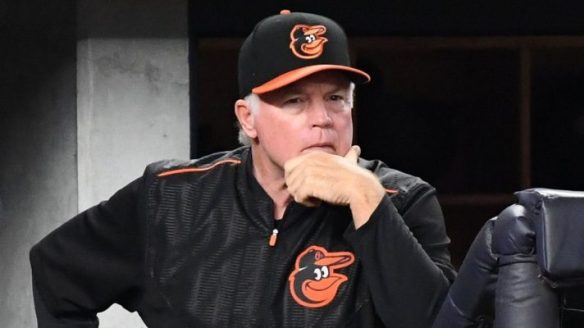
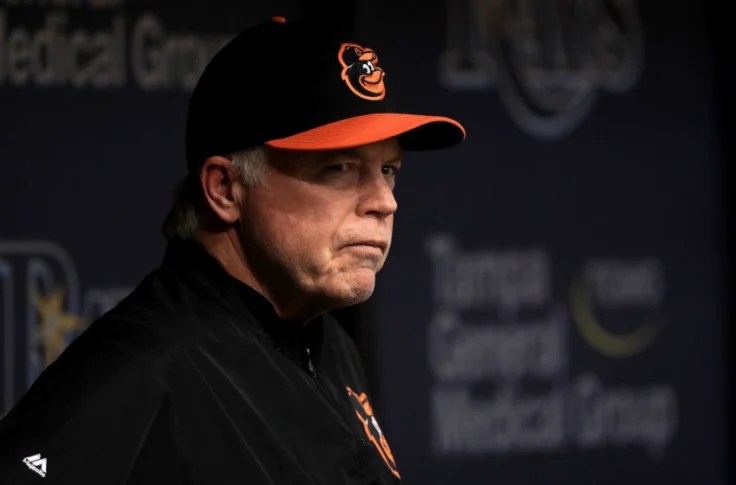
Buck Showalter

Can the smart, well-prepared, clubhouse-cohesive Showalter proved he’s learned from his most egregious mistake?

All fairness: I want to give both the Mets and Buck Showalter the benefit fo the doubt. The Mets, because they did go through a deep enough hunt before making him the 24th manager in their history. Showalter, because you don’t get to manage two decades’ worth of major league baseball without doing more than just something right.

Even if you did something so egregiously wrong once upon a time that it would stain an otherwise solid reputation for smarts, preparation, cohesion, and long-haul steadiness. Four things the Mets need abundantly and Showalter has proven he provides well enough that one terrible mistake really shouldn’t mark your entire career.

But oh, what a mistake it was. And heaven help the Mets and their new skipper if he and they should find themselves facing a comparable scenario when they arrive at the postseason and he makes the same mistake. Will George Satayana prove a baseball prophet, too?

“Those who cannot remember the past are condemned to repeat it,” Satayana wrote immortally in The Life of Reason. Baseball sometimes tries but always fails to forget the past. That can be good and bad, of course. And you’ll have little trouble finding people who’d like to forget the 2016 American League wild card game.

Let’s first put the Big One into proper perspective. It didn’t cost Showalter’s Orioles a World Series. But it cost them a chance to get into a division series from which they might, maybe, have begun a postseason journey there.

Leaving both his and baseball’s best relief pitcher in the pen while a lesser arm surrendered an eleventh-inning, wild card-losing three-run homer has left Showalter second-guessed at least as often as Gene Mauch was over the 1964 Phillies’ pennant race collapse.

That relief pitcher, Zack Britton, holds no grudge. Now with the Yankees, but facing a 2022 season away from the game while he rehabs from elbow reconstruction surgery, Britton doesn’t flinch. Ask him if he’d play for Showalter again given the chance, as The Athletic‘s Ken Rosenthal has, and his answer is an emphatic yes. One hundred percent, Britton began.

Showalter knew he’d blown it. And when he reconvened his Orioles during spring training 2017, he let them know it, Britton says.

We always had this spring training thing, which I thought was cool — off-site, get together in a movie theater, kind of show you the highlights of the previous season, just a bonding moment for the team. During that meeting, he got up there and said, ‘Before we start, I just want to address the elephant in the room.’ He apologized to me, which I didn’t think he needed to do. I think there were some guys on the team that were frustrated by the move. He just said: ‘That’s my bad. I messed up.’ And it was done with.

But was it, really?

Britton told Rosenthal Showalter “had his reasons. I’m not 100 percent sure why, but it didn’t matter. I always knew Buck was thinking through it. He always had a plan. Maybe it didn’t go according to his plan, and then it kind of backfired. But he was willing to take that risk, sticking with the plan.”

That’s the thing, though. Often enough, things happen enough that The Plan needs to be set to one side in the moment. “I don’t know his exact reasoning,” Britton admits. “But I truly think he was trying to do right by me and not hurt me. I’m going to be honest: I don’t think he thought we were going to score. And he didn’t want me to have to go out there for two or three innings.”

That game was tied at two in the bottom of the eleventh when Edwin Encarnacion checked in against Ubaldo Jimenez, a starter pressed into relief after Brian Duensing opened the inning by striking Ezequiel Carrera out. Jimenez surrendered a 1-1 base hit to Devon Travis and a first-pitch single to Josh Donaldson.

Jimenez may have been lucky that Donaldson—proud possessor of 37 regular-season home runs that year—hadn’t ended the game with something longer than a single to set up first and second. And Showalter in the moment didn’t think an 89 game-winning team that hit .256 on the regular season could put even one more run across the plate?

Both teams drained their bullpens by the time Jimenez and Encarnacion squared off. Except that Showalter still had Britton to call upon. The Jays already burned their closer Roberto Osuna, and Francisco Liriano wasn’t likely to stay in the game should the Orioles get it to the top of the twelfth. Everything favoured the Orioles.

Or would have, if Showalter brought Britton in. Now, of course this is baseball, where anything can happen—and usually does. There was always the outside chance that Britton could get tagged, too. But what’s another old saying? Oh, yes: If you’re going to go down, at least go down while you gave yourself the absolute best possible chance to survive and then triumph.

Whole book chapters have been written about the save rule wreaking more havoc then health. Showalter holding Britton because he wouldn’t be coming into a “save situation” can be found there. Possibly Exhibit A; at least, among the top three. Because that game needed to be “saved” right then and there for the Orioles to get one more chance at minimum to win.

So Jimenez stayed in the game. This time, neither he nor the Orioles escaped. Encarnacion hit the first pitch about ten tons into the second deck in left and sent the Jays to the division series.

Now, I’m going to give Showalter all credit on earth for manning up and apologising to his team during that spring movie house confab. Just the way Mauch deserves all credit for holding his team back on the plane, landing home following the end of that ’64 Phillie Phlop, a crowd awaiting them, and telling the players he’d step off the plane first: “You didn’t blow the pennant. I did.”

Just the way Tommy Lasorda—who only thought it was safe to let Tom Niedenfeuer pitch to Jack Clark with first base open and the Dodgers an out away from forcing a seventh 1985 National League Championship Series game—apologised to his players in the clubhouse after Clark’s three-run homer carried what proved a Cardinal pennant to the rear of the left field bleachers.

The New York Post‘s Steve Serby gave Showalter a chance to explain the whole thing in a 2020 interview. “You just have to wear some things,” Showalter replied, “and I can sit here and tell you ten things you may not know about that situation, but nobody wants to hear it. I’m at peace with that.”

Well, now. I’ve written before but it bears repeating. The Britton non-decision being one of baseball’s most often second-guessed, I suspect people would love to hear about the ten things that stopped Showalter from reaching to baseball’s best 2016 reliever in his bullpen other than it not having been a by-the-book “save situation.”

Rosenthal himself, a colleague of Showalter’s at MLB Network, says Showalter “has never explained the full reasoning behind his decision. But he viewed his apology the following spring as an important step in holding the team together.”

Showalter’s strengths have always including holding teams together despite periodic moments that could have driven wedges enough into them. He’s been known to handle the aftermath of bench-clearing brawls by reminding his players—without singling any one out by name—that if you’re going to fight, do it for the right reason, not just because your ego got bruised a few moments.

“[T]here’s nothing worse than supporting something you know is wrong,” Showalter said of one such Oriole incident. “That tears a club up. It’s: ‘Your actions reflect on everyone. Let’s make sure we’re fighting for a just cause’.”

Let’s assume the Mets asked Showalter about the Britton non-decision while they interviewed him for his new job. Let’s assume Showalter went back, broke it all down, reassembled it, all to the Mets’ satisfaction, and that was that.

Put the positives together and the Mets now have a manager who knows how to keep clubhouses from dissembling, who plans well, who isn’t a martinet but whose insistence on accountability doesn’t stop with his players or even with himself. His former Orioles outfielder Adam Jones has spoken of Showalter insisting on acountability from above as well as from under his command.

This is the guy who preferred to walk away from the Yankees rather than let George Steinbrenner fire his hitting coach Rick Down after the Yankees lost a tough division series to the Mariners. A man who won’t suffer The Boss’s impulses without a fight should have no trouble with Steve Cohen, the Mets’ owner whose fan friendliness often betrays tendencies that remind too many of some of Steinbrenner’s, shall we say, crazier ones.

Let Cohen rip his players in public aboard social media? Showalter might have something to say about that. He won’t quite wire himself into Cohen’s electric chair by doing so, but he won’t handle player mistakes or shortfalls quietly only to let the owner make it public and above and beyond reality, either.

He’ll have a team full of sharp veterans and maturing youth on his hands. Assuming Jacob deGrom and Max Scherzer can stay healthy, he’ll have a top two in his starting rotation to die for even if Max the Knife begins showing his age at last. He isn’t likely to let his players get themselves trapped into surrealistic nonsense or unrealistic distractions.

Just be very wary if and when Showalter brings his Mets back to the postseason, if and when their postseason advancement depends on whether he reaches for his absolute best pitching option regardless of The Plan or The Role because the immediate moment demands it.

Pray that, this time, Showalter seizes the moment to give the Mets their absolute best chance to survive and/or triumph, Plan be damned. Sending him a copy of The Life of Reason might not hurt, either.

What the Mets should ask if they want Showalter managing

Buck Showalter

Showalter still has some splainin’ to do over Zack Britton’s absence when the 2016 AL wild card game was squarely on the line . . .

If you want to keep your minds off the lockout for awhile, you can find plenty of issues with which to do that. One coming to mind almost at once is New York Post columnist Mike Vaccaro waxing, as his column’s headline said Friday, on why the Mets should hire Buck Showalter as their next manager.

“The truth is,” Vaccaro wrote, “the team [new general manager Billy] Eppler and [owner Steve] Cohen have already cobbled together — and the one that seems destined to emerge from the lockout — is a team custom-designed for Showalter’s particular talents.”

There will be plenty of veterans, and Showalter likes having vets he can trust in his clubhouse. There will be plenty of intriguing players of younger vintage—think Pete Alonso, Jeff McNeil, Brandon Nimmo—whose experiences as major leaguers have largely been shaped by the stone hands of [former manager] Mickey Callaway and the inexperienced ones of [former manager Luis] Rojas . . .

But Showalter’s teams, in addition to almost always being of a superior collective baseball IQ, also take care of their business properly . . . The Mets, under Showalter, would be a Showalter team. That may mean they’re a couple of degrees less flamboyant, maybe a few layers less fun-loving . . .

So far, so good. And Showalter’s supporters include his former Orioles outfielder Adam Jones, who acknowledged Showalter still has to go through “the process,” meaning proper vetting. “[F]olks don’t have any idea of the real impact he can make on a ball club,” Jones tweeted Friday. “And I’m not just talking players. The Franchise. He made everyone better and accountable!”

How about Showalter making Showalter himself accountable? Say, for not making the move he should have made in the bottom of the eleventh of the 2016 wild card game? Vaccaro’s Post colleague Steve Serby tried in a September 2020 interview. And Showalter failed.

“Your Orioles controversy in [that game] when you didn’t call on Zack Britton and lost in the bottom of the eleventh in Toronto,” Serby presented. “You just have to wear some things, and I can sit here and tell you ten things you may not know about that situation, but nobody wants to hear it. I’m at peace with that,” Showalter replied.

The obvious followup—In fact, Buck, people would love to hear about the ten things that stopped you from bringing in your best relief pitcher, who also happened to be the best reliever in baseball that season, despite there not being a quote save situation, unquote, despite the Blue Jays with first and third and one out in a tie ballgame—didn’t come from Serby’s mouth.

Showalter stayed with Ubaldo Jimenez, normally a starter, but working in relief of Brian Dueseng, after Dueseng opened the inning with a strikeout . . . and despite Jimenez’s prompt surrender of a pair of base hits on four pitches. And Edwin Encarnacion hit Jimenez’s first pitch to him for a three-run homer.

It wasn’t as though Showalter didn’t have a very recent precedent by which to go. Just two years earlier, then-Cardinals manager Mike Matheny made the same mistake—with his Cardinals one game from elimination, Matheny left his best relief option, Trevor Rosenthal, in the bullpen in the bottom of the ninth of a tie game . . . because that, too, wasn’t a quote save situation unquote.

The Giants then had first and second and also one out. Matheny left in Michael Wacha, still rusty from late-season injury idling. And Travis Ishikawa hit Wacha’s second pitch to him for a three-run homer. Showalter was luckier—Encarnacion’s blast into the second deck merely sent the Jays to a division series; Ishikawa’s launch to the top of Levi’s Landing had a National League pennant attached to it.

Matheny reminded everyone what Showalter would forget a mere two years later: the time to bring your absolute best relief pitcher into a game is when it’s squarely on the line, previously designated “role” be damned. Especially when postseason advancement or a trip to the World Series depends on it. That’s not purely a thought from the school of analytics. It’s what they taught in Common Sense Elementary School.

If the Mets take Vaccaro’s suggestion seriously, they should be mindful of Jones’s reminder to put Showalter through the full vetting process. That vetting must include Showalter telling them, at least, what he wouldn’t deign to tell Serby over a year ago.

The Mets should damn well want to know why else—beyond no “save situation”—Showalter left his best relief option to rot when that option just might have sent the game to a twelfth inning giving his team one more chance to win at minumum. Accountability neither begins nor ends with the players.

If Showalter says only and again that nobody wants to hear those ten things you may not know about that situation, the one that sent his team home for a winter too soon, the Mets’ proper reply should be, “Way wrong answer! Thanks for coming, Buck, and don’t let the door knob goose you on your way out.”

The Mets bet Max (the Knife)

Max Scherzer

Shown pitching against the Mets in New York in late August, Max the Knife is a Met now . . . and lucratively.

Lose a shot at bringing a solid pitcher back to the Mets? Lose a followup shot at luring a pitcher who resurrected himself in San Francisco? Go forth and sign a three-time Cy Young Award winner to what might well be his final major league deal—at a record average annual value for pitchers, future Hall of Famers or otherwise.

When you say it that way, it sounds so simple that a refugee from the Delta Quadrant could have done it, despite knowing about as much about baseball as a veterinarian knows about astrophysics. But this is baseball, these are the Mets, that’s Mets owner Steve Cohen, and this is Max Scherzer.

Never mind that Cohen first found an immediate way to atone for squandered time after his particular (and not yet detailed at this writing) rift with former Met Steven Matz’s agent dovetailed with Matz signing a nice four-year deal with the Cardinals.

Signing Starling Marte (center field with a big bat), Mark Canha (just about any outfield spot and an on-base machine), and Eduardo Escobar (solid third baseman who can play second, solid batter) turned Cohen almost overnight from a sad gag to a definite big-market player. Even if it means moving Brandon Nimmo to a corner outfield slot and saying goodbye to a Michael Conforto whose walk-year collapse didn’t look great for himself or the Mets.

Never mind, too, that Cohen and/or his designated hitter couldn’t quite close the deal with righthanded pitcher Kevin Gausman, who turned a career year with the Giants into a nice five-year deal with the Blue Jays—who lost Matz to free agency—that’s the second most lucrative in their franchise history. (George Springer’s five/$125 million beats Gausman’s five/$105 million.)

Signing Scherzer qualifies thus far as the largest, loudest splash on this off-season’s open market to date. Maybe even louder than the ten-year/$325 million the Rangers handed now-erstwhile Dodgers shortstop Corey Seager the day before. In two swell foops (as the lady once said on the radio) the Mets swept up both the single best center fielder available and the pitcher whose 5.9 wins above replacement-level player in 2021 led all free-agent pitchers this time around.

It may also be the least expected. Remember: Scherzer’s conditions for being traded from the Nationals to the Dodgers last July included that he go to either a west coast contender or those guys in his native St. Louis who just bagged Matz. New York was thought to be near the bottom of his baseball bucket list. The Yankees weren’t even a topic, really.

Remember when Hall of Famer Reggie Jackson said he signed his first free agency deal with the Yankees because George Steinbrenner “hustled me like a broad?” Cohen and his minions must have hustled Scherzer like ten ladies and their ladies-in-waiting.

Landing Scherzer means the Mets bring aboard as respected a clubhouse figure as exists in today’s game, a guy who does his best to keep the dysfunction away and also serves as a kind-of de facto second pitching coach, sitting with younger arms while they review video of their past performances and helping them analyse and prepare.

It also means the Mets just landed the guy who led the entire 2021 Show with the lowest walks-per-nine innings rate (1.8), the lowest walks-and-hits-per-inning pitched (WHIP) rate (0.86), posted a better than splendid 2.97 fielding-independent pitching rate, and mostly looked better than his usual self after becoming a Dodger at the 2021 trade deadline.

Mostly.

Max the Knife isn’t quite a kid anymore. At 37, it’s very possible that he’s just signed the final big contract of his major league career; it could even be his final major league deal, period. He pitched mostly like his classic self until his final two starts of the regular season, when he got pried for five runs by the Rockies in Coors Field (23 September) and then for six runs (five earned) by the Padres at home (29 September).

Scherzer recovered from those to pitch well enough in the postseason until former Dodger Joc Pederson yanked a two-run homer off him in the fourth in Game Two of the National League Championship Series. With his shoulder and arm feeling exhausted, Scherzer would have been that set’s Game Seven starter—if the Braves hadn’t yanked four runs out of Game Six starter Walker Buehler while the Dodgers had no answer past two runs off Braves starter Ian Anderson and reliever Luke Jackson.

Nobody would have counted Scherzer out for the seventh game that never came. Just two years earlier, he shook away a terrible neck issue to start Game Seven of the World Series, keep the Astros in check enough despite having nothing left in the tank otherwise, and leave the Nationals room to win the Series with a record fourth road win in the set. He really has been one of those pitchers who can survive on will when the stuff deserts him.

The Mets must be hoping that Scherzer has enough left in the tank to help yank them back into the races to stay. Either that or that he still has that iron will to survive on the mound when the repertoire goes from Kind of Blue to Milli Vanilli.

Assuming both a healthy Scherzer and a healthy returning Jacob deGrom, the Mets in theory would have a 1-2 punch at the top of their starting rotation equal to none today but comparable to several of the past. Sandy Koufax/Don Drysdale. Randy Johnson/Curt Schilling. Heady and three-out-of-four Hall of Famer company to keep.

In theory, too, it could be enough to cause division-rival Nats general manager Mike Rizzo, now navigating a rebuild on the fly without even thinking about tanking, to rub his head with sandpaper (since he has no hair to tear out) and mutter loudly, “If I’d known he’d end up a Met, maybe I wouldn’t have traded Scherzer at all.”

But . . .

“Scherzer could outperform 95 percent of pitchers his age through MLB history and still underperform relative to the contract,” writes Smart Baseball author Keith Law at his usual stand for The Athletic.

Good for him for getting paid, but the idea in free agency is to pay for expected future production, not past production, and the base rate for pitchers his age is not promising. They either lose effectiveness, or they get hurt. Maybe Scherzer is an outlier, just like the race isn’t always to the swift or the battle to the strong. That’s just the way to bet.

The Mets are laying a $43.3 million a year average annual value bet. As Law points out, no pitcher 37 or older has had a 5-WAR season since Bartolo Colon at 39 for the 2013 Athletics; only three since World War II (Hall of Famers Johnson and Phil Niekro, plus Roger Clemens) have delivered 7-WAR seasons at 38+; and, only twelve times have 38-year-old-plus pitchers posted 5+ WAR seasons since the turn of the century.

They’re banking on Jenny Diver, Suki Tawdry, Miss Lotte Lenya, old Lucy Brown, and company forming that big line on the right now that Maxie’s coming to town. For every Met fan and observer wondering if their boy Cohen’s done something else rash, there may be ten counting on Scherzer to become the kind of outlier the Johnsons and Niekros were at his age.

They might even be banking on Scherzer spinning a third no-hitter, this time for them. He has two already, both in 2015, the second of the two against the Mets. When he nailed his 3,000th lifetime major league strikeout last August, bagging San Diego’s Eric Hosmer in the second, Scherzer also took a perfect game into the eighth—when Hosmer exacted revenge by breaking it up with a double to deep right.

Assuming next season won’t be compromised or delayed by any coming lockout, (and it sure feels as though enough of the owners are landing their free-agent signings in a big hurry and rash to secure themselves further before any lockout—a rash which also puts the big lie to any claims of financial ill health), there’s something else to consider.

The Mets are scheduled to open against the Nats. How delicious would it be to see their next manager have to decide whether to open with deGrominator or Max the Knife? Already the National League East would look many things with boring not even close to being one of them.