Frank Thomas, RIP: The needling and the damage done

Frank Thomas

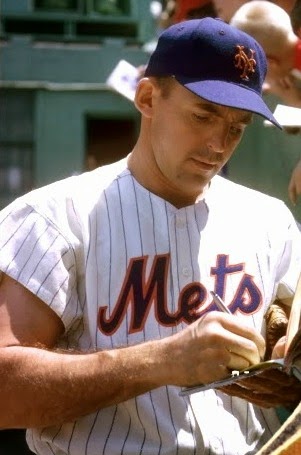
Frank Thomas, signing autographs in the Polo Grounds as an Original Met. As a Phillie, his 1965 fight with Dick Allen accelerated Allen’s undeserved war with Philadelphia racists.

Baseball’s best known Frank Thomas who isn’t the Hall of Fame bombardier died Monday at 93. The good news: That Thomas had a colourful history as one of the Original Mets, for whom he played from their 1962 birth through August 1964. The bad news is that he had a terrible history involving a teammate of colour on the 1965 Phillies.

It soiled a respectable major league career as a power-hitting outfielder/corner infielder, a three-time All-Star with the 1950s Pirates, and an Original Met who was grateful to have been remembered when the Mets reinstituted Old Timers Day last year and he fought through a neck injury to appear.

Thomas survived nasty contract battles with Branch Rickey, then running the Pirates, whose genius as a baseball thinker and courage as baseball’s colour line breaker in signing Jackie Robinson to the Dodgers was countered by his often devious and insulting penury when it came time to pay his players reasonably.

He also prospered somewhat with and survived the Original Mets, that expansion troupe remembered best as baseball’s version of . . . well, they really did have Abbott pitching to Costello with Who the Hell’s on first, What the Hell’s on second, You Didn’t Want to Know’s on third, and You Didn’t Even Want To Think About It at shortstop.

Thomas became the Mets’ first home run king, hitting 34 in 1962, a team record that stood until Dave Kingman smashed it by two in 1975. He also factored in one of the most typical of the inadvertent sketches that, perversely enough, endeared his Mets to a generation of New Yorkers bereft of the Dodgers’ and Giants’ moves west and drowning in a couple of generations of Yankee dominance and hubris.

Center fielder Richie Ashburn, eventually a Hall of Famer based on his long career with the Phillies, despaired of collisions between himself and shortstop Elio Chacón on pop flies to short left center and despaired of how to call Chacón off. Teammate Joe Christopher knew enough Spanish to tell Ashburn to holler Yo la tengo! (I got it!) Sure enough, the next such short pop to short left center had Chacón steaming out from short and Ashburn rumbling in from center.

Yo la tengo! Yo la tengo! Ashburn hollered. Chacón caught the drift at once and stopped dead. Ashburn was saved for about five seconds. Thomas had also come steaming in from left. He crashed into Ashburn and the ball fell safe. Someone forgot to hand Thomas the yo la tengo! memo.

(The pull-hitting Thomas also spent so much time trying to hit the “o” on a Howard Clothes sign on the Polo Grounds’s left field wall—because the New York clothier promised a luxury boat to the Met who hit it the most at season’s end—that manager Casey Stengel finally hollered at him, “If you want to be a sailor, go join the Navy!”)

That season proved Thomas’s final truly solid year at the plate. After a somewhat down 1963 and a 1964 that saw him in and out of the lineup with a few nagging injuries, the Mets traded Thomas to the pennant-contending Phillies that August. He hit respectably enough until he fractured his thumb on a hard slide into second base, ending his season just before the infamous collapse that cost the Phillies a pennant with which they seemed to be running away.

But now age 36, Thomas started too slowly in 1965 before the 3 July pre-game incident that ended his Phillie days in ignominy. Should-be Hall of Famer Dick Allen, the Phillies’ superstar in the making and the National League’s 1964 Rookie of the Year, was taking grounders at third while Thomas was in the batting cage and Phillies center fielder Johnny Callison came out to third to chat with Allen.

According to Phillies historian (and eventual Allen biographer) William C. Kashatus, in September Swoon, Callison suggested to Allen they give Thomas the business over a strikeout following three failed bunt attempts during a plate appearance the night before. In the batting cage now, Thomas took a big swing and miss. “Hey, Donkey!” Callison hollered. (Thomas’s nickname was the Big Donkey; he was also known as Lurch.) “Why don’t you try bunting?”

“Instead of responding to Callision,” Kashatus wrote, “Thomas glared down the third base line at Allen and shouted, ‘What are you trying to be, another Muhammad Clay, always running your mouth off?'”

Insulted by the comparison with Cassius Clay, the colourful but controversial heavyweight boxer who had recently changed his name to Muhammad Ali, Allen charged the cage, and the two players went at each other. Allen hit Thomas with a left hook to the jaw, sending him to the ground. When he got to his feet, Thomas was wielding a bat and connected with Allen’s left shoulder. By now the rest of the team was at home plate trying to restrain the two players.

In his memoir, Crash, Allen remembered Thomas knowing it was Callison who’d taunted him but aiming his return fire at Allen, wrongly.

The Muhammad Clay remark was meant to say a lot. It reminded me of how Frank would pretend to offer his hand in a soul shake to a young black player on the team. When the player would offer his hand in return, Thomas would grab his thumb and bend it back. To him, it was a big joke. But I saw too many brothers on the team with swollen thumbs to get any laughs. So I popped him. I just wanted to teach him a lesson. But after he hit me with the bat, I wanted to kill him.

Callison said hard feelings between Thomas and Allen were building well before the “Muhammad Clay” remark. One of the brothers to whom Allen referred was young outfielder Johnny Briggs, whom Kashatus quoted as saying Thomas “often made racially inflammatory comments.” But Kashatus also quoted Briggs as saying of Thomas, “Thomas agitated everybody on the team. He was just as abusive to the white guys. But the press turned that fight into a racial issue and refused to let up.”

The game that followed the ugly brawl included Allen slashing a three-run triple and Thomas hitting a pinch home run in the next inning. The Phillies lost 10-8 to the Reds . . . and Thomas was put on release waivers afterward. This, Kashatus noted, was despite Allen intervening on behalf of not letting Thomas go, pleading with manager Gene Mauch not to let it happen out of regard for Thomas’s wife and eight children. (Dolores Thomas died in 2012; one of his children, his daughter Sharon, also died before her father.)

Mauch’s fatal mistake otherwise was ordering one and all involved in the Thomas-Allen fight to keep their mouths shut or face fines: $1,000 each, except for $2,000 for Allen. That only enabled that capricious Philadelphia sports press of the time to help make life as a Phillie more miserable for Allen than the city’s racists already began making it, until he finally got the trade he’d been trying to force for long enough.

With Thomas’s release, Kashatus wrote, the veteran wasn’t bound by Mauch’s edict, and appeared on a Philadelphia radio show that often had him as a guest. “I’ve always tried to help him,” Thomas insisted. “I guess certain guys can dish it out, but can’t take it.” Said Tony Taylor, the Phillies’s talented Latino second baseman, “Since Dick was black and Thomas was white, [the Philadelphia writers] made it into a racial thing and gave Dick the label of trouble-maker. It wasn’t fair.”

“Thomas was going to go anyway,” Mauch eventually admitted about his further-fading veteran. “I should have shipped him sooner. Instead, the press came down on [Allen’s] head. If he did one little thing wrong, they would see it as so much worse because, in their heads, he was a bad guy.”

The Phillies dealt Thomas to the Astros, where he was further unhappy from knowing his baseball aging wasn’t going to reverse itself. (He’d move to the Braves and then the Cubs from there but retire in 1966.) “I would not say I enjoyed my time there,” he told an interviewer in 2017, “but not because of the city or the players.”

I was just in a bad place personally. I was an old fogey. When you reach your thirties in baseball, you’re an old man. Expendable. But I loved the guys in Houston. Joe Morgan, Rusty Staub, and my favorite Jimmy Wynn. I once got Wynn with the hidden ball trick. He was so angry with me. But what I remember most is that I hit two home runs and then they traded me! My last at-bat in Philadelphia was also a home run. I guess I just needed to stop hitting them!

Let the record show that Thomas spoke affectionately there of two black players, Hall of Famer Morgan and Wynn. Let it show further that, when the black Frank Thomas was inducted into the Hall of Fame, the first, white Frank Thomas—once one of four consecutive Braves to hit home runs in an inning, along with Hall of Famers Hank Aaron and Eddie Mathews, plus slugging first baseman Joe Adcock—was invited to join in the fun and accepted happily.

“I was the original, but he was better,” Thomas once said of his namesake. “We hold the record for most home runs hit by two players with the same name.” (Thomas is right: the two Frank Thomases actually combined for 25 more home runs than Ken Griffey, Sr. and Hall of Famer Jr. did.)

“I was told that his father was a fan of mine and named him after me,” he continued. “I have met him several times and I love him. I told him that I used to be The Big Hurt, but after meeting him I know that I was just The Little Hurt.”

Between those, and more than a few stories I’ve seen saying Thomas and Allen eventually buried the hatchet together, my better angel wants to believe that that 1965 fight and its immediate aftermath jolted the Big Donkey into a permanent awakening about human relations.

What a long, strange trip it’s been . . .

Carlos Correa

Correa took a medicals-inspired, coast-to-coast trip back to the Twins in the end.

This much we should understand about today’s typical Met fan, and it’s not the first time this lifelong (theirs) Met fan has said so: Today’s typical Met fan is ready to push the plunger on a season over one bad inning—in April. The least shocking thing when Carlos Correa didn’t go from likely signing to donning a Met jersey at an introductory press conference was any Met fan surrendering 2023.

From the moment the Twins with whom Correa played last year came back into play for the shortstop, when the Mets proved as alarmed over Correa’s long-term health as the Giants had previously, many Met fans did. Social media was as crowded with them as a major subway transfer station is crowded during a New York rush hour. But there were voices of reason to be heard if you knew where to listen.

And what those voices said, from the top down, possibly including the fellow lifelong Met fan who owns the team now, was, If this guy’s rebuilt lower leg betrays him when the deal is halfway finished or less, he’s going to become a fan target and we are going to resemble the village idiots for signing him. At least, at the full thirteen and $350 million originally planned.

Now the Twins—who weren’t exactly circumspect about wanting to have Correa back longer term—have brought him back for six years and $200 million. ESPN’s Jeff Passan broke that news aboard Twitter Tuesday. The deal is now official with the physical passed.  Even if it took Correa two long stops aboard what sometimes resembled the crazy train to get there.

Remember: The Giants had landed him—until they didn’t. They quaked over something in Correa’s medical profile, enough to let him walk right into the Mets’ open arms on the day they expected to present him at a presser climbing into a Giants jersey. First it was thought to be Correa’s back. Then, as the Mets were ready to wrap him up for Christmas, the discourse turned to that now-notorious rebuilt ankle.

The Mets had Correa ready to place under New York’s Christmas tree—until they didn’t. They, too, quaked over something in the medical profile. Unlike the Giants, the Mets were willing to adjust. We know now they worked up an adjusted deal for six years and $157.5 million (were willing to go six assured at $175.5 million (roughly $27 million annually), with additional years up to six to follow based upon annual physical examinations.

The Giants’ prudence (if that’s what it was) about Correa in the end still leaves them with more holes to fill. The Mets’ such prudence doesn’t leave them with more than maybe a dent or two to fix. Remember: the Mets won 101 games last season before they collapsed in postseason round one. They’re not exactly in terrible 2023 shape, either.

But it looks as though Steve Cohen isn’t going to be the wild free-spender the rest of baseball world believed and maybe feared. It also looks as though he’s not willing to be as risky as people thought when it comes to players with injury histories no fault of their own but profound enough. Even players he says publicly, as he did about Correa, might be necessary pieces for a full-distance championship team.

Remember: Cohen once let a shiny draft pick (pitcher Kumar Rocker) walk rather than sign him over concerns about shoulder issues. He’s the owner who let Jacob deGrom, the arguable best pitcher in baseball when healthy (underline those two words), walk. (To the Rangers, for five years and $185 million.) If he was willing to let the game’s best pitcher when healthy (underline those words) walk, he wasn’t going to fear letting one of its best left-side infielders walk over similar alarms.

Is it unrealistic to think that the Astros, who raised Correa in the first place and saw him shine with them for seven seasons, let him walk into free agency in the first place because they, too, had long-term concerns about his long-term health?

Cohen may be willing to open the vault wider than any other major league owner, but it doesn’t mean he’s going to be that drunk a sailor. Remember: He had a plan and executed it regarding deGrom, signing seemingly ageless future Hall of Famer Justin Verlander for two years.

He also locked down late-game relief ace Edwin Diáz and outfield mainstay Brandon Nimmo. Extending first base anchor Pete Alonso isn’t unrealistic, either, especially after letting talented but too-firmly blocked Dominic Smith walk into the Nationals’ arms. The plan for Correa was moving him to third to play aside uber-shortstop incumbent Francisco Lindor. Without Correa? They have a pair of talented third basemen, veteran Eduardo Escobar and sprout Brett Baty.

The Mets aren’t hurting without Correa. The Twins are risking that they won’t be hurting if and when Correa begins hurting. As it was, Correa on his 2022 deal—three years, $105.3 million, and three opt-outs, the first of which Correa exercised to play the market in the first place this winter—proved a second half godsend, when the Twins became injury riddled enough but Correa managed to stay the distance.

The Twins also liked Correa’s clubhouse leadership and prodding teammates to improve. “The vision he has,” assistant pitching coach Luis Ramirez told The Athletic, “the awareness, the anticipation about what is going to come next. When he needs to talk to a teammate about an adjustment that needs to be made, or just, to like, picking up a teammate, or paying attention to small details in the game that others don’t see—he makes us better in everything, in the field, everywhere.”

They’re also banking on Correa maturing further and further away from his Astrogate past. Correa was once the staunchest public defender of the Astros’ 2017 World Series title. Yet he said not so fast, more or less, at that notorious February 2020 word salad-bar presser; their illegal, off-field-based, electronic sign-stealing Astro Intelligence Agency was “an advantage. I’m not going to lie to you.”

If you know what’s coming, you get a slight edge. And that’s why [then-general manager Jeff Luhnow and then-manager A.J. Hinch] got suspended and people got fired because it’s not right. It’s not right to do that. It was an advantage. But . . . it’s not going to happen moving forward.

Correa also took the Astros’ superstar second baseman José Altuve off the Astrogate hook, insisting—and the evidence since brought forth backs it up—that Altuve not only declined to work with stolen signs transmitted to him but actively objected to the infamous trash can banging of the pilfered intelligence while he was at the plate.

“The man plays the game clean,” Correa insisted, after then-Dodger Cody Bellinger fumed that Altuve should return his 2017 American League MVP award. “That’s easy to find out. [Astrogate whistleblower] Mike Fiers broke the story. You can go out and ask Mike Fiers: ‘Did José Altuve use the trash can? Did José Altuve cheat to win the MVP?’ Mike Fiers is going to tell you, straight up, he didn’t use it. He was the one player that didn’t use it.”

That’s what SNY’s Andy Martino said, too, in his Astrogate book, Cheated. It’s what Evan Drellich—one of the two Athletic reporters (with Ken Rosenthal) to whom Fiers blew the Astrogate whistle—is liable to reiterate in his forthcoming (next month) Winning Fixes Everything: How Baseball’s Brightest Minds Created Sports’ Biggest Mess. It’s what too many fans continue to ignore.

Without Correa, and placing their shortstop present and future into Gold Glove-winning rookie Jeremy Peña, last year’s Astros were down to only four or five remaining from the notorious 2017-18 Astrogate roster, including Altuve. The facts didn’t stop fans from hammering Altuve along with the others with chea-ter! chea-ter! chants—all the way into the World Series they won straight, no chaser at last.

The Twins bring Correa back with a front-loaded deal that includes no opt-outs and a full no-trade clause. They’re still taking a big risk on his health even for six years. God help Correa if his ankle or anything else breaks down and reduces him to journeyman status if he can play at all. Fans never let facts get in the way of fuming rants against what they think are fragile goldbrickers. Ask any Yankee fan when it comes to Jacoby Ellsbury.

But would a cynic suggest that, maybe, just maybe, in his heart of hearts, Correa was happy enough in Minnesota to let this weird coast-to-coast, medicals-scripted swing bring him back there in the first place, for a few more dollars than the Mets were willing to go on the same six guaranteed years? Maybe a cynic would. Maybe enough Met fans would. Did I just repeat myself?

The realist knows that, as fine as he’s still going to be, Correa’s ancient ankle repair did cost him in the long run. That, and not his controversial uber-agent Scott Boras, wrote this costly script. Costly for Correa. As The Athletic also points out, he lost seven years and $150 million compared to the original Giants offer, ended up with a lower offer from the Mets (half that $315 million over half the time), and signed with the Twins for four years and $85 million less than the ten/$285 million they first offered.

But realism isn’t half as much fun as ranting your head off about a season blown because of a signing blown, is it? Such is one of the major headaches of being a Met fan since the day they were born.

All dressed up and no place to go

Carlos Correa

The Giants’ hesitation on sealing the deal sent Correa—the arguable best shortstop on this winter’s free agency market—into the Mets’ unhesitant arms for a twelve-year deal.

Well, now. A lot of teams this winter approached the free agency market like the proverbial children in the candy stores granted permission to raid the stock as they please until they can’t carry any more out. A lot of very wealthy ownerships have made a fair number of players of most ages very wealthy men going forward.

But at least one reasonably wealthy ownership, the group that owns the Giants, led by Charles Johnson but operated by his son, Greg, resembles Olympic hurdles champions who leapt and bounded their way to the gold medals without contact with even a single hurdle but tripped walking upstairs on their ways home.

They had erstwhile Astros/Twins shortstop Carlos Correa on board for thirteen years and $350 million. Then they didn’t. They had Correa in San Francisco, all dressed up and no place to go, instead of being at an Oracle Park podium ready to shoulder into a spanking new Giants jersey.

Over a week after the Giants and Correa agreed to the deal, the Giants quaked over a medical question and thus postponed the scheduled Tuesday introductory press conference. They said, essentially, “Not so fast.” The Mets, with single owner Steve Cohen bearing dollars unlimited and anything but shy about spending them, said, essentially, “Not fast enough.”

The Mets now have Correa for a mere twelve years and a mere $315 million. The Giants blinked. The Mets pounced.

The Giants pleaded a “difference of opinion” over Correa’s physical exam. Correa’s agent, Scott Boras, pleaded that the Giants got edgy over ancient medical issues, not present or coming ones. Enter Cohen, with Correa unexpectedly back on the open market, once Boras worked the phones and tracked Cohen down in Hawaii, where he and his wife are spending the Christnukah holidays.

Exit Correa from San Francisco. Enter Correa to New York. What began in San Francisco and continued with Boras and Correa over lunch probably telling each other, “Relax, brah,” ended at fifteen minutes past Simon & Garfunkel time.

That’s the time Correa agreed to become a Met, with his only immediate issue likely to have been jet lag from such a short turnaround in back-and-forth bi-coastal flights. Also pending a fresh physical, but without any apparent paranoia on Cohen’s or his organisation’s part over . . . just what, precisely?

“You’re talking about a player who has played eight major-league seasons,” Boras said. “There are things in his medical record that happened decades ago. These are all speculative dynamics. Every team has a right to go through things and evaluate things. The key thing is, we gave them medical reports at the time. They still wanted to sign the player and negotiate with the player.” Until they didn’t.

“It sounds as if there was a very old Correa injury—pre MLB—that was raised as a potential issue. It has not cropped up again,” tweeted Susan Slusser, the San Francisco Chronicle‘s Giants beat writer. “None of Correa’s other physical issues have required medical intervention or ongoing treatment.” She added that if it became cold feet, that’s usually on the owners and not their front office.

Last winter, the Twins signed Correa as a free agent to three years and $105 million, with an opt-out clause enabling Correa to terminate the deal after the 2022 or the 2023 season, his choice. He chose to exercise it after the 2022 season. They whispered about back issues last winter, until Correa had himself checked by one of the nation’s top spine surgeons, Robert Watkins, M.D.

“He said, ‘This dude is as stable, as healthy as he can be’.” Correa said then.

Hearing that from the best back doctor in the world, it was reassuring. I knew that already because I’ve been feeling great. But to get that expert opinion, after an MRI and the work I’ve been putting in . . .

This is what I tell people. There’s no way you can go out and win a Platinum Glove if your back is not right. There’s no way you can put up an .850 OPS if your back is not right against the elite pitching we’re facing nowadays. There’s no way you play 148 games—and I could have played more, but the COVID IL got me—if your back’s not right. There’s no way you sign a $105 million deal for three years, go through physicals for insurance and for the team if it’s not rightthere are a lot of people who make decisions when it comes to the Giants.

“Almost all of the small [decisions for the Giants] are no doubt made by [team president] Farhan Zaidi and/or [chief executive officer] Larry Baer,” writes Craig Calcaterra at Cup of Coffee.

When things get big—and a $350 million commitment is pretty big—I would guess that a lot more people have a say in that and I can’t help but wonder if there was some buyer’s remorse re: Correa on the part of the partnership at large in the past week. If so, it would not be hard for someone in-house to suggest, order, or otherwise put out there in the ether the notion that Correa’s medicals are scary as a pretext for scuttling things.

“The owners didn’t want to pay the contract,” Slusser added. “All this ‘we almost got Bryce [Harper] we almost got [Aaron] Judge’ is just cover for the owner to pretend he wanted to spend. He didn’t. He’s a cheapskate. How pathetic.”

Some think Cohen is channeling his inner George Steinbrenner, minus that George-bent toward turning the Mets’ atmosphere into a hybrid between the Mad Hatter’s tea party and a psychiatric ward. Those owners to whom spending is about as agreeable as a colonoscopy may think Cohen’s ignited a new, slow-burning slog liable to culminate in a future owner-provoked stoppage that translates, almost as usual, to a demand someone else (namely, the players) stop the owners before they overspend, mis-spend, or mal-spend yet again.

But then there’s the thought of a secondary method to Cohen’s apparent madness. While he puts a major league product on the field that glitters while going for the gusto, he has room aplenty to continue his oft-proclaimed intent to remake/remodel the Mets’ entire system.

Be reminded, please, that it’s not as though Cohen just went nuts on the sales floor when he went to market. He locked down incumbent relief ace Edwin Díaz to the largest deal ever for his Díaz’s line of work. Then he lost Jacob deGrom to free agency and the Rangers but replaced him with (so far) ageless future Hall of Famer Justin Verlander. He locked down incumbent center field centerpiece Brandon Nimmo and signed Japanese pitching gem Kodai Senga.

Now, pair Correa with his longtime friend Francisco Lindor on the left side of the infield, Correa slotting over to third, in a combination not alien to either player in other places. Thus, too, Cohen bumped the Mets’ offense up a few more rungs (they were good at working counts last year and Correa gives them extra there, too), behind a solid pitching staff and with a reasonable bench behind them.

The expectations now will be the Mets going deeper into the postseason next year than a round-one disappearing. Not to mention becoming first in line to shop at the booth of a certain unicorn wearing Angels silks until he reaches his first free agency next winter. The expectations for the Giants, by comparison, may only begin with a wisecrack from The Athletic‘s Giants writer, Tim Kawakami. “[L]et me suggest,” he writes, “that the Giants probably need a crisis manager as much as they need a general manager these days.”

They once said that almost annually about Correa’s new employers. But these are not your grandfather’s Mets. Sixty years ago, the Mets’ original owner told a writer that their maiden season of 120 losses begged for serious improvement. “We are going to cut those losses down,” insisted Joan Payson. “At least to 119.”

One of their fans was a Long Island kid named Steve Cohen. With the financial power to support it, he now behaves as though the Mets have just got to get the wins (regular and postseason) up at least to 119. (That’s a joke, son. Sort of.)

A sort of homegoing for Jacob deGrom

Jacob deGrom

In the end, Jacob deGrom wanted to be closer to home for five years. The Rangers gave him what he wanted and with handsome dollars. But the second-best pitcher in Mets history will be missed in New York.

Of course it’ll be strange to think of and see Jacob deGrom in a Rangers uniform. And of course the social media universe, especially those whose baseball fealty belongs to the Mets, blew like a kitchen full of whistling tea kettles over the news that deGrom signed for five years, ages 35-39, and $185 million.

Assuming a return to health, and no such further rude interruptions along the way, deGrom gives the Rangers instant credibility and the Mets the accelerated need to fill a starting rotation hole about the size of Stonehenge. With deGrom off the free agency boards, Justin Verlander now looks more like a delicious Met target.

For the Rangers, of course, the question is whether deGrom’s health will allow him to pick up where he left off before the injury assault began in May 2021. The Mets seemed just leery enough of that question and its potential answer to hold the line at the three-year deal Craig Calcaterra—the former NBC Sports baseball analyst now journaling independently—says most assumed before the Rangers offered five.

As Joel Sherman of the New York Post reported the Mets’ last offer to deGrom was around three years and $120 million. I don’t get the sense that that was a final offer or that the Mets walked away or anything, though. It was likely just the case that Texas came in with five and deGrom grabbed it, likely knowing it wouldn’t be beat.

And why wouldn’t the Rangers go for it? Texas starters had a collective 4.63 ERA last season, which ranked 25th in the majors. With deGrom at the top of the marquee above supporting players Martín Perez, Jon Gray, Jake Odorizzi, and introducing Dane Dunning, things seem poised for an improvement. The big question, of course, is whether the Rangers are going to see the insanely dominant Jacob deGrom of 2018-21 during this deal.

Until that May 2021 side injury, followed by a shoulder and then elbow injury forcing his season’s end early that July, deGrom wasn’t just off the charts, he was somewhere in his own solar system on the mound. His right scapula stress reaction took him out this year until 2 August, after which he pitched like deGrom until the stretch—when he pitched well but not quite deGrominantly.

“Some of that,” Calcaterra reminds us, “might’ve been a function of stamina but one never knows. Obviously the Rangers have seen his medicals and wouldn’t have offered him this deal if there were red flags, but deGrom will turn 35 in the middle of the 2023 season and no pitcher lasts forever.”

Let’s get this out of the way once and for all. No baseball player asks for injuries while doing his job. (Those who get injured being foolish off the field are often another matter.) It wasn’t deGrom’s fault that his 2021 was derailed by three injuries; it wasn’t his fault that his right scapula elected to hand him five-sixths of the 2022 season off.

Neither is it the Mets’ fault that they were leery of giving deGrom the fourth and fifth years he wanted and that the Rangers were willing to risk. They had baseball’s arguable best pitcher in their silks but his body betrayed him often enough to give them pause. Even if their owner Steve Cohen bought the team as much from his lifelong Met fandom as for anything else, he didn’t become wealthy enough to buy it by acting from his heart alone.

And yet . . . and yet . . .

We’re beginning to learn a little more that not everything was entirely sweet between deGrom and the Mets. He never hinted publicly at discontent, and he had reason for discontent that few of his teammates did. Remember: this is the guy who’s still accused of not being a “winner” and not knowing how to “win” because, despite winning back-to-back Cy Young Awards in 2018-2019, he “won” only 21 games over both seasons.

“Jacob deGrom’s issue wasn’t that he ‘didn’t know how to win’,” wrote MLB.com’s Anthony Castrovince, in A Fan’s Guide to Baseball Analytics. “It was that he didn’t know how to not be on the 2018 New York Mets.”

They put up 3.57 runs per deGrom start, the third-lowest support average for any qualified pitcher in the majors that season. In the end, deGrom, owner of the league’s best ERA (1.70), finished 2018 with the same number of wins as the White Sox’s Lucas Giolito, owner of the league’s worst ERA (6.13). As the great Jayson Stark wrote of deGrom’s Cy Young case in The Athletic late in the season, “So are you still asking why we’re ignoring wins? It’s obvious, isn’t it? Because there isn’t a single entry on the stat sheet that tells us less about how this man has pitched than the entry that most people used to check first. That’s why.

He had the same problem not knowing how not to be on the 2019 Mets, too. That team put up 4.1 runs per deGrom start—but gave him only 3.6 runs to work with while he was in the game. For those two Cy Young seasons, deGrom’s fielding-independent pitching (you can consider it a man’s ERA when the defenses behind him are removed from the equation) was a sterling 2.32—and his 2018 1.98 FIP led the entire Show.

He could have sued his team plausibly for non-support, but to the public and even in his clubhouse deGrom was a chronic non-complainer. “Throughout deGrom’s career with the Mets,” writes ESPN’s Buster Olney, “he was a respected teammate, especially for how he handled a chronic lack of run support.”

But he also felt in some ways like an alienated man. deGrom may be a private young man but he’s not obscure. When he made known his intention to opt out of his Mets deal—which he had every right to do since the option to do it was in the deal—it was a sign that something between the pitcher and the organisation fell just enough out of whack to compel deGrom to think of continuing and finishing his career closer to home.

There isn’t a dollar amount on earth that can match that value in a man’s soul. Not that the Rangers aren’t trying.

It’s not unlikely that, giving him the fifth year he really wanted (plus an option for a sixth), deGrom’s average annual value of $37 million a year as a Ranger was still a bargain. Sometimes, the home town discount really means the man’s actual as opposed to baseball home town, or close enough thereto.

“[T]o some in the [Mets’] clubhouse,” Olney goes on to say, “he also became a little more distant from teammates over his years in the organization; he was a private person who seemed to become a little more private.”

It was a perception likely exacerbated by that time away from the field—391 days passed between his last start in 2021 to his first start in 2022. Some teammates . . . developed a relationship with Steve Cohen after Cohen bought the Mets the fall of 2020, but friends felt that deGrom wasn’t really interested in that.

deGrom also had reduced his interactions with the large contingent of media that descends upon the Mets’ clubhouse, regularly speaking to reporters after his starts but increasingly deflecting any other requests. Early in his career, deGrom had agreed to do in-game interviews in national broadcasts on the days he did not pitch. But as deGrom’s stature in the game grew, that practice ended.

Instead, deGrom preferred to just focus on pitching. He didn’t seem particularly interested in the pomp and circumstance that can come from playing baseball in New York, a sentiment conveyed to members of the Braves even before this offseason. Based on their conversations with deGrom, some Atlanta players felt certain that if given the chance, deGrom—who had grown up in Florida as a fan of the Braves—would prefer to sign with the team he rooted for as a kid.

Indeed the Braves put themselves in play for deGrom, but they, too, didn’t want to assume the risk of deGrom’s desired five years versus the chances of deGrom’s body betraying him (and them) yet again. The Rangers were not just willing, but they had a secret weapon when it came to landing deGrom: their new manager.

Bruce Bochy managed the 2015 National League All-Stars after winning the 2014 World Series with the Giants. deGrom was one of his pitchers, the league’s 2014 Rookie of the Year. Bochy, says Olney, was impressed by both deGrom’s humility and his sixth-inning performance of striking out the side with only ten pitches.

Freshly minted as the Rangers’ manager, Bochy now engaged deGrom on a Zoom call. “To Bochy,” Olney continues, “it was clear that deGrom’s focus was on family, on pitching, on competing. The Rangers continued to dig into deGrom’s background, his preparation; they learned that deGrom was already assessing the housing market in the Dallas area. Said one of deGrom’s friends from New York: ‘He’ll probably wind up on a ranch’.”

If the Rangers continue to reconstruct a team their newly-signed top pitcher can be proud to front on the mound, and if that newly-signed top pitcher can keep doing what he does without further injuries, things in the American League West will become more than merely interesting.

Having deGrom in Ranger silks isn’t exactly the ideal scenario or best interest for the ogres of the AL West, the world champion Astros. Their Cy Young Award-winning grand old man, Justin Verlander, is now a free agent. The Mets are now said to be all-in on making sure they can make Verlander a happy man for a season or maybe two, particularly re-uniting with his old Detroit teammate/rotation mate Max Scherzer.

“deGrom is the best pitcher in baseball when he’s healthy. There’s no replacement for his potential,” writes Smart Baseball author Keith Law in The Athletic.

There is, however, a way to replace his production, since he threw just 64 innings last year, and while they were, again, comically great innings–the man made eleven starts and walked eight guys, at least one of which was probably a clerical error–he was worth about two wins above replacement, and someone else had to make the 21 starts he didn’t make. The Mets could just throw $40 million at Justin Verlander for a year, tell him they give him as good a shot as anyone at getting him another 15-18 wins, after which he can go ply his trade for another team if they didn’t give him enough run support. If he really wants to get to 300 career wins, which would be fantastic to see, they’re a great choice.

The Astros don’t exactly lack for starting pitching; their rotation made a very distinct and vivid impression during the World Series and that’s without including Verlander in the picture. But losing Verlander to their fan base isn’t quite like losing deGrom is to the Mets’ fan base. Until he signed with the Rangers Friday night, the Mets’ long-anguishing, often-masochistic fan base thought and hoped deGrom would end up a Met for life.

They’ll have to settle for deGrom having been the second-best pitcher in Mets history, behind Hall of Famer Tom Seaver. (Jerry Koosman, you say? Dwight Gooden? Try again. As a Met, Koosman’s FIP is 3.26 and Gooden’s is 2.77. deGrom’s 2.62 as a Met beats them both. He’s also only five FIP points behind Seaver as a Met. He also has the best walks/hits per inning pitched rate as a Met of the four. Better not go further, lest we careen into heresy.)

They’ve had to settle for far worse. If you don’t believe them, they’ll be more than disgustingly happy to remind you—chapter and verse. At least until they see Justin Verlander shouldering into a Mets jersey at his introductory press conference, they may now dare to dream.

Sal de mi césped?

Carlos Castro, Asdrúbal Cabrera

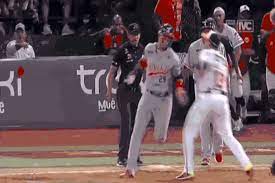
Asdrúbal Cabrera (right) telling Carlos Castro (left) that a shot in the head trumps a bat-flipping home run Saturday.

Asdrúbal Cabrera never played for the Braves during fifteen major league seasons. But on Saturday he found a way to behave as though he’d taken lessons in self-appointed Fun Policing from longtime Braves catcher Brian McCann. With a critical piece missing.

Cabrera was playing first base for Caribes de Anzoategui against Tiburones de la Guaira in the Venezuelan Winter League. It just so happened to be a game in which Tiburones’s Carlos Castro saw fit to hit three hefty home runs.

The third proved the money shot, for reasons having nothing to do with distance or the score. It proved that a 37-year-old major league veteran can display the mind of a seven-year-old who’s forgotten the meaning of fun when believing, apparently, that he and his team have been dissed.

Against lefthanded Caribes pitcher José Torres, Castro blasted one the other way to right field and clear over the fence. He strided up the first base line, bat still in hand, watching the ball fly out. On his tenth step up the line, Castro flipped his bat to begin his home run trot.

He seemed to glance toward the Caribes dugout as he approached first, but I couldn’t tell whether his face showed anything grave or provocative. The New York Post (Cabrera is a two-season former Met) described the glance as “glaring” into the dugout and Torres as “clearly upset with the antics . . . jawing at Castro as he headed to first, but it got much worse after that.”

As he rounded first, Cabrera approached from his apparent play-to-pull positioning. Castro wasn’t two steps past the pad when Cabrera swung his left arm hard to the right side of Castro’s face.

Being unprepared for such a sucker punch, Castro went down in a heap, onto his el culo, as his batting helmet took a dive toward the line under the influence of Cabrera’s flying forearm. When both benches poured out of their dugouts almost at once, Cabrera himself ended up on the ground sprawling.

Cabrera’s said to have turned an offer in free agency down last winter before sitting the 2022 season out. Considering his 2021 performance papers, he may have been fortunate to get that single offer at all. If he’s looking for one more turn in the Show for 2023, he may yet discover that a clothesline swing won’t get you half the attention a few zinging line drives to left might get.

Unless, of course, there’s a team out there that anxious to find an ancient infielder who can’t hit baseballs as often as he once did, has as much remaining defensive range as a toy dump truck with a flat inner-rear tire, but might hit a bat flipper or two blindside as a fresh new precinct commander for their self-appointed Fun Police Department. Cheap shots a specialty,

Castro rounding first looked as though he saw Cabrera coming his way but didn’t quite see the prospect of a would-be left hook until it met his face flush on. Maybe Cabrera didn’t learn what I thought from McCann, after all.

Back in late September 2013, Milwaukee outfielder Carlos Gomez tripped the Braves’ triggers when he blasted one out against Paul Maholm, a pitcher against whom he had better than respectable performance papers, enough so that Maholm had hit him with a pitch or three in the recent past, enough so to leave Gomez with a sour taste at minimum.

Now, in the top of the first in Turner Field (the Braves hadn’t yet dumped the still-not-so-old yard for Truist Park), Gomez sent Maholm’s one-out, 0-1 service over the left center field fence. He didn’t celebrate the blast so much as he pronounced it payback for a plunk too many, and he let Maholm know it. Uh-oh.

As he rounded first, then-Braves first baseman Freddie Freeman barked at him. As he rounded third, he was slightly surprised to see McCann ambling up the line, out from behind the plate, hell bent on arresting him with a choice, howling lecture accompanying the handcuffs.

Well, not so much handcuffs, but Gomez never got to hit the plate as McCann obstructed him in anger and the benches emptied. “Gomez believes Maholm drilled him intentionally two months ago, and this was his payback,” wrote ESPN’s Tim Keown at the time. “‘You hit me. I hit you,’ were apparently the words that rocked the Braves’ world. Is that a worse offense than intentionally hitting someone?”

At least McCann never went further than stopping someone to bawl him out. Sucker punching wasn’t part of his Fun Police gear.

Who knows what among the Caribes players flipped their switches when Castro looked into their dugout? Who knows what Castro had in mind when he looked? Had there been words between them over his two previous bombs in the game?

“This is not representative of baseball in Latin America,” tweeted my friend (and former Call to the Pen editor) Manuel Gómez. “Latinos are known for bringing sazón to the game. Clearly, there is some animosity between these particular teams and it was expressed in violence on the field. We are better than this!”

Tiburones went on to finish what they started, a 6-4 win. But no matter who said what to whom, Cabrera came away resembling a bit of a hypocrite. We take you back to 22 September 2016, in Citi Field, the Mets down two, when Cabrera walked it off against the Phillies with a three-run blast into the bullpen behind the right field fence.

He flipped his bat toward the Mets dugout and looked there as he started running it out. OK, he looked into his own dugout and not the opposition’s. But still. Apparently, Cabrera was fine with a flip if it came off a game-winner. But in his older baseball age he’s none too fine with a flip if it’s flipped off a blast hit before the game actually ends.

Cabrera’s not too likely to find a Show suitor for 2023. The last thing needed by a Show still coming to terms with letting the kids play is an old fart whose uniform might have sal de mi césped! as a p.s. beneath his name.