Let Bauer be on the Dodgers’ heads

The Dodgers want last year’s Bauer over a full season and without the concurrent social media migraines.

“Talented, antagonistic.” That’s how The Athletic‘s Pedro Moura describes Trevor Bauer in two words. Lots more words under either of those could be and have been written about, shall we say, the controversial enough righthander. They run the gamut from forward thinker to bully, from student of the game to misogynist.

The Dodgers pushed a big bet to the center of the table that Bauer over a full season on the mound will be what he was for the Reds in last year’s short, irregular season. The Mets were thought ready to push the biggest chips forward but let him walk into the Dodger embrace.

The Dodgers are also betting the talent will neutralise the antagonism by signing Bauer to a three-year deal that includes record-setting single-season salaries in the first two. The Mets are also betting they’ve dodged a howitzer shell by not signing Bauer to even the purely single-season deal the pitcher is known to prefer.

A starting rotation that already features Clayton Kershaw, Walker Buehler, Julio Urias, and David Price, plus two starter-capable swing pieces named Dustin May and Tony Gonsolin, just became a repository of depth approaching a season in which pitching depth is going to matter phenomenally.

Last year’s short irregular season left baseball’s pitching corps short enough of full-season regular work that there is and should be even more true alarm about pitcher health than usual approaching a more complete season. Bauer’s history of innings consumption wedded to May’s and Gonsolin’s availabilities gives the Dodgers room to manage the 2021 workloads of Kershaw, Buehler, Urias, and Price prudently.

Especially if they think the Bauer signing has indeed sent the message ESPN’s Alden Gonzalez says it sent: “There’s us, and then there’s everybody else.” And how. Not just in the pennant race. Bauer’s going to earn in one season than the entire payroll of the tanking Pirates. ESPN’s David Schoenfeld warns, though, that that isn’t exactly something new other than the dollar amounts in question.

Look, is it “fair”? No. But we haven’t had a repeat World Series champ since those 1998-2000 Yankees, low-payroll teams like Tampa Bay and Cleveland both reached the World Series in recent seasons, Kansas City won one, and even Pittsburgh had a nice little run there a few years ago. Yes, it’s a challenge for the Pittsburghs and Clevelands of the world, but good luck on finding a better system that satisfies the rich teams, the “poor” teams AND the players.

(There was such a system once upon a time, in fact. Then-commissioner Bowie Kuhn murdered it when he blocked the infamous Charlie Finley fire sale of three Athletics stars and imposed a $400,000 limit on cash sales of players. Kuhn didn’t stop to think that that now kept the “poor” teams from profiting on developing younger players without losing their abilities to return to competitiveness within shorter periods.)

It’s the other message the Bauer signing sends that has no few people alarmed, too. No, not the one about Bauer’s 2020 being a fluke even inside a fluke, which might be alarming enough. He only had one full season remotely comparable to 2020, back in 2018. He built his Cy Young 2020 almost entirely with bricks provided by weak competition: he faced .500+ teams only three times, and ten of his starts were against teams whose offenses were called “anemic” in charitable moods.

No, the other message alarming people is the antagonistic side. Bauer’s reputation isn’t exactly radar proof. His presence on Instagram, Twitter, and YouTube has made him a social media star somewhat out of proportion to his career results despite his talent and his deep studies in how to maintain his health and develop his pitches. And he isn’t exactly Mr. Congeniality across those platforms.

“[H]e will need to both own up, and put an end to, social-media tactics that include harassment when he responds aggressively to fans and reporters on Twitter, particularly women, prompting his followers to attack those who challenge him,” another Athletic writer, Ken Rosenthal, observes.

Bauer has pledged to wield his platform more responsibly in the past, only to engage in such conduct again. Those around him say he cannot control the behavior of his followers, an empty claim that does not absolve him of responsibility. Frankly, he should have been capable of seeing the impact of his actions long ago.

He has made it clear he wants to be active on social media and cultivate a large audience, which he says is because he wants to help make baseball more exciting for younger fans. But by lashing out at his critics, he fails to recognize the power he has over that audience and its desire to defend him. Continuing that behavior is inexcusable.

Bauer’s prior written nastinesses toward women just might have backed the Mets away in the end.

Yes, the Mets might have made for their own super-rotation—plugging Bauer into a rotation featuring two-time Cy Young winner Jacob deGrom plus Carlos Carrasco, Marcus Stroman, and returning Noah Syndergaard. But their recent upendings involving ex-general manager Jared Porter’s and former manager Mickey Callaway’s sexual harassment text messagings past mean the last thing the Mets needed was a pitcher with a history of misogyny compromising their work toward improving conditions for women around the team.

Bauer won’t have things simpler in Los Angeles, even if he is native to the area. The Dodgers’ media market is almost as large as New York’s. He’ll be viewed with magnifying glasses and under microscopes at least as acute and relentless as he would have been in New York.

When the New York Post‘s Joel Sherman wrote two days ago that he wouldn’t sign Bauer but if the Mets must it should be just a single season worth, he had in mind that a single season would be simpler for the Mets to escape any damage to their brand inflicted by Bauer’s way of building his own.

Bauer’s behavior does not rise near the malfeasance that Porter copped to and is alleged against Callaway. But Sandy Alderson hired both Porter and Callaway. He said in the aftermath of both disturbing revelations that had he known prior, he would not have hired Porter or Callaway. He knows what he knows about Bauer. Now. Today.

. . . Bauer might be a terrific big personality for the Mets. But there is enough risk and concern that they should offer $40 million for one year to learn for themselves.

The defending world champion Dodgers also know what they know about Bauer. They’re taking a bigger chance against it exploding in their faces during a three-year deal—from which Bauer can opt out after either this season or next—than the Mets would have taken on a strictly single-year deal.

The Mets have it simpler now. Any money they might have spent on Bauer could now apply toward landing Jake Odorizzi, whom several analyses proclaim the best starter left on the free agency market, for the back of their rotation. Odorizzi isn’t a world-beating starter but he could be the right number five man for the Mets. Could.

They might apply some of that money, too, toward Jackie Bradley, Jr., whose bat hadn’t exactly been a world beater until showing signs of life last irregular season (Real Batting Average has him .484 lifetime) but who’s still a plus defender in center field with a knack for throwing runners out from center field and turning double plays, and enough defensive runs saved.

Bradley has room to improve as a hitter, too: he’s not a big home run threat historically (he averages eighteen home runs per 162 games lifetime), but 41 percent of what he does hit goes for extra bases. And he’s a road runner on the bases: he has an .811 lifetime stolen base percentage and has taken extra bases on followup hits almost half the time he’s reached base.

Let the balance between Bauer’s talent and his headaches be on the Dodgers’ heads. The Dodgers may be deep enough that Bauer’s headaches wouldn’t make a huge impact, but they could leave the Dodgers with as many migraines off the field as their presence on it will leave for the rest the National League West, at minimum.
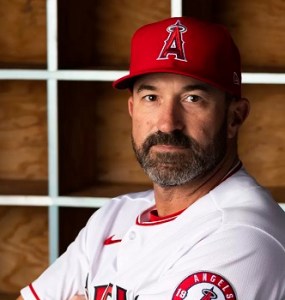
Mickey’s monkey business

If the Angels fire pitching coach Mickey Callaway over a five-year pattern of sexual harassment, it’s the least of baseball’s problems with the issue.

The man who was in over his head as the manager of the Mets seems in further over his head when it comes to ladies in the sports media. As in, five years or more worth of pursuit involving five young women, with “lewd” barely covering what he’s accused of doing.

Outside baseball’s innards, we didn’t know Mickey Callaway was any kind of sexual harasser. Inside those innards, alas, there’s a real chance that such suspicions were as one woman speaking to The Athletic says, “the worst kept secret in baseball.” If she’s right, Callaway’s head on a plate shouldn’t be the only consequence.

The Athletic‘s detailed story by Brittany Ghiroli and Katie Strang hit the Net running Monday evening. “Los Angeles Angels may be hiring a new pitching coach,” said one Facebook baseball group member in posting the article to the group. Needing a new pitching coach should be the least of the Angels’s worries. Or baseball’s.

Three organisations for whom Callaway’s worked should stand up for account. The Indians, for whom he was a respected pitching coach; the Mets, whom he managed clueslessly enough in baseball terms; and, the Angels, who probably did get caught with their own pants down about Callaway’s behaviours but probably have no choice but to fire him now.

As Los Angeles Times writer Bill Shaikin says of Callaway, “This is not a he-said, she-said story.” Not with five shes saying Callaway went considerably beyond being merely tactless in expressing his apparent interests in the five.

On baseball grounds alone there wasn’t a jury on earth that would have ruled the Mets unjustified if they’d fired Callaway months before the execution finally arrived after the 2019 regular season. In human terms, it’s now to wonder whether the Mets were half asleep when hiring him in the first place.

His reported sexually-implicit approaches to media women ran for five years across three different major league teams and in multiple cities, write Ghiroli and Katie Strang. “Two of the women said they were warned about his behavior – from fellow media members and others who worked in baseball,” they say. “An additional seven women who worked in various MLB markets said that, although they had not been approached by Callaway, they had been cautioned about him.”

The five Callaway’s believed to have pursued received anything from inappropriate photographs and requests for nude images in return to unsolicited messages, “uncomfortable” comments about their appearance, and his crotch “thrust . . . near the face of a reporter as she interviewed him.”

This emerges barely a fortnight after now-former Mets general manager Jared Porter lost his freshly-minted job over unsolicited explicit texts messages he sent a woman reporter while he worked for the Cubs.

The Indians issued a statement in response to the story saying they were “made aware for the first time tonight” that Callaway behaved like a predator toward women. “We seek to create an inclusive work environment where everyone, regardless of gender, can feel safe and comfortable to do their jobs,” the team said.

When Ghiroli and Strang contacted the Mets, the team told the two reporters they learned in August 2018 of “an incident” that occurred before they hired Callaway to manage them. “The team investigated that matter, a spokesperson said, but declined to reveal the nature of the incident, the outcome of that probe or whether Callaway was disciplined. Callaway continued managing the rest of the season.”

Mets owner Steve Cohen, who bought the team over a year after Callaway was fired, handed down a terse but unequivocal statement after seeing The Athletic‘s report: “The conduct reported in The Athletic story today is completely unacceptable and would never be tolerated under my ownership.”

Cohen had better mean that. Especially since the Porter firing and now Callaway’s exposure have the team’s personnel vetting procedures under serious question. Cohen’s owned the Mets short of three months and he’s had two nasty sexual harassment scandals to clean.

“I was unaware of the conduct described in the story at the time of Mickey’s hire or at any time during my tenure as General Manager,” said team president Sandy Alderson in his own statement. “We have already begun a review of our hiring processes to ensure our vetting of new employees is more thorough and comprehensive.”

Alderson has to do better than that. It was Alderson as GM who hired Callaway to succeed Terry Collins; it was Alderson as president who hired Porter. If he was really unaware that he’d hired a pair of sexual harassers, Alderson needs to exercise a top-down remodeling of the Mets’ vetting process.

The Angels were almost as terse as Cohen in their own statement. “The behavior being reported violates the Angels Organization’s values and policies,” the team said. “We take this very seriously and will conduct a full investigation with MLB.”

Six years ago the Angels stood on values and policies—and botched completely the Josh Hamilton incident, when he relapsed to substance abuse during a Super Bowl gathering but reported the relapse to the team promptly as required. Angels owner Arte Moreno could hardly wait to run Hamilton out of town on a rail despite the outfielder obeying the protocol.

If they were that willing to purge Hamilton without so much as a by-your-leave over “values” after Hamilton voluntarily reported his relapse straight, no chaser, the Angels better not take too long dispatching Callaway.

Hamilton’s relapse hurt no one but himself. Callaway can’t claim the same. The Angels had to find about about his predations the hard way, not by way of Callaway approaching them to say he’d been caught with everything but his pants down as a semi-serial sexual harasser.

“Rather than rush to respond to these general allegations of which I have just been made aware, I look forward to an opportunity to provide more specific responses,” Callaway said in an e-mail to The Athletic. “Any relationship in which I was engaged has been consensual, and my conduct was in no way intended to be disrespectful to any women involved. I am married and my wife has been made aware of these general allegations.”

Consensual relationships don’t generally provoke what Ghirolil and Strang describe, his pursuits putting the media women in question “in a difficult position at work given what they perceived as a stark power imbalance. The women were forced to weigh the professional ramifications of rebuffing him.” Not to mention his wife now forced to weigh the marital ramifications of her husband’s pursuits.

Don’t make the mistake of thinking Callaway and Porter before him remain isolated instances. Who can forget then-Astros general manager Jeff Luhnow rebuffing the opinion of his entire office, practically, in trading for relief pitcher Roberto Osuna at a time Osuna was still under suspension for domestic violence?

Or then-Astros assistant GM Brandon Taubman making sure three women reporters heard him loud and clear when—celebrating their 2019 American League Championship Series triumph despite Osuna surrendering an almost-game-winning home run to Yankee second baseman D.J. LeMahieu—Taubman hollered, “Thank God we got Osuna! I’m so [fornicating] glad we got Osuna!”

You don’t need to be a feminist to get that trading for an abuser of women or being so fornicating glad the team got him isn’t going to make women covering your team feel comfortable that they can do their jobs in the proper professional atmosphere.

You don’t need to subscribe to an automatic MeTooism to agree that a man taking “no” or “not interested” for an answer when he shows certain interest in a woman is simply plain sense and decency. For that matter, a woman taking “no” or “not interested” for an answer when she shows certain interest in a man is likewise.

Neither do you need to subscribe to cancel culture to agree that sending unsolicited shirtless selfies and asking for nudes in return, shoving your crotch in a woman’s face, continuous sexual implications in compliments about looks, near-incessant pressure to socialise together, or promising to share team information if she agrees to get drunk with you, among other things attributed to Callaway, are not the ways civilised men old enough to know better behave.

Baseball’s government is investigating the Callaway incidents. It needs to take an all-levels look into how rampant are the atmospheres in which women doing nothing more or less than their jobs feel discomfited by men taking too much more than professional interest in them, and refusing to take “no” for an answer to interest above and beyond the game.

Old sexts mean new unemployment

Imagine for one moment an otherwise bright child who’s made mistakes as most children make, bright or otherwise. He comes home from whatever he was doing with his friends, but he discovers an old incident he thought passed without notice or consequence was now unearthed, and his father demands accountability.

Let’s say it was something like giving a push back to that cute but obnoxious little girl who decided the way to make friends and attract the opposite sex was to push, shove, or even punch. He took it long enough because he was taught young gentlemen do not push, shove, or punch young ladies, but he finally got fed up with this particular chick who didn’t know the meaning of the words “knock it off.”

Nobody was truly harmed. It’s not as though she’d shoved him out of third-story windows, it’s not as though he finally dragged her to the nearest open window on the sixth floor. But somebody, who knows whom, let the ancient push back slip within his father’s earshot, and Dad confronts him subsequently giving him minus two seconds to explain himself.

Aware that the conversation is about a comparatively ancient error, he gives the deets straight, no chaser, certain that no father in his right mind would even think about punitive action regarding such a cobwebbed misstep. But he discovers the hard way how wrong he is when Dad pounces, pronounces him grounded for the rest of the forthcoming month, and fans his behind rather mercilessly for an exclamation point.

The boy repairs to his room with more than just a chastened ego and a very sore bottom. He’s between rage and sorrow because it was only a foolish mistake, not exactly the crime of the season. He pushed back after taking it long enough, but it didn’t make him any less a young gentleman or prove he had murder in his heart.

You might want to contemplate that when you wonder whether the Mets went a few bridges too far firing general manager Jared Porter Tuesday morning—almost a fortnight after he and the Mets delivered the trade of the winter bringing Francisco Lindor and Carlos Carrasco aboard—over infractions he committed while he was the Cubs’ director of professional scouting four years ago.

Our hypothetical push-back kid merely responded in kind at long enough last. Porter wasn’t pushed. He sent, shall we say, naughty/nasty sexual images among 62 text  messages to a young woman working as a reporter whose only provocation, if we can call it that, was exchanging business cards on the pretext of coming discussion about international baseball scouting.

The lady discovered the hard way that Porter had amorous designs upon her and didn’t readily take “no” for an answer or ignorance as a subtle hint.She was a foreign correspondent come to the United States for the first time, assigned specifically to cover the Show. She had no idea going in that she’d run into more than a few Porter screwballs on the low inside corner.

“The text relationship started casually before Porter, then the Chicago Cubs director of professional scouting, began complimenting her appearance, inviting her to meet him in various cities and asking why she was ignoring him,” say ESPN writers Mina Kimes and Jeff Passan. “And the texts show she had stopped responding to Porter after he sent a photo of pants featuring a bulge in the groin area.”

Kimes and Passan say ESPN knew of the Porter texts to her in December 2017 and thought about reporting them until she told the network she feared her career would be harmed. She has since left journalism, though Kimes and Passan say she’s kept in touch with ESPN concurrently and went public only under anonymous cover, fearing backlash in her home country.

“My number one motivation is I want to prevent this from happening to someone else,” she’s quoted as saying. “Obviously, [Porter]’s in a much greater position of power. I want to prevent that from happening again. The other thing is, I never really got the notion that he was truly sorry.

“I know in the U.S., there is a women’s empowerment movement. But in [my home country], it’s still far behind,” she continued. “Women get dragged through the mud [in my country] if your name is associated with any type of sexual scandal. Women are the ones who get fingers pointed at them. I don’t want to go through the victimization process again. I don’t want other people to blame me.”

The Mets hired Porter in December, from the Diamondbacks, for whom he worked as an assistant GM since 2017. On Monday night, Porter told ESPN that yes, he’d texted with her, but no, he hadn’t sent any pictures, until he was told their exchanges included selfies and other images, at which point he said, “the more explicit ones are not of me. Those are like, kinda like joke-stock images.”

Mets owner Steve Cohen isn’t exactly laughing, tweeting Tuesday morning, “We have terminated Jared Porter this morning. In my initial press conference I spoke about the importance of integrity and I meant it. There should be zero tolerance for this type of behavior.” Especially since, speaking metaphorically, the lady didn’t exactly push, shove, or punch Porter first all those years ago.

The Athletic‘s Ken Rosenthal says the lady had an ally in a baseball player from her home country, who helped her create a rather forceful message to Porter back when that Porter didn’t exactly heed at first: “This is extremely inappropriate, very offensive, and getting out of line. Could you please stop sending offensive photos or msg.” He’s said to have apologised to her much later.

“Colleagues of mine who are women use words such as ‘tired’ and ‘exhausted’ to describe their daily struggle to be treated the same as men, to command the same respect when they walk into a clubhouse, to do their jobs without facing sexual provocation,” Rosenthal adds. “They are professionals, not playthings.”

It’s one thing to ask a lady for a date. It’s another thing to try your best to change her mind if she says “no.” But turning from there to hot pursuit sexting is something entirely different and disturbing.

The Mets were unaware of Porter’s sexually explicit hot pursuit until Monday. They cut Porter loose early enough the morning after. A 7:30 a.m. Eastern time firing happens when enough New Yorkers have barely finished coffee at the breakfast table before rumbling out  hoping for just a little more snooze on the subway before work.

Some think the Mets could have been aware of Porter’s old lewd hot pursuit sooner. Some think Cohen and company have surrendered to cancel culture, to which Cohen had a reply when one indignant tweeter demanded to know Porter’s path to redemption “now that his life has been ruined.”

“I have no idea,” Cohen replied, though surely he knows Porter’s redemption is likelier to come away from baseball than within it, as second chances so often do. “I have an organization of 400 employees that matter more than any one individual. No action [taken] would set a poor example to the culture I’m trying to build.”

A subsequent tweeter isolated a parallel point addressed directly to the demand for a path to redemption: “As someone who is 100% opposed to cancel culture, this is a ridiculous thing to say. Jared brought this on himself. His path to redemption is on him. This has nothing to do with cancel culture.”

Others think the Mets in the Cohen era have now become the essence of decisive action when made aware of such wrongdoing. The joke is kinda like on Porter now. But nobody’s laughing.

Met fan Cohen, athwart Met fans’ impatience

Steve Cohen, an owner who believes a jump into the pool requires water in it first.

“I don’t need to be popular,” tweeted Steve Cohen, the so-far very popular new owner of the Mets, on Monday. “I just need to make good decisions.” Apparently, there were enough Met fans thinking Cohen needed to make decisions, period, in the wake of the Padres’ wheeling and dealing and the Mets deciding not to join the hunt for Japanese pitcher Tomoyuki Sugano.

Cohen’s apparent watchword is, “If Rome wasn’t built in a day, the Mets won’t be reinforced in a week.” Met fans drained from years of Wilpon family follies say the American prayer: “Lord, grant me patience—and I want it yesterday.” For Cohen, that’s about as funny as passengers booked for seafaring passage aboard torpedoes.

When the Padres blew up the hot stove with deals making Padres of Blake Snell and Yu Darvish, Met fans felt the old familiar itch to do. something. anything. like yesterday. They forgot for the moment that, before the Padres wheeled and dealt, the Mets were the most active on this winter’s odd market.

I guess on to another pitcher. @StevenACohen2 well I guess McCann and May is it for us. Time to hibernate until Spring Training,” tweeted one such fan. To which Cohen had a polite but snappy retort at once: “That’s the spirit, just give up and go to sleep.”

From the moment his purchase of the Mets was affirmed, Cohen has been singular among baseball owners for putting himself out to engage his team’s fans. He has solicited their input and suggestions. It doesn’t mean he’s inclined to suffer fools, gladly or otherwise, even if they forget that he has been a Met fan himself—like me, since they day they were born.

He knows he has a team to reinforce. He knows his amiability has made him something customarily alien to baseball owners: beloved, so far. He doesn’t want to go from there to public enemy number one, but neither does he want to step imprudently into any one of several abysses.

The New York Post‘s Joel Sherman has also caught onto Met fans’ indignation: he’s been receiving no few tweets and e-mails “wondering whether Steve Cohen is the Wilpons, just hoarding a larger stash of money.

“After all,” he continues, “why was George Springer not under the Christmas tree? Why wasn’t Trevor Bauer provided to joyously greet 2021? Why James McCann and not J.T. Realmuto [behind the plate]?”

Sherman notes what such fans forget. This winter’s free agency market, for various reasons, has been about as swift as a number 7 train with a wheel chip on each car. The Mets handing James McCann $40 million for four years is both the most free agency money invested this winter and the longest contract done yet for non-foreign free agents, Sherman reminds you.

“Cohen’s promise was that the Mets would spend like a big-market team, and he should be held to that promise,” Sherman writes. “But that promise has not been broken this offseason. At least not yet.” And Cohen did not become wealthy because he reads markets the way old television jokes read Romeo and Juliet: “Two crazy kids ran off together and died.”

He’s willing to spend but not like the proverbial drunken sailor. For one thing, Cohen knows the Mets’ farm system, what will remain of it after the Show finishes its more than slightly mad stripping of the minor leagues, needs replenishment if not a mild overhaul. For another, he knows a healthy farm often leads to healthy reinforcements either by promotion to the Mets or in deals that bring healthy reinforcements if not fresh prime.

“Hey, Give the Padres credit,” Cohen tweeted after one of the Friars’ two splashy trades. “They had a top 5 farm system that gave them flexibility to trade for Snell. Newsflash, the Mets farm system needs to be replenished.”

News flash, further: Met fans may have the patience of piranha at meal time, but Cohen has no patience for falling into the position of bidding against himself. “The Blue Jays are the only other club known to want to spend lavishly in free agency,” Sherman observes, “but historically it has been difficult to lure top free agents to Canada. Cohen will have to believe that a Springer or a DJ LeMahieu is really going before he considers that game of chicken. There certainly are quieter suitors. But, again, none of the remaining big free agents will be signing without hearing Cohen’s last and best. He will not do a deal he calculates as bad just to stop the noise of even impatient Mets fans.”

Cohen’s memory, like mine, surely harks back to the 1980s when another New York team, owned by a man to whom patience was a vice, jumped into the market pools as often as not before checking to see the water level. For every Catfish Hunter, Rickey Henderson, and Dave Winfield, there were a few too many Dave Collinses, Joe Cowleys, Don Gulletts, Steve Kemps, Dave LaPoints, Bob Shirleys, and Ed Whitsons.

Cohen also knows that, with one or two outlying exceptions, the Yankees’ greatest successes in the free agency era have come by way of a homegrown core blended with a little smart horse trading. Yap all you want about them trying to buy pennants, but when the Yankees spent the biggest in the open market they didn’t reach the Promised Land to which Yankee fans believe they’re entitled every year.

When another fan tweeted to Cohen, “What exactly are we doing? Is James McCann really going to be our biggest pickup this offseason? Please say no,” Cohen replied, “Let me put it differently. Don’t you think someone will take our money? It just has to make sense.”

The last time any Met administrator spoke about “making sense” was when?

The Mets know their starting pitching can’t stop at Jacob deGrom, re-signed Marcus Stroman, David Peterson, due-to-return Noah Syndergaard, and just another body. Seth Lugo is far better suited at the rear end of the bullpen, which also needs all the reinforcement/replenishment it can get.

They also have a very solid core around the field and at the plate, and McCann is a big upgrade behind it. But if they really want to go in for George Springer, they need to decide who’s the expendable one to slot Springer into their outfield. They need to decide how to make things work otherwise so Jeff McNeil can be restored to his natural infield habitat.

They need to decide whether Cohen’s determination to replenish the farm is worth casting eyes upon Springer, Trevor Bauer (pitcher), and D.J. LeMahieu (middle infielder). That trio, Sherman reminds us, got qualifying offers from their 2020 teams, meaning the Mets lose draft picks if they sign any or all of them. For farm replenishment, that’s not an option. If they can only afford one big ticket, Springer may yet be their prime target. May.

Cohen and the Mets also need to find a way to help commissioner Rob Manfred off the proverbial schneid and into the right decision about last year’s experimental rules. So does, well, every other Show team. You’d like to think that even ownerships as determined to tank as Cohen isn’t don’t want to embarrass themselves entirely.

In with the universal designated hitter, once and for bloody all, and out with the other nonsense. Among other salutary things—such as an end to the lineup slot wasted by spaghetti-bat pitchers, and rallies murdered when enemy pitchers work around that potent number eight bat to strike out their counterparts—it’ll keep Dominic Smith’s bat in the lineup without having to sacrifice Pete Alonso’s bat (yes, children, Alonso’s 2020 was an aberration of a down irregular season) at first base.

Cohen seems determined to avoid the comedies of errors committed by prior team ownerships and administrations. He resists the temptations to which too many Met fans would be prone if placed into his position for even one week. A man who speaks about making sense is a man who earns a very wide benefit of the doubt.

Speaking for myself alone, now, I have a wish of my own for Cohen. It has nothing to do with wanting him to slip into a sailor’s uniform, get himself bombed out of his trees, and throw dollars around the free agency market like they were just blasted out of a pinata.

My wish is that Cohen might consider a gesture on behalf of more than a few of the Met players he, like me, grew up watching and rooting for in the 1960s and 1970s. Players whose major league careers were kept too short for assorted reasons. Players who were frozen out unconscionably when, in 1980, owners and the Major League Baseball Players Association re-aligned baseball’s pension plan.

The re-alignment awarded pensions to players after 43 days’ major league service (previously, a player needed four years) and health benefits after a single day’s major league service. But it didn’t apply to short-career major leaguers who played between 1949 and 1980.

For those short-career players, their sole redress was a 2011 deal between then-commissioner Bud Selig and then-players union director Michael Weiner, a deal giving them $625 per quarter for every 43 days’ major league time they had, up to four years’ worth. The kicker, right in the pants, is that they can’t pass that money to their loved ones if they pass before they stop collecting the money.

Several former Mets are among what are now 618 such short-career players without full pensions other than what they receive under the Selig-Weiner deal. They include pitchers Bill Wakefield, Bill Denehy (traded to Washington in exchange for manager Gil Hodges) and Jack DiLauro (a 1969 Met, though not in the postseason), infielder Bobby Pfeil (another Miracle Met), outfielders Rod Gaspar (still another Miracle Met) and George (The Stork) Theodore, and others.

Denehy, Pfiel, and Gaspar have each told me in interviews they believe that, if Weiner had lived (he died of brain cancer in 2013), he would have worked to go further with such pension redress. The players union since has taken little to no interest in such redress; neither, apparently, does the Major League Baseball Players Alumni Association.

But Marvin Miller, the late pioneer of the players union, is known to have said that not re-visiting the 1980 pension changes on behalf of the short-termers was his biggest regret. And if the Show has now conferred proper formal, official major league status on the seven known Negro Leagues we believed to our souls contained major leaguers all along, it should be known that there are African-American and other minority players among the frozen-out 618.

I’m not a man who believes I have the right to tell anyone else how to spend his or her money or where to channel their resources. Nor do I believe I have the right to choose another person or group’s obligations, moral or otherwise. But Gaspar had a point when he told me, last month, “They have so much money, the owners, the players’ union, they have so much money, how much money would it cost them to give the [pre-1980 short-career] guys who are still alive the pension?”

It would be a phenomenal gesture on Steve Cohen’s part if he should think well, by himself, of doing something solely for the short-career, pre-1980, former Mets affected negatively by that pension change. If nothing else, the image augmentation would be invaluable—an owner doing what the players union and alumni association either can’t or won’t.

Should Cohen consider it, however he might choose to do it, it might even kick off a wave among his fellow owners to do likewise for their teams’ frozen-out, pre-1980 short-career former players. Might. Quick: Name one owner who wouldn’t mind making the players’ union look a little foolish.

No, no—a thousand times, no

Steve Cohen’s purchase of the Mets closed Friday. Almost at once, Cohen became the Mets’ version of the Hoover—beating, sweeping, cleaning. He flipped team president Sandy Alderson’s switch and Alderson hit the carpet roaring.

General manager Brodie Van Wagenen? Hasta la Volkswagen. Special assistant and former GM Omar Minaya? Gone. Assistant GMs Allard Baird and Adam Guttridge? Bye, bye, birdies. Executive director of player development Jared Banner? Dearly departed.

So said ESPN’s “news services” within a blink of the Cohen purchase closing. And then, a red flag: “Friday’s moves make [manager Luis] Rojas’ future uncertain. Fired Astros GM Jeff Luhnow, who completed a season-long suspension last week, could be a candidate for the analytics-oriented Cohen.”

Met fans celebrating the official consecration of Cohen as the new owner and that feeling of relief with the eighteen-hundred-ton Wilpon truck finally pulling away and off their backs should be hollering, “Danger, Will Robinson!”

They should remember that Alex Rodriguez and Jennifer Lopez and their gang probably got spurned as potential Met buyers not just because they couldn’t round up the full dollars but because A-Rod was foolish enough to seek informal administrative counsel from Luhnow, while Luhnow remained under suspension and J-Rod were still in the running to buy the team.

They should remember that seeking Luhnow’s advice on baseball operations compares to seeking marital counseling from Zsa Zsa Gabor.

They should remember that Luhnow continues blaming God’s will or any and everybody else for the Astrogate debacle that brought that a world champion and American League West dominator not to its knees but to a stance of defiance despite being exposed as particularly extralegal electronic video cheaters.

They should remember that, given another chance to own up, Luhnow lied to Houston NBC reporter Vanessa Richardson when he said, “Whether it’s the players or the video staffers, they just decided on their own to do it and that’s a shame, because had they come and asked me for permission I would have said no. Had they gone and asked Jim for permission, he would have said no. There’s just no reason why that should have happened.”

They should remember that,  even before the advent of the Astro Broadcasting Company, Luhnow was exposed (by Wall Street Journal reporter Jared Diamond) as seeing and not rejecting a front office-developed algorithm, Codebreaker, that the intern showing it to him said could be deployed for off-field-based sign stealing.

They should remember that Luhnow’s Astro “culture” was well exposed as a result-oriented culture in which human relationships were cheap, disposable, and disregarded. ”Luhnow had all year to speak,” thundered baseball writer Jose de Jesus Ortiz in a delicious Twitter rant. “But as was the case throughout his tenure Luhnow is as calculated as ever. That’s why baseball folks throughout the country say he’s dismissive of traditional baseball folks, scouts, players, etc. He sees them as assets, people to manipulate.”

They should remember that Luhnow dismissed the near-complete opposition in his front office, when he dealt disgruntled relief pitcher Ken Giles for then-under-domestic-violence-suspension relief pitcher Roberto Osuna in 2018. And, that Luhnow tried to cover the hide of his then-assistant Brandon Taubman being so fornicating glad they got Osuna in the presence of female reporters after the Astros won the 2019 American League Championship Series.

They should remember that, when Luhnow said to Richardson, “there’s no reason why we needed to explore breaking the rules to gain an advantage, it made no sense to me,” it begged the question of why Luhnow didn’t kill the Astro Intelligence Agency in its Codebreaker crib.

They should remember that 2017 Astros designated hitter Carlos Beltran, hired by Van Wagenen to manage the Mets last fall, never got to manage even a single spring training game for the Mets—because Beltran’s own Astrogate culpability got him suspended for 2020, too.

They should remember that it’s one thing for the Tigers to hire a repentant A.J. Hinch, especially since he won’t be getting his second chance at the original scene of the crimes at which he looked the other way, mostly; but, it’s something else that the Red Sox re-hired Alex Cora, whose fingers were all the way in the Astrogate pie, while not quite being in the pie known as the Rogue Sox Replay Room Reconnaissance Ring. Hinch and Cora are like the Watergate burglars but not the Big Enchiladas when all is said and done.

They should ask aloud that, if the new owner about whom they’re raving otherwise is as analytically inclined as advertised, Cohen shouldn’t even think of Luhnow and the stain he’d bring to the Mets, when there are likely a good number of candidates with the same inclination but a parallel respect for the humans who work or play under them and an equal disinclination toward cheating your way to the top.

They should insist that Cohen, who’s shown a remarkable agreeability to reasonable fan input, keep the house clean once he’s cleaned it up. That Cohen and Alderson should have but one thing to say about even the outside prospect of inviting Luhnow into his remaking/remodeling Mets: “No, no—a thousand times, no!”