Willie Mays, RIP: Loss, but Gratitude

Willie Mays

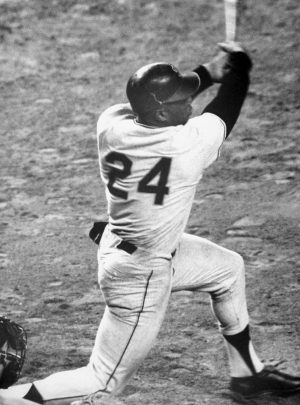
Mays hitting his 500th career home run, in 1965. “He has gone past me,” Ted Williams would say at his own Hall of Fame induction, after Mays hit number 522, “and he’s pushing, and I say to him, ‘Go get ’em, Willie’.”

Seeing Willie Mays in my boyhood when he was a Giant still in his prime was as transcendent as seeing him in his baseball dotage, as a late-career Met, was heartbreaking. Having Mays at all back in the city where he really made his baseball bones was as much a belated blessing as having him too much less than his best was sorrow. But . . .

“What do you love most about baseball?” asked Joe Posnanski, in The Baseball 100. (He ranked Mays number one.) Then, he answered. “Mays did that. To watch him play, to read the stories about how he played, to look at his glorious statistics, to hear what people say about him is to be reminded why we love this odd and ancient game in the first place.

“Yes, Willie Mays has always made kids feel like grown-ups and grown-ups feel like kids. In the end, isn’t that the whole point of baseball?”

But having Mays say farewell the way he did in Shea Stadium on 25 September 1973, with the Mets still yanking themselves back to take a none-too-strong National League East, brought tears not just of loss but of gratitude. If so few of the greats retire before the game retires them, fewer than that retire with Mays’s soul depth:

I hope that with my farewell tonight, you will understand what I’m going through right now. Something that—I never feel that I would ever quit baseball. But as you know, there always comes a time for someone to get out. And I look at the kids over here [pointing toward his Mets teammates], the way they are playing, and the way they are fighting for themselves, tells me one thing: Willie, say goodbye to America.

America never really said goodbye. Now America must say a reluctant au revoir. Mays left this island earth at 93 Tuesday. “I want to thank you all from the bottom of my broken heart for the unwavering love you have shown him over the years,” said his son, Michael, in a statement. “You have been his life’s blood.”

We’ve been his life’s blood? The younger Mays had it backward. His father was the lifeblood of every objective and appreciative baseball fan of his time. He didn’t have to wear the uniform of the team for which I rooted since their birth (not right away, anyway) to be that for me, in hand with Sandy Koufax, and believe me when I tell you that watching Koufax going mano a mano against Mays was something precious to behold.

(For the record, Mays faced Koufax 122 times and nailed 27 hits. Five were home runs, eight were doubles, one was a triple, for 33 percent extra bases off the Hall of Fame lefthander. Mays also wrung 25 walks out of him while striking out 20 times.)

Before Mays’s Giants and Koufax’s Dodgers high tailed it out of Manhattan and Brooklyn for the west coast, the most bristling debates in New York involved not politics, finance, or rush-hour traffic, but baseball. As in, whom among the three Hall of Fame center fielders patrolling the territory for each team was The Best of the Breed.

I was born in the Bronx and raised there and on Long Island; I heard the debates for years to follow after the Dodgers and the Giants went west. I had skin enough in that game long before Terry Cashman wrote and recorded his charming hit, “Willie, Mickey, and the Duke (Talkin’ Baseball).” Well, now. Let’s look at the trio during their New York baseball lives two ways, for all the seasons they played in New York together. (Snider was a four-year major league veteran by the time Mays and Mantle arrived in 1951.)

First, according to my Real Batting Average metric (total bases + walks + intentional walks + sacrifice flies + hit by pitches, divided by total plate appearances):

Together In New York PA TB BB IBB SF HBP RBA
Mickey Mantle 3493 1648 524 34 11 5 .636
Willie Mays 3299 1718 362 70 23 11 .662
Duke Snider 2629 1305 283 42 6 7 .625

Mays has a 26-point RBA advantage over Mantle and that’s with Mays losing over a season and a half to military service. (Mantle’s osteomyelitic legs kept him out of military service; Snider served in the Navy before his major league days began.) Mays also landed 70 more total bases and was handed 36 more intentional walks.

Mantle may have been a powerful switch hitter, but just from one side of the plate Mays outperformed him while they shared New York even with precious lost major league time between ages 21-23. Mantle also had a .756 stolen base percentage to Mays’s .738, but a) Mantle’s already compromised legs kept him from trying more often; and, b) Mays led his league in thefts twice during the period under review. (Snider? Even a hobbled Mantle left him behind: for their shared New York years, his stolen base percentage was .586.)

Sometimes Mantle gets the props as the best of the trio purely because his Yankees were far better teams than the others’. Actually, Snider’s Dodgers were almost as good as Mantle’s Yankees. It was no more Snider’s fault that his Dodgers couldn’t get over those Yankee humps until 1955 than it was Mantle’s sole doing that his Yankees won seven pennants and five World Series (three consecutively) while they shared the Big Apple.

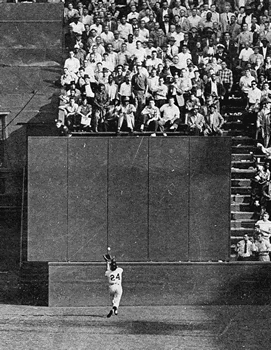
And it was hardly Mays’s fault that his Giants won a mere two pennants in the same shared span, even if Mays’s Giants got squashed by the Yankees in five in the 1951 Series but swept the far better Indians in the 1954 Series. You may have heard of a little play known as The Catch from Game One of that Series, happening when it seemed the Indians had a shot at taking the opener. (Mays would play on two more pennant winners, too, the 1962 Giants—who beat the Dodgers in another memorable pennant playoff—and the 1973 Mets.)
Willie Mays

“The Catch,” of course—460+ feet from home plate in the ancient Polo Grounds.

“That really wasn’t that great of a catch,” harrumphed curmudgeonly Indians pitcher Bob Feller, nearing the end of his own Hall of Fame career. What made him think not? “As soon as it was hit, everyone on our bench knew that he was going to catch it . . . because he is Willie Mays.” (But did they know Mays would also keep Hall of Famer Larry Doby from scoring with an equally staggering throw in to the infield off The Catch?)

Which brings me to the titanic triumvirate in center field. We’re going to look at them according to total zone runs, the number of runs their play in center field turned out above or below their leagues’ averages. Baseball-Reference begins measuring total zone runs with the 1953 season, so we’ll have five solid Big Apple seasons to review for each of the trio:

Willie Mays: +45.
Mickey Mantle: +22.
Duke Snider: +25.

Once again you see where Mantle’s physical health issues got in his way despite his supernatural talent and skill. But it might not have mattered. Mays and Mantle both played in unconscionably deep home center fields before the Giants and the Dodgers left the Apple for 1958. You can fantasise all you like how many runs Mantle might have prevented on good legs, but if you guess that he might have proven just about even you’re making a solid guess.

“Willie Mays going after a fly ball was cotton candy and a carousel and fireworks and a big band playing all at once,” Posnanski wrote. “His athletic genius was in how every movement expressed sheer delight.”

When Mays got to San Francisco, he and Mantle continued their top of the line play. When he got to Los Angeles, Snider had two decent seasons followed by a decline phase that actually took him back to New York for a round with the early Mets before finishing his career in 1964 as . . . a Giant, of all things.

Mantle managed to remain Mantle through the end of 1964. Mays managed to remain Mays through at least 1971. Even if his home run power had dissipated somewhat in the previous four seasons, he spent 1971—at age 40—leading the National League in walks and on-base percentage. Mantle’s body took him out at last at age 36; Mays’s, at age 42; Snider’s, at age 37.

And here is how the trio finished career-wise. First, how they sit among the Hall of Fame center fielders whose careers covered the post-World War II/post-integration/night-ball era, according to RBA:

Center Field PA TB BB IBB SF HBP RBA
Mickey Mantle 9907 4511 1733 148 47 13 .651
Willie Mays 12496 6066 1464 214 91 44 .631
Ken Griffey, Jr. 11304 5271 1312 246 102 81 .620
Duke Snider 8237 3865 971 154 54 21 .615
Larry Doby 6299 2621 871 60 39 38 .576
Andre Dawson 10769 4787 589 143 118 111 .534
Kirby Puckett 7831 3453 450 85 58 56 .524
Richie Ashburn 9736 3196 1198 40 30 43 .463
HOF CF AVG .588

But now, how they sit among center fielders for run prevention above their league averages, showing the top ten:

Andruw Jones +230
Willie Mays +176
Paul Blair +171
Jimmy Piersall +128
Kenny Lofton +117
Devon White +112
Carlos Beltrán +104
Willie Davis +103
Curt Flood +99
Garry Maddox +98

Thanks to his leg and hip issues, Mantle finished his career at -10. Snider finished his at -7; his late career was compromised by knee, back, and arm injuries. (Richie Ashburn, their great Hall of Fame contemporary, finished his career +39.) Two such talented center fielderss who’d had excellent throwing arms and range deserved far better than such physical betrayals.

Mays stood alone as the complete, long-enough uncompromised, all-around package. He was blessed with a body that wasn’t in a big hurry to betray him, but no blessing means a thing if you don’t take it forward. Good luck stopping Mays from doing so. Should-be Hall of Famer Dick Allen once advised Hall of Famer Mike Schmidt to play the game as though he were still the kid who’d gladly skip supper to play ball. Mays played the game precisely that way until age began to say “not so fast,” after all.

“The greats don’t always go gently into that good gray night when they can no longer play the games that made their names,” I wrote when Mays turned 90.

This son of an Alabama industrial league ballplayer fought a small war in his soul when his age insisted he was no longer able to play the game he loved so dearly at the level on which he’d played it for so many years. Some said he’d become sullen, moody, dismissive in the clubhouse. Some resented him, others felt for him, still others mourned.

. . . When he smiled as a Met, you still saw him in his youth, you didn’t see the manchild who was yanked rudely into manhood by a San Francisco that shocked him with skepticism as a New York import rather than a hero of their own. By a San Francisco that also shocked him, for all its reputation otherwise, when his bid to buy a home with his first wife was obstructed long enough by the sting of neighbourhood racism.
Willie Mays

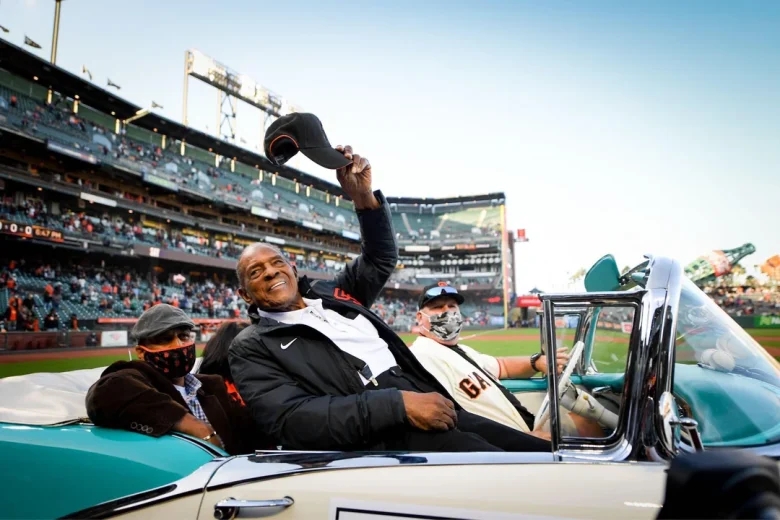
Mays taken for a drive around PacBell Park in a 1956 Oldsmobile to celebrate his 90th birthday. San Francisco came to love him as New York did, but not without growing pains.

After his first marriage ended in divorce and in his son living across country with his mother, Mays dated Mae Louise Allen for about a decade before marrying her after the 1971 season. His happiness there was compromised by her premature Alzheimer’s diagnosis; his caring for her until her death in 2013 is the stuff of true love stories.

A welcome presence at the Hall of Fame’s induction ceremonies following his own in 1979 and at various Giants events (and numerous home games) in the years that followed, Mays wouldn’t be able to attend this year’s Field of Dreams game at Birmingham’s Rickwood Field, the field where he first played with the Birmingham Black Barons of the old Negro American League.

“I’d like to be there, but I don’t move as well as I used to,” he said in a statement on Monday. “So I’m going to watch from my home. But it will be good to see that. I’m glad that the Giants, Cardinals and MLB are doing this, letting everyone get to see pro ball at Rickwood Field. Good to remind people of all the great ball that has been played there, and all the players. All these years and it is still here. So am I. How about that?” A day later, sadly, he was gone.

Mays never apologised for making the game look fun with his fabled basket catches in front of his belt, his winging turns running the bases as his deliberately oversized hat flew off, his high-pitched voice sounding like a kid getting to play yet another inning.

“That’s what his idea was,” said one-time Giants relief pitcher Stu Miller, “to please the crowd.”

“I’m not sure what the hell charisma is,” said Ted Kluszewski, the musclebound Reds first baseman of the 1950s, “but I get the feeling it’s Willie Mays.”

“The only thing Willie Mays could not do on a baseball diamond,” Posnanski wrote, “was stay young forever.”

May his entry into the Elysian Fields, where it’s Willie, Mickey, and the Duke once again,  and especially his reunion with his beloved Mae, have been as joyous for him as the way he played the game was joyous to us for as long as we were honoured to see him play.

Are Hal Chase’s statistics “meaningless?”

Hal Chase

Hal Chase—The talent said a great defensive first baseman; the corruption says otherwise. (Sporting News photo.)

If there’s one thing that baseball itself will debunk somewhere, some time, somehow when you least expect it, it’s the idea that you’ve seen everything on or off the field. The moment you satisfy yourself that you have, the game has a way of replying in a split second, “Pants on fire!”

That doesn’t work with great hits or great plays alone. You think you hear it all (over again) whenever Pete Rose’s dwindling supporters burp up yet another mealymouth argument on behalf of putting him into the Hall of Fame despite what Rule 21(d) and the Hall’s own rule about ballot eligibility say? Brace yourselves.

For whatever reason, the subjects of the day a few days ago, on a Society for American Baseball Research (SABR) social media group thread, included Hal Chase, whom history still treats as perhaps the poster boy for baseball’s gambling infestation from the late 1800s through the end of the Dead Ball Era.

A thread opener cited Babe Ruth’s once-famous observation, when asked to name those he thought the best at their positions:

[T]he Prince was also a very fine hitter who played his entire career before the ball was juiced up. He couldn’t run, he could fly. And aside from Ty Cobb, he was the best baserunner I ever saw. Fielding, are you kidding? Prince Hal was the greatest fielding first baseman that ever played. He was worth the price of admission just to watch him toe-dance around first base and pick those wild throws out of the dirt.

Funny, but that’s not exactly what Chase’s statistics say. When I pointed that out in the thread, among the replies was, “And that’s what makes the stats on him useless,” which was dubious enough. But then came the real corker: “Just goes to show how much stats are useless.” Not the stats on Chase himself but stats overall. On a SABR group thread, no less.

Just about all accounts of Chase affirm that what Ruth saw in him was there. But add that it tended to happen only when Chase was of a mind to exercise it. You don’t even have to read Donald Dewey and Nicholas Acocella’s The Black Prince of Baseball to comprehend. The record was long enough in place attesting that, in baseball’s arguable most corrupt era, Chase was its arguable most corrupt figure.

“Chase’s talents,” wrote SABR director of editorial content Jacob Pomrenke in a 2013 essay, “were legendary: He made one-handed catches with astonishing ease, played farther off the bag than anyone had ever seen and charged sacrifice bunts with speed and agility. He also earned the reputation of being the best hit-and-run batter in the American League and frequently ranked among league leaders in batting average, RBI and stolen bases.”

There is, of course, an ocean’s worth of distance between one’s talents and one’s development and exercise of them. In this instance Pomrenke’s reminder is vivid enough:

His career in the major leagues from 1905 to 1919 was checkered with accusations of game-fixing. Two of his managers with the New York Highlanders (later the Yankees), George Stallings and Frank Chance, accused him of “laying down” on the team. He missed signs frequently (especially on the hit-and-run, causing base runners to be hung out to dry) and dropped balls from his infielders in such a subtle way that it made their throws look like errors. But whenever a stink was raised about his play, club owners Frank Farrell and Big Bill Devery sided with their star first baseman—and even made him the manager once, a decision that satisfied no one. Chase lasted just one full season in the role.

We’re not going to run down the entire record of Chase’s corruption here. We know that the Dead Ball Era could also have been called the Dubious Ball Era considering how many players were involved in gambling-inspired game fixing and how many owners and managers lacked clean hands themselves. (It only begins with remembering New York Giants manager John McGraw owned a piece of a pool hall belonging to and run by eventual 1919 World Series financier Arnold Rothstein.)

We won’t even go into the complete details about how Christy Mathewson—pitching star (and charter Hall of Famer) turned manager of the 1916 Reds, where Chase landed after a two-season term in the upstart/outlaw Federal League—caught Chase dead to right bribing teammates and opponents to help him fix games and suspended him, only for Chase to be let off after Mathewson entered the Army during World War I and was unable to testify at a league hearing.

Let’s hark back to the Ruthian recollection of Chase’s abilities. Far from being meaningless, Chase’s actual major league statistics do portray him the way the stats so often portray outsize talents that don’t turn them into performance at the plate or on the field:

A very fine hitter. Well, Chase won a batting title in 1916 and had four other top-ten finishes. That might speak well of a player with a short career, but Chase played fifteen major league seasons. He finished third in the batting race once, eighth once, and tenth once. For eleven major league seasons (including his Federal League years) he wasn’t a top-ten guy for batting average.

Aside from Ty Cobb, he was the best baserunner. This one’s tricky, because the stats are incomplete on how often Chase was caught stealing while he did steal 363 bases and finished in the lower third of his league’s top ten three times.

He was worth the price of admission just to watch him toe-dance around first base and pick those wild throws out of the dirt. Ruth’s hardly the only Chase contemporary or semi-contemporary to praise Chase as a fielder. But considering the full story, isn’t it possible that Chase flashed that amazing ability selectively, delivering the goods just as Pomrenke observed, when he bloody well felt like it or when it was in his personal as opposed to his teams’ interest?

Think of this, too: Forgot for the moment how dubious “errors” are (think deep and ponder that an “error” is some official scorer’s notion of what should have happened on a play no matter how tough) and consider that Chase led his league eight times (it’s the most black ink on his record), finished second three times, third twice, fourth twice, fifth once, and seventh once. All fifteen major league seasons he played show him with top ten finishes including eight league leaderships in fielding errors.

Christy Mathewson

Christy Mathewson—the charter Hall of Fame pitcher turned manager may have been the only man in pre-Landis baseball willing to challenge and try purging Chase and other gambling-corrupt elements in the game before the Black Sox scandal forced the game’s hand.

The final stats show Chase shaking out as the 124th best first baseman who ever played the major league position. I think the entire body of evidence shows that he didn’t just hurt his teams and his game with his game-fixing actions.

Writing The New Historical Baseball Abstract, Bill James ranked him number 76, but that was published in 2001. “[W]hat greatness as a baseball player comes down to is, ‘What did he do to help his teams win?’ If you were trying to win a pennant, how badly would you want this guy? Hey, this is not Joe Jackson that we are talking about here. This is not the corrupted. This is the corrupt.”

As James pointed out further, Chase never played on a pennant winner, “and most of the teams he played for declined precipitously when he joined them and improved dramatically after he was gone.” Let’s look at that all the way. Was James right? The following table shows where Chase’s teams finished the year before he joined, right after he joined, and the year after he left:

Joined Before After Left Year After
New York (AL) 1905 2nd 6th (-) 1913 6th (push)
Chicago (AL) 1913 4th 5th (-) 1916 3rd (+)
Cincinnati (NL) 1916 7th 7th (push) 1918 1st (+)
New York (NL) 1919 2nd 2nd (push) 1919 2nd (push)

Two Chase clubs finished farther out of the race after he joined them than they finished the year before. Two finished exactly the same after he joined, but one (the 1916 Reds) won the pennant the year after he left. One (the 1919 Giants) finished the same before, with, and after Chase.

What we have is a baseball talent who elected to undermine his own skills on behalf of the worst elements in baseball during the era that climaxed with the disgraces of the Black Sox scandal. (Chase had no part in the 1919 World Series fix attempt himself, but it’s on the record that he made $40,000 betting against the White Sox.) He was avariciously corrupt enough to undermine his own abilities and thus his own final statistics.

You can run down baseball history and find scores of players who had all the talent but none of the final results that equaled the talent. Many were undermined by injuries, many squandered or eroded their talents by themselves. For every truly talented player who worked concurrently on the team-first ethic, there’s another who placed himself well beyond the team need.

Chase was a team player in the sense that he enlisted teammates and even opponents to be part of a game-tanking for profit fraternity whose purpose was to continue undermining the very essence of honest competition for his and their own profit.

Ruth and other contemporaries praising Chase’s skills so extravagantly begs the question of just how far they were willing to look the other way. How far were they willing to ignore the dark side leaving Chase with a statistical record on both sides of the ball that’s nowhere near what you expect or hope of a ballplayer that gifted who exercises and advances his talent.

You’d be as hard pressed to find a player as simultaneously gifted and corrupt as Chase as you’d be to understand what about him (other than equally corrupt or corrupted officials) enabled him to skate on numerous attempts to run him out of the game. Except perhaps his personal popularity.

Rose’s gambling issues traced back at least to the mid-1970s. But as John Helyar wrote, in The Lords of the Realm, “baseball let him get away with it. GMs wouldn’t mess with a gold-plated gate attraction. Writers had no need to expose the best quote in the business. And baseball’s security director then, Henry Fitzgibbon, limited himself to Dutch-uncle talks with Rose.”

Only when it became too flagrant to dismiss did baseball finally take steps forward. But in Peter Ueberroth’s final days as commissioner he called Rose in, listened to Rose’s flat denials, then told a reporter, “There’s nothing ominous, and there won’t be any follow-through.” Not so fast, we came to learn the hard way soon enough.

Chase was insulated similarly long enough. He was popular, according to most accounts from his time; in fact, he was the first homegrown star of the Yankee franchise. (They were known as the Highlanders when he came up; the name changed in 1913.) A game that deep in gambling corruption wasn’t that anxious to make an example of Chase, no matter how earnest the equally popular Mathewson was—and he might have been the only man in pre-1920 baseball willing to stand up to the gambling cancer—in trying to purge him and similar elements.

Only in 1919 as a Giant did Chase’s major league career come to a halt. Technically, he suffered an injured wrist, but even McGraw couldn’t look the other way anymore when he’s said to have caught Chase and third baseman Heinie Zimmerman trying to bribe teammates to tank a few games.

The following spring, Chase was home on the west coast playing semipro ball when his old Reds teammate Lee Magee blew the whistle: Magee and Chase conspired to throw games in 1918. Chase was also caught trying to bribe players in the Pacific Coast League in 1920. The only thing knocking those out of the headlines was the slowly revealing scandal of the 1919 World Series.

The PCL banned Chase for life. (Chase came to the Highlanders/Yankees attention originally when he starred for the PCL’s Los Angeles Angels.) Incoming baseball commissioner Kenesaw Mountain Landis didn’t ban Chase formally from the rest of organised ball, but the hammer upon the Black Sox plus Chase’s age (37), injuries, and flagrant corruption meant he wasn’t going to be seen in the majors again.

Chase didn’t inaugurate baseball’s gambling corruption. That was established before he emerged as a major league first baseman. He merely found himself at home on the corrupt side. His major league statistics aren’t meaningless. They’re the outcome for a genuinely talented player who embraced instead of rejecting the game’s pre-1920 corruption.

Marberry fields forever

2019-06-17 FirpoMarberry

Firpo Marberry, whose manager Bucky Harris saw the future in part through his eyes and arm in 1924 . . .

The Washington Senators of ancient times, you may know, had a slightly exaggerated image, thanks to a San Francisco writer: “Washington—First in war, first in peace, and last in the American League.” Then, in 1924, they did what people who buy the legend might consider impossible. They won the pennant. And the World Series.

And those Senators, with a stacked six-man starting rotation led by Hall of Famer Walter Johnson, won that Series with what we’d call today—wait for it!—bullpenning.

Remember: these were the Good Old Days of the Grand Old Game. When men were men, pitchers pitched until their arms looked as though they’d self-amputate, and managers wouldn’t even joke about having regular bullpens except as the holding area for the starters who couldn’t cut the mustard in the first place or the washed-up just hanging on a little longer. Right?

But 1924 was also when the Senators’ “Boy Wonder” shortstop/manager, Bucky Harris, basically said he wasn’t going to wait for self-amputation. He couldn’t quite grok why he shouldn’t have good pitchers in his bullpen in the event that, you know, the games at hand required him to reach for a stopper or close enough to one.

If anyone howled over it during the season, they must have quit laughing for awhile after Game Seven of that Series 95 years ago. But only for awhile. “The Senators,” wrote Brian Kenny in Ahead of the Curve: Inside the Baseball Revolution, “had given the rest of the league a template to winning baseball. It responded by ignoring it.” For a long enough while.

Harris’s Game Seven starter Curly Ogden, a righthander, didn’t get hurt or shellacked right out of the chute. His arm wasn’t even thinking about a self-amputation. He struck out Hall of Famer Freddie Lindstrom and walked Hall of Famer Frankie Frisch to open. No big deal. Pitchers can and often do shake such walks off and escape unscathed otherwise.

Except that Ogden knew going in that he wouldn’t get the chance. Ogden and Harris knew bloody well that Harris sent him out to deke New York Giants Hall of Fame manager John McGraw into loading his lineup with lefthanded hitters, giving Harris the raison d’etre to reach for lefthander George Mogridge that soon. You think today’s managers are too obsessed with “matchups” to just let the boys pitch? The 1924 World Series-winning manager thought about the matchups in the earliest hour of the biggest game in his and his team’s life to that point.

And until the top of the sixth, Harris looked like a genius. Thanks to Harris’s own fourth-inning home run and Mogridge’s stout pitching, the Senators led 1-0. Then Mogridge ran into trouble in the top of the sixth, walking Hall of Famer Ross Youngs and feeding Hall of Famer High Pockets Kelly a base hit with room enough for Youngs to take third. Exit Mogridge, enter Firpo Marberry, who in 1924 blew the prevailing traditional observations about relief pitching right out of the Potomac.

The 1924 American League batted a collective .290; Marberry kept hitters to a .263 collective hitting average whether he was a starter or a reliever. The 1924 American League delivered a cumulative 4.23 ERA and 4.14 fielding-independent pitching rate; Marberry had a cumulative 3.09 ERA and 3.76 FIP. His starting ERA: 3.66; his relief ERA: 2.82. (Complete games were falling around the Show: 48 percent of pitching starts went the distance; a decade earlier, it was 55 percent; a decade later, it would be 43 percent.)

He threw a live fastball but relied on contact and his defense, and he knew what he was doing on the mound. He was probably the Old Nats’ not-so-secret weapon that season.

Before Game Seven, Marberry worked in relief in Game Two (retroactive save), started Game Three (charged with the loss despite surrendering only one earned run in three innings), and threw the final two innings in Game Four. (Retroactive save.) Now he was in Game Seven with a World Series on the line and a 1-0 lead to work with.

It cost Marberry a run to get the first out: pinch hitter Irish Meusel flied out to right deep enough to let Youngs tag and score the first Giants run. (The sacrifice fly didn’t become a rule until 1954.) But then, after Hall of Famer Hack Wilson singled Kelly to third, Marberry was betrayed by his defenders: first baseman Joe Judge fumbled Travis Jackson’s hard grounder, and Ossie Bluege—spelling Harris at shortstop—let a hard shot by Hank Gowdy get through his legs. The errors allowed two unearned Giants runs home.

Marberry retired the next two hitters to keep the damage at 3-1, Giants. The bad news is that his fielders’ mistakes hung a retroactive blown save on Marberry, making you wish there could be some way to award the equivalent of a blown save to errant defenders. (Mets reliever Jeurys Familia would learn the hard way about defenders blowing your saves for you in the 2015 World Series.)

But Marberry pitched a scoreless seventh and eighth, the former inning disrupted only by a walk and the latter only by another infield error. In the bottom of the eighth Harris hit the to-be-fabled bad-hop high bouncer that eluded Lindstrom at third base to tie the game at three and cause President Calvin Coolidge attending the game to drop his cigar.

“What happened next,” wrote Judge’s grandson, Mark Gauvreau Judge, in Damn Senators, “would have been rejected by Hollywood producers as too shamelessly contrived.” (It’s possible that the younger Judge never saw the film version of The Natural.) Harris brought in Johnson for the top of the ninth.

“I saw men crying unashamed, and men and women praying aloud,” Johnson’s wife, Hazel, would remember. Baseball men might have been crying, too, including Johnson’s fellow Hall of Famer Christy Mathewson in the press box: “Poor old Walter, it’s a shame to send him in.” Johnson had looked tired earlier in the Series and some thought he still might be.

But except for second and third in the ninth (Frisch tripled with one out) and a man on second in the eleventh, Johnson pitched as well as he could be expected to go at that point in his career, walking three but striking out five and scattering three hits over his four innings’ work.

It took a staggering stretch play by Judge at first to pick off a wide throw from third to end the ninth inning threat. Judge opened the bottom with a base hit and took third on Bluege’s infield hit, but Judge was stranded on an inning-ending double play. It took Gowdy catching his foot in his discarded mask in the bottom of the twelfth, on Muddy Ruel’s foul pop, to keep Ruel alive long enough to double down the left field line. Then Johnson himself beat out an infield hit, before Earl McNeely whacked a high hopper up the third base line.

Once again, the ball sailed over Lindstrom’s head. This time it enabled Ruel, normally a slow runner, to score the Series-winning run, thanks also in part to Meusel not charging toward the infield when he expected Lindstrom to field the ball.

If you believe Baseball as I Have Known It author Frederick Lieb, no less than commissioner Kenesaw Mountain Landis asked aloud whether the ’24 Series was “the zenith of baseball.” Of course it wasn’t. Landis wasn’t that visionary.  Even if he didn’t see it, someone else showed baseball the future, even if baseball would still have to be  dragged kicking and screaming toward it.

“Even with the Senators’ success,” Kenny wrote, “credit went to the Big Train and the rest of the starting staff. No other club felt compelled to jump on board and create their own Firpo Marberry.” Not, perhaps, until Harris himself and then Casey Stengel (with Joe Page) in 1947 and 1949 with the Yankees; and, Eddie Sawyer (with Jim Konstanty) in 1950 with the Phillies.

With his season-long deployments of Marberry, his clever deke of McGraw, Marberry holding up despite the Game Seven lead-losing fielding miscues, and Johnson coming out of the pen delivering whatever he had left, Bucky Harris looked into the future. And what he saw gave his Senators their best chance to win.

It didn’t make him want to run home to Mommy. Or to seek absolution in the places where old ballplayers thundered about how much better it was in their days. It let his team’s fans crow, “Washington—First in war, first in peace, and first in the American League.”

1924. The year in which Lenin died; Rhapsody in Blue premiered; Coolidge became America’s first radio president; Hitler got five years for the Munich beer hall putsch; Mercedes-Benz and Sarah Vaughan were born; and Kafka, Puccini, and Woodrow Wilson died. And, in which bullpenning pulled the corks on the only World Series-winning champagne Washington has yet tasted.