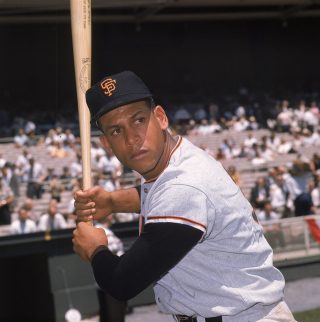
Willie Mays, RIP: Loss, but Gratitude

Willie Mays

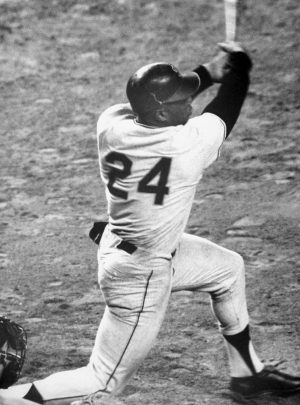
Mays hitting his 500th career home run, in 1965. “He has gone past me,” Ted Williams would say at his own Hall of Fame induction, after Mays hit number 522, “and he’s pushing, and I say to him, ‘Go get ’em, Willie’.”

Seeing Willie Mays in my boyhood when he was a Giant still in his prime was as transcendent as seeing him in his baseball dotage, as a late-career Met, was heartbreaking. Having Mays at all back in the city where he really made his baseball bones was as much a belated blessing as having him too much less than his best was sorrow. But . . .

“What do you love most about baseball?” asked Joe Posnanski, in The Baseball 100. (He ranked Mays number one.) Then, he answered. “Mays did that. To watch him play, to read the stories about how he played, to look at his glorious statistics, to hear what people say about him is to be reminded why we love this odd and ancient game in the first place.

“Yes, Willie Mays has always made kids feel like grown-ups and grown-ups feel like kids. In the end, isn’t that the whole point of baseball?”

But having Mays say farewell the way he did in Shea Stadium on 25 September 1973, with the Mets still yanking themselves back to take a none-too-strong National League East, brought tears not just of loss but of gratitude. If so few of the greats retire before the game retires them, fewer than that retire with Mays’s soul depth:

I hope that with my farewell tonight, you will understand what I’m going through right now. Something that—I never feel that I would ever quit baseball. But as you know, there always comes a time for someone to get out. And I look at the kids over here [pointing toward his Mets teammates], the way they are playing, and the way they are fighting for themselves, tells me one thing: Willie, say goodbye to America.

America never really said goodbye. Now America must say a reluctant au revoir. Mays left this island earth at 93 Tuesday. “I want to thank you all from the bottom of my broken heart for the unwavering love you have shown him over the years,” said his son, Michael, in a statement. “You have been his life’s blood.”

We’ve been his life’s blood? The younger Mays had it backward. His father was the lifeblood of every objective and appreciative baseball fan of his time. He didn’t have to wear the uniform of the team for which I rooted since their birth (not right away, anyway) to be that for me, in hand with Sandy Koufax, and believe me when I tell you that watching Koufax going mano a mano against Mays was something precious to behold.

(For the record, Mays faced Koufax 122 times and nailed 27 hits. Five were home runs, eight were doubles, one was a triple, for 33 percent extra bases off the Hall of Fame lefthander. Mays also wrung 25 walks out of him while striking out 20 times.)

Before Mays’s Giants and Koufax’s Dodgers high tailed it out of Manhattan and Brooklyn for the west coast, the most bristling debates in New York involved not politics, finance, or rush-hour traffic, but baseball. As in, whom among the three Hall of Fame center fielders patrolling the territory for each team was The Best of the Breed.

I was born in the Bronx and raised there and on Long Island; I heard the debates for years to follow after the Dodgers and the Giants went west. I had skin enough in that game long before Terry Cashman wrote and recorded his charming hit, “Willie, Mickey, and the Duke (Talkin’ Baseball).” Well, now. Let’s look at the trio during their New York baseball lives two ways, for all the seasons they played in New York together. (Snider was a four-year major league veteran by the time Mays and Mantle arrived in 1951.)

First, according to my Real Batting Average metric (total bases + walks + intentional walks + sacrifice flies + hit by pitches, divided by total plate appearances):

Together In New York PA TB BB IBB SF HBP RBA
Mickey Mantle 3493 1648 524 34 11 5 .636
Willie Mays 3299 1718 362 70 23 11 .662
Duke Snider 2629 1305 283 42 6 7 .625

Mays has a 26-point RBA advantage over Mantle and that’s with Mays losing over a season and a half to military service. (Mantle’s osteomyelitic legs kept him out of military service; Snider served in the Navy before his major league days began.) Mays also landed 70 more total bases and was handed 36 more intentional walks.

Mantle may have been a powerful switch hitter, but just from one side of the plate Mays outperformed him while they shared New York even with precious lost major league time between ages 21-23. Mantle also had a .756 stolen base percentage to Mays’s .738, but a) Mantle’s already compromised legs kept him from trying more often; and, b) Mays led his league in thefts twice during the period under review. (Snider? Even a hobbled Mantle left him behind: for their shared New York years, his stolen base percentage was .586.)

Sometimes Mantle gets the props as the best of the trio purely because his Yankees were far better teams than the others’. Actually, Snider’s Dodgers were almost as good as Mantle’s Yankees. It was no more Snider’s fault that his Dodgers couldn’t get over those Yankee humps until 1955 than it was Mantle’s sole doing that his Yankees won seven pennants and five World Series (three consecutively) while they shared the Big Apple.

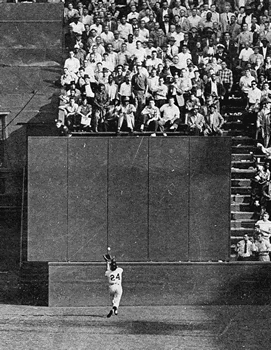
And it was hardly Mays’s fault that his Giants won a mere two pennants in the same shared span, even if Mays’s Giants got squashed by the Yankees in five in the 1951 Series but swept the far better Indians in the 1954 Series. You may have heard of a little play known as The Catch from Game One of that Series, happening when it seemed the Indians had a shot at taking the opener. (Mays would play on two more pennant winners, too, the 1962 Giants—who beat the Dodgers in another memorable pennant playoff—and the 1973 Mets.)

Willie Mays

“The Catch,” of course—460+ feet from home plate in the ancient Polo Grounds.

“That really wasn’t that great of a catch,” harrumphed curmudgeonly Indians pitcher Bob Feller, nearing the end of his own Hall of Fame career. What made him think not? “As soon as it was hit, everyone on our bench knew that he was going to catch it . . . because he is Willie Mays.” (But did they know Mays would also keep Hall of Famer Larry Doby from scoring with an equally staggering throw in to the infield off The Catch?)

Which brings me to the titanic triumvirate in center field. We’re going to look at them according to total zone runs, the number of runs their play in center field turned out above or below their leagues’ averages. Baseball-Reference begins measuring total zone runs with the 1953 season, so we’ll have five solid Big Apple seasons to review for each of the trio:

Willie Mays: +45.
Mickey Mantle: +22.
Duke Snider: +25.

Once again you see where Mantle’s physical health issues got in his way despite his supernatural talent and skill. But it might not have mattered. Mays and Mantle both played in unconscionably deep home center fields before the Giants and the Dodgers left the Apple for 1958. You can fantasise all you like how many runs Mantle might have prevented on good legs, but if you guess that he might have proven just about even you’re making a solid guess.

“Willie Mays going after a fly ball was cotton candy and a carousel and fireworks and a big band playing all at once,” Posnanski wrote. “His athletic genius was in how every movement expressed sheer delight.”

When Mays got to San Francisco, he and Mantle continued their top of the line play. When he got to Los Angeles, Snider had two decent seasons followed by a decline phase that actually took him back to New York for a round with the early Mets before finishing his career in 1964 as . . . a Giant, of all things.

Mantle managed to remain Mantle through the end of 1964. Mays managed to remain Mays through at least 1971. Even if his home run power had dissipated somewhat in the previous four seasons, he spent 1971—at age 40—leading the National League in walks and on-base percentage. Mantle’s body took him out at last at age 36; Mays’s, at age 42; Snider’s, at age 37.

And here is how the trio finished career-wise. First, how they sit among the Hall of Fame center fielders whose careers covered the post-World War II/post-integration/night-ball era, according to RBA:

Center Field PA TB BB IBB SF HBP RBA
Mickey Mantle 9907 4511 1733 148 47 13 .651
Willie Mays 12496 6066 1464 214 91 44 .631
Ken Griffey, Jr. 11304 5271 1312 246 102 81 .620
Duke Snider 8237 3865 971 154 54 21 .615
Larry Doby 6299 2621 871 60 39 38 .576
Andre Dawson 10769 4787 589 143 118 111 .534
Kirby Puckett 7831 3453 450 85 58 56 .524
Richie Ashburn 9736 3196 1198 40 30 43 .463
HOF CF AVG .588

But now, how they sit among center fielders for run prevention above their league averages, showing the top ten:

Andruw Jones +230
Willie Mays +176
Paul Blair +171
Jimmy Piersall +128
Kenny Lofton +117
Devon White +112
Carlos Beltrán +104
Willie Davis +103
Curt Flood +99
Garry Maddox +98

Thanks to his leg and hip issues, Mantle finished his career at -10. Snider finished his at -7; his late career was compromised by knee, back, and arm injuries. (Richie Ashburn, their great Hall of Fame contemporary, finished his career +39.) Two such talented center fielderss who’d had excellent throwing arms and range deserved far better than such physical betrayals.

Mays stood alone as the complete, long-enough uncompromised, all-around package. He was blessed with a body that wasn’t in a big hurry to betray him, but no blessing means a thing if you don’t take it forward. Good luck stopping Mays from doing so. Should-be Hall of Famer Dick Allen once advised Hall of Famer Mike Schmidt to play the game as though he were still the kid who’d gladly skip supper to play ball. Mays played the game precisely that way until age began to say “not so fast,” after all.

“The greats don’t always go gently into that good gray night when they can no longer play the games that made their names,” I wrote when Mays turned 90.

This son of an Alabama industrial league ballplayer fought a small war in his soul when his age insisted he was no longer able to play the game he loved so dearly at the level on which he’d played it for so many years. Some said he’d become sullen, moody, dismissive in the clubhouse. Some resented him, others felt for him, still others mourned.

. . . When he smiled as a Met, you still saw him in his youth, you didn’t see the manchild who was yanked rudely into manhood by a San Francisco that shocked him with skepticism as a New York import rather than a hero of their own. By a San Francisco that also shocked him, for all its reputation otherwise, when his bid to buy a home with his first wife was obstructed long enough by the sting of neighbourhood racism.

Willie Mays

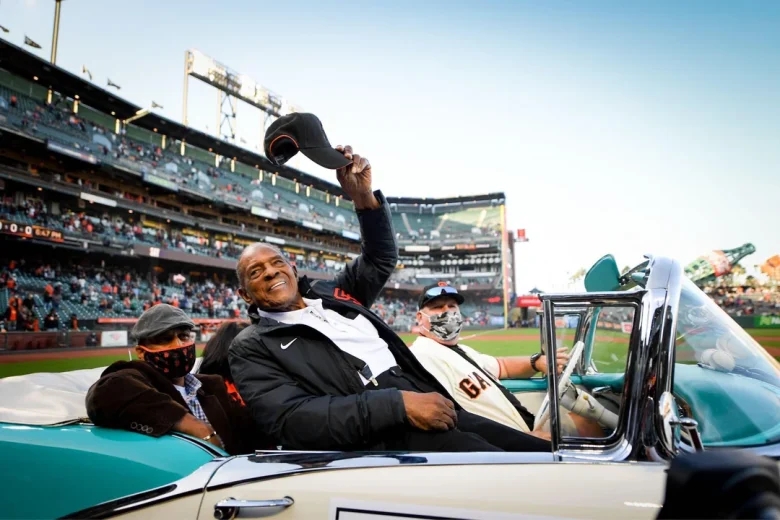
Mays taken for a drive around PacBell Park in a 1956 Oldsmobile to celebrate his 90th birthday. San Francisco came to love him as New York did, but not without growing pains.

After his first marriage ended in divorce and in his son living across country with his mother, Mays dated Mae Louise Allen for about a decade before marrying her after the 1971 season. His happiness there was compromised by her premature Alzheimer’s diagnosis; his caring for her until her death in 2013 is the stuff of true love stories.

A welcome presence at the Hall of Fame’s induction ceremonies following his own in 1979 and at various Giants events (and numerous home games) in the years that followed, Mays wouldn’t be able to attend this year’s Field of Dreams game at Birmingham’s Rickwood Field, the field where he first played with the Birmingham Black Barons of the old Negro American League.

“I’d like to be there, but I don’t move as well as I used to,” he said in a statement on Monday. “So I’m going to watch from my home. But it will be good to see that. I’m glad that the Giants, Cardinals and MLB are doing this, letting everyone get to see pro ball at Rickwood Field. Good to remind people of all the great ball that has been played there, and all the players. All these years and it is still here. So am I. How about that?” A day later, sadly, he was gone.

Mays never apologised for making the game look fun with his fabled basket catches in front of his belt, his winging turns running the bases as his deliberately oversized hat flew off, his high-pitched voice sounding like a kid getting to play yet another inning.

“That’s what his idea was,” said one-time Giants relief pitcher Stu Miller, “to please the crowd.”

“I’m not sure what the hell charisma is,” said Ted Kluszewski, the musclebound Reds first baseman of the 1950s, “but I get the feeling it’s Willie Mays.”

“The only thing Willie Mays could not do on a baseball diamond,” Posnanski wrote, “was stay young forever.”

May his entry into the Elysian Fields, where it’s Willie, Mickey, and the Duke once again,  and especially his reunion with his beloved Mae, have been as joyous for him as the way he played the game was joyous to us for as long as we were honoured to see him play.

Mickey Mantle, as he actually was

Mickey Mantle

Even now it’s impossible to see discussions of Mickey Mantle without unfair laments over what the Hall of Famer wasn’t.

It’s almost three decades since Mickey Mantle’s death and it is a half century since he was elected to the Hall of Fame. Wouldn’t you think by now that the lamentations over what could have been, should have been, would have been, might have have been for Mantle had ceased and desisted? Isn’t what been been far more than enough?

Could have been one of the truly greats. Never quite lived up to his potential. Squandered so much of his enormous talent. Variations on those themes and more. All patent nonsense. I began getting that a-ha! when reading Allen Barra’s 2002 book, Clearing the Bases: The Greatest Baseball Debates of the Last Century.

Barra devoted a chapter to an in-depth comparison between Mantle and his transcendent contemporary Hall of Famer Willie Mays. Near the end of it, he ran down the foregoing laments, sort of, then asked, “But what about what Mantle did do?” to finish the chapter:

We spent so much of Mantle’s career judging him from [his longtime manager] Casey Stengel’s* perception as the moody, self-destructive phenom who never mastered his demons, and we spent much of the rest of Mantle’s life listening to a near-crippled alcoholic lament over and over about what he might have been able to accomplish. For an entire generation of fans and sportswriters who saw their own boyhood fantasies reflected in Mantle’s career and their worst nightmares fulfilled by his after-baseball life, Mantle’s decline became the dominant part of the story.

It’s time to dispel this myth . . . He was one of the most complete players ever to step on a big league field, a hitter with a terrific batting eye . . . spectacular power, blinding speed, and superb defensive ability. He could do things none of his contemporaries could do . . . He could switch-hit for high average and power, and he could bunt from either side of the plate, and no great power hitter in the game’s history was better at stealing a key base or tougher to catch in a double play . . . That his life is a cautionary tale on the dangers of success and excess can not be argued, but as a player he has a right to be remembered not for what he might have been but for what he was.

Of course Barra was and remains right. Even Mantle’s most unapologetically cynical observers buy that of course he’d have smashed Babe Ruth to smithereens, of course he’d have out-run Willie Mays in center field, of course he’d have out-stolen Ty Cobb first, of course he’d have left an impossible bar to clear, if only his lifelong-troublesome legs and a less young-death-present upbringing had left him the whole body and fully sound mind do it.

(For a contrast, hark back to Jim Bouton’s original lament in Ball Four: “Like everyone else on [the Yankees], I ached with Mantle when he had one of his numerous and extremely painful injuries. I often wondered, though, if he might have healed quicker if he’d been sleeping more and loosening up with the boys at the bar less. I guess we’ll never know.” Critics crucified Bouton over that, written in 1969-70. Whoops.)

If only. Enough.

When Barra wrote, no player—not Hall of Famers Lou Gehrig, Yogi Berra, Babe Ruth, nobody—played more games as a Yankee than Mantle’s 2,401. Hall of Famer Derek Jeter got to play two more seasons and 346 more. Jeter’s the only Yankee to suit up in the fabled pinstripes for more games than Mantle did.

If you want to lament what couldawouldashouldamighta been for Mantle, you should keep it to his center field play. That’s where his notorious legs really cost him. Sure, he could run a fly ball down with the best (he saved Don Larsen’s World Series perfect game with just such a running stab), but he finished his career ten fielding runs below his league average in center field—and only once was good for ten or more above it. (In 1955.)

Mantle had an excellent throwing arm but his legs kept his range factors at his league’s average as long as he played center field. He had twenty outfield assists in 1954 . . . and ten or more only twice more his entire career, both in the 1950s. His legs also hurt him on the bases: he did finish with an .801 stolen base percentage, but playing in the time when the running game returned he never stole more than 21 bases in a single season.

But . . . he did take extra bases on followup hits 54 percent of the time he reached base in the first place. Willie Mays out-stole him (and led the entire show annually from 1956-58), yet Mays finished with a slightly lower lifetime stolen base percentage. (.767.) In center field? No contest. Mays was worth +176 fielding runs lifetime.

So who was really better at the plate? I’m going to repeat a table I posted as a footnote a few days ago, when I assessed where Mike Trout sits among Hall of Fame center fielders who played all or most of their careers in the post-World War II/post-integration/night-ball era. The table looks at those center fielders according to my Real Batting Average metric: total bases + walks + intentional walks + sacrifice flies + hit by pitches, divided by total plate appearances:

Player PA TB BB IBB SF HBP RBA
Mickey Mantle 9907 4511 1733 148 47 13 .651
Willie Mays 12496 6066 1464 214 91 44 .631
Ken Griffey, Jr. 11304 5271 1312 246 102 81 .620
Duke Snider 8237 3865 971 154 54** 21 .615
Larry Doby 6299 2621 871 60 39** 38 .576
Andre Dawson 10769 4787 589 143 118 111 .534
Kirby Puckett 7831 3453 450 85 58 56 .524
Richie Ashburn 9736 3196 1198 40 30** 43 .463
AVG .576

Mantle’s RBA is twenty points higher than Mays. (Trout, I repeat, is 21 points higher than Mantle at this writing, believe it or not.) You might notice that he took almost two hundred more walks than Mays despite playing several seasons fewer. They actually finished with the same average home runs per 162 games (36), but Mays was the far more difficult strikeout: 66 per 162 games, compared to Mantle’s 115.

So where would Mantle finish with an RBA twenty points higher than Mays. Look deeper. Mantle hit into far fewer double plays than Mays did. Even with his badly-compromised legs, which you might think would get him thrown out at first a little more often in such situations, Mantle hit into 138 fewer double plays than Mays did.

Here’s a couldashouldawouldamighta for you: Imagine how many fewer double plays Mantle might have hit into if he had healthy or at least less-frequently-injured legs. Today’s blowhard fans, writers, and talking heads love to yap about the guys who strike out 100+ times a year. Ask them whether they’d take Mays’s 66 against 11 GIDPs a year . . . or Mantle’s 115 against six.

Try this on for size. Mantle was seen so often as lacking compared to the Hall of Famer he succeeded in center field, Joe DiMaggio. Yet, and Barra himself noted this in the aforementioned book, Mantle averaged 83 more strikeouts than DiMaggio . . . but DiMaggio hit into seventeen more double plays even playing five fewer seasons. When last I looked a strikeout was a single out. (Unless, of course, you swing into a strike-‘im-out/throw-’em-out double play, and we don’t know how many of those were involved in Mantle strikeouts.)

Here’s another: In the same era, only three players have win probability added numbers above 100. In descending order, they are: Barry Bonds (127.7), Ted Williams (103.7), and Mays (102.4). Henry Aaron’s 99.2 is just behind Mays; Mantle’s 94.2 is right behind Aaron. Those are the only five players from the same era with WPAs 90 or higher. (Did I forget to mention Teddy Ballgame whacked into 197 double plays?)

If you still want to tell me that a guy with a 94.2 win probability added factor “didn’t live up to his potential,” go right ahead. But then I’m going to tell you that we don’t have to wonder what couldawouldaashouldamighta been if Mantle’s physical and mental health allowed.

They didn’t calculate wins above replacement-level player [WAR] when Barra wrote Clearing the Bases, alas. Mays (156.1) has Mantle (110.2) beaten by ten miles. Mantle was 36 when he retired. Mays from 36-40 was still worth an average 5.0 WAR a season, which is actually still All-Star caliber. It’s not Mantle’s fault Mays’s body allowed him a longer useful baseball shelf life. Any more than it was Mays’s fault he didn’t get to play on more than four pennant winners and one World Series champion.

I don’t know if the foregoing will put a lid on the couldawouldamightashoulda stuff around Mantle once and for all. But I can dream at least as deeply as all those fans and sportswriters did when Mantle was in pinstripes doing things nobody else save one in his time did, and doing it for teams that won twelve pennants and seven World Series rings while he did them.

For me, I haven’t cared about how great he couldawouldamightashoulda been since I first read Barra’s book. I still don’t. Pending the final outcome of Mike Trout’s career (Trout, too, has had injury issues enough the past three seasons, and he’s right behind Mantle as the number five center fielder ever to play, according to Baseball Reference), Mantle and Mays remain the two single greatest all-around position players who ever suited up.

It’s still heartbreaking to remember Mantle apologising for and owning what he wasn’t in life itself not long before his death. But he owes nobody any apology for what he was on a baseball field in spite of his compromised health. Barra remains right: “as a player he has a right to be remembered not for what he might have been but for what he was.”

———————————————————————————-

* My personal favourite story about Mickey Mantle and Casey Stengel: When Mantle first became a Yankee, the team was scheduled to play an exhibition with the Dodgers in Ebbets Field before the regular season began. Stengel took Mantle to the once-fabled Ebbets Field wall from right field to center field, bisected by a giant scoreboard and beveled to create an angle toward the field in its lower half.

Stengel wanted to show Mantle the tricky angles made by the scoreboard and the bevel. “Now, when I played here,” Stengel began. He was cut off by Mantle exploding into laughter, hollering, “You played here?!?” (Stengel did, as a contact-hitting, base-stealing  outfielder with the Dodgers from 1912-1917, then with three other National League teams including the Giants from 1918-1925.)

“Boy never saw concrete,” the Ol’ Perfesser told a reporter who happened to overhear the exchange. “He thinks I was born sixty years old and started managin’ right away.”

A trio grand for Cooperstown

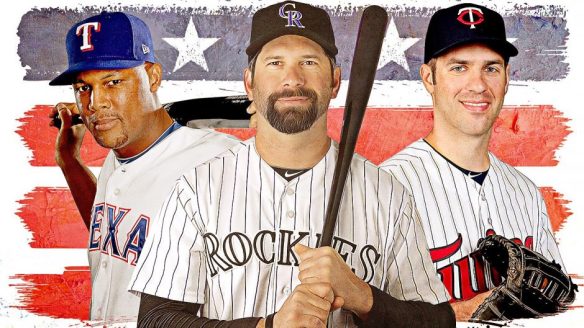
Adrián Beltré, Todd Helton, Joe Mauer.

L to R: Newly-elected Hall of Famers Beltré, Helton, Mauer—They’ll join Contemporary Baseball Era Committee choice and longtime manager Jim Leyland on the Cooperstown stage come July.

The third baseman whose surname begins with “belt” and was way more than just a great belter. The first baseman who wasn’t just a Coors Canaveral product at the plate. The catcher forced to first base by concussion but who forged his case as the game’s number seven catcher all-time, defying his haters who still call him a thief.

Ladies and gentlemen, meet your newest Hall of Famers—Adrián Beltré, Todd Helton, and Joe Mauer. Beltré and Mauer deserved to be the first-ballot Hall of Famers they are now. Helton should have been, too, if only the voters his first time around on the Baseball Writers Association of America ballot had taken the dive that went deeper and deeper the longer Helton stayed on the ballot.

Beltré is probably in the most unique position of the trio. The number four third baseman of all (I’d rank him a touch higher for his combination of power hitting and off-the-charts defense) has something none of his peers can claim. Quick: name the only third baseman, ever, with 1) 3,000+ hits and 2) five or more Gold Gloves.

Hall of Famer Wade Boggs has two Gloves. Hall of Famer George Brett has one. Hall of Famer Paul Molitor (who probably got in more as a designated hitter than a third baseman) has none. Beltré, of course, has five. Now you can argue that a lot of Gold Glove award voting has been suspect over the years. You can’t argue with only two of the quartet being in the top twelve for run prevention at third base: Beltre (+168 total zone runs; 2nd) and Boggs (+95; 12th).

There’s only one other third baseman in the top twelve for run prevention who had anything like Beltré’s power in hand with it: Hall of Famer Mike Schmidt. Hall of Famer Eddie Mathews (512 home runs) was worth 40 defensive runs saved but that doesn’t get him quite to the levels of Beltré and Schmidt among the biggest bopping third basemen.

Here’s Beltré, among post-World War II/post-integration/night-ball era Hall of Fame third basemen, according to my Real Batting Average metric (RBA): total bases + walks + intentional walks + sacrifice flies + hit by pitches, divided by total plate appearances:

HOF 3B PA TB BB IBB SF HBP RBA
Mike Schmidt 10062 4404 1507 201 108 79 .626
Chipper Jones 10614 4755 1512 177 97 18 .618
Eddie Mathews 10100 4349 1444 142 58 26 .596
Scott Rolen 8518 3628 899 57 93 127 .564
George Brett 11625 5044 1096 229 120 33 .561
Ron Santo 9397 3779 1108 94 94 38 .544
Wade Boggs 10740 4064 1412 180 96 23 .538
Adrián Beltré 12130 5309 848 112 103 97 .533
Paul Molitor 12167 4854 1094 100 109 47 .510
Brooks Robinson 11782 4270 860 120 114 53 .458
HOF AVG .555

You see he was hurt most at the plate by taking a lot less unintentional walks than everyone else on the list. But he’s the number two most run-preventive third baseman ever behind Brooks Robinson. His combination of power and defense should nudge him up to the number three all-around third baseman who ever played. WARriors, take note: Beltré’s 93.5 is bested among Hall third basemen by two, in ascending order: Mathews (96.0) and Schmidt (106.8).

Among his group of Hall of Famers, Beltré was also the most fun Fun Guy of the game. Even if his career was an ascending trajectory to genuine greatness (people still wonder how the Dodgers could have let him take a hike into free agency), there was always a sense about him that he really did play more for the fun of it than the riches of it.

I’ve asked elsewhere: how often do you get to send one of the real Fun Guys to Cooperstown? Too many playing or managing greats were about as fun as open-heart surgery. Too many of the game’s Fun Guys weren’t all that much fun when they were actually on the field or at the plate. (Dick Stuart, for example, was one of the funnest of his time’s Fun Guys—but he earned his nickname Dr. Strangeglove at first base. He only got to play major league baseball because he could hit baseballs across city limits.)

Ernie Banks, Yogi Berra, Bert Blyleven, Roy Campanella, Dizzy Dean, Whitey Ford, Lefty Gomez, Rickey Henderson, Minnie Miñoso, David Ortíz, Satchel Paige, Babe Ruth, and Warren Spahn were bona-fide Hall of Famers and Fun Guys in the bargain as players. (And several of them had to do it through unconscionable bigotry.) Casey Stengel was both as a manager. Beltré will grace their company.

I did notice someone aboard social media ask aloud if someone could arrange for his old Texas teammate Elvis Andrus to come rub his head at his induction. Not a half bad idea. Barring that, maybe the Hall could arrange for Beltré head-touching bobbleheads to pass out come induction day? Barring that, maybe the Hall staff would let him drag the on-deck circle mat lonce more?

Helton may have finished what Hall of Famer Larry Walker started and fractured the idea that a career spent half or more with Coors Field as your home ballpark will kill or at least cast abundant doubt on your Hall credentials. Helton lacked what Walker had, enough time in another uniform to show that he was Hall of Fame good without the Coors factor. But Helton has this distinction: the first Rockie-for-life to go to Cooperstown.

Now, look deeper, once again, please. The Toddfather posted an .855 OPS on the road to his 1.048 at home. An .855 OPS across the board might mean a spot in the Hall of Fame for a lot of players. Helton’s road OPS is higher than the across-the-board OPSes of (in ascending order) live ball-era Hall of Famers Eddie Murray, Gil Hodges (who played most of his career in a bandbox home park), Orlando Cepeda, Ben Taylor (Negro Leagues), Sunny Jim Bottomley, Harmon Killebrew; and, one point below Fred McGriff. His across-the-board .953 is better than all but nine Hall of Fame first basemen.

Let me apply my RBA to Helton among post-World War II/post-integration/night-ball era Hall of Fame first basemen:

First Base PA TB BB IBB SF HBP RBA
Jim Thome 10313 4667 1747 173 74 69 .653
Jeff Bagwell 9431 4213 1401 155 102 128 .636
Todd Helton 9453 4292 1335 185 93 57 .631
Willie McCovey 9692 4219 1345 260 70 69 .615
Harmon Killebrew 9833 4143 1559 160 77 48 .609
Fred McGriff 10174 4458 1305 171 71 39 .594
Gil Hodges 8104 3422 943 109 82 25 .565
Orlando Cepeda 8698 3959 588 154 74 102 .561
Eddie Murray 12817 5397 1333 222 128 18 .554
Tony Pérez 10861 4532 925 150 106 43 .526
HOF AVG .594

Helton has the number three RBA among those Hall of Fame first basemen, he’s 37 points above the average RBA for those Hall first basemen, and it wasn’t all or purely a product of Coors Field. He also had a 144 OPS+ over his ten-year peak of 1997-2007. OPS+, of course, adjusts for ballpark factors. That peak OPS+ alone should disabuse you once and for all about whether the Toddfather was pure Coors.

By the way, for those of you obsessed with swinging strikeouts at the plate and the metastasis thereof, be reminded that Helton lifetime walked more than he struck out, especially as the leverage situation rose. He averaged eleven more walks (96) than strikeouts (85) per 162 games, and he walked 160 times more than he struck out. Would you like to know how many of the other aforelisted Hall of Fame first basemen walked more than they fanned? Z-e-r-o.

Mauer joins a unique Cooperstown group—one of the three field positions (catcher) that have resulted in only three first-ballot Hall of Famers. (It’s still impossible to believe that Yogi Berra wasn’t a first-ballot Hall of Famer.) Thus does Mauer join Johnny Bench and Ivan Rodríguez in the Cooperstown Trinity of the Tools of Ignorance. (The other two positions with only three first-time Hall of Famers: first base and second base.)

He also has a .569 RBA that puts him third among post-World War II/post-integration/night-ball Hall catchers. (Only Mike Piazza and Roy Campanella—who played in the same bandbox as Hodges when he made the Show in 1948—are ahead of him.) He wasn’t all bat as a backstop despite his gaudy batting averages, either; the pitchers who threw to Mauer posted an ERA almost a full run below his league average, he was worth +65 total zone runs behind the dish, and he threw out a respectable 33 percent of runners who tried to steal on him lifetime. (He led the American League twice: 53 percent in 2007; 43 percent in 2013.)

WARriors should remind themselves, too, that in the ten seasons Mauer played as the Twins’ regular catcher, he out-WARred the three other catchers active during all ten of those seasons by a wide margin: his 44.6 bested Victor Martinez (28.1), Yadier Molina (27.6), and Jorge Posada (20.0).

Well, now. A year ago, after Scott Rolen’s election to the Hall of Fame provoked the usual chatter about who’d be elected this year, Twins fans tried to smother social media with assaults and batteries of Mauer for “stealing” the money in that yummy contract extension he signed before his first concussion compelled the Twins to get him the hell out from behind the plate.

He suffered his second well into the extension, chasing a foul ball from first base. Those brain-dead fans either forgot, never knew, or didn’t care that injuries incurred in the line of duty don’t equal goldbricking or defrauding. I swore then that I wouldn’t say another word about their idiocies, but I can’t resist today.

Who has the last laugh now?

For those who’ve passed to the Elysian Fields . . .

Brooks Robinson

The Hoover, called up to beat, sweep, and clean the Elysian Fields.

Once upon a time, Hall of Famers Yogi Berra and Whitey Ford stood in Yankee Stadium on an Old-Timer’s Day and watched a video board presentation of former Yankees who’d gone to the Elysian Fields that year to date. Berra turned to his old battery mate and said, “Boy, I hope I never see my name up there.”

Mr. Yogi went there in 2015; the Chairman of the Board, three years ago. Their ranks now serene and happy in the presence of the Lord have swollen, as inevitably if sadly they must, by several this year, including a badly haunted former teammate, a Hall of Fame third baseman, an infamous umpire, and perhaps the rarest of baseball people—a likeable, even loveable owner. Among too many others.

Brooks Robinson (86) turned third base into a black hole for hundreds of hitters while maintaining such a sterling reputation as a person that his Day’s master of ceremonies told the crowd Baltimoreans didn’t name candy bars but their children after The Hoover. Frank Howard (87) was traded to the second Washington Senators for lefthanded pitcher Claude Osteen after the 1964 season, in the event the Dodgers’ Hall of Famer Sandy Koufax broke down into a once-a-week pitcher. The 6’7″ Howard became a Washington matinee idol who hit mammoth home runs (including a heartbreaker in the final Senators game before moving to Texas), and wore a nickname entirely contrary to his friendly, gentle-giant  personality. (Capital Punishment.) “By the time you learn to play this game properly,” he observed as his career ended, “you can’t play anymore.”

“No one,” George F. Will once observed, “has ever paid money to go to a major league baseball game in order to see the team’s owner.” The exception might have been Peter Seidler (63), who was so beloved in San Diego that Padres fans could be seen wearing team jerseys with his name on the back as often as with assorted Padres players. “He brought passion to that fan base,” Brewers owner Mark Attanasio said of him, “and that’s as loud a crowd as you will ever hear.”

Joe Pepitone (82) was the shakiest 1960s Yankee, a haunted, self-immolating young man produced by a ferociously abusive father, a talented first baseman (three Gold Gloves and All-Star teams) whose inner turmoil and outer taste for night life and carnal knowledge helped him trash marriages, friendships, and family ties, until he finally sought and acceped the proper help late enough in life to repair most of those family relationships. A later-generation Yankee, George Frazier (68), was the last pitcher to be saddled with three losses in the same World Series (1981) and the cleverest to defend himself against charges of chicanery on the mound: “I don’t use foreign substances. Everything I use is made in the U.S. of A.”

Jesús Alou (80) was a serviceable utility outfielder, one of the first three brothers to patrol the same outfield as Giants, and the answer to a San Francisco graffitist’s gospel trivia question. (Jesus is the Answer! What’s the question? Who’s Felipe and Matty’s kid brother?) His immediate contemporary Vic Davalillo (84) won one Gold Glove, two World Series rings (1971 Pirates, 1973 Athletics), turned up number 32 on my own survey of the 33 best pinch hitters of all time (300+ plate appearances in the role), and married his second wife over the telephone.

Jesus (left), Matty (center), and Felipe Alou: Jesus is The Answer! What’s the question? Who’s Felipe and Matty’s kid brother?

Albie Pearson (88) would tell you Jesus is the answer without being pushy or obnoxious about it, waiting until someone asked him before speaking of it. Known as “The Littlest Angel” during his tenure with the original Angels (“I think he’ll be an archaeological find,” Angels coach Rocky Bridges said of him), the 5’5″ outfielder looked good enough (he was a tough strikeout, a 1958 Rookie of the Year, and a 1963 All-Star) until back trouble shortened his career—and sent him to a second life as an ordained Baptist minister and, especially, the co-founder (with his wife) of Father’s Heart Ranch in southern California, devoted to abused and abandoned boys between six and twelve.

Vida Blue’s (73) reward for pitching his way onto a Time cover and into a Cy Young Award and a Most Valuable Player Award with 301 strikeouts and a league-leading 1.82 ERA 1971 was to be told by A’s owner Charlie Finley, during contract talks, I know all that. And if I was you, I would ask for the same thing. [A $100,000 salary—JK.] And you deserve it. But I ain’t gonna give it to you. It yanked Blue inside-out, nearly destroyed his love of the game (despite becoming the first pitcher to start All-Star Games for each league), and left him and too many to wonder what might have been before he kicked substance addiction in retirement and became a Bay Area philanthropist.

Blue’s teammate on the Swingin’ A’s of the early 1970s, third baseman Sal Bando (78) was considered the soul of those teams, a solid third baseman underrated for his fine defense and quick to defuse trouble whether from the front office or in his own clubhouse. (The godfather. Capo de capo, boss of all bosses . . . Sal was the leader and everyone knew it.—Hall of Famer Reggie Jackson.) The bad news was that, as the American League’s overall player rep in 1980, Bando—eventually the Brewers’ general manager—voted against including short-career, pre-1980 major leaguers in the pension plan realignment that meant full pensions after 43 days’ major league service time and full health benefits after one day’s service time.

Tim McCarver (81) let black Cardinals teammates (especially his eventual longtime friend Bob Gibson) teach him with wit as well as wisdom about race, became a personal favourite catcher to a pair of Hall of Fame pitchers (Gibson and, in St. Louis and Philadelphia, Steve Carlton), then became a Frick Award-winning Hall of Fame broadcaster whose own wit married to his deft analyses instructed as well as delighted several generations of fans. (Before he made his Hall of Fame speech, McCarver would remember, “I saw Frank Robinson at breakfast and said, ‘I’ll try to be brief.’ He said, ‘You?'”)

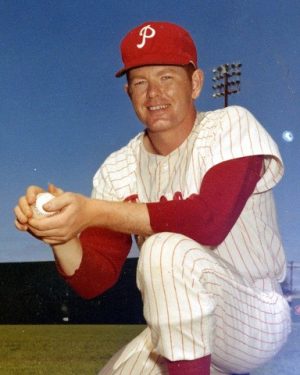
Jack Baldschun (86) was Gene Mauch’s favourite relief pitcher on the early 1960s Phillies, with a nasty screwball he’d learned to throw without arm stress and with excellent results . . . until he wasn’t, during the ill-fated 1964 season that saw the Phillies bring veteran Ed Roebuck aboard and both Mauch and general manager John Quinn lose confidence in him inexplicably. They traded Baldschun to the Orioles and he was an Oriole for 72 hours—long enough to be part of the package that brought the Orioles Frank Robinson from the Reds. His career never the same again (he suffered what he called “arm lock” while in Cincinnati and spent his final seasons in the minors except for a 1969 with the newborn Padres: “I felt like a man serving time for a crime he didn’t commit”), he retired to lumber sales and family life.

Jack Baldschun

“I felt like a man serving time for a crime he didn’t commmit.”—Jack Baldschun.

Nate Colbert (76) was plucked from the Astros organisation for the 1969 expansion draft and became the Padres’ first genuine star (he averaged 30+ home runs a season), tying one record and setting another with five bombs and thirteen steaks in a 1972 doubleheader, but saw his career curtailed by chronic back trouble after five years as a Padres then two years in three towns. (Detroit, Montreal, Oakland.) He remains the franchise’s career home run leader (173) and—after one dicey scrape involving fraudulent loan applications and six months in prison—reclaimed his post baseball life as a minister.

Dick Groat (92) was a slick shortstop, the National League’s Most Valuable Player as a member of the World Series-winning 1960 Pirates, and eventually held the same job without winning the same award for the World Series-winning 1964 Cardinals. Bob Garibaldi* (81) resisted the personal recruitment of Casey Stengel for the Mets to sign with the Giants, pitch in fifteen games over four seasons, then (after long years in the minors) become a college basketball referee. Pat Corrales (82) was a reserve catcher, major league manager (the first Mexican to have such a job), and well enough respected as a man that, when his first wife died giving birth to their fourth child in 1969, Frank Robinson ordered all the fines collected by his kangaroo court in the Baltimore clubhouse to be given to him instead of used for the usual season-ending party. (Corrales remarried happily soon enough.)

Wayne Comer* (79) was a 1968 Tiger (usually a late game replacement for outfield star Willie Horton; he got a base hit in his lone World Series plate appearance), a 1969 Seattle Pilot (his 3.2 wins above replacement tied for the team lead), a 1970 Brewer, and a respected high school baseball coach in his native Virginia. He was also the subject of a hilarious attempted game ejection in the minors: an umpire assumed Comer was giving him the business from the team bullpen and ordered him ejected, whereupon the team’s manager told the arbiter, “You’re going to have to yell louder. We sent Comer to Detroit this morning.”

Dennis Ribant (81) was the first Mets pitcher to finish in the National League’s ERA top ten (in 1966) and with a winning season’s record. (11-9, also 1966.) His reward was being traded after that season—to make room for a kid named Seaver. His ill fortune resumed in 1968, when—reduced to journeyman relief work by then—he was one of only three Tigers who was actually native to Detroit (catcher Bill Freehan and outfielder Lenny Green were the others) . . . but he got little enough work and was traded to the White Sox late that July. After several more seasons of being traded and put into the minors at once (he was once traded for legendary pitcher-playboy Bo Belinsky), the righthander who once admitted “experimenting” with a spitball despite learning a good changeup from Hall of Famer Warren Spahn retired to life insurance, living in Newport Beach, and (with his daughter, Tracy) winning the Equitable Family Tennis Championship at Forest Hills in 1983.

Tim Wakefield

Tim Wakefield: Knuckleball inspired a catcher to use a first baseman’s mitt. Narcissistic teammate denied his right to fight his illness privately.

Willie Hernández (69) won the American League’s 1984 Cy Young Award and MVP as the World Series-winning Tigers’ relief king with his 1.92 ERA. Two years later, he blew his popularity in Detroit during a struggling season when a critical Mitch Albom column provoked Hernández to dump a bucket of ice water over Albom’s head. Elbow trouble put paid to his pitching career before he had a second successful act as the owner of a steel construction business and cattle ranch in his native Puerto Rico, before his health (including multiple strokes) hit bottom.

Tim Wakefield (57) was a class act, a good knuckleball pitcher (his floater was tough enough to inspire one of his catchers to use a first baseman’s mitt behind the plate), who picked himself up, dusted himself off, started all over again after surrendering a pennant-losing home run (to Aaron Boone in 2003), and became a key to the Red Sox’s 2004 drought-busting triumph at last. Beloved in Boston, Wakefield and his wife were also done dirty by a 2004 Red Sox rotation mate who decided their choice to fight two insidious diseases together out of the public eye wasn’t their choice to make.

Ken MacKenzie (89) was the first Mets pitcher who could call himself a Yalie. An Original Met, the bespectacled MacKenzie was once brought into a deep jam with manager Stengel telling him, “Now, just pretend you’re pitching against Harvard.” (As a Yale pitcher, MacKenzie’s record against Harvard was 6-0.) Roger Craig (93) turned ignominy as an Original Met (an eighteen-game losing streak in 1963 despite often solid pitching) into a later life as a messenger of the split-fingered fastball and a World Series-winning manager. (The “Hum Baby” 1989 Giants.) Their Original Met battery mate (for a short while), Hobie Landrith (93) landed me two crates of oranges for winning a sports radio trivia contest long after he performed his greatest service to those Mets: being traded for Marvelous Marv Throneberry.

Ken MacKenzie

Ken MacKenzie: Yale Class of 1956; Original Mets Class of 1962-63: “Now just pretend you’re pitching against Harvard.”

Yet two more Original Mets—Frank (The Big Donkey) Thomas (93) and Joe Christopher (97) factored in a couple of classic Metsian mishaps: Christopher had to tell Hall of Famer Richie Ashburn how to holler “I got it!” in Spanish to keep shortstop Elio Chacon from plowing into him on short flies to the shallow outfield. The first time Ashburn hollered Yo la tengo, yo la tengo, Chacon backed away . . . but Thomas, the Mets’ first home run king (34 in 1962), running in from left field, plowed into Ashburn instead. The passings of Christopher, Craig, Landrith, MacKenzie, and Thomas leave only nine men standing at this writing who served sentences as Original Mets and still live to tell about it.

Don Denkinger (86) developed a sense of humour about his hour of infamy, blowing the call at first base in the top of the ninth of Game Six, 1985 World Series. (He called the Royals’ Jorge Orta safe when everyone in the ballpark and watching on television saw Orta was out by a full step plus.) He also proved a better man than most calling for his prompt execution: he not only owned the mistake but, in due course, advocated powerfully enough for the proper resolution: replay review in the postseason.

His umpiring career went forward with little enough controversy. And, with distinction: he was behind the plate for Hall of Famer Nolan Ryan’s sixth no-hitter, Hall of Famer Jack Morris’s 1991 World Series jewel, and Kenny Rogers’s 1994 perfect game. (Having also called Len Barker’s 1981 perfecto, he’s the only ump to call the pitches for two perfect games.)

But Denkinger showed baseball and the world the right way to atone for a grievous error. (And, no, it wasn’t his fault the Cardinals went from the Game Six loss to imploding completely in Game Seven, either.) It’s a lesson only too many umpires (and non-baseball people, for that matter) could stand to learn, and re-learn.

—————————————————————

* Garibaldi and Comer were two of the now 500+ short-career major leaguers denied pensions in the 1980 pension realignment.

The Hawk wants to flip his lid

Andre Dawson

If Andre Dawson has his way, his Hall of Fame plaque will change from showing him as an Expo to showing him as a Cub.

Even before any new Hall of Famers are elected, the question (and controversy?) about hat logos on the plaque portraits has arisen. You can thank Hall of Famer Andre Dawson for that, now that his letter on the subject to the Hall’s chairman of the board Jane Forbes Clark was publicised by the Chicago Tribune.

Dawson asked Clark to compel her board to review his plaque and its hat logo. When he was elected to the Hall’s Class of 2010, the Hall elected to adorn him in a Montreal Expos hat. Dawson wasn’t exactly amused, since his own preference was to be shown in a Cubs hat.

“It’s hard for stuff to bother me, to a degree,” the Hawk told Tribune columnist Paul Sullivan. “But this has toyed with me over the years for the simple reason that I was approached with the (announcement) that was going to be released to the press that I was going to wear an Expos emblem.

“I didn’t agree with it at the time,” he continued. “But for me, getting into the Hall was the most important thing. Over time, I’ve thought about it more and came to the (conclusion) I should have had some say-so.”

No one should be surprised that Dawson would prefer being seen as a Cub. He was a victim of the first 1980s owners’ collusion, the Expos offering him a two-year deal that amounted to an annual pay cut from his 1986 salary of $1.2 million. That’s when his agent, Dick Moss, sold him on the blank-contract idea that drew the Cubs to him.

He went from the blank-contract fill-in of $500,000 from the Cubs for 1987 to win that year’s National League Most Valuable Player award, after leading the league with 49 home runs and 353 total bases. That was despite several players having arguable better seasons, including Hall of Famers Tony Gwynn, Tim Raines (Dawson’s longtime Montreal teammate), and Ozzie Smith, plus Cardinals bomber Jack (The Ripper) Clark.

Dawson parlayed that gambit into five years and $10.6 million, not to mention shaking out as a particular Wrigley Field fan favourite. After finishing his career with two seasons in Boston and two in Miami, Dawson needed nine tries to reach Cooperstown but reach it he did. It came with a price. The artificial turf in Montreal’s Olympic Stadium turned the Hawk’s knees into science experiments; he’d had as many as a reputed ten knee surgeries.

Even the president of Expos Fest, Terry Giannias, whose group celebrates the Expos’ history, gets it. “I’m not going to lie,” Giannias told MSN.com, “it sort of was like a shot in the gut.” But neither would Giannias lie about why he gets Dawson’s feelings:

I just know what everybody else knows, is the way he left the Expos. When you talk about the stars of the Montreal Expos, especially in the ’80s . . . and in the 35 years (of their existence) in general, it’s Andre Dawson, Tim Raines and Gary Carter, right? So, when Carter moved on, when they got rid of him, the prodigal son should have been Andre and the way they treated him during the collusion thing . . . that was really dirty. I don’t know if somebody forgets that. Obviously, that plays a role in it. But I don’t believe it’s got much to do about that anymore, but just his love for Chicago, because Chicago embraced him, like right away and he’s had a great relationship with the city ever since. So I think it’s less of a grudge and more of an appreciation for his adopted city, he’s an ambassador there.

Carter was vocal about his preference to enter the Hall of Fame as a Met; he’d often withstood unjust criticism in Montreal before being traded to the Mets in 1985 and becoming a key to their 1986 triumph while having his last great seasons there. The Hall said, no soap, you’re going in as an Expo.

When did the Hall become that picayune about cap logos on Hall of Famers’ plaques? Hark back to 1999, when then-future Hall of Famer Wade Boggs was winding up his career with the embryonic (Devil) Rays.

Boggs was going to get to Cooperstown on his first try, in 2005. Nobody but a cynic argued otherwise. But some time in 1999, there came reports that the Rays offered to compensate Boggs handsomely if he’d consent to enter the Hall with their logo on his plaque hat. Two years later, the Hall said, well, we’ll just see about that crap. Long since, with exceptions you may be able to count on one hand, the Hall has exercised the final say on who wears which hat on his plaque, even after “consulting” with the player.

Boggs, of course, reposes in bronze in Cooperstown with a Red Sox hat on his head. Appropriately, since he posted the bulk of his credentials with the Olde Towne Team. But he also debunked the reports about the Rays’ compensation offer six years ago. “I think it came from when Jose Canseco said, ‘If I get in the Hall of Fame, I’m going in as a Devil Ray’,” Boggs told WFAN. “And someone probably misconstrued that I said that and that [original Rays owner Vincent] Naimoli offered me a million dollars to be the first Devil Ray to go into the Hall of Fame, and that conversation never took place.”

Last year, the Hall “consulted” with Scott Rolen, then assented to his request to be shown as a Cardinal. Understandably, Rolen preferred to be shown as a member of the team that made him feel both at home and like the World Series champion he became with them in 2006. Not as a member of the Phillies, who’d too often let him become an undeserved fall guy for their organisational failures prior to his departure.

Last year, too, the Hall “consulted” with Fred McGriff, who elected with their blessing to have his hat left blank. He was a frequent-enough traveler, often for reasons not of his own making, and his longest single-team tenures were a dead heat between the Blue Jays (five years) and the Braves (five years). The Crime Dog decided that a man who played for six teams (seven if you include the Yankees who discovered but unloaded him in the first place) simply shouldn’t choose one above the other in the circumstances.

When Mike Mussina was elected at last, he had a pretty pickle to ponder: his career split almost dead even between the Orioles (ten seasons) and the Yankees (eight seasons). Perhaps diplomatically, Mussina, too, elected to be blank on his plaque.

Roy Halladay’s career split twelve seasons in Toronto and four in Philadelphia. He’d posted most of his Hall case with the Blue Jays, but he did win a second Cy Young Award with the Phillies (the fifth pitcher to win one in each league), not to mention pitching that no-hitter in Game One of the 2010 National League division series. The Hall talked to his widow. Brandy Halladay elected to leave her late husband’s hat blank, not wishing to offend either team or its fans.

The rare single-team players have never had an issue, of course. (How rare? 23 percent of 270 players elected to Cooperstown as of this writing have been single-team players.) It was no issue for such men as Luke (Old Aches and Pains) Appling, Jeff Bagwell, Johnny Bench, Craig Biggio, Roberto Clemente, George Brett, Joe DiMaggio, Roy Campanella, Lou Gehrig, Bob Gibson, Tony Gwynn, Derek Jeter, Walter Johnson, Chipper Jones, Al Kaline, Barry Larkin, Mickey Mantle, Edgar Martínez, Stan Musial, Pee Wee Reese, Mariano Rivera, Jackie Robinson, Jim Rice, Mike Schmidt, Ted Williams, and Carl Yastrzemski, among the Hall’s 54 single-team men.

If elected as they should be, Todd Helton and Joe Mauer are also single-team men who would go in as a Rockie and a Twin, respectively. The blank hat makes sense for players with multiple franchises on their resumés if they didn’t spend, say, 65 percent or more of their career with just one. Andruw Jones should go in as a Brave; Chase Utley, a Phillie; Billy Wagner, an Astro.

Adrián Beltré is trickier. He played seven season with the Dodgers and his final eight with the Rangers. (In between, there were five in Seattle and one in Boston.) Under Frank McCourt’s heavily mortgaged and controversial ownership, the Dodgers let him walk as a free agent in 2004, after he led the entire Show with 48 home runs. Considering his relationship with and in Texas, if he doesn’t enter Cooperstown with a Rangers hat on his plaque head there will (should) be protests up and down the Lone Star State.

A player who posted the bulk of his Hall case with one team has a better case to be shown with that team’s hat. Unless, of course, he went from mere Hall of Famer to triple superstar elsewhere. (Think, for example, of Vladimir Guerrero, Sr. as an Angel, Reggie Jackson as a Yankee, and Randy Johnson as a Diamondback.) But then there was Greg Maddux. Born and raised a Cub, but going from mere greatness to off-the-charts as a Brave. He put two more teams on his resumé and elected to be inducted with a blank lid.

The blank might have worked for Dawson, too, until you consider his actual feeling about it. He might have been a star in Montreal, but after the Expos colluded his way out of town he became more than than that in Wrigleyville. That daring blank-contract MVP season turned not just into further riches but a love affair. The North Side embraced him and he returned the embraces.

Even after leaving as a free agent, even though he participates occasionally in Expos-related events, Dawson’s heart probably never truly left Chicago. If the Hall reconsiders and gives the Hawk his heart’s desire here, it would be the first time the Hall ever flipped an inductee’s lid at his request. That assent would not come without complications.