Not now, Snakes

Arizona Diamondbacks

The Diamondbacks fell in this World Series, and losing the final three at their own Chase Field really stings. But . . .

Stop right there. I mean you, everyone who thought “Bill Buckner” the moment Diamondbacks center fielder Alek Thomas over-ran Jonah Heim’s top of the ninth RBI single into an extra Rangers run, two outs before Marcus Semien slammed an exclamation point down upon the season and the Diamondbacks’ fate.

For one thing, the Diamondbacks still had three outs to play with coming at the plate. For another thing, these Snakes were that resilient bunch who usually found ways to overcome when absolutely necessary, no?

Not this time. Just as they couldn’t quite close a Game Four blowout into a possible tie and overthrow, they couldn’t turn a near-eleventh hour Game Five deficit into another tie or overthrow. It hurt even more losing the World Series with a three-sweep at home after splitting the first pair in Arlington.

At last, as Semien’s two-run homer off Diamondbacks finisher Paul Sewald disappeared over the left center field fence in the top of the ninth, that Diamondbacks resiliency failed them even as the Rangers’ equal resiliency hurtled them to the Promised Land in five arduous World Series games.

“I definitely could have done a better job of getting in front of the [Heim] and calming down and just fielding it,” Thomas said postgame, refusing to shrink away, “but I think I rushed it and just didn’t get the glove down. I think I made an error on that two times last year and this year, and I think by now I should learn my lesson on how to go about that ball. But definitely gonna work on that in the offseason, make sure that doesn’t happen again.”

Long before Thomas had his moment of ill fate, the Diamondbacks failed to rise to several occasions. Their gallant starting pitcher Zac Gallen took a no-hitter through six innings while his Rangers counterpart Nathan Eovaldi pitched into and out of heavy traffic yet refused to surrender so much as a single run.

They loaded the bases on Eovaldi in the first and the fifth and left them that way. They had to know Eovaldi didn’t have his best stuff to throw and couldn’t do more than four hits despite also drawing five walks on the veteran righthander.

Then the most they could do against the Ranger bullpen was a seventh-inning walk, an eighth-inning base hit, and nothing else to show for it while that pen struck them out five times, including Ketel Marte looking at strike three from Josh Sborz to end Game Five and the Series whole.

“To get a taste of postseason baseball and the World Series,” said veteran Snakes designated hitter Tommy Pham, “if this doesn’t motivate you, I don’t know what will. This is a young team. There’s a core you can build around. And now everybody knows what it takes to get here.”

Pham surely didn’t mean backing into the postseason in the first place, as the Diamondbacks did claiming a wild card slot after finishing well back of the National League West-owning Dodgers on the regular season. Once they got there, though, they swept two division winners (the Brewers, the Dodgers) out of the wild card and division series rounds, then fought the Phillies to a seven-game National League Championship Series conquest.

Then they ran into the Rangers. Except for their 9-1 Game Two win, for the Diamondbacks this was like running into a pack of snake hunters unwilling to show much in the way of mercy. Even when they fought back from a 10-1 blowout in the making to make it 11-7 in Game Three, the Rangers were too much for the Diamondbacks to handle.

These Snakes didn’t have the star power of their 2001 World Series-winning predecessors. They kind of liked it that way, too. “I felt like we’re definitely a bunch of misfits,” said relief pitcher Ryan Thompson after Game Five ended.

That’s what makes us special. We got a bunch of young guys who are hungry, doing it for the first time. We got a bunch of veterans who have been there, done that, but not quite won the whole thing. It’s awesome being able to put our names on the map.

Gangs of misfits have won World Series in the past, with or without star power. The 1934 Cardinals, that shameless brawling Gas House Gang, was one. The Bronx Zoo Yankees of 1977-78 were another. The 2004 Red Sox called themselves the Idiots as though it were a badge of high honour. The 2010 Giants—managed by now-triumphant Rangers manager Bruce Bochy—thought of themselves as a bunch of morons.

What these Diamondbacks had was future star power. Corbin Carroll, Gabriel Moreno, Zac Gallen, Merrill Kelly, and Thomas himself. You could say it wasn’t their fault the Rangers hunted, pecked, pounded, pricked, and pulverised them. But you’d also have to say these Diamondbacks made enough of their own mistakes to enable that Ranger romp, too.

You credit the Rangers for such seizures. But you hand it to the Diamondbacks for making a showing for themselves before the World Series arrived. In a sane world, ruled by a sane commissioner and group of owners, they wouldn’t have reached the postseason in the first place.

But under the way things are set now, the Diamondbacks made the most of their entry. They left the Brewers looking brewed to a fare-thee-well. They left the Dodgers to a winter of self-re-examination. Then they ran into a Texas chainsaw massacre, more or less. There was no shame in that.

Oh, sure, they looked foolish a few times. Especially when manager Torey Lovullo talked early in the postseason about all those “receipts” the Diamondbacks kept to stick right back up the rears of those who doubted, the cynics who figured they were due for an early and painful postseason exit, the snorters who figured the big bad Phillies would make rattlesnake stew out of them.

They outlasted the Phillies. It wasn’t really easy to do. But the Rangers were another proposition entirely. The Diamondbacks really didn’t stand much of a chance no matter how bravely they hung in for five games, no matter that this Series matched two of baseball’s best defensive teams on the season.

The Rangers were only too happy to stuff those Diamondbacks receipts right back where they came from. But the Diamondbacks have no reason for shame otherwise.

“I’m so proud of what they’ve done,” Lovullo said. “And we have to step back for a minute and tell ourselves that we’ve done a lot of really amazing things this year. And then we got on this really fun ride through the course of the postseason. You just never want it to stop.”

But that’s the problem. They can never rescind the rule that somebody has to lose games.  The good news further is that the Diamondbacks are a comparatively young franchise and lack the kind of snake-bitten history that once plagued such antiquities as the Cubs, the Red Sox, and even the 63-year-old Rangers. And still plagues the Guardians, who haven’t won a World Series since the Berlin Airlift.

Barring unforeseen calamity or brain damage, the Diamondbacks will be back soon enough. For now, let them mourn lost opportunity while celebrating how they got to have the chance in the first place.

ALCS Game Six: Seriously?

Adolis García

That was Game Five: Adolis García at home, plunked and brawling over it. This was Game Six: García’s grand slam in Houston turning a tight Ranger lead into a blowout win.

Were the Elysian Fields demigods drunk Sunday night? Did Bryan Abreu appealing his two-game suspension, enabling him to pitch if called upon, absolutely have to mean he and Adolis García would square off again, in the top of the eighth, two nights after their confrontation turned into a bench-clearing brawl, three ejections, and the Astros taking a 3-2 American League Championship Series lead?

And did García just have to shake off his fourth swinging strikeout of the Game Six evening at Abreu’s hand only to turn a tight Ranger lead into a 9-2 blowout with a grand slam in the top of the ninth? Seriously?

Of course, to both. Because a) those demigods can rarely resist the opportunity for farce. And, b) because this is baseball, where (said before, saying again) anything can happen—and usually does.

The top of the ninth was absurd enough, with the Rangers loading the pillows on Astro reliever Rafael Montero with a leadoff walk (Josh Jung), a fielding error when José Altuve couldn’t handle Leodys Taveras’s high chopper charging in from second, and Marcus Semien setting García’s moveable feast table with a sharp base hit to left.

This is where you could see those Elysian demigods snickering behind their heavenly brewskis as Astros manager Dusty Baker brought Ryne Stanek in from the bullpen. Stanek got credit for the “win” when the Astros blew the Rangers out in Game Four, and now someone among the demigods had to have had the devil on the horn reminding him to collect his due.

First, Stanek hit Corey Seager with a pitch on 1-0 to send Jung strolling home with the fifth Rangers run. Then, Stanek had García at a 1-1 draw, before throwing him a fastball right atop the bull’s eye of the strike zone. It disappeared midway back into Minute Maid Park’s Crawford Boxes faster than any known American highway speed limit allows.

Thanks, Dev, you could hear the Elysians purring. Eff you, Ol’ Splitfoot, you could hear Astroworld fuming.

Two air outs to follow ended the inning but not García’s glory. On the night Abreu could pitch while appealing his two-game suspension for throwing at García in Game Five, García—who probably should have drawn a similar suspension for starting the brawl to follow when he got into Astro catcher Martín Maldonado’s grille over the driller—made himself the Rangers’ man of the hour.

Maybe even the entire ALCS, too. Even if Rangers starting pitcher Nathan Eovaldi could stake a claim with six and a thirds’ stout two-run, five hit pitching in which he struck out fourr and walked three. But Eovaldi, the solid defenders behind him, and the solid enough bullpen bulls to follow him, made you ponder whether they were merely toying with the Astros allowing a pair of runs on a first-inning RBI single (Yordan Alvarez) and a sixth-inning sacrifice fly (Mauricio Dubón).

Before García unloaded, he’d spent the night striking out swinging twice against Astro starter Framber Valdez, once against Astro reliever Phil Maton, and of course against Abreu. He looked so overmatched in those turns at the plate you could have forgiven him for wondering whether to carry a window, a door, or a great oak tree up to the plate his next time up.

Concurrently, Rangers designated hitter Mitch Garver enhanced one of his finest postseason nights—a game-tying solo bomb in the second; a two-out single telegraphing Josh Heim’s two-run homer in the fourth—by taking out late insurance for his team. After Abreu struck García out, Garver slashed a 3-1 slider on a high line to left that bounced once, ricocheted with a clang off the scoreboard wall, and enabled road-running mid-game Rangers left field insertion Evan Carter (leadoff infield hit; steal of second) to come home in the eighth with the fifth Rangers run.

The Minute Maid audience spent most of the evening booing lustily every time García checked in at the plate and cheering just as lustily every time he struck out. Then he sliced that ninth-inning salami. That was enough to quell the crowd’s appetite and send them starting to strike for the exits before the bottom of the ninth.

And, for Rangers reliever Andrew Heaney to throw four pitches for three ground outs to end the game. If you were an Astro fan still in the ballpark, those four pitches seemed like a mercy killing, no matter that the ALCS was now merely tied at three, but given this year’s Astros’ comparative weakness on the road including a 1-4 postseason record there so far.

Just don’t ask Astros left fielder Michael Brantley. “That doesn’t matter,” he said postgame. “It’s in the past. We need to turn the page and be ready for tomorrow.” They’ll need a lot more than page turning if precedent still matters—including the one saying that no team who lost more at home than on the road in the regular season has yet reached a World Series.

“It’s something you can’t explain,” Dubón said. “We could come tomorrow and win tomorrow and everybody would forget about it. It’s part of baseball. We win on the road. This year, we didn’t win at home and we have one more game to prove it.” Unfortunately, for this year’s Astros, that last remark could be taken two ways.

The Rangers probably couldn’t care less. They were a home powerhouse (.617 percentage) and just under .500 on the road during the season. Three of the four best road teams this year (the Braves, the Orioles, the Dodgers) were punted out of the postseason early.

The Astros, number four on the road overall, might be on the threshold of a postseason exit, but they’re still the Astros, and—in the phrasing of a one-time Astros coach—they’re not out of it until they’re out of it.

And the Rangers know it. Seriously.

Ask them why it’s been the visitors walking into the other guys’ houses and looting and plundering them, and Garver is stuck for an answer. “Seems a little odd nobody is winning at home,” he said postgame. “And I would like for it to stay that way.”

Stuck for an answer, too, is manager Bruce Bochy. “That’s the million dollar question,” said the man who managed the Giants to three World Series-winning games in five years on the road. Including the first of the lot—against a different collection of Rangers, in 2010. This group won’t take the Astros for granted no matter where they’re playing.

“I said it in August, it’s going to be a dogfight all the way to the end,” said Garver. “Really, really good ball club on both sides. They have pitching. They have hitting. But so do we. It’s one game to settle it all, and I think everyone is excited for that.”

Bochy is on record prominently as saying he doesn’t really like a lot of drama. Do you think Game Six changed his mind a little? He’d just been handed the Astros’ heads on a plate courtesy of one of the most dramatic late-game detonations in his team’s history.

“It’s been entertaining with me,” he said postgame. “It’s intense. There’s no getting around it. People ask you, ‘Are you having fun?’ Yeah, it’s fun, you try to enjoy it, but it’s intense out there. That’s what I came back for, to be in this situation. It’s exciting”

Seriously? What happened to the wish for little to no drama? Maybe Bochy knows that wish’s last stand disappeared the moment García’s salami did. Seriously.

ALCS Game Two: Rangers bent, not broken

Nathan Eovaldi

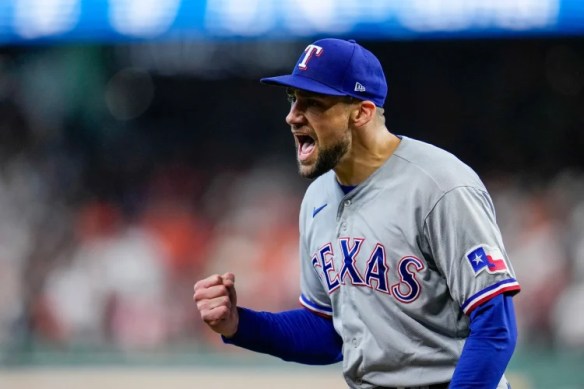
Nathan Eovaldi, after wresting the Rangers out of a bases-loaded jam in ALCS Game Two. It helped the Rangers go up 2-0 despite Houston bombardier Yordan Álvarez’s two-homer day.

The War for Texas is two games in. The Rangers have won them both, in Houston. Despite being bent a lot more in American League Championship Series Game Two than they were in Game One.

That’s what a four-run first, an arduous wriggle out of a bases-loaded/nobody out fifth-inning jam, and a gutsy four-out save does for you. Even on a day when Yordan Álvarez recovers from an apparent virus and a three-strikeout Game One to hit two bombs.

Álvarez turned out trying to play Game One through an ailment that left him unable to hold food down or avoid headaches, not to mention unable to sleep very much. When it came time for Game Two, Álvarez still knew something his team didn’t until game time: he was going to play Monday no matter what, and nothing short of house arrest would stop him.

And if only the Rangers hadn’t jumped all over Astros starting pitcher Framber Valdez in a four-run first inning, Álvarez’s two-homer Game Two might, maybe, have become something beyond just another tale he can tell his eventual grandchildren.

But it still took a large effort by the Rangers to keep the Astros from overthrowing them and sweeping the first Houston leg of this ALCS. Large enough to prove that you can bend but not quite break these Rangers, who held on tight to win Game Two, 5-4.

It took ten pitches and a throwing error from Valdez to put the Rangers up 4-0 before the game’s first out was recorded. With Nathan Eovaldi starting for the Rangers, Ranger fans could have been forgiven if they thought the rest of the game might, maybe, be something of a leisurely game.

Marcus Semien and Corey Seager opened by hitting the first pitch of each plate appearance for back-to-back singles, Seager’s a shuttlecock that landed before Astros third baseman Alex Bregman running out could reach it. Then it took Valdez pouncing upon Robbie Grossman’s dead-fish tapper back but bobbling it a moment before throwing wild past first, allowing Semien to score and leaving second and third.

Then came Adolis García lining a single the other way to right to score Seager, and Mitch Garver pulling a line single to left to score Grossman. Finally, Valdez nailed an out striking Josh Heim out swinging on three pitches, but Nathaniel Lowe replied almost immediately to follow by sneaking a base hit through the left side of the infield to score García.

That wasn’t exactly in the Astros’ game plan. Valdez finally struck Josh Jung out and got a fly out by Leody Taveras to end the inning. It made Álvarez’s first homer, a yanking drive into the second deck behind right field in the bottom of the second, a crowd pleaser but a mere interruption. Eovaldi went from there to sandwich a strikeout between two ground outs to third, the first of which took a grand throw by Jung from the foul side behind third base to get Chas McCormick by a step.

Nor was it in the Astro plan for Valdez to last only two and a third innings, after Heim led off the top of the third with a blast into the Crawford Boxes for the fifth Rangers run.

“I thought the quality of my pitches were good,” the righthander said through his interpreter postgame. “I think they were good and they maybe got a little bit lucky. There were a couple of balls that they didn’t hit well that fell for base hits a couple times. I tried going as far as I could.”

Valdez has a few more things to learn about luck. These Rangers prefer to make their own luck. They might attack with aplomb at the plate but they’re going to turn your mistakes into disaster, too. You’d better not call them lucky, either, when you’re the poor soul who mishandled and then threw away a potential double play grounder that might have kept the Rangers’ first-inning damage down to a small dent.

Bregman nudged the Astros a little closer back with a leadoff bomb ringing the foul pole in the fourth. Then Eovaldi had to shove his way out of a no-out, bases-loaded jam in the fifth by striking pinch-hitter Yainer Díaz and José Altuve out back-to-back before Bregman beat one into the ground toward third—where Jung, whose over-run of Jeremy Peña’s bouncer loaded the pads in the first place, threw him out at first by three steps.

Michael Brantley pulled the Astros back to within a pair with a sixth-inning RBI double. Josh Sborz relieved Eovaldi for the seventh and got the side in order, including a called third strike on Altuve to end it. Aroldis Chapman went out to pitch the eighth and, after a Bregman fly out to center and a Tucker ground out to second, the first pitch he threw Álvarez would be his last of the day, Álvarez lining it hard and fast into the lower right field seats.

“You can never count us out,” McCormick said of his Astros post-game. “We don’t ever quit.” That was true enough to compel Rangers manager Bruce Bochy to get Chapman out of there after Alvarez’s second launch and ask Jose Leclerc for a four-out save.

Leclerc shook off back-to-back walks to get McCormick to force José Abreu at third for the side, then dispatched the Astros in order in the ninth—the hard way. Peña’s deep fly to right collapsed into an out at the track. Díaz’s grounder toward third was stopped by Jung on the slide before Jung threw him out. Altuve’s fly to center was only deep enough to land in Taveras’s glove for the side and the game.

“We’ve had some chances to win some games,” said McCormick, painfully aware the Astros had several grand Game Two chances laid waste. “Usually we do come through with some big hits. We did earlier in the year and, this time around, we haven’t come up with that big hit.”

Indeed. The Astros have been 1-for-9 with men in scoring position all ALCS so far. And, out of their 24 postseason runs thus far this time around, Álvarez is responsible for eighteen of them, either scoring them or sending them home. But even he can’t thwart the Rangers by himself. Not the way these Rangers do things. Not when they can make a two-homer game by him a sidebar.

“We’re jumping on teams early,” Jung said postgame, “and that helps us settle in. Our pitching has been outstanding. You can’t ask for anything more than what they’ve given us.”

Eovaldi has the knack of transforming from a solid regular-season pitcher to a Hall of Fame-level pitcher in the postseason. Even if he wasn’t quite at his pure best in Game Two, he still had enough to keep the Rangers well ahead of the game by the time his outing ended. He now has a 2.87 ERA and a 2.60 fielding-independent pitching rate in nine career postseason series.

“Something just clicks for him,” his catcher Heim said postgame. “I’m not sure. Same preparation. Same mentality that he has had all year. Just something about big games that he loves.”

It may yet prove to be something Ranger fans will love for eternity and beyond. The Rangers are halfway to the World Series, still unbeaten this postseason, and going home to their own inviting playpen in Arlington. They were far better at home than on the road in the regular season—but now they’ve won seven straight postseason contests with six coming on the road.

“We’ll get ’em in Texas,” Astros manager Dusty Baker vowed after Game Two. Ahem. You weren’t exactly out of Texas in Games One and Two, sir. You’ve been gotten in Texas so far.

The All-Scar Game

Austin Riley, Pete Alonso

Austin Riley’s (Braves, left) kneeling throw to kneeling scooper Pete Alonso (Mets, right) ended the bottom of the All-Star Game eighth with a double play . . . (MLB.com photo) . . .

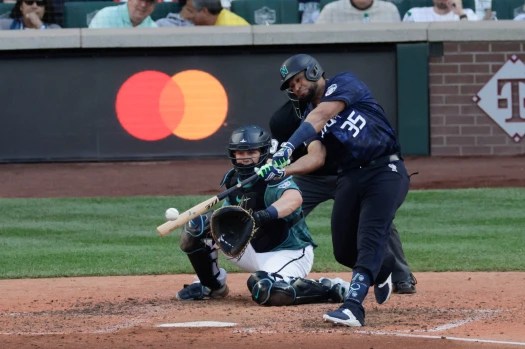
The best thing about Tuesday night’s All-Star Game? Easy. That snappy eighth inning-ending double play into which Athletics outfielder Brent Rooker hit. He shot one up the third base line to Braves third baseman Austin Riley, who picked and threw on one knee across to Mets first baseman Pete Alonso, who scooped on one knee to nail two outs for the price of one, doubling Blue Jays second baseman Whit Merrifield up.

That play preserved what proved the National League’s 3-2 win over the American League in Seattle’s T-Mobile Park. They got the second and third runs in the top of that eighth, when Elias Díaz (Rockies) pinch hit for Jorge Soler (Marlins) with Nick Castellanos (Phillies) aboard after a nine-pitch leadoff walk and nobody out. Díaz sent Orioles righthander Félix Bautista’s 2-2 splitter off a bullpen sidewall, then off an overhang into the left field seats.

It meant the first NL All-Star win since 2012. It also meant Díaz becoming the Rockies’s first-ever All-Star Game Most Valuable Player award winner. Otherwise? It meant almost nothing. Because the worst thing about this year’s All-Scar Game was . . . just about everything else.

Mr. Blackwell, call your office. All-Star Game specific threads have been part of it for long enough. They began ugly and devolved to further states of revulsivity. But Tuesday night took the Ignoble Prize for Extinguished Haberdashery. The only uniforms uglier than this year’s All-Star silks are those hideous City Connect uniforms worn now and then during regular season games. Both should be done away with. Post haste. Let the All-Stars wear their regular team uniforms once again.

Who are those guys? They sort of anticipated long ovations for the hometown Mariners’ All-Star representatives. But they didn’t anticipate they’d be longer than usual. To the point where two Rays All-Stars—shortstop Wander Franco, pitcher Shane McLanahan—weren’t even introduced, when they poured in from center field among all other All-Stars. (Rays third baseman Yandy Díaz, an All-Star starter, did get introduced properly. But still.)

Maybe the two Rays jumped the gun trotting in while the ovation continued, but they should have been announced regardless.

While I’m at it, what was with that nonsense about bringing the All-Stars in from center field instead of having them come out of the dugouts to line up on the opposite base lines? Some traditions do deserve preservation. Not all, but some. What’s next—running the World Series combatants’ members in from the bullpens? (Oops! Don’t give the bastards any more bright ideas!)

Down with the mikes! In-game miking of players has always been ridiculous. But on Tuesday night it went from ridiculous to revolting. When Rangers pitcher Nathan Eovaldi took the mound miked up, the poor guy got into trouble on the mound almost at once. He had to pitch his way out of a two-on, one-out jam in the second inning. He sounded about as thrilled to talk while working his escape act as a schoolboy ordered to explain why he put a girl’s phone number on the boys’ room wall.

What’s the meaning of this? We’ve got regular-season interleague play all year long now. The National League All-Stars broke a ten-season losing streak? Forgive me if hold my applause. So long as the entire season is full of interleague play, the All-Star Game means nothing. Wasn’t it bad enough during those years when the outcome of the All-Star Game determined home field advantage for the World Series?

The road to making the All-Star Game mean something once more is eliminating regular-season interleague play altogether.

Elias Díaz

. . . saving the lead (and, ultimately, the game) Elias Díaz gave the NL with his two-run homer in the top of the eighth. (And, yes, the All-Star uniforms get uglier every year. Enough!) (AP Photo.)

Tamper bay. Sure it was cute to hear the T-Mobile Park crowd chanting for Angels unicorn star Shohei Ohtani to come to Seattle as a free agent. The problem is, he isn’t a free agent yet. He still has a second half to play for the Angels. I’ll guarantee you that if any team decided to break into a “Come to us!” chant toward Ohtani, they’d be hauled before baseball’s government and disciplined for tampering.

I get practically every fan base in baseball wanting Ohtani in their teams’ fatigues starting next year. If they don’t, they should be questioned by grand juries. But they really should have held their tongues on that one no matter how deeply you think the All-Scar Game has been reduced to farce. Lucky for them the commissioner can’t fine the Mariners for their fans’ tamper chants. (Not unless someone can prove the Mariners put their fans up to it, anyway.)

Crash cart alert. Cardiac Craig Kimbrel (Phillies) was sent out to pitch the ninth. With a one-run lead. The National League should have put the crash carts on double red alert, entrusting a one-run lead to the guy whose six 2018 postseason saves with a 5.90 ERA/6.74 fielding-independent pitching still felt like defeats. The guy who has a lifetime 4.13 ERA/4.84 FIP in postseason play.

Kimbrel got the first two outs (a fly to right, a strikeout), then issued back-to-back walks (six and seven pitches off an even count and a 1-2 count, respectively) before he finally struck Jose Ramirez (Guardians) out—after opening 0-2 but lapsing to 2-2—to end the game. Making the ninth that kind of interesting should not be what the Phillies have to look forward to if they reach the coming postseason.

Sales pitch. How bad is the sorry state of the Athletics and their ten-thumbed owner John Fisher’s shameless moves while trying and failing to extort Oakland but discovering Nevada politicians have cactus juice for brains? It’s this bad—when the T-Mobile crowd wasn’t chanting for Ohtani to cast his free agency eyes upon Seattle, they were chanting “Sell the team!” when Rooker whacked a ground rule double in the fifth.

Can you think of any other All-Star ballpark crowd chanting against another team’s owner in the past? Not even George Steinbrenner’s worst 1980-91 antics inspired that. That’s more on Fisher, of course, but it’s still sad to think that a team reduced to cinder and ashes with malice aforethought captured an All-Star Game crowd’s attention almost equal to the attention they might have paid the game itself.

Starters-as-relievers postseason? As new as Lysol.

Walter Johnson

Hall of Famer Walter Johnson—a starter used in relief to help win the 1924 World Series.

Baseball’s capacity to amuse is almost as profound as the game’s ability to inspire. It’s amusing to see the gnashing of teeth and the wringing of hands over this postseason’s phalanx of starting pitchers who had to yield to their bullpens for assorted reasons. You’d almost think someone was trying to legislate the pitching star out of baseball.

If someone is, they simply weren’t watching the games or hearing the crowds. They also have a rather troublesome ignorance of baseball history. And maybe, too, a continuing bias against relief pitching.

Sure, we love to see and remember the greatest starters of our times. I grew up watching the Hall of Fame like of Jim Bunning, Steve Carlton, Don Drysdale, Whitey Ford, Bob Gibson, Catfish Hunter, Sandy Koufax, Juan Marichal, Jim Palmer, Tom Seaver.

But I also remember seeing and feeling the thrills and kicks when the bullpen like of Dick Radatz came into a game. Hell, Radatz was practically the only reason to bother with the 1963-65 Red Sox. He was big, beefy, intimidating-looking (not for nothing was his nickname The Monster), and looked as though he was about to eat the opposing hitters for lunch.

Until his shoulder deserted him (overwork, plus [speculated] taking someone’s advice trying to add a slider to his howitzer fastballs) some time in 1965, Radatz was as big a pitching star as any starting virtuoso. Even if he did come in for the ninth of the 1964 All-Star Game and surrender a walkoff bomb to then-Phillies star Johnny Callison.

There were more relief aces than you might remember in Radatz’s time. Ted Abernathy, for a few seasons, anyway. Lindy McDaniel. Elroy Face. Eddie Fisher. Stu Miller. Ron Perranoski. Pedro Ramos, at least for the final weeks of that staggering Yankee stretch drive to snatch the 1964 American League pennant. Phil (The Vulture) Regan. Larry Sherry (the 1959 World Series MVP). Hoyt Wilhelm (the first Hall of Fame relief pitcher). Al Worthington.

You might care to note that, whether you’re paying attention now or paid attention then, four of those relievers had top-five Most Valuable Player finishes: McDaniel (1960) and Radatz (1963) each had a fifth-place finish; Perranoski (1964) and Fisher (1965) each had a fourth-place finish.

Think about that for a moment: In four of those seasons there were MVP voters who thought a quartet of relief pitchers might have been among the most valuable players in baseball. Now, those voters then considered won-lost records; those guys were credited with double-digit wins, and a few of them probably got their wins after blowing leads but hanging in while their teams managed to eke or bang out the wins late.

(Face, of course, was an 18-game “winner” in 1959, still a record for relief pitchers, never mind that he also had nineteen save opportunities—applied retroactively—and blew nine of those. In fact, according to Cooperstown Cred, one of the major reasons Chicago Tribune scribe Jerome Holtzman came up with the dubious “save” stat was his feeling that Face’s won-lost record actually over-stated his real value.)

But still.

Were you really watching when AJ Minter and Tyler Matzek clamped the vault door shut on the Dodgers in Game Six of the National League Championship Series? The noise in Truist Park when that pair threw four scoreless relief innings, helping the Braves punch their tickets to the World Series, could have drowned a heavy metal concert out.

Especially when Matzek walked right into a small fire his immediate predecessor Luke Jackson left behind. With eight pitches, Jackson surrendered a leadoff double, a walk, and an RBI double setting up second and third. With eight more pitches, Matzek struck out the side—including future Hall of Famer Albert Pujols and fellow former MVP Mookie Betts.

When Matzek got the Mookie Monster swinging to finish that escape act—if you can go from crossing the high wire to breaking your way out of the chains in the tank in one inning, Matzek did—the Truist crowd went from nuclear to Crab Nebula.

There’s been no better moment of absolute pressure relief pitching than that in this postseason. So far. Who knows what the World Series will bring, above and beyond Yordan and Eddie Tonight? Whatever it brings, come on, baby, don’t fear the reliever. (Unless you have to hit against him.) Or, for that matter, the starter-as-reliever.

You say the starter-as-reliever is just another nefarious creation of today that’s ruining pitchers and pitching? It didn’t exactly come up roses for Max Scherzer this time, of course. But it hasn’t crossed a lot of minds, either, that maybe a 37-year-old man who threw a heavier workload in September than he had any month all season might have been bound for a dead arm by the time he had to say no to starting NLCS Game Six.

But it wasn’t exactly a new thing, either. Not. even. close.

Go back to the 1924 World Series, Game Seven, for openers. When Washington Senators manager Bucky Harris not only delivered what we call a bullpen game to win that Series but secured the Old Nats’ shot at it by bringing (and the crowd went wild, too) Hall of Fame starting pitcher Walter Johnson in from the bullpen for what proved four innings’ shutout relief.

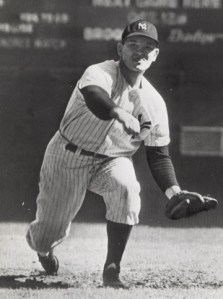
When Casey Stengel managed the Yankees, his five straight pennants and World Series rings out of the chute came in no small measure because he was audacious enough to use a starter in relief. You may have heard of him: Allie Reynolds.

The Ol’ Perfesser used Reynolds as both a starter and reliever in several of those World Series. (Including in the ninth of Game Four, 1950 Series, when Stengel brought him in to get the final out of the Yankee sweep—after rookie Ford allowed the potential tying run to reach.)

Allie Reynolds

Allie Reynolds—Casey Stengel loved using his terrific starter in relief when it mattered most. Especially in a few World Series.

Reynolds also spent 1951 throwing two no-hitters and making six relief appearances on the regular season. Pay careful attention now: Reynolds, his Hall of Fame catcher Yogi Berra, and St. Louis Browns starter Ned Garver—credited with 20 wins for the hapless Brownies—tied for the most first-place votes in that year’s American League Most Valuable Player Award voting. (Yogi won the award by way of his superiority in the secondary votes.)

And, even with the stat applied retroactively, Allie Reynolds—who started 71 percent of his games and relieved in 29 percent of them—is tied for the third-most relief saves in World Series history, behind The Mariano and Hall of Famer Rollie Fingers.

Starters as relievers? Unprecedented and the End of the Grand Old Game As We Knew It? Please.

Smokey Joe Wood, 1912 World Series Game Eight. (Two scoreless after coming in in the eight; surrendered the tying run, bailed out by “Snodgrass’s Muff” in the tenth inning.) Hall of Famer Grover Cleveland Alexander, Game Seven 1926 Series. (The fabled bases-loaded, inning-ending strikeout of Hall of Famer Tony Lazzeri.)

Hank Borowy, 1945 Series. (Four scoreless relief innings, Game Six.) Harry Brecheen, 1946 Series. (Credited with his third win of the set in Game Seven—in relief.) Bob Turley. (Won the ’58 Series MVP winning one start and making two relief appearances including the Game Seven-winning seven-inning gig.)

Hall of Famer Bert Blyleven, Game Five 1979 Series. (Four innings shutout relief in a Pirate must-win.) Four Royals starters in relief in the 1985 World Series. Sid Fernandez, Game Seven, 1986 World Series. (Four strikeouts in two and a third’s shutdown relief enabling room for a Mets comeback win.)

Orel Hershiser, 1988 NLCS. (A save in Game Four.) Hall of Famer Randy Johnson, Game Seven 2001 Series. (An inning and a third shutout relief preceding Luis Gonzalez walking it off for the winning Diamondbacks.)

Madison Bumgarner

Starter-as-reliever: MadBum, Game Seven, 2014 World Series.

Madison Bumgarner, Game Seven 2014 Series. (Five scoreless in relief for the Giants’ third Series rings in five years.) Charlie Morton and Clayton Kershaw, Game Seven 2017 Series.

Nathan Eovaldi, 2018 Series. (The Game Three extras, six virtuoso before Max Muncy ended it with an eighteenth-inning home run.) Chris Sale, 2018 Series. (The final three Game Five outs for the Red Sox triumph.) Stephen Strasburg, 2019 NL wild card game. (Three scoreless in relief.) Max the Knife, Game Five, this year’s NLDS.

The only reason any of those ballpark crowds wouldn’t have gone nuts was because the deeds were done by the visiting pitchers. (Game Five, this year’s NLDS between the age-old-rival Dodgers and Giants in San Francisco, a notable exception.)

And if starters-as-relievers looks like a more contemporary phenomenon, it may well be because they’ve played more postseason games as the years went passing by.

Well, it was amusing to see the teeth gnashing and hand wringing over the starters-as-relievers this time around—for a little while. The problem is that it comes from lack of self-informing, willfully or otherwise. It’s not funny anymore to see some stubborn “purist” or “traditionalist”—in the stands, in front of television, or in the press—blow his or her gasket first and do their homework later.