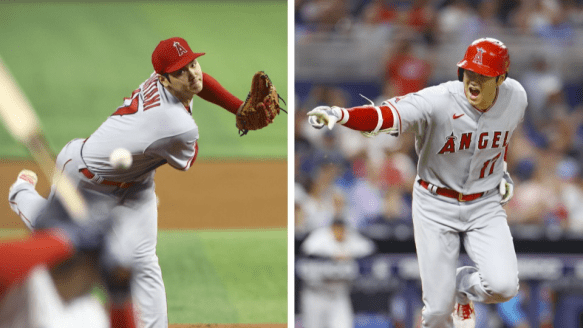
It’s the same sad song . . .

Mike Trout

Another season, another unwanted injury for a star-crossed star.

Once upon a time, when cooler heads actually found a hearing in the Angels’ front office, the idea was floated to talk Mike Trout into moving out of center field and into one of the less demanding outfield positions. Maybe even moving him toward designated hitting for the majority of his time in due course, went a reasonable concurrent thought.

With Trout then coming away from some injury-disrupted seasons, they talked about it during the owners’ lockout of 2021-22. They planned to talk to Trout about it when the lockout ended. They didn’t bank on then-manager Joe Maddon blabbing about it to reporters before they had the chance to present it to Trout.

Idea killed before it could spend its first hour out of its crib. Maddon’s execution orders may have been written right there, awaiting only one false move on the season to stamp them irrevocably.

The guillotine blade dropped after those 2022 Angels went from a deceptive 27-17 start to a twelve-game losing streak. And, after Maddon ordered an intentional walk to the Rangers’ Corey Seager with the bases loaded and the Angels down. Just as inexplicably, the Angels overthrew a wider deficit to win that game at the witching hour. It wasn’t enough to save Maddon’s rep or his kishkes.

But the busted Trout plan probably did make it a matter of when and not if the Angels would purge Maddon. The plan might also have kept Trout from inflicting any further great risk upon a body that simply refuses to cooperate with its owner’s iron will.

We may never know whether a leftfielder named Mike Trout or a right fielder named Mike Trout would have managed to avoid some of what bedeviled him from that point forward. 2022: Five weeks on the injured list with a back issue that might yet bear the potential of putting paid to his career. Last season: Hamate bone fracture in July, one game in August, season lost otherwise.

Now we have a spectre that’s only too familiar to baseball world as a whole and Angel fans in particular: Trout on the injured list, about to undergo surgery for a torn meniscus in his knee. Expected to be out anywhere from eight to twelve weeks. Exactly what triggered the tear isn’t quite known, but we do know that Trout felt it go while walking back to the Angels’ dugout.

Even though he said, “It’s just frustrating. But we’ll get through it,” we can’t really know the precise thoughts and feeling that poured into his heart and mind when he noticed the tear and resigned himself to yet another injured list term. If he’s telling himself, “This is getting to be more ridiculous than a contemporary presidential campaign,” there isn’t a jury on earth that would convict him of warped thinking.

Until that injury, Trout spent the season’s first month doing whatever he could to prove he still had what made him both the single most outstanding player of the 2010s and, concurrently, the number five all-around center fielder who ever played the game.

His hitting average was an anemic .220 and pulled his lifetime number down to .299, but even at this writing he leads the Show with ten home runs, while exactly half his 24 hits have been for extra bases. He’s even stolen six bases, something he’d said he wanted to return to doing after letting that side of his run-making game expire after 2019.

According to my Real Batting Average metric (total bases + walks + intentional walks + sacrifice flies + hit by pitches), Trout was actually batting .611 before his knee said not-so-fast. Little by little, piece by piece, he put himself back together into a semblance of his 2010s self when disaster decided it was time to speak up. Again.

For his first eight full seasons, Trout’s ability to post wasn’t even a topic. He’d averaged 145 games a year over the eight, and he did things the best players do in their fantasies. After the pan-damn-ically short 2020, his body became an orthopedic experiment. And all he’d ever done wrong was play the game firmly.

He’s also been loyal to a fault to an organisation administered like the Mad Hatter’s tea party, overseen and often overlorded by an owner whose fortune came from marketing but who hasn’t yet figured truly that marketing doesn’t build winning baseball teams.

The Angels had two generational talents, Trout and Shohei Ohtani. The latter took the first available hike as a free agent. The former insists he wants to be around when the Angels return to a winning culture and even a postseason or two. But the Angels’ administration still hasn’t figured out how to restore that culture. And, may not for the rest of Trout’s career—however long his body allows him to have one.

Trout could retire this instant and his Hall of Fame plaque would be prepared for his first-ballot election. That might still outrage fans who still cling to the idiocy that injuries are signs of moral turpitude and character weakness. Those fans should be dismissed.

“It’s not as though he has a singular chronic issue,” writes The Athletic‘s Sam Blum. “They’re all independent of each other, and seemingly haven’t impacted him beyond the duration of their individual recoveries. But they add up to the same problem: an all-time legend who can now no longer stay on the field.”

Trout is still good enough that, as FiveThirtyEight says, “the cost to the Angels of losing him for only a couple of months would be on par with season-ending injuries suffered by other star players.” Indeed.

Almost promptly, the Angels signed veteran Kevin Pillar as a fourth outfielder. Once a good center field defender, he’d be behind Mickey Moniak now despite Moniak’s modest bat. Pillar cleared waivers after the White Sox designated him for assignment. He’s considered good in the clubhouse and has a relationship with Angels manager Ron Washington from Atlanta, where Pillar played last year while Washington was the Braves’ third base coach.

Pillar will cost the Angels nothing more than a prorated major league minimum salary. That’s the least of their losses. Losing Trout—again—costs them something no dollars can replace. But imagine what it’s costing Trout in his mind and heart. Again.

Even Trout has his limits

Image

Mike Trout

The greatest position player in Angels history may yet become fed up with the Angels’ lack of loyalty in return for his.

When Shohei Ohtani signed with the Dodgers in December, the nearly-universal observation—by those not wanting to trash his merch in protest—was remembering he was well on record as saying he wanted to win above and beyond his own performance papers. At least two trade deadlines featured thoughts about the return the Angels could have hauled in in a deal for him.

Then they let Ohtani walk as a free agent, knowing his would be one of the most high-ticket free agencies in baseball history. While he begins life as a Dodger, the eyes of those who still care about the Angels turn to the other big ticket in their fatigues, a guy who sacrificed his free agency-to-be in return for staying with the team that unearthed, nurtured, and let him shine, while building nothing truly serious around him.

He’ll never put it into just these words, but even Mike Trout has his limits. And he’s no longer just the child prodigy who delivered more prodigiously than any other player during his time. Now, he’s man of the house. But his team doesn’t behave that way.

The man Baseball Reference holds as the number five all-around center fielder ever to play the game doesn’t need any more accolades. The 32-year-old from New Jersey who leads all active players at this writing with a .997 OPS and a 173 OPS+ has already punched his ticket to the Hall of Fame several times over.* If and when the Angels elect to retire number 27, it’ll be for Trout and not for Hall of Famer Vladimir Guerrero, Sr.

It’s one thing for Trout to smile upon the Angels giving their too-often-suspect bullpen a big overhaul this offseason. But with significant free agents still unemployed as spring training is in full operation, Trout is no longer shy about saying what, oh, every last Angels observer thinks and he in his heart of hearts knows.

“I was in contact with both of them, just pushing, pushing, pushing,” Trout said before the team began its first full-squad workouts this week, “them” being owner Arte Moreno and president John Carpino.

There’s still some guys out there that can make this team a lot better. I’m going to keep pushing as long as I can. Until the season starts or until those guys sign. It’s just in my nature. I’m doing everything I can possible. It’s obviously Arte’s decision. I’m going to put my two cents in there.

And, while he reiterated his intent to remain an Angel for life, something the glandular contract extension he signed in 2019 made clear enough, even he would be amendable to a trade in the near future if things come to that. The same trade deadlines that pounded with thoughts of the return haul for Ohtani pounded likewise for Trout, even during the seasons when injuries kept him off the field for long, long periods.

“I think the easy way out is to ask for a trade,” he added. “Maybe down the road, if some things change.” Meaning, probably, that he still sees the Angels’ administration trying for real, but if he senses they quit trying even his loyalty isn’t going to hold for very much longer.

Praising Moreno’s willingness to spend up to certain points is one thing. So is praising general manager Perry Minaisian for the bullpen overhaul. But the Angels haven’t yet overhauled their starting rotation or the lineup around Trout. Asking them for the same commitment to actually winning, overall, that Trout’s made, is something else entirely.

“[W]hen I signed that contract, I’m loyal. I want to win a championship here,” Trout insisted. “The overall picture of winning a championship or getting to the playoffs here is bigger satisfaction [than] bailing out and just taking an easy way out. So, I think that’s been my mindset. Maybe down the road if something’s changed, but that’s been my mindset ever since the trade speculations came up.”

Moreno—the man who made his fortune in marketing, the man who still seems to think more like a marketer than a baseball man when he does move toward big or semi-big signings—isn’t making it easier for Trout. “I’m not going to spend money just to show that we’re going to spend money,” he told an interviewer, “unless it’s going to substantially change the team.”

Trout’s told at least one reporter and possibly more that, if that was exactly what Moreno told him directly, it didn’t exactly mean he was going to hit what free agency market remains now. “It’s, uh, yeah, no, you know how Arte is,” he said. Some said he laughed a bit. If only it was really funny.

Ordinarily, when an eleven-time All-Star talks, his team listens. Trout may well be perfectly content still to be where he is, but even he has his limits. Until now, he’d never hinted that greatly about those. But they’re there. For the moment, Trout wants to play a full season unimpeded by yet another injury in the line of duty.

Loyalty is supposed to be a two-way street, right? For Trout, as for Ohtani, loyalty in return means building a viably contending team around them with brains more than the kind of impulsiveness that saw the Angels plunge all-in last July . . . only to have it blow up in their faces (an 8-19 August) and into waiving five players—including two they acquired at that trade deadline—when September arrived.

Ohtani was lucky the Dodgers had a readymade contender awaiting him. He’s lucky that his new team has won ten of the past eleven National League West titles and gone to eleven straight postseasons. He’s lucky that, barring unexpected catastrophe, the Dodgers are liable to reach to the postseason to come at minimum. That’s a guarantee the Angels haven’t been able to hand Trout.

They can’t just put nine prime Mike Trouts into their starting lineup. They can barely build something to sustain the one Mike Trout they’ve been blessed to have. “I’m going out there and play my game,” that one Mike Trout said. “I got to put a full season together and see what happens.”

Uninjured, he may yet have another couple of seasons of the kind of play that punched his Cooperstown ticket in the first place. Whether it means anything above and beyond his place in baseball history isn’t up to him, and never has been.

———————————————————————-

* For those who gaze upon wins above replacement (WAR) without seeing it the be-all/end-all of a player’s value, but still an extremely valuable way to measure him, be advised at this writing of this: Trout’s 65.1 peak WAR and 85.2 career WAR are, respectively, 20.4 and 13.6 above the average Hall of Fame center fielder.

And, despite his recent injury history, Trout still holds the number one slots among active players for: offensive winning percentage, adjusted batting runs and wins, situational wins added, and power-speed number. He also enters this season with a lifetime .301/.412/.582 slash line.

For perspective, the last two entries on the lifetime slash are higher than those for Hall of Famers Willie Mays and Henry Aaron, and his lifetime .301 “batting average” thus far is one point below Mays.

For further perspective, according to my Real Batting Average (RBA) metric, this is how Mike Trout would look among Hall of Fame center fielders who played all or most of their careers in the post-WWII/post-integration/night-ball era, if he were to retire this instant and await his call to Cooperstown. (One more time: RBA = total bases + walks + intentional walks + sacrifice flies + hit by pitches, divided by total plate appearances.)

Center Field PA TB BB IBB SF HBP RBA
Mike Trout 6521 3142 964 119 55 99 .672
Mickey Mantle 9907 4511 1733 148 47 13 .651
Willie Mays 12496 6066 1464 214 91 44 .631
Ken Griffey, Jr. 11304 5271 1312 246 102 81 .620
Duke Snider 8237 3865 971 154 54** 21 .615
Larry Doby 6299 2621 871 60 39** 38 .576
Andre Dawson 10769 4787 589 143 118 111 .534
Kirby Puckett 7831 3453 450 85 58 56 .524
Richie Ashburn 9736 3196 1198 40 30** 43 .463
HOF AVG .587

** Sacrifice flies weren’t official until 1954. Doby and Snider played a third or more of their careers before the rule. How to overcome that hole? I found one way a few years ago: take their recorded sac flies, divide them by their total MLB seasons under the rule, then take that result and multiply it by their full number of MLB seasons.

The formula, for you math nerds: SF / SFS x YRS (years). Thus a reasonable if not perfect number of sac flies you could have expected them to hit for their entire careers.

The Shoh is on hiatus

Shohei Ohtani, Mike Trout

Ohtani (left) is done for the season, an oblique injury added to his elbow’s now-reinforced UCL tear. He can walk in free agency, but Trout (right) may be entertaining trade thoughts a lot more deeply now . . .

George F. Will once wrote (in Men at Work: The Craft of Baseball) that A. Bartlett Giamatti was to baseball’s commissionership what Sandy Koufax was to the pitcher’s mound, having “the greatest ratio of excellence to longevity.” The Athletic‘s Marc Carig wrote last Satuday of Shohei Ohtani, “singular excellence is no match for collective mediocrity.”

Last Friday, Ohtani’s Angel Stadium locker was empty, and a large duffel containing his equipment and other belongings sat in front of it, after he was placed in the injured list at last—with an oblique strain. “No ceremonial sendoff,” Carig wrote. “No expressions of gratitude. Just a tender oblique and a good old-fashioned Gen Z ghosting. How appropriate. Now the credits roll on a baseball travesty.”

Ohtani has also undergone surgery on his pitching elbow at last. His surgeon, Dr. Neal ElAttrache, the same surgeon who performed Ohtani’s prior Tommy John surgery—called the new procedure “reinforcement” of the torn ulnar collateral ligament, not full Tommy John surgery. It means Ohtani won’t pitch again until 2025, but he will suit up as a DH in 2024. For whom, only time and the off-season free agency market to be will tell.

“Thank you very much for everyone’s prayers and kind words,” Ohtani said on Instagram following the Tuesday procedure. “It was very unfortunate that I couldn’t finish out the year on the field, but I will be rooting on the boys until the end. I will work as hard as I can and do my best to come back on the diamond stronger than ever.”

Note that he didn’t say for whom he expects to come back after signing a new deal this winter.

A baseball travesty? The Angels had the two greatest players of their time together in their fatigues for six years, and they couldn’t support the two with a competent, competitive supporting cast who could pick it up when one or both was injured. It was as if the 1962-66 Dodgers had swapped in the ’62-’66 Mets for everyone except Hall of Famers Koufax and Don Drysdale.

Carig called it “sabotage.” You could think of far worse applications. “They did this through general mismanagement and their own brand of incompetence,” Carig continued. “Those sins endured despite their churn of managers and front-office regimes, only further reinforcing that the full credit for this failure falls at the feet of the constant throughout it all: the owner, Arte Moreno.”

It may be wasting breath and writing space to recycle that Moreno brought a marketer’s mentality to a baseball team, aiming once and forever at what George Steinbrenner used to call “name guys who put fannies in the seats,” without stopping first to ponder whether they’d equal a cohering team on the field and at the plate and whether his true baseball people had other such cohering parts in mind. And, whether it was always good for a player’s health.

Baseball people who did stop to ponder such things didn’t last long under Moreno’s command. Whether by way of the owner’s caprices or by way of their own mistakes turned into impossible-to-ignore disaster, Moreno’s Angels have been the Steinbrenner Yankees of the 1980s as you might have imagined them if The Boss hadn’t been so shamelessly public a nuisance.

Think about this: It took an oblique strain almost four weeks later for the Angels to do what should have been done when Ohtani’s ulnar collateral ligmanent tear took him off the mound but not out of the batter’s box. The adults in the room should have overruled Ohtani’s understandable desire to continue at least with his formidable bat, disabled him entirely, and placed his health at top priority.

You can only imagine the look when last Friday came with Ohtani’s packed duffel in front of his locker. Don’t be shocked at it. If he can’t play the rest of the season, he can come to the park in moral support without having to unpack it or bring it from home.

Someone had to find the adults in the Angel room in the first place. Apparently, there were none to be found. Whether draining the farm at the trade deadline for one more run at it that proved impossible, whether turning right around and waiving most of what they drained the farm for, whether managing the health of their two supermarquee presences, the Angels room remains bereft of adults.

Oft-injured third baseman Anthony Rendon, who’s had little but injury trouble since signing big with the Angels as a free agent, developed a habit of discussing his injuries with a wary sarcasm, until he finally cut the crap and said the shin injury incurred on the Fourth of July wasn’t the mere bone bruise the Angels said it was but, rather, a full-on tibia fracture—and that he only learned it was a fracture in mid-August.

Now, Rendon was asked whether he was actually considering retirement from the game. “I’ve been contemplating it for the last ten years,” he said. If he actually does it, it would give the Angels something other teams would love but might raise fresh alarms in Anaheim: financial flexibility. Just what they need, more room for fannies-in-the-seats guys assembled with no more rhyme, reason, or reality.

Mike Trout, the player of the decade of the 2010s and still formidable when healthy, has been injury riddled the past few seasons. He may not be jeopardising his Hall of Fame resume, but something is badly amiss when he feels compelled to return perhaps a little sooner than he should return, then ends up back in injury drydock yet again after one game.

Once upon a time it was impossible to think of Trout anywhere but Anaheim. But trade speculation and fantasies around him have sprung up now more than in the recent past. Trout himself has dropped hints that he’s exhausted of the team doing either too little or not enough (take your pick) to build a genuinely, sustainingly competitive team around himself and Ohtani.

That’s not what he signed up for when he signed that blockbuster ten-year, $370 million plus extension a year ahead of what would have been his first free agency. That’s not what he signed up for when he showed the world he wasn’t that anxious then to leave the team on which he fashioned and burnished a jaw-dropping Hall of Fame case.

It was Trout, too, who welcomed Ohtani to the Angels with open arms and personal charm, then had to find too many ways to grin and bear it as the pair—when healthy—performed transcendence while surrounded by unimportance. If Trout now questions the Angels’ commitment to competitiveness and their regard for the health of those in their fatigues, pondering himself as well as Ohtani, only fools would blame him.

Most major league teams would kill to have even one such king of kings on their roster. Two of this year’s affirmed division winners (the Braves, the Dodgers) have at least one each. (Ronald Acuna, Jr., Braves; Mookie Betts, Dodgers.) The Angels had the two most singular such kings of kings and blew it higher and wider than the Hiroshima mushroom cloud.

“What remains stunning in all of this,” Carig wrote, “is the level of waste. The Angels have succeeded like nobody else in doing so little with so much.”

Sound organizations create a plan and then follow it. These Angels, not so much. A throughline can be drawn from Albert Pujols to Anthony Rendon, with Ohtani and Trout’s extension in between. What’s clear is that all of these big-ticket transactions weren’t part of some grand plan. Rather, they were the product of a billionaire collecting baubles, just faces to slap on a billboard.

Ohtani’s free agency is still liable to become a bidding war of stakes once thought unfathomable. With or without his recovery time limiting him to a DH role, Ohtani’s going to have suitors unwilling to surrender until he does. Which one will convince him they know what they’re doing to fashion truly competitive teams around him? We’ll know soon enough.

But considering that baseball medicine can still be tried by jury for malpractise, whomever plans to out-romance the Angels for Ohtani and seduce them into a deal for Trout had better come with adults in the room to manage them and their health prudently. There’s no point telling the billionaire with his baubles and billboards to grow up otherwise.

Moreno won’t trade Ohtani? Let it be on his head

Shohei Ohtani

Shohei Ohtani could bring back a trade deadline haul that might push the Angels (and their trading partner, depending) into the postseason at last. But it would serve their owner right for failing to deal him and then letting him walk as a free agent bringing back . . . nothing.

Unless there is something festering in the deep background that nobody can expose, I have a contrarian thought for everyone insisting Angels owner Arte Moreno absolutely must trade Shohei Ohtani. I ask only that you save your ammunition until you read whole.

If Moreno’s that insistent upon keeping Ohtani until that very day when he becomes a free agent for the first time after the season ends, let him.

If Moreno insists upon remaining the kind of owner whose sense of marketing is more acute to the tenth power than his sense of baseball and of his team’s true competitiveness, let him.

If Moreno is that bent upon receiving nothing in return for Ohtani by letting him walk this coming winter, rather than receive the kind of value whose terms his baseball people can all but dictate, considering the prize Ohtani is, let him.

It would serve him right, even if it might serve long-enough-suffering Angel fans not so right.

Remember, this is the owner who was “exploring options” to sell the Angels almost a year ago. When that news broke, the sigh of relief from Angel fans could be felt from the Newport Beach coast to the farthest-planted lighthouse in Maine.

Moreno even let it slip that he had a pair of offers that would have eclipsed what Steve Cohen paid to buy the Mets. The problem was, Moreno let that slip this past March, when he also announced he simply couldn’t bear to part with the Angels just yet. Not while there was (ahem) “unfinished business” to tend.

“[We] feel we can make a positive impact on the future of the team and the fan experience,” he said in a formal statement when announcing his sale plans were done for who knew how long. “This offseason we committed to a franchise record player payroll and still want to accomplish our goal of bringing a World Series championship back to our fans. We are excited about this next chapter of Angels baseball.”

As of this morning, the Angels had gone from a season-opening 18-14 to a dead-even 48-48. The last time they had a four-or-more-games-over-.500 standing was when they were nine games over following a two-out-of-three winning stand against the Royals in mid-June. They’ve been 7-15 since.

The culprits have been the usual ones for this team—inconsistent pitching by one and all not named Ohtani; inconsistent hitting by one and all not named Ohtani (or Mike Trout); and, a near-consistent parade of patients for the injured list. Somehow, the Angels are four and a half games back in the American League wild card race, and nine out of first in the AL West.

That’s close enough for a major trade deadline deal to maybe make a difference, for the wild card hunt if not the division hunt. Right now, the biggest deal of deadline season could be Ohtani for whatever prime enough talent he’ll bring back, even if the acquiring team knows he might be just a rental for the rest of the way. (Even if that means a division, a pennant, maybe even a World Series ring.)

For a contending team loaded in surplus, that rental could still mean a deep postseason dive. For the Angels, it might mean surviving into the postseason, even through the back door, but just enough to give Ohtani (and Trout) a taste of postseason action neither has been granted to see since Ohtani became an Angel in the first place.

No, Ohtani won’t return a whole qualified starting rotation, a whole bullpen full of more than bull, or an entire additional lineup of Ohtanis (or Trouts). But he would return pieces solid enough to keep the Angels in this race and maybe, just maybe, a race or two to come.

“Ohtani is a once in a lifetime player, and moving off of him is akin to trading Babe Ruth,” writes Deadspin‘s Sean Beckwith. “You hold onto that kind of talent for as long as possible, and hope for the best.” And that last part, Beckwith knows, is the most problematic part:

Considering “hoping for the best” is the Angels’ entire organizational strategy — it’s why they’re in this current predicament — they will inevitably be crippled by indecision, or disillusioned by the “LA” on the hat, and stand semi-firm that Ohtani will stand by them.

This is, of course, an asinine strategy, and antithetical to the thinking of front offices, and sports media. The pleas for trade destination slideshows are being heeded everywhere you click, and all the big market teams are tallying their assets to see how much they could offer in a trade, because [general manager Perry] Minasian said he’s not going to trade Ohtani if they’re still in contention.

The thing is, contention is subjective, and four-and-a-half games back of the final wild card spot is more than enough for the Angels to grasp onto the belief that Shohei Ohtani will stay regardless of no tangible reason to do so.

It’s more than enough, too, to prevent Moreno—an owner who thought (erroneously) that his life’s success in marketing qualified him as a baseball man, when it only meant he could put (the old George Steinbrenner creed) “name guys who put fannies in the seats” on the field first and worry about rhyme, reason, cohesion, and performance (an awful lot of which his own capriciousness obstructed) second—from doing the sensible thing. Or, from letting Minasian do the sensible thing.

So let him cling to Ohtani until the two-way unicorn’s Angels deal expires this winter. Let him get less than nothing in return for the unicorn if that’s the way he wants it. Ohtani has been at least as sensational a baseball talent as Mike Trout was before the injuries became a near-annual thing for him. He (and Trout) deserve better than to be kept prisoners to merely hoping for the best.

Let Moreno explain why clinging to his unicorn to the very last was more important than letting his unicorn bring back what just might have pushed the Angels into their first postseason since they were swept out of a division series by the Royals, in the first of Mike Trout’s three Most Valuable Player Award seasons. Nine years ago, if you’re scoring at home.

That explanation should prove the funniest and saddest monologue since the Marvelous Mrs. Maisel first wandered onto the stage of a fleabag nightclub to schpritz about her husband dumping her for his secretary. Mrs. Maisel got laughs and a brilliant career out of it. It would serve Moreno right to get nothing back for the unicorn to whom he sold an illusion.

Emphasis on “classic”

Shohei Ohtani

Baseball’s great unicorn struck baseball’s greatest all-around position player out to end the WBC in Japan’s favour. Who says baseball’s gods don’t know how to script classics anymore?

Well, now. Japan walked it off against Mexico, earning the chance to face the United States in Tuesday’s World Baseball Classic final, and those who hadn’t been driven away by the harrumphing over Edwin Diáz’s season-ending injury after closing out a win by Puerto Rico last week got the most dreamy of dream matches.

Teammates on the Los Angeles Angels, Mike Trout and Shohei Ohtani squared off in the WBC final. It was Japan’s third trip to that final dance and first since 2009. It was Trout’s first appearance in any kind of championship or championship-aiming game since his third full major league season.

The game’s greatest all-around position player, still, against its unicorn of a virtuoso two-way player. Anyone who says this was what Trout and Ohtani really signed up for when Ohtani joined the Angels and Trout extended with them is fooling him or herself. But it slammed an exclamation point down upon this WBC in ways that would have been ridiculed as corny in a Hollywood treatment.

There was Trout, with Mets jack-of-most-trades Jeff McNeil aboard on a leadoff walk and two out—thanks to Mookie Betts dialing Area Code 4-6-3—for the United States. There was Ohtani on the mound for Japan. There was Cardinals first baseman Paul Goldschmidt on deck. And there was Ohtani throwing a slider just away from Trout’s swing. Strike three. 3-2, Japan. Third WBC title for Japan in three trips to the penultimate game.

“I was hoping,” Goldschmidt said postgame, “when Jeff got on base, that if Mike hit a two-run homer to win the game, that everyone was going to go bananas, that the world was going to end.”

“Great pitch,” said Cardinals third baseman Nolan Arenado. “If Mike Trout’s not hitting it, I don’t think anybody else is.”

“It sucks it didn’t go the way I wanted it to,” Trout said postgame. Then, he tipped his fins to his Angels teammate in Japan’s silks. “He won Round One.” Suggesting there might be yet one more showdown between the pair in another WBC a few years hence. Might. Who knows? Both Angel teammates say they’ll be back for the next one.

Teammates and friends in MLB, Trout and Ohtani (and everyone else partaking) knew this one had the potential of immortality. After Ohtani ignited the rally that pushed Japan past Mexico at the eleventh hour, with a leadoff double, he let the world know just how aware of it he really was.

“Obviously, it’s a big accomplishment to get to the championship series,” he told reporters, “but there’s a huge difference between getting first and second. I’m going to do all I can to get to first place.” He made good on it.

Dream makers loved nothing more than to see Ohtani on the mound with Trout at the plate. Ohtani said he’d be available for bullpen duty in the title game. If brought in and Trout was on his inning’s menu, there wouldn’t really be words to describe the moment’s electricity.

That wouldn’t stop assorted observers and pundits from hunting those words. They wouldn’t all be hosannas, either. From the moment Diáz went down with a patellar tendon tear that put paid to his 2023 season for the Mets while celebrating a Puerto Rico win, the volume of screaming bloody murder has equaled that of reminding one and all that freak injuries—which is precisely what Diáz’s was—can happen any old time.

In spring training. En route a spring training camp. In your own home or driveway. At the supermarket or the mall. Even playing with your children at home or on the beach or in a park. Celebrating after MLB wins regular, postseason, or postseason-sending alike. Or, suffering a non-contact anterior cruciate ligament tear just prior to the WBC’s beginning in the first place—as happened to Dodgers middle infielder Gavin Lux to put paid to his 2023 season, too.

My, but the lack of bleating about canceling spring training because of its dangers was enough to leave you with a bad case of tinnitus, wasn’t it? But the Mets’ top relief pitcher incurring an absolute freak injury that can happen—and has happened—any old time during an MLB season or postseason caused what seemed like half the world demanding the WBC’s demise, post haste.

Trout probably spoke for his teammates, the players on all competing WBC teams, and the fans watching those games in the ballparks and on television where possible, when he said, “It was probably the funnest ten days I’ve ever had. I can’t really express what’s different about it. You can just feel it in your veins. It’s a special, special feeling.”

Baseball was fun to play again. The WBC was fun to watch. Three trainloads of MLB players entered the WBC representing their home countries or countries to which their families have powerful enough ties. They had the time of their lives playing games that meant something to them personally. In a tournament that looked more sensibly arrayed than MLB’s competition-diluting postseason array. Jumpstarting renewed interest in baseball in the countries whom they represented.

Maybe Mets pitcher Max Scherzer’s onto something when he says move the WBC out of springtime and into the All-Star break’s time frame.

Maybe with the All-Star Game meaningless, after all, what with the infestation and continuing pestilence of regular-season interleague play, it ought to be dumped once and for all and the WBC should take center stage in mid-July.

Maybe MLB’s lords should think twice before signing off on any more Rob Manfred rule tinkerings, time-of-game twistings, and postseason maneuverings. Then, maybe they should tell him to either think of remaking MLB’s postseason as truly meaningful as the WBC proved or find another line of work. (While they’re at it, they can tell him they’ve had it with broadcast blackouts, just the way fans have had it. It hurts the lords, too.)

Maybe MLB’s lords should just think, period. Or would that be asking them to behave beyond their competence?