“I’m the one probably most surprised . . . “

Shohei Ohtani

Ohtani takes one of his curtain calls from the Miami audience Thursday evening.

If you absolutely must become baseball’s first 50/50 man, as in 50+ home runs and 50+ stolen bases in a single season, you couldn’t pay for any more earth-moving way to do it than Shohei Ohtani found Thursday evening.

A 6-for-6 day at the plate. As many runs batted in in one game as his Dodgers teammate Freddie Freeman has so far in all September. Three RBI hits serving as just the overture to both Ohtani’s history-making suite and the Dodgers smothering the hapless Marlins, 20-4, in the Fish’s own tank.

Theft number 50 after a first-inning double and theft number 51 after the second-inning RBI single. A two-run double in the third ruined only by Ohtani getting himself thrown out trying to stretch it into a triple.

Almost exactly the way Hall of Famer in waiting Albert Pujols demolished the Rangers after the sixth inning in Game Three of the 2011 World Series (three bombs: one each in the seventh, eighth, and ninth innings), Ohtani’s real mayhem began in the sixth:

A man on second and one out in the sixth, Ohtani sent an 0-1 slider into the second deck behind right center field. It made him only the second Dodger behind Shawn Green to hit 49 in a season. Second and third off a wild pitch and two out in the seventh, Ohtani hit one the opposite way into the left field bullpen. That founded the 50/50 Club and earned him a loud curtain call in a road ballpark.

First and second and two out in the ninth, Ohtani slammed the best possible exclamation point upon the proceedings when he drove a high meatball from a sacrificial lamb (read: Marlins position player, Vidal Bruján) well into the upper deck behind right field. With another curtain call to follow.

“To be honest,” Ohtani told a television interviewer through an interpreter post-game, “I’m the one probably most surprised. I have no idea where this came from, but I’m glad that I performed well today.”

The loanDepot Park audience in Miami didn’t have much to root for from their own lack of heroes this year (the Marlins have already been eliminated from the postseason mathematically), so it didn’t cost them anything but netted them plenty of respect to hand history their day’s loudest ovations.

If you’re my age, you can compare it to the day the usually unapologetic rooters of the early Mets suddenly turned on their anti-heroes on that fine 1964 Father’s Day in Shea Stadium, when Hall of Fame pitcher Jim Bunning threatened to pitch the first perfect game in the 20th Century National League. When Bunning finished what he started, he was hit with a wild standing O and an invitation to appear on The Ed Sullivan Show.

Credit Marlins manager Skip Schumaker, whose ten-year major league playing career included one season (2013) with the Dodgers, for looking into the teeth of the hurricane demolishing his club, with Ohtani potentially carrying number 50 in his bat, seeing second and third and two outs in the seventh, electing not to put Ohtani aboard to give the Fish a better survival chance with aging Kevin Kiermaier—whose bat is now as useless as his glovework remains a study—due to hit behind him.

“If it was a tight game, one run lead or we’re down one,” the manager said postgame, “I probably put him on. Down that many runs [nine], that’s a bad move baseball-wise, karma-wise, baseball god-wise. You go after him to see if you can get him out. I think out of respect for the game, we were going to go after him. He hit the home run. That’s just part of the deal.”

“A lot of us actually looked at the opposing dugout and I think a lot of the coaches were telling Skip, ‘Hey, we should walk him right here’,” said Dodger third baseman Max Muncy, who’d scored on Ohtani’s early single and final home run. “I’ve always loved Skip. When he was the first base coach in San Diego, I always talked to him. I heard all guys love to play for him. For him to do that, that’s awesome.”

“The game was certainly out of hand,” said Dodger manager Dave Roberts. “Guys got their starters out and then to take that potential moment away from the fans, Shohei himself, Skip understood that. It was bigger than that and I’ve got nothing for respect for that.”

Kiermaier striking out to end that seventh merely amplified the magnanimity of what Schumaker refused to do. A team out of any pennant race has a lot more for which to apologise to their fans than trying to stop the unstoppable force on a night he’s making history on its dollars. And leading his team to a National League West division clinch while he’s at it.

Ohtani previously entered the rareified 40/40 club by hitting a grand slam. This was different. This was a night the Dodgers used the Marlins for target practise and Ohtani proved to have the most ammunition to expend. Even MLB officials were in on the act, swapping out regulation game baseballs for pre-authenticated balls before Ohtani batted in the seventh.

When he turned Mike Baumann’s curve ball into history, those officials scurried to siphon as much memorabilia as they could carry away from Ohtani, perhaps leaving observers to ask only how they’d managed to miss his uniform belt, undershirt, and jock strap.

It isn’t every day that a player has a ten-RBI, six-hits, five extra-base hits, three home runs, two stolen bases day. No player had done all of those over a career, according to OptaSTATS. Not Babe Ruth or Lou Gehrig, not Ted Williams or Stan Musial, not Mickey Mantle or Willie Mays, not Henry Aaron or Roberto Clemente, not Dick Allen or Mike Schmidt, not Barry Bonds or Ken Griffey, Jr.

Ohtani did all five in a single day.

“With this game of baseball, it was a win for Major League Baseball,” said Roberts. “I know people all over the globe were watching this game and we’re excited to see that they got a chance to witness history.”

Roberts and Schumaker understood what too many forget, including among those who administer the game, but which longtime New York Times baseball writer George Vecsey got, watching then-commissioner A. Bartlett Giamatti getting it, too, when Giamatti almost gave in and pumped his fist watching Hall of Fame pitcher Nolan Ryan ring up his 5,000th lifetime strikeout at Hall of Fame outfielder/base larcenist Rickey Henderson’s expense: “baseball is about rooting, about caring.”

Nowhere was that more evident than when Ohtani popped out of the visitors’ dugout to take one of a couple of curtain calls after his blasts. A young fan on the other side of the side rail, holding a sign up just above the rail, but level with Ohtani’s face:

I SKIPPED MATH
TO WATCH
HISTORY.
OHTANI 50/50.

If I’m that boy’s English teacher, I give extra credit for the school-age pun of the season.
“I try to control what I can control”

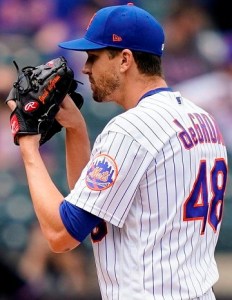
Jacob deGrom

He pitches like Tom Seaver for a team that hits like the St. Louis Browns when he’s on the mound.

Here we go yet again. And it’s getting more ridiculous than before. To the point where someone might be tempted to spike Jacob deGrom’s MP3 player with the Four Tops.

Once upon a time, that legendary Motown quartet sang, “It’s the same old song/with a different meaning since you’ve been gone.” Except it isn’t deGrom who’s gone, it’s the Mets offense when he’s on the mound.

He’s too much a team player to say it, but he must be tempted to wish his teammates wouldn’t just sing “Reach Out, I’ll Be There” but mean it and show it.

For the second time in his first two 2021 starts, deGrom pitched like a Hall of Famer. For the second time in his first two starts, his Mets could have been hauled into court for non-support and for trashing what he left behind. Or, at least, for impersonating the St. Louis Browns.

On Saturday his only blemish was the 0-2 fastball Marlins rookie Jazz Chisholm deposited over the right field fence in the top of the second, after deGrom struck Garrett Cooper and Brian Anderson out swinging.

Those were two of fourteen strikeouts deGrom nailed in eight innings’ work. He threw 95 pitches and 76 were strikes; he scattered five hits including the Chisholm bomb; he was, in other words, the Jacob deGrom who may still remain the favourite for this year’s National League Cy Young Award.

If the Mets keep playing this kind of baseball with deGrom on the mound, the righthander may set another precedent, even in theory: the first 20-game “loser” to win the Cy Young Award.

Don’t laugh, it could happen. DeGrom has an 0.64 ERA and a 1.55 fielding-independent pitching rate. Right now, these Mets seem capable entirely of going the distance to hang 20 losses in deGrom’s locker despite him making their late Hall of Famer Tom Seaver resemble the late Anthony Young.

Marlins rookie Trevor Rogers pitched like a deGrom aspirant on the other side, with ten punchouts in six innings and three measly hits against him while walking two to deGrom’s none. He threw 68 percent of his pitches for strikes to deGrom’s 80 percent. These Marlins need all the good news they can find and Rogers, a lefthander who stands an inch taller than deGrom does physically, may be some of their best news this year.

For eight innings the game stayed 1-0 and deGrom’s elegant assassination of the Marlins other than the Chisholm blast was rewarded with the Mets forgetting that it’s neither necessary nor possible to hit six-run homers every time they check in at the plate.

They had Brandon Nimmo opening the first with a double and taking third when the Marlins misplayed Francisco Lindor’s bunt at second base—and stranded him when Lindor got arrested for attempted grand theft second base followed by Michael Conforto and Pete Alonso striking out.

They had Dom Smith leading off the fifth with a line single past second base but James McCann dialing an immediate Area Code 6-4-3; then, they got the gift of Jeff McNeil wringing Rogers for a full count walk and taking second on a balk with Jonathan Villar at the plate—but they also got Villar striking out for the side.

They had deGrom himself leading off the sixth with a base hit, first and second when Nimmo followed immediately with a walk, and first and third when deGrom had room enough to tag for it on Lindor’s fly to the back of right field—and Conforto and Alfonso striking out for the side again.

They had six chances to get men in scoring position home and blew all six chances. Even allowing how tough Rogers was on the day, that’s six veterans unable to out-think the rookie when they were at the plate and give their own man even two runs to work with.

Of course, in deGrom’s first start the Mets actually let him leave a game with a lead only to see one inning of shutdown relief followed by another of the bullpen puking the bed. This time, the Mets left deGrom in a 1-0 hole—and the bullpen had another stomach upset.

Specifically, the one imposed by Edwin Diaz opening the Miami ninth. He served Starling Marte a grapefruit to hit for a long double on 0-1 and handed Jesus Aguilar a 1-0 meatball to dump into short right center for an RBI single. Just when it looked like Diaz would contain the damage with a fly out to center (Cooper) and a grounder to short (Anderson) forcing Aguilar at second, he walked Chisholm unintentionally and served Miguel Rojas an orange to shoot through the hole at shortstop and send Anderson home.

Then Jeurys Familia kept the damage to a pair by striking out Chad Wallach on three pitches. What was the reward in the bottom of the ninth? Doing nothing against Miami reliever Yimi Garcia. Lindor lined out to the right side of the infield, Conforto grounded out to second, and Alonso looked at strike three right on the floor of the zone on 1-2.

Guess Conforto couldn’t elbow his way into getting something going the way he did Thursday, when he did or didn’t quite get out of the way of a pitch that caught him on the elbow guard with the bases loaded in the bottom of the ninth.

Twenty viewings of that segment and I still couldn’t tell for dead last certain whether Conforto thought about a swing and snuffed the thought at once, or whether he thought he might get away with taking one for the team. Those who think Conforto was looking for a sneaky play should be reminded that his career-long habit with two strikes on him is to lean over the plate a little more than normal.

Plate ump Ron Kulpa rung him up on strike three—then called hit batsman. A replay review didn’t overturn the call that Kulpa knew should have been strike three with the batter failing to get out of the way of the strike. Even the Mets’ own broadcast team—Gary Cohen, Keith Hernandez, and Ron Darling—knew Conforto got away with manslaughter.

The ump declared mea Kulpa right after that game. He got cheered by the Citi Field crowd Saturday, appropriately. We know too much about ump malfeasance and umpires refusing to admit they blew one; we should expect an ump getting some love when he admits he made a big mistake.

The boo birds let the still-struggling Conforto have it in the sixth. Speculation abounds that Conforto in his contract walk year and other formidable Met hitters are pressing too heavily at the plate. (They’re 6-for-41 with men in scoring position so far.)

Nimmo all but admitted as much when he told a reporter, “That could be happening, I’m not in everyone’s mind, but I do try and talk and figure out what guys are thinking, but that definitely could be happening as the game goes on and the runs are not there . . . it definitely could be happening in some guys’ minds.”

Ask deGrom—as the same reporter did about him having a 2.06 ERA since 2018 while the Mets have been six games under .500 in his starts in the same span—and you’re not going to get him to admit he just might have those non-support papers ready to file at the nearest courthouse.

Even if he isn’t quite the most luck-afflicted of hard-luck pitchers. Nobody denies deGrom pitches in an ocean of rotten luck. But he’s not even the most hard-luck pitcher in Met history, believe it or not. That dubious honour belongs to Jon Matlack, whose 39 percent of starts with two runs or less to work with is the highest in franchise history. Higher than the 37 percent shared by Matt Harvey and Hall of Famer Nolan Ryan, higher than the 33 percent of Hall of Famer Tom Seaver, higher than deGrom’s 35 percent.

That could change rather drastically, if the Mets continue their very dubious practise of forgetting how to hit when deGrom is on the mound. Bless him, deGrom doesn’t want to think about things like that. Yet. “I try to control what I can control,” he insisted, “and that’s getting ready for my next start. I hadn’t seen that stat. These guys are great. They’re going out there giving 100 percent. Today we just got beat.”

If he doesn’t exactly sound like the abused spouse who’s willing to believe yet again that the abuser will keep the promise to never, ever, ever do that again, he’s not that far from it, either. If he keeps pitching like a Hall of Famer and wins a third Cy Young Award this year, despite his team making his “won-lost” record resemble an Anthony Young Award winner’s, someone’s going to have to do an intervention.

Kim Ng, inside the box

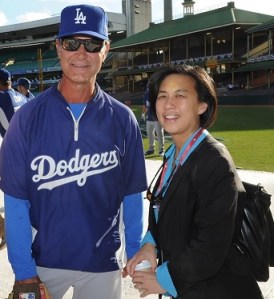
Kim Ng (right) with Don Mattingly, when Mattingly managed the Dodgers and Ng was their assistant GM. Ng is now, among other things, Mattingly’s new boss in Miami.

Whatever you do otherwise, please don’t call Kim Ng’s hiring as the Miami Marlins’ new general manager “outside the box” thinking. It’s an insult to hers and the Marlins’ intelligence, and it should be to anyone else’s, too.

Yes, Ng is the first woman and the first Asian-American to hold such a job. But yes, she also has three decades worth of experience in baseball operations which only began when she joined the White Sox as a front office intern and worked her way to becoming the team’s assistant director for baseball operations.

The Marlins hired her away from baseball government itself, where Ng just finished her ninth year as the Show’s senior vice president for baseball operations, focused specifically on tightening up and administering MLB’s international baseball reach and operations, working with MLB front offices and international organisations alike, and enforcing international signing rules.

In between her term with the White Sox and in the Show’s government, Ng became the youngest assistant GM (at 29) ever when she took that job with the Yankees, then joined the Dodgers as an assistant GM, her performances of which jobs plus her performance in MLB’s organisation itself put her on several team radars as a GM to be.

Outside the box? Ng is about as inside the baseball box as you can get with her experience and reputation. The only thing outside the box about her is that, well, she’s a lady, and she’s the daughter of a Chinese American father who worked as a financial analyst and a Chinese Thai mother who worked as a banker.

She’s Indianapolis born but New York raised, and she grew up among other things playing stickball on the Queens streets before going to the University of Chicago, earning a degree in public policy, and, oh yes, winning a Most Valuable Player award as an infielder on the university’s softball team.

“[I]t is the honor of my career to lead the Miami Marlins as their next General Manager,” Ng says in a formal statement. “We are building for the long term in South Florida, developing a forward-thinking, collaborative, creative baseball operation made up of incredibly talented and dedicated staff who have, over the last few years, laid a great foundation for success.”

When was the last time you heard terms like “forward-thinking” or “collaborative” or “creative baseball operation” applied to the Marlins? OK, so that might be outside-the-box—the Marlins’ box, that is.

“This challenge is one I don’t take lightly,” she continues. “When I got into this business, it seemed unlikely a woman would lead a Major League team, but I am dogged in the pursuit of my goals. My goal is now to bring championship baseball to Miami. I am both humbled and eager to continue building the winning culture our fans expect and deserve.”

It’s a recent enough expectation, of course, but one that doesn’t lend itself to gags now that manager Don Mattingly was named the National League’s Manager of the Year for shepherding the Fish to a second-place irregular season finish in the National League East and as far as a division series in the postseason.

Ng has knocked on history’s door more than a few times in her career. With the White Sox, she was the first woman and youngest human to present and win a salary arbitration case, for pitcher Alex Fernandez. When the Yankees hired her as an assistant GM, Ng became one of only four women ever to hold the position, joining Elaine Weddington Steward and Raquel Ferreira of the Red Sox and fellow Yankee Jean Afterman.

She started showing up on team radars as GM material in 2005, when the Dodgers interviewed her. They handed the GM job to Ned Colletti, but Colletti almost immediately kept her as an assistant GM. She’s since been interviewed for such jobs by the Angels, the Giants, the Mariners, and the Padres.

When she left the Dodgers to take her MLB job, there were those pondering aloud whether Ng had a chance to become the first woman ever named as baseball commissioner. So much for that idea, so far. She’s content to have gotten where she is now. But would you really object to the idea down the road apiece?

Ng won’t exactly be wading into virgin territory with the Marlins. Chief executive officer Derek Jeter was en route his Hall of Fame career as a Yankee shortstop while Ng worked in their front office. Mattingly’s playing career ended a few years before the Yankees made her an assistant GM, but he was a coach for them while she was there. And, he managed the Dodgers while Ng was still their assistant GM.

Jeter’s own formal statement cites Ng’s “wealth of knowledge and championship-level experience.” The Yankees won three straight World Series while she worked there; the Dodgers challenged for or won a few NL Wests while she worked in their front-office brain pool. As a front-office executive Ng has gone to eight postseasons total.

“Her leadership of our baseball operations team will play a major role on our path toward sustained success,” Jeter continues. “Additionally, her extensive work in expanding youth baseball and softball initiatives will enhance our efforts to grow the game among our local youth as we continue to make a positive impact on the South Florida community.”

The lady is a champ who just might deliver when it comes to making the Marlins champs. Just don’t accuse the Fish of going that far outside the box by hiring her in the first place.

Cut the crap

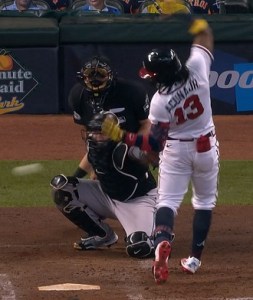
Sandy Alcantara’s pitch ricochets off Ronald Acuna, Jr. in the third.

So far as the Miami Marlins seem concerned, the heir apparent to Freddie Freeman as the Atlanta Braves’s franchise face doesn’t wear a Braves uniform. He wears a target. Especially after he hits home runs, in the postseason and otherwise.

Here we went again Tuesday afternoon. Game One, National League division series. And, yes, it was weird enough that the Braves and the Marlins played in Houston’s Minute Maid Park, with the Braves as the home team.

Then Acuna hit the second pitch from Marlins starter Sandy Alcantara over the right field fence opening the bottom of the first. As is characteristic of the ebullient outfielder, he watched for the briefest moment before flipping his bat to one side on his way up the first base line to run it out.

Acuna had reason enough to celebrate even before the Braves demolished the Marlins with a comeback 9-5 win. He became the youngest man in Show history to hit a leadoff bomb in a postseason game. He and the Braves got to enjoy it until the bottom of the third, with the Marlins holding a 4-3 lead and Acuna at the plate with one out.

Alcantara threw at and hit Acuna on an 0-1 count with a 98 mph fastball. At least Alcantara waited until Acuna greeted him again instead of going completely infantile and drilling Freeman following Acuna in the first. That may be the only thing to his credit.

Acuna might have said after the game that he’s kinda, sorta, kinda getting used to being Fish fodder, but that didn’t mean he was necessarily thrilled to be so high on their hit parade when the third-inning pitch struck. He took a few steps forward, toward the mound, holding onto his bat a bit, and both Braves coaches and umpires surrounded him before he entertained any ideas about relieving Alcantara of his head or any other extremities.

“I looked over to their bench,” Acuna said post-game. “I said it’s been five times. At this point, I think we’ve become accustomed to it.” Not necessarily. If that were true, the Braves wouldn’t have engaged in a chirping contest with the Marlins before Acuna finally dropped his bat and took his base.

They also might not have answered the Marlins’ three-run top of the third with Marcell Ozuna doubling Acuna home following Freeman’s followup fly out and Travis d’Arnaud doubling Ozuna home to bring things back to within a run.

And they wouldn’t have bided their time, chased Alcantara out of the game in the seventh with a pair of inning-opening infield singles, one by Acuna himself, before Freeman forced Acuna at second with Yimi Garcia on the mound, Ozuna singled home Austin Riley to tie the game at four, and d’Arnaud hitting a 2-0 grapefruit far enough over the center field fence.

Nor would Ozzie Albies have followed d’Arnaud’s demolition with a base hit to chase Garcia in favour of James Hoyt, whose first service to Dansby Swanson disappeared over the center field fence, too.

That’s where the score stayed other than Matt Joyce’s excuse-me RBI single in the top of the eighth.

“I think it woke us up,” d’Arnaud said of Alcantara drilling Acuna. “And we took advantage of the momentum.” Said Braves manager Brian Snitker, “You better be good at going in and not hitting [Acuna] after a homer.”

Alcantara wasn’t, obviously. Nor was he especially good at covering his tracks after the game. Any expressions of the-ball-got-away-from-him/the-dog-ate-his-homework got vapourised when he added, referencing Acuna’s brief but interrupted advance to the mound, “If he’s ready to fight, I’m ready to fight, too, no matter what happens.”

Cut the crap.There was only one reason Acuna might have been ready to fight, and that was getting drilled his next time up after hitting one out and—oh, the hor-ror!—showing his pleasure over his feat.

Cut the crap. He’s hitting for a .318/.414/.665 slash line against them since he first faced them in 2018. It couldn’t possibly be that the Fish are fed up with Acuna making tuna salad out of them so far in his career.

Cut the crap. It doesn’t matter that has a .182 lifetime batting average against Alcantara into the proceedings. Maybe Acuna also felt like celebrating finally having something more to show than two walks, two strikeouts, and nothing else off the Miami righthander in ten previous plate appearances. Since when does that give Alcantara a license to drill when the first hit he surrenders to Acuna is a parabolic opening launch?

Jose Urena, whose 2018 drilling of Acuna after a bomb-flip got Urena suspended six games, has decent performance papers against Acuna otherwise, if not quite those of Alcantara’s: five strikeouts, three walks, four hits including that lone bomb, and a .235 batting average against him. But Acuna also has a .409 on-base percentage against Urena in 22 plate appearances. And he’s been hit twice in the bargain.

Cut the crap. I’ve said it before, I’ll say it again. You don’t want Acuna turning his bat into a helicopter rotor when he hits one out against you, stop throwing him cantaloupes to hit in the first place. You want to be a Fun Policeman, wear a police uniform and not a Marlins uniform on the mound.

It ruined Alcantara having a solid outing otherwise, until the Marlins bullpen—whose main men are the proud possessors of a 2.72 irregular season ERA—got dismantled in the seventh. It also put a little smudge on the Marlins’ 2020 reputation as a pleasant surprise who missed winning the National League East by finishing four behind these Braves.

But it also reminded close observers that Acuna has been bitten twice as often by the Fish as he’s been by any other major league team. MLB.com’s Mark Bowman was kind enough to point out that Acuna’s been drilled by Miami pitching once every 41.2 plate appearances—and once every 80 plate appearances by everyone else’s pitching staffs.

Acuna answered on social media after the game too. “They have to hit me because they don’t get me out,” he said in one tweet. “I’d like to take this time to apologize to absolutely NOBODY,” he insisted in an Instagram post. I’d like to take this time to say Acuna owes apologies to absolutely nobody.

Fish fouled

Adam Duvall has just low-fives third base coach Ron Washington after helping the Braves to an eleven-run second and a 29-9 slaughter.

Not even Joe West’s umpiring crew working the game could prevent it. For all anybody knows, maybe even Country Joe himself took pity on the Miami Marlins and called the Hague–or, at least, the Georgia Department of Natural Resources—himself, to file on their behalf against the abuses they suffered in Atlanta Wednesday night.

Or, at least Marlins manager Don Mattingly might have slipped a note to Atlanta Braves manager Brian Snitker, asking only partially puckishly, “Brian, could we have the bottom of the second back? Pretty please? With tartar sauce on it?”

Call it the Fish Fricasee. But call the Braves’s 29-9 cleaning, scaling, and fileting the arguable nastiest combined attack of ground troops, close-cover strafing, aerial assault, and strategic bombing ever committed by them, their 29 runs setting a new franchise record.

Sure, the Milwaukee Brewers de-clawed the Detroit Tigers 19-0 in Comerica Park earlier in the day. Only they did it in gradual clips and snaps, a couple of runs here, a few there, a few more yonder. Who the hell needed that nonsense from rude guests when you had the hosts in Truist Park treating their oceanic guests like a shipment of cat food?

What started as a 2-0 Marlins lead got vaporised by fourteen Braves batters including four repeaters before Ender Inciarte showed the Fish mercy and cast his line for an inning-ending ground out to first base. The carnage only began with Dansby Swanson singling his way aboard against Marlins starter Pablo Lopez.

Lopez’s next two mistakes were back-to-back walks to Austin Riley and Adam Duvall. And then it began:

* Ozzie Albies returning from a month on the injured list pushed Swanson home with a ground out to first.

* Inciarte sent a sacrifice fly to the deeper region of left center field, tying the game at two.

* Duvall took third on the play and the Marlins called for a review to see whether third baseman Brian Anderson got the tag on the sliding Duvall’s leg before or after a) Duvall’s foot hit the pillow and b) Riley crossed the plate. The review said no, sir, umpire Hunter Wendelstedt making the emphatic safe sign.

* After Lopez walked Ronald Acuna, Jr., Freddie Freeman hit a line drive to right that diving Marlins right fielder Monte Harrison couldn’t grab, the ball bouncing under his blue glove, scoring Duvall and sending Acuna to third.

* Marcell Ozuna floated a pop to shallow left near the line that hit the grass before Miami left fielder Lewis Brinson could reach it, sending Acuna home. “And the Braves are first-and-thirding the Marlins to death,” crowed Braves broadcaster Chip Caray after the fourth run rang in.

* Travis d’Arnaud, the former Met, checked in with first and third yet again. He hit the first-pitch hanging changeup into the first empty row of the left field seats. The blast ended Lopez’s evening and it’s not impossible that the only thing the Marlins righthander could say when Mattingly came forth to end his misery was, “What took so long, Skip?”

Exit Lopez, enter Jordan Yamamoto for the Fish. Swanson greeted him with a base hit to left, then Riley shot one right between shortstop and third basemen trying to converge to send Swanson home. Then Duvall hit yet another first pitch into the right center field bullpen.

Yamamoto finally said too much was enough about the Braves’ first-pitch hitting and wrestled Albies to an eighth pitch. Unfortunately, it was finally ball three and a full count, forcing Yamamoto to throw a ninth pitch. And Albies drove it four rows up the empty center field seats.

A smooth-looking righthander otherwise, Yamamoto shares a surname with World War II’s Japanese Combined Fleet commander. What the U.S. Navy did to Admiral Yamamoto’s forces at Midway and beyond, the Braves did to the Marlins in the bottom of the second. They one-upped the ten-spot second under which they might have buried the Philadelphia Phillies two Sundays ago—but for the Phillies crawling back to make the Braves sweat out a 12-10 final.

Yamamoto the pitcher’s misery didn’t end when he and the Marlins finally escaped the second inning with what was left of their lives, unfortunately. He’d pitch two and two-thirds innings total and leave with twelve earned runs on his evening’s jacket. Making him only the second relief pitcher in seventy years to take twelve or more for the team, joining the sad company of Vin Mazzaro—who took fourteen from the Cleveland Indians for the Kansas City Royals in two and one third on 16 May 2011. He’d have had better survival odds if he was a World War II naval commander.

About the only thing the Braves didn’t do to the Marlins Wednesday night was drop the atomic bomb. Oops. Take that back. After a one-out single, a hit batsman, and a shallow base hit against another Marlins reliever, Josh A. Smith, Duvall—who also hit a three-run homer in the fifth—dropped the big one, slicing salami on an 0-1 meatball in the bottom of the seventh, for what proved the final four Atlanta runs.

Whoever files the report with the Hague, or with the Georgia department’s fisheries management, they’re going to have to include that. It might be the only time in history that a late atomic bomb did less damage and was less lethal than what happened earlier in the war.