Two champion Series finishers move on

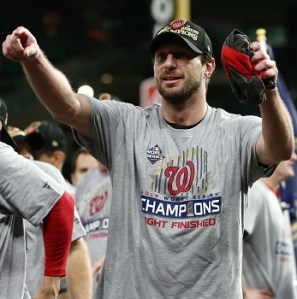
Max Scherzer

Max the Knife celebrates the World Series triumph he helped author with his on-fumes Game Seven start. Can he help the Dodgers go back to the Series?

The author of maybe the single most uplifting game in Nationals history is a Nat no more. The fellow with one blue and one brown eye who forced his way past a neck issue to keep the Nationals in line to win their first World Series has gone west.

That was hours after the Cubs finally said goodbye to the man who snapped into his mitt the final out of their first World Series win since the premieres of cellophane, the Geiger counter, and the Model T Ford.

Trade deadlines don’t often feature two or more signatures of two off-the-charts World Series champions changing addresses and wardrobes. When they’re men identified that tightly with their teams, even those with no rooting skin in their games can’t help thinking that the world just got knocked more out of order than it seemed going in.

This year’s Nats don’t have a staggering rise from the dead in them just yet, if at all. This year’s Cubs were bent on selling while the selling was good, with their National League Central chances this year anything but. “Go Cubs Go,” that rollicking anthem of the 2016 conquerors, now has another meaning.

Max Scherzer goes west for a better chance at a postseason return with the Dodgers. That was just moments, seemingly, after the entire world thought the splash-happy Padres had him all but loaded on the plane west. Ouch.

Anthony Rizzo goes east in a Yankee hope that a couple of heretofore missing lefthanded bats—they’d landed all-or-nothing portside slugger Joey Gallo from the Rangers just prior—might turn their season from somewhat lost to yet another shot at the Promised Land.

The Nats hope the package of prospects Scherzer and shortstop Trea Turner brought back from Los Angeles mean this season proves a hiccup on their way back to the races to come. The Cubs hope the pair Rizzo brought back from the Bronx means likewise, especially depending on what they can bring back in any deal for Rizzo’s partner in 2016 World Series crime, third baseman Kris Bryant.

But ending eras is never pleasant. And these two deals ended a pair of eras that’ll live as long as Washington and Chicago live. The Rizz speared Bryant’s herky-jerky on-the-move throw over to secure the Cubs’ World Series winner. Max the Knife’s empty-tank performance of sheer will kept the Nats alive enough to pull just enough lingering rabbits out of their hats to nail Game Seven in 2019.

Chicago and Washington won’t forget as long as those cities and those men live. The feeling is very mutual with the players involved.

“This city,” Rizzo said when the deal to the Yankees was done, “will be ingrained in my heart for the rest of my life.” Told he was as transformational a figure in Wrigley Field as anyone who ever wore a Cub uniform, Rizzo accepted the idea with no small pride. “That’s what matters most—leaving this place better than when I found it. I can say the mission was accomplished.”

Scherzer still wasn’t sure whether he’d still be a Nat after he pitched Thursday and threw three-hit, one-run ball at the Phillies, in a start that was as much a showcase for his renewed health (he’d missed a start with a triceps strain a few days earlier) as for the trading floor. But he wanted to think about what Washington meant to him from the moment he’d signed that mammoth seven-year deal due to expire after this season.
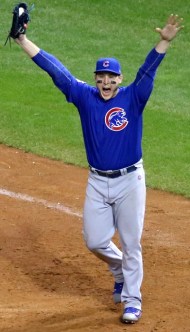
Anthony Rizzo

Nobody beats The Rizz: Clutching the final out of the Cubs’ 2016 World Series conquest.

First, there were the purely baseball considerations. “I signed a seven-year deal here and we won a World Series. That’s the first thing I said when I signed, that I was here to win. And we won. We won a World Series,” he said. “That’s a lifelong dream come true and something I’ll always be proud of with these guys here, to be part of a championship team, looking forward to reunions and stuff like that.”

Then, there came the familial and community considerations. Scherzer arrived childless in Washington with his college-sweetheart wife, Erica. They’re going to Los Angeles with two of Scherzer’s three Cy Young Awards and three daughters.

“I’ve watched my girls grow up here,” Max the Knife said. “Living in Virginia in the DMV area, I’ve really gotten used to it, all the politics that are going around. Being in the nation’s capital has been kind of fun as well, driving by the monuments every day . . . What can you say about the fans? That championship will always mean something to all of us and we’ll always have that flag.”

Parting with uber prospects Keibert Ruiz (catcher), Josiah gray (righthanded pitcher), Gerardo Carillo (righthanded pitcher), and Donovan Casey (outfielder) made sense only if the Dodgers were going to bring in something well above average. They brought in the best pitcher and the best position player—a still-young shortstop with a live bat—on the trading floor.

If the Dodgers want to close the brief distance between themselves and the uber-surprising Giants in this year’s National League West, they couldn’t have done better if they’d gone to the lab and mixed the right ingredients in the test tubes and beakers.

The Nats aren’t exactly leaving themselves helpless. They have have pushed the plunger on this year, but with Juan Soto around whom to remodel they’re looking at 2022 and beyond. Particularly with a returning Stephen Strasburg and who knows what off-season deals or signings to come.

Mostly, Scherzer relieves the pressures on the Dodger starting rotation, what with Dustin May lost for the season recovering from Tommy John surgery and Trevor Bauer persona non grata when all is said and done, in the wake of a police investigation into a couple of turns of rough sex crossing the line from consensual to downright unwanted sexual assault.

Whether he proves a rental or whether the Dodgers want to keep him for the rest of his baseball life remains to be seen. Don’t bet against the Dodgers deciding to make the latter happen.

The Yankees should be so lucky with Rizzo and Gallo. Yes, they sent out a lineup full of raw power until those deals, but that lineup lacked consistency and lefthanded hitting, the long-traditional fuel of that long-vaunted, long-legendary Yankee power.

Rizzo is the far more balanced hitter between the two newcomers as well as a multiple Gold Glover at third base. Gallo is so all-or-nothing despite his ability to work walks that he actually lets you imagine Mario Mendoza as a power hitter, but he is a solid defensive outfielder with range and arm enough to maybe make the Yankees forget about Brett Gardner at long enough last. Maybe.

So where was the pitching help the Yankees really needed? Why weren’t they all-in yet on someone like Scherzer? Despite his expressed preference for going west, the Yankees have been nothing if not able to persuade such determined men otherwise in the past.

Why not all-in on resurgent and available Cubs closer Craig Kimbrel? Especially with other teams trailing him including now the Rays, rumoured to be pondering a package of Kimbrel and Bryant coming aboard? Or resurgent and available reliever Daniel Hudson, the 2019 World Series finisher whom the Nats dealt to Seattle before the trading floor really began bristling with prize packages?

Or Jose Berrios, the formidable Twins starter whom the Blue Jays have snapped up for a pair of prospects and who’ll have him through the end of 2022 at minimum pending their ability to sign him longer-term from there?

The Yankees are still in the race, technically. The problem is, they’re three games plus behind the Athletics in the American League wild card picture and eight and a half games behind the Red Sox in the American League East.

And while Dodgers mastermind Andrew Friedman may be taking bows enough for Max the Knife and Trea Chic, Yankee general manager Brian Cashman—whose questionable at minimum construction of the current Yankee roster should take the heat Yankee fans heap upon hapless manager Aaron Boone—may yet have some very serious splainin’ to do.

How not to strip the naughty sauce

Max Scherzer

Max the Knife wasn’t quite ready to perform a full strip tease over his third stop-and-frisk Tuesday night . . . but but perhaps some pitcher will, soon.

Long before she surrendered the newspaper columnist’s life for life as a novelist and eventual periodic Newsweek columnist, Anna Quindlen observed cheekily (in her early New York Times column, “Life in the 30s”) that basketball allowed women a sublime extracurricular pleasure. It was the only sport, she wrote, in which women got to watch men run around in their underwear.

Let’s be kind and allow that Quindlen thought boxing was as much of a sport as Charles Manson was a family counselor. But she wrote when the NBA’s uniforms still resembled something as close to men’s underwear as you could get away with in public without filming a comedy movie scene.

That was also then, and this is now. Major League Baseball’s ham-fisted mid-season bent on enforcing foreign-substance rules long on the books and long un-enforced may yet give women another such sublime pleasure. Baseball may yet be the first American sport in which women at the ballpark will get to watch men perform strip teases on or around the pitcher’s mounds.

Don’t be afraid to bet the rent or the mortgage on it. There just might be a pitcher ready to coordinate with the ballpark’s public address people and have David Rose’s ecdysiastical  classic “The Stripper” cued up and ready to go, hard and loud, at the split second he hands his hat to an umpire under orders to stop and frisk for naughty sauce.

It nearly happened at least twice on Tuesday night. First, Nationals ace Max Scherzer finally decided too much was enough with Phillies manager Joe Girardi’s harassment in the fourth inning—and thrust his hat and glove to the ground before yanking his belt open savagely enough that you thought he would drop trou on the spot.

Scherzer didn’t, of course. But Athletics reliever Sergio Romo almost did out in Oakland after finishing the seventh. Romo dropped trou just enough that his almost knee-length uniform jersey still kept his hind quarters covered well and good. He bent forward just so, leaving you the impression Romo was trying to moon the fools who imposed the current crackdown without quite being too cheeky about it.

So neither Max the Knife nor El Machon felt confident enough to perform baseball’s first known on-the-field striptease. Somebody just might, though. It could take long enough for Jacob deGrom to make plans, coordinate, then sail into it to David Rose’s tune at the moment he’s accosted and handed the search warrant.

When deGrom had the dubious honour of being the first under the fresh crackdown (or should that be crackup?) to be stopped and frisked Monday afternoon, he couldn’t stop grinning wide when he wasn’t laughing his head right off his shoulders. Maybe if Scherzer had been the first he’d have thought it was funny, too. Maybe.

But do you think a fellow like deGrom, who’d laugh his way through one of his sport’s most ridiculous over-compensatory gestures, would find it hard to resist a shot at making the Chippendales resemble the Chipmunks in order to send a counter-message to baseball’s garbled and clumsy one?

Commissioner Rob Manfred is a man with a ten-thumbed touch and a pronounced cognitive inability to recognise the true roots of crises that spring from his apparent need to demonstrate that Rube Goldberg should have been a baseball executive.

But even Manfred and his gang couldn’t ignore the ridiculously sublime message sent if and when baseball’s best pitcher decides the way to start putting a stop to this is to channel his inner Gypsy Rose Lee. Could they? They already seem somewhat immune to the concept that there might have been a better way to address the naughty sauce than this.

Resisting Manfred’s Rube Goldberg side to experiment with the baseballs themselves would have kept this issue from getting sticky in the first place. Pitchers normally have enough trouble just keeping their arms, elbows, and shoulders from breaking and tearing, whether they’re throwing speeding bullets, voluptuous breaking balls, or slop.

Not to mention their sides, swinging the bats, in the National League at least, since the designated hitter is not yet permanently universal as it should be.

(Don’t even think about it. Just as Nolan Ryan was an absolute outlier for his 27-season career and insane in the brain work loads—though it’s oft forgotten that Ryan had physical issues very early in his career, including missing all 1967 with one—Jacob deGrom and his .407/.407/.444 slash line as of Wednesday morning is an absolute outlier among this years pitchers hitting a whopping .112/.153/.142 slash line thus far.)

Of course, resisting Manfred’s Goldberg side would also require—what do you know—the immediate disappearance of the three-batter minimum for relief pitchers and the free cookie on second base to begin extra half-innings. Don’t say it as though disappearing them would be terrible things.

What has Manfred thought about his precious pace-of-play improvement campaign now that the mandatory stop-and-frisking for naughty sauce has gone from the ridiculous to the deranged and has probably delayed games by a few more minutes apiece?

What does he think’s going to happen to the pace of play when an indignant pitcher finally gets beyond Max Scherzer’s or Sergio Romo’s kind of annoyance and goes as full Ned Braden as a baseball player can go on grass and dirt?

(Who’s Ned Braden? As played by now-retired actor Michael Ontkean, Braden was the anomalously non-violent minor league hockey player diverting the bloodthirsties’ howling blood lust during an on-ice championship game brawl by performing a gracefully-skated strip tease around the rink—provoking the high school band in the stands to make with “The Stripper” and the ladies in the arena to go bonkers with delight—in the Paul Newman film Slap Shot.)

In absolute fairness, it doesn’t seem as though the umpires are necessarily thrilled about being under orders to stop and frisk for naughty sauce, either. Understandable. They have enough trouble with their current reputations for being only too human, with the almost-pandemic blown calls and enough in their ranks believing fans pay their hard earned dough to come to the park to see them behave as laws unto themselves.

They need to be the Commish’s Elite Guard about as badly as deGrom needs two more miles an hour on his best fastball. No member of the crew working the Yankees-Royals game Tuesday night could have felt thrilled about having to stop and frisk Yankee reliever Jonathan Loaisiga after coming out of an eighth inning in which he was slapped silly for four runs on five hits.

Some of us call that adding insult to injury. Others of us wondered if the umps were trying to tell him that, if he did have a little naughty sauce at hand (or anyplace else on his assorted anatomy), there was no excuse for getting pinata’d like that.

The crew working the Nats-Phillies game that got Scherzer’s underwear in a twist has the likewise dubious honour of having thrown out the first manager because of the naughty sauce crackdown.

Girardi called for the third Scherzer stop-and-frisk, just because a) he could, and b) there’s a too-fine line between real cheating alarm and bad-faith gamesmanship (which the memo says can get a manager suspended, folks), but when he tried goading Scherzer and several hollering Nats coaches into a fight Girardi got sent to bed without his supper for the night.

Clayton Kershaw thinks that’s not enough. “I think there should be a punishment if they don’t catch anything on the guy,” the future Hall of Famer said after he saw Max the Knife get knifed in the fourth. “I think Scherzer, you know, he’s one of the best pitchers of our generation. To see him get checked . . . and mess up his rhythm . . . you better find something if you’re going to call him out like that.”

So who’s it going to be, ladies and gentlemen? Who’s going to be the first pitcher to decide too much is enough and go Ned Braden on or around the mound before Manfred gets the a-ha! and addresses the naughty sauce—and the baseballs themselves—reasonably? Who’s going to be the first likewise indignant umpiring crew to let him?

Maybe make the Girardis strip tease if they’re going to cross the line between reasonable doubt and trying not to pay the rent to live in a pitcher’s head. (Oops. Better be judicious about that, especially if you’ve seen Tony La Russa lately.)

I wonder if someone makes breakaway baseball uniforms. If this keeps up, he or she may soon find themselves making such Mets, Nats, A’s, or other uniforms. Unless entire teams decide to play with nothing on but their briefs, jocks, and socks. Nothing to see there! Move on! David Rose, wherever you are, cue up the band.

The Book of Ecdysiastes 1, 3, and 4

Max Scherzer

“I’m so happy I could just strip!”

“In the name of God and His servant Preacher Roe, just what the hell did Joe Girardi think he was doing out there tonight?” That was Gunko Gluedius on the Zoom. He was watching the Phillies play the Nationals Tuesday.

He couldn’t believe Max Scherzer came straight from the injured list and onto the suspect list. Three times in the same game.

“The TSA isn’t this freakazoid when they run you through the airport security checks,” I said, as calmly as I could. I know Gunko. He’s a pitching freak. It’s almost the only part of baseball he really loves. The other part is watching people like Anthony Fauci throw ceremonial first pitches sideways while aiming forward.

“No, they’re not,” Gunko replied. “Not with me, anyway. I had to fly to Seattle last week. I didn’t have the pre-check pass but they still didn’t think I should be peeled like a banana.”

Sometimes Scherzer looks like a fellow who’s spent as much time under the old-fashioned automotive grease rack as he’s spent on the mound. Sometimes he looks like a fellow who spent too much time cleaning the oven so his wife could have a big break.

But that doesn’t necessarily mean he’s given to keeping anything like Goop, Pennzoil, Easy-Off, or pieces of Brillo hidden around his assorted anatomy.

He didn’t have to be thrilled about it, but he knew going in he’d be checked after his first inning’s work. But then Girardi decided to get cute. Especially with the Nats holding a 3-1 lead after three, the lone Phillies run to that point courtesy of former Nat Bryce Harper hitting a down and in cutter up and out into the right field seats in the second.

After a clearly unamused Scherzer stood for his second mandatory random search of the game in the third, Girardi asked the umpires to check Max the Knife again in the fourth.

“I bet that’s the only time in baseball history a manager decided to punish a pitcher for surrendering a bomb to his guy,” Gunko joked. I’m not necessarily sure he’ll win that bet.

As soon as he realised the fourth inning warrant was sworn out and being delivered, any amount of cute left Scherzer’s person at once. He thrust his hat and his glove to the ground. Then he opened his belt with such a savage yank there must have been those fearing for a split second that he was going to peel himself like a banana.

You thought the Citi Field people missed an opportunity by not playing “The Pink Panther Theme” when Jacob deGrom had the honour of first come, first frisked under the Show’s new this-time-we-mean-it-until foreign substance crackdown?

The Citizens Bank Park people should have had that classic from the Book of Ecdysiastes on cue and ready to blast, bump, grind, and growl. Right down to the last trombone.

“I bet you every woman in the house would have coughed up double the price of their tickets to see Scherzer drop trou–and anything else he could think of,” Gunko crowed.

Unless his wife would cough up triple the going price to have divorce papers drawn up on the spot. Grounds? Since Max the Knife isn’t exactly reputed to be one of baseball’s heretofore-unconfirmed cheaters, I’d hazard the guess it would be on the grounds of unaccounted for exhibitionism outside the marital home.

But perhaps Mrs. Scherzer instead would lead the cheers. “Get it, honey, Get it! Show ’em what I know you’re made of!”

Obviously, not even pitching and surviving Game Seven of a World Series with nothing left to throw but meatballs, grapefruits, and canteloupes up to the plate after a neck issue almost took him out showed enough of what Scherzer’s made of.

Remember, the Phillies’ pitchers had to be stopped and frisked, too. Except that Nationals manager Dave Martinez isn’t the kind of guy who’d have had three warrants per pitcher per game sworn out.

He’d better not be. When Scherzer got the third stop-and-frisk order of the night, Martinez looked more ready to file brutality charges than Scherzer did.

Maybe Martinez remembered the night Girardi was managing the Yankees and his starting pitcher Michael Pineda got caught and suspended for suspicious ring around the neck.

“Did you see Scherzer hollering, ‘I got nothing! I got nothing!’ when he got searched the third time?” Gunko hollered to me. Of course I did. It was easier to read Scherzer’s lips than the first George Bush’s.

If you think the pitchers were trying to get away with murder with their new fashioned medicated goo before—and just maybe they were doing it not to be cute but to deal with Commissioner Nero’s incessant ball tinkering the last few years—beware the managers trying to get away with murder for using their newly-conferred freedom to file ball police complaints not to uncover contraband but to live and rattle rent-free in a pitcher’s head.

They can be sent to bed without their supper for it, too. Not just after Girardi got sent there after Scherzer stared him down cold following the fourth-inning flap. It’s in the memo:

Please note that a manager will be subject to discipline if he makes the request in bad faith (e.g., a request intended to disrupt the pitcher in a critical game situation, a routine request that is not based on observable evidence, etc.)

“Oh, that’s cute,” said Gunko when I read that portion to him. “Bad faith, huh? That’s about as clear as a glass of water from the East River.”

“I haven’t had a glass of water from the East River since Bill Clinton was still in the White House, Gunko. But it’s right there. This isn’t supposed to become downright harassment.”

By that time, the Phillies’ Rhys Hoskins made the score 3-2 with a healthy belt on a highball out over the left center field fence off Nats reliever Tanner Rainey. Somehow, another Nats reliever, Brad Hand, survived the bases loaded and one out in the ninth to escape with his and the Nats’ lives.

By that time, too, up in New York, Yankee pitcher Jonathan Loaisiga got frisked on a warrant—after pitching two thirds of the eighth inning and getting battered like a pinata on five hits for four earned Royals runs. Why were those umps patting Loaisiga down—for not using the naughty sauce properly?

And where were the Oakland Coliseum PA people when Athletics relief pitcher Sergio Romo almost did what Scherzer couldn’t quite bring himself to almost do—drop trou after finishing the seventh, but only far enough to let his long jersey keep him covered? Not even two bars of “The Happy Organ.”

“Let’s talk about bad faith,” Gunko urged. “You ever heard of the cop who pulls a driver over for a taillight issue and uses it as an excuse to have the poor sap’s car searched and stripped without a warrant? Don’t tell me there’s a manager alive who wouldn’t dream up a taillight issue for an excuse to have a pitcher stripped, searched, and slammered.”

I wouldn’t dare tell Gunko that. It’s right there, in Ecdysiastes 1, 3, and 4.

Alfred Hitchcock presents Opening Night

AlfredHitchcockAt long enough last came Opening Day. Well, Opening Night. On which New York Yankees right fielder Aaron Judge nailed the COVID-19 delayed season’s first hit and his teammate Giancarlo Stanton nailed its first home run two batters later.

On which the Washington Nationals opened without a key element, outfielder Juan Soto, whose positive COVID-19 test result came back well enough before game time to make him a scratch.

Before that rain-shortened game even got started, the word came from the opposite coast that Clayton Kershaw was scratched from his Opening Night start thanks to a back problem sending him onto the injured list.

In Washington, the Nats’ co-ace Max Scherzer would have loved if Judge and Stanton were Thursday night scratches. They accounted for all Yankee runs in the 4-1 final shortened in the top of the sixth when the rains smashed in with the Yankees having first and third and one out.

In San Francisco, Los Angeles Dodgers rookie Dustin May pitched five innings to San Francisco Giants veteran Johnny Cueto’s four, both men leaving with a one-all tie, and the Dodgers’ new $396 million man Mookie Betts broke the tie scoring on an infield ground out in the top of the seventh.

Scherzer’s good news Thursday night: eleven strikeouts. His bad news: four walks and an inability to solve Judge and Stanton. Judge also doubled home Tyler Wade in the third and Stanton singled home Gio Urshela in the fifth. Remove Judge and Stanton from the Yankee lineup and the Nats’ Adam Eaton’s hefty solo home run in the bottom of the first would have been the game’s only score.

Betts singled with one out in the top of the seventh and called for the ball. Published reports indicate that ball plus the evening’s official lineup card now repose in his home. “It’s just a new chapter in life,” he told reporters after the 8-1 Dodgers win.

After he came home when Justin Turner grounded into a force out, Corey Seager’s grounder got Cody Bellinger caught in a rundown at the plate, but Enrique Hernandez singled home Turner and Seager (who’d taken second during the rundown), Joc Pederson and A.J. Pollock walked back-to-back to load the pads, Austin Barnes sent Hernandez home with an infield hit, and Max Muncy walked Pederson home.

And, on both coasts, all four teams figured out a solution to the issue of whether or not to take a knee for “The Star Spangled Banner” that might actually help more than hurt the too-easily outraged.

Abetted by a suggestion from Philadelphia Phillies outfielder Andrew McCutchen, the Yankees and the Nats lined up on the base lines holding a long, long, long black ribbon, standing apart enough for social distance, then took their knees before “The Star Spangled Banner” was played.

On the same suggestion, the Dodgers and the Giants held a similar long, black ribbon and took their knees before the anthem’s playing. In Washington, both the Yankees and the Nats rose from their knees while the anthem was played. In San Francisco, ten Giants including manager Gabe Kapler plus Betts on the Dodgers’ side stayed on their knees during the anthem, with Bellinger and Muncy putting hands on Betts’s shoulder as a gesture of support.

I went back on record Thursday saying that there are far worse ways than kneeling before a national anthem to protest something you think is dead wrong. Kneeling, as two Scientific American writers I cited remind us, is anything except disrespect.

“While we can’t know for sure, kneeling probably derives from a core principle in mammalian nonverbal behavior: make the body smaller and look up to show respect, esteem, and deference,” wrote psychologists Jeremy Adam Smith and Dacher Keltner in 2017.  “. . . Kneeling can also be a posture of mourning and sadness. It makes the one who kneels more vulnerable. In some situations, kneeling can be seen as a request for protection.”

I’ll ask again: Would you rather those outraged by rogue police doing murder against black or any people raise clenched fists, burn a flag on the field, or start a riot with or without looting and plundering in the bargain? Neither would I. But if only now-former football quarterback Colin Kaepernick had thought in the first place to take his original knee before the anthem played, would that have worked very differently for himself and the outraged?

Let me repeat, too, that you don’t have to subscribe to every last clause or every last impulse of the social justice warriors to agree that rogue police doing murder is not what the land of the free and the home of the brave was supposed to mean. Neither must you subscribe to the formal Black Lives Matter movement itself to agree that black lives and all lives don’t deserve to end when those entrusted to uphold the law break it instead.

Let me repeat further that it’d be far better for baseball to limit playing “The Star Spangled Banner” to before games on Opening Days, games played on significant national holidays, the All-Star Game, and Games One and (if it goes that far) Seven of the World Series. Not so much to cut back on the kneeling protests but to re-emphasise that patriotism compulsory is patriotism illusory.

Back on the field, Soto’s COVID-19 positive test approaching Opening Night shook the game up just enough to provoke serious questions as to how MLB is going to navigate even this truncated season without further medical issues. And, whether the most stringent health and safety protocols will keep more Sotos from turning up positive.

Other surrealities include the empty stands, other than cardboard cutouts of fans in the seats, and the canned crowd sounds at the ballparks. The coronavirus world tour already turned baseball into something between The Twilight Zone and the Mad Hatter’s tea party. Now that the season is underway at last, should we throw Alfred Hitchcock Presents into the mix?

At least neither Opening Night game went to extra innings, so we didn’t have to deal right off the bat with the free cookie on second base awarded each team to start its extra half-inning. The mischief that’ll inspire will just have to wait.

Funny thing, though, about that equally nefarious three-batter minimum for pitchers. Two Giants relievers faced the minimum in that five-run Dodger seventh before surrendering any runs. If bullpen preservation was part of it even if those two got pried, I can see already that this dumb rule isn’t going to end well for Kapler and other managers.

And, let’s be real, the PA people in charge of the piped-in sounds are only human, after all. Who’s going to be the first poor sap having to live down the accident of cranking up the wild cheering when the home team’s batter gets hit by a pitch?

On the other hand, it was easy enough to feel normal again once the Yankees and the Nats got underway . . . when home plate umpire Angel Hernandez began blowing pitch calls. Calling a few strikes balls and a few balls strikes? That’s about par for the course for him. So when’s that umpire accountability coming at last?

Before the game, Dr. Anthony Fauci—otherwise doing his best to battle a pandemic involving both a stubborn virus and a political (lack of) class that surely makes him wonder if he was really there when all this happened—threw out a ceremonial first pitch. Later, he was seen in the stands with his Nats-themed face mask off his face a spell. What’s up with that, Doc?

You’d love to say Fauci threw a perfect strike to Nats relief pitcher Sean Doolittle behind the plate, but you’d be lying like an office holder. Fauci’s delivery is described politely as resembling a man trying to compensate for a fractured upper arm. The ball sailed almost to the on-deck circle. Rumour has it that Hernandez called it a strike on the outside corner.

“Stop us before we mal-spend again”

2020-05-28 MaxScherzer

Max Scherzer isn’t buying the owners’ bid to renege on a March agreement to pay players their 2020 salaries pro-rated if baseball returns this summer.

Most of major league baseball’s labour issues have come down, historically and factually, to the owners trying to order the players to stop them before they overspend, misspend, or mal-spend yet again. And, again. Despise Scott Boras to your heart’s content, but he has a point when he calls upon players to decline bailing the owners out for their financial follies.

The players seem to want nothing more but nothing less than for the owners to live up to the agreement they secured in March, that the players would play a shortened 2020 with their regularly-due 2020 salaries pro-rated accordingly. The owners want the players to forget that deal and pitch and swing for less.

“If this was just about baseball, playing games would give the owners enough money to pay the players their full prorated salaries and run the baseball organization,” says the uber agent in a memo obtained by the Associated Press. But, of course, this isn’t just about playing baseball.

“The owners’ current problem is a result of the money they borrowed when they purchased their franchises, renovated their stadiums or developed land around their ballparks,” Boras continues.

This type of financing is allowed and encouraged by MLB because it has resulted in significant franchise valuations.

Owners now want players to take additional pay cuts to help them pay these loans. They want a bailout. They are not offering players a share of the stadiums, ballpark villages or the club itself, even though salary reductions would help owners pay for these valuable franchise assets. These billionaires want the money for free. No bank would do that. Banks demand loans be repaid with interest. Players should be entitled to the same respect.

Under normal circumstances such borrowings might have made a certain level of sense and seem unnecessary at certain points, as Boras and others who wheel and deal in the game understand well enough.

I’m hard pressed to recall what occupied Joe and Jane Fan’s mind more, the deficit financings by which the Ricketts family bought the Cubs and redeveloped Wrigley Field in the first place, or the Cubs reaching the Promised Land at long enough last four years ago. Uh, oh. It’s been four years since the Cubs won the World Series. Will their next Series drought last even half of 116 years?

Whatever you think of him, Boras—and he’s hardly alone—would like to remind you appropriately that it wasn’t the players who counseled the owners to borrow big buying their teams, and the players benefit comparatively small from baseball’s recent record revenues and profits.

Beware the rat, Boras advises: the Rickettses [and other owners likewise] “will be able to claim that they never had any profits because those profits went to pay off their loans. However, the end result is that the Ricketts will own improved assets that significantly increases the value of the Cubs — value that is not shared with the players.”

Before the AP made the Boras memo public, Washington Nationals pitcher Max Scherzer tweeted, “We have previously negotiated a pay cut in the version of prorated salaries, and there’s no justification to accept a 2nd pay cut based upon the current information the union has received. I’m glad to hear other players voicing the same viewpoint and believe MLB’s economic strategy would completely change if all documentation were to become public information.”

Remember: An awful lot of public misinformation accompanied the runup to and the duration of the 1994 players’ strike. Hall of Famer Tom Glavine was there. Last week, he reminded one and all, “If it were to come down to an economic issue and that’s the reason baseball didn’t come back, you’re looking at a situation similar to the strike of ’94 and ’95 as far as fans are concerned. Even if players were 100% justified in what they were complaining about, they’re still going to look bad.”

The players association “has held firm that a March 27 agreement between the parties ensures the players their prorated share, while the league believes that language in the agreement calls for a good-faith negotiation in the event that games are played in empty stadiums,” notes ESPN’s Jeff Passan.

Good faith, indeed. The players, with good contemporary and historical reason, Passan continues, are “skeptical of the data the league shared that showed significant losses across the sport and recently submitted additional document requests to the league in search of information about local television revenue, national television revenue, sponsorship revenue and projections from teams.”

With the coronavirus pandemic still in play, too, the players and the owners have health concerns to address and secure to the best extent possible if they want to play ball this summer. You may think the players are being greed heads for insisting that the owners live up to the March agreement and cut the shenanigans, but what does it say for the owners looking to use the pandemic still in play to force the players yet again to stop them before they overspend, misspend, or mal-spend—again?

There will always be the folks who blame the players no matter what,” tweets The Athletic‘s Marc Carig. “But let there be no mistake about it. The blame will also fall to the owners, who seem to have made weakening the union a priority over getting baseball back on the field.”

Part of that, of course, is an availability issue. It’s headlines when players sign bazillion-dollar contracts, but it’s crickets when the owners are asked to provide complete, undoctored financial disclosures that would indicate how much they actually as opposed to allegedly invest in actual baseball activity.

Do yourselves a couple of favours, dear readers. (All ten of you). Don’t let yourselves fall into the trap of thinking this is all a bunch of hooey over playing a kid’s game, for crying out loud! Remember whom you pay your hard-earned money to see at the ballpark. (Hint: it isn’t the owners, or even the general managers, no matter how dubious was that lopsided trade for which your team’s GM got the short end of the stick.)

Then, ask yourselves, if it’s just a kid’s game, for crying out loud, whether you, too, could really handle going to work every day knowing there’ll be about fifty thousand people watching you do your job at the office, on the loading bay, or along the conveyors—never mind whether you, too, could really hit Scherzer, Jacob deGrom, or Jack Flaherty into the bleachers or sneak a meatball past Mike Trout, Christian Yelich, or Cody Bellinger.

Now, put the dollar amounts to one side, and ask yourselves how you’d feel if you had a deal with your employer and your employer decided you need to renegotiate it down, because said employer needs a bailout after borrowing up and out the kazoo despite having the wherewithal to carry on without debt financing.

Thought so.