ALCS Game Three: Max the Knifed

Max Scherzer

Max the Knifed watches José Altuve’s leadoff bomb disappear in the top of the Game Three third Wednesday night.

Which would be more treacherous a thought entering American League Championship Series Game Three? The Astros in the 2-0 hole, needing to win twice for any hope of taking the series home where the Rangers proved impossible to intimidate in the first two? Or Max Scherzer starting for the Rangers at all?

My guess going in was that it was even money. The Astros may have manhandled the Rangers on the regular season, including winning five of six in Globe Life Field. But they got out-wrestled by the Rangers in Houston to open this ALCS, neither team hitting with overwhelming force but the Rangers holding an ALCS ERA one full run lower.

That might or might not change in Game Three, I thought. Scherzer’s age began showing this season well before the Rangers made him their marquee trade deadline catch at July’s end, well before his arm (specifically, it turned out, his armpit) tried to resign on 12 September, knocking him out of the Rangers’ high-wire final stretch.

Scherzer was also once considered a non-factor for this postseason. He, of course, had other ideas. “When this injury happened, we were kind of in that four- to six-week window,” he said before Game Three. “I took one day to feel bad about it and the next day I was back to grinding because I knew we have a team that can compete with anybody . . .

“I’ve pressed all the buttons I can,” he continued. “I’m ready to go . . . I feel normal. That’s all I can say.  All I can do is describe what I feel like and if I have an issue, I have to let them know. But my arm feels fresher.”

On the surface, that sounded better than the 2019 World Series, when Scherzer was a National and had to miss his scheduled Game Six start because of a neck issue that called for a cortisone shot and Stephen Strasburg standing in to deliver heroic pitching. When Scherzer started Game Seven and kept things to a 2-0 Astro lead while he had nothing left in his tank but fumes.

The Nats, of course, went on to win that game and that Series. “We were all kind of making fun of him,” then-Nats catcher Kurt Suzuki said, “saying he was going to rise from the dead.”

Scherzer just might have had to do that again Wednesday night. Whether he’d be Max the Knife or Max the Knifed, he did have a history of sheer survival on the mound going in. But he also had over a month’s rest and rust. And these Astros aren’t quite the same Astros he held off four years ago, but they’re just as formidable—and they flayed him for a 6.55 ERA in two starts on the season.

Plus, Globe Life is a hive where big bops thrive, and Scherzer has averaged 25 home runs surrendered per 162 games lifetime. That won’t paralyse his Hall of Fame case, but there was always the chance that one, two, or even three Astro bombs might murder him and the Rangers in Game Three. And these Astros were a far better road (.630 win percentage) than home team (.481) on the regular season.

Well.

Scherzer and Astros starter Cristian Javier matched shutout innings in the first. But the slider that’s done slightly over half his lifelong lifting began disobeying his orders after that. Fatally. Scherzer said postgame that, while his arm feels good (“That’s the number one thing”), he doesn’t know how he’ll be used the rest of the postseason.

The Rangers may not know just yet, either. Not even if manager Bruce Bochy said he had decent stuff and made “some mistakes.” Scherzer did throw eleven first-pitch strikes and nailed fourteen called strikes. But a little over half his strikes were put into play. The wipeout slider deserted him. The Astros weren’t inclined to show mercy.

Scherzer plunked Yordan Alvarez on the back foot to open the second, then caught José Abreu looking at strike three—before he loaded the bases on a followup walk and a base hit with nobody out.

Then he got Jeremy Peña to pop out to short center, but he wild-pitched Alvarez home with Martín Maldonado at the plate. Seeking his first ALCS hit, Maldonado then nailed it with a two-run single past Rangers third baseman Josh Jung. Maldonado was thrown out at second trying to stretch, but Scherzer left the inning in a 3-0 hole. Which became a 4-0 hole when José Altuve sent a 1-2 service into the left center field seats.

Scherzer went back out for the fourth. Abreu said a rude leadoff hello with a double to the back of center field, and a ground out later Mauricio Dubón singled Abreu home for a 5-0 Astro lead. Getting ahead in the count on most of the Astros he faced did Scherzer no good in the end. The Rangers went to their postseason-surprise bullpen after four full innings.

Max the Knifed.

Javier (.119 batting average against him in his postseason life) kept the Rangers in check with location more than speed, until Nathaniel Lowe rapped a two-out single into left and Jung sent one into the right center field bullpen in the bottom of the fifth. With Cody Bradford on the mound for the Rangers, center fielder Leodys Taveras pulled a likely sixth-inning homer back against Alvarez.

In the bottom of that inning, Rangers rookie Evan Carter sent Javier out of the game and the Rangers’ hair with a two-out double. But Michael Brantley ran down a likely extra-base hit into an out with a running catch on the track off Adolis García’s followup drive and might have saved the game for the Astros.

It must have put a further jolt into the Astro lineup. Alvarez smacked a bases-loaded, two-run single off Rangers reliever Will Harris with two out in the seventh. Then Lowe and Jung delivered a rerun of their fifth-inning flogging—Lowe with a two-out single, this time to right, and Jung with another two-run homer, this time over the straightaway center field fence.

The Astros added an eighth in the eighth off Jon Gray with Peña’s bouncing single through the right side sending Tucker home. It might have been more but for Seager going into the hole at short to stop Altuve’s one-out smash and throw Dubón out at third, before Martin Perez relieved Gray and rid himself of Brantley on the ground for the side. It seemed off script when García singled Marcus Semien home in the bottom of the eighth.

After Alvarez got thrown out at home to end the top of the ninth, here came one final chance for the Rangers in the bottom—the numbers two and three scheduled hitters were Lowe and Jung, following Mitch Garver, even with Astros closer Ryan Pressly coming into the game.

Garver did his part, wringing his way to a full-count leadoff walk, before Lowe struck out swinging and Jung grounded into a game-ending double play. There went the Rangers’ postseason winning streak. The Astros still have an uphill climb ahead of them no matter how good a road team they were this year. Even if they’ve won six out of their last eight games in Arlington.

Scherzer’s competitiveness hasn’t abandoned him. But after the roughest regular season of his major league life, as Yahoo! Sports’s Hannah Keyser observes, “the problem is not rising to the moment but, rather, succumbing to his own physical limitations.” Succumbing to the very real prospect that he really isn’t Max the Knife anymore.

And, to the very real prospect that, however much the Rangers respect him, however much his teammates admire his undiminished need to compete, they may not be able to afford another chance to find out if there’s even one final quality start—never mind one more miracle performance—left in him this year.

“It comes down to execution,” said Max the Knifed postgame. “I know what I need to do.” He almost sounded like a chastened child who made a huge mistake trying to pass a mud pie off as a chocolate cake. That’s not the way a 39-year-old future Hall of Famer or his World Series-aspiring team wants him to sound.

The Maplegate that isn’t

Martín Maldonado

Martín Maldondo using a bat gifted him by ex-teammate Albert Pujols to nail a Game One single. Maldonado had to put the bat away for Game Two when it was determined an illegal bat—by a rule Maldonado wasn’t aware of going in.

Let’s see. Framber Valdez manhandled the Phillies for six and a third Saturday night, and the only run charged to his ledger was surrendered by his relief. The Astros jumped Zack Wheeler for a very early lead and made it stick, this time, for a 5-2 win in World Series Game Two.

The Phillies had a couple of close calls in the batter’s nox but not close enough to overthrow the Astros a second straight game. The Series still goes to Philadelphia tied at a game each, and the Phillies now have a home-field advantage until or unless the Astros snatch it from them.

But enough of the paranoiac crowd harped on Astro catcher Martín Maldonado’s illegal Game One bat, most likely after hearing it discussed by Fox Sports announcers Joe Davis and Tom Verducci during the Game Two telecast.

The bat in question was a gift from Maldonado’s one-time Angels teammate, Hall of Famer-in-waiting Albert Pujols. The reason the bat was made illegal—pay very close attention, ladies, gentlemen, and miscellaneous—has nothing to do with any contraband thunder inside it and everything to do with safety.

Maple bats have been around since 1993 World Series hero Joe Carter hipped Barry Bonds to their virtues, and Bonds helped forge his controversial third act swinging them. The type Pujols used and passed on to Maldonado—a Marucci A5 model with a 2.75-inch diameter—was banned starting in 2011. The ban included a grandfather clause allowing those like Pujols who’d used them in the Show before that to continue using them.

“I don’t think it’s strange,” the 36-year-old veteran catcher told reporters postgame. “It’s a rule, and I’ll follow it.” Translation: This isn’t exactly something to call Maplegate.

Maldonado drove the second Astros run home in Game One with the Pujols poker. It was his only hit in the game. He wasn’t aware of the bat’s status until MLB officials let him know prior to Game Two. (Maldonado’s MLB career began after the ban took effect.) He went back to his normal bat supply posthaste and went 0-for-3 Saturday night.

He was far more effective shepherding Valdez through a start that more than atoned for the bushwhackings the smooth lefthander took from last year’s World Series-winning Braves. In a series or Series between any two other teams, the Maldonado bat would be a nothingburger, medium rare.

But because it involves the Astros, of course, and the Astros have a tainted World Series championship that still lingers, even this nothingburger’s going to be elevated to a chateaubriand of prospective chicanery.

Even if it involves a player who wasn’t anywhere near the Astrogate team until the Angels traded him at the 2018 non-waiver deadline for pitcher Patrick Sandoval. Not to mention the same player leaving as a free agent after 2018 but returning to Houston in a July 2019 trade from the Cubs.

So let’s forget the Astros jumping Zack Wheeler for three straight doubles delivering two runs without an out in the bottom of the first Saturday night. Let’s forget the inning’s third run coming when Phillies shortstop Edmundo Sosa threw Yuli Gurriel’s bouncer low and on the short hop to first baseman Rhys Hoskins who couldn’t hold the short hop, enabling Yordan Alvarez (the third straight double) to come home.

Let’s forget Valdez unbalancing the Phillie lineup with murderous breaking balls going over, under, sideways, down, anywhere but face-to-face meetings with Phillie bats that managed a mere four scattered hits before the Astros turned to their bullpen.

Let’s forget Alex Bregman—following a double play that needed review because it didn’t look clear at first that Sosa’s toe brushed second base as he took the throw from third baseman Alec Bohm in the overshift—blasting a two-run homer into the Planet Fitness arch behind left center field for what proved the Astros’ two insurance runs in the bottom of the fifth.

Let’s forget the bullpens continuing to keep each other throttled except for Jean Segura’s seventh-inning sacrifice fly in the seventh and Bohm scoring on an error at third off Brandon Marsh’s grounder in the ninth, before Astros closer Ryan Pressly induced the game-ending ground out.

Let’s forget Kyle Schwarber missing a tremendous two-run homer in the top of the eighth, that would have pulled the Phillies back to within a mere pair. The Schwarbinator’s 2-2 blast off Astros reliever Rafael Montero looked like a bomb until it wasn’t, passing the right field pole by a hair on the foul side. Then he blasted another one, on the next pitch, deep enough to push Astros right fielder Kyle Tucker up against the fence . . . to catch it.

No, let’s just talk about the Maldonado bat switch for Game Two. Let’s just talk about how the Astrogate taint still holds deep enough that something for which any other team would have received a shrug receives red flags and white heat.

Maple bats have their own controversy for their tougher densities. The softer ash bat may be going the way of the canvas base bag thanks to a pestiferous pest that treats ash like dinner with all the trimmings. When maple bats splinter they’re believed more dangerous, even to the guy who swung it.

So let’s have a concurrent reality check. A none-too-well-hitting catcher whose presence is more for his pitchers’ benefit than his lineup’s isn’t going to provoke deep investigations for making the mistake of accepting as a gift and using a bat he didn’t know he wasn’t in the league long enough to ride a grandfather clause.

But a team that operated an illegal, above and beyond mere replay room reconnaissance and other sign-stealing sneakiness, electronically-based, unlawfully-camera’d, front-office-abetted (via the in-house-developed Codebreaker algorithm) sign-stealing intelligence agency?

A team still owned by the man who has never shown fealty to the ancient maxim that when you lead (or own) you take responsibility for what’s done by your subordinates?

The original Astrogate revelations‘ shocks hadn’t even hinted at wearing away when Jim Crane faced a very inquisitive followup press at the 2019 winter meetings and said, “If you want to talk about baseball, I’ll talk about baseball.” As if Astrogate had nothing to do with baseball. When the team held its infamous February 2020 non-apologetically apologetic presser, Crane said he “doesn’t think” he should have been held accountable.

On the threshold of the World Series there came credible speculation that Crane is thinking seriously about cashiering his general manager, James Click. Click’s done nothing since stepping in for the disgraced Jeff Luhnow but remake/remodel the Astros on the fly—especially building this year’s hammers-down Astros bullpen—to keep a great team on the field while simultaneously working his can off to leave Astrogate as far in the rear view mirror as possible.

Click plus manager Dusty Baker did the heaviest lifting to pull the Astros away from  Astrogate. And this is the thanks Click may yet receive? It’s one thing to acknowledge Crane felt as though Luhnow had torched him. It’s something else to seek more trustworthy advisors and operators yet fail to appreciate one of the key men pulling his team as far past that disgrace as possible while continuing to rule the American League.

Even Click can’t entirely negate the point that the Astros won’t cease to be suspect until or unless they win a World Series without even the merest suspicion of subterfuge. That’s as unfair as what the former Astros regime sanctioned in 2017-18. Suggesting Martín Maldonado was up to no good, using a gifted bat he had no knowledge was illegal for him to use, is likewise unfair.

Opening Day: Cross it off the bucket list

Shohei Ohtani

Shohei Ohtani, shown on the Angel Stadium video board during his pre-game warmup as the teams lined up on the foul lines, on Opening Day. He pitched brilliantly but in a lost cause, the Angels losing 3-1.

The owners probably won’t stop by to see what I’m about to write, but their otherwise ill-advised 1 December-10 March lockout did me one solid. But only one.

After the World Series, and as soon as they went on sale, I’d bought tickets for what I thought would be the Angels’ home opener. They were scheduled originally to open the season on the road. But commissioner Rob Manfred’s cancellation of the regular season’s first series, in light of the owners’ further goalpost-moving shenanigans, turned the Angels’ home opener into Opening Day, after all.

It wasn’t enough to turn my thinking toward the owners’ side one iota, but it did enable me to cross something off my bucket list. Despite a lifetime of loving the game and watching countless games in the stands and on television, I’d never actually had the chance to be at the ballpark on Opening Day. Until Thursday evening.

The best part of the evening was that I got to do it with my now 28-year-old son, Bryan. The second-best part was being able to cross another item off the baseball bucket list within half an hour of us getting our pre-game food and drink, after putting replica 1972-1990 Angels hats onto our heads.

The Ball

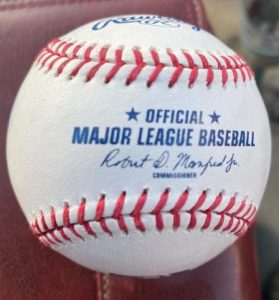
The foul ball, now crossed off my bucket list, sitting atop my notebook, before I handed it to my son.

While the visiting Astros took batting practise, a line drive sailed into our section down the right field line. Adjacent fans made it impossible for me to see just which Astro hit the ball, but the ball bounced around off seats in front of us, then under them, and riocheted off a fan two seats to our right, before rolling on the floor under us to where I could grab the ball before another fan reaching under the seat in front of me did.

I held the ball up to see for myself that I wasn’t seeing or imagining things, then handed it to my son. He’d only been asking to try to catch a ball at Angel Stadium since, oh, the first time I got to take him there—in 2000, when the Angels beat the visiting Yankees one fine evening by prying the winning run out of The Mariano himself. We’d gone to plenty of games since. Thursday night, it was pay dirt at long enough last.

Of course, there was now a game to play, and the Angels lost, 3-1. These are my ten takeaways:

1) Shoh-time! The good news for the Angels was Shohei Ohtani starting on the mound. I’m convinced that what looked to be a lockout-dejected, ho-hum crowd in advance, shot into a near-sellout once Ohtani was announced as the Opening Day pitcher. Lockout after-effect, I suspected: I’d checked the ticketing for the game just prior to the announcement and there were several thousand seats remaining for the taking.

Well, now. The day before I set out for southern California from my home in Las Vegas, I checked the ticketing again. The tickets seemed to have flown off the board once Angel fans knew it would be Shoh-time. And Ohtani didn’t disappoint, much. He pitched four and two-thirds innings of one-run, nine-strikeout, four-hit, one-walk baseball.

The best the Astros could do against him was the third inning, after he caught Martin Maldonado looking at strike three and blew Jose Altuve away with a swinging third strike: Michael Brantley banged a double off the right center field fence and Alex Bregman sent him home promptly with a base hit to left center.

As a matter of fact, when Ohtani wasn’t becoming the first player in Show history to throw his team’s first pitch of the season and make his team’s first plate appearance of the season (the Angels like to bat him leadoff), he manhandled Altuve for three strikeouts on the night, including the nasty slider that shot over Altuve’s hard swing for the third such strikeout in the top of the fiftyh.

2) The bad news: Astros starter Framber Valdez was just as effective in six and two-thirds innings. (The Angels planned to keep their starting pitchers on an 80-pitch limit for the time being, after the lockout-imposed too-short spring training.) He struck six out, walked one, and surrendered two of the Angels’ four hits on the night.

3) The worse news, for the Angels: They came to within inches of taking a 2-1 lead in the seventh. Mike Trout led off by beating out a throw from shortstop that should have been ruled an infield hit but was ruled an error. Then Anthony Rendon hit a high liner that sailed into the left field seats . . . but missed the foul pole on the wrong side by a hair.

“When I saw the ball flying in the air,” Valdez said post-game of his narrow escape, “I got mad with myself that I didn’t make my best pitch. I just took a deep breath and threw my best pitch.” That would be the hard sinkerball on which Rendon promptely dialed Area Code 4-6-3.

Matt Duffy promptly beat out an infield hit to third, which promptly moved Astros manager Dusty Baker to end Valdez’s night and bring Phil Maton in to strike Jo Adell out swinging for the side.

4) Cruising speed: Maton seemed on a bit of a cruise in relief until he hit Brandon Marsh with a pitch with two out in the bottom of the eighth and David Fletcher shot a 1-2 pitch through to the back of left center and gunned it for an RBI triple. That was the Angels’ first and last run of the game, alas.

5) The worse news, for baseball as a whole: That ridiculous three-batter minimum for relief pitchers. Under normal circumstances, if your reliever comes into the game and gets murdered right away—as Angels reliever Ryan Tepera was in the top of the eighth—you’d know he didn’t have it that night, right?

Father and son

Father (right) crossed Opening Day off his bucket list at last—and had the pleasure of doing it with his 28-year-old son.

Oops. Tepera’s first pitch to Alex Bregman sailed into the left field seats. The next Astros batter, Yordan Alvarez, hit a hanging slider on 1-1 over the center field fence. The Angels were lucky to escape with their lives after two prompt deep fly outs (Yuli Gurriel, Kyle Tucker) followed by a sinking liner up the middle (Jeremy Peña) that Trout caught on the dead run in from somewhat deep center to retire the side. (Trout also drew a loud ovation after he turned around and, from half-shallow center, winged the ball to fans halfway up the right center field bleachers.)

6) But there was good news on the relief front. Neither manager burned his relievers in the bullpens. If either Baker or Joe Maddon warmed a pitcher up, he either came into the game as soon as needed or he was handed what amounted to the rest of the night off. No Angels or Astros reliever was called upon to warm up more than once.

I paid as much attention to the relievers in the pen as I could, considering I was seated far opposite the pens behind the left field fence. The Angels used five relievers and the Astros, three. None of those eight pitchers threw any more than maybe 20-25 pitches before they were brought into the game. None of them could be called gassed going in.

Tepera simply didn’t have it Thursday night; Maton got vulnerable after ending one inning and getting two outs to open the next. The rest of the two teams’ bullpen corps (Hector Neris and Ryan Pressly for the Astros; Aaron Loup, Austin Warren, Jose Quijada, and Archie Bradley for the Angels) pitched clean-as-a-hound’s-tooth relief. Would that all major league managers were that judicious handling their pen men.

7) Memo to: Angel fans. Subject: The Wave. The 1980s called. They want their obnoxious, obstructive Wave back. One fan adjacent to our section kept calling for fans to do the Wave. I kept shaking my head, but I did notice that each of about ten attempts at it starting in our part of the park died before flowing to a fourth section of the field-level seats. Maybe there’s hope in such deaths, after all.

8) You were saying? The back-to-back Astro bombs to one side, this game wasn’t exactly the kind to send the old farts screaming to the whiskey shots. The game’s twelve total hits included three Astros doubles, Fletcher’s triple, and six singles. Altuve even stole second in the ninth, for whatever that was worth, since he ended up stranded.

9) Wasted Out Department: Altuve, the Astros’ pint-sized, gallon-hitting second baseman, also dropped a sacrifice bunt to third with one out in the seventh against righthanded reliever Warren, after Chas McCormick opened the inning with a double. Remember: A man on second with one out, and you have less chance of scoring a run after that bunt than you did before the bunt, even if you do exactly what Altuve did pushing McCormick to third.

Just what a man with a lifetime .512 Real Batting Average (total bases + walks + intentional walks + sacrifice flies + hit by pitches, divided by total plate appearances), and a .297 lifetime hitting average with a man on second and one out, is doing thinking sacrifice escapes. With his team leading a mere 1-0 at the time, the Angels brought Quijada in to pitch to Brantley, and Brantley flied out shy of the track in right center for the side.

That’s what a wasted out did. The righthanded-hitting Altuve might have been futile against Ohtani on the night, but he has a lifetime .301 hitting average against righthanded pitchers. The Astros would have had a better chance scoring McCormick if Altuve hit away.

10) When Bregman checked in at the plate in the top of the eighth, the Angel Stadium video boards flashed a graphic with Bregman’s head shot plus this: [He] donated over 200 iPads  w/protective cases and iTunes gift cards to several Houston-area elementary schools that have autistic classrooms. He does that through his Bregman Cares charity, with a particular focus upon autistic children.

It was almost as admirable for the Angels to show Bregman such respectful acknowledgement as it was for Bregman and his wife, Reagan, to take such an interest in lending hands to autistic children. Even if Bregman’s idea of saying thank you for such respect was to smash a leadoff homer in reply.

WS Game Five: Winning in a walk

Martin Maldonado

Maldonado, you’re no longer the weakest link. For now.

The good news is, the Braves can win in Houston. They proved it in Game Two. The bad news is, they’ll need to win there to win the World Series now.

The Astros didn’t let a little thing like a four-run hole after a single Game Five inning on a single swing drive them into an early season’s grave Sunday night.

Not with manager Dusty Baker flipping his lineup a little bit. Not with proving there are times a bases-loaded walk and a well-timed single in the middle of a game are more powerful than a grand slam out of the gates.

Not with the Astros’ heretofore, mostly dormant longtime core finding their bats. And, not with the Braves’ heretofore impenetrable bullpen proving they’re only human, after all, while their own usually tenacious bats mostly went askew following their early slicing, slashing, and thundering.

Their early, incendiary Game Five lead turned into a 9-5 loss to the Astros—but doesn’t have them up against the wall just yet.

“When we won [Game Four], it made it easier, I guess, coming into this one — but we knew it was going to be tough,” said Braves manager Brian Snitker postgame. “That’s just a lot of innings to cover (by relievers) against a club like this that swings a bat so well. The good news is we’ll take a day off and be in good shape.”

Meaning, including and especially, a rested bullpen as well as a re-grouping lineup. But it’s the opposite now of where they stood after Game Five of the National League Championship Series, after the Dodgers flattened them 11-2 in Los Angeles and despite still holding a 3-2 lead in the set.

Then, the Braves’ longtime first baseman and leader Freddie Freeman said they were still in good shape, they still led the set, and they liked their chances going back home to Atlanta. Now, Snitker’s putting the Brave face on and saying, “I’ll take it anywhere. If we win the World Series, it doesn’t matter where it is.”

Two years ago the Nationals proved that in abundance against the Astros. The Braves won’t be winning all needed Series games on the road, but with their Series lead now they need to win only once. It sounds simple when you say it. It’ll be anything but simple when they play it starting Tuesday night.

You can’t get any more profound a reminder of how tough a World Series can be than the Braves got when they only thought they had the Astros buried alive in the bottom of the first Sunday night.

They loaded the bases on Astros starter Framber Valdez with a leadoff base hit by Jorge Soler, a two-out single by Austin Riley, and a 3-1 walk to Eddie Rosario. Then Adam Duvall couldn’t wait to drive Valdez’s first service to him into the seats above the right field wall.

Hindsight’s almost as wonderful as foresight. Snitker has both in abundance. This time, though, hindsight was his BFF. “I’d rather we scored those runs in the seventh inning when you don’t have so much time to cover,” the manager said postgame. “We knew we had a long, long way to go in that game and anything could happen.”

Anything did happen, right away.

Heretofore slumber bat Alex Bregman hit with first and second and one out in the second and lined Braves opener Tucker Davidson’s the other way, all the way to the right center field wall, scoring Yuli Gurriel (one-out, one-hop single to center). Heretofore macaroni bat Martin Maldonado sent Kyle Tucker (full-count walk) home with a sacrifice fly cutting the Braves’ lead in half.

The Astros might have gotten one more run home but for the next batter—Valdez himself. Two swinging strikes around a ball in the dirt, then looking frozen at strike three on the inside forner after a ball just low. You still don’t want the designated hitter in the National League’s parks, old farts? Imagine if the Astros didn’t have to bat Valdez there. They might only have had a one-run deficit to end the frame.

No matter. Their unraveling of the Braves began the very next inning, when Dansby Swanson at shortstop misplayed Jose Altuve’s leadoff hopper, bumping the ball from his glove, recovering too late to throw the swift Mighty Mouse out at first. The rest of the Series will prove whether or not that’ll be this postseason’s most egregious Braves mistake of all.

Davidson walked Michael Brantley on a 3-1 count and Carlos Correa—another of the formerly dormant-at-the-plate Astro core—doubled Altuve home. A fly out later, Brantley scored on Gurriel’s ground out to short. Tie game. The tie lasted long enough for Freeman to lead the bottom of the third off with a mammoth full-count, tiebreaking blast half way up the right center field seats.

The 5-4 Braves lead lasted until the bases loaded and two out in the top of the fifth. Checking in at the plate: Maldonado, the Astros catcher still vying for the title of the single most automatic Astro out, after the Braves ordered Bregman walked on the house to load the pads in the first place.

What came next may yet prove one of the ten most powerful walks of all time. Maldonado looked at ball four inside from Braves relief star AJ Minter, sending Correa (leadoff one-hop base hit to center) strolling home with the re-tying run. Martin, you’re no longer the weakest link. For now.

Not only did Maldonado get daring enough to stand right on top of the plate during the entire plate appearance, the better to get an edge against Minter’s cutter, he even showed bunt as ball four sailed in. He didn’t do it for a laugh, either.

“He came back to the dugout yelling at me, ‘You like my Little League bunt?'” said Astros hitting coach Alex Cintron postgame. “He was prepared before he stepped up to the plate. He was ready for that at-bat. That made the difference.”

“I thought of it in the moment,” said a grinning Maldonado. “I wasn’t going to swing until 3-2. Maybe it would throw him off.”

Then Baker sent Marwin Gonzalez—returned to the Astros after a detour through Minnesota and Boston when the Red Sox released him in August—out to pinch hit for Jose Urquidy, whose shutout fourth set him up to get the Game Five “win.” Gonzalez dumped a floating quail into left center that hit the grass with room enough to send Gurriel and Bregman home with a 7-5 Astro lead.

Maldonado lined Tucker home with a base hit off another Braves pen man, Drew Smyly, in the seventh, and Correa—perhaps sensing Smyly was really taking one for the team now—singled Altuve home with the ninth and last run in the eighth.

Baker made a few pre-game moves to shake his lineup a bit, particularly moving the previously slumping Bregman down to bat seventh. The third baseman’s struggles at the plate this postseason became that alarming—to the manager and to Bregman himself.

“I’ve got a really weak top hand right now,” he said. “I’m releasing the bat behind me, which is causing a ton of problems.” He spent pre-game batting practise all but forcing himself into a two-handed swing finish. It helped when he knocked that second-inning RBI double. It damn near helped him hit one out his next time up.

“The second at-bat, I just missed what would have been a three-run homer, just barely missed under it,” Bregman said. “I’ve got to fix a weak top hand. Normally I hold (the bat) tight and squeeze it, kind of. I’m not able to do that right now.” Missing more than two months of the regular season didn’t exactly do him many favours, either.

For Minter’s part, he credited the Astros with finding their swings when they looked pinned otherwise. “I felt my stuff was just as sharp tonight as it was in other outings,” the lefthander said postgame, denying any fatigue factor from his previous prominent presence. “I felt like I was 1-2, 0-2 on every hitter. Those guys made quality swings on two strikes.

“I guess I could have made some better pitches with two strikes,” he continued, “but with Correa, I got him 0-2, left a cutter up, base hit. Got a good strikeout against Alvarez. And then Gurriel — cutter, backdoor cutter. He stuck his bat out there and had a good hit as well.”

Minter and the Braves now have down time enough to regroup and refresh. They still have the Series lead, even if the Astros and their fans might prefer to think the Braves have the Astros right where the Astros want the Braves.

The better news is, at least we’re rid of that infernal, obnoxious, demeaning Tomahawk Chop for the rest of the calendar year and—barring unforeseen wisdom from baseball’s governors—at least until next spring’s exhibition games begin.

Now, if only we could get rid of the Big Ben tolling, bonging chime that rings in both Truist Park and Minute Maid Park for the rest of this Series. Ask not for whom the bell tolls. It tolls too early, too often, and it’s enough to drive a bat in the belfry bats.

Both parks’ public address people have a habit of sounding Big Ben before the home team has the win secured. It’s pretentious and presumptuous. Almost worse than the Truist Park organist’s too-insulting walk-up serenades to some Astro hitters. Good for perverse laughs among the home audience, good for Astro incentive at the plate. Brilliant.

Wise up, Braves and Astros. The Phillies’ people in Citzen’s Bank Park use Big Ben, too. But at least they have the brains to wait until the Phillies can take a win to the bank.

WS Game Two: Hunted, pecked, pricked, poked

Max Fried

Max Fried—getting stung repeatedly in the second hurt almost worse than if he’d been bludgeoned.

If you look purely at the line score of World Series Game Two, you’d think the Braves had their heads handed to them in the bottom of the second. But if you watched the game, you know the Astros dismantled them, almost too simply, and with some inadvertent help from the Braves themselves, to win 7-2 Wednesday night.

As a matter of fact, when the game began you could have been forgiven for thinking it might turn into a bit of a pitching duel despite the teams swapping a run each between the bottom of the first and the top of the second—one on a solo home run, one on a sacrifice fly.

Overall that’s about how the game shook out—if you didn’t include the Astros’ hunt-peck-prick-and-poke of four runs out of Braves starter Max Fried in the bottom of the second, after he fooled Carlos Correa into looking at a particularly nasty third-strike curve ball. Jose Altuve’s eighth-inning home run almost seemed a by-the-way insurance run.

“We didn’t want to go to Atlanta down by two,” Altuve said postgame. “So we left everything we had in there tonight. Obviously, very important win to tie the Series to keep going from there.”

“Obviously, I’m not happy about it.” said Fried. “Playoffs is a big momentum game. You’ve got to do everything you can to keep the crooked number off the scoreboard.”

It might actually have hurt less if he’d been bludgeoned than it did the way he was pecked in the second. And, if Astros starter Jose Urquidy hadn’t brought his A game to the mound, leaving the Braves mostly unable to hit him even if they’d swung warehouse gates.

Fooling Correa into the strikeout must have seemed aberrant even to a pitcher who struck out six in five innings’ work and walked only one batter. The second inning made Fried’s outing look far worse than it was in the long run, but a true shelling it wasn’t. It was like getting stung by angry hornets one after the other a few times before he finally slithered out of it.

It started with Kyle Tucker spanking a base hit up the middle and Yuli Gurriel punching one through the shift-opened right side for a base hit to follow up at once, sending Tucker to third. Fried jammed Jose Siri into a slow tumbling grounder to the far left side of the mound, but Tucker came home when they couldn’t get the swift Siri at first.

Then Martin Maldonado, a catcher so prized for his work behind the plate that Astro manager Dusty Baker bears with his pool noodle of a bat, punched one through the left side for a base hit. The problem now was the Braves’ usually sure-handed, sure-armed defense.

Left fielder Eddie Rosario came up with the ball and threw to third in a bid to stop Siri if they couldn’t stop Gurriel from scoring. Only third baseman Austin Riley came trotting down the line to serve as the cutoff man, and shortstop Dansby Swanson got caught unable to get to third covering in time because he was in short left. Rosario’s throw thus sailed wild and Siri sailed home with the fourth Astro run of the night. Ouch!

Maldonado went to second on that throw and took third when Braves catcher Travis d’Arnaud let one escape with Altuve at the plate in an 0-2 count. Altuve flied out with Maldonado having to hold at third, but Michael Brantley pulled a base hit to right on which Maldonado could have walked home safely, making it 5-1.

Innings like that are as common to the Astros when they’re swinging right as you might think the big bombing innings would be. But they were the best in the game this year at avoiding strikeouts at the plate and hitting in most directions out to the field.

They may also have picked up on Fried tipping pitches. No, they’re not pulling another Astro Intelligence Agency trick or three. The rules since Astrogate’s explosion and aftermath include maximum replay room security. But the Astros were known without and before any Astrogate shenanigans for picking up even the tiniest tells from opposing pitchers and exploiting them mercilessly.

Fried’s habit of wiggling his glove fingers around the ball in his hand rapidly as he prepares to throw to the plate, like an amphetamine-driven lobster clawing its dinner down to manageable bites, may well have handed the Astros inadvertent but invaluable pitch  intelligence. After the second, Fried quit the glove snapping for the most part—and retired the next ten hitters he faced.

When Yordan Alvarez walked and Correa sent a base hit to left opening the bottom of the sixth, Braves manager Brian Snitker hooked Fried in favour of Dylan Lee. After Tucker forced Correa at second with Alvarez taking third, the Braves’ defense faltered into the sixth Astro run.

Gurriel grounded sharply to Swanson at shortstop. He threw to second baseman Ozzie Albies hoping to start an inning-ending double play. Albies lost the ball as he turned to throw on to first. Tucker was ruled safe until a review was called—did Albies have control of the ball to get the out while losing it as he drew the ball out of his glove to throw on?

Several television replays showed Albies lost control of the ball after all, but not by as much as first surmised. The safe call held, and Alvarez scored, but Albies’s throw wasn’t in time to get Gurriel at first. Lee shook off a rather daring double steal to set up second and third by striking Siri out. Snitker brought in Jesse Chavez, and Chavez got Maldonado to fly out for the side.

The Braves got their second run in the top of the fifth when Freddie Freeman singled d’Arnaud home. Other than that, both bullpens kept each side behaving itself except for Altuve sending Drew Smyly’s first pitch of the bottom of the seventh into the Crawford Boxes, before the veteran reliever fell into and squirmed out of his own bases-loaded jam with no further damage.

Maybe the true shock of the evening was the Braves handing the ball to Kyle Wright for the bottom of the eighth. Wright’s a 26-year-old pitcher with a 6.56 fielding-independent pitching rate in four seasons. He had a 9.64 FIP and a 9.95 ERA in two brief starts on the regular season while up and down from the minors.

Throwing that against the Astros was something like offering to assure Hall of Famer Henry Aaron would face nothing but batting practise pitchers by decree, right? Wrong. Wright shocked the entire ballpark by striking the side out in order—including Maldonado and Altuve looking at third strikes after Siri opened with a three-pitch swinging strikeout.

“It was so encouraging to see Kyle tonight,” said Snitker postgame, even if he was thrown up as a sacrificial lamb in a lost game. “Just getting in there for that one inning and getting him out there and experiencing this atmosphere because he could play a huge part going forward. I thought he threw the ball extremely well.”

Wright lived on effective curve balls and sinkers Wednesday night. Snitker was inspired enough to ponder possibilities for Wright to spot start or even open a bullpen game during the Atlanta leg. With Charlie Morton gone thanks to that fibula fracture, Snitker needs to get even more creative with his pitching arrays now. Wright’s surprise may lift some of that burden a hair or two.

“He was locating,” said catcher d’Arnaud postgame. “His sinker was moving a lot. His curveball was moving a lot. He did a tremendous job. When I caught him in a rehab game for me, he looked exactly the same as he did that day. It was fun working with him, and it was great seeing him have the success today, especially in the World Series.”

With the tied Series moving to Atlanta for three possible games, thus switching the Braves to a home field advantage, it’s comforting to know that near the end of a night the Braves were pecked to death they might have found the Wright stuff, for however long.