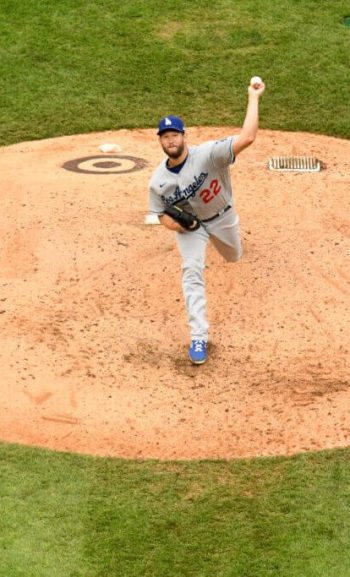
The All-Star Game was Clayton’s place

Clayton Kershaw, Blake Grice

National League All-Star starter Clayton Kershaw with fan Blake Grice, who touched Kershaw by telling the future Hall of Famer he was meeting him for Grandpa’s sake.

By right, this year’s All-Star Game start for the National League should have belonged to the Marlins’ Sandy Alcantara (he leads the Show’s pitchers with 5.3 wins above replacement level and his 1.76 ERA). And if the game were played someplace other than Dodger Stadium, it might have been Alcantara’s to start.

Braves manager Brian Snitker, managing the NL All-Stars as the previous season’s World Series skipper does, had his own idea. Especially since this was the first All-Star Game in Dodger Stadium since Jimmy Carter was still in the White House, and a Dodger icon was having an All-Star worthy season himself.

So Snitker elected to hand the opening ball to Clayton Kershaw. A Hall of Fame lock, approaching the sunset of an off-the-charts career, starting the All-Star Game in his home ballpark. You could imagine Snitker thinking to himself that you couldn’t pay to pre-arrange more serendipitous circumstances. Even with his own All-Star Max Fried among his pitching options.

It was a class gesture by the defending World Series-winning manager. Only one thing could have seen and raised, and that one thing was Kershaw himself. By most reports, one of the first things the 33-year-old lefthander did when Snitker called him to say the opening ball was his was to call Alcantara himself.

“He was awesome about it. I was really thankful about that,” Kershaw said, after the American League hung in for a 3-2 win through no fault of Kershaw’s own.

He let himself take the entire atmopshere in, even foregoing his usual pre-start intensity that compels teammates, coaches, and even his manager Dave Roberts to say nothing much more than “hello” to him. (He even let Roberts share lunch with him on Tuesday.) About the only thing Kershaw did remotely work-related was study some American League scouting reports.

One he didn’t have to study was Shohei Ohtani (Angels), whom Kershaw retired thrice when pitching last Friday. Wary of opening the All-Star Game with one of his signature breaking balls, Kershaw pumped a fastball that doesn’t have its former speed and Ohtani—interviewed before the game, promising to swing on the first pitch—smacked a broken-bat floater up the pipe into short left center for a leadoff single.

Then, having Aaron Judge (Yankees) 1-2, Kershaw suddenly couldn’t think of what to throw next. Some described him as buying time when he lobbed a throw to first. He bought more than he bargained for. He’d caught Ohtani having a snooze. Ohtani had drifted away from the pad and Kershaw’s lob turned into the first All-Star pickoff in fourteen years.

The two-way Angel could only laugh. Kershaw could only grin after first baseman Paul Goldschmidt (Cardinals) tagged Ohtani out. Dodger Stadium went nuclear. Kershaw finished striking Judge out, walked Rafael Devers (Red Sox), and lured Vladimir Gurrero, Jr. (Blue Jays) into an inning-ending ground out. The man who wanted to take it all in from start to finish then ducked out of sight and to a press podium under the ballpark.

Shohei Ohtani, Clayton Kershaw

All they could do was grin and laugh after Kershaw (right) picked Othani off first while working to Yankee bombardier Aaron Judge.

While the National League took an early 2-0 lead with Mookie Betts (Dodgers) singling home Ronald Acuña, Jr. (Braves; leadoff double off AL starter Shane McLanahan [Rays]) and—after a double play grounder by Manny Machado (Padres)—Goldschmidt hammering one into the left center field bleachers, Kershaw finished his press conference with a ten year old boy raising a hand.

“What’s up, dude?” Kershaw asked pleasantly.

The boy introduced himself as Blake Grice and told Kershaw how much his late grandfather loved both him and the Dodgers’ long-enough-retired broadcast deity Vin Scully and had wanted to meet them both. (His family had passes courtesy of MLB itself.) “So this moment is important to me,” the boy continued, “because I’m meeting you for him.”

The father of four children himself, Kershaw couldn’t resist when he heard that and saw the boy’s tears of likely gratitude for getting to do something for his grandpa in the presence of a Dodger icon who’s been the closest the Dodgers have had to longtime eminence Sandy Koufax.

“Come here, dude,” Kershaw beckoned. He hugged the boy, gave him a clap on the back, and said, “Great to meet you. Thanks for telling me. That took a lot of courage to tell me that. Your grandad sounded like an awesome guy.” When Kershaw asked Blake if he had a parent with him, the boy’s father held up his cell phone. Kershaw beckoned him forward and he snapped a photo of the pitcher and the boy speaking for Grandpa.

It was more than enough to atone for the prayers thousands of fans in the ballpark and perhaps the millions watching on television must have had that, despite going down to its ninth straight All-Star loss and 21st such loss in 25 such games, the National League didn’t tie the game in the bottom of the ninth.

That’s because the latest to emerge from baseball’s apparent laboratory of mad science would have had the game decided in favour of the Home Run Derby winner’s league if nine full innings ended in a dead heat. (On Tuesday it would have been the National League, thanks to Juan Soto [Nationals] winning the Derby.) Thank God and His servants Branch Rickey and Jackie Robinson that that didn’t come to pass.

The AL overthrew the NL lead with one out in the fourth when Giancarlo Stanton (Yankees) batted with Jose Ramírez [Guardians] aboard (leadoff single) and took Tony Gonsolin (Dodgers) far into the left center field bleachers. Byron Buxton (Twins) following at once found himself ahead in the count 2-1 when he caught hold of a Gonsolin fastball up and drilled it into the left field bleachers. Just like that, Gonsolin had surrendered 882 feet worth of home run travel.

Buxton admired game MVP Stanton’s blast from the on-deck circle and thought to himself, “I ain’t matching that.” Until he damn near did. “I don’t even know if you can put it in words how hard [Stanton] hit the baseball,” Buxton said after the game.

It made all the difference when the game otherwise became a pitching duel of sorts between eleven American League pitchers (including Framber Valdez [Astros] getting credit for the “win” despite striking nobody out in his inning’s work) and nine National League pitchers including the hapless Gonsolin tagged for the loss and, officially, a blown save.

For just the sixth time in four decades an All-Star pitcher got to start the game in his home ballpark. And for a few shining moments on the mound, Kershaw gave his home park’s audience a thrill topped only by the one he gave a ten-year-old boy looking to do his grandpa in the Elysian Fields a favour that couldn’t be done while the older man still lived on earth.

None of the highest highs or the comparatively few lows he’s endured in fifteen major league seasons have let Kershaw forget that baseball at core is about rooting, caring, loving. He had the parallel chance to remind a Dodger Stadium audience about it and to affirm it for a ten-year-old boy. He didn’t flinch at either opportunity.

Platinum arm, platinum man, cast in bronze

Sandy Koufax

Sandy Koufax with his wife, Jane Parucker Clarke, afront the statue unveiled at Dodger Stadium Saturday afternoon.

Hall of Fame pitcher Sandy Koufax’s least favourite subject has always been himself. It was to wonder, then, just how he’d handle things when he came to the center field plaza behind Dodger Stadium Saturday, when a statue honouring what he means to the franchise and to baseball itself was unveiled.

It turned out that Koufax knew how not to rise to even the bait of his capture in bronze, frozen in his once-famous high and broad right leg kick as his left arm prepared to deliver to the plate.

After a tribute film was shown to the gathering, he began by quipping, “I think the film said everything I wanted to say, so I’ll be leaving now.” The gathering, which included his protegé/friend Clayton Kershaw and Hall of Fame manager/former catcher-third baseman  Joe Torre, laughed heartily enough.

People who meet him testify that he’ll talk your ears off if the subject isn’t him, preferring to learn about them, but the moment the subject becomes him he makes Puxsatawney Phil resemble a 24/7/365 social butterfly.

His best biographer, Jane Leavy, has described him as a man who’d love nothing more than to be just another fellow in the neighbourhood. Just like any other fellow who has a plaque in Cooperstown and spent the bulk of his post-playing career living as a kind of renaissance man learning about things as diverse as flying, restoring houses, theater, music, and wine, and once carrying a business card identifying himself as “Peregrination Expert”—an expert at making a long, long journey.

Come Saturday, after opening with maybe the cleverest reimagining possible of Groucho Marx’s once-famous warble, “Hello, I must be going,” the peregrination expert talked for ten minutes. Getting him to speak that long in public is an achievement worthy of a combat decoration as it is.

But he talked about practically anyone except himself. Just as he had fifty years to the day earlier, when he was inducted as the youngest man ever elected to the Hall of Fame. A day intended to do him honour—and he did call it the greatest honour of his life—turned out to be the day Koufax preferred doing honour to about sixty people who had affected his life and career.

From the high school catcher whose father urged him onto the sandlot team the older man coached to the University of Cincinnati basketball coach (Koufax attended on a basketball scholarship) who also coached the baseball team and welcomed him there. From Jackie Robinson, the only other Dodger to be secured in bronze outside that center field plaza, whom he called a teammate and friend who “went out of his way to make me feel welcome and I’ll never forget his kindness on that,” to every pitching coach he had. (Both Robinson’s and Koufax’s statues come from the same sculptor, Branley Cadet.)

From his only major league manager, Hall of Famer Walter Alston (I’m not sure if he was happy with me as a bonus player, but we came to have a pretty good relationship through the years) to assorted roommates such as Doug Camilli (reserve catcher), Dick Tracewski (second baseman, and his roommate the morning he awoke to an elbow swollen so profoundly it turned into the [for public consumption] arthritis diagnosis that ultimately put paid to his pitching career), Norm Sherry (the reserve catcher who helped him correct the hitch that kept him from greatness until 1961), and Carl Furillo (the Brooklyn legend with the steady bat and the throwing arm that got him nicknamed the Reading Rifle).

From all his teammates during his twelve major league seasons—particularly his longtime catcher John Roseboro but also the Dodgers’ all switch-hitting infield of 1965 (Jim Lefebvre, Wes Parker, Jim Gilliam, Maury Wills)—to his relief pitchers (particularly Ron Perranoski and Phil [The Vulture] Regan). From the trainers and clubhouse manager Nobe Kowano to Vin Scully. (GOAT used to be a bad thing, now it’s greatest of all time. Well, that’s the end of the discussion. Vin Scully is the greatest of all time.)

“I think my only regret today,” Koufax said near the finish, “is that so many are no longer with us and I’m unable to let them know how much I thank them and appreciated them. Thank you to all the fans who treated me so well, and tell them how lucky they are to have such a competitive team to root for for so many years.”

“I remember one of the first times I got to sit down and speak to Sandy, it was on a flight to L.A. for Joe’s charity event,” Kershaw said before his longtime mentor and friend took his turn. “And I was sitting there, and I thought, Sandy and Joe, some old ballplayers, I’m just gonna have to sit through ‘Back when we played,’ or, ‘This is how I used to do it,’ and I thought I was going to have to sit through that the whole flight.”

Koufax would crack in due course, “Conventional wisdom has always said, ‘Don’t give an old man a microphone, he’s got too many years to talk about’.”

“But it was a far cry from that,” Kershaw continued. “I got to know Sandy on that flight and after that I thought, Wow, Sandy genuinely cares about how I’m going to do in this game. From then on I was able to talk to Sandy. He’d call me when good things happened and congratulate me. He’d call me when bad things happened to encourage me. He’d even call during the offseason to check in on Ellen and I and see how the chaos of our life had gone with our four kids.”

Koufax has no children of his own, but he has been remarried happily to his third wife, Jane Parucker Clarke, for almost two decades and counting. Once, appearing at the first showing of a documentary about Jews in sports, Koufax had a small chat with New York Times writer Ira Berkow. After Koufax seemed somewhat reserved when told most boys of his generation dreamed of striking out the Yankees and he’d done it in a World Series, Berkow asked what Koufax did dream about. Koufax pointed to his lady without missing a beat and replied, “Her.”

Those who knew him in his playing days continue to be solicitous without being obstreperous about his accomplishments. (“I have to be careful how I word things,” Torre told the Saturday gathering, “because I say I hit against Sandy Koufax, but I have to take that back: I faced Sandy Koufax.” For the record, Torre couldn’t hit Koufax with a hangar door: a pair of home runs but a .220/.233/.339 slash line against him.)

My own call is there’s a statistic that, even in the pitching-friendly era during which Koufax went from good to great to off the charts, says more about him than the 699 strikeouts he nailed in his final two, painfully overmedicated seasons. (Including the then-record 382 he bagged in 1965.)

Koufax’s fielding-independent pitching rate (FIP: you can see it as your earned-run average when the help from your defense is removed from the equation) for his final six seasons, the seasons that made him the ultimate peak-value Hall of Famer, is 2.18. Granting the stat applies retroactively, in his case, but ponder this: Sandy Koufax led the entire Show in FIP—the measure of what he himself was responsible for, including keeping the ball in the park, striking the other guys out, keeping the walks and hit batsmen to a minimum, everything he himself could control in a baseball game—for six consecutive seasons, and it averages out to 2.18 for the six. Even in a pitching-friendly era, that’s a surrealistic accomplishment.

So often compared to Koufax as a lefthanded pitcher, Kershaw preferred to honour Koufax the friend. “I was looking back at the time we were at [Scully]’s retirement ceremony on the field and something you said stuck with me, about Vin,” he said. You said that the thing you treasure most about Vin is that he allows you to call him a friend. And that’s the same for me. So, I’m grateful for that, Sandy. I know you don’t believe it, but there is no one more deserving of this honor.”

Kershaw had to hold tears back when he said it.

“Ted Williams, Joe DiMaggio, and Sandy,” Steve Garvey once told a reporter. “They’re the only ones that seem to grow bigger with the years.” It may depend upon how you define “big.”

Williams became a kind of cantankerous roving hitting instructor in his retirement, when not indulging his parallel passion for fly fishing, often still out to prove he knew best. DiMaggio presented himself as regal and demanded regal treatment. They seemed too aloof even in crowds on their own behalfs. Koufax guards his privacy powerfully but he’s considered accessible enough if you don’t treat him like a royal or a deity.

He’s probably been the least cantankerous or self-possessed baseball legend of his time, except perhaps for the late Yogi Berra. He’s turned up at Dodger and other spring camps over several decades to instruct and observe, to share but not “prove” his knowledge. “A lot of people look around to see how they can keep you from climbing up there with them,” the late fellow Hall of Famer (and longtime Dodger) Don Sutton once said. “Sandy has always gone out of his way to pull everybody up there with him.”

“To the extent that he removed himself from public view,” Leavy wrote in her biography, “it was not so much because he believed there are no second acts in American life as because he was determined to have one. He does not disavow who he was or what he accomplished. He is proud of it. He simply refuses to exist in cinders and ashes. He doesn’t speak of himself in the third person, but he does think of ‘Sandy Koufax’ as someone else, a persona separate from himself. If he was seeking refuge from anything, it was that.”

Having pulled everyone else up there at his own statue-unveiling ceremony, there was but one way for Koufax to conclude, and he did just that. “For all of you who came out,” he said, “thank you. To my family and friends, I love you one and all. I’m done.”

Bauer outage: suspended two years

Trevor Bauer

Bauer’s two-year suspension won’t ease his victims’ pain or his way back to baseball—and in that order.

In considering Trevor Bauer’s unprecedented two-season suspension Friday for violating MLB’s domestic violence protocols, under which he won’t be paid and the Dodgers will be off the hook for the rest of his salary, I can’t help harking back to something pointed out last August. That’s when Los Angeles County Superior Court Judge Dianna Gould-Saltman lifted a temporary restraining order against the pitcher.

During the hearings preceding that lift, the victim in the case testified for twelve hours. Bauer’s legal team may have drawn some inconsistencies from her regarding secondary items, but as Cup of Coffee writer and former NBC Sports analyst Craig Calcaterra wrote then, they never discredited “the central claim that he assaulted her in horrible ways.”

Maybe that makes it harder for the accuser to recover any money from him in a civil suit. Maybe that makes a prosecutor less likely to bring a criminal claim against Bauer for fear of the case being difficult. But the central truth of this entire affair—the stuff that Major League Baseball will look to regarding Bauer’s behavior, irrespective of whether charges are brought—points pretty clearly to Bauer doing exactly what his accuser said he did. Everything else is secondary.

After 12 hours of testimony, his accuser said, under oath, “I did not consent to bruises all over my body that sent me to the hospital and having that done to me while I was unconscious.” There was zero evidence presented which explained how those bruises appeared in a way that was benign or refuted the idea that the woman was unconscious when Bauer inflicted them. That, in my mind, is all that matters. (Emphasis added.)

This past February the 31-year-old righthander found himself off the purely legal hook, after Los Angeles County prosecutors decided not to press criminal charges against him. “Those words don’t say the evidence is false,” I wrote at the time, “as much as they say getting a criminal conviction at trial would be tougher than hitting an outside slider over the center field fence.”

The Dodgers knew Bauer was a mere misogynist when they signed him as a free agent in February 2021. “The Dodgers didn’t know Bauer would be accused of sexual assault,” writes Los Angeles Times columnist Dylan Hernández. “However, they knew he was always in some sort of trouble.

They knew how respected baseball people such as Kevin Towers and Terry Francona wanted nothing to do with him. They knew he sliced open his pitching hand repairing a drone.

They knew he threw a ball over the centerfield wall instead of handing it to the manager when he was taken out of a game. They knew of his online harassment campaign against a female college student . . . The question was never about whether Bauer would get into trouble; the question was about what kind of trouble he would get into.

But almost from the moment Bauer’s suspension was announced, defenders sprang up all around the social media universe to decry justice denied. He was cleared of all wrongdoing by a court of law! Well, not exactly. Wrongdoers aren’t always compelled to answer for their wrongdoing in the courts.

Employees from the most obscure clerk, warehouse worker, or line worker, to the highest-powered executives do get suspended and even fired from their jobs over wrongdoings that won’t get them into legal trouble at all, never mind prison time or fines. They are no less wrongdoings for lacking the weight of the law’s punishments.

Why would baseball suspend Bauer two full seasons if prosecutors decided they couldn’t get a criminal conviction against him? ESPN writers Alden Gonzalez and Jeff Passan asked and answered:

The standards in criminal and civil cases differ from those of a private business. The judge dissolving the temporary restraining order and declining to issue a permanent one does not absolve Bauer of liability within the joint policy. Neither does a prosecutor passing on pressing charges.

MLB’s imposed discipline is based on its own investigation, separate from the criminal proceedings. The league’s investigation into Bauer’s case lasted 10 months. Details about MLB’s findings have not been released, but the league’s investigators considered more than just the sexual assault allegations of the San Diego woman from last year. They looked into at least one other allegation, from an Ohio woman who sought a temporary restraining order against Bauer in June of 2020, details of which were reported by the Washington Post.

Hours after Bauer’s suspension was announced, the Post published a story about another Ohio woman who accused Bauer of choking her unconscious without consent during sex on multiple occasions over the course of a relationship that dated back to 2013. Bauer strongly denied those allegations, as he did the allegations by the other women. But the two Ohio women told the Post they cooperated with the league’s investigation, and we don’t know if others were involved as well.

What kind of sex you enjoy is irrelevant so long as it’s with a fellow human and under mutual, conscious consent. What you do while your partner is unconscious and thus unable to consent any further is very relevant when you’re being investigated formally after accusations of sexual assault, whether it’s a legal investigation or one by your employer.

There are those among Bauer’s defenders who raise the question as to why it should have been Bauer and not other known domestic violence violators to be hit with a hammer as heavy as the one with which he’s been hit. (Bauer said at once he’d appeal the suspension.) That’s not an unfair question.

Among others, Yankee relief pitcher Aroldis Chapman was suspended thirty games in 2016 for choking his girlfriend and possessing a firearm he fired into a wall. Then-Cubs infielder Addison Russell was suspended forty games in 2018—after the Cubs lost the National League wild card game—for beating his now-former wife. Braves outfielder Marcel Ozuna was suspended twenty games retroactively in November 2021 over what proved to be trying to choke his wife before throwing her against a wall and hitting her with the cast on his broken left hand.

Those were letting such crimes off the hook too easily, even allowing that those players “accepted responsibility” for their acts. But then free agent reliever Sam Dyson was suspended for the entire 2021 season after his former girlfriend accused him of rape, battery, and psychological abuse.

Some of Bauer’s defenders think commissioner Rob Manfred came down heaviest upon Bauer because Bauer’s been an outspoken critic of of Manfred’s administration in the past, before his sexual assault issues came forth. A very few of those defenders even implied Bauer’s entire domestic violence issue might have been ginned up as a way to try shutting him up.

Even Manfred isn’t that foolish. You’d have to have precisely the imaginative mind Manfred lacks to forge that kind of plot just to push a particulaly outspoken critic to one side. Even if you’re a commissioner who can be accused of abuse of power. But there is a way for Manfred to show he doesn’t care what his in-game critics say or think when it comes to certain very grave matters.

Get with the Major League Baseball Players’ Association and adjust the domestic violence protocol to allow for suspending any player found violating baseball’s domestic violence policy for one full season’s worth of games minimum from now on. I phrase it that way because they won’t all come forth before a season begins, as Dyson’s did.

The bad news is that even that won’t ease their victims’ pain. But it would send forth a more powerful affirmation that baseball suffers no domestic violence benignly and that, no, Bauer wasn’t just singled out for particular punishment, for any corresponding reason.

“But . . . history, dammit!!!”

Clayton Kershaw

Clayton Kershaw pitching in Target Field, against the Twins, Wednesday. He was lifted after seven perfect innings and the world went nuclear.

Finally, Steven Kwan went hitless. It took his sixth major league game before somebody’s pitchers finally found ways to get him out all day long, if you don’t count the bases-loaded walk he took in the second to start the scoring in a 7-3 Guardians win.

Then Vladimir Guerrero, Jr. smashed three home runs against the Yankees in the south Bronx, including a pair off Yankee ace Gerrit Cole, en route a  6-4 Blue Jays win, a performance that had even the Yankees dropping their jaws in amazement.

Those might have been the top stories Wednesday if not for Clayton Kershaw and Dave Roberts.

Kershaw pitched seven perfect against the Twins in Minneapolis. Despite his having thrown “only” seventy pitches while striking thirteen Twins out including striking the side out in the sixth, Kershaw didn’t come back for the eighth inning. Roberts ended Kershaw’s day knowing both men agreed he’d be on a limited leash in his first season’s start at all, never mind pitching in temperatures in the thirties.

The world went nuclear over it.

Sometimes during the uproar it seemed nobody wanted to listen when Kershaw postgame explained, among other things, “I knew going in that my pitch count wasn’t going to be one hundred. It’s a hard thing to do, to come out of a game when you’re doing that. We’re here to win. This was the right choice.”

He’s Clayton Freaking Kershaw and he should have been entitled to finish that perfect game!

“Those are selfish goals. We’re trying to win,” said the lefthander who pitched a no-hitter in 2014 and whose black ink from ages 23-29 has already secured his reservation in the Hall of Fame.

That’s really all we’re here for. As much as I would’ve wanted to do it, I’ve thrown 75 pitches in a [simulated] game, and I hadn’t gone six innings, let alone seven. Sure, I would’ve loved to do it. But maybe I’ll get another chance.. . . I would have loved to have stayed, but bigger things, man, bigger things . . . Earlier in my career, I’d be built up to a hundred pitches. Blame it on the lockout. Blame it on me not picking up a baseball until January. My slider was horrible the last two innings. It didn’t have the bite. It was time.

Whaddabout history?!? Whaddabout entertainment?!? This is the way baseball brings the fans back?!?

What about the injury history of a 34-year-old pitcher, working in that 30-degree temperature range in crisp Minnesota, after an owners’ lockout-imposed badly abbreviated spring training, and coming off a season ended by forearm/elbow inflammation, accompanied by speculation he might even face Tommy John surgery? To say nothing of Kershaw not picking up a ball until January because of continued recovery from that forearm issue?

Goddam analytics!!!!!

Protecting a pitcher’s health—which is exactly what Roberts did, presiding over a starting rotation about whose long-term health Roberts has said on the record is the key to the Dodgers’ long-term seasonal health and success—has absolutely nothing to do with analytics. All the analytical information available to managers and players about their own and their oppositions’ tendencies isn’t going to tell you whether or when a player’s liable to incur injuries. Analytics aren’t that smart.

“It was a short spring training after a lockout,” reminded no less than Aaron Gleeman, who covers the Twins for The Athletic. “He’s not fully built up. Nothing to do with analytics.”

Nolan Ryan wouldn’t have come out after only seventy [fornicating] pitches, and his manager would have had a fight on his hands if he tried to lift Ryan!!!!

Any time any starting pitcher gets the early hook for any reason in any circumstance—never mind that most managers now have their starters on pitch limits in an admirable bid to compensate for the too-short spring training preparation and assure their long-term season’s health as best as possible—there still comes even one ignorant Ryan name-drop. This one delivered truckloads of them all around social media.

I’m going to let Athletic analyst Keith Law say it for me as I also did when reviewing the book in which he said it, The Inside Game: Bad Calls, Strange Moves, and What Baseball Behaviour Teaches Us About Ourselves, two years ago:

The center square on your [Pitch Count Bingo] card is Nolan Ryan, whose name is certain to come up in any attempt to discuss the limits of the human body to throw a projectile at 95 mph repeatedly over a three-hour span . . .

Nolan Ryan was a physical marvel, and an extreme outlier when it came to durability, although most discussions of the latter ignore the part where he missed 1967 and 1968 with persistent arm trouble. Ryan did things we will probably never see again, not now that pitchers throw harder than ever and play more than ever as kids, while teams work to keep their most gifted pitchers healthy until they reach the majors . . .

Nolan Ryan is the ultimate survivor, the survivor ne plus ultra, the übersurvivor when it comes to survivorship bias. Yes, Ryan defied everything we know now about pitch limits, and shouldered (pun intended) workloads that no MLB would ever allow a pitcher to carry [now], whether in individual games or entire seasons . . .

He is . . . an outlier, a great exception—not one that “proves” the rule, but one that causes many people to discard the rule. Most pitchers can’t handle the workloads that Ryan did; they would break down and suffer a major injury to their elbow or shoulder, or they would simply become less effective as a result of the heavy usage, and thus receive fewer opportunities to pitch going forward. Teams did try to give pitchers more work for decades, well into the early 2000s, but you don’t know the names of those pitchers because they didn’t survive: they broke down, or pitched worse, or some combination of the above. (Emphasis added.)

By the way, the Dodgers did finish the victory they began while Kershaw was in the game. They led 3-0 when he came out. With one out in the top of the eighth, Cody Bellinger, Gavin Lux, and Austin Barnes smashed back-to-back-to-back home runs off Dereck Rodriguez working his fourth inning of relief. Then Max Muncy greeted Rodriguez’s relief Griffin Jax by leading off the top of the ninth hitting a full-count fastball over the right field fence.

They also lost the perfecto when Kershaw’s relief Alex Vesia surrendered a one-out line single to former Yankee Gary Sanchez in the bottom of the seventh. Nobody saw Kershaw complain. If anything, he looked about as jovial and hail-fellow in the dugout as a man can look after being “robbed” of a shot at “history.” A man who knows his baseball immortality is already assured is far more sanguine in such circumstances than the world going nutshit about his “robbery.”

There were 233,345 major league baseball games before Wednesday, and only 23 of them were perfect. Thirteen (57 percent) were pitched by men who’d get to the Hall of Fame as visitors only. Only one—Hall of Famer Sandy Koufax’s jewel of 9 September 1965, after Koufax threw mere no-hitters in each of his three previous seasons—actually proved that practise makes perfect.

Should the Dodgers fail in their quest for one full-season World Series championship while Kershaw remains among them, it won’t be because he was lifted after seven perfect innings in his first season’s start. Should they succeed in that quest, it will be in considerable part because Roberts placed his pitcher’s long-term, season’s health—with his pitcher on board entirely—ahead of “history.”

“But who is a perfect game for, anyway?” asks Sports Illustrated writer Emma Baccelieri, who answers promptly. “It might be just as easy to conceive of it as selfless rather than selfish: a great communal gift as much as a great individual achievement. Everything on Wednesday made sense. But perhaps it is not selfish—not unreasonable—to wish that everything did not have to make so much sense all the time.”

Would I have loved to see Kershaw consummate a perfect game? You might as well ask if I still enjoy being alive. Just don’t ask me to list the roll of Hall of Fame pitchers who never got to pitch perfect games, either. They’d only begin with Walter Johnson, Christy Mathewson, Warren Spahn, Whitey Ford, Juan Marichal, Bob Gibson, Tom Seaver, and, yes, St. Ryan himself—who threw seven no-hitters but was never perfect even once.

You’re worried about “entertainment?” The single most entertaining things in baseball other than actual games and even World Series triumphs are arguments liable to last as long as baseball itself will last. Even when those arguments are as witless as the day is long.

Brothers in baseball and bereavement

Jose Iglesias, Freddie Freeman

Iglesias mourned his father after his first hit of the season Friday; Freeman hugged and empathised with him.

José Iglesias signed with the Rockies in March. For the first ten seasons of his career, his father, Candelario, who’d played professionally in Cuba, saw over three thousand of his plate appearances. The elder Iglesias died a few weeks before Opening Day; the son still grieves even as he plays the game father and son loved together.

The son tagged his first base hit against Dodgers starter Walker Buehler in the bottom of the second Friday. He couldn’t fight his emotion as he arrived, nor could he resist a gesture heavenward. And the Dodgers’ new first baseman, Freddie Freeman, wouldn’t let him fight or resist either.

Freeman asked what was wrong. The Rockies shortstop acknowledged his grief over losing his father. Freeman—the defending World Series MVP with last year’s Braves, who has never been shy about his own grief following his mother’s death when he was ten—hugged Iglesias by his head, leaned it against his shoulder a moment, then gave him a few fraternal pats on the shoulder and head before play continued.

Iglesias had just knocked a run home to stake the Rockies to an early 2-0 lead (he went 1-for-4 on the day) that would turn into a 5-3 Dodgers win, with no small help from Freeman, who struck out, was hit by a pitch, then had a hand in the Dodgers’ five-run fourth by walking, going first to third on an RBI base hit, and scoring on a wild pitch, before he beat out an infield hit in the sixth (he was stranded) and looking at a third strike in the eighth.

But in the second inning, Freeman and Iglesias weren’t opponents but brothers in parental bereavement. “There’s nothing harder than losing a parent,” Freeman said to Iglesias before the game resumed.

“He was everything to me,” Iglesias said of the father who’d once played shortstop, too,  but would come home to play ball with his son after long post-baseball days labouring in a factory for $10 a day in Castro’s Cuba. [The younger Iglesias defected in 2008.] “His dream was to watch me in the big leagues. He told me once ‘If I can watch you play for one day, I’ll be good to go after that.’ He watched me play for ten years . . . he’s in a better place now, watching me play every day.”

“We’ll never know what any of us are going through in life,” Freeman told reporters postgame.

I think it just kind of reminds you to just have some compassion, some humility, and just be kind to others. That’s what’s so special about baseball too is you get to be around so many great people and so many people that just care about and love the game of baseball. His father was shining down on him to be able to get that single.

“You never forget your dad. All I could do is give him a hug. You know, when you lose a parent, all you can do is just give that person a hug. There are no words. No word is really going to be enough. Just let that person know you care about him.

“It was a beautiful moment,” Iglesias said, “beyond baseball, we’re human beings. That was very nice of Freddie.”

Freeman’s mother, Rosemary, died of melanoma in 2000. The son who was ten at that time can never forget climbing aboard her hospital bed despite his size for his age just to stay close to her, believing to his ten-year-old soul that she’d recover.

“Her pain was a twenty out on a scale of ten and she never said one word,” Freeman told ESPN’s Buster Olney for a profile a year ago. “She let us crawl in bed and she tried to be as much as she could to us, even though she had to lay there. And she was more than that, a mom, even in those times. We obviously thought she was going to beat it . . . She did everything she could to beat that disease.”

So Freeman eventually held on to his father. Now, an opponent pulling up to first base let his grief over his father’s death, over his father no longer seeing him play except from a heavenly perch, overcome him. Freeman more than most understands such loss, no matter what age parental bereavement comes, and cares. He cares enough not to give a damn who’d object to his comforting a stricken opponent.

“We have different uniforms on,” Freeman said, “but you take the uniforms off and we’re all friends in this game. That’s the key. That’s the beauty of this sport. We all switch teams throughout our careers so you get to come across a lot of amazing people. From the looks of it, [Iglesias’s] family loves baseball just as much as we do, so I’m just glad to be able to be a part of anything I could do for him.”

Bet that Rosemary Freeman and Candelario Iglesias sat together in the Elysian Fields exchanging hugs and agreeing that there’s one word for what Rosemary’s son did for Candelario’s in the second inning. The word is class.