The Angels win with overloaded hearts

2019-07-03 TrevorCahill

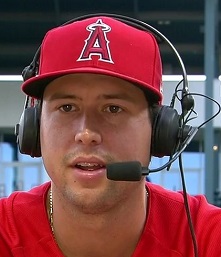
Angels relief pitcher Trevor Cahill gives a salute to the late Tyler Skaggs. Showing class to burn, the Rangers installed Skaggs’ uniform number—in the Angels’ uniform font—behind their pitching rubber in memorial tribute for Tuesday’s game.

A teammate dies without warning as a season comes to within sight of the halfway marker. Your scheduled road opponent is gracious enough to cancel the game scheduled that night out of respect for your loss. The grief within your clubhouse and your front office is too real to suppress. And back home your fans are laying out item after item, flower after flower, message after message in your teammate and friend’s memory.

“LTBU in heaven!” said a scrawl on one souvenir batting helmet left among the memory gifts, referring to Angel fans’ customary call (Light that baby up!) after Angels wins, to light the halo around the original stadium big A scoreboard now implanted in the back parking lot.

Angel fans get to mourn Tyler Skaggs a little longer than the Angels themselves in terms of the schedule, because the Angels still had a game to play against the Rangers in Arlington Tuesday night.

Whether you’re in the depth of a pennant race, on the race’s fringes, or headed for the repose where the also-rans will commiserate when it’s all over, you know in your heart of hearts, gut of guts, and mind of minds, that the young man you mourn would rather you suit up, shape up, and step up on the mound, at the plate, on the bases, in the field, than spend more than a single day’s grief without playing the game he loved with you.

So the Angels did what they knew their lost brother wanted. They suited up, shaped up, stepped up, with Skaggs’s uniform number (45) on a small round black patch on their jerseys’ left breasts. They carried Skaggs’s Angels jersey for a pre-game moment of silence in his honour.

“It was just kind of something unplanned. His jersey was hanging in his locker. We wanted to take him out there with us one more time,” said pitcher Andrew Heaney later. “He was definitely my best friend. There’s probably about 100 other people out there that would say he was their best friend, too, because he treated everybody like that.”

His best friends beat the Rangers, 9-4, on a night during which the Rangers showed the Angels such respect as canning the walkup music and others among the normal rackets for Ranger feats at home. The Rangers even installed a red number 45 behind the pitching rubber. In the Angels’ uniform font. To do Skaggs and his team honour.

And not a single Angel tried to hide his grief at a post-game conference.

Their all-everything center fielder, Mike Trout, spent most of the game walking three times and scoring on a base hit. Maybe the single greatest star in the Angels’ firmament, ever, Trout couldn’t get through a simple expression of what Skaggs meant to himself and their team without several chokings back of tears.

“Lost a teammate, lost a friend, a brother, we just got to get through it,” he said shakily. “He was an unbelievable person. It’s all about him. Husband of Carli, what a sweet girl, Debbie his mom, you know, a good relationship with them. You know, it’s just a tough, you know, 24 hours.

“We’re getting through it, tough playing out there today, but like Brad [Ausmus, the Angels’ manager] said earlier, Skaggs, you know, he wouldn’t want us to take another day off,” Trout continued. “The energy he brought into this clubhouse, you know, every time you saw him he’d pick you up. It’s going to be tough, you know, these next couple of days, the rest of the season, the rest of our lives, you know, to lose a friend . . . All these guys in here, you know, I see these guys more than my family. To lose somebody like him is tough.”

In Washington, Nationals pitcher Patrick Corbin, close friends with Skaggs since their Diamondbacks days, switched his uniform from 46 to Skaggs’s 45. Then he went out to pitch his regular turn, his manager Dave Martinez saying it was just about all Corbin could do. Corbin himself affirmed it after the Nats beat the Marlins, 3-2, Trea Turner walking it off with an RBI hit.

“When you have a loss, you want to keep things as normal as you can and just try to go out there and do what you have to do,” Corbin said after that game. But he never said it would be easy to pitch through the memories of their being drafted together by the Angels, traded together to the Diamondbacks, and in each other’s wedding parties this past offseason.

Corbin not only changed his uniform number to Skaggs’s but scratched the number in the dirt behind the mound before he managed to pitch seven innings despite being disrupted by a rain delay of over an hour, surrendering one run, no walks, and seven strikeouts.

Another Nat had personal ties to Skaggs. Adam Eaton played in the fall instructional leagues with Skaggs. And they were eventually traded away from the Diamondbacks in the same three-way deal that returned Skaggs to the Angels and sent Eaton to the White Sox.

“Saw his debut. Saw his first hit. Saw his first strikeout. Know his wife. My wife knows his family. It’s just . . . I’m not quite sure it’s hit me yet,” the outfielder said, shades covering his teary eyes. “My family, our hearts go out to his family. He’s kind of kicked us in the pants in his passing that we need to take every day as it’s our last and enjoy our family and love our family and what’s important in our life, and know that we’re blessed to play this game every day. That’s the gift he’s given us, even after.”

As for the Angels, they started the game with a first-inning, run-scoring ground out before a first-inning sacrifice fly, a third-inning solo homer, and a double steal including home put the Rangers up 3-1. The Angels tied it in the fifth on a base hit that turned into two runs home on an outfield throwing error; a four-run sixth—an RBI single, a runner-advancing throwing error, another RBI single, and a sacrifice fly—put them ahead to stay.

The Rangers got their final run on another sacrifice fly, and the Angels got their final two when shortstop Andrelton Simmons opened the top of the eighth with a walk and, one out later, right fielder Kole Calhoun drove a middle-high fastball parabolically over the right center field fence. The win pulled the Angels back to .500 and to within four games of the American League wild card hunt.

Those small details were probably the last things on their minds Tuesday night. They might be a little more concerned for Tommy La Stella, their breakout All-Star, who had to leave the game in the sixth after fouling a pitch off his right leg below his knee. But La Stella probably thought his injury was tiny compared to the wrench in the team’s hearts.

“It’s bigger than the game. The friendship and the love I had for him and his family, it’s more than that,” Trout said.

“Today it was just different,” said Calhoun after the game, “and there’s no playbook on how it’s supposed to go today and you’re supposed to act and react. But getting back to the game definitely is what he would have wanted. Today was a day that we leaned on each other like we really needed to do.”

The same thing happened ten years earlier, after rookie pitcher Nick Adenhart was killed by a drunk driver while out celebrating after a splendid first start of the season. The day after Adenhart’s death, the Angels beat the Red Sox, 6-3, in Angel Stadium. The win was only partial comfort then just as it was Tuesday night in Arlington.

It doesn’t always work that way.

Cardinals pitcher Darryl Kile died unexpectedly of a heart attack in June 2002, while the Cardinals were in Chicago to play the Cubs. The following day, they lost to the Cubs, 8-2, with the Cubs scoring all eight before the eighth inning including a four-run sixth, and the Cardinals able to muster only two in the eighth—on future Hall of Famer (and current Angel) Albert Pujols’s two-run homer—and one in the ninth on an RBI single.

When Yankee catcher Thurman Munson was killed in the crash of his own aircraft, the Yankees played the Orioles the day after and lost a 1-0 heartbreaker in Yankee Stadium. In a game featuring three future Hall of Famers (Eddie Murray, Reggie Jackson, and Goose Gossage) and a pitching duel between Scott McGregor of the Orioles and Luis Tiant of the Yankees, the lone run came when John Lowenstein hammered a Tiant service over the fence.

A year earlier, Angels outfielder Lyman Bostock was murdered while on a visit to Gary, Indiana, in a car, when a man fired at the car hoping to hit his estranged wife, whom he suspected having an involvement, shall we say, with another man in the car. The next day, the Angels beat the Brewers in extra innings, Carney Lansford singling home Danny Goodwin with two out in the tenth.

Death in season sometimes rallies teams and other times knocks them apart. Maybe no death in Reds’ history was as shocking as the 2 August 1940 suicide of reserve catcher Will Hershberger—whose own father had committed suicide previously. Blaming himself for a doubleheader loss, Hershberger reportedly told manager Bill McKechnie more than that troubled him but nothing to do with the team, and McKechnie never disclosed the rest.

The Reds played another doubleheader the day after Hershberger’s death. They swept the Boston Braves (then known as the Bees), then went on to win the pennant with a 23-8 September before beating the Tigers in seven in the World Series. McKechnie publicly dedicated the rest of the season and the pennant chase to Hershberger, and the Reds awarded a full winning World Series share to Hershberger’s mother while they were at it.

And when Indians shortstop Ray Chapman died after being coned by Carl Mays’s fastball in 1920, the stricken Tribe—with just a little help from the explosion of the Eight Men Out being taken out in Chicago at almost season’s end—ended up winning the pennant and the World Series.

The 1955 Red Sox were headed only to a fourth place finish but they suffered the unexpected death of promising young first baseman Harry Agganis to a pulmonary embolish on 27 June that year. The following day, the Red Sox swept the Washington Senators in a doubleheader compelled by a rainout earlier that season. The scores were 4-0 in the opener and 8-2 in the nightcap.

These Angels may or may not band up and make a surprise run to the postseason from here. But they honoured their effervescent pitching teammate now gone in the only coin all accounts suggest Skaggs would have accepted. They played ball. And they beat a team who probably didn’t really mind getting their tails kicked for just one night, because the grief felt around baseball over Skaggs’s unexpected death was just too real.

“We knew what they were dealing with on the other side,” Rangers manager Chris Woodward said after the game. “We were trying to comprehend the impact something like that would have on our ball club. I can’t even describe the feelings they were having. Obviously, it wasn’t our best game, but clearly it affected us in some way. Honestly, I don’t know how to describe that feeling. It was just kind of obvious they deserved to win.”

“We know we’ve got an angel watching over us now,” Calhoun said. “When I got to the plate, it felt right to pay some respect to him, and like I said, we know we’ve got somebody watching over us up there.” Somebody who didn’t deserve to die at 27.
Tyler Skaggs, RIP: Another heavenly Angel, damn it . . .

2019-07-01 TylerSkaggs

Tyler Skaggs—accommodating, joyful, and tragically dead at 27.

The Angels are a franchise with a sad enough history of calamity in its ranks. It’s a shame to think of things this way, but it’s been a decade since the last death among their active family, young pitcher Nick Adenhart. Just maybe the franchise’s sad history of active duty rendezvous with the Grim Reaper would get an even longer break.

Then came the news that pitcher Tyler Skaggs was found dead at 27 in the team’s Southlake, Texas hotel Monday afternoon, as the Angels were about to open a road set with the Rangers. Even the Rangers were staggered by his death. They had no issue at all with cancelling Monday’s game.

Skaggs was a Santa Monica High School standout, the son of their longtime softball coach Debbie Skaggs, a good if sometimes inconsistent pitcher in the major leagues, and with a reputation for approachability that went back to his high school days and a sense of humour that got wicked without getting nasty.

Only recently Skaggs deployed his humour on behalf of getting teammate Tommy LaStella to this year’s All-Star Game, in a hilarious video in which Skaggs interviewed Angels two-way star Shohei Ohtani—with Skaggs in English and Ohtani, playfully, in his native Japanese. It must have helped, since LaStella was voted by fellow players to the American League All-Stars “in a career year nobody saw coming,” least of all LaStella.

“I will remember the smile and spirit he always showed during his Santa Monica High days,” wrote Los Angeles Times baseball writer Eric Sondheimer almost immediately after learning of Skaggs’s death. “The beach, the ocean, the air — it helps creates a personality that people want to embrace. He’s left us but won’t be forgotten. Now’s the time to remember all the joy he brought people through his 27 years.”

Skaggs was a mid-to-back-of-the-rotation starter whose best pitch was considered his curve ball while he also owned a changeup that could be effective but wasn’t quite fully developed. He missed all 2015 and most of 2016 recovering from Tommy John surgery; he battled subsequent injuries including adductor strains; he was still freshly married to his wife, Carli, having tied the knot last December.

And he was a prodigal Angel, having been dealt to the Diamondbacks in mid-2010 in the deal that made Dan Haren an Angel, but returning in 2013 in the three-way deal that brought him back to the Angels, sent slugging but defense challenged outfielder Mark Trumbo to the Snakes, and sent Adam Eaton from the Snakes to the White Sox, with the Angels also getting swing pitcher Hector Santiago while they were at it.

He was posting a fine season marked by a little hard luck this year, his 4.29 ERA counterweighted by a fine 3.84 fielding-independent pitching rate and a mere 3.8 runs to work with from his mates during his times in the games to prove the hard luck spells.

None of which matters as heavily as the Angels having to say a permanent goodbye to a good pitcher who was an apparent joy in the clubhouse. Police say no foul play was suspected. Leaving us only to speculate sadly over just what could have taken a young guy with as much to live for as Skaggs had.

My son, Bryan, an inexhaustible Angels fan since early boyhood, called me to tell me the news, my cell phone ringing just as I was stepping into a supermarket. His first words were, “Another Angel’s going to heaven.” He’d been shattered by Adenhart’s death at the hands of a drunk driver ten years earlier.

He probably had little enough idea that the Angels have been there only too many times in their franchise life. Since 1965, when they were freshly relocated to Anaheim, and when rookie pitcher Dan Wantz surprised observers by pitching his way onto the staff with an unexpected strong spring  training, only to die of a brain tumour at 25 four months later.

There was Minervino Rojas, late blooming but seemingly inexhaustible relief pitcher. (“He’s got three pitches,” a rival said of the deceptively effective Rojas, formerly buried in the Giants’ system. “Slow, slower, and come and get it.”) A fireman’s fireman whose off-speed repertoire helped him lead the American League retroactively with 27 saves in 1967, in the era when the one-inning closer wasn’t even a topic. Arm trouble forced his retirement in spring 1969. A year later: a hit-and-run driver killed two of his three children, though his wife and infant son survived, and left Rojas a paraplegic.

There was utility infielder Chico Ruiz—once famed for the steal of home as a Red that kicked off the 1964 Phillie Phlop—dead in an offseason auto accident in 1972, a year after he’d helped poison an already-poisoned clubhouse by threatening talented but deeply troubled outfielder Alex Johnson, who loved him yet also loved to needle him incessantly, with a pistol. At 33.

There was Bruce Heinbechner, pitching his way onto the roster in spring 1974, seen as the Angels’ forthcoming lefthanded relief specialist, until the 23-year-old was killed in a pre-season auto accident. There was Mike Miley, shortstop, three years later. Seen as a prospective Rookie of the Year challenger at 23–before he, too, was killed in a pre-season road accident.

There was Lyman Bostock, outfielder, one of the Angels’ earliest big-money free agents after a promising career to date with the Twins. Like Skaggs, outgoing and popular. So enthusiastically chatty in the clubhouse that Bostock’s Angels teammates nicknamed him Kareem Abdul Jibber-Jabber. Shot to death at 27 a year after Miley’s death, while riding in a car with a relative and friends in Gary, Indiana. The shooter said he was aiming at his estranged wife; the case prompted Indiana to change its insanity defense laws.

There was Donnie Moore, relief pitcher, haunted both in his own soul and in the aftermath of surrendering the fateful home run to Boston’s Dave Henderson when the Angels were a strike away from going to the 1986 World Series—still coming to terms with the end of his career and his personal demons when he shot and injured his wife before shooting himself to death, in 1989.

And, there was Adenhart, who threw six shutout innings in his first 2009 start, scattering seven hits and striking out five, killed at 22 by a drunk driver while riding as a passenger in a mini-van. The driver, Andrew Thomas Gallo, was sentenced to 51 years-to-life behind bars.

2019-07-01 TylerCarliSkaggs

Tyler Skaggs posted this wedding photo on Instagram after marrying his wife, Carli, last December.

Skaggs took his lady to the Bahamas in November 2017, to propose to her. He looked happier with Carli Skaggs on their wedding day than at any other time in a life most accounts say was as happy as the day was long.

That only makes his death now even more heartbreaking than any game lost, any pitch that didn’t make it the way he wanted it. The Angels lose a teammate and friend but a young lady loses a husband whom she knew deeply had too much life to share and live.


Some people can never be satisfied, still

20190627_190740

Left to right: Emily, Bryan, and the author, Bryan’s father, relax in Angel Stadium before a game between the Angels and the Athletics Thursday night. Guess which of the game’s seventeen total hits got the loudest ovations . . .

What’s that old saying about some people can never be satisfied? Unfortunately it also remains a true saying. That’s whether baseball’s get-off-my-lawn contingency complains about not enough hitting (in 2014) or too many home runs (this year), or whether Orioles fans look the proverbial gift horses in the mouth because of a choice of . . . uniform.

This year’s epidemic of home runs includes such side effects as strikeouts rising, singles falling, stolen bases on various endangered species lists, and howitzer-armed bullpens turned to arson squads.

It’s not unreasonable to lament the large percentage of game action that involves home runs. The absolute flip side of the proverbial coin would be a game full of nothing but singles and a crashing bore unless the pitchers are virtuoso charismatics and the fielders resemble the Flying Wallendas. (Only nine percent of this season’s fielding assists so far involve turning double plays. Ground ball pitchers, where are thy stings?)

I happened to be in Angel Stadium Thursday night, treating my son, Bryan, and his girlfriend, Emily, to a game, the first of a weekend set between the Angels and the rival Athletics, to finish their final home stand before the All-Star break. (They hit the road to meet the Rangers and the Astros to finish the season’s first half.)

The occasion was a gift for Bryan’s graduation from southern California’s North Orange Continuing Education program in which disabled students make their transitions gradually but affirmatively to whatever full collegiate work they can perform toward the level of independent life they can attain.

Bryan is speech-language impaired, and the only one in the house more proud of the courage he shows living, laughing, and persevering through his disability is his father, to whom Bryan is a hero every day, not just those during which he graduates or helps his Special Olympics team nail a silver medal in softball, as he did at last year’s national games in Seattle.

(P.S. In his first ever plate appearance in a national Special Olympics, Bryan socked a home run. In baseball, 118 players have homered in their first major league at-bats. The most recent: Lane Thomas, Cardinals, 19 April.)

And lo! Come Thursday night, the Angels defeated the Athletics, 8-3, to open a weekend set. From our nesting at field level down the right field line, we saw the runs score on:

* A second-inning home run. (A’s center fielder Ramon Laureano, leading off.)

* Another second-inning home run. (Kole Calhoun, a two-run shot that ricocheted off the rocks behind the left center field fence in the bottom of the inning.)

* A third-inning home run. (Shohei Ohtani, the defending American League Rookie of the Year, resuming designated-hitter duties if not pitching as he continues recovering from Tommy John surgery, hitting one clean over the center field fence.)

* A pair of third-inning RBI singles. (Hall of Famer in waiting Albert Pujols, driving home Justin Upton; and, Luis Rengifo, driving home Calhoun.)

* A fourth-inning home run. (Matt Olson of the A’s, leading off the top.)

* A sixth-inning single. (Mike Trout, the Angels’ all-everything center fielder, sending home Andrelton Simmons, the flying shortstop freshly restored from the injured list.)

* An eighth-inning single. (Oakland’s Marcus Semien, sending home Robbie Grossman.)

Of the game’s seventeen hits (the Angels had twelve), 24 percent of them sailed over the fences. Through this morning’s writing, major league games this season have featured 3,390 home runs out of 21,265 hits. That, folks, is 16 percent of this season’s hits. Last year, 14 percent of baseball’s hits were home runs. Oh, the horror.

Fume all you like about the home run epidemic, if epidemic it is, but doesn’t it seem peculiar that such an epidemic accounts for that small a percentage of baseball’s hits? Thirty-six percent of this year’s hits are doubles; two percent are triples. But we don’t hear either loud complaints about the epidemic of doubles or the near-extinction of triples as much as we hear about the bombs bursting in air at record levels.

On Thursday night, except for Trout’s RBI knock in the sixth, knowing that this guy gets standing ovations just taking his position in the field to open a game (a cursory look around the park tells you Trout remains the single most popular Angel based on jerseys and jersey-reproducing T-shirts with Ohtani a close enough second), guess which hits got the loudest ovations, even among the A’s fans who scattered around the stands?

Hint: it wasn’t the four RBI singles.

(A note on the Angel Stadium video display when Laureano batted midway through the game: he’s the first Athletic in their entire franchise history—going all the way back to the birth of the Philadelphia Athletics—to have made his first major league hit a game-winning RBI hit. Ever. Not even the franchise’s celebrated Hall of Famers—not Home Run Baker, Jimmie Foxx, Al Simmons, or Reggie Jackson—did that. Laureano did it in 2018.)

Once upon a time, Washington Senators owner Clark Griffith bragged (if that’s the correct word), “The fans love home runs, and we have assembled a pitching staff that is certain to please them.” This year, commissioner Rob Manfred all but brags that since the fans like home runs, baseball has introduced a ball that was certain to please them. Apparently, the “pill” at the ball’s center is being centered more accurately. Makes some people want to reach for the nearest bottle of pills.

Pitchers may not be pleased as greatly as the fans seem to be. Rangers pitcher Drew Smyly picked the wrong year to return from Tommy John surgery: he surrendered nineteen bombs in 51 and a third innings before the Rangers released him last week. And until Phillies pitcher Jared Eickhoff landed on the injured list, he’d pitched 58 and a third 2019 innings and eighteen services landed on the far side of the fence.

ESPN’s David Schoenfield says Smyly’s home run rate per nine innings this year (3.3) was baseball’s worst and Eickhoff’s (2.8) the seventh worst, but don’t get him started on those who’ve been nuked worse in fewer innings. Poor souls such as Alex Cobb (nine bombs in twelve and a third), Edwin Jackson (twelve in 25.1), or Dan Straily (22 in 47.1).

And, yet, Schoenfield continues, overall scoring per game remains “within historical norms” at 4.78 runs a game, which he says is the highest since 2007’s 4.80. Apparently it’s how you score that matters yet again. If the game levels itself out in due course (as it always seems to do, never mind the periodic equipment tinkerings) and the runs begin coming in singles-, doubles-, and triples-hitting droves, brace yourself. The death of the home run will be pronounced loud and long, too.

I mentioned the Orioles earlier. Back to them. How does this strike you—the Orioles, who are on a pace Schoenfield says will see them surrender 324 home runs for the full season (or, if you’re scoring at home, an average of 36 homers per lineup spot against them), spent Friday and Saturday doing what no team before them has done: back-to-back shutouts in which they themselves scored thirteen runs or more.

The Indians were the victims. On Friday night, John Means and three Orioles relievers kept the Indians to six hits against Mike Clevinger and three Indians relievers surrendering sixteen hits—only (count them) two of which were home runs. On Saturday night, Andrew Cashner and one reliever kept the Tribe to five hits against Zach Plesac and four Indians relievers surrendering thirteen hits—only four of which were home runs. That’s back-to-back home run percentages of 13 and 31 percent per game, and 21 percent for the two games.

But Oriole fans couldn’t even enjoy that rare a two-night spread without finding something to complain about. In this case, the Orioles’ uniforms Saturday. Commemorating Maryland Day, a state holiday, the Orioles’ jersey sleeves and cap visors displayed the image of Maryland’s state flag. “Hideous” was probably the least indignant adjective applied.

Well, as I was saying, some people can never be satisfied. Thank God and His servant Jackie Robinson that my son and his lady aren’t among the perpetually dissatisfied.


Dr. Pujols and Mr. Hydes

2019-05-10 AlbertPujols2000thRBI

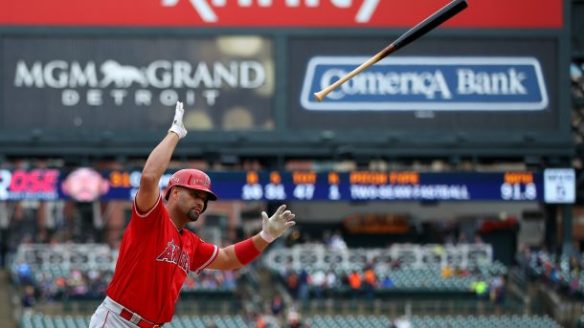
Albert Pujols flips his bat heartily after hitting the solo home run that meant RBI number 2,000 Thursday . . .

Sometimes it just doesn’t pay to catch history in your hands. Even when you’re not trying to get paid for it.

Albert Pujols cranked a hefty solo home run in Comerica Park Thursday to land his 2,000th career run batted in. The blast put the future Hall of Famer into some very distinguished company as it was.

Cap Anson drove in his 2,000th run at the end of the 1896 season, but unless the Hall of Fame has an online-accessible library I couldn’t discover just how he drove it in. And the run batted in wasn’t counted as an official statistic until 1920.

But Henry Aaron drove his 2000th in in July 1972 with a three-run homer and Alex Rodriguez drove his 2000th in in June 2015 with a two-run homer. Babe Ruth is in the 2,000 RBI club, too. Yes, you might think the Big Fella did it with a big blast but, yes, you’d be wrong: he worked out a walk with the bases loaded against the St. Louis Browns in May 1932 to do it.

A 33-year-old Tigers fan named Ely Hydes just so happened to catch Pujols’s bomb in the top of the third, after Pujols turned on a Ryan Carpenter fastball right down the pipe and drove it into the left field seats, right into Hydes’s waiting hands.

Along came baseball government to prove that no good deed goes unpunished. When its representatives at the game refused to authenticate the ball, it crowned Hyde’s indignation not over the milestone sphere but things in general at Comerica Park involving the Tigers, as he sees it.

“I am not rich. I am a broke-ass law student,” Hydes wrote in a Facebook post. “I did not do this out of any sort of  ‘entitlement’ . . .  I had the best of intentions. This ball will most likely end up in the Hall of Fame. I’m sorry if no one can ‘authenticate’ it, but the only reason I ended up with it is because Tigers management treated me so terribly.”

Detroit Free Press reporter Aleanna Siacon writes that the Tigers and the Angels each made “generous efforts” to retrieve the milestone ball but Hydes didn’t much like being treated like an opportunist. You know, the sort of fan who can’t wait to cash in a history-making baseball for prolific pelf. Giants fans brawled in the stands over who’d get to leave the park with the ball Barry Bonds smashed for his 600th career home run in 2002.

And sometimes such opportunists try stealing souvenirs with less history attached to them. In 2014, a Minute Maid Park fan wearing a Derek Jeter shirt in the field boxes on Opening Day—Jeter’s last as a player—was spotted by Jeter himself. But when the longtime Yankee captain tried to hand the girl a ball, a woman in an Astros jersey sitting in front of her in the seats tried to steal the ball. Jeter wouldn’t have it. He leaned up against the rail and put the ball in the girl’s hands despite the woman’s upstretching.

Hydes wasn’t exactly in the frame of mind to brawl over the Pujols bomb, nor did he steal it from any adjacent fans.

“I considered it an honor to catch Pujols’s ball,” Hydes wrote in his Facebook post, “and tried to act all day with the honor I thought it obligated me to.” Indignant about current Comerica Park policies such as refusing to allow ballpark ushers to be tipped, which he said compelled him to put tips right into their pockets physically, Hydes tore into the younger generation of Illitches and how callously he thinks they’ve behaved since the death of Tigers owner Mike Illitch.

But his indignation with MLB is just about equal. “Honestly, if they were just cool about it I would’ve just given them the ball,” he told WXYT interviewer Kyle Bogenschutz. “I don’t want money off of this, I was offered five and ten thousand dollars as I walked out of the stadium, I swear to God . . . I just couldn’t take being treated like a garbage bag for catching a baseball.”

Pujols himself took a sanguine attitude about the ball and Hydes.

“I think he was given a little hard time and I told the guys, just you know, just leave it,” Pujols told reporters. “Just let him have it, I think he can have a great piece of history with him, you know. When he look at the ball he can remember . . . this game, and I don’t fight about it. You know, I think we play this game for the fans too and if they want to keep it, I think they have a right to. I just hope, you know, that he can enjoy it . . . He can have it . . . He can have that piece of history. It’s for the fans, you know, that we play for.”

Hydes was aware of Pujols’s comment. “You’re a class act,” he wrote, addressing Pujols. “You wouldn’t pay me a penny for the ball and I wouldn’t take a penny.”

When Roger Maris finally hit his 61st home run on 1961’s final day, busting Ruth’s single-season record, a 19-year-old Yankee Stadium fan, Brooklyn truck driver Sal Durante, caught the ball with one bare hand in the right field seats. Stadium ushers came to Durante for the ball. Durante asked only one thing—to hand it to Maris personally.

The ushers agreed. They brought him to the Yankee clubhouse and Durante—who later admitted he’d had to borrow the money from his future wife, Rosemarie, to get his ticket for that game in the first place—handed it to Maris saying, “Here’s the ball, Roger.”

With his family and some team officials around him, Maris surprised Durante by signing and dating the ball and handing it back to him. “Keep it, kid,” Maris said genially. “Put it up for auction. Somebody will pay you a lot of money for the ball. He’ll keep it for a couple of days and then give it to me.”

Somebody did. California restauranteur Sam Gordon paid Durante $5,000 for the ball and then turned it over to Maris. Gordon also paid for the honeymoon when Durante married Rosemarie, with whom he raised three children as a Coney Island bus driver.

Durante was subsequently offered another $1,000 to catch the ball on the street after being dropped from the top of a giant Seattle World’s Fair ferris wheel (the Space Needle was ruled out for safety reasons)—by Tracy Stallard, the Red Sox pitcher who’d thrown the ball Maris hit out for the record. Durante wore a catcher’s mitt for the stunt and the ball hit the mitt and bounded right to the pavement. He got the $1,000 anyway.

Maris died in 1985. Rosemarie Durante died in 2014. Sal Durante is still alive at 77. He once admitted that he, like a lot of Yankee fans and other baseball people at the time, hoped originally that Hall of Famer Mickey Mantle and not Maris would break Ruth’s record. He once said meeting Maris and his family made him glad it turned out to be Maris.

Sometimes giving a player a milestone ball hurts in the aftermath. When New York cell phone salesman Christian Lopez caught the ball Jeter clobbered for a home run that was also his 3,000th major league hit, in 2011, Lopez happily gave Jeter the ball, and Jeter and the Yankees happily gave him season tickets for the rest of that season and a pile of signed memorabilia. The guesstimated value was $80,000.

The bad news was that Lopez would be hit with a hefty tax bill for his effort. A number of companies ponied up to pay it for the generous fan.

Alex Rodriguez remembered. When A-Rod homered off Justin Verlander for his 3,000th major league hit, a fan named Zack Hample—notorious as an all-but-professional souvenir hunter (his trophies are said to include Mike Trout’s first major league home run)—refused to turn the ball over.

“The thing I was thinking about is, where’s (Jeter’s) guy?” Rodriguez said after Hample refused to hand over ball—which was authenticated almost on the spot, by the way. “The guy that caught (Jeter’s) ball? That’s the guy that I needed here. Where is that guy? I wasn’t so lucky.”

“A-Rod will not be in possession of this ball tonight,” Hample harrumphed, “unless he personally mugs me outside on 161st St.”

Hydes says the Pujols ball now reposes on his coffee table. But not for long, perhaps. “I don’t know it’s been a rat race so far, but I’ve got a brother who’s a huge St. Louis Cardinals fan,” he says, referring to the club where Pujols shone for so long, “so I might give him the best gift ever.”

Pujols’s milestone mash made 4-0 a game that ended with the otherwise struggling Angels blowing the Tigers out, 13-0. He would have been overtaken after awhile by Angels second baseman Tommy La Stella hitting two out, one in the second and one in the seventh, if baseball government hadn’t been so cavalier about the milestone mash.

In a career that’s seen a glandular share of headlines and bombs, married to an equal reputation for being one of the game’s most humane players, Pujols probably never figured to achieve a milestone with controversy attached to it, even as his career has had a sad decline phase provoked mostly by injuries since becoming an Angel.

But, typical of the man, he’s handled this one with the class baseball government lacked.


UPDATE: Several hours after I published the foregoing essay, Ely Hydes changed his mind, agreeing to give the ball to either Albert Pujols or the Hall of Fame.

“All I ever wanted was to sleep on it,” he told the Detroit News. “I slept on it and I woke up and I think [Pujols] is a class act. He’s not my player, he’s not my guy, I don’t deserve the ball. I reconsidered. One-hundred percent, I’m either going to give it to Pujols or to the Hall of Fame.”

Hydes still refuses to accept money for the ball, too.

Cahill another low-risk Angel arm

2018-12-20 TrevorCahillSigning Matt Harvey even to what may prove a single-season rental befuddled no few who watch the Angels closely. Signing Trevor Cahill to what may prove a single-season rental seems to do likewise until you look a little closer. Angel fans hope the pitching-needy team knows what they’re doing and won’t have yet another reasonably-laid plan explode in their faces. Especially when they could have had a couple of

Cahill isn’t trying to overcome even half the baggage Harvey had to start overcoming in Cincinnati last year. Signing Cahill for a year and $9 million with about $1.5 million possible in incentives looks at least as reasonable and with just as small a risk. And, as with Harvey, the Angels couldn’t have been unmotivated by the thought that division-rival Oakland had eyes upon Cahill, this time in terms of bringing him back again.

The Athletics bought low on the veteran righthander for 2018 and he proved valuable enough for their slightly surprising run to the wild card game. The only reason he made only twenty starts worth 110 innings was an Achilles tendon strain that knocked him onto the disabled list in mid-June and kept him there until almost mid-July.

He posted the best fielding-independent pitching rate (ERA minus defense factors) of his career with a better than respectable 3.54, and the best strikeout-to-walk rate (2.44) of his career. And he continued the overall bounceback from a 2016 spell of relief pitching by getting ground balls at a rate almost equal to his career 55 percent.

All that while making seventeen quality starts (three earned runs or fewer) out of his twenty. He came away from the season with a 7-4 won-lost record and eight no-decisions out of the quality starts. Three of those turned into A’s losses; if they could have hung up the key lead runs while he was in the game Cahill’s won-lost record might have ended up at 12-4.

In other words, Cahill at last re-emerged as the decent pitcher who launched his Show career with the A’s in 2009 and whose signature tendency seems to have been working with his defenses to get results and keep them in games. If the A’s might have won the three no-decision losses instead, Cahill might have been 15-4 in 2018; add to that two losses in which he pitched well enough to win and he might have been 17-2.

If the Angels have Harvey as a number-three starter, they likely have Cahill as the fourth man. Both pitchers finished 2018 having shown they can get ground balls and miss bats at reasonable rates. Getting grounders and missing bats are things the Angels love unconditionally.

With Garrett Richards and Shohei Ohtani (as a pitcher) down for the 2019 count thanks to Tommy John surgery they may yet lack a legitimate ace, but there have been teams who’ve gone to the wars and endured in the pennant races with four or five solid pitchers despite no ace. It’s difficult but not impossible.

Still, the Angels could have made more impressive-looking moves. Charlie Morton could have been had for comparable money to Harvey; the now-former Astro signed for two years and $30 million with the Tampa Bay Rays. They went in on Nathan Eovaldi but they, too, couldn’t convince him to say goodbye to the world champion Boston Red Sox. Nor could they convince Patrick Corbin to stay southwest; Corbin went to the Washington Nationals for six years and $140 million, or about $12 million a season more than the Angels will pay Harvey just in 2019.

I get the Angels might have been wary about a six-year commitment to Corbin considering their recent history with multiple-year deals going past two or even three. That’s allowing that those deals’ implosions haven’t really been anyone’s fault. I say again:  nobody including Albert Pujols asked his heels and knees to betray him, and nobody including Josh Hamilton asked a) him to incur a substance-abuse relapse that Super Bowl Sunday or b) the Angels’ brass to make such a disgraceful hash out of trying to humiliate Hamilton for it.

The deal for which you can really crucify the Angels in the past decade was Vernon Wells—and it wasn’t even a free agency signing. But it was done purely out of rage; or, purely out of owner Arte Moreno channeling his inner 1980s version of George Steinbrenner, after then-GM Tony Reagins couldn’t convince then-free agent Adrian Beltre to sign up after the 2010 season.

Moreno hit the ceiling hard enough to go through it and almost to the moon. When he came down, he gave Reagins one day to deal for Wells or else. Knowing now-retired manager Mike Scioscia preferred defense-uber-alles catchers, for all the good that did him anyway, Reagins sent big-hitting Mike Napoli to the Toronto Blue Jays, who needed catching help and a big bat, for Wells. Whoops.

Beltre, of course, went on with his just-ended, Hall of Fame-in-waiting career. Napoli went on to contribute mightily to World Series teams in Texas and Cleveland and won a ring while he was at it with the 2013 Boston Red Sox. Wells was a Gary Matthews, Jr.-level bust in Anaheim, so much so that the Angels choked on a lot of money on Wells’s inexplicably backloaded contract to move him to the New York Yankees, where his once-promising career ended in something close enough to a whimper.

The Angels now have a much-improved farm system; last spring it was rated the second-best in the American League West behind the Astros. Want to know how long it took for the Angels to recover the farm? How does eight years strike you?

At the same time Moreno went ballistic over losing out on Beltre and demanded the deal for Wells, the Angels made a sacrificial lamb of their scouting director Eddie Bane. Bane was made to pay for a series of bad drafts and worse free agency signings even though Bane was the lead instigator in the Angels’ landing a kid named Mike Trout.

Bane’s execution followed the Angels gutting most of their international scouting operation, and executing its director Clay Daniels, over bonus skimming shenanigans by underlings who kept Daniels in the dark about their doings. The Angels cashiered the man whose smarts brought them the likes of Francisco Rodriguez (one of the late secret weapons in the Angels’ 2002 world championship run), Ervin Santana, Kendrys Morales, and Erick Aybar in the first place.

It’s forgotten sometimes, too, that the Angels let Corbin escape in the first place. That happened when Reagins (under Moreno’s orders, perhaps?) made the 2010 non-waiver trade deadline deal that practically drained the best of the Angel farm (including then-promising Tyler Skaggs, too) in order to get Dan Haren, who may have led the American League in strikeout-to-walk ratio in his first full Angel season but who gave them 1.7 total wins above replacement-level for his two-and-a-half years with them.

They got Skaggs back in a convoluted three-team deal and Skaggs’s second Angels life has been riddled with injuries, too.

Maybe compared to all that, signing Harvey and Cahill even on a seasonal rental might actually wreak less havoc than the Angels have brought upon themselves in the past decade. Maybe. Might.